Day: February 29, 2024

EU: Survey Shows EU Consumers Want Better Animal Welfare Laws.

Survey shows EU consumers want better animal welfare laws

28 February 2024

Almost 9/10 consumers responded that they support better animal welfare laws for animals raised for consumption, and believe that the EU should act to update legislation to offer them protection.

In a new survey by BEUC, which aimed to analyse consumer’s attitudes on animal welfare, 6/10 consumers said that they have a low level of knowledge on animal welfare practices and 3/4r want a better labelling system for animal-derived products. Consumers expressed that they have a low trust in animal welfare claims by companies and 84% would react negatively to welfare-washing.

7/10 respondents expressed the need for the cost of transition to be equitably shared, and that the EU must provide funds to farmers to implement higher standards. 

A large majority, 78%, agreed that imports of animal products should be subject to the same welfare rules as those produced in the EU. This has been supported by another report by Vrije Universiteit Brussel and BEUC, which concluded that EU trade policy is not sufficiently coherent with the Green Deal, and consumers must be treated fairly through import requirements, and through better labelling that allows them to make an informed choice.

With 9 in 10 consumers supporting new laws for better animal welfare, our survey confirms that the way we treat animals raised for food matters to people. It is high time the EU Commission delivered on its promises to revise EU laws on farm animal welfare

Monique Goyens, Director General, BEUC.

This survey spans Belgium, Germany, Hungary, Italy, the Netherlands, Portugal, Spain and Sweden. 1,000 respondents per country were surveyed in November 2023.

WAV Comment – EU citizens are not the ignorant ones; it is those in the Commission who fail to take note !

Regards Mark

Canada: Animal Rights Groups Get Rare Authorization for Private Prosecution in Live-Horse Export Case.

Animal rights groups get rare authorization for private prosecution in live-horse export case (msn.com)

Animal rights groups get rare authorization for private prosecution in live-horse export case

Story by Karen Pauls

Kaitlyn Mitchell is director of legal advocacy with Animal Justice, a non-profit that wants a ban on the horse meat industry. (Travis Golby/CBC)© Provided by cbc.ca

In what’s believed to be a first in relation to farmed animals, a court has given animal welfare advocates the green light to privately prosecute a live-horse exporter in Manitoba.

“We have so few laws on the books to protect these horses,” said Kaitlyn Mitchell, director of legal advocacy with the non-profit group Animal Justice.

“The least that we can do is to make sure that what few laws we do have are actually enforced. Otherwise, what good are they?”

The case involves an air shipment of live horses in December 2022 from Winnipeg to Japan. The Korean Air cargo plane was supposed to stop in Anchorage, Alaska, for refueling and a crew change, but there was a blizzard, so they had to find an alternate route. 

That, combined with delays in Winnipeg, meant the shipment exceeded the 28-hour maximum time live horses can be transported without food, water and rest.

Several organizations — Animal Justice, the Winnipeg Humane Society, the Canadian Horse Defence Coalition and Manitoba Animal Save — filed a complaint with the Canadian Food Inspection Agency, which acknowledged the breach and confirmed three horses had fallen during the transport, but said there would be no penalty.

“We urged them [CFIA] to take enforcement action, and we were incredibly disappointed when they didn’t,” Mitchell said.

“Once we realized that the CFIA was not going to take action, then we made the decision to commence this private prosecution.”

The group argued three different laws were violated and proposed three separate charges.

After a hearing in Winnipeg Tuesday, a Manitoba provincial court judge allowed a charge to be laid against Carolyle Farms — a live-horse exporter located in Swan River, Man. — under a section of Canada’s Health of Animals Regulations, which require a contingency plan to respond to unforeseen delays that could result in the suffering of an animal. 

But the Crown stayed a proposed charge under the regulations for exceeding the maximum time limit for a transport, because it said the CFIA was part of those discussions. It also stayed a proposed charge for causing distress to animals, citing jurisdictional concerns. 

“Where did these horses collapse? Was it somewhere over the ocean? We just don’t know. So that’s frustrating,” Mitchell said, adding the case is a rare example of a private prosecution — in which a private individual, rather than public authorities, is permitted by the court to lay a charge for an alleged offence. 

“I vividly recall that cold winter night one year ago,” said Manitoba Animal Save organizer Danae Tonge, who documented the 2022 shipment.

“I am relieved that the court allowed this charge to be laid and look forward to the next steps in this case.”

Farm owner defends decision

Lyle Lumax, the owner of Carolyle Farms, said Tuesday that a phone call from CBC News was the first he’d heard of the court action.

He defended the decision to carry on with the December 2022 flight, even though it would exceed the legal time limit. 

Lumax, who says he understands and loves horses, said the contingency plan is always to bring the horses back to the farm, but that 10-hour round trip puts even more strain on them.

“I can’t exactly remember, but it was something like we were three hours over the 28 hours,” he said.

“And everybody involved decided that was far less risky to the horses then putting them back on the trucks, driving back to the farm, loading them and putting them back into the plane and into the crates again.”

CBC has also asked the Canadian Food Inspection Agency for comment.

Canada is among the leading exporters of live horses, mostly Clydesdales and Percherons, bred specifically for human consumption — an industry worth tens of millions of dollars a year.

Raw horse meat sushi is considered a delicacy in Japan. The horses exported sell for up to $9,000 each, Lumax said. The horses are fattened up in Japan before being slaughtered, according to the CFIA

Mitchell estimates nearly 4,000 horses have been exported from Calgary, Edmonton and Winnipeg in the last year.

In a 2021 mandate letter, Prime Minister Justin Trudeau told his agriculture minister to work toward ending exports of live horses for slaughter. Advocates and activists have circulated petitions and put pressure on the federal Liberals to follow through.

private member’s bill before Parliament now would prohibits exporting live horses from Canada by air for slaughter.

Mitchell said she will testify before an agricultural committee in Ottawa on Thursday.

Regards Mark

South Africa: Live Export Of Animals Under Fire Following Abhorrent Conditions In Which Animals Were Kept On The ‘Al Kuwait’ Vessel.

The National Council for the Society for the Prevention of Cruelty for Animals (NSPCA) has called for a complete ban of livestock exports via sea following the discovery of the abhorrent condition in which animals were kept on the Al Kuwait, which docked in Cape Town last week to load feed on its way from Brazil to Iraq.

Cattle on board the Al Kuwait ship, which docked in Cape Town last week.
Photo: The National Council of SPCA

According to the NSPCA, the stench that came from the ship and raised concerns from members of the public was indicative of the awful conditions the animals, which had been on the sea for two-and-a half weeks up until then, had to endure due to a build-up of faeces and ammonia.

The NSPCA discovered diseased, injured and dead cattle among the 19 000 cattle aboard, and had to euthanise eight cows because of their poor condition. Treatment was given to the other animals to prevent further mortalities.

The NSPCA stated that the incident served as a stark reminder that the live export of animals by sea was a gruesome and outdated practice and underscored the urgent need for legislative reform and heightened global awareness to end this cruelty.

The Red Meat Producers Organisation of South Africa (RPO) clarified in a statement that the ship belonged to the international company Al Mawashi and that the current situation had nothing to do with the South African industry or Al Mawashi South Africa, which arranges and coordinates South African exports.

The NSPCA since 2019 had been in and out of court fighting for a live sheep export ban from South Africa, but it lost its case against Al Mawashi South Africa in 2021, with the exports allowed to continue subject to certain conditions.

Dr Frikkie Maré, CEO of the RPO, told Farmer’s Weekly that the RPO was concerned about the welfare of the animals on the ship, and recognised the rights of animals as noted in the Constitution of South Africa: “As primary producers, our animals are our pride. It grieves us to see animals receive poor treatment.”

Maré said that the industry was concerned about the possible influence the situation might have on the biosecurity of South Africa, with people moving on and off the ship and the possibility of dead animals being offloaded, especially because the Western Cape does not really have the capacity to handle livestock.

“As a country that is already struggling to regain its animal health status from the World Organisation for Animal Health, we cannot afford more breaches of our biosecurity.”

With the renewed call for a complete ban of live animal exports via sea, Maré pointed out that South Africa needed this alternative market to grow the industry, which in turn would contribute to rural development, poverty alleviation and job creation.

“We export both live animals and carcasses. We cannot move away from live animal exports as this is what the import markets desire, usually for religious reasons.”

He pointed out that government in collaboration with the industry had drawn up a protocol for live exports, with more than 300 inputs by industry taken up in the protocol to ensure that exports were done responsibly. Work is currently underway to turn the protocol into legislation.

Since the only livestock export harbour in South Africa is in East London, the Eastern Cape RPO has established a livestock export forum, which together with the SPCA and other institutions, ensures that exports from South Africa take place according to this protocol.

He added that live exports from South Africa by ship had a good record, with mortalities on board being lower than mortalities in domestic feedlots.

Dr Ivan Meyer, the Western Cape Minister of Agriculture, in response to the incident made submissions to the ad hoc Committee on the Powers Bill in the Western Cape Provincial Parliament for the inclusion of veterinary services in the bill.

He explained that the Western Cape Powers Bill called for the Western Cape Government to gain greater control over the management of the port and trade.

If approved, the Western Cape Powers Bill will allow the Western Cape Government to intervene in similar situations and safeguard animal and public health, defend animal welfare and advance biosecurity.

In the interim, he said, the department would continue to support the relevant authorities in addressing concerns related to veterinary care, public health, and biosecurity.

Regards Mark

USA: Please Oppose Prosecution of Activist (vs prosecution of neglectful farmer) Who Rescued Cows.

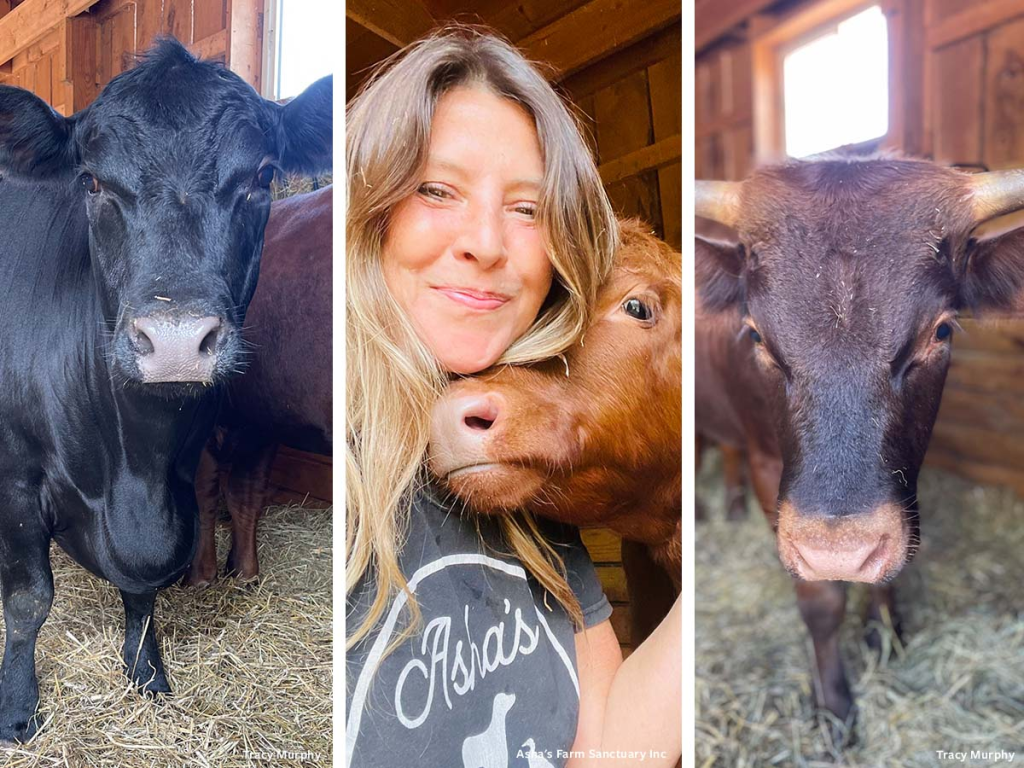
Source Tracy Murphy via IDA

Thanks to Stacey as always – Mark

Please Oppose Prosecution of Activist (vs prosecution of neglectful farmer) Who Rescued Cows | Our Compass (our-compass.org)

Please Oppose Prosecution of Activist (vs prosecution of neglectful farmer) Who Rescued Cows

Please click HERE to sign petition

Source In Defense of Animals

Asha’s Farm Sanctuary owner Tracy Murphy has a big heart for animals. When two cows wandered into her sanctuary, she provided them with a safe haven. Now she’s being charged for caring for the escaped cattle she named Ismael and Little Willow. Tell the district attorney to drop the charges against Tracy for having compassion for all animals, including those who usually are eaten by humans!

As founder and president of Asha’s Farm Sanctuary in upstate New York, Tracy was merely doing her job by rescuing two cows who wandered onto the sanctuary, which is a refuge for abused cattle, pigs, and chickens. She cared for the cows and immediately reported them to the Society for the Prevention and Cruelty to Animals in July 2022.

Tracy, acting on the advice of her attorney at the time, refused to hand over Ismael and Little Willow without proof of ownership. After another week, the police executed a search warrant and arrested Tracy. Sadly, authorities seized Ismael and Little Willow, and returned them to the purported “owner,” probably for slaughter.

Since her arrest, Tracy has faced significant financial and emotional hardships, along with facing one count of grand larceny and up to seven years in prison. Tracy was publicly humiliated when she was forced to wear shackles in court and suffered ostracization, harassment, and threats throughout this case.

Fortunately, the Animal Activist Legal Defense Project at the Sturm College of Law is defending Tracy. With its assistance, a superior court lifted the gag order placed on Tracy and two town justices have recused themselves from this case.

This summer, Tracy will go to trial for her compassionate actions. Her next court hearing is scheduled in the Town of Wheatfield for March 5. Help us urge Niagara County District Attorney Brian Seaman to dismiss the charges against Tracy to free her from the shackles of injustice and ensure the lives of Ismael and Little Willow were not taken in vain.

Other actions:

1. Make a polite call. Please call and leave a courteous message for Niagara County District Attorney Brian Seaman who has the power to end this legal nightmare and permit Tracy Murphy to continue her noble work for animals.

Dial (716) 439-7085 and leave a message for Brian Seaman.

You can say, “Asha’s Farm Sanctuary Founder and President Tracy Murphy was simply doing her job when she rescued two cows who wandered onto her sanctuary. She should be rewarded for her kindness and compassion, not punished. Please dismiss the charges against Tracy.”

2. Go Vegan. If you love animals and want to save cows like Ismael and Little Willow, try vegan meals today! Download our veg guide for fast and easy recipes.

www.idausa.org/vegguide

3. Post on Social Media. Show your support for Tracy Murphy on the Niagara County Facebook page and Instagram.

You can say, “Don’t convict Tracy Murphy for compassion for cows. She’s just doing her job. Sanctuary owners rescue animals. Please drop the charges against Tracy Murphy!”


I wonder why, when nonvegans and antivegans proclaim they “care” about animals, do they then malign, harass, and prosecute vegans who SAVE ANIMALS?

Why was the NEGLECTFUL FARMER whose harmful actions leading to Ismael and Little Willow just wandering away, NOT prosecuted?

Why do I have to write prosecutors almost EACH DAY to prosecute violent crimes against ANIMALS?

I’ll tell you why: because as long as vegans can be characterized as criminals/stupid/cultish/malnourished/blahblahblah/etcetcetc, non/antivegans can, somehow, comfortably ignore us and continue violently abusing and killing animals (yes, even if you personally don’t slaughter the animals you consume, you are still responsible for the violence and harm perpetrated against them). And prosecuting violent crimes against animals is an uncomfortable slippery slope for many nonvegans: if harming a cat is considered animal cruelty, why doesn’t the law consider harming a chicken animal cruelty? Like human animals, they both experience pain, fear, and suffering.

And seriously? Shackles? Was it so terrifying being in the same room with a NONVIOLENT VEGAN who SAVES and RESCUES? Or was it to humiliate her? The mocking of injustice, and the representation of the judicial system with juvenile and bullying theatrics, is embarrassing and cruel. But people would rather immaturely deflect from the violent suffering of the most defenseless and vulnerable beings by ridiculing the humans who reject such injustice because otherwise the nonvegans would have to acknowledge their participation in the unrelenting, incalculable suffering of animals.

You indifferently dismiss the victims because you personally enjoy stealing from their bodies, and then you mock the humans who oppose animal suffering.

The most dangerous humans include those whose indifference towards animal suffering fuels their indifference towards human suffering.

This injustice is disturbing and disgusting and, quite frankly, criminal. You just enjoy a status quo of normalized violence towards animals and normalized, acceptable hatred and intolerance towards vegans.

And do remember: regardless of how humans define the suffering of animals in terms that provides humans comfort causing the suffering of animals (humane, welfare …) animals are required to suffer, their violent, cruel, unwilling deaths are inherent as are their brief existences of required pain, control, and separation of family.

FYI, again:

I’m going to link a couple previous articles here that establish the suffering animals are required to endure in each “phase” of “animal agriculture” as documented via recent exposes and, predominately, industry data from the USDA; I’m sharing them again here due to the fact that “anag” is responsible for the incalculable suffering of TRILLIONS of animals violently killed each year for “food”, either directly consumed, or during the “process”, such as those killed for AI or those who are killed as infants outside a slaughterhouse.

You don’t kill and consume animals because you honestly believe that NOT killing and NOT consuming animals is INhumane or UNethical, correct?

Why cause animal suffering that you can easily NOT?

One of These Things Is Not Like the Other

If your god demands unrelenting suffering and death, maybe you should invent another god NOT offended by nonviolence and least harm…

SL


Download Your free Vegan PDF HERE

Order a free vegan kit HERE

Dairy-Free Info HERE

Take the Dairy-Free Challenge HERE

Click HERE for more Dairy-Free

Fish alternatives can be found HERE

Learn about eggs HERE

Find bacon alternatives HERE and HERE

Take PETA’s Cruelty-Free Shopping Guide along with you next time you head to the store! The handy guide will help you find humane products at a glance. Order a FREE copy HERE

Searching for Cruelty-Free Cosmetics, Personal-Care Products, Vegan Products, or more?
Click HERE to search.

Free PDF of Vegan & Cruelty-Free Products/Companies HERE

Click HERE for clothing without suffering

Click below for nominal, or no, fees to vegan literature that you can use to convince others that veganism is the only humane:

PETA HERE

Vegan Outreach HERE

Get free Anti-Speciesism Activist Kit material from PETA HERE

Click HERE for Well-Fed World’s Free Climate Food Guide PDF