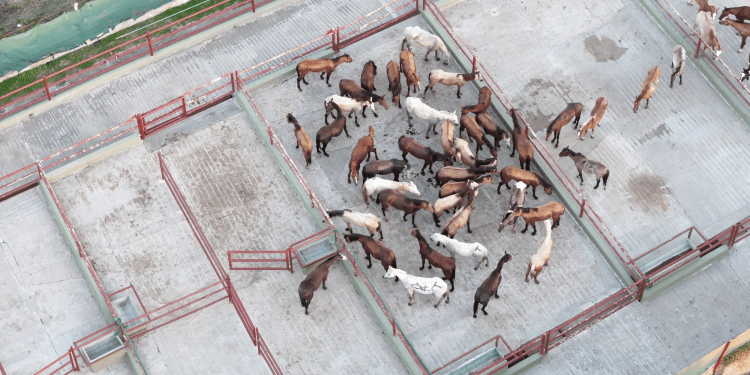
Photo – AWF/ TSB/ GAIA
15 October 2024
GAIA
The German Animal Welfare Foundation (AWF) and the Swiss Tierschutzbund Zürich (TSB) present a new film documentation on horsemeat from Argentina. The footage, taken between 2022 and 2024, shows cruelty and poor animal welfare in the handling of horses at Argentinian horse slaughterhouses and assembly centres and during transport on unsuitable cattle trucks.
Together with Eurogroup for Animals (Brussels), Welfarm (France) and GAIA (Belgium), AWF and TSB are calling on the European Commission to stop the import of horsemeat from Argentina. In a resolution in 2021, the European Parliament also spoke out in favour of an import suspension. The Belgian Meat Federation FEBEV and the Swiss importer Skin Packing, on the contrary, want to prevent reporting on the cruel conditions in Argentinian slaughterhouses by taking AWF and TSB to court.
Since 2010, investigations carried out by AWF, TSB and GAIA have shown that horsemeat producers in Argentina do not comply with the EU’s import requirements. The animal welfare organisations criticise the EU Commission for not imposing the same measure against Argentina as that already imposed against Mexico and Brazil, from which horsemeat imports have been suspended. EU audits conducted in Argentina identified very similar issues regarding food safety and animal welfare, confirmed by EU Commissioner Olivér Várhelyi, who said that “the specific issues raised, such as residues of veterinary medicines, animal welfare, illegal cross-border movement and traceability, were all identified during the audits the Commission services have conducted (…)”. Nevertheless, horsemeat from questionable sources continues to enter Europe.
“Our investigations are disturbing the European importers. They want to prevent the publication of our findings by taking legal action against AWF and TSB. The EU audit reports, however, have repeatedly confirmed what is shown in our film documentaries”, explains Sabrina Gurtner, AWF|TSB project manager.
Argentinian media regularly report on criminal organisations that abuse the horsemeat business, yet even horse traders who have been under police investigation for years and have been banned from the animal trade remain in the business illegally. They are known to use the uncontrollable network of slaughterhouses, assembly centres and horse suppliers for their criminal business. “From official sources, we have received a list of 2,600 addresses of horse assembly centres and suppliers. This network is an ideal hiding place for criminal gangs”, reports Sabrina Gurtner.
For example, the Lamar slaughterhouse near Buenos Aires has repeatedly been the target of police investigations. The media reported a raid in 2022 at the Lamar slaughterhouse and its supplier in Ibicuy. The latter is being investigated by the police for forming a criminal organisation, money laundering, tax evasion, possession of weapons and animal cruelty.
The new film by AWF and TSB shows the state of horsemeat production in Argentina – with seriously injured and highly emaciated horses left unattended, driven limping from the transporters into pens. Foals born in the slaughterhouse wander unprotected between nervous, thirsty and hungry horses. The presence of foals also indicates that heavily pregnant horses continue to be transported, despite being unfit to do so. The film also shows workers beating the horses incessantly with sticks and brooms. The horses are not adequately supplied with food or water, nor do they have sufficient protection from the weather. These horrific animal welfare conditions are present despite the fact that the visited slaughterhouses participate in the European importers’ “Respectful Life” project.
Several audits carried out by the EU as well as investigations of the animal welfare organisations show that the traceability of horses is not guaranteed. This leads to an increased risk to food safety and there is no information about where the horses actually come from. Stolen horses have frequently entered the slaughter pipeline.
A public petition calling on the EU Commission to stop horsemeat imports from overseas, has so far collected more than 213,000 signatures. “On behalf of several European animal welfare organisations, we are calling on the Commission to require equivalent animal welfare standards in exporting countries and to suspend any horsemeat imports from countries where no effective traceability system is in place”, explains Iza Arrieta, Programme Manager, Cats & Dogs and Equines, Eurogroup for Animals.
Sébastien de Jonge, COO GAIA, says: “The investigations carried out by the animal welfare organisations have led many supermarket chains to stop selling horsemeat from countries that violate animal rights. In Belgium, all supermarkets have ceased selling horsemeat from South America. It is now crucial for Europe to follow the example set by these private actors and close its borders to products resulting from the worst practices towards animals.”
Ghislain Zuccolo, CEO WELFARM, says: “It is unacceptable that some supermarkets in France still sell horsemeat from South America. This situation is in total contradiction with the ambitions of these same distributors with regard to animal welfare. They can no longer ignore the sufferings involved with this trade.”
Mark.
 World Animals Voice