Category: Asia

Singapore – Kitten Stuffed Into A Container At Tech Park Spurs Outcry Amid Calls For Harsher Animal Cruelty Laws – Fortunately; It Survived.

A disturbing case of a kitten stuffed into a container at a workers canteen in Tech Park Crescent has triggered renewed public outrage and intensified calls for stronger animal cruelty legislation in Singapore.

CCTV allegedly captured the incident; but a Manager refused to hand it over to the Society for the Prevention of Cruelty to Animals – the SPCA. The site supervisor was allegedly aware of what happened; but by refusing to hand over the CCTV footage; the SPCA then took further action by taking the case to the Animal and Veterinary Service AVS for further investigation.

Fortunately, the suffering, abused kitten was released after about one and a half hours; during its time confined in the container it was allegedly rolled around the floor. This is where obtaining the CCTV footage is essential.

Read what is known AT PRESENT here https://theindependent.sg/kitten-stuffed-into-a-container-at-tech-park-spurs-outcry-amid-calls-for-harsher-animal-cruelty-laws/ but this emphasises why tougher anti cruelty legislation is desperately required in Singapore.

Take action by signing the petition at https://www.change.org/p/cats-can-t-scream-but-we-can-strengthen-animal-cruelty-laws-and-enforcement-i?signed=true

China – Yes, The Yulin Dog Meat and Lychee ‘Festival’ Is Just Days Away. What We Know About This Year 2025.

More than TEN MILLION DOGS are killed in China each year for their meat.

The YULIN ‘ dog eating festival’ is anything but traditional. It was ‘invented’ around 2010 by dog traders who simply wanted to increase their profits; nothing more. Before the festival started, Yulin had no history of mass dog slaughter and consumption.

Like all animal welfare legislation in China; THERE IS NONE; animal protection laws DO NOT EXIST; so issues like this simply continue, unchecked by national authorities.

For all of us in welfare, the annual nightmare of Yulin commences in a few days.

Here is a link to posts we have covered for this event over past years – https://worldanimalsvoice.com/?s=yulin

‘Yulin’, as it is simply known to many of us, takes place in Yulin, Guangxi, China; during the Summer solstice period which commences on 21st June. During the event, observers of the ‘festival’ consume huge amounts of DOG MEAT. accompanied by lychees and other plants.

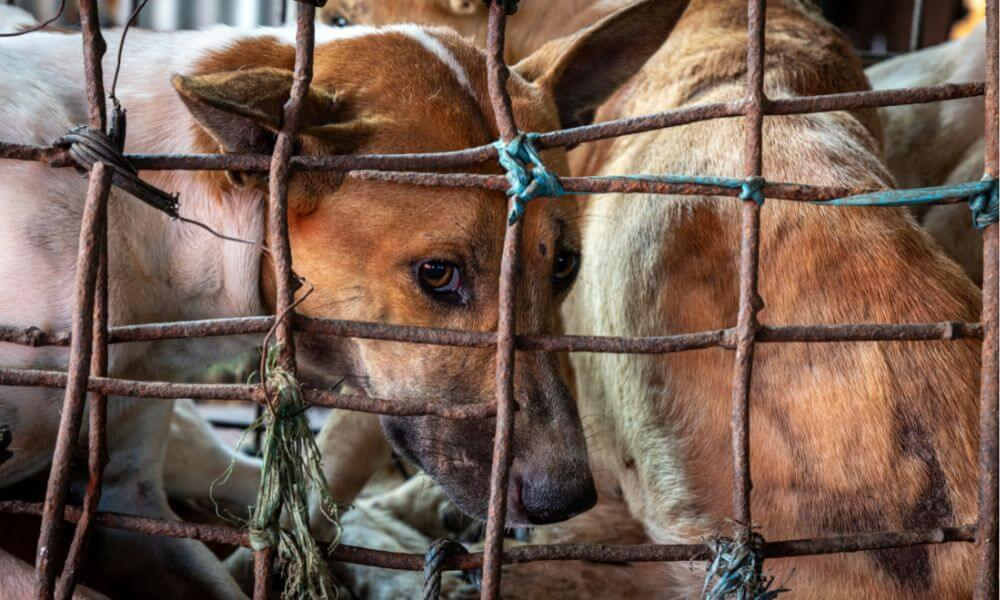
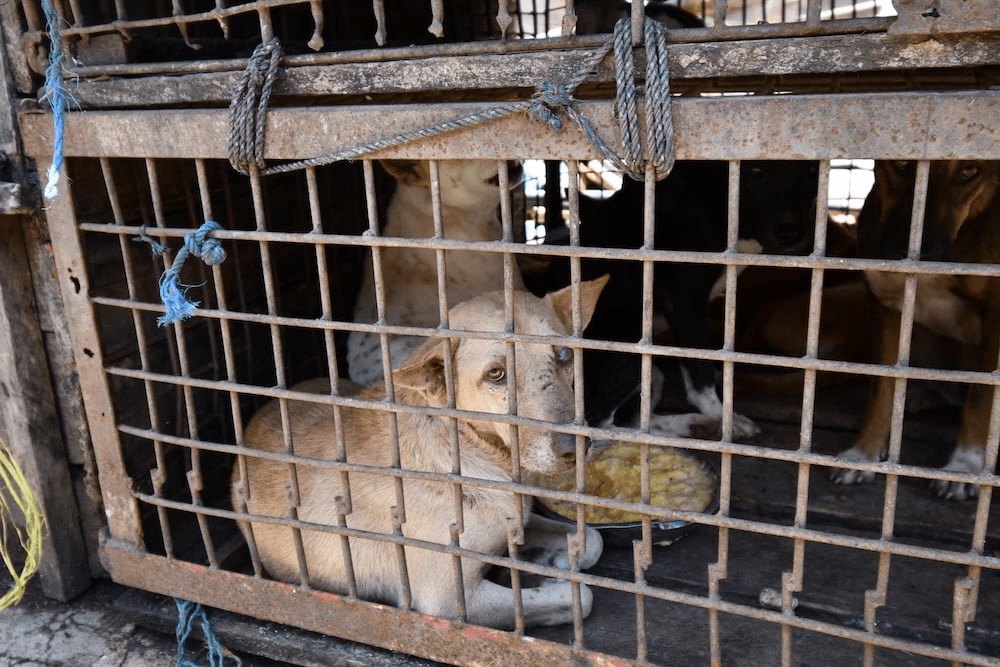
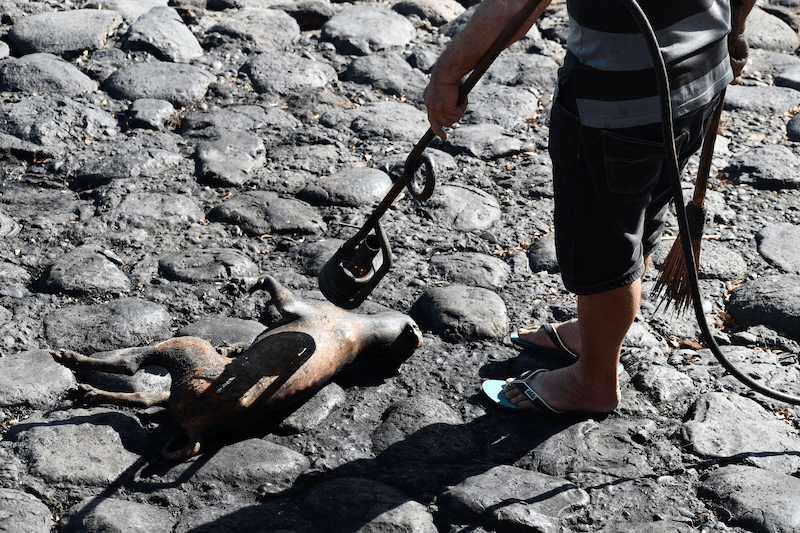
Many of the animals consumed at Yulin are STOLEN COMPANION ANIMALS; or strays grabbed from the streets; many of the owned pet animals still wearing their collars when they reach the disgusting, makeshift slaughterhouses. Typically, THEY ARE BEATEN TO DEATH as there are no other means of killing them.

The festival began in 2009 and lasts for 10 – yes ten days. During this time; many THOUSANDS of dogs are slaughtered in the most barbaric way. The festival has drawn criticism both domestically and internationally for the amount of suffering it causes; especially as the origins of many of the dogs slaughtered are unknown. There is a lot of talk that peoples pets are caught and shipped on to be slaughtered for the event. Crammed into shipment boxes; some may travel for days; without food or water; and their handling during transportation can cause many to suffer broken bones.

Have a look here to see what we are talking about; dogs on the road being transported to their deaths https://worldanimalsvoice.com/2024/06/24/cn-yulin-dog-meat-festival-2024-2/

Here is a photo of an owned, but illegally captured, pet dog, being dragged off to slaughter. Once a dog that gave a person love and devotion.

Although known as the Dog Meat Festival; copious amounts of cats are also slaughtered and consumed.

So what do we know about Yulin 2025 ?

https://www.humaneworld.org/en/news/china-yulin-dog-meat-festival-new-survey

https://www.breitbart.com/asia/2025/06/06/china-prepares-for-gruesome-yulin-dog-meat-festival-as-poll-shows-most-in-city-do-not-partake/

https://www.earthandanimals.com/advocate/companion-animals/params/post/1280835/end-the-china-yulin-dog-meat-festival

WAV is monitoring the news and coverage of Yulin 2025. As it has not yet started, things and news will change – we hope to be able to provide you with some updates over the next few weeks.

(IN) Good news: India’s first-ever emergency animal evacuation shelter to be established in Wayanad

Set to open in 2026, the shelter will provide safe refuge for up to 150 animals during disasters, including goats, cows, pigs and dogs

https://www.humaneworld.org/en/news/indias-first-emergency-animal-evacuation-shelter-established-wayanad

Date: March 14, 2025

WAYANAD, Kerala—A pioneering emergency evacuation shelter designed to evacuate animals prior to disasters like floods and landslides, is set to be established in Kottathara panchayat in Wayanad district, Kerala. Situated in a region prone to multiple hazards including annual floods, cyclones and landslides, this commitment marks a significant step forward in disaster preparedness for animals in India. The collaborative project will bring together the Kerala State Disaster Management Authority, the Wayanad District Disaster Management Authority, Kottathara Grama Panchayat and Humane World for Animals India (formerly called Humane Society International India) to make India’s first such shelter for animals.

The shelter, set to begin operating in 2026, will have the capacity to accommodate up to 150 animals such as goats, cows, pigs, dogs and cats. The single-story structure is expected to include dedicated space for a veterinary clinic and a quarantine area, along with storage and equipment rooms. The shelter is intended to serve as a model for similar facilities across the country.

Praveen Suresh, disaster preparedness and response team manager at Humane World for Animals India, said: “This is an historic moment for Kerala and India from both an animal welfare and disaster preparedness point of view. It is especially significant for Wayanad district with its growing need for a dedicated facility to evacuate and care for animals during disasters like floods and landslides. While the shelter will provide immediate medical care and relief, it will also serve as a long-term resource to support animal welfare in the community. We are grateful to the Government of Kerala and the State Disaster Management Department for approving this important initiative. This animal shelter highlights the power of collaboration between multiple agencies to safeguard animals and their communities and to strengthen disaster management efforts in India.”

Over the last seven years, Humane World for Animals India has gained a notable presence in Kerala through its disaster preparedness, response and relief efforts. During the 2024 Wayanad landslides, the organization’s rescue team aided over 180 animals. Along with partner organizations, Humane World for Animals India is working to make Wayanad a disaster-resilient district for both humans and animals. Among other activities, the organization is conducting capacity building programs for the community through outreach to schools and self-help groups like Kudumbashree. Once constructed, the shelter will serve as a hub for efforts to safeguard animals and the families who depend on them during disasters and a catalyst for continued commitment to build community resilience in the face of future emergencies that put humans and animals at risk.

Please also refer to ..

(Sri Lanka) Animal cruelty still punishable by Rs.100 fine

Animal Welfare Coalition

https://www.dailymirror.lk/breaking-news/Animal-cruelty-still-punishable-by-Rs-100-fine/108-311404

12 June 2025 09:32 pm

Coalition (AWC) has raised concerns over the outdated legal framework governing animal cruelty offences in Sri Lanka, calling for swift legislative reforms to better protect animals.

According to Charuka Wickremesekera, an executive member of the AWC, the country’s current penalties for animal cruelty offences remain based on the Animal Cruelty Act of 1907, enforced through the Cruelty to Animals Ordinance. Under this ordinance, individuals found guilty of most animal cruelty offences can be fined up to 100 rupees, imprisoned for up to three months, or both. In cases involving the killing of an animal in an unnecessarily cruel manner, the maximum imprisonment term extends to six months.

Wickremesekera said that while the Sri Lanka Police continue to make efforts to tackle animal cruelty cases, the absence of robust, modern laws hinders their ability to impose adequate punishments and raise public awareness through legal action.

“It’s time to improve the legal system and protect animals better,” Wickremesekera said.

He also highlighted the growing role of social media in raising public consciousness about animal welfare issues. The sharing of videos exposing acts of animal abuse has not only discouraged such behaviour but also empowered the public to report incidents more readily.

“People now think several times before harming animals after seeing these videos online,” he said. “In the past, there may have been many cases of animal cruelty, but there were no proper organizations where people could complain. Now, many animal welfare groups receive a large number of complaints from the public.”

The AWC believes that alongside stronger laws, public engagement and awareness will play a critical role in eradicating animal cruelty in the country.

(Singapore) Singapore reckons with animal cruelty as abuse cases surge: ‘we can do better’

https://www.scmp.com/week-asia/lifestyle-culture/article/3313409/singapore-reckons-animal-cruelty-abuse-cases-surge-we-can-do-better

Published: 7 Jun 2025

They don’t yell or protest. They don’t hold signs or march. But in Singapore, a chorus of concern is rising on their behalf. From living rooms to parliament, the country is facing hard questions about the way animals are seen, protected and valued.

In February, a 32-year-old Singaporean man was sentenced to 14 months in jail for abusing five community cats – a spree of violence that culminated in the horrific act of throwing two of them from high-rise public housing blocks in Ang Mo Kio.

Just three months later, in May, a 20-year-old man pleaded guilty to sexually abusing a neighbour’s cat in Bukit Panjang, an act captured on surveillance cameras.

These disturbing events, along with other recent high-profile cases, have triggered widespread public outrage and prompted a national reckoning over animal welfare. Campaigners warn that not only are abuse cases becoming more extreme, but they are also exposing gaps in Singapore’s animal protection laws – and underlining the need for a cultural shift in how animals are treated.

Animal cruelty reports reached a 12-year high last year, according to figures released in January by the Society for the Prevention of Cruelty to Animals (SPCA). The surge has galvanised Singaporeans, with some signing petitions and others submitting proposals to parliamentary representatives, demanding reforms and tougher enforcement.

Authorities have acknowledged the public concern. A legislative review is under way, examining the penalties for animal cruelty and the extent of current animal welfare laws.

Under current legislation, those convicted of animal cruelty in Singapore can face up to 18 months in jail, a fine of up to S$15,000 (US$11,700), or both. Repeat offenders risk three years’ imprisonment or a fine of up to S$30,000.

The Animals and Birds Act – the main legal framework governing animal protection – has been under review since at least 2022, according to a statement from the Animal and Veterinary Service on Friday. The act was last amended in 2014, and authorities say future revisions will incorporate feedback from stakeholder consultations held this year.

From 2017 to 2020, around 1,200 cases of alleged animal cruelty were investigated annually, according to Singapore broadcaster CNA. Between 2017 and 2021, 40 people were fined and 23 jailed for related offences.

In Jalan Besar, newly elected Member of Parliament Shawn Loh said many constituents had approached him with suggestions to strengthen animal protections in the wake of recent incidents.

Suggestions included stricter penalties for abusers, a registry barring convicted lawbreakers from pet ownership and improved community vigilance, Loh told This Week in Asia.

Shawn Loh, the newly elected member of parliament for Jalan Besar multi-seat constituency. Photo: Shawn Loh

“We therefore decided to hold an engagement session to hear all these views, so that I may appropriately engage the relevant agencies and effectively advocate for change,” he said, adding that the coming session had already reached full registration.

“Following our own discussions [with residents] at Jalan Besar GRC, I hope to put together a balanced list of practical recommendations for the government’s consideration and effectively advocate for change on behalf of our residents,” Loh added.

Fellow MP Lee Hui Ying, representing the Nee Soon Group Representation Constituency, made a similar call for stronger laws and enforcement – and better protection for animals – following a visit to the Springleaf Gardens estate on Tuesday following the death of a disembowelled cat.

Momentum is growing elsewhere as well. On May 31, Young PAP, the youth wing of the ruling People’s Action Party, hosted a focus group to discuss stronger animal cruelty laws.

“Cruelty is rising. Protection must keep pace,” the group wrote in a social media post about the event. “We must act now – let’s make animal cruelty a serious crime.”

Several online petitions have echoed that call. One petition, seeking harsher penalties, has garnered more than 12,000 signatures.

“Convicted animal abusers often receive punishment which can only be described as no more than a slap on the wrist,” said Dr Ryan Leong, co-founder of Pets Avenue Veterinary Clinic and Referrals.

“Such punishment will never deter the next person who is about to commit a similar crime.”

Shelby Doshi, 40, a former cat rescuer, said Singapore’s sophisticated surveillance infrastructure should make it easy to identify perpetrators – but that same urgency is lacking when the victims are animals.

Stray cats that were rounded up amid a government-run euthanasia programme in Singapore in 2003. Photo: AP

A person abusing someone in public in Singapore would likely be identified within a day with the help of video surveillance, she said. “Yet, when a similar or more drastic act happens to a community cat, the effort to apprehend [someone] is sorely lacking, simply because they are not viewed as important.”

“As a first-world country, we certainly can and should do better.”

Shef*, an adoption counsellor at Action for Singapore Dogs – a non-profit organisation focused on stray and abandoned dogs – said law enforcement agencies needed to be given “more teeth” to intervene when animals were in danger.

“Even if we see something, all we can do is tell the family we really need the dog back. But if the family says no, there’s only so much we can do as a non-profit,” said the 38-year-old, referring to cases of neglect involving adopted pets.

Public outrage tends to spike whenever a high-profile case of animal cruelty emerges, said Aarthi Sankar, executive director of the SPCA.

“They may urge the SPCA to intensify pressure on the authorities to implement stricter penalties and tighter enforcement of animal welfare laws, both of which the SPCA has been actively lobbying the government on,” she told This Week in Asia.

Sankar added that any legal reform must acknowledge not only the financial burden of animal abuse, but also the lasting trauma inflicted on sentient beings.

“They [animals] may physically recover from the abuse, but any traumatic experience will likely shape how they go on to perceive the world and their interactions with humans,” she said.

Kalai Vanan Balakrishnan, chief executive of Singapore’s Animal Concerns Research and Education Society (Acres), cautioned that legislative change alone would not be enough to stop abuse.

“I’ve been working here 15 years and I’ve seen multiple incidents where there is a high-profile case and uproar on social media. Then that dies down. Then it happens again,” Balakrishnan told This Week in Asia.

“There needs to be a push to get to the root of the problem. And it should involve a multi-agency effort.”

Such collaboration would allow organisations like Acres to share legal expertise and advocate for tougher penalties, he said.

Two feral cats sit in front of a house in Singapore. Experts say cultivating compassion about animals’ pain can help reduce animal cruelty cases.
Photo: Shutterstock

He also pointed to deeply ingrained misconceptions about animal sentience – some still believe that certain species, like snakes, do not feel pain. A 2023 case in which men were filmed killing a python with a cleaver highlighted this ignorance.

“If from a young age, we cultivate compassion in children so that they know animals do feel pain and they’re sentient beings, as they grow up, I think we will see less of such cases,” he said.

That view is shared by Dr Genevieve Zhang, a veterinarian at Pets Avenue Veterinary Clinic, who said long-term change would require a cultural shift rooted in empathy.

When more people openly share stories about the emotional bonds they form with pets, non-owners may better understand animals’ capacity to feel and connect, she said.

“They need to understand animals have feelings as well and are lives we need to protect, given that humans can easily overpower them,” Zhang said.

*Full name withheld at interviewee’s request

Animals Asia – Jill; More Than A Special Person -The Day ‘Animals Asia’ Was Founded.

You know; we campaigners in the welfare / rights movement have a saying; it goes:

‘Everybody has gone through something that has changed them in a way that they could never go back to the person they once were’.

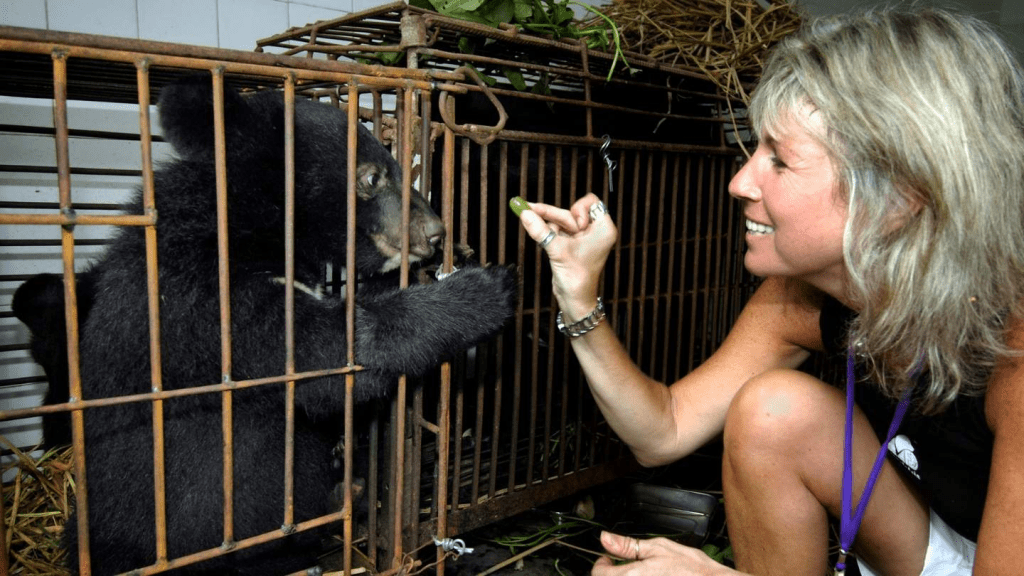
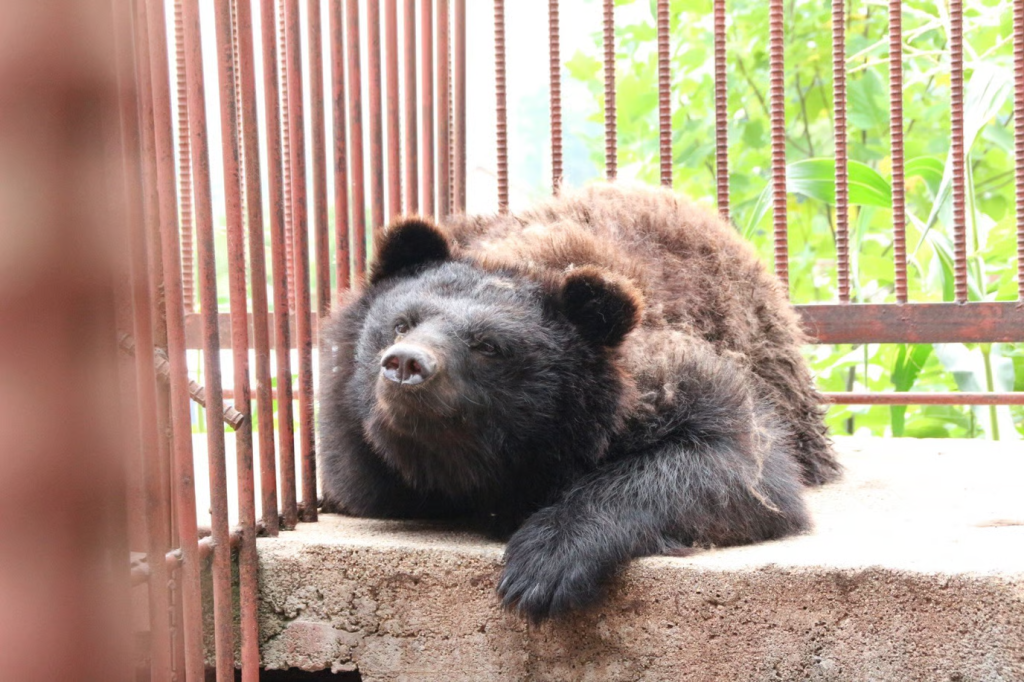
Jill is very much one such person that was changed by something she saw one day – her visit to a bear bile farm; and covertly diverting off down into the vaults to see the actual reality of this disgusting business, was the time, place and specific moment when her world changed forever. Jill says:

** Please refer to the photograph above. **

‘This is Hong, and I must tell you now ,,,,, this was the first and last time I ever saw her.

She never made it out of this farm; but this is the very moment ‘Animals Asia’ began.

By reaching out her paw to me, she started a movement.

Because of you, Hong has saved countless of her Moon Bear brothers and sisters from her own fate.

I still think about her so often – Please, for Hong, for Crescent, for ever set of precious paws still out there, will you give a gift today ?

We have the utmost respect for Jill – Animals Asia has grown from basically nothing at the start; to now what is one of the best and most professional campaign organisations in the world – take a look:

https://www.animalsasia.org/intl/social/jills-blog/

Photo – Animals Asia.

https://www.animalsasia.org/uk/about-us/who-we-are.html

https://www.animalsasia.org/uk/about-us/leadership/

Photos – Animals Asia

https://www.animalsasia.org/intl/our-work/bear-sanctuaries/

https://www.animalsasia.org/uk/our-work/end-bear-bile-farming/

Photo – Animals Asia

https://www.animalsasia.org/uk/our-work/cat-and-dog-welfare/

https://www.animalsasia.org/uk/our-work/captive-animal-welfare-program/

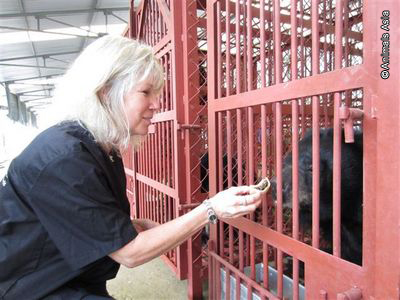
Above – Jill

Below – Jill feeding one of the newly rescued bears.

We urge you please to give anything financially that you can to this wonderful organisation.

https://www.animalsasia.org/uk/donate/

Thank You – for those who have begun; and for those still waiting for a new life of freedom; Mark and Diana.