In documents dating to 2006, government officials predicted that a pandemic would threaten critical businesses and warned them to prepare. Meatpacking companies largely ignored them, and now nearly every one of the predictions has come true.
At the end of June, with hundreds of his workers already infected with COVID-19 and several dead, Kenneth Sullivan, the CEO of Smithfield Foods, the world’s largest pork producer, sent a pointed letter to two U.S. senators who had launched an investigation into outbreaks in meatpacking plants and industry warnings of an impending food shortage.
In blunt, unapologetic terms, Sullivan chastised critics for suggesting Smithfield had acted too slowly to prevent the disease from spreading among its workers and surrounding communities. These “revisionist historians,” he wrote, refused to be “bound to reality” by saying meatpackers could have spaced workers out, slowed processing lines or stockpiled face masks.
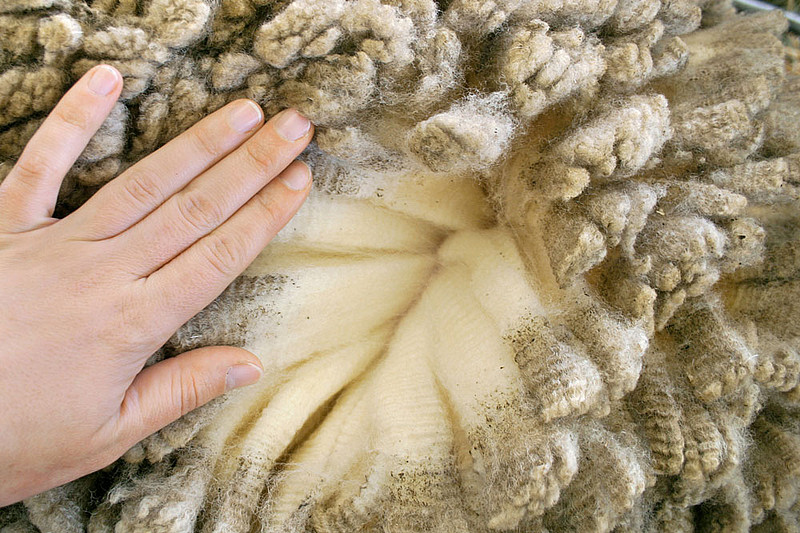
This is the story of a chic, fluffy wool sweater. It belonged to a lamb. And this little lamb had a butt.
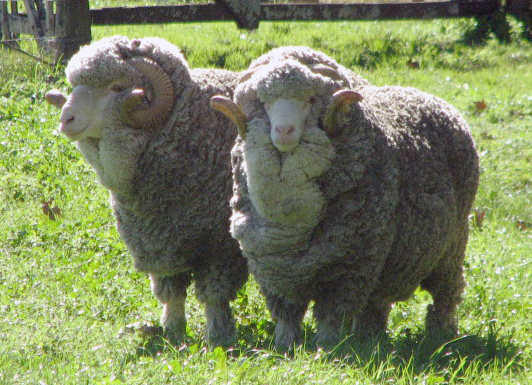
They once lived in Australia, which is where 90% of the fine wool used in the clothing industry worldwide comes from.
But the fluffy lambs have natural enemies. Flies that lay their eggs in the many folds of skin around the lamb’s butts. Parasites.
Mulesing / ˈmjuːlziŋ / is the method that wool producers want to prevent this fly infestation.
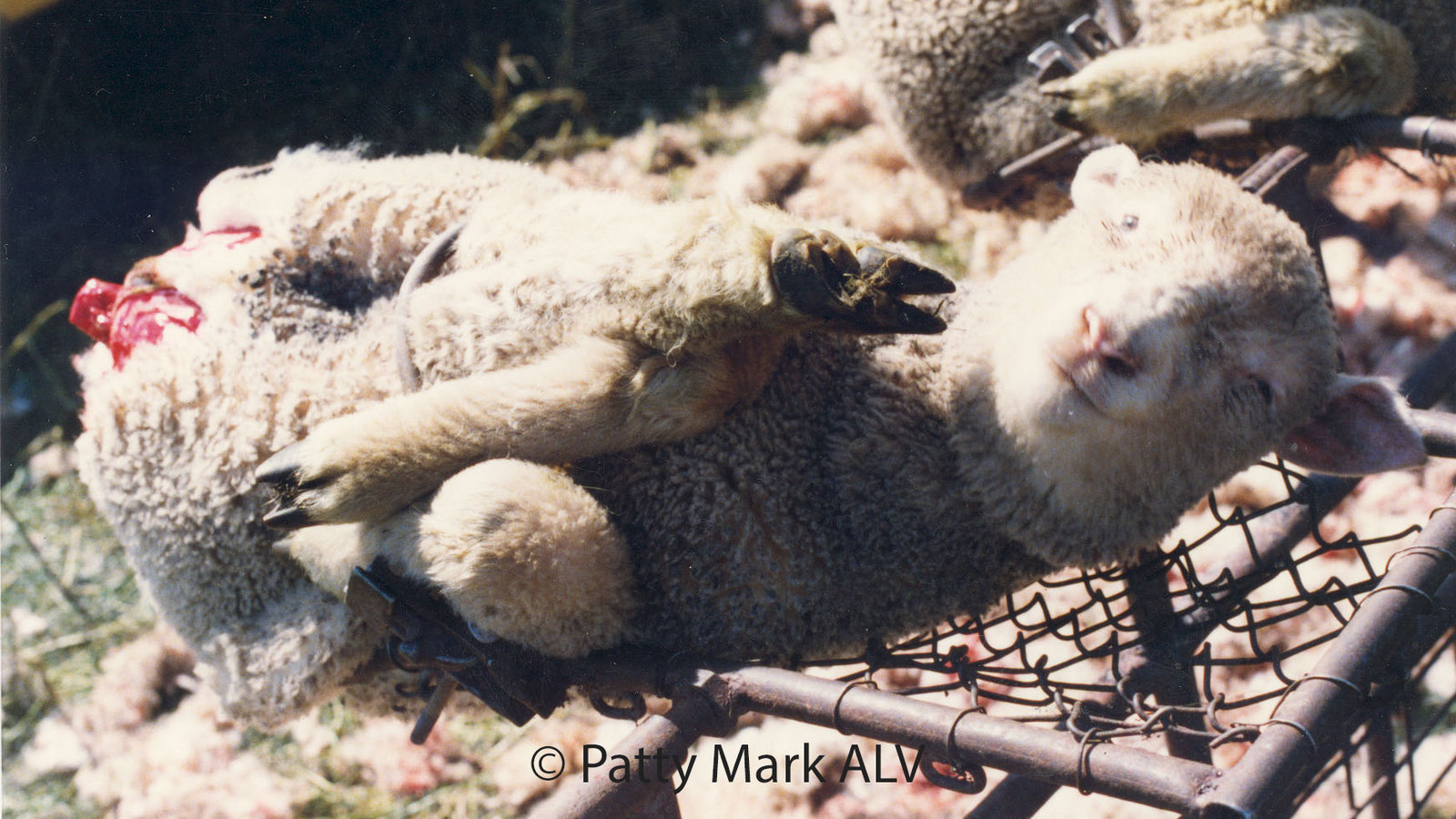
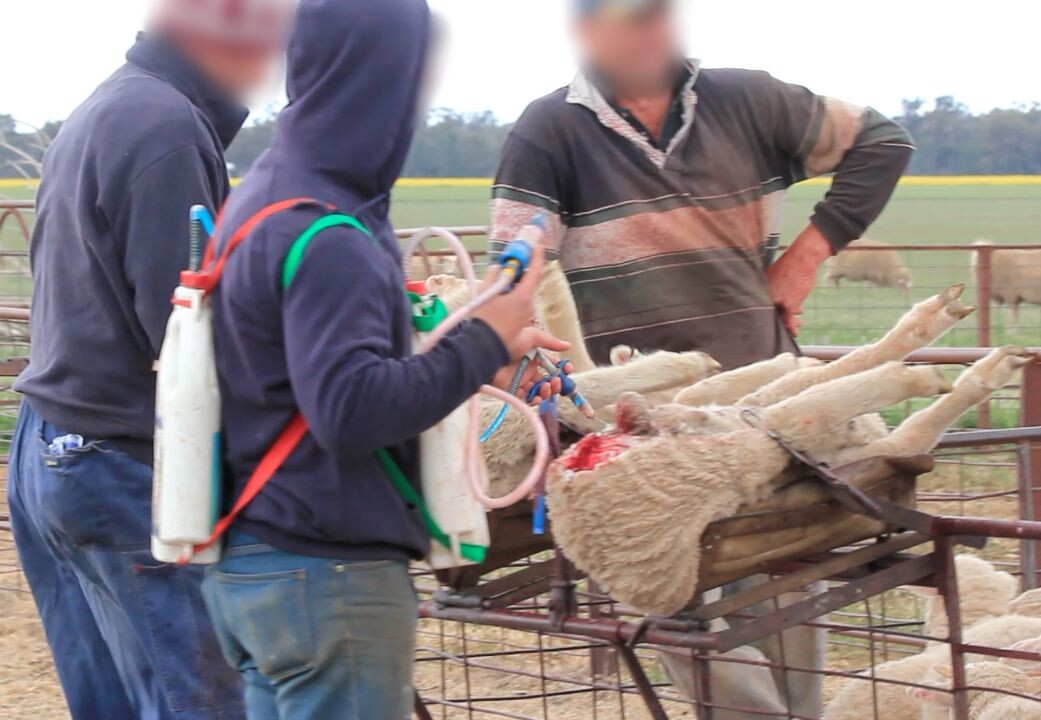
Australia | 2017 | Sheep and lambs on a farm with mulesing practice. Mulesing is the removal of strips of wool-bearing skin from around the breech (buttocks) of a sheep to prevent flystrike (myiasis). Here: mulesing practice.
They strap on the little lamb, who is a few weeks old, and cut off the skin around his but. This is done with scissors and usually without anesthesia.
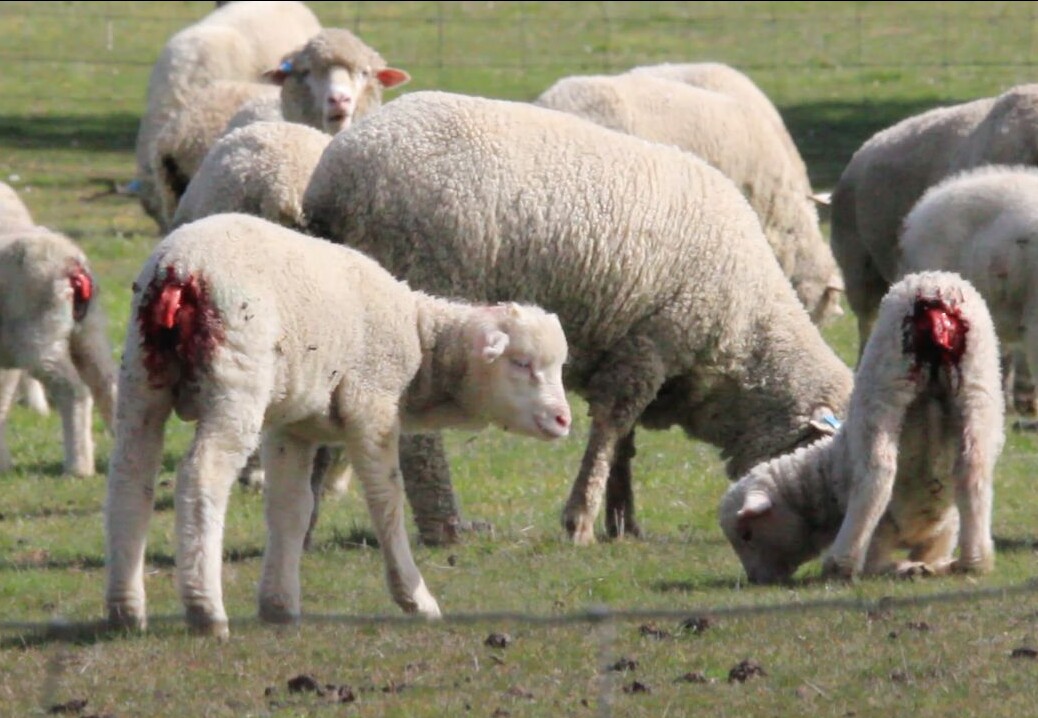
Australia | 2017 | Here: Mulesed lambs next to their mother sheep
The bleeding lamb runs back to his flock in shock. In many cases, despite the mutilation, the flies come back. The lamb suffers for our clothing. The wool sweater was once part of a living being with emotions, fear, and pain.
But there is a solution: sheep that are naturally less prone to fly attacks.
Switching to these sheep is an expense for wool producers, but it is feasible.
Result: “Wool with butt”
The more people ask for “wool with butt”, the more brands will fall back on this wool. And no fluffy lamb has to endure mulesing anymore.
Do you only consider “wool with butt?
(Petition text, also as information): Very few people know that part of a sheep’s butt was cut away without anesthesia to make your woolen sweater or coat. In fact, this is a common practice on the many sheep farms where merino sheep live for wool production.
But there are already painless alternatives.
Much of the wool used by international clothing brands comes from Australian sheep. These suffer from a problem: in recent years they have been bred to have as many skin folds as possible. Because it was assumed that a lot of skin folds meant more wool.
It is precisely these skin folds that become a problem for animals.
Fly maggots settle in the region around the butt and cause painful inflammation and can even be fatal.
The farmers, therefore, resort to so-called mulesing:In this practice, large folds or strips of skin are cut away from the butt with knives.Without anesthesia and in tremendous pain!
However, there are already alternative methods that make mulesing superfluous and can curb fly maggot infestation without pain and trauma to the animals.
Many consumers are unaware that by buying merino wool clothing they are supporting the cruel process of mulesing.
Many producers of merino wool have already taken the right step and no longer allow this outdated practice. However, the rest of the industry has to follow suit. The time has come for more brands to step up their supply chain and get rid of mulesing.
With your signature, call on clothing brands to work with the wool industry to end the cruel practice of mulesing. Together we can rethink the industry and save countless sheep from the pain.
And I mean…New Zealand introduced a ban on mulesing on October 1, 2018. In Australia, there is only a voluntary ban in which each sheep farmer can decide for himself whether his sheep are mulched or not.
Many large fashion chains, including H&M,Hugo Boss, and Adidas, distance themselves from “mulesing wool”.
However, I wonder how these many and large chains can control this.
Australia is the world’s largest wool exporter, so it cannot be guaranteed whether wool that comes from this country is really mulesing-free or not.
This animal suffering can be ended for good by not buying wool.
Materials such as organic cotton, modal, hemp, or polyester fleece also keep us warm and are also a great alternative for knitting enthusiasts.
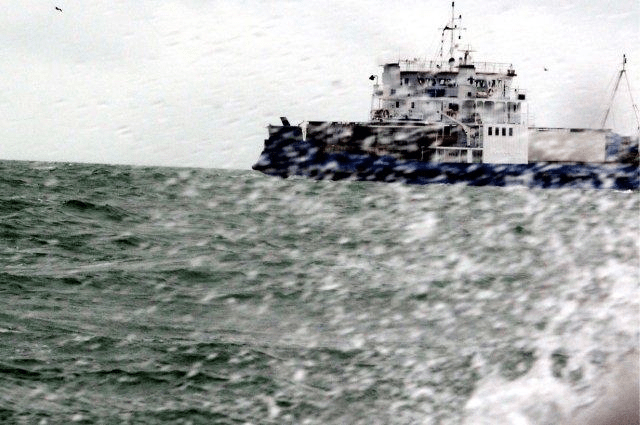
The carcass of a cow floats in waters, about 120 kilometers northwest of Amami Oshima in the East China Sea. Japanese rescuers found a second crew member and multiple dead cows Friday in waters where a livestock ship capsized and sank during stormy weather two days earlier.
Photo: The 10th Regional Japan Coast Guard Headquarters via AP
4/9/20
We have been doing a bit more work into the very recent sinking of the ‘Gulf Livestock 1’ vessel near to Japan.
Japan’s coast guard rescued a second ‘survivor’ who was unconscious and floating face down in a dinghy on Friday. The man, whose identity was unknown, was taken to a hospital where he was later pronounced dead, said Takahiro Yamada, a spokesman for the regional coast guard headquarters. Mr Yamada also stated that rescuers had spotted dozens of cow carcasses floating in the area. We know the crew of ‘Gulf Livestock 1’ originally sent a distress signal early Wednesday.
Regarding the vessel before the incident, there are a few interesting issues that have arisen from further investigation:
The ship is technically managed and crewed by Germany’s Marconsult Schiffarht GMBH – what exactly does the term ‘crewed by’ mean ? – if crewed by Germany, then why so many Filipino ‘crew’ on the vessel ?
A December inspection report from Indonesian authorities on the website of Equasis, which collates ship safety information from both public and private sources, logged issues with the ship’s propulsion and auxiliary machinery.
Issues included “deficiencies” with the propulsion main engine and gauges, thermometers. We understand from the sole survivor of the incident that he told rescuers the ship stalled when an engine stopped, then capsized after being hit by a powerful broadside wave and sank.
A 2019 report by the Australian government on the same cattle ship’s transit in June from Australia to Indonesia noted the vessel’s departure was delayed for a week because of “stability and navigation issues identified by the Australian Maritime Safety Authority (AMSA).”
AMSA’s website showed Gulf Livestock 1 was detained by the Australian authorities for three days in May 2019, because of issues related to its navigation Electronic Chart Display and Information System. The report cited both a lack of up-to-date charts and training for officers using the system.
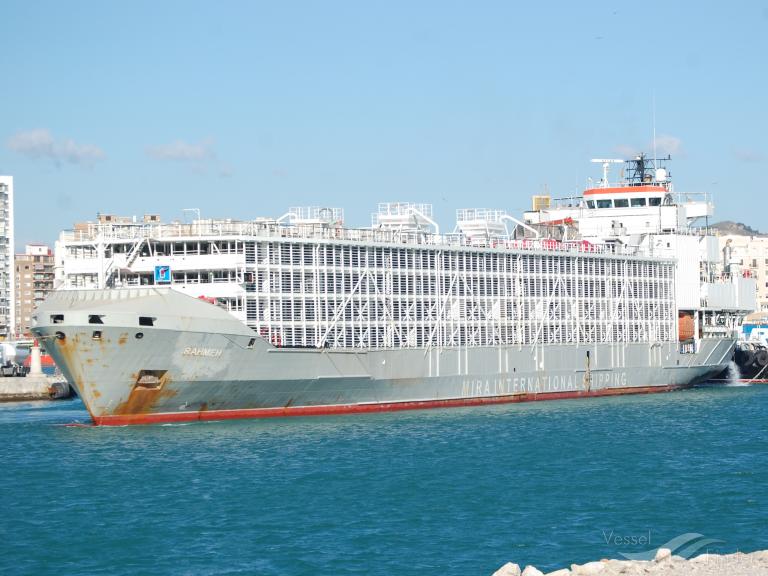
A report on the website of FleetMon, a German-based maritime tracking site, shows the ship, under its previous name of Rahmeh, anchored off the Turkish coast in September 2018 “to fix a mechanical problem” that required the delivery of spare parts.
The FleetMon report also noted some concern from local residents about the ship’s extended stay at Cesme port, because livestock on a previous voyage had been found to be infected with anthrax.
Today, 4/9/20, it appears that Maritime New Zealand found no issues with the livestock ship, Gulf Livestock 1, before it left the port of Napier (New Zealand) last month. The ship with 43 crew and nearly 6000 cattle on board sailed from Napier on 14 August bound for China.
Maritime New Zealand said the vessel was checked on arrival and prior to departure from Napier, and no irregularities were found.
The marine regulator said livestock carriers were checked for stability and the conditions of the livestock pens.
At the same time, the animal activist group SAFE is calling for the minister of agriculture Damien O’Connor to be held to account over the sinking of Gulf Livestock 1.
We wonder why ? – So far, O’Connor has declined all media requests on the issues.
Yesterday, the Ministry for Primary Industries (MPI) temporarily suspended consideration of cattle livestock export applications.
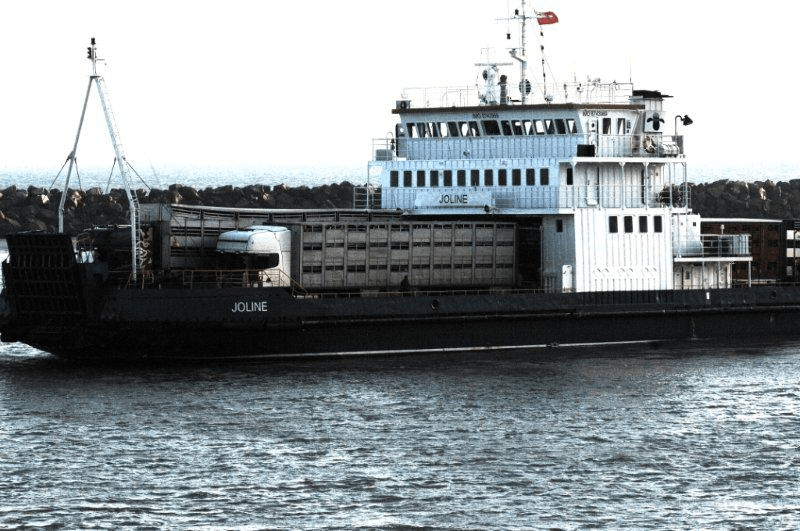
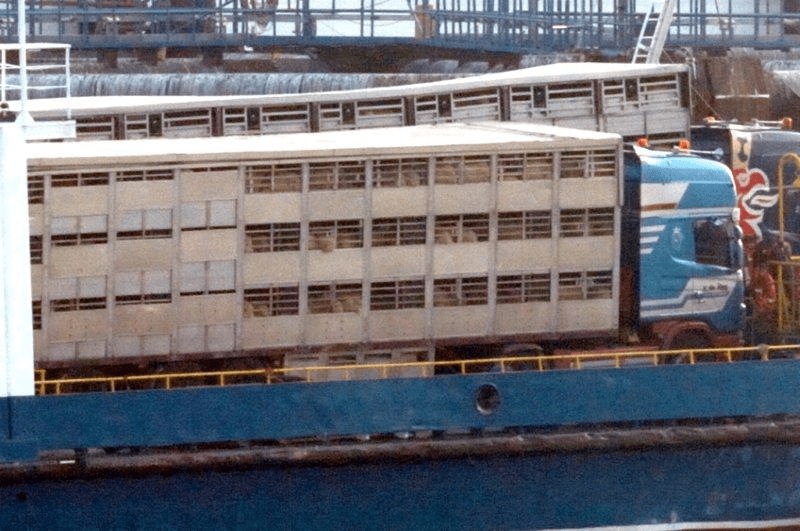
Video footage supplied to us today by activist Jane in England shows another issue which English campaigners have been attempting to get official UK authority action on for many years. It concerns an ex Soviet battle tank RIVER vessel called the ‘Joline’ which is operated by a Dutchman to take British livestock across the English Channel into Europe for slaughter. It should be remembered that the Joline is a river use vessel and was not designed for crossing the English Channel as it does now.
UK activists have raised concerns about the use of the Joline as an animal transporter carrier for many years. At WAV it is thought that as long as it (Joline) does not bury human victims on the sea floor; the vessel and its animal ‘cargo’ will continue to be used. In our opinion; the authorities do not have the guts to stop it by taking action.
Above – the Joline. Note openess and low level of deck. Trailers are loaded with live animals, Photos: Val Cameron.
Above – the Joline in the English Channel in rough weather. Note loaded livestock transporters on deck.
Here at WAV it is also considered that the New Zealand Minister would never have banned a single animal transport if the accident off Japan had not drowned 43 human animals. There are just a few basic, simple words for the other 6,000 non human animals that drowned and died such terrible deaths. The ban in NZ now, in which O’Connor has declined all media requests on the issues we mention, has been done solely out of public pressure, and not out of philanthropy, or ensuring the welfare of animals. Very little is said for the 6,000 sentient beings who lost their lives; only for the 43 human beings carried by the vessel.
We would hope that the relatives and families of the lost crewmen who vanished the other night would show solidarity with us simply because we have a common enemy; the live export mafia. Sadly, but probably; the shipping industrialists will compensate and comfort them with the fact that their loved ones were ‘victims of a typhon’, that seldom happens, but it can happen.
Very little, or nothing, will be said about the technical defects or as we show above, for June 2019, the vessel’s departure was delayed for a week because of “stability and navigation issues identified by the Australian Maritime Safety Authority (AMSA).” Most of the crew who perished are Filipino; their families; probably like them, are most likely poorer people who cannot pay lawyers.
So it looks as if the mafia of the animal transport industry will win again, by banging out a few nice words; making excuses for defects, and as always; simply ignoring the deaths of thousands of animals they are allegedly responsible for. Words mean little; but actions mean a lot.
We will continue to fight for the paltry injustice served to the animals – the victims of the money grabbing meat makers. I have done it with many others for the last 30 years; so tomorrow will be no different for me.
A cargo ship carrying 43 crew and nearly 6,000 cattle sank off Japan after reportedly losing an engine in rough seas caused by Typhoon Maysak, a survivor has said.
The Filipino crew member, named as Sareno Edvarodo, a 45-year-old chief officer, was rescued late on Wednesday after Japanese navy P-3C surveillance aircraft spotted him wearing a life vest and waving while bobbing in the water.
Cargo ship with 43 crew and nearly 6,000 cattle sank off Japan, survivor says | World news | The Guardian
Edvarodo, who was in good health, told rescuers the ship capsized before sinking, said Yuichiro Higashi, a spokesman for the Japanese coast guard’s regional headquarters conducting the search.
The Panamanian-registered vessel, called Gulf Livestock 1, sent the distress call from the East China Sea early on Wednesday, to the west of Amami Oshima Island in south-western Japan, Japanese public broadcaster NHK reported.
According to Edvarodo, the ship lost an engine before it was hit by a wave and capsized, a coastguard spokeswoman said.
Crew were instructed to put on lifejackets as the ship capsized, he said, adding that he had jumped into the water and had not seen any other members of the crew before he was rescued.
The crew comprises 39 Filipinos, two Australians and two New Zealanders, Kyodo news agency said.
The Australian Department of Foreign Affairs and Trade (Dfat) said it was in touch with the families of the two Australians on board.
“The Australian government is providing consular assistance to the families of two Australian crew members on board a cargo vessel reported missing in Japanese waters,” Dfat said.
The cause of the distress was not immediately known, but the weather was rough in the area due to Typhoon Maysak. Strong winds and torrential rain from the typhoon had initially hampered the search operation, but the weather has improved, Higashi said.
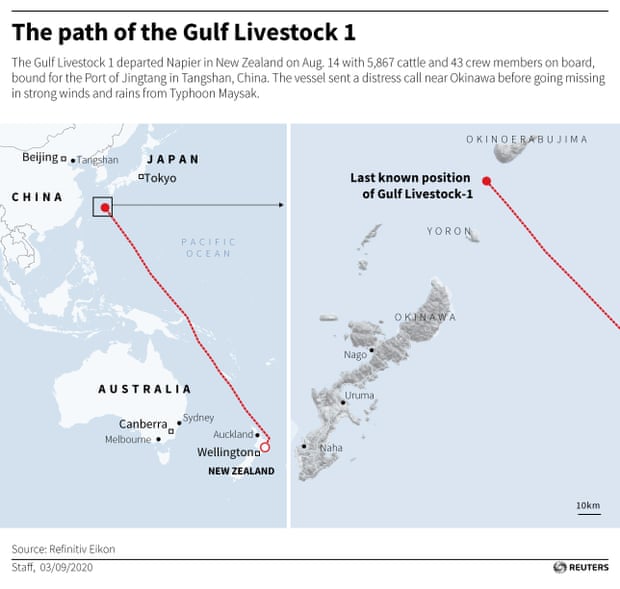
The vessel, owned by Gulf Navigation Holding based in the United Arab Emirates, departed Napier in New Zealand on 14 August with 5,867 cattle on board, New Zealand’s foreign ministry told Reuters.
The vessel was en route to the Port of Jingtang in Tangshan, China, with an estimated journey of approximately 17 days, it said.
New Zealand animal rights organisation SAFE said the tragedy demonstrated the risks of the live animal export trade.
“These cows should never have been at sea,” said campaigns manager Marianne Macdonald.
“This is a real crisis, and our thoughts are with the families of the 43 crew who are missing with the ship. But questions remain, including why this trade is allowed to continue.”
Typhoon Maysak had weakened to a tropical storm as it arrived off the east coast of North Korea on Thursday.
North Korean state TV showed flooding along the eastern coast but there were no immediate reports of casualties.
The country is vulnerable to natural disasters due to its poor infrastructure, with flooding in deforested mountains and hills a particular concern.
Earlier on Thursday, the typhoon had caused brought down trees and caused flooding in parts of South Korea, knocking out power to more than 270,000 homes and leaving at least one person dead.
Reports say the Gulf Livestock 1 issued a distress signal at around 1:20 a.m. local time Wednesday (3/9/20) while around 115 miles west of Amami Oshima Island in southwestern Japan. … The ship is reported to be carrying 43 crew members.19 hours ago
The Japanese Coast Guard is searching for a livestock carrier with 43 crew members on board after a distress signal was sent from the vessel on Wednesday.
Reports say the Gulf Livestock 1 issued a distress signal at around 1:20 a.m. local time Wednesday while around 115 miles west of Amami Oshima Island in southwestern Japan.
The ship is reported to be carrying 43 crew members.
The search is being conducted in the general vicinity of Typhoon Maysak, which was last reported to be packing 130 mph winds, equivalent to a Category 4 hurricane.
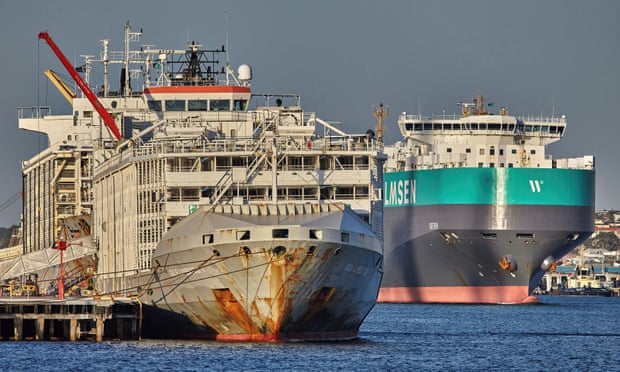
The Gulf Livestock 1 was reportedly transporting cattle from Napier, New Zealand to Tangshan, China. The vessel was built in 2002 and registered in Panama. It is owned by Dubai-based Gulf Navigation.
In late July, the Philippine Navy rendered assistance to the Gulf Livestock 1 after it lost propulsion off Balut Island in Southern Philippines. Repairs were eventually completed without incident.
Ship carrying 43 crew and almost 6,000 cattle missing in typhoon off Japan
A ship carrying 43 crew and nearly 6,000 cattle from New Zealand to China has capsized after losing an engine in stormy weather in the East China Sea, the only crew member rescued so far told the Japan Coast Guard (JCG) Thursday.
The Gulf Livestock 1 sent a distress call from west of Amami Oshima island Wednesday as Typhoon Maysak headed through the region towards the Korean peninsula, bringing strong winds, heavy seas and drenching rains.
The JCG said it had rescued one crew member, Sareno Edvarodo, a 45-year-old chief officer from the Philippines, on Wednesday night while searching for the ship.
According to Edvarodo, the ship lost an engine before it was hit by a wave and capsized, a coastguard spokeswoman said.
When the ship capsized, crew were instructed to put on life jackets. Edvarodo told the coastguard he jumped into the water and did not see any other crew members before he was rescued.
Pictures provided by the JCG showed a person in a life jacket being hauled from choppy seas in darkness.
Three vessels, five airplanes and two divers had been deployed to continue the search, the coastguard said.
The crew included 39 people from the Philippines, two from New Zealand and two from Australia, it added.
The Philippines government said it was coordinating with Japan’s coastguard as it searched for the missing crew members ahead of another typhoon expected to hit the area.
Typhoon Haishen was already in the northwest Pacific, tracking through the East China Sea towards South Korea.
At least one person was reported killed in South Korea after Typhoon Maysak made landfall Thursday when strong winds shattered a window in the southern city of Busan.
The Gulf Livestock 1 departed Napier in New Zealand on Aug. 14 with a cargo of 5,867 cattle bound for the Port of Jingtang in Tangshan, China. The journey was expected to take about 17 days, New Zealand’s foreign ministry told Reuters.
New Zealand animal rights organization SAFE said the tragedy demonstrated the risks of the live animal export trade.
“These cows should never have been at sea,” said campaigns manager Marianne Macdonald.
“This is a real crisis, and our thoughts are with the families of the 43 crew who are missing with the ship. But questions remain, including why this trade is allowed to continue.”
Last year, New Zealand’s government launched a review of the country’s live export trade, which was worth around NZ$54 million ($37 million) in 2019, after thousands of animals being exported from New Zealand and Australia died in transit.
A conditional ban on the live export of cattle was one of several options being considered, Agriculture Minister Damien O’Connor said.
🥥 On this day the world celebrates one of the most healthy food, and everyone is talking about the miracle cure “Coconut Milk”…
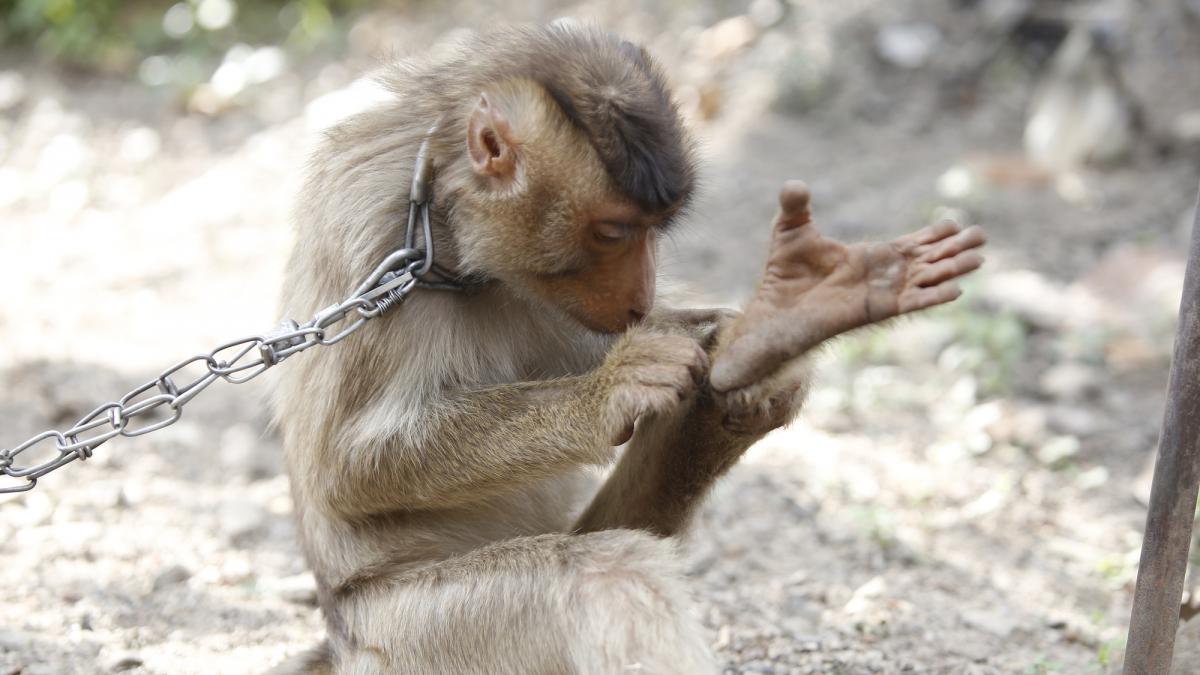
…but we are talking about the pig monkeys,the slaves who provide your healthy milk under agonizing conditions and until the end of their life.
The monkeys are chained with metal collars before and after the coconuts are harvested and kept in isolated cages.
We remind again that this healthy food comes from illegal animal slavery predominantly in Thailand, where the pig monkey business flourishes.
The monkeys are trained to harvest as many coconuts as possible. They are supposed to harvest up to 1,000 coconuts per day.
The monkeys are chained with metal collars before and after the coconuts are harvested and kept in isolated cages.
Monkeys who fight back will have their fangs torn out. Accordingly, many animals lose their minds and hurt themselves.
The U.K government is facing calls to stop ignoring the link between animal farming and the climate crisis.
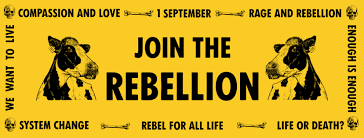
Animal Rebellion – an offshoot organization of environmental advocacy group Extinction Rebellion which is calling for a plant-based food system – has launched a 10-day rebellion against the U.K government as MPs return to Parliament.
The group has vowed to carry out ‘creative and inspiring actions across London and the U.K’ in a bid to persuade politicians to meet three key demands: to ‘tell the truth’ about animal farming and fishing being a leading cause of climate catastrophe; to ‘act now’ by leading a transition to a just and sustainable plant-based food system; to create and be led by the decisions of a Citizen’s Assembly on climate and ecological justice.
‘A plant-based food system’
“Those in power can no longer ignore the link between animal farming and the climate emergency,” Kieran Blyth, a spokesperson for Animal Rebellion, said.
“They must acknowledge that we can only avoid climate catastrophe by way of a full transition to a plant-based food system.”
‘Any sort of future’
Celina Madigan, a member of Animal Rebellion and former primary school teacher, added: “I loved my job and being able to transfer knowledge to the younger generation, but my students will not have a future unless we make changes now.
“We need a transition to a just and sustainable plant-based food system if we, and the next generation, are to have any sort of future on this planet.”
‘The science is clear’
Kerri Waters, a researcher at Animal Rebellion, said: “Animal agriculture is responsible for up to 18 percent of global greenhouse gas emissions – more than the whole transportation sector combined – and up to 83 percent of global farmlands.
“The most comprehensive research project on the environmental impact of farming and food distribution, published by Joseph Poore in 2018, concluded that a plant-based food system could reduce global farmlands by 75 percent.”
Harley McDonald-Eckersall, a spokesperson for Animal Rebellion, concluded: “The science is clear, yet those in power still refuse to act. That is why we will be going straight to the top and bringing the animal and climate emergency to the halls of power.”
EU MUST USE TAXPAYERS’ MONEY WISELY AND PROMOTE PLANT-RICH DIETS
Today, we submitted feedback to the EU’s food marketing campaign, currently under review. We call on the EU to use taxpayers’ money wisely and promote plant-rich diets in order to reduce animal suffering, improve our health and save our planet.
Every year, the EU Commission gives away around €200 million of public funds to promote agricultural products in order to enhance the competitiveness of EU agriculture. Instead of tackling our over-consumption of animal products by promoting plant-based products only, the EU gives out subsidies to promote meat and dairy consumption.
This policy is outdated and not in line with the needs of the 21st century. EU funding used for the promotion of animal products should eventually cease. During the transition period and till it is actually stopped, any funding should be limited and made conditional on meeting higher animal welfare standards using certain eligibility criteria.
Compassion in World Farming and other NGOs call for a minimum 50% reduction in land animal and fish products by 2030, with a concomitant rise in plant-rich nutrition.
The EU’s commitment to meat, dairy and fish production may have overshadowed the opportunities for growth in its horticultural sector. Promotion budgets should be directed to production and consumption of organic, healthy, minimally processed wholegrains, fruit, vegetables, nuts, legumes and other plant nutrition.
Promotion policy should, therefore, be used to help create changes in demand to provide producers with market incentives that are consistent with a transition towards a healthy, nutrition minded agriculture, and environmentally, socially and animal welfare friendly food systems.
The EU should also shift focus away from promoting exports to the internal market instead and support a sustainable food systems transition. The use of public money should be fully aligned with a sustainable food policy within and outside the EU.
The EU Commission’s public consultation on the topic is open until 11 September 2020.
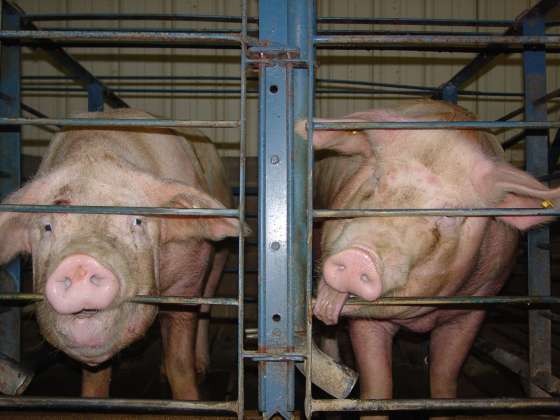
Cows gruesomely mutilated and abused on filthy dairy farms
It’s like in the worst science fiction films, images that are unbearable even for strong nerves.
Australia is well known for its lack of environmental and animal welfare.
The corrupt government of Morrison is repeatedly asked to do something to protect animals and the environment, especially since Australia is also hardest hit by the consequences of climate change.
So far with little success.
Australia has over 160 million sheep and 24 million cattle – it doesn’t take much imagination what damage these million animals can do to the fragile ecosystem of the dry soil.
In addition, there is an enormous cultivation of sugar cane. Large amounts of fertilizer and pesticides are washed from the sugar cane cultivation areas over streams and rivers into the sea and pose a serious threat to the Great Barrier Reef.
The agricultural lobby is very strong in Australia because the first pillar of Australian agriculture is sheep farming, followed by cattle breeding. That is why factory farming in Australia has developed into a law-free area.
TODAY we know more about nutrition than ever before, which is why there are no longer any arguments in developed industrial countries why animals and their hormone products MUST be part of a diet.
Only Indifference and the fascist law of the stronger allow us to act like this.
If all consumers had all the information about slaughterhouses and factory farming from the beginning of their lives, then the majority would definitely make different decisions.
But we don’t get any more information, we get propaganda.
The media are the servants of governments, journalists who report the truth lose their jobs.
This is why the farmer and the meat mafia invented pink piglets and purple cows on the sunny meadow.
This is how the animal cruelty business model flourishes in the billions.