

To check out all the latest news and actions for Korean dogs; please click on this link:
http://koreandogs.org/newsletter-september-1-2018/?utm_source=sendinblue&utm_campaign=Korean_Dogs_Need_Your_Voice__New_Calls_for_Action!&utm_medium=email
To check out all the latest news and actions for Korean dogs; please click on this link:

Hi Mark,
If a day is a long time in politics then I’m sure you’d agree that the last week has felt like a year!
There’s been a lot of media commentary overnight about Sussan Ley’s inability to progress her private member’s bill to end sheep exports, now that she is a member of executive government. I knew this would leave many of our supporters, who have been passionately lobbying their MPs to support her bill, concerned and disappointed.
The first thing I want you to know is that we are still on track to end the cruel live sheep export trade.
Here’s why:
The trade continues to unravel before our eyes…

All of these factors will lead to fewer animals being shipped and a dramatic reduction in the commercial ‘attractiveness’ of this trade. Much of this industry’s profits have been built on its ability to operate unlawfully. Those days are now gone.
While it’s disappointing that Sussan Ley and Sarah Henderson are no longer in a position to progress their private members bill, they’ve both publicly committed to continue to work within the government to obtain support for a phase out of the trade. Importantly, as you know, the ALP has committed to ending live sheep exports if elected to govern and polls are showing them clearly in front as we head towards an election.
The way forward:
In terms of next steps … the Senate bill to phase out the trade is still set to be voted on in coming months. If it passes, this will be another historic milestone in this campaign. This bill’s ability to progress further is dependent on the Morrison government, which controls the House of Representatives. As lobbying opportunities emerge, we will be sure to let you know.
The political developments of last week present a classic example as to why the key to effective campaigning is the ability to embrace developments, seize opportunities and pivot strategy at a moment’s notice. I should add to that list … resilience, and never taking your eye off the end goal!
Please rest assured that in the midst of this political upheaval, all remains well and momentum is still with us. There is as much reason to be optimistic today as there was a week ago.
As always, I am incredibly grateful to have you on this historic journey with us.
For the animals,
Lyn
Lyn White AM
Director of Strategy

The demand for donkey skins in particular, to produce Ejiao – a traditional Chinese medicine made from donkey-derived gelatin, has generated a significant trade across the globe and we believe current practices are unsustainable and causing mass-scale suffering.
It is reported that in China, millions of donkeys are farmed for their skins to produce a medicinal gelatin (ejiao). The global trading of donkey skins is now having an impact on donkey welfare and the livelihood of people around the world.

The donkey skins are being used to make gelatin for a product called ejiao, a product that has been used as a traditional Chinese medicine for thousands of years.
Ejiao (said: eh-gee-yow) is a hard gel that can be dissolved in hot water or alcohol to be used in food or drink, or in beauty products such as face creams. Believed to improve blood circulation, ejiao is used as a blood tonic by people with anaemia, low blood cell counts or reproductive problems.
The stolen donkeys are mostly working animals, which means the owners then have no transport and can’t get to market, fetch water or get children to school. The trade in skins means that the value of donkeys has risen dramatically, which makes theft more likely but also makes it much more difficult for owners to afford to replace a stolen donkey. In Egypt, the cost of buying a donkey has increased from £17 to £170.
Read more:
https://www.thedonkeysanctuary.org.uk/what-we-do/issues/donkey-meat-skin-and-milk/what-is-ejiao

The donkey skins used in the product were previously largely sourced from Chinese farms. But with China’s donkey population dropping from 11 million in 1990 to 5.4 million in 2016, manufacturers are now targeting donkeys from Africa to meet demand. This is having a significant impact in a number of the countries where SPANA works – for instance, Botswana’s donkey population has decreased by 38 per cent in two years.
Donkeys that are sold for their skins are often treated terribly throughout the transport and slaughter process loaded roughly onto cramped, dangerous vehicles, starved, and killed brutally.
Read more: https://spana.org/donkey-skins
DONKEYS are the backbone of many farming villages in developing countries. But if current trends continue, the world’s rural poor may soon need to find a new beast of burden. The animals’ ranks have thinned dramatically in many African countries: Kenya’s donkey population, for example, has fallen by half since 2009, to 900,000. The primary cause is neither disease nor declining demand for live donkeys, but instead a burgeoning market for their pelts.
Read more: https://www.economist.com/graphic-detail/2018/03/30/donkey-skins-are-the-new-ivory
China is reducing the import tax on donkey skins for use in traditional medicine despite fears over a global reduction in the animal’s population.
From Monday, the tax will fall from 5% to 2%, making imports cheaper.
Gelatine made from donkey skin is highly prized in China and purchases of hides have soared in recent years.
§ 1.8m skins are traded every year – according to estimates from UK-based charity The Donkey Sanctuary – but the demand is as high as 10m
§ China’s donkey population dropped from 11m in 1990 to 3m in 2017, based on government data
§ Ejiao, the gelatine produced by boiling donkey skins, can sell for up to $388 (£300) per kilo
§ Uganda, Tanzania, Botswana, Niger, Burkina Faso, Mali, and Senegal have banned donkey exports to China
Read more: https://www.bbc.co.uk/news/world-asia-china-42527299


At an information demonstration against mass animal husbandry and milk production, a young woman addressed me: “Why can not we drink milk, the cows get children anyway and the calf in the yard of my neighbor has enough to drink”!
I immediately asked myself: did not we inform enough?
The media often report about it, the newspapers bring meanwhile once a week important documentations, the suffering of milk and farm animals is often known to the public… is this society really so stupid, or just uninformed?
That’s why I searched for very good and simple information about the production of milk.
It’s from PETA. Maybe some of you would also need this information for a demonstration, I definitely !!


SUNDAY 7 OCTOBER AT 10.45 AM
Back in 2012, after the events that took place and were exposed in Indonesia in 2011, the public rallied to our second Human Chain in droves, and we had 1,200 people attend. Sadly, the numbers keep dropping as people get complacent or lose hope. Last year we had “only” 600-700 people 😦
This year we MUST make it HUGE again.
Yes – Emanuel Exports have lost their licence, and that does include their subsidiary company EMS Rural Exports, but they are appealing that decision, and their Kuwaiti shipping agent Kuwait Livestock Transport and Trading (KLTT) has applied for a licence to carry on their dirty work. We also know that the second largest exporter of live sheep, Livestock Shipping Services (LSS) is buying up sheep as I type, readying to try to send a shipment in September.
BUT WE HAVE NEVER BEEN CLOSER! And we must use this political momentum to our advantage and keep the pressure on. We have never seen any Liberal MPs speak out against the trade, now we have at least three who were ready to cross the floor to see a Bill to end the live sheep trade passed.
The Labor Party, which has always supported the trade, has committed to end at least, the live sheep trade.
Animals Australia is threatening to seek an injunction against any permits being issued to ship sheep by sea, to the Middle East during the months of May to October.
Hinch and Rhiannon have a Bill ready to go for the Senate, and the numbers suggest it WILL pass!
LET’S SHOW THE GOVERNMENT AND THE MEDIA THAT WE WILL NOT BACK DOWN.
PLEASE be at Stop Live Exports’ HUMAN CHAIN on Sunday 7 October, no later than 10.45 AM.
WEAR BLACK, and please DOWNLOAD print off and wear your “I AM A ________ STILL OPPOSED TO LIVE EXPORT” sign.


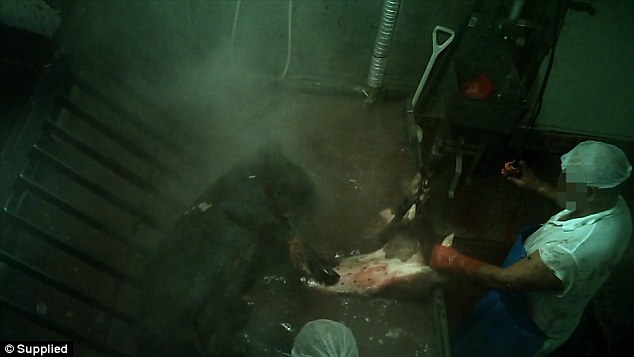

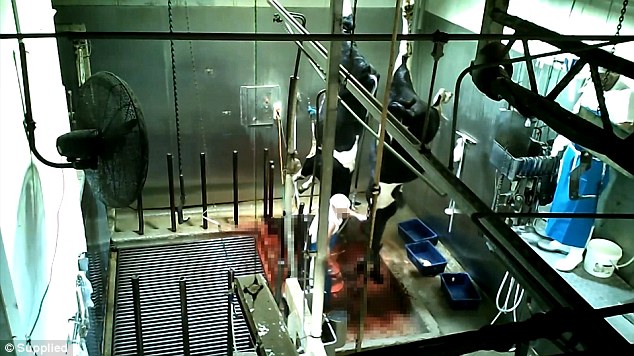

Regarding our recent post on UK sheep shearers abusing sheep:
Now, and quite rightly; it seems that these same people could be facing criminal charges; something which we welcome.
Read the full article here:
The RSPCA is considering whether to prosecute after an undercover investigation revealed horrific cruelty and abuse behind the scenes as sheep were sheared on British farms.
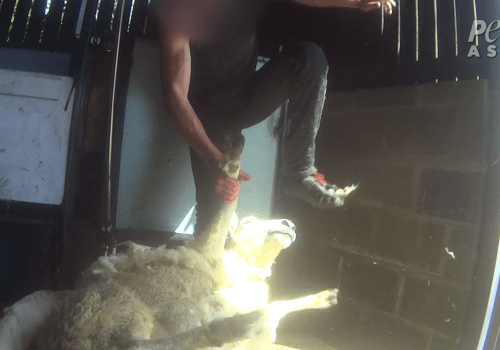
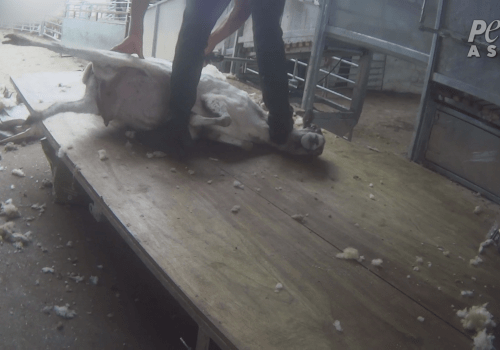
Animals could be seen writhing in agony as they were violently hit, punched and stamped on, and had their limbs twisted.

WAV Comment – The lambs would be slaughtered in the UK and NOT exported live. But when they are slaughtered in the UK, are they stunned in accordance with UK and EU law, or non stunned as required by Saudi ? – big issue which will cause many to question the attitude of the government. Clarity required.
—————————————
The UK government has been accused of watering down animal welfare standards after it emerged that British lambs sold to Saudi Arabia in a major new trade deal may not be stunned before slaughter.
The deal, understood to be worth £25 million over the next five years, has been criticised by MPs and animal welfare groups.
The British Veterinary Association has called on the government to clarify whether the lambs would be killed using a ‘cruel’ non-stun method, which the body condemns as causing ‘unnecessary suffering’.


WAV Comment – Sheep suffer abuse the world over. Australian live export to the middle east; Museling; Shearing; Slaughter; Eid Sacrifice – sadly the UK shearing business is getting as bad as the filth that abuse sheep in Australia. Shame on them for dragging good UK welfare into the gutter. But what else should we expect ?
Check out our recent footage of Australian slaughter abuses on sheep at https://worldanimalsvoice.com/2018/08/24/it-happens-everywhere-a-dangerous-generalization/

Above – Australian sheep Mulesing.
————————————————————————————-

As you can see in the groundbreaking video footage,
shearers violently punched these gentle animals in the face, beat them, jabbed them in the head with sharp metal clippers, and stamped and stood on their heads and necks. They threw scared sheep around and slammed their heads and bodies against hard wooden floors. The eyewitness never saw any veterinary care being given to the animals, including those with mastitis – a painful udder infection – and prolapsed uteruses.
These animals need your help.
Will you pledge to ditch wool and share this footage with your family and friends?
Together, we can make a difference for these suffering animals.
All you have to do is take action today


 .
.

