Category: Farm Animals

|

Study: Americans Are Ready for Slaughter-Free Meat
Results of a recent study by Faunalytics show that about two-thirds of American consumers (66.4 percent) are willing to try slaughter-free or “clean” meat – which is produced in a laboratory using animal cells. Of the study’s 1,185 participants, 45.9 percent stated that they were willing to buy clean meat on a regular basis, and 52.8 percent would be happy to eat it in place of conventional meat.
The study, entitled “Messages to Overcome Naturalness Concerns in Clean Meat Acceptance,” addressed issues raised by prior research conducted three years ago, which reported that the primary concern of consumers in eating clean meat was that it was “unnatural.”
The goal of the study was to find effective ways to describe and market clean meat that would address the concerns about naturalness. Participants were asked to read one of three key messages surrounding the production of clean meat and rate their reactions.
Out of the messages trialed, the study found that the best way to persuade people to give clean meat a chance was to discuss how unnatural the mass farming and production industry is, with its use of hormones and antibiotics. The other messages attempting to describe clean meat as a more natural product or arguing that naturalness was unimportant were far less effective.
The majority of respondents agreed that clean meat is more environmentally friendly than conventionally produced meat, with more benefits to society overall.
Clean meat is, in fact, cleaner than traditionally produced meat in every aspect. The production uses far less land and will not have the same catastrophic effects on the environment. It’s also better for human health – farm animals are pumped full of antibiotics and hormones – not to mention that the production of clean meat does not require the suffering or death of innocent animals.
Worldwide, companies like MosaMeat, JUST and Memphis meats are racing to get the first ever clean meat products to market, which is expected to happen in the next two or three years.
Even conventional meat producing companies Tyson Foods and Cargill recognize that cultured meat is the way of the future, and have invested in Memphis Meats.
With technology rapidly developing, companies are searching for ways to reduce production costs to make clean meat affordable for the mass market. It’s only a matter of time before slaughter-free meat is available, hopefully consigning the inhumane agricultural industry to the history books.

https://mailchi.mp/viva.org.uk/vivahealth-august18-e-newsletter?e=26c03356b8
Vegetarians International Voice for Animals (Viva)
Website: https://www.viva.org.uk/

Mercy For Animals

Main web link – https://mercyforanimals.org/
Inspiring Compassion. Ending Cruelty.
Mercy For Animals is dedicated to preventing cruelty to farmed animals and promoting compassionate food choices and policies.
Imagine a world free of cruelty, a world in which we nurture our bodies, minds, and spirits with wholesome, healthy food that is kind to animals and sustainable for our planet. MFA believes that world is possible. In fact, it is inevitable if we work together to elevate humanity to its fullest potential.
See their range of investigative videos via this link:
https://mercyforanimals.org/about
JBS Exposed
A JBS supplier mutilates pigs, crams them into tiny cages, and kicks them in the face.
http://www.jbstorture.com/
Other examples of undercover investigations. See above for the link to more.

https://www.ciwf.org.uk/our-campaigns/?gclid=EAIaIQobChMI47rkpvXf3AIVDSjTCh0RrwliEAAYASAAEgLEZvD_BwE
https://www.ciwf.org.uk/get-involved/
https://www.ciwf.org.uk/our-campaigns/
https://www.ciwf.org.uk/
https://twitter.com/ciwf?ref_src=twsrc%5Egoogle%7Ctwcamp%5Eserp%7Ctwgr%5Eauthor
https://www.ciwf.org.uk/our-campaigns-1/investigations/pig-investigations/

Comment – Great news but why so long ? – why not 2020 ?
I am very pleased to announce that with the help of our supporters, we have achieved a major victory in pig welfare.
Kroger, the largest grocery chain retailer in the U.S. has committed that by 2025 they will no longer source pork from farms that use cages.
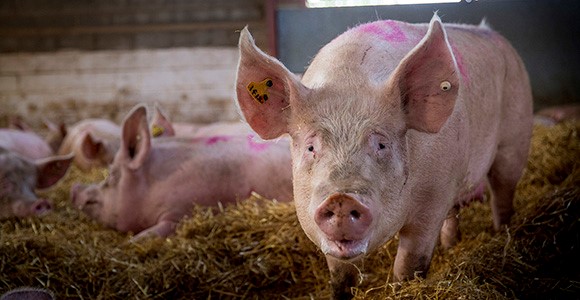
If you recall, World Animal Protection launched a petition in May, garnering more than 72,000 supporters to join with us in asking Kroger to be a leader in the industry and use their buying power to get suppliers to raise pigs right.
At the end of July, Kroger released their latest sustainability report, including a commitment to source 100% of fresh pork from suppliers who have transitioned all their self-operated and contracted farms away from gestation crates by 2025. We are excited about this commitment, but we will continue to do more for pigs.
While some major fast food brands are making similar commitments to source pork responsibly, grocery chains have been slower to move, and grocery chains buy the bulk of pork produced.
U.S. supermarket customers expect more. Eighty-nine percent of grocery shoppers surveyed believe that supermarkets have a responsibility to ensure pigs are treated well. We need to continue to work with grocery chains to change their practices.
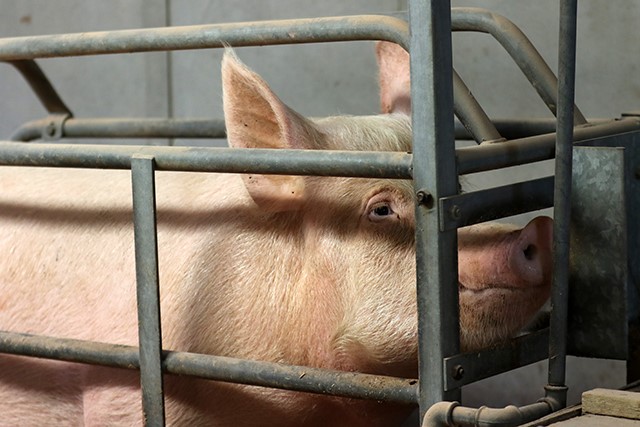
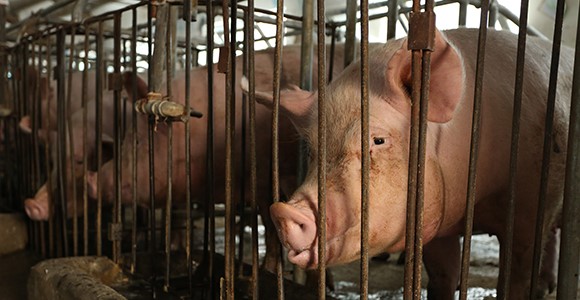
Three out of four mother pigs remain in steel cages for life. These cages are no bigger than the average fridge. They are unable to turn around, root, explore, move comfortably or socialize with other pigs. Mother pigs become chronically depressed and bite the steel bars of their cages in frustration. Sows are treated as breeding machines. Mother pigs go constantly hungry because their food is restricted to limit weight gain and avoid complications, while giving birth to huge litters. They resort to repetitively chewing when their mouths are empty, until they foam at the mouth.
World Animal Protection research shows that 72 percent of international respondents find the way pigs are raised upsetting, wrong or shocking. However, 80 percent of U.S. respondents were concerned after seeing the realities of commercial farming.
What can you do about this?
You can talk to your local grocery store about where they source their pork. Ask them to do better on labeling so you know where the pork is sourced from and demand that they have higher welfare pork from pigs that have been raised right. Click here to download and complete this letter for your grocery store manager. Retailers carry what consumers demand so you can help #RaisePigsRight by speaking up.
You can also click here to make a donation supporting our work to protect pigs and other animals in need.
Look out for more updates from us in the coming months. We appreciate your continued support as we work towards additional victories for pigs.
| In solidarity, Alesia Soltanpanah Executive Director World Animal Protection US |

Do you know what Mulesing is ?
Comment – and to think that Aus sheep suffer this before they suffer the live export trade !
https://en.wikipedia.org/wiki/Mulesing
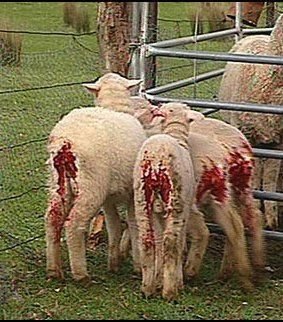
Mulesing is the removal of strips of wool-bearing skin from around the breech (buttocks) of a sheep to prevent flystrike (myiasis).[1] The wool around the buttocks can retain feces and urine, which attracts flies.
The scar tissue that grows over the wound does not grow wool, so is less likely to attract the flies that cause flystrike.
Mulesing is a common practice in Australia for this purpose, particularly on highly wrinkled Merino sheep.[1] Mulesing is considered by some to be a skilled surgical task.[2] Mulesing can only affect flystrike on the area cut out and has no effect on flystrike on any other part of the animal’s body.
Mulesing is a controversial practice. The National Farmers Federation of Australia says that “mulesing remains the most effective practical way to eliminate the risk of ‘flystrike’ in sheep” and that “without mulesing up to 3,000,000 sheep a year could die a slow and agonising death from flystrike”.[3]
The Australian Veterinary Association (AVA) “recognises the welfare implications of mulesing of sheep. However, in the absence of more humane alternatives for preventing breech strike, the AVA accepts that the practice of mulesing should continue as a sheep husbandry procedure”. The AVA also supports the use of analgesics and the accreditation of mulesing practitioners.[4]
The Australian Royal Society for the Prevention of Cruelty to Animals accepts mulesing when the risk of flystrike is very high, when it is done properly, and even then only as a last resort.[5] The animal rights organisation PETA strongly opposes mulesing, says the practice is cruel and painful, and that more humane alternatives exist,[6] and claim that sheep can be spared maggot infestation through more humane methods, including special diets and spray washing.[7]
In July 2009, representatives of the Australian wool industry scrapped an earlier promise, made in November 2004, to phase out the practice of mulesing in Australia by 31 December 2010.[1][8][9] Mulesing is being phased out in New Zealand.[10]
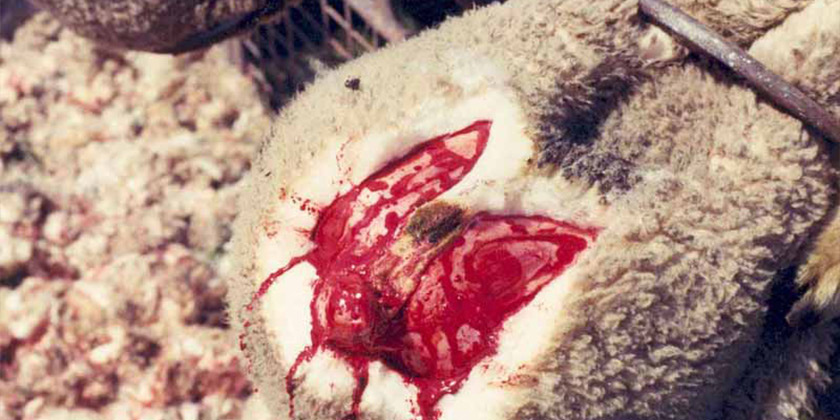
Mulesing is a procedure which, in Australia, is carried out by a person who has completed the mandatory accreditation and training programme, usually a professional mulesing contractor.[1]
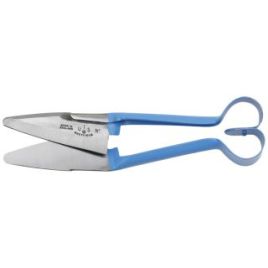
While the lamb is under restraint (typically in a marking cradle), the wrinkled skin in the animal’s breech (rump area) is cut away from the perianal region down to the top of the hindlimbs. Originally, the procedure was typically performed with modified wool-trimming metal shears, but now there are similar metal shears designed specifically for mulesing. In addition, the tail is docked and the remaining stump is sometimes skinned.[13] The cuts are executed to avoid affecting underlying muscle tissue.
The New South Wales Department of Primary Industries states in the Standard Operating Procedures that, “While the operation causes some pain, no pre or post operative pain relief measures are used”. Antiseptics, anaesthesia and painkillers are not required by Australian law during or after the procedure but are often applied, as the procedure is known to be painful to the animal.[1][2] Products have been approved for pain relief during the procedure, including Tri-Solfen. The minor use permit for Tri-Solfen[14] makes the product available for use by both veterinarians and sheep industry employees, such as mulesing contractors and graziers.[15]
After a heavy mules, non-wooled skin around the anus (and vulva in ewes) is pulled tight, the cut heals and results in smooth scar tissue that does not get fouled by fæces or urine. Most sheep have a light mules which does not leave the skin bare, but simply removes the skin wrinkle leaving a reduced area to grow wool and stain.[13]
When managed according to the standards, policies and procedures developed by the CSIRO, lambs are normally mulesed a few weeks after birth. The operation usually takes less than a minute. Standard practice is to do this operation simultaneously with other procedures such as ear marking, tail docking, and vaccination. Because the procedure removes skin, not any underlying flesh or structure, there is little blood loss from the cut other than a minor oozing on the edges of the cut skin.
Mulesed lambs should be released onto clean pasture. The ewes and suckling lambs should receive minimal disturbance until all wounds are completely healed (about four weeks). Observation should be carried out from a distance.[1]
Mulesing should be completed well before the flystrike season, or else chemical protection should be provided to reduce risk to the lambs and ewes.
Lambs that are slaughtered soon after weaning generally do not need mulesing because they can be protected by chemical treatment for the short time they are at risk.[16]
Comparison to crutching
Mulesing is different from crutching. Crutching is the mechanical removal of wool around the tail, anus (and vulva in ewes) in breeds of sheep with woolly points where this is necessary. Mulesing is the removal of skin to provide permanent resistance to breech strike in Merino sheep. Other breeds tend to have less loose skin, and wool, so close to the tail and may have less dense wool.
Crutching has to be repeated at regular intervals as the wool grows continuously. Frequent crutching of Merinos reduces the incidence of flystrike, but not as much as mulesing.[citation needed]
At the time mulesing was invented, crutching was done with blade shears. In Australia, these have been almost universally replaced with machine shears. Hand shears were being used when Mules inadvertently carried out the procedure during crutching. Mulesing would not inadvertently occur using modern machine shears.
Non-surgical alternatives
Several non-surgical alternatives are currently being researched:
- Insecticides: Any number of insecticides are now available for prevention of fly strike.[40] and even early reviews proclaimed the effectiveness of using dip across the whole animal, rather than cutting one small portion that left the rest of the animal still susceptible “dipping is still the most cost effective means of protecting sheep from flystrike”. [41]
- Topical protein-based treatments which kill wool follicles and tighten skin in the breech area (intradermal injections)[39]
- Biological control of blowflies.[12]
- Plastic clips on the sheep’s skin folds which act like castration bands, removing the skin (breech clips).[39]
- Tea tree oil as a 1% formulation dip where tests have shown a 100% kill rate of first stage maggots and a strong repellent effect against adult flies, which prevented eggs being laid on the wool for up to six weeks.[42]

In the Romandie (also called French-speaking Switzerland, with a population of 2 million) Virginia Markus is the best-known pioneer of the Anti speciesists, a radical animal protection movement.
Especially her actions cause a stir: In March, she and 18 of her co-workers freed 18 kids from a slaughterhouse near Rolle (VD), having previously recorded the conditions in a slaughterhouse with hidden cameras and occupied appropriate facilities. There are several criminal cases against her.
 Virginia Markus
On 3.08.2018 she gave a very good interview in the “Neue Zürchner Zeitung”. I only translated the main points of this interview because it is quite long, but you can read the whole thing from the link.
https://www.nzz.ch/schweiz/fuer-tiere-wuerde-ich-auch-ins-gefaengnis-gehen-ld.1408633
NZZ: You chose the radical form. When did you eat your last piece of meat?
Markus: When I was 18, my former geography teacher showed me the effects of meat consumption on the environment. That opened my eyes. The decision to live vegetarian was easy, because I was always surrounded by animals. It was harder to give up my beloved cheese six years later. But I had to do it because I realized that if I only consume dairy products, I’m indirectly responsible for the deaths of animals.
NZZ: In what way?
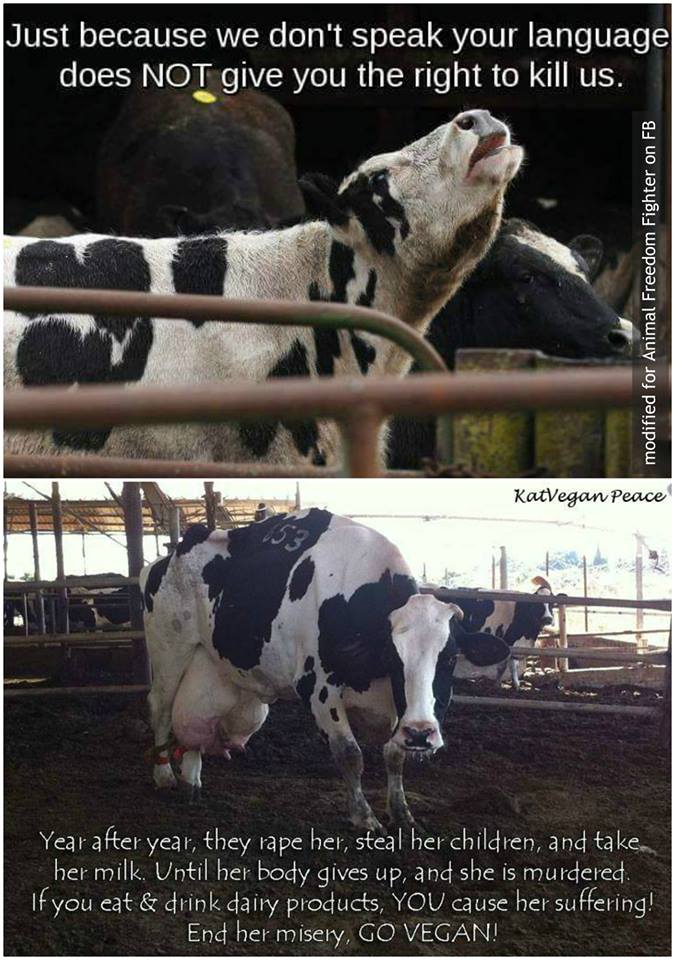
Markus: Many people feel that a cow is constantly giving milk. It is not so. She has to give birth to a calf regularly, which will soon end up on the slaughter if it is male. And if she does not produce enough milk, the cow is also slaughtered. That is irresponsible for me. The decision not to eat any more animal products was a liberation for me: at last I could live in harmony with my values.
By consuming animal products, one is jointly responsible for murdering an animal.
NZZ: Do you – ethically speaking – make no distinction between animals and humans?
Markus: No! as far as their will to live is concerned. An animal that suffers is like a person who suffers. Which of course does not mean that there are no physiological and cognitive differences.
NZZ: In nature, there are also differences and a hierarchy: A cat hunts the mouse – and we humans keep us the livestock.
Markus: A cat acts by instinct, she can not think the consequences of her actions. Fortunately, we can do that. There are no people born with the instinct to kill.
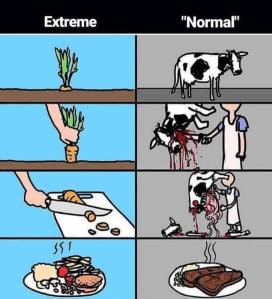
I do not deny that it can give pleasure to eat meat. But that does not justify doing it – it implies sacrifice. By consuming animal products, one is jointly responsible for murdering an animal.
In other areas of life, nobody also questions that one must put own pleasure back, if it is to the detriment of others. Why not with the food?
NZZ: They not only hide cameras, they also block roads to slaughterhouses and even liberate animals. Four criminal cases are currently pending against you. Why should not the law apply to you?
Markus: Only in this way can we sustainably influence public opinion. Civil disobedience is only a remedy for us when all others are exhausted. We force the society, so to speak, not to close its eyes.
Our first big goal is that cows, calves and other fattening animals in Switzerland are as well protected as cats and dogs. Still, animals do not have the same rights as humans. So in our opinion, more radical methods are needed to combat this malady.
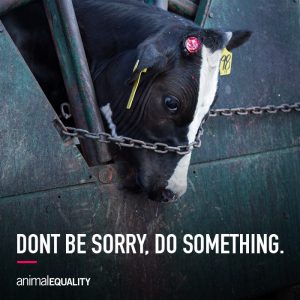
I am insulted on all possible channels, someone has already bitten me the tires. To some extent, I can even understand the anger of many people. However, I am not insecure by such reactions, as well as by judicial decisions. For the protection of the animals I would go to jail.
Last question: what has become of the liberated kids?
Markus: I can only reveal so much: 17 of the 18 rescued animals still live. They had to be elaborately maintained, meanwhile they are all well again.
My best regards, Venus

Source:
Farm banned by Red Tractor for pig cruelty supplies meat to major wholesalers
‘The sound of piglets’ heads being smashed against the wall, the cries of agony as their tiny teeth are clipped, and the terrified squeals of pigs being forced onto the slaughter truck with electric shocks could all be straight out of a horror film’
A farm where workers inflicted a string of torments on animals is a supplier to one of Britain’s biggest abattoirs that sells meat to major wholesalers.
It also sells pigs to a local butcher – prompting campaigners to say the footage proves it is a myth that locally bred meat means higher welfare.
Video taken at the Bedfordshire farm revealed a litany of abuse that broke welfare regulations including:
- A worker swinging a tiny piglet by one leg and smashing its head against a wall
- Piglets teeth being clipped off without pain relief
- Pigs being illegally and repeatedly shocked with an electric prod in their sides and neck
- A piglet left frothing at the mouth on a pile of corpses
- Dozens of dead piglets littering the floor of the farrowing (birthing) shed as well as live piglets trapped in crates with dead siblings
- Pigs crammed into barren pens so small they are forced to lie on each other in the heatwave
- At least one creature suffering from a tumour or hernia
Animal-welfare investigators uncovered the breaches of regulations at Rosebury Farm in Dunstable, Bedfordshire, which had passed five Red Tractor inspections this year including one last month – all of which the farm had been alerted to in advance.
Footage of wounded pigs raises questions over Red Tractor scheme
But an unannounced inspection took place lafter the activists, from Animal Equality, disclosed the footage. The farm was then suspended.
The activists’ evidence showed how when piglets were slammed against a wall one continued to kick for at least 10 seconds, suggesting it died in extreme pain.
Last month The Independent revealed how animals at a farm that had been inspected and authorised by Red Tractor officials were found to be suffering from painful, infected injuries.
The practice of using an electric prod is restricted to “extreme circumstances only” under law. At Rosebury Farm in Dunstable workers were filmed using an electric prod to load pigs onto a lorry heading to an abattoir.
The investigators trailed one lorry load of pigs from the farm to Cheale Meats in Essex, a slaughterhouse that supplies the biggest wholesalers in the UK. It is believed meat from Cheale ends up in major supermarkets.
Another lorry went from the farm to Evans & Son, a “traditional” butchers in Bedfordshire that boasts of selling only local meat.
Many consumers mistakenly believe that buying meat from a local butcher or farmers’ market means the animals had a better life.Toni Shephard
Dr Toni Shephard, executive director of Animal Equality, said the investigation showed it was not true that local butchers or farmers’ markets guaranteed better welfare.
She said: “The sound of piglets’ heads being smashed against the wall, the cries of agony as their tiny teeth are clipped, and the terrified squeals of pigs being forced onto the slaughter truck with electric shocks could all be straight out of a horror film.
“Yet these harrowing scenes are from the much romanticised local, family farm producing British pork under the Red Tractor label.
“It’s time consumers were told the truth – labels and certificates do not prevent animals from suffering in the meat industry, but choosing from the ever-increasing selection of meat-free options will.”

