The Scottish government have joined England and Wales in hosting a consultation regarding live animal exports. Animal Aid would like to see a complete ban on the needless live export of animals, however this brings an opportunity to improve conditions for some of the victims of the animal farming industry.
Please join us in responding to the Scottish consultation. We have provided some example responses to the consultation questions below to help you, although greater consideration may be given to responses in your own words, rather than exact duplicates.
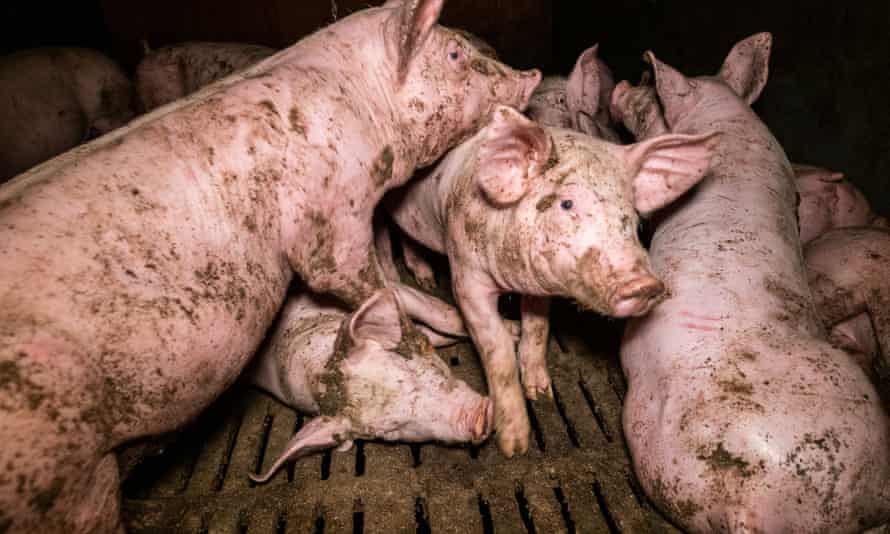
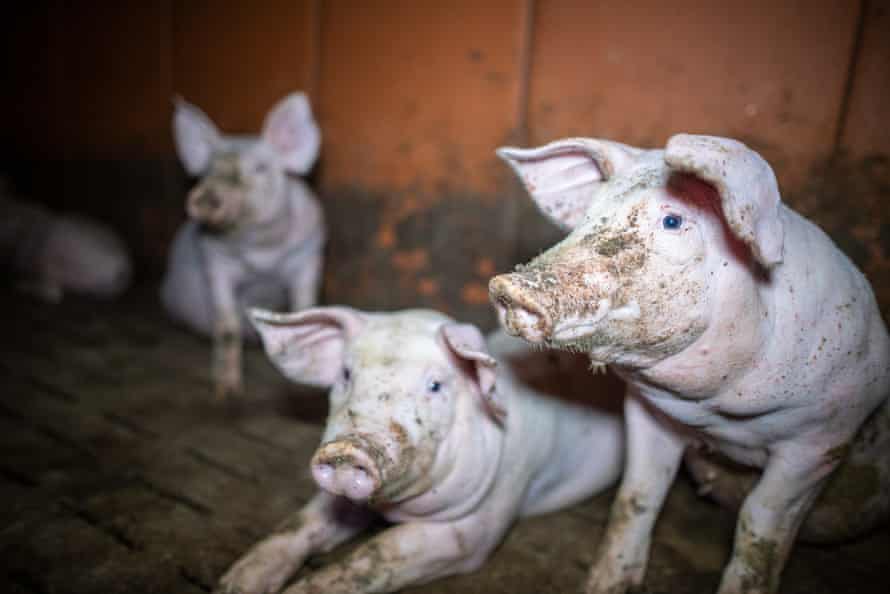
Video footage released by French animal welfare group, L214, in December 2020 appears to show pig cannibalism, overcrowding and dead animals lying in pens. Photograph: Courtesy of L214
Undercover footage at French pig farm shows ‘abusive’ conditions
The unit, which supplies the Herta brand, had been cleared by French state vets and claimed to be addressing concerns
French veterinary officials have been accused of publishing “falsely reassuring” inspection findings after undercover footage at a farm appeared to show pigs in conditions that continued to breach regulations following allegations of abuse in December.
The farm is a supplier for the Herta brand of frankfurter, part-owned by Nestlé, which is sold by most major UK supermarkets.
In December 2020, the French NGO L214 released undercover footage that appeared to show pig cannibalism and other serious issues at a farm that supplies the Herta pork brand. The brand is 60% owned by Spanish food company Casa Tarradellas and 40% by Nestlé.
These allegations prompted Waitrose to suspend sales of Herta products and Nestlé to pause supply from the farm to Herta, pending investigations. Separately, the Allier regional government launched its own inquiry.
On 16 December, Allier effectively cleared the pig breeder of any mistreatment charges. Its statement said: “In general, the inspection concludes that the farm is in good condition and that there are no major non-conformities.”
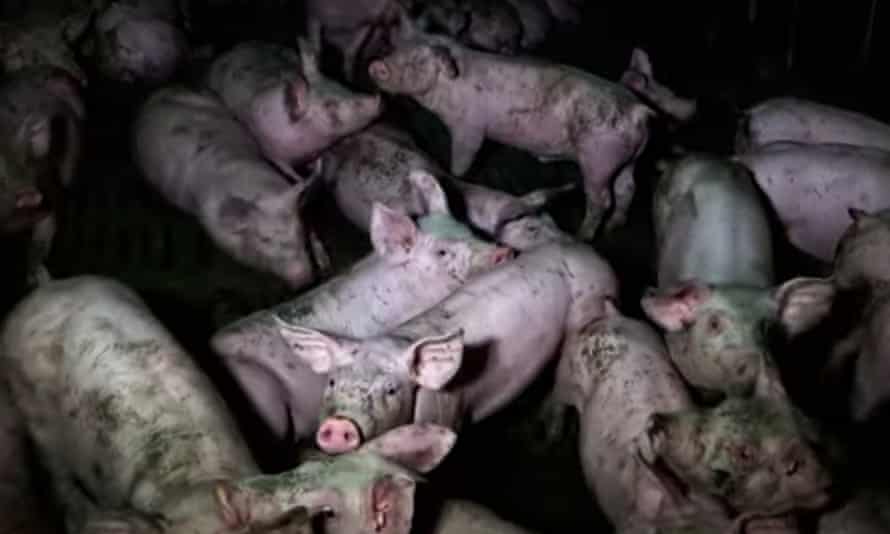
New undercover footage, however, said to have been filmed in January 2021 and released on today, appears to show pigs in conditions that continue to breach French regulations, L214 said. Infringements cited by the NGO include: the absence of any hay, straw or other bedding, no apparent fresh water, pigs with docked tails and unsuitable flooring.
New footage released by French animal welfare group L214 appears to show conditions at the farm haven’t improved since it released its first video in December 2020. Photograph: Courtesy of L214
EU law governing pig welfare stipulates they “must have permanent access to” rooting materials “such as straw, hay, wood, sawdust, mushroom compost, peat or a mixture of such”. Pig tail docking is outlawed in the EU, other than in exceptional circumstances.
Vets contacted by the Guardian and who watched the undercover footage also raised concerns.
Vicky Bond, a UK vet and director of the Humane League, described the pigs’ conditions shown in the footage as abusive and said UK consumers were “often unaware that we import products that fall below UK animal welfare laws”.
Speaking in a personal capacity, Alfonso Senovilla Labrador, a Spanish civil service vet, said although the video was not as bad as some he had seen, there were several welfare infractions he would have noted as part of an inspection.
“The most important ones are the lack of water for some animals,” he said, as well as overly-wide slatted flooring gaps in which pigs could trap their feet.
In another area, Senovilla noted that a newborn piglet’s legs were trapped by a different type of floor slatting. Without help, he said, the piglet probably died. Senovilla also pointed to areas in the pig barn that were in “an excessively dirty condition”.
Walter Sánchez-Suárez, a vet and consultant to US NGO Mercy for Animals, said he was struck by the poor hygiene, inadequate flooring and apparently “systematic” tail docking – a procedure he described as painful.
Tail docking, he said, aimed to prevent pigs biting each other’s tails to relieve the stress “typically caused by poor environmental conditions and management practices”.
Sánchez-Suárez said the apparent shortages of water and enrichment materials – items meant to relieve pig boredom – should have seen the farm “deemed as non-compliant with the current EU laws”.
L214 has begun legal action against the French state for “the failure of the veterinary services to fulfil their mission”.
In a statement L214 said: “Contrary to what the veterinary services claimed in a press release issued 16 December 2020, [the pig farm area] violates the regulations on a multitude of points: systematic cutting of tails, untreated injured animals, lack of water for many animals, lack of materials to occupy the pigs, [parts of a] roof collapsing in one of the buildings.” The “easily observable non-conformities” should, it said, have been noted and sanctioned.
The NGO further claimed that the “falsely reassuring” inspection findings led to Herta reinstating the pig breeder as a supplier, and to Waitrose restocking Herta products.
A statement to the Guardian from the Allier regional government, where the pig breeder is based, said that while there had been some welfare issues, they were being resolved.
The statement said although the inspection “did not reveal any major non-compliances”, there were “minor or average non-compliances justifying a formal notice to the farm, communicated on 17 December, asking it to bring itself into compliance”.
It added that a visit by inspectors this week showed “the operator has indeed initiated the expected corrective measures”, and was installing watering equipment and enrichment materials, replacing floor grates and reducing the number of pigs in each pen.
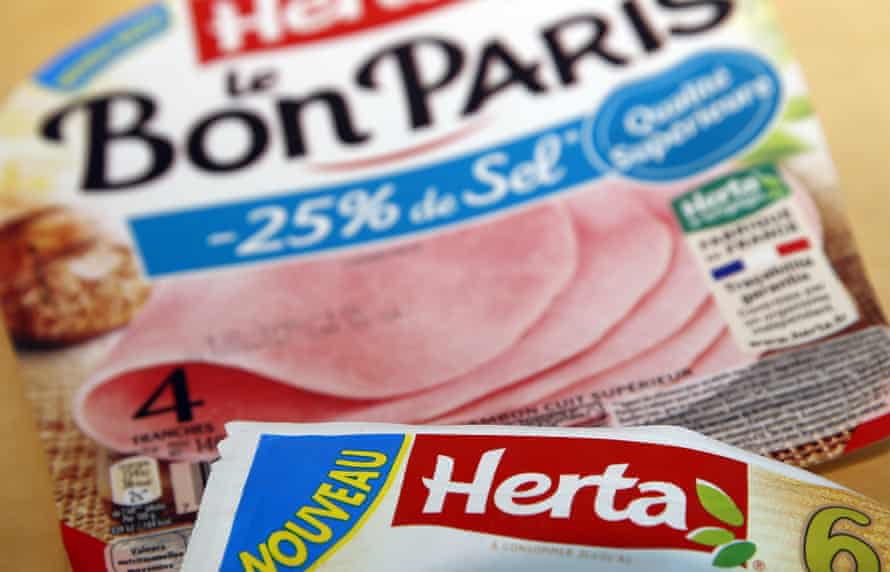
Herta branded products, as seen in supermarkets across Europe. Photograph: Getty
Responding to questions from the Guardian, Herta said in a statement: “This farm was suspended from the Herta supply chain following allegations in December. An investigation was carried out including an onsite audit by French authorities who found there were ‘no major non-conformities’ and that the farm complies with legal and national standards. The farm was therefore restored as a supplier.”
In a statement, Nestlé said it was “strongly committed to improving animal welfare in its supply chain”, and that it condemned any mistreatment of farm animals. It was in close contact with Herta, it added, and continued “to support all efforts to drive up farming standards”.
Waitrose said it has again suspended pork products from the Herta brand while it investigates the new footage. Other major UK supermarkets stock Herta pork products and they are available online.
The Guardian approached one of the owners of the French pig farm, who did not wish to comment.
The L214 footage appears to show that pigs on the farm had their tails docked and lacked enrichment materials to stop them getting bored. Photograph: Courtesy of L214
12/02 – Here is the latest newsletter from Korean Dogs.
Important – Re the call for action 1-10 in the text; we have found that in the past messages get returned by the administrator. We understand now that the e mail lists have been updated, so maybe now they will be ok. We have sent a set off to check out if anything is returned.
Note that a suggested letter which you can copy and include in your mail s supplied FOR EACH REGION – you cannot send just one for all; they have to be copied from the 1-10 regions given; and then sent to those contacts in that region ONLY.
UPDATE – fairly quickly, within minutes; we have had 6 out of the mails sent returned to us. We expect more very soon. We have contacted Korean Dogs in California to tell them of our experiences and we hope maybe they will get back to us.
In the meantime here is a statement they have on their site:
You have so many petitions. Can you automate it so that we can sign them all at once?
We do have a lot of petitions as it is one of the most effective ways to raise awareness, gather support and show the Korean Government just how many people are actively opposed to dog-meat consumption. The online petition platform we have chosen to use is change.org because, not only are they a free resource, but they are one of the largest and most successful. They provide functions that are useful for our campaign, but they do not offer the functionality of allowing you to sign multiple petitions at once. Each petition should be individually read and then signed and although we recognise that, as we have so many petitions, it is very time consuming for our supporters, we are not able to change this. However, your voice is very important because your voice is the only one these animals have.
Well this week (8-13/2) it has been very cold here in England; with snow affecting everywhere and temperatures down to -22 degrees in the North.
Apart from my usual (above link) I have been doing extra food for our feathered friends – as they really need to take in food and extra fat to help them survive the very cold nights.
11/2 – A sunnier day today and nice to see everybody enjoying their food in the garden. Here are the Doves of Peace:
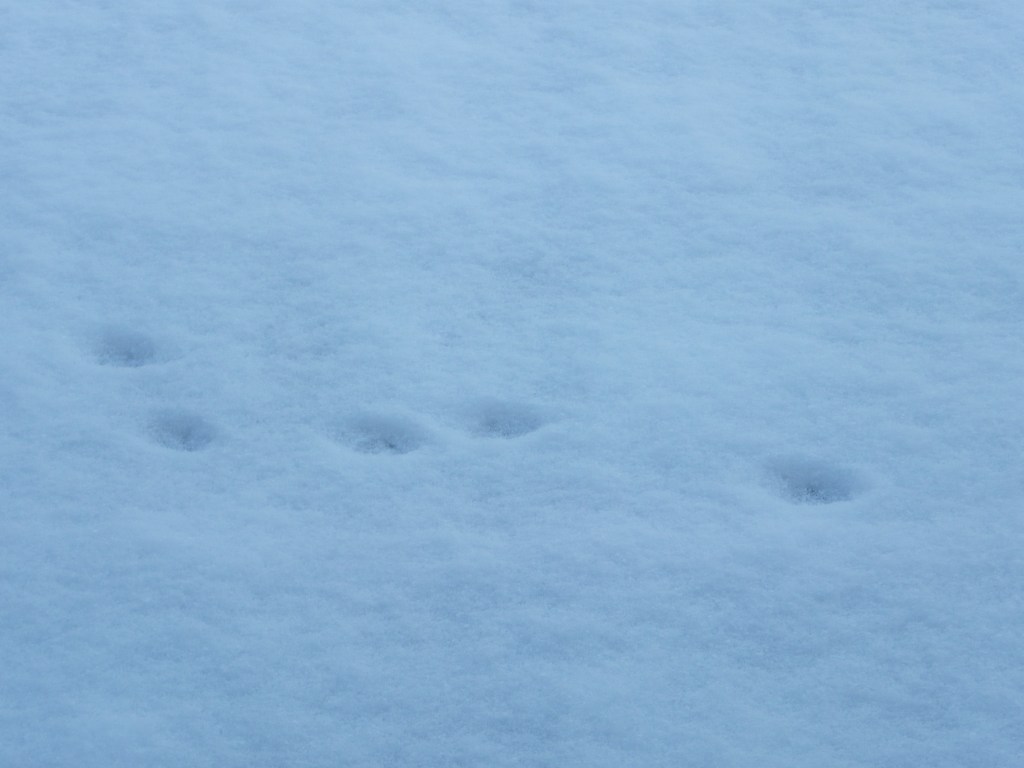
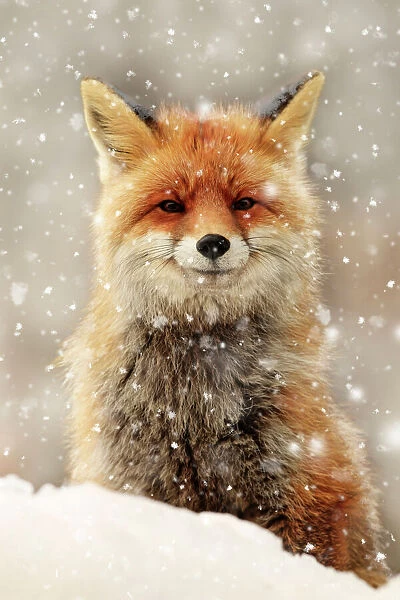
Mr Fox has been around also during the night – maybe it was the leftover cat food and slices of cake that he stopped off for iin the early ours. He left his tracks in the snow as clear evidence that he had been around. Note the pictures are not good as they were taken later in the morning when some of the snow was melting.
Below – Mr Fox leaves his tracks.
Photo – Media storehouse
But keep feeding your birds when you can; they need to put on reserves so that they can get through the night ok. For us; it will be getting significantly warmer at the weekend; which will help the birds survive the night; but we will ensure they still get their daily feeds.
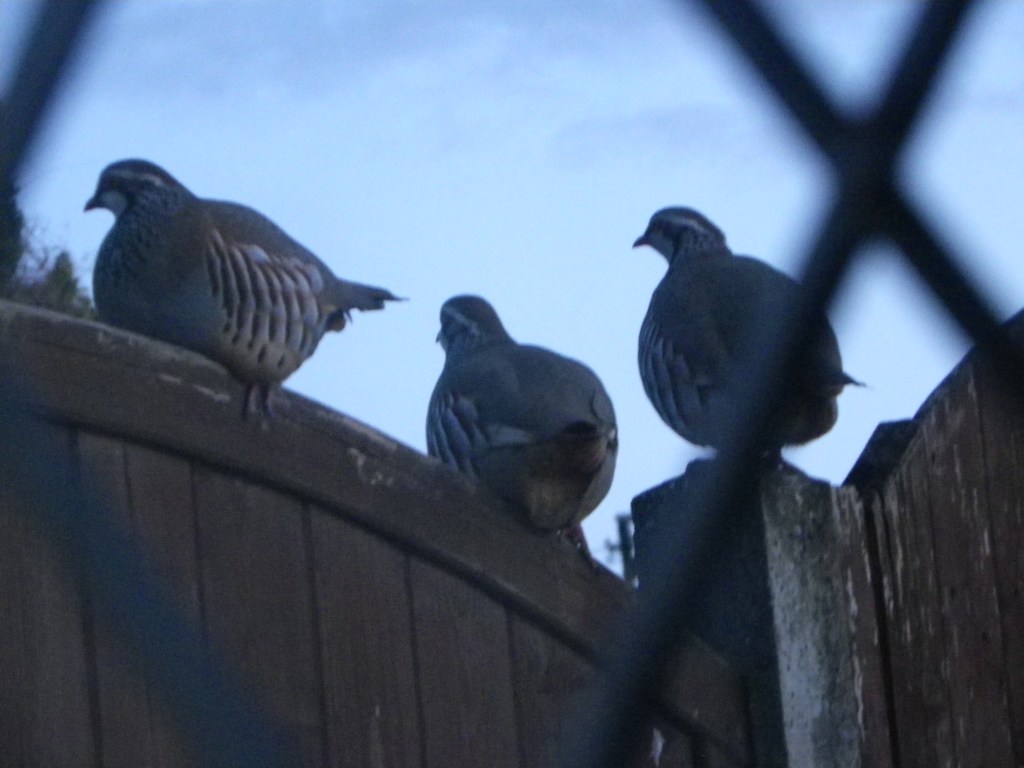
Here are a few shots from this morning of the ‘diners’; and the Red Legged Partridges sitting on the fence after they had fed up last evening. They are looking really good !
Winter is a good time for spotting wildlife in your area.
Regards Mark
Below – the ‘Red Legers’ sit on the gate at nightfall after they have had their feed.
Below – a graphic of the Red Leg Partridge – from ‘Whatbird’ UK
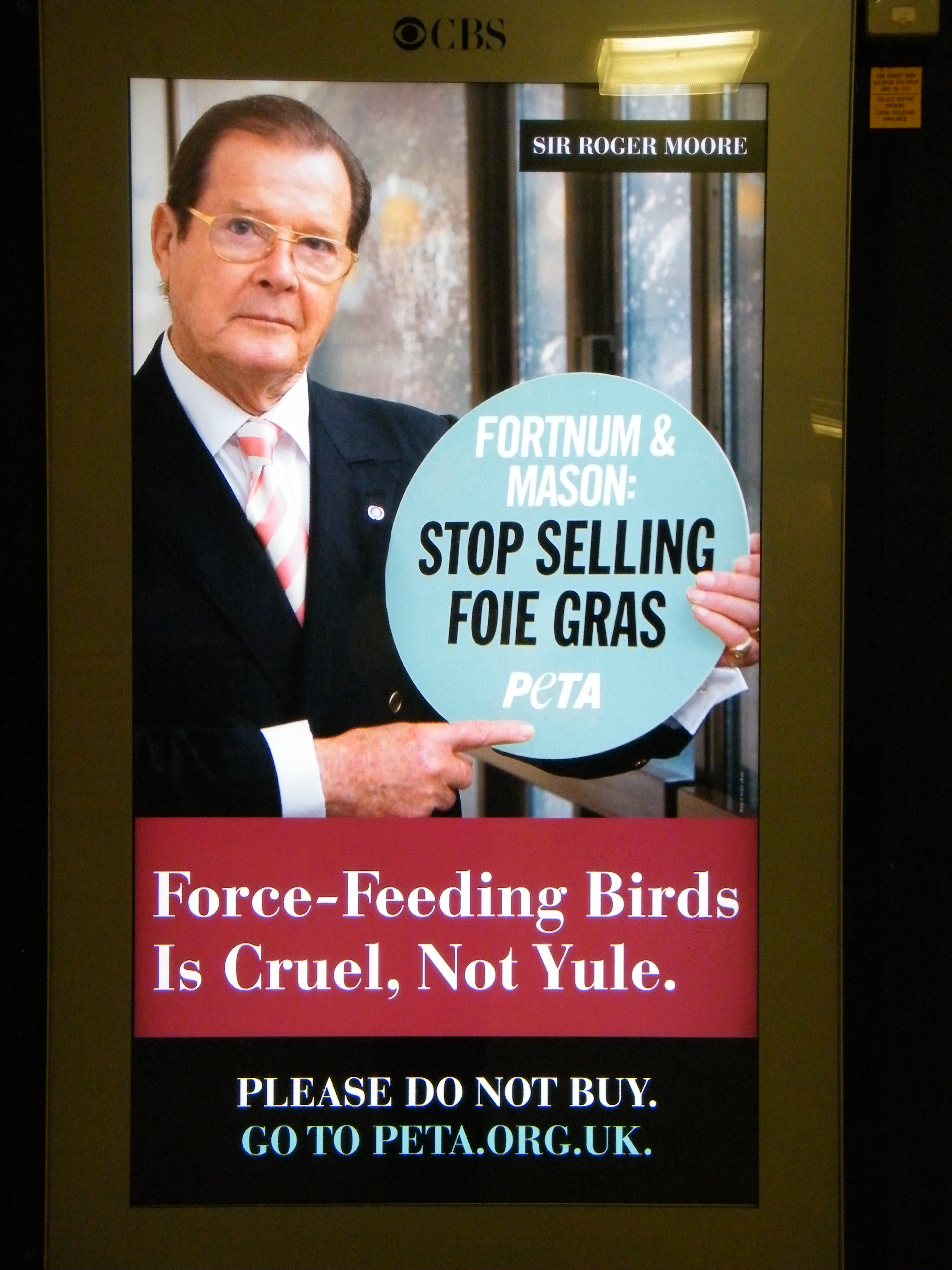
WAV Comment – Lady Moore, widow of Sir Roger Moore, said the James Bond star would have been “delighted” that his campaign finally bore fruit.
She said: “My late husband, Sir Roger Moore, was a staunch advocate for animal rights, and foie gras production was one of the many issues he took a stand against.
This is really brilliant news. We know that despite being ‘James Bond’ and everything that went with it; the real Roger Moore was a staunch animal rights advocate; and for years campaigned hard with regard Foie Gras and the use o animals in British circuses. Very sadly, Sir Roger is no longer with us to celebrate this wonderful news; but we will always remember his respect for, and his involvement in the animal rights movement.
Celebrate today and respect the work on this campaign by Sir Roger.
Exclusive: Fortnum & Mason to stop selling foie gras after campaign by celebrities
This news comes as the government considers a ban on the product now we have left the EU
For over a decade, Fortnum & Mason has stood against the pressure to stop selling “torture in a tin” as it remained one of the last great department stores to sell foie gras.
It has long been a contentious issue between those who see the product as a traditional luxury, and those who balk at the idea of force-feeding a duck or goose for human consumption. But now, the landmark London shop has given into campaigners and is phasing it out.
Celebrities including the late Sir Roger Moore, Twiggy, Joanna Lumley, Bill Oddie and Ricky Gervais have for years been part of a campaign by People for the Ethical Treatment of Animals (Peta) to picket the shop.
Lady Moore, widow of Sir Roger Moore, said the James Bond star would have been “delighted” that his campaign finally bore fruit.
She said: “My late husband, Sir Roger Moore, was a staunch advocate for animal rights, and foie gras production was one of the many issues he took a stand against. For years, he joined Peta in urging Fortnum & Mason to stop selling this product of horrific cruelty. I know he would have been delighted to hear that the retailer has finally made the compassionate decision to remove foie gras from its shelves.”
Defra minister Lord Goldsmith has joined campaigners in the crusade against the goose liver product, and the government is now considering a ban on the product.
A spokesperson said: “The Government has made clear that the production of foie gras from ducks or geese using force feeding raises serious welfare concerns, and the practice is rightly banned in the UK.
“The Government is considering the further steps it could take in relation to foie gras.”
Fortnum & Mason confirmed to this newspaper that they have stopped buying in the product and are now selling off the rest of their stock. Once it runs out, foie gras will no longer be on the department store’s shelves.
A spokesperson said: “This decision was made last year as part of an ongoing focus on the way we do business.”
The last few tins are still being sold on its website, which reads: “Our foie gras is produced by just two farms carefully selected for their excellent welfare standards; smooth and creamy, it is the simplest way to transform a meal into a banquet.”
This has often been a contentious issue for department stores which wish to cater to their more well-heeled clientele without sparking mass protest by animal rights activists. Selfridges stopped selling foie gras in 2009 – but customers were so keen to get their hands on the luxury item that the butcher sold it “under the counter”. In 2012, he was caught and swiftly fired. Harrods still sells the product.
Joanna Lumley has long campaigned against foie gras CREDIT: Heathcliff O’Malley
Fortnum & Mason previously maintained that it would not bow to pressure from activists, arguing that demand for it was “very strong”. He and the store had “many thousands of customers” who wanted to buy “what is essentially a very traditional product”.
Campaigners celebrated the news.
BBC presenter Chris Packham said: “The world is changing, every more rapidly, in its regard to the way we treat animals. They are not there for us, they and we are part of a world that should support them. And we are waking up not the fact that what was acceptable yesterday is no longer tolerable today. Hats off to Fortnums, this is a timely signal that time are changing, and for the poor abused geese in France, they will be changing for the better.”
Lorraine Platt, the co-founder of the Conservative Animal Welfare Network, the influential network of which Prime Minister’s fiancée Carrie Symonds is a member has been part of the protests.
She said: “I campaigned for Peta outside Fortnums just before we launched Conservative Animal Welfare Foundation to protest against the sale of foie gras in the store wearing a mask of Sir Roger Moore- who was leading the campaign for Peta back then. I was fortunate enough to be invited to a very private dinner with Sir Roger Moore and his family and had the opportunity to thank him face to face for all he was doing at the time to press Fortnums to stop selling the grotesque product.”
Peta Vice President Mimi Bekhechi added: “From boardroom meetings to being force-fed outside the doors of the famous store by Steven Berkoff, our campaigning activities ran the gamut.
“Although it took far too long, we’re thrilled that the penny has finally dropped and Fortnum & Mason is joining the extensive list of iconic British institutions that reject this torture in a tin.”
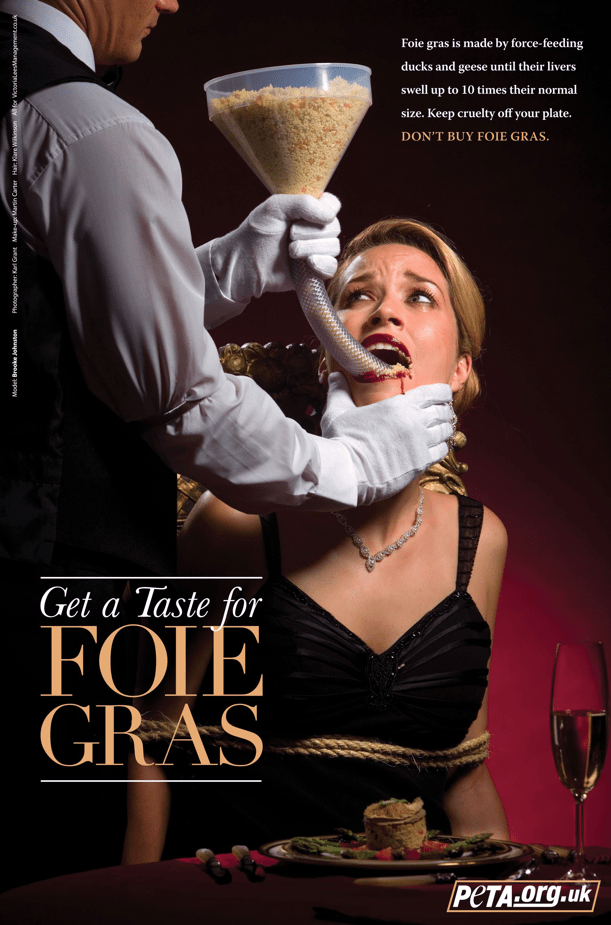
To produce foie gras, ducks and geese are force-fed several times a day until their livers become diseased and swollen. By the end of their lives, many birds have trouble breathing because their enlarged livers compress their lungs, which is why the EU’s Scientific Committee on Animal Health and Animal Welfare recommends “that force-feeding of ducks and geese should stop and this could be best achieved by the prohibition of the production, importation, distribution and sale of foie gras.”
Today (February 9, 2021), the World Health Organization(WHO) wrapped up its investigation in China into the origins of COVID-19.
According to reports, the WHO’s team of experts from 10 countries concluded that it’s “highly unlikely” the virus leaked from a nearby laboratory, and is most likely to have jumped from a non-human animal to a human.
WET MARKETS: The WHO team spent time researching a particular market in Wuhan, but has not yet determined the specific animal or location where the virus first jumped from animals to humans.
However, judging from the significant role that animal farming has played in the mutation of respiratory diseases in the past decade, it would be no surprise if live animal markets, also known as wet markets, played a role (!!) in the evolution of the virus from animals to humans.
Last year, with the help of local Chinese activists, our investigators went to wet markets in China and documented that, despite promises from the government, many of these live animal markets were still operating business as usual.
Footage reveals living and dead animals in close proximity to humans and in extreme confinement and unsanitary conditions—the perfect breeding ground for zoonotic diseases to emerge.
Now, over half a million people have signed our petition asking the United Nations to call for a ban on wet markets that sell live and dead animals.
Not only are wet markets that sell and slaughter animals extremely dangerous, but they’re also horrific places for the animals who are kept in squalor and killed typically without stunning and in full view of each other.
INDUSTRIAL FARMS: Like wet markets, industrial farms pose a great risk to public safety and are a living nightmare for the animals in them.
While COVID-19 may not have started on a farm, many other infectious diseases developed in humans as a result of animal agriculture, such as SARs, H1N1, Swine Flu, and Q Fever, to name a few.
And just recently, a new respiratory disease was discovered in The Netherlands that could’ve originated in goats. If animal cruelty alone isn’t enough, these deadly outbreaks should be a wake-up call for change.
It’s only a matter of time before the next pandemic originates from a factory farm, and there’s no telling how widespread it will become.
WHAT YOU CAN DO: Whether in China or here in the United States, raising and killing animals for food is a dangerous and cruel business.
The good news is that we all have the power to help stop it.
Every time you choose a plant-based food option over an animal-derived one, you’re doing your part to reduce the demand, and thus reducing the number of animals held in extreme confinement on farms.
Now more than ever, going vegan is the best decision for humans, animals, and the future of our planet.
MAKE A CHANGE BEFORE IT’S TOO LATE.
Try vegan and sign our Petition to close live-animal markets
And I mean…So it’s clear the virus did not come from a lab. Did they get any evidence of where it did come from?
Quote from the interview with NPR’s global health correspondent Michaeleen Doucleffin the NPR newspaper:“ So the team says the most likely hypothesis is that the virus started in a bat, jumped into an intermediate host, like a pangolin or mink, and then into humans. And exactly what animal that is and where that happened is still a big mystery. However, they said the pandemic did not start in the Huanan Seafood Market.
The virus was already circulating before then. And so they’re trying to figure out how the virus got to the market. And one possibility, they said, could be frozen foods “ (we have to stop eating pizza)
The interview ends like this: “This investigation has raised more questions than it has answered”.
Therefore we feel enlightened and safe, and we rely on research!
Nowadays, anyone who thinks they are well, comprehensively, and diversely informed is sleeping the sleep of the just.
In the medium and long term, a rude awakening is almost inevitable.
No, Elon Musk, there is nothing ‘cool’ about experimenting on animals
Neuralink Corporation, a company Musk co-founded, has wired up a monkey’s brain with an implant to attempt to make it play video games with its mind – can this ever be acceptable?
Elon Musk, chief executive of Tesla and SpaceX, became the richest person in the world last month, according to Forbes. This week, he bought $1.5bn worth of Bitcoin, causing the price of the cryptocurrency to reach an all-time high. Love him or loathe him, what Musk does matters to millions.
This is why it was so concerning to hear the news that Neuralink Corporation, a company Musk co-founded, has wired up a monkey’s brain with a tiny implant to attempt to make it play video games with its mind.
In a private speech given on the invitation-only social media app Clubhouse, Musk said: “One of the things we’re trying to figure out is whether we can have the monkeys playing mind pong with each other. That would be pretty cool.”
This is not the first time Neuralink Corporation has experimented on animals. The company has previously implanted wireless technologies into the brains of pigs. Musk described this as a “Fitbit in your skull with tiny wires”.
Despite the company’s claims that these experiments could help find cures for spinal cord injuries and neurological conditions, such as Alzheimer’s and dementia, many other scientists are less convinced.
Sadly, Musk’s actions are hardly an isolated incident. They reflect an increase in the number of experiments on animals taking place, despite mounting public concern and a growth in alternative approaches to scientific research. At leading laboratories in the US, experimenting on animals has increased by a staggering 73 per cent in recent years, while more experiments on animals are conducted in the UK than in any other country in Europe. The latest government figures revealed a total of 3.4 million experiments were completed during 2019, with more than half of these performed in universities, often paid for by the taxpayer.
Take the recent outcry in Edinburgh, where the university was accused of using the widely discredited “forced swim” test to research antidepressants. This is where animals are placed in beakers of water from which they cannot escape, literally giving them the choice of sink or swim. While it’s unclear what provoking a drowning experience in small animals can teach us about the difficulties humans face battling depression, these experiments did raise awareness of some of the creative but barbaric ways we still employ, pushing the limits of animals in the UK.
The harmful use of animals in experiments is not only cruel but so often ineffective. In fact, 90 per cent of drugs that successfully pass the preceding animal tests fail in human trials. Animals do not get many of the human diseases that people do, such as major types of heart disease, many types of cancer, HIV, Parkinson’s disease, or schizophrenia. Often the symptoms have to be simulated, to then be tested on. As a result, fewer than five per cent of medicines tested on animals lead to approved treatments within 20 years.
Analysis of 27 “breakthroughs” in the UK also revealed there was a high degree of exaggeration by animal researchers in their findings. Most do not result in anything useful. Sadly, this hasn’t stopped the UK being the second biggest tester of dogs in Europe, including weed killer tests performed on beagles. Beagles are particularly useful to experimenters because they are a very trusting breed towards humans. These tests are unnecessary, cruel and not supported by the British public.
Yet, as we have seen at Neuralink Corporation, animals are increasingly not being used even to test medical or domestic products. Fifty seven per cent of experiments in universities are now believed to be in the area of basic research, much of it driven by the “curiosity” of university researchers. It can be a vicious cycle – many scientists need to perform experiments to be published but the data they are using for comparison is based on animal testing.
It is obvious we all need to ask questions about the direction we are heading in. There are still too many examples of animal experiments being conducted, even when validated non-animal methods are available that are often cheaper, quicker and in many cases, more accurate.
Science has performed admirably during the Covid-19 crisis, but whether it is in British universities or Silicon Valley, we can all clearly do more when it comes to achieving human-relevant science without suffering.
French president Emmanuel Macron has said Europe should grow its own soy and that to depend on Brazilian soy “would be to condone deforestation of the Amazon”. The EU is the second largest importer of Brazil’s agricultural products after China, and Brazil is seeking to expand exports with a trade deal with the EU. More than 1m tonnes of soya used by UK livestock farmers to produce chicken and other food could be linked to deforestation, according to Guardian reports last year.
Outbreaks of bird flu continue to be reported across Europe, with hundreds of cases in poultry in France, Germany and Poland. Sweden was reported to be planning to cull about 1.3 million chickens after bird flu was found on a farm. There have been more than 20 bird flu cases on commercial poultry farms in the UK with all birds, including free-range ones, now required to be housed indoors. In Asia, South Korea is reported to be culling 19 million poultry to control bird flu outbreaks in the country.
Denmark is offering more than £2bn in compensation to mink farmers following its decision to cull millions of animals over fears that a Covid-19 mutation moving from mink to humans could jeopardise future vaccines. Denmark had been the world’s largest exporter of mink fur, but has now suspended farming of the animals until 2022. Sweden has also paused mink fur farming for a year, and there have been calls to ban the practice in Spain. A Covid-19 vaccine for mink could, however, soon be available to breeders. In the US, officials have recommended workers on US mink farms to be given the vaccine as a priority.
New strains of the deadly pig disease, African swine fever (ASF), have been discovered in China. The disease has destroyed a large chunk of the pork industry in the country since 2018, although it is reportedly recovering quickly. One beneficiary of the shortfall has been Spain, which reported a rise in pork exports to China in 2020. ASF has continued to spread in Europe, with 30,000 pigs culled after an outbreak on a farm in Romania.
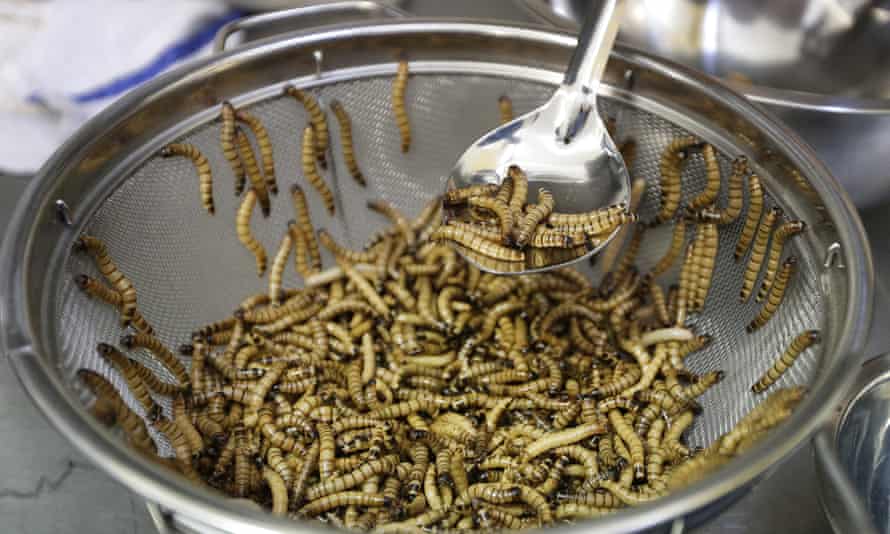
Yellow mealworm, a maggot-like insect, has been approved as safe for human consumption by the EU food safety agency. Photograph: Ben Margot/AP
Yellow mealworm, a maggot-like insect, has been approved as safe for human consumption by the EU food safety agency. Insects are seen as a source of protein with comparatively low associated greenhouse gas emissions. The biggest potential market is expected to be as animal feed for chickens, pigs and other livestock, rather than human food products.
Germany has approved a draft law banning the culling of male chicks from 2022. The government has been exploring the use of dual-purpose breeds of birds which can lay eggs and be reared for meat. It has also invested in technology to detect egg sex prior to hatching and dispose of male eggs earlier. Separately, an Israeli startup has announced that it is planning to go further and change the sex of poultry embryos as they develop, doing away with the need for disposal.
News from the UK
Non-stunned halal and kosher meat must be clearly labelled to give consumers the choice not to buy it, the British Veterinary Association (BVA) has said after a government review of slaughter regulations. More than 90 million cattle, sheep and poultry were slaughtered without being pre-stunned in England in 2018. There is no non-stun slaughter in Scotland, Wales, and Northern Ireland. The BVA said animals not stunned before slaughter are “highly likely to suffer pain, suffering, and distress during the cut and bleeding”.
Egg producers have been left struggling after a collapse in wholesale trade during the pandemic. The difficulties in exporting post-Brexit have also added to a fall in wholesale prices despite positive retail sales. Some producers have warned the situation could lead to chickens being culled. One free-range producer has reported giving tens of thousands of eggs to food banks.
Pig farmers in Northern Ireland are to get more than £2m in government support after a Covid-19 outbreak among workers led to the closure of a food processing factory for two weeks last summer. The meat plant is reported to process about 10,000 animals a week. Some farmers faced additional penalties on overweight pigs. Production was also halted at Scotland’s biggest pork processing plant in Brechin in January after several workers tested positive for the virus.
The UK’s veterinary capacity is at risk post-Brexit, MPs from the environment, food and rural affairs select committee have warned. About 95% of official veterinarians, who undertake vital certification and supervision work in abattoirs, are EEA-qualified nationals. The sector faces an increased workload due to additional export checks, Covid and disease outbreaks such as bird flu.
New Zealand is backing the UK as it seeks to join the Comprehensive and Progressive Agreement for Trans-Pacific Partnership, whose members also include Japan, Australia, Canada, Vietnam, Singapore and Mexico. The New Zealand meat industry has called for greater access to the UK market for its beef and lamb.
Finally, Kim, a 12-month-old Welsh-born sheepdog, has been sold for a world record £27,100. Although a Welsh speaker, the seller Dewi Jenkins said he trains his dogs in English to allow him to sell them across the world, including in the US, Norway, Belgium, France and Ireland.
Animals Farmed
A decade after an outbreak of Q fever killed 95 people in the Netherlands, there are worries about human cases of pneumonia linked to goat farms. The Q fever outbreak followed a period of rapid growth in goat dairying in the Netherlands and its aftermath heightened tensions around zoonotic disease threats, especially in the south of the country where the highest numbers of goat farms and infection rates were found.
The EU has been revealed to be world’s biggest live animal exporter with more than 1.6 billion chickens, pigs, sheep, goats and cattle transported across a border in 2019.
In the UK, live farm animal exports to mainland Europe have come to a standstill post-Brexit. The UK government consultation on banning the export of animals for slaughter and fattening is due to end later this month.
Brazilian companies and slaughterhouses including the world’s largest meat producer, JBS, sourced cattle from supplier farms that made use of workers kept in slavery-like conditions, according to a new report. JBS said it had “a zero-tolerance approach to forced labour and also urge anyone who suspects or has evidence of individual or farm-level malpractice to report it”.
Outbreaks of African swine fever and Covid among workers in meat plants in Germany have raised questions over the consequences of the country’s fixation on “cheap meat”. In China, experts have questioned the effectiveness of new animal health rules in preventing another zoonotic disease outbreak. And news of plans to develop animal-only antibiotics has been criticised as a “techno-fix” for intensive farming practices.
A Welsh council has admitted it should not have granted planning permission for a 110,000-chicken farm in the “poultry capital of Wales” after campaigners crowdfunded a judicial review. Former free-roaming nomads in Tibet are facing a struggle for their identity, stuck between China’s push for more industrialised farms and Buddhist monks urging them to embrace vegetarianism. Finally, we’ve reported on the mounting death toll of people and animals in Nigeria as herders seeking dwindling reserves of pasture clash with farmers.
From the Blog of “Animal Liberation Press Office”:
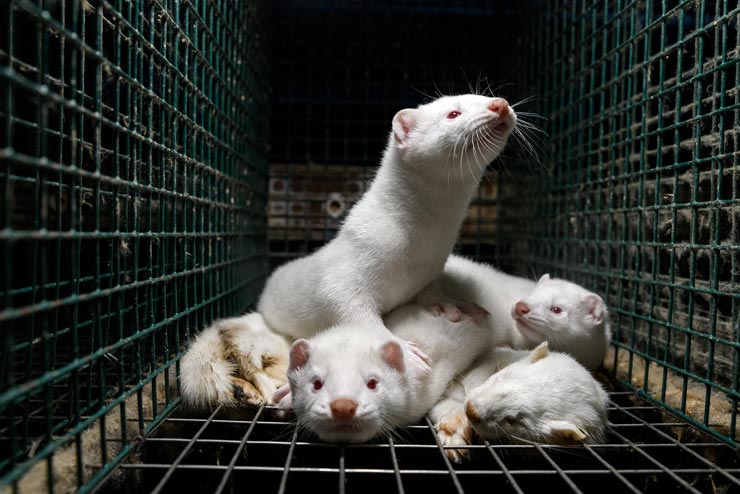
“According to media reports, 600 mink were freed from cages at a fur farm in Tingsryd during the night of January 22.
The same farm was raided by activists in September 2019.
We, Animal Liberation Press Office, have not received a statement in relation to the action, but you can read the report that was released after the action in 2019;
Sweden
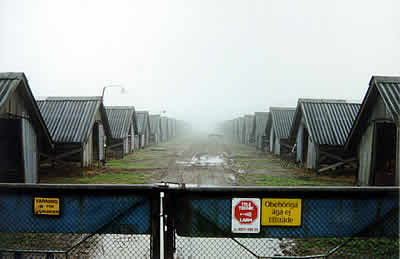
In the early hours of September 3, 2019, all of the prisoners on a small mink farm in Hölkemåla, Blekinge, Sweden, escaped from the cages.
In total, about 1500 persons managed to get free.
We gave a helping hand by disassembling the fence of the farm and then opening all the cage doors. We removed parts of the fence using a wrench to ensure a way out.
Sweden-Mink farm
The fur farm was situated right next to a lake where we hope that as many as possible now get to live.
In a world where freedom exists only in moments of rebellion and insurrection, we still think that the possibility of life in the forest and lake is quite the opposite of that in a cage.
We do recognize that the already destroyed eco-systems and colonized nature is nothing like a dream, but since it is all that we have it is where we will go from our imprisoned existences.
Norway
A passion for freedom is what drove us to this hidden killing facility to increase freedom for all of us.
Our desire to share this moment of freedom with the minks is rooted in solidarity and love as well as anger and hatred towards those who dominate us and try to steal our lives.
We strongly believe that there is no limit to the things we can do, all we need is to make up our minds and pick a target”.
And I mean…The Swedish government decided on January 27, 2021, to ban fur farming in Sweden until the end of 2021.
On October 3, 2010, around 18,000 mink were released from a fur farm in Skillingaryd, Sweden. According to media reports, only 4,000 mink were recaptured and around 50 were run over by cars.
Sweden-2010
This means that around 14,000 mink have been given the chance to live in freedom.
Just one day later, on October 4th, another 4,000 mink were released at a facility near Vaggeryd, Sweden.
The action was one of the largest liberation actions in the history of the animal liberation movement.
In the same year, the largest animal liberation action in the history of the animal rights movement took place in Greece, where around 50,000 mink were freed from a farm
Since the Swedish animal rights organization Djurrattsalliansenpublished extensive research on fur farms in August 2010, the Swedish fur industry has been under enormous pressure, not least because of media interest.
Today, and thanks to Corona, the list of countries that have banned this cruel business is growing every day!
In Austria, Great Britain, Croatia, Slovenia, Bosnia and Herzegovina, Serbia, and Macedonia, fur farms are prohibited by law.
A fur farming ban came into force in the Czech Republic in 2019
In the Netherlands, the second-largest mink producer in Europe that keeps chinchillas and foxes is already banned. The last mink farms should close in 2024 as the farms will close this year due to the coronavirus.
Then came Norway, Denmark …Only Finland persistently does the cruel business in the north.
In Germany, no more animals were kept on the last German fur farm in Rahden (North Rhine-Westphalia) in March 2019
Corona has dealt the last blow to this cruel business for a year.
Before that, however, it was also the economic losses caused by the direct exemption measures in fur farms that also contributed to the death of the fur industry.
Supported by our demos, petitions, and the educational work of the animal rights organizations
We sincerely thank the activists and wish those who have been liberated a long life in nature.
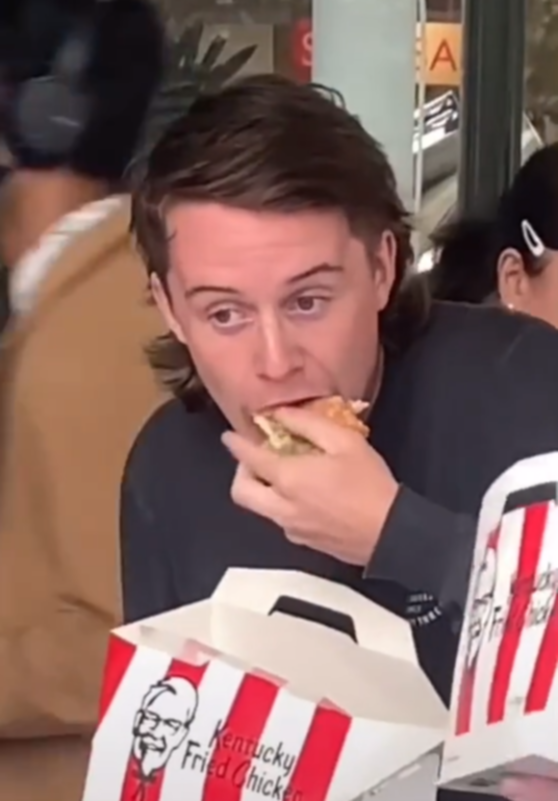
A pair of Melbourne pranksters have been slammed on social media after filming themselves eating KFC in front of vegan protesters.
Nick and Bill, who boast a following of more than 85,000 on TikTok, uploaded the video over the weekend.
As seen in the video above, the duo is seen eating fried chicken pieces and burgers in front of a group of protesters near the Royal Arcade in the CBD.
“Do you want a bite?” one of the boys is heard asking a protester at one point.
Two protesters are seen speaking to the boys in the video, as they scoff down burgers.
“I actually really appreciate these guys being here,” one protester is heard saying, “it’s creating a spectacle”.
The video has since been viewed more than three million times on TikTok, with users slamming the duo as “disrespectful”.
“This isn’t funny or cool, I’m not even vegan but it’s about respecting others,” one person commented.
One of the two clowns
“They’re not disrupting anyone and they were being polite why did (you) go out of your way to buy food and eat it in their face and film it, that’s weird,” another person wrote.
Despite the backlash, some hailed the pair “heroes”, while others said their “respect” for them increased after viewing the video.
But it’s not the first time the duo tried out the stunt.
In a video posted to TikTok in November, the pair were again seen eating KFC in front of protesters at what appeared to be the same location.
And I mean…To call someone a hero just because they do the same thing as the other 7.8 billion carnivorous human animals on the planet is ridiculous.
And the carnivorous provocateurs show very little experience in the field.
Because they think that with two or three pieces of dead meat in the bag they can annoy or provoke the experienced demonstrators.
They take themselves very seriously, these flat-foot- carnivores.











 Sweden
 Sweden-Mink farm
 Norway
 Sweden-2010
 One of the two clowns
