Category: General News

Justice for Regan Russell – the lie industry of the animal transport mafia

Truckers say they’re getting death threats after animal rights protester’s death (!!!)

regan_russell jmit plakat pg

by “Ashley”
CDL Life News

After a prominent animal rights activist was fatally struck by a truck last month, the trucking company he works for says that they’ve received death threats.
The incident occurred on June 19 in Burlington, Ontario, when 65-year-old Regan Russell was fatally struck by a truck hauling pigs while protesting with the group “Toronto Pig Save” outside of a meat processing plant.

Regan_Russell_We_would_be_here_for_you_too

On July 20, the Halton Regional Police Service (HRPS) announced that the 28-year-old truck driver had been charged with Careless Driving Causing Death.
The trucking company that the unnamed truck driver worked for, Brussels Transport, now says that they have been targeted with threats from animal rights groups.

Tyler Jutzi, whose family owns Brussels Transport, told CTV News, “They threatened to blow up trucks. They threatened to sabotage trucks. They threatened to burn the slaughterhouse down.”
Jutzi also said that activist groups “put a bounty out on the driver, offering rewards for information about his name and whereabouts. This is terrifying, that someone might try to come to his home, to harm him or his family, over an accident.” (!!!)

In a GoFundMe set up to help defend the truck driver as he faces both charges and threats from the activists, Brussels Transport writes:

“The driver’s name is being kept anonymous in order to protect him and his family. He has already been the focus of threats by animal activist groups on social media should they determine his identity.

Brussels Transport is raising the money on his behalf to continue to protect that anonymity. He needs our help to cover the big costs of fighting this. All money raised will go towards covering his legal fees in fighting this unacceptable charge, as well as tending to his mental health needs.
This charge is not acceptable to the driver, other drivers in the industry, or the agricultural community as a whole.

The driver was just doing his job to help feed people around the world, delivering pigs to slaughter.

Continue reading “Justice for Regan Russell – the lie industry of the animal transport mafia”

USA: NRDC; Fighting Hard Against Trump for the People, the Environment and Animal Welfare.

Dear Mark,

A few weeks back, we promised we’d file suit to stop the Trump administration’s new policy that guts the landmark National Environmental Policy Act (NEPA). Well, we’ve done it.

Last week, a coalition of environmental justice and environmental groups — represented by NRDC attorneys and joined by other civil rights and environmental organizations — sued the Trump administration over its attempt to roll back NEPA.

NEPA is a critical part of our democracy that requires thorough environmental reviews and public input before major federal projects — including dangerous fossil fuel infrastructure — can be approved. It protects the people’s right to speak out against the destructive influence of polluters and hazardous projects that poison communities today and lock us into the climate crisis for decades to come.

The Trump administration’s rollback would eliminate environmental reviews for too many projects, erode government transparency, and thwart public participation.

The courts are our best bet at stopping the Trump administration from gutting this landmark environmental protection. So NRDC rushed to court to defend NEPA alongside environmental justice organizations from around the country, including:

Our litigation partners also include Sierra Club, National Audubon Society, and the New York Civil Liberties Union.

Be sure to visit the websites of our partners to find out more about their critical work.

Dear Mark,

A few weeks back, we promised we’d file suit to stop the Trump administration’s new policy that guts the landmark National Environmental Policy Act (NEPA). Well, we’ve done it.

Last week, a coalition of environmental justice and environmental groups — represented by NRDC attorneys and joined by other civil rights and environmental organizations — sued the Trump administration over its attempt to roll back NEPA.

NEPA is a critical part of our democracy that requires thorough environmental reviews and public input before major federal projects — including dangerous fossil fuel infrastructure — can be approved. It protects the people’s right to speak out against the destructive influence of polluters and hazardous projects that poison communities today and lock us into the climate crisis for decades to come.

The Trump administration’s rollback would eliminate environmental reviews for too many projects, erode government transparency, and thwart public participation.

The courts are our best bet at stopping the Trump administration from gutting this landmark environmental protection. So NRDC rushed to court to defend NEPA alongside environmental justice organizations from around the country, including:

Our litigation partners also include Sierra Club, National Audubon Society, and the New York Civil Liberties Union.

Be sure to visit the websites of our partners to find out more about their critical work.

And read all about the Trump administration’s disastrous NEPA rollback and what NRDC and our allies are doing to stop it at NRDC.org.

Trump’s rollback is a clear example of environmental racism.

Weakening of NEPA will most directly impact low-income communities and BIPOC communities, who have long faced disproportionate levels of pollution due to industrial facilities placed in or near their neighborhoods.

These are the same communities who have been hit the hardest by the COVID-19 crisis, which is especially critical as preliminary research shows that long-term exposure to air pollution is associated with higher death rates from the coronavirus.

Predictably, Trump has decided to double-down on exposing them to dangerous pollution and continued health risks. NRDC, our partners in the lawsuit, and our allies across the movement, will do everything in our power to stop attacks on NEPA.

Find out more about Trump’s disastrous attack on NEPA at NRDC.org and from the original email we sent you below.

Earlier this year, NRDC and our sister organization, the NRDC Action Fund, submitted over 100,000 public comments — alongside nearly half a million more from green and environmental justice groups — opposing Trump’s NEPA rollback.

Now, we’ll continue the fight to save NEPA in the courts, alongside our important litigation partners from across the country.

This is NRDC’s 121st lawsuit against the Trump administration — and we’ve won nearly 90% of the cases that have been resolved — an astounding record of success fighting back against illegal actions by this president that harm our environment and public health. And we’re confident that with this lawsuit, we will prevail again.

While America faces the crises of the COVID-19 pandemic and its history of racism and inequity, President Trump is pushing ahead with an anti-environmental assault that would exacerbate both challenges in one fell-swoop.

The Trump administration just finalized its disastrous rollback of the National Environmental Policy Act (NEPA) — a landmark law that empowers people to make their voices heard about hazardous projects in their communities and stop pollution in their own backyards.

This attack on NEPA is an attack on democracy, our environment, our climate, and YOUR voice, Mark.

And NRDC will respond immediately, taking the Trump administration to court if that’s what it takes to stop this reckless assault on one of the pillars of environmental law. And we couldn’t respond so effectively without the support of NRDC supporters like you — thank you.

Get all the facts about Trump’s harmful attacks on NEPA, and how NRDC and our allies and partners are fighting back, and more at NRDC.org.

If Trump’s NEPA rollback is allowed to stand, disastrous polluting projects — like coal mines, highways, incinerators, oil and gas drilling operations, and pipelines — could be expedited with little-to-no environmental review, public input, or analysis of long-term impacts on the environment, our climate, or the people who live near these projects.

Make no mistake: this rollback is a clear attempt to silence people and make it easier for industry to pollute our communities.

And it will further marginalize low-income communities, Black communities, Indigenous communities, and communities of color who already suffer disproportionately from the adverse health impacts of industrial pollution — and who have been hit the hardest by the COVID-19 crisis. This is especially critical as preliminary health studies suggest that long-term exposure to air pollution is associated with higher death rates from the coronavirus.

NEPA gives people the right to weigh in before a highway project tears up their neighborhood or a pipeline goes through their backyard. Steamrolling their concerns will mean more polluted air, more contaminated water, more health threats, and more environmental destruction — and it will encourage the government to ignore how massive polluting projects contribute to climate change.

We must — and will — do everything in our power to stop the Trump administration’s rollback and save NEPA, including fighting back in federal court if necessary.

This dangerous new rollback comes weeks after another sweeping executive order that prods administration officials to ram through polluting projects without public notice, let alone adequate environmental reviews.

And it comes amid an onslaught of other Trump administration rollbacks over the past few months — including a move that could allow industrial polluters to evade penalties if they unlawfully fail to monitor and report on their pollution during the coronavirus crisis.

NRDC is fighting many of these rollbacks in court — just as we’ll fight to save NEPA as well, if that’s what it takes. NRDC has filed 118 lawsuits against the Trump administration. With the law on our side, we’ve won nearly 90 percent of the cases resolved so far.

Thank you for standing with us at this critical moment.

Sincerely,

Sharon Buccino
Senior Director, Land Division, NRDC

https://www.nrdc.org/

Italy: New Investigation Revealing Horrific Swordfish Harpoon Fishing Practices.

New investigation revealing horrific harpoon fishing practices

6 August 2020

Essere Animali

Every summer in the Strait of Messina, the feluccas (typical swordfish fishing boats) set sail to catch the fish whose meat is sold to fishmongers and restaurants. Although it is considered a more sustainable method than industrial fishing, as there is no unwanted bycatch of other species, harpoon fishing causes serious suffering. This year Essere Animali was on board documenting the horrific practices.

After being pierced with the harpoon, swordfish struggle in vain to free themselves. Once hoisted onto the boat, their flesh is cut in several places with a knife while they are still alive to facilitate the extraction of the spearhead. This procedure causes extreme and prolonged pain to the swordfish.  

After being caught, the swordfish are frequently doused with water. The purpose of this procedure is to keep them alive as long as possible to ensure the freshness of their meat; it does not bring any relief to the animals.

Death comes as a result of asphyxiation after several long minutes of agony, during which the fish remains conscious and gasps for breath, its body riddled with wounds.  

The post ‘New investigation revealing horrific harpoon fishing practices’ is modified from an article published by Essere Animali in their original language.

England: Running for Their Lives – Hare Hunting Exposed – League Against Cruel Sports (London).

Produced with massive help from the ‘League Against Cruel Sports’ (LACS) – London.

https://www.league.org.uk/?gclid=EAIaIQobChMIsKblx5mV6wIVA-ztCh0UTAoMEAAYASAAEgJm_PD_BwE

Much of the information is reproduced from their site at  https://www.league.org.uk/hunting-act

The Hunting Act 2004 is the law which bans chasing wild mammals with dogs in England and Wales – this basically means that fox hunting, deer hunting, hare hunting, hare coursing and mink hunting are all illegal, as they all are cruel sports based on dogs chasing wild mammals.

The introduction of the Hunting Act followed an extensive and often exhausting campaign spanning 80 years, with the League Against Cruel Sports and its supporters (including us) at the forefront since 1924. In Scotland, hunting with dogs was banned earlier by a different law, the Protection of Wild Mammals (Scotland) Act 2002.

Securing the Hunting Act was a key moment in the history of animal protection legislation in the UK and public polling consistently shows it is a popular law. Yet, since its introduction, the Hunting Act has been the target of considerable attack from the pro-hunt lobby which has waged an on-going campaign to try and undermine the Act with the aim of getting it scrapped or weakened, and defied the Act by developing and promoting methods to circumvent it in the form of false alibies or illicit exploitations of its exemptions.

This sabotage of the law continues today, despite the legislation of 2004.

Prosecutions and Exemptions

Official figures demonstrate that the Hunting Act has protected animals, with people being convicted for crimes covered by the law. However, far too many allegations of illegal hunting have not been properly investigated and far too many illegal hunters have got away with it unpunished, which means that the Act has a serious enforcement problem. Because of the weak enforcement by the authorities the successful prosecution of registered hunts was spearheaded by the League when we took private prosecutions against illegal hunters.

While many people have been convicted under the Hunting Act, most of these are in fact poachers rather than hunters. Unfortunately we believe that illegal hunting with dogs by organised hunts is very common across the country, while there are very few prosecutions. The problem is that considering the defiance of the hunting fraternity and how they have created sophisticated alibies and illicitly exploited the exemptions of the Act, it is often hard to catch hunts in the act of chasing and killing a fox, and even if they are caught, it is hard to prove in court.

The Act contains ‘exemptions’ built into its Schedule, which were designed to prevent the ban affecting activities which Parliament did not intend to prohibit. Unfortunately, hunts often use these exemptions as an excuse if they are caught hunting. For example, staghunts use the ‘Research and Observation’ exemption that was designed for researchers and not hunters, and some fox hunts carry birds of prey in order to claim that they use the ‘falconry’ exemption, which was designed for falconers.

However, the most common way illegal fox hunters use to avoid prosecution is with ‘trail hunting’. Most registered fox and hare hunts now claim to be trail hunting – an activity that was not in existence or envisaged when the Hunting Act was drafted, and which should not be confused with ‘drag’ hunting.

Trail hunting is an entirely new invention which purports to mimic traditional hunting by following a scent trail (using fox urine, according to the hunters) which has been laid in areas where foxes are likely to be. Those laying the trail are not meant to tell those controlling the hounds where the scent has been laid, so if the hounds end up following a live animal scent the hunt can claim that they did not know.

This image has an empty alt attribute; its file name is lacs-hare-2.jpg

Having looked over 4,000 hunt monitoring reports of over 30 hunt monitors from different organisations covering the majority of hunts in England and Wales (157), since the Hunting Act 2004 was enacted these hunt monitors have reported witnessing someone laying a possible trail only in an average of around 3% of the occasions they monitored hunts, but they believed that only an average of around 0.04% of the occasions they may have witnessed a genuine trail hunting event, rather than a fake one.

Trail hunting is not the same as drag hunting, a legitimate sport created in the 1800s which is not intended to mimic animal hunting, but instead is a sport using hounds to search for a non-animal scent without the pursuit or killing of wild animals.

In drag hunting, or in bloodhounds hunting (or hunting the ‘clean boot’ as it is also known) where the scent of a human runner is followed instead of a drag, the trail never contains animal scent, is never laid in areas likely to have foxes, and those controlling the hounds always know where the trail was laid.

This is why in drag hunting, ‘accidents’ when live animals are chased are very rare, while in trail hunting they are very common.

The League believes there is no such a thing as the ‘sport of trail hunting’ and it is simply a temporary, false alibi to cover for illegal hunting while the hunting fraternity hopes for the hunting ban to be repealed or weakened.

For more information visit our trail hunting page and read or download our detailed report on trail hunting, drag hunting and the ‘clean boot’.

Hare hunting and hare coursing

Hare hunting is the lesser known cousin of fox hunting and deer hunting, but in the days before hunting was banned in England and Wales, one in three hunts were actually hare hunts. Despite the ban, when hunting with dogs was made illegal, most of these hunts still exist, and are chasing and killing hares in the name of ‘sport’.

Hare coursing is a different ‘sport’, involving two fast dogs being set loose to chase a hare. Traditionally, this could take place on a small scale but also as a large-scale, organised event, such as the famous Waterloo Cup event which attracted thousands of spectators who came to watch and place bets. Hare coursing was banned, along with hare hunting, by the Hunting Act 2004, and is illegal, but coursing still takes place

According to the Hare Preservation Trust, the number of brown hares in the UK has declined by 80% since the late 1880s – that’s a devastating drop. While modern farming practices are thought to be the main cause of this decline, hare hunting and hare coursing also had an impact. A return to these cruel sports could see brown hares wiped out in many parts of Britain. The brown hare is listed as a conservation priority in the UK’s Biodiversity Action Plan, meaning we should be doing all we can to protect this vulnerable species.

There is nothing ‘natural’ about a hare being chased with a pack of dogs. Hares have evolved to sprint at high speeds for short periods to escape predators. They cannot match the stamina of hunting hounds who will continue the chase until the hare is exhausted and can run no more. When talking about hares and hunting with dogs, the Government’s Burns Report published in 2000 concluded that ‘this experience seriously compromises the welfare of the hare.’

Ref – https://www.league.org.uk/hare-hunting-and-hare-coursing

Watch the reality of the Hare hunt:  https://youtu.be/Xrhkt0EOGx4

Regards Mark

In many ways it is still a bloodbath !

Australia: Italian Fashion Giant Prada Bans the Use of Kangaroo Skin. But States of Victoria and New South Wales Still Allow Kangaroo Killing. Take Action Here. Has Australia Not Killed Enough Wildlife Rcentl;y ?

Image shows a dead kangaroo

Great news,

Italian fashion giant Prada has banned kangaroo skin.

The Prada Group – which includes Prada, Miu Miu, Church’s, and Car Shoe – has confirmed that it will no longer purchase any new kangaroo leather. The decision will spare these remarkable Australian animals immense suffering.

Prada joins the likes of Versace, Victoria Beckham, Chanel, and Paul Smith in banning leather made from kangaroos.

Some 2.3 million kangaroos are reportedly killed every year for their skin. To produce leather, the animals are first shot. Then, the injured kangaroos – as well as orphaned joeys – are decapitated or hit sharply on the head to “destroy the brain” before their skin is torn off so it can be exported and made into accessories often labelled as “k-leather”.

As you read this, state governments are approving permits to hunt kangaroos.

Please join our campaign urging the New South Wales and Victorian governments to stop issuing permits for the mass slaughter of kangaroos

While wildlife carers are still working day and night rehabilitating burned, otherwise injured, and starving animals, the Victoria and New South Wales governments are allowing permits to be issued for the mass slaughter of kangaroos – often simply because they compete for food with introduced farmed animals raised for meat, leather, and wool.

It’s outrageously easy to get a permit to kill kangaroos in these states – in fact, in New South Wales, it’s called a “Licence to Harm” and applicants can even renew over the phone. 

Meanwhile, Queensland’s commercial slaughter has been halted and the South Australian government has stopped plans to slaughter wallabies on Kangaroo Island after one-third of the island caught fire. 

More than 1 billion animals perished in Australia’s recent fires. The death toll is high enough. 
Join us in urging the New South Wales and Victoria governments to stop issuing permits to kill wildlife.

Take Action Here:

https://secure.peta.org.au/page/56507/action/1?utm_source=PETA%20AU::E-Mail&utm_medium=Alert&utm_campaign=0820::skn::PETA%20AU::E-Mail::Prada::::aa%20em&ea.url.id=4858960&forwarded=true

Regards Mark.

Japan: a unique animal goes into captivity


SHIZUOKA, Japan – A rare turtle with tiny horns on both its eyelids, which was discovered in Shizuoka Prefecture last year, has gone on display at a local zoo, with curators saying it is “probably the only one in the world.”

“Ë‹N‚ª‚ ‚éƒNƒTƒKƒ
A rare horned Chinese pond turtle is seen in this photo taken at Zoo in Kawazu, Shizuoka Prefecture, on Saturday. | KYODO

The female Chinese pond turtle is believed to be around 10 years old judging from its body size, having a 16-centimeter shell, and weighing 670 grams, said curators at Zoo, a facility showcasing reptiles and amphibians in the town of Kawazu.

The zoo used X-ray to check its horns, roughly 1 cm in length, and believe they have been formed from dead skin cells.

It was captured by a man while he was fishing in Fuji in the prefecture in the summer of 2019.

When he sent an image of the horned turtle to the zoo, “I couldn’t believe my eyes. I thought it might be a composite picture,” said Tsuyoshi Shirawa, chief curator of the zoo.

The man kept the turtle at his home for a while but donated it to iZoo in July this year, believing it should be seen by many people (!!)

The zoo has mated the horned turtle with a male Chinese pond turtle to see if any horned baby turtles will be produced.

Babies are expected to hatch next spring, according to the zoo.

https://www.japantimes.co.jp/news/2020/08/09/national/horned-turtle-zoo-shizuoka/#.XzFfnDVCRPZ


And I mean…Head-tied Siamese children are more likely to be born than horned turtles.
There are certainly many perverts who want to watch these beings in their everyday life, how they eat, sleep, or go to the toilet.
But nobody would ever think of showing them as exhibits in a hospital or museum.
Morality forbids it, and it is right!

However, this only applies to human animals.
Because they have rights and human animals are protected even as newborns.

We have denied animals all of their rights to this day. Animals did not even have a hint of rights, and that because we humans, from birth, act under the fascist conviction of the better race.

The turtle belongs to the open sea and not as a show object in the Japanese zoo prison.

“Ë‹N‚̐¶‚¦‚½ƒNƒTƒKƒ

And the Japanese won’t get any knowledge or intelligence about turtles if they come to the zoo to gawk at the new captive, a horned turtle.

They will only achieve one thing: that this animal will spend the rest of its life in captivity and suffering.

My best regards to all, Venus

Mass Culling System Shutdowns. The Failures of Factory Farming. Video Graphic Content.

Thanks to Stacey at ‘Our Compass;  https://our-compass.org/author/ourcompasses/ for sending this latest over.  Mark.

https://our-compass.org/author/ourcompasses/

System shutdowns and the failures of factory farming by Stacey

Warning: Graphic Content

A particularly disturbing scene illustrates one method of “euthanasia”, a euphemistic term describing a person sliding a chick’s head off with no hesitation, no remorse.

Animals are “produced” en masse under a human-manufactured moniker of “welfare”. To subject animals to such dismissively indifferent procedures as normalized violence substantiates the fact that “welfare” is only meaningful to humans, and not to the animals who are controlled, violated, and violently killed, in direct contradiction to anything remotely resembling or defining “welfare”.

Please note that exploitation is endemic on all farming sizes, be they small or locally owned 20-animal operations, or CAFOs confining 125,000 animals. And all animals exploited for food in the United States are specifically exempt from the Animal Welfare Act. 

Meat processing plants, or slaughterhouses, have been making headlines these past months as epicenters of the coronavirus pandemic. Outbreaks of positive cases amongst workers have caused the industry’s rapid processing lines to slow or stop for days on end, resulting in a pileup of tens of millions of animals who have reached slaughter weight with nowhere to go.

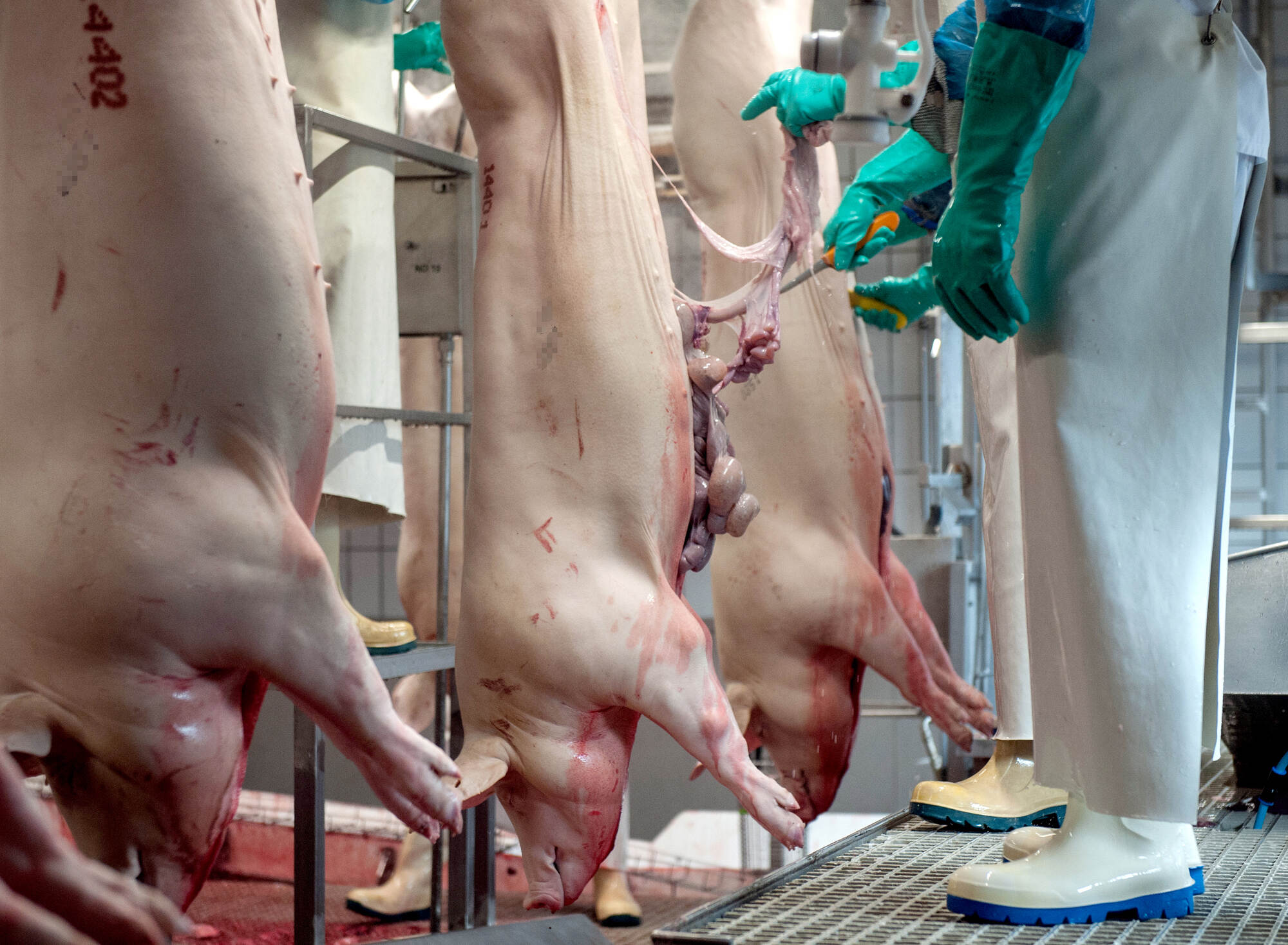
Much of this burden falls on the farms, which are designed neither to kill nor dispose of animals en masse, and the methods many resort to are truly disturbing. One farmer reported shooting all 3,000 of his pigs over the course of a day. Tanks of carbon dioxide are pumped into barns to gas and suffocate chickens by the thousands. Recently, undercover footage from a pig farm in Iowa documented a deliberate ventilation shutdown followed by the release of hot steam into a barn full of live animals. With temperatures in excess of 140 degrees, the animals inside were slowly roasted.

As a practice, the culling and subsequent disposal of animals en masse pre-dates the current Covid-19 outbreak. It’s the unfortunate answer from a system whose scale defies logic to the challenges presented by unanticipated supply chain disruptions. As factory farms continue to grow in size, and supply chains become increasingly monopolized, times of crisis reveal troubling vulnerabilities in the American food system. The close confinement of factory farmed animals is a death sentence when lethal strains of swine or avian flu spark an outbreak. Rescue is not an option for the millions of chickens or tens of thousands of pigs who become immediately trapped in the face of catastrophic events like hurricanes, tornadoes, or fires. Each time any one of these indisputable disasters strikes, massive numbers of animals are killed, yet each time the numbers are reported, they still continue to astound us.

The number of animals that have and will continue to be culled in the wake of Covid-19 represent a mere fraction of those who are killed for our consumption every single day. Their deaths, now newsworthy, reveal the failings of a system destined to repeat itself.


Click HERE to go Dairy-Free

Take the Dairy-Free Challenge HERE

Learn about eggs HERE

Download Your FREE Vegan PDF HERE

Order a FREE vegan kit: HERE

Bacon alternatives HERE

Take PETA’s Cruelty-Free Shopping Guide along with you next time you head to the store! The handy guide will help you find humane products at a glance. Order a FREE copy HERE

Searching for Cruelty-Free Cosmetics

, Personal-Care Products, Vegan Products, or more?
Click HERE to search.

Click HERE to find out How to Wear Vegan!

Want to do more than go vegan? Help others to do so! Click below for nominal, or no, fees to vegan literature that you can use to convince others that veganism is the only compassionate route to being an animal friend:

PETA: HERE

Vegan Outreach: HERE

Get your FREE Activist Kit from PETA, including stickers, leaflets, and guide HERE

Have questions? Click HERE

Source We Animals Media and We Animals Media YouTube
Text and video by Kelly Guerin
Images by Jo-Anne McArthur

Iceland / UK; Good News of the Week. Beluga Whales (Little Grey and Little White) Finally Arrive In Iceland At New Sanctuary Home; After Years ‘Performing’ In China.

WAV Comment – Really wonderful news in these down times ! – I watched the move live into the special area, before going into the real sanctuary waters, on the BBC this morning (10/8/20); and it was great to see so many happy faces from people who have given so much to achieving this ‘dream come true’.  Thanks also to ‘Cargolux’, who flew the whales to their new home.  UK Merlin entertainments and the Charity ‘Sea Life Trust’ who were behind all of this all the way; and it is great to see that they know that wild animals such as these belong in the wild and not performing dumb tricks for even dumber humans who pay to go and see them ! – Mark.

Thanks but NO tanks !

Beluga whale Little Grey is one of two whales to be freed from captivity in China to swim in the sea for the first time in nearly a decade

Above – Beluga whale Little Grey is one of two whales to be freed from captivity in China to swim in the sea for the first time in nearly a decade

Beluga Whales Little Grey and Little White swim in the bayside care pool where they are acclimatising to the natural environment


Beluga Whales Little Grey and Little White swim in the bayside care pool where they are acclimatising to the natural environment
Beluga whales rehomed in worlds first open sea sanctuary

Our past posts on the trip to the sanctuary:

https://worldanimalsvoice.com/2020/05/22/thanks-but-no-tanks-in-just-a-few-weeks-little-grey-and-little-white-will-enter-their-new-sanctuary-home-where-they-can-live-a-proper-life/

https://worldanimalsvoice.com/2019/06/19/little-grey-and-little-white-have-now-begun-their-journey-to-their-new-sea-sanctuary/

https://worldanimalsvoice.com/2019/04/05/beluga-whales-little-grey-and-little-white-moved-to-the-worlds-first-beluga-sanctuary-in-april-2019-confirmed/

https://worldanimalsvoice.com/2019/02/21/very-close-now-to-moving-little-grey-and-little-white-to-their-sanctuary-home-in-iceland/

https://worldanimalsvoice.com/2019/06/20/update-two-very-special-belugas-have-arrived-at-their-new-sanctuary-home/

Beluga whale Little Grey is one of two whales to be freed from captivity in China to swim in the sea for the first time in nearly a decade

Meet the whales with plenty to smile about! Two belugas are transported from captivity in China to a new ocean refuge 6,000 miles away thanks to British charity

All photos via the Daily Mail – UK newspaper.

Click on this link to see all the photos and videos of this amazing trip to freedom !

https://www.dailymail.co.uk/news/article-8610215/Two-beluga-whales-transported-captivity-China-new-ocean-refuge-6-000-miles-away.html

Whales Little Grey and Little White have been taken to a sanctuary in Iceland

The belugas had been taught to perform tricks at Ocean World in Shanghai

It is the first time they  have been in the sea since they were taken in 2011 

They are creatures who always seem to have a smile on their faces.

And now, two beluga whales are sure to be feeling much happier thanks to British charity the Sea Life Trust.

The whales, called Little Grey and Little White, have been freed from captivity in China to swim in the sea for the first time in nearly a decade. 

In a painstakingly-planned, 6,000-mile journey the charity relocated the 12-year-old pair from a Chinese aquarium – where they performed as show animals – to the world’s first open water sanctuary.

They are now exploring a special area of the facility at Klettsvik Bay off the south coast of Iceland to acclimatise before their final release in to the wider sanctuary.

Andy Bool, head of the Sea Life Trust, said: ‘We’re absolutely delighted to be able to share the news that Little Grey and Little White are safely in their sea sanctuary care pools and are just one step away from being released into their open water home.

‘Following extensive planning and rehearsals, the first stage of their release back to the ocean was as smooth as we had hoped and planned for.’ 

It is the first time the belugas, both female, have been in the sea since they were taken from a Russian whale research centre in 2011, the charity said.

The cetaceans were later transferred to China, where they performed tricks for fish.

For their trip to Iceland, the pair were put in specially-designed slings with custom-made foam matting to cushion their bodies during the complex journey, which involved a lorry, a Boeing 747-400ERF cargo aircraft and a harbour tugboat.

The final stage of their release is due in the coming weeks. Merlin Entertainments, the UK firm that owns Sea Life centres, acquired Changfeng Ocean World aquarium in China in 2012, and had been searching for a new home for the belugas. 

The company made a ‘substantial donation’ to the Sea Life Trust to fund the operation.

The Sea Life Trust describes Little Grey as ‘very playful’ but she also has a mischievous side – and likes to spit water at her care team. 

Little White is ‘much more reserved but still likes to play and forms close bonds with her carers’.

The average life span of a beluga is 40 to 60 years. An estimated 200,000 live in the wild.

USA: Constipation ‘Research’ on America’s cats include Snapping their Spines and Injecting Potato up their Backsides for “research”, sickening records show. US Taxpayers Pay $500,000-$1million (£782,000) Per Year for this waste and abuse.

FRIGHTENING experiments on America’s cats include snapping their spines and injecting potato up their bums for “research”, sickening records show.

Barbaric tests on moggies as young as six months old for constipation and incontinence experiments involve the implantation of electrodes to stimulate bladders and colons, say campaigners.

Gut-wrenching photos and video of cats being operated on to insert devices have been provided exclusively to The Sun by the White Coat Waste Project, which obtained them through the Freedom of Information Act (FOIA).

Thousands of dollars have been spent on the lab cats in the US, FOIA information shows

The group was given receipts showing that thousands of dollars are being spent on lab cats supplied for the Department of Veterans Affairs’ (VA) research.

These include a tabby called Milo; Oreo, a black and white cat; and tabbies Prince, Otis and Joey – all used for constipation research.

The FOIA info shows:

  • The VA buys healthy cats and performs invasive surgeries to implant electrodes to remotely stimulate their bladders or colons, severs some of the cats’ spinal cords, and then kills and dissects them.
  • It exposes bowels for electrode placement, before increasing pressure on the cats’ colon “in response to rectal stimulation”.
  • Artificial poos made from bran, potato flour and saline “are used for bowel experiments”.

The Veterans Department says it has been granted approval to use felines to help Americans with debilitating illnesses.

For example bladder-based research was needed as, “more than 15 million Americans face the challenges of incontinence, frequent urination, or dysfunctional voiding”, where people struggle to pass stools.

The electrodes are placed inside felines as part of constipation and bladder research

CATS ‘BIG ENOUGH FOR DEVICES’

This is “often related to spinal cord injury, diabetes, or ageing, which are common in the veteran population,” says the VA.

It aims to find “better ways to diagnose and treat the causes of these problems” by using devices “that can monitor bladder volume and pressure under everyday conditions and in people without sensation.

“Cats control their bladders in ways similar to how people do, and are large enough for devices developed with them to be scalable for human use.”

FAKE POO USED

But, the VA has been slammed by the White Coat Waste Projects as “taxpayers are being forced to pay over $500,000-$1million (£782,000) per year for this waste and abuse.

“Using the FOIA, we have obtained never-before-seen videos, photos and other documents detailing constipation experiments in a US govt lab.

“Cats are given spinal cord injuries, implanted with experimental devices, and then fake faeces are forced into their rectums.

“At the end, the cats are killed,” the group says.

Justin Goodman, vice president of advocacy and public policy at the taxpayer watchdog group, told The Sun: “Taxpayers shouldn’t be forced to pay millions for VA bureaucrats to buy healthy cats, cripple and mutilate them, and videotape their abuse in wasteful, bizarre and deadly constipation experiments.”

Gruesome pics show the cats being operated on to insert devices

Analysis of medical records obtained via the FOIA show the experiments and procedures cause the cats “distress, seizures, bloody urine, and depression”, the group found.

It’s accused the VA of “torturing cats as young as six months old in cruel and wasteful constipation and incontinence experiments”.

Instead of using animals, the tests “could be done in human volunteers which would give results directly related to people”, WCW urged.

From initial information released so far, two of the experiments show approval to “use and kill 35 cats”, the campaigners added.

Purchase receipts provided by the VA shows its researchers “typically buy cats for these experiments in August and September each year.

The VA insists the procedures help those with bladder and bowel control problems

“All of these tests are classified as painful experiments.”

Since January 2016, the VA’s constipation tests have cost taxpayers about $200,000 (£156,000) a year. This project is scheduled to run until December 2020.

These have been running alongside incontinence tests.

Mr Goodman said that after crucial lobbying “by our watchdog group and its over two million members, Congress has drawn a line in the sand.

“It has cut funding for the VA’s dog tests and directed it to phase-out its wasteful experiments on cats by 2025.

“But this taxpayer-funded horror show we’ve uncovered underscores that action is urgently needed right now.”

The VA has been urged to stop using animals for 'distressing' tests


The VA says on its website that it “is committed to supporting the research that is needed to improve medical care for Veterans”.

More than half of its research is “done with human subjects, computer models, analysis of existing data, or collection of data from biological systems other than vertebrate animals”.

Of the remainder, rats and mice are mainly used, while “less than five per cent of that last one per cent depends on living vertebrate animals involving dogs, cats, or nonhuman primates”.

Its animal testing is approved before going ahead, with “feedback provided by at least one boarded laboratory animal veterinarian” and it undergoes further reviewing.

The VA says that “cats are the smallest known species in which the control of bowel storage and emptying are managed as in humans.

“Research is to learn more about the neurophysiology mechanisms involved, so that better therapeutic approaches can be developed.”

Felines are also used for research on sleep, to help people suffering from sleep apnoea.


Talking of back passages – here above is a prime one.

Regards Mark

England: Want to Pay NO Tax and have a Very Limited Crew John ? – Then Register Your Ship In Panama.

SARAH M photo

What with the Panama registered livestock ship (Sarah M) operating for Irish exporters taking Irish cattle to Libya; and the environmental disaster today relating to a ‘Japanese owned’ but Panama registered tanker “Wakashio”, causing environmental havoc in Mauritius, I decided to look into ‘Panama and shipping’ a little more. 

With great help from the BBC in London, here is what was found.

Panama is a small nation of approximately three million, yet it has the largest shipping fleet in the world, greater than those of the US and China combined.

Thanks to its location and slender shape, Panama enjoys a position as the guardian of one of the world’s most important marine trade routes, which connects the Pacific and Atlantic oceans.

Cheaper foreign labour

Most merchant ships flying Panama’s flag belong to foreign owners wishing to avoid the stricter marine regulations imposed by their own countries.

Panama operates what is known as an open registry. Its flag offers the advantages of easier registration (often online) and the ability to employ cheaper foreign labour. Furthermore the foreign owners pay NO income taxes.

About 8,600 ships fly the Panamanian flag. By comparison, the US has around 3,400 registered vessels and China just over 3,700.

Under international law, every merchant ship must be registered with a country, known as its flag state.

That country has jurisdiction over the vessel and is responsible for inspecting that it is safe to sail and to check on the crew’s working conditions.

Open registries, sometimes referred to pejoratively as flags of convenience, have been contentious from the start.

By last year, almost three quarters of the world’s fleet was registered under a flag of a country other than its own.

The registry is lucrative for Panama, bringing in half a billion dollars for the economy in fees, services and taxes.

However, critics of the system point to the ease of hiding the true identity of shipowners and the lax enforcement of rules and regulations.

Luis Fruto, representative of the International Transport Workers’ Federation (ITF) in Panama, says the country turns a blind eye to its “responsibilities in order to acquire higher registration”.

The ITF has led a campaign against flags of convenience since 1958. It considers that Panamanian registration is better than some “from a safety viewpoint, but it remains seriously flawed in areas such as oversight, accident investigation and crew assistance”.

Two years ago, Mr Fruto investigated the death of a woman sailor, 22, on her first voyage. She became trapped in machinery that was reportedly faulty and died.

The ITF says that, rather than heading for the nearest port as rules dictate, the ship continued to sail for more than two weeks with her body in a freezer.

Further investigation by the ITF suggested that some of the shipping certificates had been bought.

International legal requirements insist that countries operating open registries inspect vessels, comply with international regulations and investigate accidents and corruption.

But critics say that Panama cuts corners in all these tasks, putting maritime workers at risk.

Indeed, accidents involving Panamanian-registered ships are high.

In 2000, ITF general secretary David Cockroft was able to buy a Panamanian first officer’s certificate for $4,000 to navigate a ship – even though he had no maritime skills or experience.

Despite repeated assurances that the country was cleaning up its act, Roberto Linares, the head of the Panama Maritime Authority, resigned in June after it was discovered that workers were being certified without the proper qualifications.

“Panama’s registry will last for ever,” said Jorge Luis Sanchez, professor at the International Maritime University of Panama. “Those who don’t like the open registry can opt to do something else with their ships.”

Jazmina Rovi, former director of the Panama Maritime Law Association, said unions are better off enforcing uniform standards than eliminating the registry altogether.

With the new maritime administrator sworn in last month, it remains to be seen whether Panama will crack down on corruption and safety breaches or continue to live with the taint that still clings to flags of convenience.

We (WAV) doubt that the crew operating the Panamanian registered livestock  vessel ‘Sarah M’ are that familiar with the EU Regulation 1/2005 on the protection and welfare of animals in transport.  Thus, one has to ask if the Irish operators of the Libyan consignment; the  Purcell Brothers and Curzon Livestock. have concerns about animal welfare; or is it simply a case of getting the cheapest deal possible to operate a shipping vessel to carry livestock at any cost – and that is to find one registered in Panama ?

Regards Mark