In rare positive news about the live animal trade, Australia finally announced its plan to end its live sheep export trade by 2028, due to the serious animal welfare issues involved. Now, the European Union (EU) must follow suit.
As the world’s largest livestock exporter, the EU has a responsibility to lead by example and put an end to the cruel and perilous journeys that animals endure.
Sign the petition to demand the European Union Commission ban live sheep exports!
Animal welfare organizations have long criticized the live export trade for its cruelty. The heartbreaking reality is that animals in the live export trade suffer unimaginable conditions on long sea voyages during trade, leading to avoidable injury, sickness, and death.
Countries like Germany have already begun to acknowledge these horrors by restricting or ending their involvement in live exports, but the EU remains the largest live sheep exporter in the world. Now, it is time for the entire EU to step up and protect these vulnerable creatures.
As we move towards more humane and ethical practices, ending live exports is a crucial step. The proposed ban not only aligns with global moves to protect animal welfare but also addresses public health and ethical concerns.
European leaders must not delay in making this vital change. By banning live sheep exports, the EU can prevent further animal suffering and demonstrate its commitment to compassion and innovation in agriculture.
Sign the petition to join us in calling on the European Union Commission to enact a full ban on live sheep exports.
Regards Mark
Following photos – WAV / SAV contacts.
We expose live sheep being shipped from Serbia to Israel
Today (14th May) The Conservative Animal Welfare Foundation (CAWF) is delighted the Animal Welfare (Livestock Exports) Bill has passed its Third Reading in the House of Lords.
This follows the Bill passing its Report Stage on 8th May in the House of Lords and Committee Stage on 14th March, having already passed all of its stages in the House of Commons.
The Bill has now completed all of its stages and will soon receive Royal Assent to become law and ban live exports for slaughter and fattening.
Throughout its passage in the House of Commons and the House of Lords, the Bill has attracted support across parties. During the Third Reading in the House of Commons, Minister Mark Spencer said that ending live exports for fattening and slaughter “is close to the hearts of many in this House”. Several Conservative MPs spoke in support of the Bill, including Patron and former Secretary of State for Defra Theresa Villiers MP, Patron Henry Smith MP, former Secretary of State for Defra Dr Therese Coffey MP, and Sir Mike Penning MP.
.The commitment to end live exports for fattening and slaughter honours a popular Conservative Party Manifesto commitment and delivers an important component of Defra’s Action Plan for Animal Welfare. Since the founding of Conservative Animal Welfare Foundation in 2016, ending live exports for fattening and slaughter has been a core campaign. Historically Great Britain has exported large numbers of sheep and calves abroad to France and as far afield as Spain. Overcrowding means that some cannot lie down at all, while those who do may be injured or trampled to death. They can be in transit for days, suffering extremes of temperature and often without sufficient food, water or rest.
Animals may end up in countries with far poorer welfare standards than our own, enduring practices which are illegal in the UK such as veal crates. Calves placed into the Dutch white veal pen systems, where they are unable to perform natural behaviour, are barely able to turn around.
Conservative Animal Welfare Foundation would like to thank the Prime Minister Rishi Sunak MP, Secretary of State for Defra Steve Barclay MP, and the Defra team for their continued support for this critical measure which will spare many animals the suffering they endure on long journeys overseas.
Lorraine Platt, Co-Founder of Conservative Animal Welfare Foundation, commented: “We are delighted the Animal Welfare (Livestock Exports) Bill passed its Third Reading in the House of Lords. With the Bill now awaiting Royal Assent, today we have made history in passing legislation to finally put an end to the cruel live export trade for fattening and slaughter.”
“This Bill –which delivers a key Manifesto commitment, as well as an important component of Defra’s Action Plan for Animal Welfare– has enjoyed the strong support of MPs and Peers across the political spectrum.”
“We are grateful to Minister Lord Douglas-Miller for leading the Bill in the Lords, and Secretary of State Steve Barclay for leading the Bill in the Commons, as well as to the wider Defra team for their hard work on this important subject.”
About the Conservative Animal Welfare Foundation (CAWF) The Conservative Animal Welfare Foundation was established in 2016 to raise awareness on the lives of billions of animals reared on intensive farms around the world and how this impact upon animal welfare, the environment and public health. We want to highlight the action people can take to help advance farm animal welfare.
Animal welfare is an increasing concern amongst the public, who frequently look to Government to take the lead in both maintaining and improving standards.
The Conservative Animal Welfare Foundation believes it is highly important that the welfare of farm animals is placed at the forefront of the Governments plan for food and farming along with its focus on productivity, competitiveness, and technology.
After Tory dither and delay, parliament FINALLY passes Animal Welfare Bill to protect farmed animals
On Tuesday 14 May, the UK House of Lords passed a landmark new bill on animal welfare. Of course, it’s a major win for animal rights. However, it likely could have happened a lot sooner if not for Tory wrangling on previous bills.
Animal Welfare Bill passes through parliament
The Animal Welfare (Livestock Exports) Bill prohibits the export of cattle, goats, pigs, and horses for slaughter, and fattening for slaughter.
It aims to improve animal welfare in farming by ending long, arduous journeys to other countries. These journeys regularly put animals through overcrowding, exhaustion, dehydration and stress.
However, on 14 May (2024), the House of Lords passed the new bill that will bring this appalling practice to a close. It will now head for royal assent before becoming law.
Activists have been calling for the ban for decades. Emma Slawinski, director of policy, prevention and campaigns at the RSPCA animal charity, described it as “an extraordinary achievement” that activists had campaigned on for 50 years. She said that:
Back in the 90s we had more than a million animals going out from the UK. It’s an abhorrent trade. The suffering is intense and it goes on for a long time.
Some of those journeys were measured in days, not in hours, and they’re never going to happen again.
Activists launched particularly fierce and dedicated campaigning during this time. Notable among this was a coordinated wave of protests and direct action against the practice at the port of Brightlingsea in Essex in 1995. UK media dubbed the event “The Battle of Brightlingsea”.
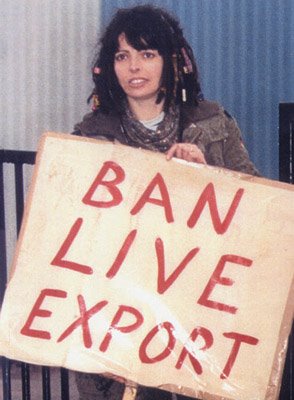
In tandem with this, on February 1, 1995, Jill Phipps (photo above) was one of a few dozen animal rights activists who broke through a police line at Coventry Airport in central England. She was crushed to death under a lorry as she protested against the export of live calves for veal in 1995.
More than 500 candidate MEPs have pledged to do more to protect animals at EU level should they be elected to the European Parliament in three weeks.
The Vote for Animals campaign, run by Eurogroup for Animals and its members, asks candidates to take a pledge committing to do more for better protection of all animals at EU level.
The pledge addresses live animal transport, non-animal science, welfare of aquatic species, the conservation of wild animals, imports of animal-based products, and welfare of companion animals. It also addresses a future fur farming ban, the importance of sustainable food production and an ask for an EU commissioner for animal welfare.
Candidates spanning the entire political spectrum across 26 Member States have made the commitment. So far, Finland, Italy and France have the largest number of candidates supporting the pledge.
EU citizens have the opportunity to ask their candidates to sign the pledge, by sending a message through a dedicated platform, which is available in all EU languages. So far, over 9,000 citizens have sent a message to their candidates.
An estimated 400 million EU citizens are eligible to vote in the European elections set to take place between 6-9 June. The demand for improved EU legislation on animal welfare has been resoundingly voiced: 91% of Europeans believe that safeguarding the welfare of farmed animals is crucial, while 84% feel that current protection measures are not enough.
Taking the pledge for the animals is a commitment that in the next legislature, should I be elected, I will continue to push for better EU legislation to protect all animals across their lifespan. There is a critical need for action to phase out animals in cages, as per citizens’ demands, and a push for more ambitious legislation for animals during transport. The promised revision of the animal welfare legislation should be a top priority for the next Commission.
Niels Fuglsang, candidate MEP (Socialdemokraterne, Denmark) and Vice-President of the Intergroup for Animal Welfare.
The majority of EU citizens want animals to be better protected in Europe. To achieve this, we need more MEPs who want the EU to do more. Voting for candidates who have signed the Vote For Animals pledge is the best way to advance animal welfare in the EU. If I am re-elected, I pledge to continue to be the voice of animals and their defender in the European Parliament.
Caroline Roose, candidate MEP (Europe Écologie, France) and Vice-President of the Intergroup for Animal Welfare.
It is great to see so many candidates take a pledge for the animals. It is important that the next European Parliament represents citizens’ demands for better protection of all animal species, and MEPs can help to ensure that this topic stays on top of the agenda for the next term.
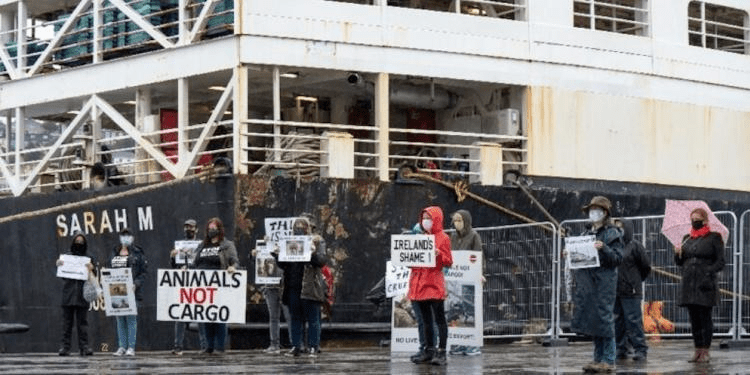
Ethical Farming Ireland succeeded in preventing a 45 year old transport vessel from coming into port at Greenore to collect Irish cattle for export.
The Sarah M was scheduled to dock at Greenore on Ireland’s northeast coast on April 30, to collect 2000 young bulls for export.
The ship had recently been classed with the Russian Maritime Register of Shipping, and was therefore subject to European Union sanctions which include denial of access to EU ports.
Ethical Farming Ireland alerted the Department of Transport of this breach, which resulted in the vessel being denied entry.
The organisation has long campaigned against live export from Ireland to mainland Europe and beyond, as thousands of animals are exported to countries as far afield as Libya, Jordan, Morocco, Lebanon, Israel, Egypt and Turkey each year.
The organisation has expressed disappointment that their intervention was necessary in order to ensure proper regulation of the vessel.
Such incidents are not uncommon amongst live transport vessels, as revealed in new research by Animal Welfare Foundation. Nearly half of the animal transport vessels approved in the EU are flying the flag of a country marked by the Paris Memorandum of Understanding as a black flag (for example Togo, Sierra Leone or Tanzania).
This flag indicates these vessels pose a high risk to maritime traffic, as well as to the animals, crew and environment.
A five year phase out plan and $107m support package has been promised by the Australian government, meaning live exports of sheep will end on 1 May 2028.
Agriculture Minister Murray Watt made the announcement on 11 May, noting that legislation will be introduced in this term of the Australian Parliament to end the trade in law.
The decision was taken after years of campaigning from animal welfare organisations, with polls revealing that the majority of Australian citizens want to see an end to the cruel trade.
The live sheep export industry has shown time and again that they are unable to meet the community’s expectations.
Murray Watt, Australian Agriculture Minister
Live export has also been in a long-term economic decline, and now accounts for only 0.1% of Australia’s agricultural exports.
This has directly corresponded with an increase in the trade of meat products, with trade in chilled sheep meat now 58 times the value of the live sheep export trade. Sales of chilled Australian sheep meat to the Middle East alone now represent $632 million, compared to only $77 million of profits from the entire live sheep export trade.
Decades of investigations have confirmed the stressful, dirty and overcrowded conditions that sheep are subjected to during long sea journeys from Australia. Heat stress can be fatal for animals aboard transport vessels, as tragically proven during the 2017 Awassi Express disaster where around 2,400 sheep died from heat stress whilst travelling between Australia and the Middle East.
While of course we wish it was sooner, we also recognise and respect the responsibility of the Government to consider all who are impacted by this historic decision… Considering the decades of dedicated effort and advocacy, it is understandable that some doubted whether this trade would end in their lifetime. Now we know differently.
Animal advocates are celebrating after parts of a controversial Ontario agriculture law that made it illegal to get a job on a farm under false pretences to expose conditions inside were deemed unconstitutional.
Justice Markus Koehnen struck down parts of Bill 156, the Security from Trespass and Protecting Food Safety Act, earlier this month after advocacy group Animal Justice, along with an activist and a journalist, launched a Charter challenge in 2021.
They argued the new law infringed on their freedom of expression because they could not tell the outside world what was happening inside a farm if they gained access to the property through a false pretence.
The act required consent from the owner to be on a property where animals are kept, raised or slaughtered. That consent was voided under the law if someone lied to get on the land.
“The act limits the mode of expression by preventing undercover exposes or even eyewitness descriptions of the conditions in which animals are raised or slaughtered if the person providing the description gained access to premises using false pretences,” the judge wrote in his decision.
“In light of the foregoing, I find that one of the purposes and one of the effects of the act and the regulation is to infringe on the applicants’ freedom of expression.”
The province enacted the legislation in response to demands from the agricultural industry and about 120 municipal resolutions calling on the government to do more to control trespassing, the decision said.
Ontario argued the legislation was aimed at “protecting animal safety, biosecurity, and the safety of farmers as well as preventing economic harm that can arise from threats to animal safety and biosecurity.”
Part of the case focused on lying.
“If lies can amount to protected speech in a context as odious as Holocaust denial, they should be equally protected when someone denies having a university degree or being affiliated with an animal rights group to obtain employment at or entry to an animal auction, petting zoo, rodeo, fair or circus,” the judge decided.
The judge agreed with animal rights activists
The news thrilled Camille Labchuk, executive director of Animal Justice.
“It’s a decisive victory over unconstitutional ‘ag-gag’ laws that were designed and had the effect of covering up serious animal cruelty on farms,” she said.
“In light of this ruling, we’re looking forward to getting back to doing investigative work in Ontario as soon as possible.”
The animal advocates had submitted undercover video of farms that were eventually aired on national television broadcasts and led to criminal charges and convictions in some cases. None of that would have happened without lying to get a job in the first place.
“The expression is of public interest,” Koehnen wrote.
“Publicizing the way in which animals are treated is an issue of interest to at least some members of the public. It is an issue about which the public is entitled to be informed if they want to be.”
The advocates who brought the case also argued undercover operatives would follow the rules on farms, only deviating to take pictures of video of what was happening with the animals.
The judge agreed.
“For a potential employee to deny any association with animal-rights groups in a job interview does not threaten biosecurity, the food supply chain or animal safety,” the judge wrote.
“Nor does the follow up act of such an activist communicating what they see in an agricultural facility.”
The bill also made it illegal to interact with animals inside transport trucks, a law seemingly designed to target one group in the province: Toronto Pig Save. The group is part of the large Save Movement whose members “bear witness” and hold vigils for animals en route to slaughter.
They often gave water to the pigs inside trucks stopped at intersections to “show kindness and compassion to animals in their final moments,” the decision noted.
The Ministry of the Attorney General may appeal
Two days after the bill came into force in June 2020, a truck hauling a load of live pigs ran over and killed Regan Russell, 65, who was protesting the new law outside a slaughterhouse in Burlington, Ont. The driver, Andrew Blake, pleaded guilty to the provincial offence of careless driving causing death. He was fined $2,000 and given 12-months of probation.
The Regan Russell Foundation intervened in this case, arguing the law interfered with both its constitutional right to protest and freedom of expression.
The judge disagreed and held up that portion of the act.
“The purpose of protecting freedom of expression is to do just that, allow people to express themselves,” Koehnen wrote. “It does not allow people to appropriate, even momentarily, the property of others as a means for that expression.”
Russell’s stepson, Joshua Powell, was disappointed with that part of the decision.
“It is upsetting, but we are very, very elated that the judge upheld the ability to hold vigils at these sites as a protected act,” Powell said.
“And, most important, we are really happy that undercover exposes, from journalists or activists, won’t be illegal anymore. It was one of the main reasons Regan was out there that day.”
The Ministry of the Attorney General said it is reviewing the decision and has not yet decided if it will appeal.
We want to send congratulations to Lyn and our friends at AA on getting this amazing result. Being a UK live export campaigner for 35+ years I personally know the immense amount of work that is needed to achieve results such as this.
All the time you are speaking for them, your mind never distracts from the continual suffering to the animals that this trade brings. Without doubt, Australian live exports are probably the biggest nut of all nations to get victory over in this sordid trade.
We all want an immediate ban, but in this instance the head rules over the heart. Despite our feelings; it has to be accepted that ‘meat’ in some form will continue to be exported from Australia. As we say in the UK, better on the hook than on the hoof ! – sadly the process of killing animals will not stop, but the suffering on the ships will. In the next few years there will be a lot of things that need to be addressed by both Australia and the states they currently export to; a change from meat on the hoof to that on the hook. New slaughterhouses may need to be built in Australia to process the animals; and maybe methods with all involved to store and export meat by refrigeration. It is not what I want to see and probably what you all do not want to see; but it will happen; animals will be killed as always but they will be saved immense suffering on shithole rust buckets as they currently are. A large cruelty chunk of the puzzle will be removed; and that is something I at least welcome.
Going veggie or vegan for sure is the way forward and the way to reduce this suffering. Every rust bucket livestock carrier that ends up going for scrap is a real positive as far as I am concerned; it is every time, another nail in the coffin and another page written to put this disgusting abuse of animals into the history books.
Well done and big congrats to everyone who has showed year of tenacity to get this news today,
I wanted to write to you this evening to express the most heart-felt ‘thank you’.
Today, because of our combined efforts, we now know the date that the live sheep trade will end. Australian Agriculture Minister, Murray Watt, announced this morning that the live sheep trade will, after some 60 years of operation, end on May 1st 2028.
Importantly, the Minister also announced that this end date will belegislated in this term of government.
While of course we wish it was sooner, we also recognise and respect the need to consider all who may be affected by this historic decision. Considering the decades of dedicated effort and advocacy behind today’s announcement, it is understandable that some doubted whether this trade would end in their lifetime. Now we know with certainty that it will. We can now count down towards the day that the last sheep shipment will leave our shores.
And that is why, aside from my great relief at this announcement, I am filled with overwhelming gratitude to you Diana. Truly, this day would not have come without you. You supported our investigations. You refused to get disheartened. You achieved something extraordinary: you convinced an Australian government that animals deserved better and that an industry that had long enjoyed political support, should be concluded.
We now know beyond any doubt, that so powerful is human compassion, it can make the seemingly impossible, possible. The resilience so needed to stay the course was born of compassion. The courage we needed on the most difficult days was fuelled by compassion. The commitment to write letter after letter to politicians was driven by compassion. To witness together a government decision based on compassion for animals, is, I am sure you will agree, a momentous day. A day to long savour. Please remember your part in this, as I always will.
My deep appreciation today also extends to our colleague groups for their exceptional efforts that ensured the animal protection sector spoke for Australian sheep with a strong and united voice. They have been magnificent.
And it is so very appropriate that I also mention my wonderful colleague, friend and co-investigator Shatha Hamade. My time as an investigator in the Middle East had to come to an end, as my face had become too well known. When Shatha joined Animals Australia, it was as our lawyer, not an investigator. Yet she didn’t hesitate to say ‘yes’ when I told her she was needed.
Since then, as you know, Shatha has given her heart and soul to being where Australian sheep have needed her to be. And finally, my gratitude goes to Fazal Ullah, the crewman, who in witnessing the suffering before him, chose to act, rather than accept.
We will all be forever grateful for this young man’s courage. It is so very clear that today’s historic announcement has been the result of a team effort like no other.
Thank you so very much for the critical part you have played. For the animals,
After years of campaigning, the sentience of animals is now officially recognised in the Constitution of Belgium. The Constitution takes precedence in the hierarchy of Belgian legal norms, and now includes a reference to ensure the protection and well-being of animals.
After a lively debate in a plenary session of the Chamber of Representatives, including concerns raised by the agriculture sector, a critical two-thirds majority was ultimately reached to approve the addition.
Belgium is now the 6th EU Member State to include animals in its Constitution, following Italy, Germany, Luxembourg, Slovenia and Austria. Other nations have also acted to enshrine constitutional animal sentience, including Switzerland, Egypt, Brazil and India.
The following passage has now been officially added to Article 7 of the country’s Constitution:
In the exercise of their respective powers, the Federal State, the Communities and the Regions ensure the protection and well-being of animals as sentient beings.
Animal sentience is also enshrined in law at EU level, as Article 13 of the Treaty on the Functioning of the European Union mandates EU Member States to consider animal welfare as a significant commitment. Animals are recognised as sentient beings, acknowledging their capacity to experience pain and suffering, and emphasising the moral duty to treat them with care and respect.
As well as sending a strong message about the commitment of Belgium to protect animal welfare, the inclusion should also have a direct impact as regulations made by federal and regional parliaments, as well as local authorities, must comply with the Constitution. It could also have the impacy of strengthening enforcement of animal welfare laws.
This is a historic victory for GAIA and all those who defend animals’ interests. Only 30 years ago, such a breakthrough was simply unthinkable. Today, animal welfare is becoming a constitutional value in its own right, joining other fundamental principles. This recognition reflects a major change in society and highlights the growing importance of animal protection in our country. It is this kind of progress that GAIA has been fighting for since it was founded.
Farm Animals Programme Officer, Susanna Blattner, was recently invited by our member Essere Animali to follow trucks transporting lambs across Italy. The purpose of the investigation was to monitor any legal violations to the animals, intervening where possible, and to record firsthand the experiences of these lambs to show where the current Transport Regulation is falling dramatically short of protecting their welfare. This is her account of her experience.
As a veterinarian with experience in slaughterhouses, I thought I was ready for this experience. I arrived on the day of the investigation prepared; I reviewed European regulations until I could cite the most common breach articles from memory. I studied Italian regulations, legislative decrees, previous investigations, watched hours of videos, and talked to several colleagues to prepare myself as best as I could.
Unfortunately, it wasn’t enough. Theory doesn’t prepare you for certain things, and from this experience, I return even angrier and sadder but with a greater awareness of the importance of my role in Brussels.
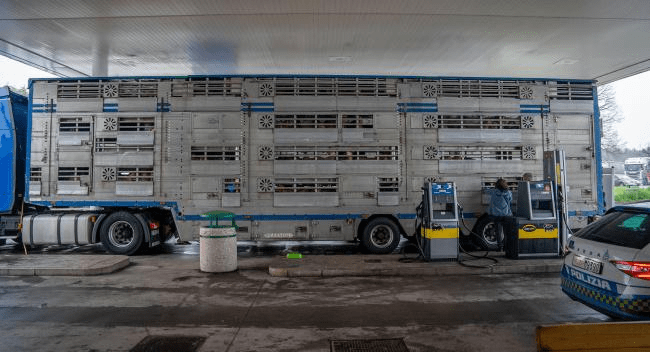
The days were organised like this: wake up at 4am, head to a service station in Friuli, near the border with Slovenia, and wait in the car until a truck containing lambs arrived (sometimes they stopped at the service station) to follow and monitor it. In case of obvious irregularities, call the police and report any problems.
I expected long hours of waiting, but instead, the trucks kept coming. Sometimes I could even hear the lambs bleating from tens of metres away, and every truck spotted with a Hungarian or Romanian licence plate was a blow to the heart.
Their bleating was persistent. I still have it in my ears.
The times when the trucks stopped at a service station and I had the opportunity to inspect them were devastating. The trucks were overcrowded, the lambs touching the upper shelf with their heads, unable to drink. When I stroked them, they searched for me insistently, as if they understood that I was there for them.
Essere Animali
Their bleating was persistent; I still have it in my ears. One morning, we followed a truck from Friuli to Emilia Romagna – four hours of pursuit during which even on the highway, with the windows closed, I could hear their lament.
One of the things that struck me the most was my complete helplessness. I met police officers with big hearts who, when I explained that I was a veterinarian, listened to me and called Italian colleagues to try to do something for the welfare of those poor animals and penalise the people who had allowed such cruelties. I met veterinarians who worked with heart, and above all professionalism, ready to meticulously inspect every truck and penalise every minor infringement, with tearful eyes. But I also encountered police officers who accused me of wasting their time for “such a thing”, and veterinarians who laughed in my face because I wasn’t in touch with reality and it made no sense to fine a truck for “so little.” The “so little” were more than 800 lambs on a truck without adequate safety measures and devices for drinking.
A stronger Transport Regulation will be the key to changing the sad state of live animal transport.
However, what troubled me the most was the impossibility of protecting the animals being transported due to endless bureaucratic loopholes: the grey areas of the current transport law, that allow transporters to do things without considering animal welfare at all, the inability of law enforcement to impose adequate penalties, and so on.
But there was something that gave me a glimmer of hope – the people I met during this experience.
The petrol station attendant who, while we waited at the service station for the arrival of the veterinarians, brought us a bowl to give water to the lambs.
The clerk who, when he realised what we were doing, showed us videos of other atrocities done to animals that he had managed to film.
The travellers who, when they arrived at the service stations, came to ask us what was happening to the animals, and upon our explanation, realised the cruelty of this practice.
The television journalist who was with me all day to film the events, and at the end said to me, “But how can I still eat these little animals now?”
It was a strong, bittersweet experience, one that would be very challenging to repeat due to the physical and emotional fatigue it incurred, but one I will never forget either. I am now even more motivated to work hard, and fight to protect the millions of animals transported every year.
It’s critical the European Commission takes its revision to the Transport Regulation seriously, creating species-specific rules across the sector that robustly protect the welfare of all animals involved.















 World Animals Voice

