
A few of my own trees:



A few of my own trees:

18 July 2023
GAIA

GAIA welcomes the new Flemish Animal Welfare legislation, saying it is a clear step forward for animal welfare but which has a number of major shortcomings which must be addressed. The revision was announced by Flemish Animal Welfare Minister Ben Weyts and agreed by the Flemish Government on Friday.
In addition to all the existing bans on slaughter without stunning, wild animals in circuses, fur farming, street horse racing, force-feeding for foie gras production, rabbits in individual battery cages and compulsory sterilisation of cats, as well as other regulations, the Flemish Animal Welfare Code contains important new provisions for which GAIA has been campaigning for many years:
Ban for new businesses from 01/01/2024. For existing businesses, the ban takes effect from 01/01/2036. “Of course, we would have preferred the 12-year transition period to be much shorter, but the principle of the ban is legally supported by a clear perspective for change (switch to free-range systems): no more caged laying hens by 1 January 2036 at the latest!” commented Michel Vandenbosch, President of GAIA.
We welcome the ban on imports and breeding BUT an exception has been made (conditional derogation) for Boudewijn Seapark, which is still allowed to keep a maximum of 6 dolphins on condition that an outdoor dolphin tank is built by 2027. If an assessment concludes that there is an operational alternative, such as a sanctuary, which offers the dolphins a better level of comfort and quality of life, the dolphins will have to be transferred to this site. The first assessment is not due until 2037, which means that these changes will not be implemented until then. We believe that a waiting period of more than 13 years is too long for the dolphins.
“I don’t see why the dolphins in Bruges couldn’t be transferred immediately if a more appropriate environment where they can spend the rest of their lives can be found sooner,” commented Michel Vandenbosch.
The Code does not prohibit the cruel surgical castration of piglets. The most animal-friendly alternatives will not be compulsory and pig farmers are allowed to decide which alternative suits them best. In addition, there is no transition period set.
“With this Code, we are already making significant progress and obtaining new legislation for which we have been campaigning for years. With the standstill principle explicitly mentioned, the Flemish Code indicates the direction in which regulations must evolve in the interests of animals: gradually and without going backwards.”
Michel Vandenbosch, President of GAIA
“The same applies to long transition periods,” adds GAIA. “The legal settlement of the dolphin issue also provides for unreasonable delays. In any case, the Animal Welfare Code offers a legal perspective that will (in the long and short term) put an end to certain persistent forms of organised animal cruelty and avoidable animal suffering that GAIA has been fighting against for years. Even with this Code, there is still a lot of work to be done.”
It is regrettable, however, that the Code does not prohibit, among other things, a practice as cruel as the castration of piglets, which causes clearly avoidable suffering to millions of piglets.
Regards Mark
Injecting animal welfare in renewed EU-Latin American trade relationships
18 July 2023
As leaders from the EU and from the Community of Latin American and Caribbean States (CELAC) gather in Brussels for the third EU-CELAC summit, willingness to accelerate the conclusion of controversial trade agreements is on the agenda. What’s at stake for animals?
During the EU-CELAC Summit on 17-18 July, the Executive Vice-President of the European Commission and Ministers of Foreign Affairs of Mercosur countries reiterated their “determination to work towards the conclusion of the Agreement between the EU and MERCOSUR by the end of 2023”.
Instead of pushing forward an unsustainable and harmful trade policy, the EU should redesign its trade deals to be compatible with the EU Green Deal and the Farm-to-Fork Strategy. These deals, as exemplified by the EU-Mercosur FTA, grant further unconditional market access to animal based products, leading to an increase in the trade and further fuelling the intensification of farming both in the EU and abroad. This trend not only implies poor animal welfare conditions, but also raises public health concerns in terms of zoonoses and antimicrobial resistance (AMR). Intensification of animal production also generates high levels of deforestation, impacting the welfare of millions of wild animals.
For all these reasons, Eurogroup for Animals, together with 50 civil society organisations from South America and Europe, and with the support of MEPs from the Greens/EFA, the Left and S&D, organised an international conference calling for ‘A new EU-Latin America trade relationship for the 21st Century’.
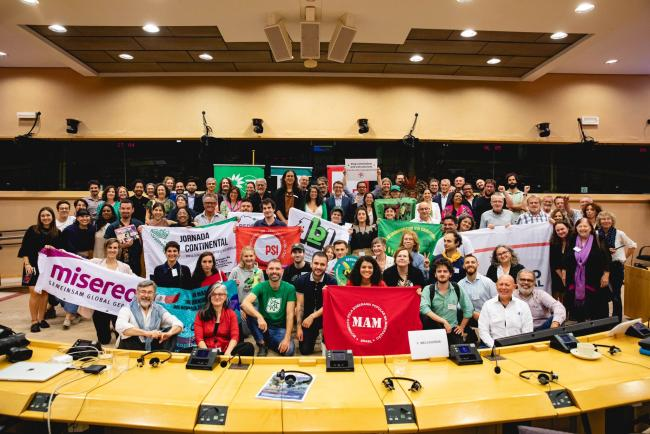
The Left in the EP
During the conference, a wide range of speakers from the EU and South America agreed that the EU-Mercosur deal is toxic for indigenous people, workers, the environment and animals, and that the proposed additional protocol offers nothing more than cosmetic, unenforceable adjustments. Furthermore, the risks of the deal aggravating deforestation cannot be restrained by the recent EU legislation on imported deforestation, given that the legislation ignores many products that contribute to deforestation and other biomes destroyed by intensive agriculture. For example, soy-fed animals such as poultry are not covered by the legislation.
Other speakers echoed Eurogroup for Animals’ criticism of the EU-Mexico and EU-Chile agreements. These deals have had devastating consequences for local communities, including pollution and destruction of natural habitats, and their “modernised” versions are likely to have further negative impacts on animal welfare, human rights, deforestation, the climate crisis and biodiversity. While the agreements do include some animal welfare provisions – including on animal sentience and growth promoters and, in the case of Mexico, a standalone chapter on animal welfare and antimicrobial resistance – the language is weak and will do nothing to offset the negative impacts unconditional trade liberalisation will have on animals, people and the planet.
All eyes are now on the European Commission, the European Parliament and the Council to avoid fast-tracking the EU-Chile and the EU-Mexico FTAs by side-stepping national and regional parliaments and removing Member States’ veto right. This is critical given the range of negative impacts the agreements will have on animal welfare, human rights, the climate crisis and biodiversity. Concerning the EU-Mercosur FTA, Eurogroup for Animals calls for a full renegotiation of the deal, including conditioning all trade preferences granted in the agreement to EU-equivalent animal welfare standards.
Regards Mark
Making animals count in the Spanish elections

19 July 2023
AnimaNaturalis
AnimaNaturalis, together with Equalia, FAADA and over 50 other Spanish animal protection organisations have launched a campaign to influence Spain’s political agenda and encourage citizens to vote in the national elections this Sunday 23rd July.
Following disappointing results for the leading Spanish Socialist party (PSOE) in the May local elections, Prime Minister Pedro Sánchez called snap elections for the end of July. The Popular Party (PP) under Alberto Núñez Feijóo have their eye on victory, but neither the PP nor PSOE are projected to win enough votes to govern on their own – with the conservatives likely needing the support of far-right party Vox, and the Socialists looking to left-wing group Sumar.
Under AnimaNaturalis’ initiative, the new coalition of animal protection organisations in Spain have been working together to ensure that the main political parties include animal welfare commitments, such as explicit support for the end of cages in European livestock farming based on the “End the Cage Age” initiative.
The coalition prepared a decalogue of 17 asks for animals in the next term. A website launched earlier this month, AgendAnimal, includes a ranking of political parties according to their commitments to these asks.
The ranking shows support for many of the asks by parties Sumar, PACMA, Junts and ERC. Closing fur farms received the most consensus (6 parties), and 5 parties commit to move towards the end of cetacean captivity.

The union of animal organisations is key to achieving our objectives and defending the rights and welfare of animals effectively. Together we are stronger in our fight for a world where all living creatures are treated with compassion and respect. We have always been clear about it, but at such a decisive moment for Spain as the one we are currently experiencing, we could not act otherwise.
Cristina Ibáñez García, Lawyer and Coordinator AnimaNaturalis International

See below the decalogue of asks for animals:
Repeal Law 18/2013 for the regulation of bullfighting as cultural heritage
Develop the regulations of Law 7/2023 on the protection of animal rights and welfare
Include companion animals expressly excluded from Law 7/2023
Reduce veterinary VAT for pets from the general rate of 21% of the reduced rate of 10%
Develop a clear labelling system for meat products and derivatives
Support the transition to a cage-free system
Prohibit the slaughter of day-old chicks
Ban force-feeding ducks and geese to produce foie gras
Promote good aquaculture practices that prioritise animal welfare and sustainability
Close fur farms
Apply and promote the protection of fauna in wind farms and power lines
Prohibit pigeon shooting
Promote R&D of alternative methods to animal experimentation
New regulations on zoos
Moving towards the end of cetacean captivity
Build a state rescue centre for seizures of CITES species
Guarantee the continuity of the General Directorate for Animal Rights
Read more at source
Regards Mark
 World Animals Voice