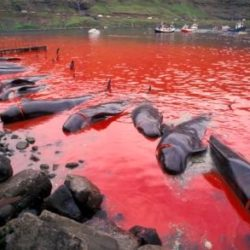
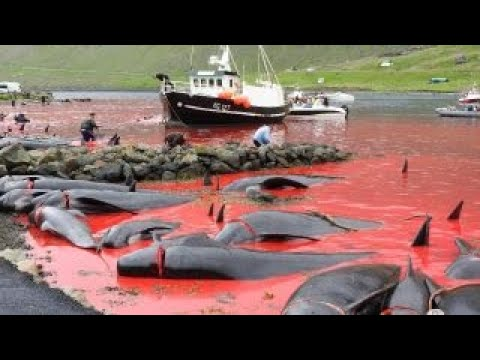
Cruise line apologises after passengers witness dozens of pilot whales being slaughtered
We have campaigned against this along with thousands of others for decades – at least the uninformed may know a bit more about the abuse that takes place every year.
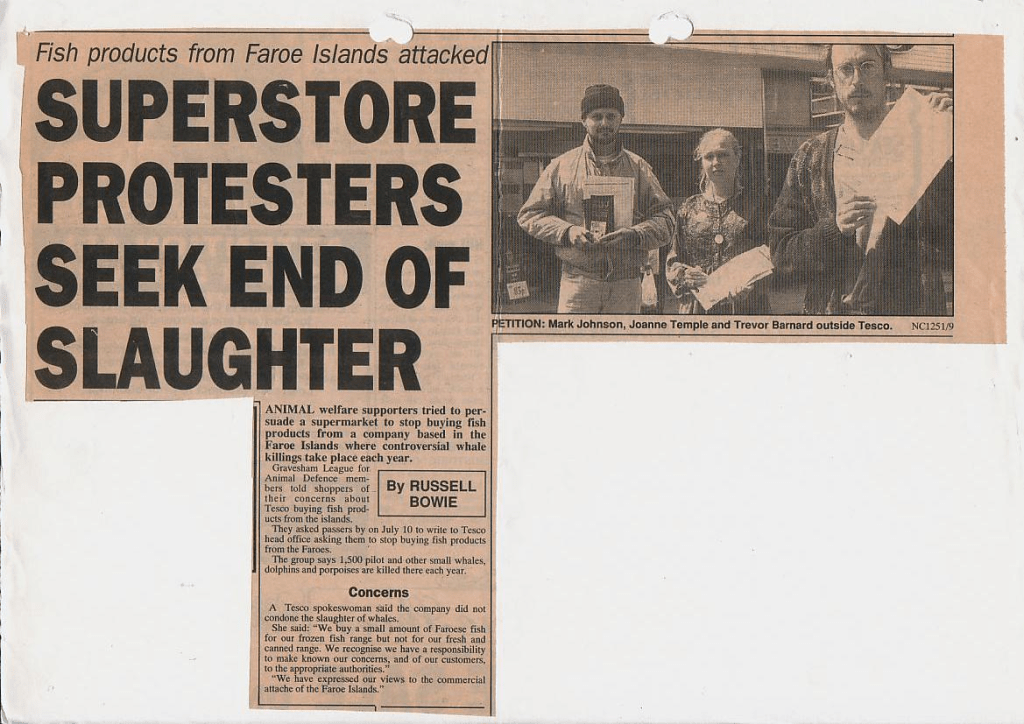
Myself, Joanne and Trev fight to get Faroese fish stopped in our local supermarket – when was this ? late 80’ s ? To see more pictures please click on https://serbiananimalsvoice.com/about-us/
Others have called on cruise ship companies to boycott the Faroe Islands in order to end the killing of whales in the area. “Cruise companies need to take a stand in support of ocean wildlife and remove the Faroe Islands from itineraries,” Rob Read, the chief operations officer at Captain Paul Watson Foundation UK, told Yahoo News Australia. “Their continued visits to the Faroe Islands inadvertently supports the abhorrent practice that is the Grindadráp.”
“Utterly unacceptable and unlawful”: Ireland’s mistreatment of male calves
14 July 2023
EFI
Investigation
A new documentary by Ireland’s RTÉ Investigates programme, ‘Milking It; Dairy’s Dirty Secret’ has exposed animal welfare breaches of male calves in Ireland, both on-farm and during live export to Europe.
Irish milk production has jumped 68% since the EU milk quota system was abolished in 2015. Ireland now produces just short of 9 billion litres of milk every year and 10% of the world’s infant formula. To meet this demand, approximately 1.5 million dairy calves are born in Ireland every year. While female calves are reared to become dairy cows, over half a million male calves born each year are considered a valueless by-product of the sector, as they neither produce milk nor fatten well for beef. Male calves therefore face a difficult fate: either killed at a few days old, or shipped to veal farms in Holland, Spain, Italy, and, more recently, to a growing market in Poland and Romania.
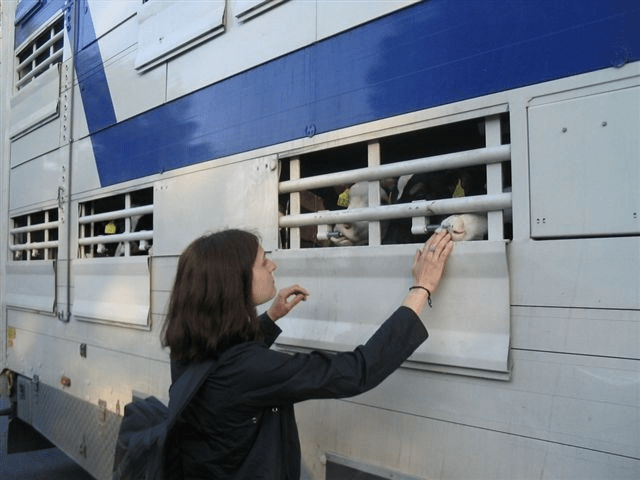
The RTÉ documentary included investigation footage carried out by L214 and Eyes on Animals, assisted by our member organisation Ethical Farming Ireland, which covered the journey of calves transported from Ireland to France and the Netherlands.
Despite scientific evidence suggesting that these animals should not travel until 12 weeks old due to their undeveloped immune systems and incapacity to correctly use feeding devices, the industry continues to ignore this recommendation, and calves are exported at around 15 days old. Also, The European Food Safety Authority (EFSA) recommends a minimum age of 5 weeks for transport, emphasising the vulnerability of these animals during their early stages of life.
Furthermore, EU regulations clearly state that unweaned calves must be given water and, if necessary, fed after 9 hours of transport, when they should receive a rest period of at least 1 hour before being transported again. However, footage reveals that the calves are subjected to 30-hour journeys without milk or rest: a flagrant violation of EU law, and a general disregard for animal welfare.
Further footage taken by RTÉ told the same story of gruelling journeys for young calves that breach the EU Regulation on the transport of live animals. In addition, workers could be seen repeatedly kicking young calves, hitting them with sticks, and throwing them from trailers. .
The documentary has caused political outcry, with the Irish Department of Agriculture confirming an investigation into the programme findings. Irish Agriculture Minister Charlie McConalogue called the practices uncovered in the documentary “utterly unacceptable, and in some instances unlawful”.
Irish Taoiseach (Prime Minister) Leo Varadkar described the footage as “repugnant”. Mr Varadkar said there would be “robust and timely” action against people found to have breached regulations in the footage, and that the reputation of the sector relied on compliance with the regulations in place.
The documentary proves once again that the existing animal welfare legislation does not go far enough to protect EU farmed animals at rearing, transport or slaughter. The European Commission has the power to improve the transport regulation this year, with the revision of the EU Animal Welfare legislation. In particular, they must:
Ban ‘unfit animals’ from being transported, including unweaned animals, for whom these journeys are even more difficult to bear
Place strict limitations on journey times
Ensure that the new rules are better enforced
Let’s be clear, there is no way to export calves humanely or in line with legislation because it is not possible to feed calves during transit. That is the simple truth. The dairy industry must find an alternative outlet for their calves, and keep them with the herd until weaned. If you don’t have the facilities to look after them then don’t breed them in the first place.
Caroline Rowley, Founder of Ethical Farming Ireland
Indeed, and as recommended during the documentary, the culling and mistreatment of “valueless” male calves should be avoided, which is currently possible by using sexed semen. The transport of farmed animals should be reduced, refined and replaced by meat and carcasses, semen and embryos as recommended by the FVE, WOAH and EFSA.
I have more to say about Irish calf transport investigations which we have undertaken in the past; I will provide details and links in another post very soon.
Industrial animal farming can continue polluting as the European Parliament waters down emissions directive
12 July 2023
CIWF
The European Parliament has voted to exclude emissions from industrial cattle farms from the Industrial Emissions Directive. The Parliament also voted for scrapping the Commission’s proposal for updated thresholds for pig and poultry farms. Thereby the proposal from the European Commission, that could reduce emissions from the largest polluters that keep animals in cramped conditions, is substantially weakened and puts the EU off track on its climate commitments.
The Industrial Emissions Directive controls emissions from the largest industrial installations in the EU, including a small number of the largest pig and poultry farms. Any installation controlled by the IED is forced to reduce emissions into air, water and soil and needs a permit to operate. With the European Commission proposal, the Directive would increase the coverage from 18% to 60% of emissions of ammonia from cattle, pigs and poultry, and extend the coverage from 3% to 43% of methane emissions.
The Parliament voted for going back to the current insufficient thresholds of 750 Livestock Units that only cover farms with 40,000 poultry, 2,000 pigs and 750 sows or more, with cattle farms entirely excluded. This stands in stark contrast to the Commission’s proposal of 150 Livestock Units which would cover all large farms, including cattle as it is the main emitter. In numbers this would mean that farms with example 500 pigs, or 150 dairy cows, or 10,700 laying hens or 21,400 broiler chickens would be included while the Directive would not affect small and medium sized farms.
In addition, the result of the Parliament’s vote shows a declining ambition even below the current Industrial Emissions Directive by further reducing the obligations for the industrial poultry and pigs farms with 750 Livestock Units and that will be covered by the Directive.
Animal farming is responsible for 67% of EU ammonia emissions and more than 50% of EU methane emissions. Cattle farming is by far the biggest source of methane emissions from agriculture. Failure to reduce these emissions puts the EU on track to break its commitment under the Global Methane Pledge (pledging to reduce methane emissions by 30% by 2030) as well as failing on its Zero Pollution Action Plan. In order to reduce emissions it will be necessary to address more of the large livestock farms. In addition to the negative impact the intensification of animal farming has had on animals, a strong Industrial Emissions Directive would bring significant health and environmental benefits for citizens.
Overall, the Parliament’s vote points to an even lower climate ambition than the agreed position by the Council. Earlier in spring, the Environmental Ministers agreed to include cattle in the scope but increase the thresholds as compared to the Commission’s proposal. The revision of the Industrial Emissions Directive will now go to interinstitutional negotiations (trilogues) between the Council, Parliament and the Commission. The results of the negotiations can potentially mean that the IED will continue to exempt the majority of the largest polluters.
The debate around the Industrial Emissions Directive has pinpointed how EU animal farms have intensified during the last years, with detrimental impact on animal welfare and with the EU potentially failing to address their emissions if this is not rectified in trilogues.
For more information, please see the briefing by Eurogroup for Animals’ members Compassion in World Farming and FOUR PAWS.
Unbound the Greyhound: One Kind launches campaign to end dog racing in Scotland
11 July 2023
OneKind
Greyhound racing in Scotland is on its last legs, with just one unlicensed track remaining. The dog racing industry is rife with welfare issues such as deaths, injuries and doping, and OneKind believe it has no place in a modern Scotland.
Together with 8 other animal protection organisations based across Scotland, England and Wales, OneKind is calling for an end to the cruel greyhound racing industry. This outdated form of entertainment causes a range of welfare issues for dogs:
Inadequate kennel conditions
Many greyhounds used by the racing industry are kept in kennels, in conditions which do not allow the dogs to thrive. In the worst instances, dogs can live in dank, dirty kennels, suffer from untreated wounds and injuries, receive inadequate veterinary care, and be shouted at or roughly treated. The dogs may also be constantly muzzled.
Doping
Greyhound Board of Great Britain’s records show that dogs in the racing industry have been doped with performance-enhancing drugs, including class A substances such as cocaine. Research has shown that the adverse effects of cocaine in dogs include neurological and muscular abnormalities, increased heart rate, convulsions/seizures, weakness, vomiting and lethargy.
Overbreeding
Thousands of puppies are bred to supply a racing pool across the UK. However, not all of these dogs will make the racing grade and thus some will be superfluous to the needs of the industry. Not all greyhounds will be passed to rehoming centres. Sadly, some may be killed instead.
It is also clear that the Scottish public do not support this cruel industry. One poll revealed that the majority of Scots (60%) want to see the Scottish Government take action to put an end to greyhound racing.
The EU-New Zealand trade deal includes animal welfare conditionality
9 July 2023
Press Release
On Sunday 9 July, the EU and New Zealand officially signed their Free Trade Agreement (FTA) after five years of negotiation. While the FTA liberalises trade for all animal-based products, thereby further stimulating animal agriculture in the EU and New Zealand,Eurogroup for Animals still welcomes that the beef quota is reserved for grass-fed animals.
This is only the second time the EU negotiates an animal welfare condition in a trade agreement. The controversial EU-Mercosur FTA introduced the first one in relation to shelled eggs. Yet, the volume of shelled eggs imported by the EU from the Mercosur countries is quite low. In the case of New Zealand, the EU managed to obtain an animal welfare condition for one of the animal products most traded between the partners. While New Zealand only had one feedlot built for exports to Japan, recently there has been a push to establish new ones, and this condition in the FTA will ensure EU consumption is not responsible for that.
We welcome the explicit exclusion of meat derived from commercial feedlots from the list of products benefitting from preferential access thanks to the FTA, also based on sustainability reasons. In addition to being a significant source of pollution, feedlots are detrimental to animals as they suffer from respiratory and digestive diseases, which are the main causes for cattle death under such rearing conditions. So far, EU trade policy has been blind to the unsustainable methods of production it can stimulate abroad, including the development of feedlots.
This trade agreement shows that the EU can condition relevant trade flows to higher animal welfare standards. The EU should apply this approach to all animal products in FTAs, and negotiate ambitious animal welfare conditions with all trading partners, including Mercosur countries. Why would it be sustainable to include meat derived from commercial feedlots in the quota granted in the EU-Mercosur agreement, when it’s not sustainable to do so with New Zealand? Especially as feedlots are a much more common method of production in Mercosur countries.
Reineke Hameleers, CEO, Eurogroup for Animals
Apart from this condition on preferential market access for beef, the FTA, like many others, includes a chapter on animal welfare cooperation. Yet, the language used in this chapter remains aspirational and the impact of such wording will only depend on the political willingness of the EU and New Zealand to work on this together. Surprisingly, the language on animal welfare has been separated from the chapter on Sustainable Food Systems (SFS), contrary to most recent EU FTAs. This means that in that chapter, no mention is made to animal welfare or to the close connections between animal welfare and public and environmental wellbeing. This creates silos that can be harmful and create detrimental trade-offs for animals.
The EU-New Zealand FTA has also been praised for being the first EU trade deal integrating sanctions in its Trade and Sustainable Development (TSD) chapter. While this is welcome, it does not change the intrinsic issue that if the language used in such a chapter is often non-committal, which is the case for provisions related to wild and aquatic animals, no violation can be found.
Introducing animal welfare-based conditions in FTAs, as the EU did with New Zealand, is one option to avoid that the EU further externalises its animal welfare concerns. However, as negotiations of trade agreements can be long and difficult, Eurogroup for Animals calls on the European Commission to seize the unique opportunity offered by the revision of the EU’s animal welfare legislation to propose the inclusion of all animal products placed on the EU market, regardless of their origin, within its scope.






 World Animals Voice
