Month: October 2023

Polish elections: which parties defend animal welfare?

Polish elections: which parties defend animal welfare?

13 October 2023

Otwarte

For the first time, Polish organisations Albert Schweitzer Foundation, Otwarte Klatki, Green REV Institute and Compassion in World Farming Poland joined forces on a pre-election campaign to encourage citizens to vote for animals in the national elections taking place on 15 October.

On their campaign website, the organisations demand protection of animals used for the production of meat, milk, eggs, and clothing. They oppose industrial farming that negatively affects the well-being of people, animals and the environment, and they support transforming the food system to a sustainable and plant-based one.

According to their ranking of Polish political parties, the Razem (Together), Zieloni (Greens) and Nowa Lewica (New Left) parties are the leading parties for animal welfare issues in Poland. The ruling nationalist Prawo i Sprawiedliwość (Law and Justice) party is vying for an unprecedented third term in office, but is not projected to gain a majority in the parliament. The main opposition party Platforma Obywatelska (Civic Platform), led by former European Council president Donald Tusk, would also need support from a coalition. Civic Platform ranks 6th for animal welfare, and is likely to join up with other more animal welfare-friendly parties. Prawo i Sprawiedliwość ranks 8th with a final score below zero, and would seek a coalition with Konfederacja (Confederation), who rank bottom in the animal welfare chart. 

Every year, over a billion chickens are killed in our country. We produce the most poultry meat for slaughter in the entire EU. We want to inform voters interested in the fate of farm animals about the views and plans of political parties regarding the protection of their rights. We want to create pressure on politicians to take urgent actions to improve the welfare of farm animals.

Grzegorz Stachacz, Director, Albert Schweitzer Foundation

The campaign has reached major media, with coverage on TVN24, the largest online news service in Poland, ONET, and FAKTY TVN

The ranking is based on party positions for welfare demands including phasing out cages for laying hens, pigs, calves, rabbits and quails, banning fur farming and the slaughter of day-old chicks. On transport, the organisations call for a ban on the export of live animals and a maximum transport duration of 8 hours for live cattle, pigs, sheep and goats. For poultry and rabbits, the transport duration should be limited to 4 hours.

The ranking also covers party positions on creating an Ombudsman position on animal protection, and transitioning to a sustainable food system.

Regards Mark

EU: European Parliament Hearing: one step closer to a Fur Free Europe.

European Parliament Hearing: one step closer to a Fur Free Europe

12 October 2023

Press Release

The Europeans Citizens’ call for a Fur Free Europe was presented today at the European Parliament: animal protection organisations, scientists and former fur industry representatives reiterated the critical need for the EU to ban the cruel practice of fur farming once and for all, while they stressed the importance of the publication of the full proposals on animal welfare.

European Parliament Hearing: one step closer to a Fur Free Europe

More than 1.5 million citizens asked for a Fur Free Europe, and 20 Member States have already totally or partially banned fur farming on grounds of animal welfare and public health, sending a clear sign that under no circumstances can fur farms protect the welfare of wild animals. The call to ban fur farms for good has been supported by a number of MEPS as well as Member States at Council level.

In fur farms wild animals are kept in tiny cages, hindered from displaying natural behaviours and killed solely for their fur. In addition, the farms pose a significant risk on animal and human health, and a threat to biodiversity.

Whatever the claims made by the fur industry, neither welfare regulations nor any industry certification scheme can ever change the reality of sentient animals being condemned to live their entire, miserable lives in tiny wire cages. These wild animals are deprived of their basic freedoms, for a product that has no necessity value. Fur is produced only to satisfy the vanity of a very small and rapidly diminishing number of people. That is unacceptable. We must stop it.

Mike Moser, a former fur industry CEO, who is now advocating to ban fur farms

Following an initial meeting between the ECI organisers and the European Commission (EC), this parliamentary hearing is part of the formal ECI procedure. By mid-December, the European Commission is expected to provide an official reply.

Meanwhile, animal protection organisations, MEPs and other stakeholders gathered together yesterday in front of the Berlaymont to publicly call on EC President Ursula von der Leyen to publish the animal welfare proposals in the current term. Amongst the proposals, the Kept Animal Regulation should include the ban on fur farming. 

It is hard to believe that anyone would agree that a life on a fur farm is worth living. Looking at the scientific evidence, it is not surprising that European citizens are strongly against fur farming. It is becoming increasingly difficult to defend the indefensible, with the industry’s own supporters turning against it. The moment could not be more favourable for adopting these bans and including them in the Kept Animal Regulation, a vital part of the revised animal welfare revision. The EC has now the chance to deliver on its promise to publish the full proposals by the end of the year.

Reineke Hameleers, CEO, Eurogroup for Animals

Mink are active predators whose natural behaviour includes roaming over large areas, hunting, climbing, and swimming. They are highly motivated to seek for food in streams and lakesides where a significant part of their hunting occurs in water. Unlike many other animals in captivity, minks are not suited to live in groups, as they are territorial and typically solitary in the wild. On mink farms, keeping them in small cages, their living conditions are not suited for the life they are adapted for.

Bo Algers, Professor emeritus of veterinary medicine, Swedish University of Agricultural Sciences

The practice of farming animals for fur breaches the most fundamental principles of animal welfare. The farming systems do not align with the species-specific needs of animals bred on fur farms. This should be seriously considered during the ongoing revision of the EU animal welfare legislation.

Johan Lindsjö, veterinary expert at the Swedish Centre for Animal Welfare (SCAW), Swedish University of Agricultural Sciences

Regards Mark

EU: Ursula von der Leyen urged to uphold democracy and deliver full proposals for the animals.

Ursula von der Leyen urged to uphold democracy and deliver full proposals for the animals

11 October 2023

Press Release

Animal protection organisations, MEPs and advocates gathered in front of the Berlaymont and publicly called on President von der Leyen to publish the promised full proposals for a revised animal welfare legislation.

In 2020, the European Commission (EC) committed to revise the animal welfare legislation as part of the Farm to Fork Strategy, but with only months before the end of the political term, the EC has announced that it will only publish one of the four promised proposals (Transport Regulation), leaving millions of animals unprotected and citizens’ calls ignored.  

With the current legislation not having been revised for over two decades, several research studies, including EFSA’s latest opinions, have highlighted that the existing regulations are outdated and insufficient to protect the welfare of animals in Europe. This calls for the urgent need to revise the Kept Animals and Slaughter regulations, yet the EC has failed to provide a timeline.

Among the promised proposals, the EC is expected to reveal its action plan to phase out cages, in response to 1.4 million citizens who have called for their ban in the End the Cage Age ECI.

MEPs Tilly Metz (Greens/EFA, LU), Anja Hazekamp (The Left, NL), Niels Fuglsang (S&D, DK), Michal Wiezik (Renew Europe, SK), Thomas Waitz (Greens/EFA, AT), Manuela Ripa (Greens/EfA, DE), Petras Auštrevičius (Renew Europe, LT), Francisco Guerreiro (Greens/EFA, PT), Caroline Roose (Greens/EFA, FR), Martin Hojsík (Renew Europe, SK) and Martin Buschmann (NA, DE), joined the gathering and publicly called on the EC to deliver the full proposal, as promised.

Millions of citizens are waiting for the European Commission to deliver on these promises and it is in the interest of the credibility of our European institutions not to let them down.

Tilly Metz, MEP

The call was supported by renowned ethologist and conservationist, UN Messenger of Peace and founder of the Jane Goodall Institute, Dr Jane Goodall, PhD:

Every year, 300 million sentient animals are caged, confined in industrial farms across the EU. These systems are outdated and cause immense suffering to animals who are able to feel frustration, fear and pain. Unfortunately, it seems that the powerful agribusiness lobby has been opposing these desperately needed reforms, because for them, the wellbeing of animals is not important. It seems that President von der Leyen has listened to big business, rather than the millions of EU citizens who support the promised ban on cages.

Dr. Jane Goodall

She publicly asked President von der Leyen to meet with her and discuss the issue.

In the past weeks, over 600 scientists,  over 100 MEPs and up to 50,000 citizens have called on the EC President to address Europeans’ demands and deliver the proposals.

This commission publicly committed to improve animal welfare. Yet now, at a pivotal moment, we are faced with ambiguity. We don’t need dialogue anymore, we do not need any more economic assessments, and we will not settle for tokens. We are long past those stages. Animal welfare is close to the heart of millions of citizens who now hold this Commission fully accountable for the commitment made to improve the lives of billions of animals in Europe. The time is now, as promised. Revising the animal welfare legislation is the right thing to do.

Reineke Hameleeers, CEO, Eurogroup for Animals

On Thursday 12th October, the European Parliament is set to host a debate on another successful ECI, Fur Free Europe, which calls for the ban of fur farming and the placement of fur products on the European market. The farming ban should also be included in the revised Kept Animals Regulation, answering the call of 1.5 million citizens.

Regards Mark
England: Where do things stand with the world’s first octopus farm?

Where do things stand with the world’s first octopus farm?

8 October 2023

CIWF

Spanish seafood company Nueva Pescanova announced plans in 2019 to establish the world’s first octopus farm in the port of Las Palmas de Gran Canaria.

To mark World Octopus Day 2023, we take a look at the application’s progress following resounding opposition from scientists, animal welfare and environmental organisations, and the general public.

Our case study Uncovering the Horrific Reality of Octopus Farming published together with Compassion in World Farming (CIWF), attracted significant international media attention

In our new video, we update you on key welfare and environmental concerns of octopus farming, the current state of the application processes to establish the farm, and options for citizens to support our call to stop octopus farming.

Thanks to continuing media attention, online petitions and protests worldwide, the issue remains on the radar, and public pressure is working. 

At regional level, the Canary Islands government has recently required a more exhaustive environmental impact procedure. Typically, intensive aquaculture projects in Spain are only subject to a simplified environmental assessment, but it was concluded that the octopus farm could have a significant impact on the surrounding environment. For Nueva Pescanova, this means that after waiting 2 years for the green light, they must now start over with a tougher evaluation process.

At EU level, several MEPs have expressed their opposition to the farm, raising a parliamentary question to the European Commission, as well as sending a joint letter to the Canary Islands government. 

Outside the EU, Washington state has proposed a bill prohibiting octopus farms, and the UK has legally recognised octopuses as sentient beings. Hawaiian authorities have closed the Kanaloa octopus research farm, and in Canada, a governmental petition was proposed to ban octopus farming. 

Moreover, the well known seafood certification labelling schemes by RSPCA and Friend of the Sea have made a resolute stance announcing their refusal to certify any farmed octopus products. 

Nevertheless, we have to keep up the pressure to make sure octopus farming never sees the light of day. 

Led by CIWF, on the occasion of World Octopus Day 2023, we have joined forces with 75 NGOs and experts worldwide to urge the Canary Islands Government to reject plans for the world’s first octopus farm in a joint letter

In the face of overwhelming scientific evidence, ethical concerns, and global opposition, creating the world’s first octopus farm is a perilous path we must not tread. Octopuses, solitary in nature, and with extremely complex behaviours, simply do not suit intensive farming conditions. There is no effective stunning method for the slaughter of farmed octopuses, and no EU legislation exists to protect farmed octopuses. Their wellbeing and the harmony of our ecosystems should stand as our guiding principles, urging us to abandon the notion of commercial octopus farming.

Keri Tietge, Octopus Project Consultant, Eurogroup for Animals

Citizens can help to continue the momentum by signing petitions against octopus farming, joining protests such as PACMA’s Save the Octopuses Fest on 4 November 2023 in Las Palmas de Gran Canaria and spreading the word using the hashtags #BanOctopusFarming and #StopOctopusFarming. 

Regards Mark

EU: European Parliament debates and votes on CLP revision.

European Parliament debates and votes on CLP revision

6 October 2023

The European Parliament held its long-awaited plenary vote on the revision of the Regulation on the Classification, Labelling and Packaging of chemical substances and mixtures (CLP) on 4 October. Although some new measures in the revised regulation are encouraging, other measures are still too weak and do not go far enough to reduce and ultimately phase out animal testing.

The CLP Regulation, one of the two cornerstones of the EU chemicals regulatory framework along with the regulation on the Registration, Evaluation, Authorisation and Restriction of Chemicals (REACH), requires companies to classify and label their substances and mixtures to ensure a high level of protection for human health and the environment.

In December 2022, the European Commission proposed a revision of the CLP Regulation, as announced in the EU Chemicals Strategy for Sustainability (CSS). The proposed CLP revision package consisted of a legislative proposal for the amendment of the CLP Regulation and a delegated act as a complement to the legislative proposal. While the delegated act has already entered into force in April 2023 following scrutiny by the European Parliament and the Council, the procedure of adopting the legislative proposal into EU law is still ongoing. 

Eurogroup for Animals, in collaboration with its members and other animal protection NGOs, has been working hard over the last year by submitting amendments to both the CLP legal text itself and related guidance documents. In particular, we have sought to ensure that the revised legislative proposal is aligned with the CSS objective of reducing reliance on animal testing, with the EU goal of fully replacing the use of animals in science, and most recently with the European Commission’s 2023 announcement of a roadmap to replace animal testing in chemicals regulation. To this end, we have repeatedly called for the revision of the CLP Regulation to include concrete steps to better recognise and adopt non-animal methods, to prevent both new animal tests and an increase in existing tests, and to ensure that animal tests are truly considered as the last resort.

The plenary vote in Parliament follows a vote by the Environment Committee (ENVI) in early September, where various compromise amendments to the text of the CLP regulation were discussed and agreed. The plenary vote was the moment of truth for our lobbying efforts, as it would ultimately represent the Parliament’s position for later negotiations with the Council. 

Following the vote, we welcome some of the new measures, such as improved wording on the use of non-animal methods and to allow the CLP Regulation to take into account future advances in animal-free science. In particular, Article 7 has been amended to read “non-animal, animal, and human testing, along with a newly added paragraph clearly stating “tests using new approach methodologies shall also be considered. In addition, Article 53 has been amended to include “the promotion of alternative methods for assessment of hazards of substances and mixtures, expressly addressing it as a priority for future adaptations to the regulation.  

However, we are concerned that other provisions of the Regulation are still too weak and do not sufficiently encourage the transition away from animal testing or maximise the use of existing non-animal methods available. In addition, there is still conflicting information in the revised CLP Regulation and related guidance documents with regard to new animal testing requirements. Although these files state that hazard classification under CLP does not lead to any new testing requirements, the recent introduction of new chemical hazard classes, such as endocrine disruptors, may potentially result in significant increases in new animal tests. Eurogroup for Animals and other NGOs called for wording allowing new animal tests to be removed, but this was rejected. 

Eurogroup for Animals is continuing its work to achieve real-world measures towards animal-free regulatory testing and scientific innovation by pursuing our efforts on the CLP Regulation. For example, we will continue to lobby for the CLP to reach the same standards as the United Nations’ Globally Harmonized System of Classification and Labelling of Chemicals (GHS) in recognising and promoting non-animal methods, and on which CLP is based. We will also continue our work on the revision of the REACH Regulation, with a legislative proposal expected to be brought forward by the Commission by the end of this year, and strive to ensure that the Commission’s promised roadmap includes concrete steps to move away from animal testing in chemical safety assessment. 

Finally, as part of the broader EU strategy and political mandate to transition to non-animal science, we will seek to ensure that modern, scientifically relevant, animal-free innovations continue to be  implemented in research, training and education

Regards Mark

England: Hope !

Years ago I was the investigator for Carla’s charity; and we were both devoted to stopping live animal transport.  I did a lot of investigation work into British hoses being exported for the meat trade; though their official paperwork; approved by Defra, was saying that they were being exported to mainland Europe for ‘Riding’.  Time, and a lot of work at the docks, combined with visiting horse sales markets gave us the proof we needed. I still have all the information in several files; information which took ages to gather, collate and write about ready for presentation.

Carla and I met with the Minister in London one day to present them with our investigation evidence.  Around the same time farmers dumped many dozens of baby calves at Carlas, expecting her to have them destroyed because of sheer numbers involved and the money needed to raise them – they wanted to be able to say that the veggie animal rights activist had killed calves.  NO WAY !

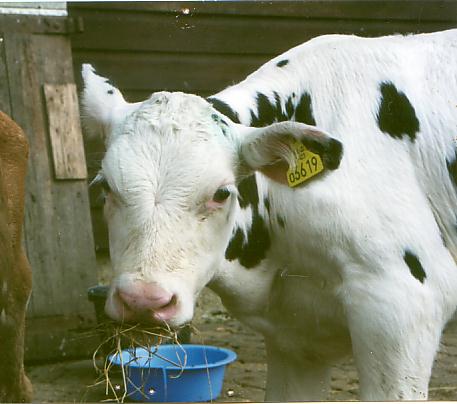
Carla kept every calf and raised them all into beautiful adult cattle.  One day, when they were still young, Carla asked me to name one of the calves.  I decided to call him ‘Hope’, as I hoped for a future free of live animal exports, and my own personal hope that there was a future with more hope and compassion for innocent beings.

Here is a photo of ‘Hope’

Above – ‘Hope’

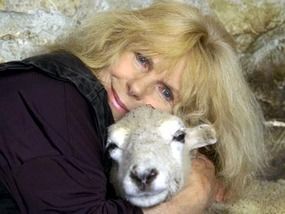
Here my favorite photo of wonderful Carla:

Live export unfortunately still continues all these years later; but many of us gather evidence and footage which is presented to he powers that be – with a simple message ‘stop it’.  It will happen and I think and hope soon, in the near future,

I came across this video, and noted that this suffering dog was also named ‘Hope’ by the wonderful people that took him in and literally changed every aspect of his being; from mere existence and survival on the street to one of a loved and very cared for dog.  It is a video which tells a story which has not yet finished.  Every credit to all involved; especially the girl who saw him suffering on the street, and who initially took time off work to help and feed this sentient.

Enjoy he video; a story of ‘Hope’

Regards Mark

About Us. | Serbian Animals Voice (SAV)

In the past, Mark worked with television comedy scriptwriter Carla Lane for many years; and had the position of being the investigator for her animal charity (Animaline) throughout the years of the horse export investigations.  Through undercover investigation work, port monitoring, visits to UK horse markets, and trails into Europe, it was shown that British horses were being exported from the UK whilst being declared as ‘going for riding’ to Europe.  In reality, the animals were being exported to Europe for their meat.  What was declared on the export licenses was a complete and utter lie to get around the complexities of exporting  sentient animals for one thing when they were actually going to their deaths !

After all the investigative work was completed and documented, which involved a lot of work, Carla and Mark teamed up in London one day and made formal presentations to the UK Government Ministry – DEFRA (previously  MAFF) about all the investigation work.

To this day, Mark will never forget what was witnessed in the investigations into beautiful, live horses being exported from the UK to Europe as a scam for the meat trade under the guise of ‘riding horses’.  This, combined with live farm animal export work over the last 27 years or so has meant that the export of live farm animals is a top ‘hate’ and will always be campaigned against – be it in the UK, Europe, Australia, South America, North Africa, Anywhere !

In the early hours of one morning, after investigating yet another consignment of UK horses being exported to the EU; declared as ‘going for riding’ but really destined for the meat trade; Mark returned home and decided that he just had to get something down on paper to express what he had experienced so many times, with the real knowledge (and proof) of what was happening to these beautiful animals despite what the (false) paperwork declarations said.  Gorgeous Jo was at home and supportive as always.  Unable to just go to bed and sleep for what was left of that night; something had to be recorded as a simple memory of what ‘official’ wrongs had been experienced so many times during these horses journey.

Mark penned the following to sum his immense anger and feelings of the scam events through an official government Ministry that allowed 14+ beautiful horses to be exported to Europe each week for meat; whilst passing and stamping the paperwork to say that they were ‘going for riding’.

The poem was called:

EXH6 – For Beautiful Horses Betrayed By The System

EXH6

‘EXH6’ is the official export license which is required for horse exports from the UK.

Mark says – ” eventually some time very late that night Jo and I climbed into bed; but despite being with her, my thoughts very much remained with those innocent animals – I was asking myself questions like: where were they now ?; what were they experiencing ?; were they suffering ? – and how was this being allowed to happen when Jo and I could easily see the wrongs on the paperwork, why cannot the Ministry officials !”

To all the guys at CIWF undercover investigations unit – we had some great times and we had very sad depressing times; Steve and I felt the bad arm of the law a few times; but in the end the evidence was gathered. You want to beat the shit out of these animal abusers, but evidence gathering and biting your tongue is more important.

https://www.youtube.com/results?search_query=ciwf+investigator

For John:

Photo – Val C.

Man Knows Best – I Think Not !!

Latest EFSA report on avian influenza cause for concern

5 October 2023

Infections now regularly occur not only in wild and domestic birds but in an increasing number of mammalian species, with occasional human cases.

According to the latest report published by the European Food Safety Authority (EFSA), between the end of June and 1 September 2023, highly pathogenic avian influenza (HPAI) outbreaks continue to be reported worldwide. 

These are worrying results, especially regarding infections in mammals: numerous cases occurred in raccoon dogs, foxes, and American mink kept for fur, as well as in wild otters and seals. Occasional infections in domestic cats and dogs have also been recorded. Some strains now have developed mutations that improve the virus’ ability to infect human cells, increase its resistance to certain antivirals, and augment its virulence. Research is ongoing into the effects of such mutations, but these new subtypes could have a higher zoonotic potential (not yet demonstrated). 

What is clear is that some of the circulating HPAI variants have the ability to jump from one species to another. For instance, it is believed that A(H5N1) which carries markers for adaptation to mammalian cells jumped from chickens to cats in one outbreak in Poland. On Finnish fur farms, the virus jumped from wild birds to kept mammals and further mutated once inside the farms. For this reason, the EFSA recommends increasing biosecurity in fur farms and promptly culling all animals in case of a HPAI outbreak. As long as fur farming remains lawful in the EU, we can thus expect more mass culling events like those witnessed in recent years and even very recently due to COVID infections in animals. 

For now, human infections are infrequent and are therefore considered sporadic, usually as a consequence of direct human contact with infected poultry. However, the situation is evolving and the EFSA recommends consistent and continued monitoring of outbreaks in wild and domestic animals.

Recommendations from the report include:

Increased surveillance of the circulation of the virus both in wild birds and in free-living domestic carnivores;

Increased biosecurity in fur farms with prompt culling of all animals in case of a confirmed outbreak of HPAI, because of the increased risk of mammalian adaptation of the virus;

Timely and accurate reporting of cases in mammalian species for epidemiological purposes;

Both people and domestic carnivores should avoid contact with infected carcasses;

Hospitalised human patients with severe respiratory symptoms should be assessed for exposure risk to HPAI.

Of particular concern is the finding that “about 47% of the characterised viruses contain at least one of the adaptive markers associated with increased virulence and replication in mammals […]. These mutations with potential public health implications have likely emerged upon transmission to mammals.” 

Additionally, in April 2023 a HPAI virus identified in farmed dogs in China had a key mutation that would allow it to jump directly from birds to humans

As this report was published, South Africa was (and still is) dealing with the devastating economic consequences of its latest HPAI outbreak, which has resulted in the culling of several million broiler chickens and laying hens. A vaccination program will probably begin in the coming weeks.

Regards Mark