Comedian Ricky Gervais has donated £1.9 million to animal charities across the globe.
The stand-up and creator of television shows such as After Life and The Office, has donated a substantial sum raised from ticket sales from his latest Armageddon world tour.
The money will be split equally between 11 worldwide animal charitiesthat have been chosen by Gervais.
These include All Dogs Matter, Animal SOS Sri Lanka, Catastrophes Cat Rescue, Chaldon Animal Sanctuary, Dogs On The Streets, Helping Rhinos, Millions of Friends, Mira Dogs, Paws2Rescue, PDSA and Wild Futures.
About the move, BAFTA, Emmy and Golden-Globe winning comicGervais, 62, said: “I hope the dogs, cats, rhinos and monkeys invest this money wisely, because when my career goes tits up I’ll need it back.”
In an effort to take action against ticket touts, Platinum Tickets for the Armageddon tour went on sale to guarantee premium seats at market rates, with the extra profits from these ticket sales going to Gervais’s animal charities.
Gervais, a vegan, is a long-standing supporter of animal rights and has put his name to various initiatives in the past.
Earlier this year, he supported a campaign to end bear bile farming in Vietnam, where bears, trapped in small cages, are subjected to a painful method of extracting bile for use in traditional medicine.
Breaking – Animal Rights Advocate Benjamin Zephaniah dies
A very bad day for animal rights
He was diagnosed with a brain tumour eight weeks ago, a post on his Instagram page said, describing him as a “true pioneer and innovator” who “gave the world so much”.
Videos of vigilantes confronting and beating the man have sparked a debate on animal rights in China.
In the chat group, anonymous users compared notes about how they tortured and killed cats for fun, sharing disturbing photos and videos of their abuse. Li, a man in the eastern Chinese city of Suzhou, bragged that he had butchered several cats that week and said he planned on adopting four cats and streaming their killing live that night.
Alerted to the man’s plan late last month, a group of animal rights activists took matters into their own hands and confronted Li at a shopping mall on Feb. 25 when he was about to adopt a kitten, according to an account of the event shared by a Beijing-based animal rights group and confirmed by police. In videos that went viral on Chinese social media last week, the man, cornered by the group of volunteers, was roughed up and repeatedly slapped himself in the face. He also confessed to abusing five cats, including pouring boiling water on them.
The case has sparked an online debate about vigilantism and animal abuse in China. While some condemned the activists for resorting to violence, many applauded them for stopping Li in the act and blamed the Chinese government for failing to protect animal welfare. “They gave him a taste of his own medicine. Fair enough,” read a top comment with over 12,000 likes on the platform Weibo.
So far, Chinese authorities have refrained from taking sides. In an official notice issued on Feb. 28, police in Suzhou’s Wuzhong district said they were investigating Li for allegedly killing adopted cats and sharing videos of the abuse, as well as the activists for allegeding detaining and beating Li.
According to Companion Animals Working Group, a Beijing-based nonprofit, Li was part of a group on Chinese social media platform QQ, where dozens of users had gleefully shared videos of themselves torturing cats to death. Some were force fed acid, while others were thrown from heights or burnt alive.
In its posts on the Chinese messaging platform WeChat, the nonprofit said it had received a tipoff about the group’s operation. The nonprofit also shared screenshots of conversations, where a user, allegedly Li, claimed he killed three to five cats per week and posted clips of injured, bleeding cats as evidence.
Animal welfare groups have limited options when they come across cases of animal abuse, Naomi Fu, a volunteer at the nonprofit, told VICE World News. “The first step of getting authorities to open a case is already challenging,” she said.
The nonprofit implored authorities to investigate and hold members of the QQ group accountable, and urged Tencent, the developer of QQ, to stamp out similar operations on the messaging platform. It also renewed calls for regulation and law enforcement to deter abuse.
“China still lacks a comprehensive and effective set of animal protection laws,” Suki Deng, director of the China Cat and Dog Welfare programme at Animals Asia, told VICE World News. “While some municipalities prohibit animal abuse in local regulations on dog management, they lack details and are not enforced effectively.”
Peter Li, an associate professor at the University of Houston-Downtown and a China policy specialist at the animal charity Humane Society International, said the attitude of authorities is also to blame. “Officials in general do not take animal cruelty seriously unless the act also directly impacts public health, public safety or economic interests,” Li said.
Meanwhile, activists have raised alarm over acts of animal cruelty across the country; instances in which even when caught red-handed, perpetrators were let off with only a slap on the wrist.
In 2020, a student at the Shandong University of Technology was caught brutalizing 80 stray cats and selling the videos online. He received psychological counseling and was kicked out by the school, but received no further punishment. In 2021, an investigation by the Chinese outlet Legal Daily found that behind these individual acts was a flourishing underground market, where abusers were paid for producing clips or livestreaming their acts.
More recently, eight cats were found dead—some strangled and some poisoned—on the campus of ShanghaiTech University in February. This has prompted students and faculty members to sign a joint petition urging school authorities to take the matter seriously and expel the student accused of killing the cats.
Some measures are on the cards as China’s rubber-stamp parliament, the National People’s Congress, meet in Beijing for their annual session this week. Zhao Wanping, a delegate and agricultural scientist, has proposed the introduction of animal cruelty laws, as well as a crackdown on the slaughter of dogs and cats and the sale and consumption of their meat across the country, citing how the illicit trade could be a public health risk.
While China reclassified dogs as pets instead of livestock in 2020 in response to the pandemic, only some cities, such as Shenzhen and Zhuhai, outright banned the eating of dogs and cats.
But it remains to be seen if Zhao’s proposals will be adopted.
“The Chinese government has been hesitating to take legislative actions to outlaw animal cruelty largely because of economic concerns,” said Li, of Humane Society International, citing fears that costs of farm animal products could go up because of the need to improve conditions. “Some productions, such as foie gras and bear farming, would have to be shut down.”
A Man Said He’d Adopt Cats and Torture Them in a Livestream. Then Vigilantes Took Action.
According to Companion Animals Working Group, a Beijing-based nonprofit, Li was part of a group on Chinese social media platform QQ, where dozens of users had gleefully shared videos of themselves torturing cats to death. Some were force fed acid, while others were thrown from heights or burnt alive.
In its posts on the Chinese messaging platform WeChat, the nonprofit said it had received a tipoff about the group’s operation. The nonprofit also shared screenshots of conversations, where a user, allegedly Li, claimed he killed three to five cats per week and posted clips of injured, bleeding cats as evidence.
Large carnivores, including wolves, should remain strictly protected within the EU, and have a right to co-exist with humans, say an overwhelming majority of rural inhabitants across 10 EU Member States.
Wolves are currently at the risk of having their protection downgraded, as the European Commission is currently assessing ‘evidence’ generated by an irregular public consultation process initiated in September 2023, which could lead to a proposal to do so. This move would jeopardise efforts made in the last years for the recovery of wolves in Europe.
The survey, released today, highlights that many rural inhabitants are supportive of protecting wolves and other large carnivores, with 68% stating that they should be strictly protected and over two-thirds (72%) agreeing that they have a right to co-exist.
The farming and hunting lobby have consistently been pushing for the protection status of wolves to be downgraded. Yet a very low proportion of respondents indicated that they feel well-represented by hunting (12%) and farming (18%) interest groups.
66% of respondents said that decision-makers, including EU institutions, should prioritise the conservation of large carnivores, with 65% saying that the killing of individual problematic large carnivores should only take place if it can be proved that adequate protection measures have been implemented and failed. Almost 7 in 10 respondents (69%) expressed that the benefits and functions of large carnivores should be considered in decisions related to their management. Wolves, as an example, play a crucial role in regulating prey populations, preventing overgrazing, and ultimately contributing to healthier ecosystems. The survey identified environmental protection for future generations (80%) and conservation of biodiversity (78%) as important priorities for the European Union.
While the risk of attacks by wolves and other large carnivores remains extremely low and can be further reduced by behaving appropriately in the event of such an encounter, the survey clearly highlights a need for greater awareness, with 62% of respondents saying that they would feel safer if they better understood how wolves and bears behave and how to scare them off if they had an encounter.
Tools to prevent and compensate for the economic damage caused by wolves to farmed animals are available, and in light of these results, we call on the European Commission and other EU institutions to listen to the voice of rural communities, as provided in the long-term Vision for the EU’s Rural Areas, maintain the strict protection status of wolf populations and continue to implement an ambitious Habitats Directive.
The return of the wolves in Europe is a cause of celebration, not of fear. Despite the narrative being presented by some, the results of this survey clearly highlight that the majority of those living in the proximity of wolves support their protection status and are willing to co-exist. Sound data, and the recognition of the importance of conservation and biodiversity should drive the European Commission’s decisions and not the interest of a few.
Reineke Hameleers, CEO, Eurogroup for Animals
The loudest voices in the chorus calling for the removal of the protection status for wolves have thus far been the farming and hunting lobbies. They have positioned themselves as representing the interests of rural communities. Yet, the results of this survey strongly suggest that many EU citizens living in rural areas are keen to uphold legal protections for such large carnivores, and support peaceful coexistence with these animals. It is vital that these rural voices are also heard by the European Commission and that ecologically important species like wolves are not declared fair game due to a failure of some to accept that it is necessary to coexist with them.
Joanna Swabe, Senior Director of Public Affairs, Humane Society International/Europe.
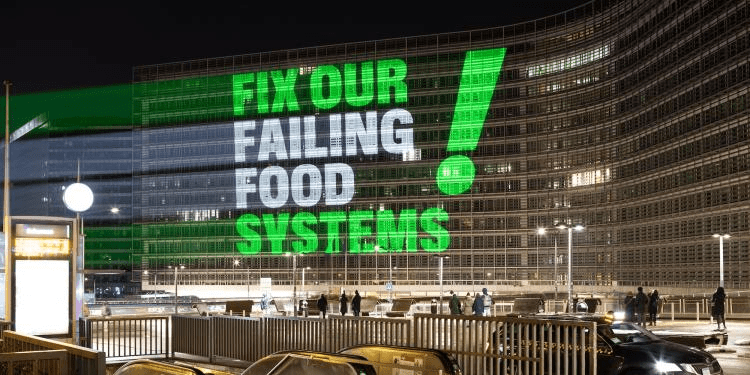
On Sunday night, the European Commission headquarters in Brussels were lit up with bright lights beaming a clear message to EU policymakers: fulfil your promises on the Farm to Fork Strategy and the urgent transition toward sustainable food systems.
Against the backdrop of the EU Agricultural Outlook conference, a major European Commission event on food and farming, some of Europe’s largest green NGOs and consumer associations joined forces to call out the European Commission on its failure to deliver both its promised proposal on the framework law for sustainable food systems (SFS) and its revision of the outdated animal welfare legislation.
As a cornerstone of the EU Green Deal, the Farm to Fork Strategy included a series of vital policies and initiatives to address the growing overlapping crises surrounding the state of our environment, people’s health, and the welfare of animals.
The action’s name “Broken Promises” hints at the State of the Union speech Commission President Ursula von der Leyen delivered last September. The speech’s motto was “Promises kept”, which is only partly true. While the Commission has shown partial commitment to delivering on some policies, two major promises remain glaringly absent: the framework law for sustainable food systems (SFS Law) and the revision of the animal welfare legislation.
Intensive unsustainable farming systems are the cause of immense animal suffering. Chickens, fish, pigs, and many more species are being treated as commodities and products in order to produce cheap and unhealthy meat and dairy as quickly as possible. Evidence shows that this industrial system harms everyone: animals, the planet and humans. As showcased by many ECIs and polls, citizens want change. And the good news is that change is perfectly possible if policymakers dare to take the right decisions and challenge the harmful status quo. Frontrunners in animal farming are leading the way. The time is now for the European Commission to make a firm commitment and make progress on the legislation.
Reineke Hameleers, CEO, Eurogroup for Animals
A food system which is making unhealthy diets the norm is not only causing ill health for consumers across Europe, it is also harming our planet. This same system has allowed food waste in Europe to pile up to record levels, at a time when more and more Europeans are going to bed hungry. The EU must do everything it can to make the sustainable food choice the easy, attractive, and affordable one. And the SFS law is the first step to do so.
Monique Goyens, Director General, European Consumer Organisation (BEUC)
Instead of promoting the health of people and planet, our food systems contribute to a huge burden of ill health and early death, it massively increases the risk of anti-microbial resistance, and contributes to climate change and environmental degradation. The EU must urgently recraft its food systems so that human and planetary health are protected. Making healthy sustainable food choices the easy, default option IS an option.
Dr Milka Sokolovic, Director General, European Public Health Alliance
A key pillar of the European Commission’s Farm to Fork Strategy, the SFS Law is a unique opportunity for this European Commission to pave the way for a future where everyone has access to healthy and sustainable food, farmers are supported, ecosystems are protected, and animal rearing is not defined by suffering. The Commission must fulfil its duty to people and planet and deliver this vital proposal – as well as its promised revision of EU animal welfare legislation – before the end of its mandate.
Faustine Bas-Defossez, Director for Nature, Health and Environment at the European Environmental Bureau
From Mark – there is a lot to absorb here from Reineke – I started to underline and bold main points; but almost ended by doing everything !! – thus I stopped. Bad news all round whatever, but what else would you expect from the EU ? – Regards Mark
Photo – PMAF (France)
1 December 2023
Opinion
Written by Reineke Hameleers
A revised Regulation on live animal transport, possibly together with rules on cat and dog breeding, is the only piece of updated legislation that will be put forward in this political term. This is at a time when we, and millions of European Citizens, fully expected the European Commission to deliver on its firm commitment to revise all animal welfare rules.
It is, therefore, all the more striking that the leaked Commission’s legislative proposal on the transport of animals is even less ambitious than we could have imagined.
The general tone is that ‘animal welfare is a common good, but business is business and as few obstacles as possible must be put in its way’. Perhaps the most evident proof is that the extremely controversial live exports to non-EU countries are here to stay, albeit with more restrictions, most notably on the vessels that can be authorised for sea consignments. There is even an explicit recognition that this is a lucrative sector and that someone else would profit from it if the EU decided to withdraw.
The draft Regulation appears to ignore the European Court of Justice Ruling (C-424/13) establishing that animals must be protected according to EU legislation until their final destination, within or outside the EU territory. According to the new draft rules, the operators who should be reporting any animal welfare problems are the same people in charge of the animals during the journey. The same people who are profiting from the business. We can only imagine how eager these operators will be to report their own violations to the competent authorities.
For the rest, the alignment with the recommendations of the latest scientific opinions commissioned to the European Food Safety Authority (EFSA) is inconsistent, and some of the requests of the Animal Transport Committee of the European Parliament (ANIT) have been disregarded. True, the leaked draft includes some positive elements, among which the most important are the proposed lower maximum journey times for most species, updated space allowances, compulsory real-time traceability of all road journeys, and the minimum age of five weeks for transporting unweaned calves. But, as is often the case, the devil is in the details, and those details are concerning.
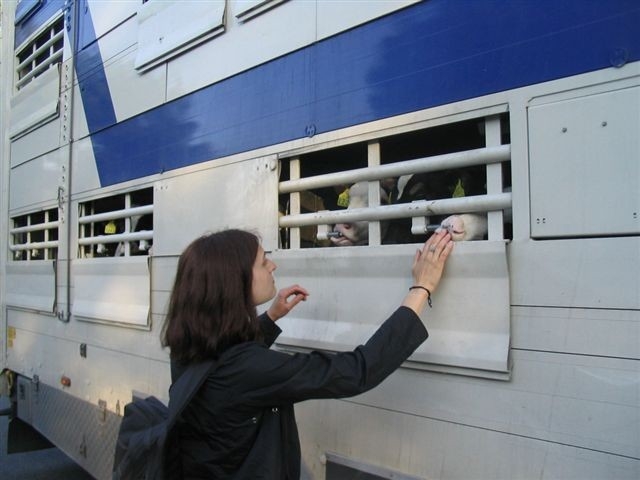
To start with a striking example, unweaned animals (calves, lambs, foals, etc.) are recognised as vulnerable but, thanks to a derogation, can still be transported for two consecutive 9h periods with a 1h period of rest in between (so 19h in total) if the trucks are equipped with specific feeding devices – whose effectiveness the Commission intends to “verify”. As if this weren’t enough, when the journey of unweaned calves is roll-on, roll-off (RORO, meaning that the trucks are partially transported by sea), the time spent at sea is not included in the total journey calculations – as if hunger, dehydration, and exhaustion in unweaned animals (and indeed, in all animals) were not time-dependent. This provision, which is so damaging it beggars belief, to all effects legitimises the Irish dairy calf export trade, which in 2022 involved 153.000 calves (for 2023, the numbers have already increased by 30,000 animals). Dairy calves are sent on 18h RORO crossings to be further transported to fattening or slaughter to international destinations. The current requirement to rest the animals for 12 hours after a long RORO crossing apparently disappeared from the new draft Regulation. Another favour to the industry in plain sight. There is also no real consideration for end-of-production (ie, cull) or pregnant animals, two additional vulnerable categories.
Only animals that are fit for transport should start a journey. However, although fitness for transport is a prerequisite before an animal can be loaded (and it should be guaranteed for the entire journey), the proposal does not provide any concrete and species-specific ways to assess this fitness. EFSA had proposed a series of animal-based indicators in its last scientific opinions: for instance, severely lame poultry or poultry with open wounds/prolapses, broken legs or wings should not be transported. Similarly, severely lame cattle or cattle with pneumonia should be considered unfit for transport. The operators cannot make informed decisions without clear and species-specific indicators of reasons for excluding a vulnerable animal from starting a journey. The draft Regulation only mandates the use of (yet-to-be-defined) indicators at the destination, but this is insufficient to protect animal welfare for the whole journey.
Other shortcomings concern the allowed minimum and maximum temperatures for transporting animals. Again, looking at the most recent EFSA recommendations, the proposed ranges of temperatures, particularly the maximum allowed ambient temperatures (30 degrees) for transports during the daytime, are inadequate to guarantee animal welfare. For farmed animals there is no mention of minimum and maximum allowed temperatures inside the trucks or containers, nor does the draft mention compulsory monitoring systems for microclimate inside the vehicles (again, ignoring EFSA’s recommendations).
All the while, contingency plans, while mandatory, are not described in any detail, posing another hazard to animal welfare in case of traffic disruptions, extreme weather conditions, accidents, disease outbreaks, etc. Throughout the text of the new draft, there is a strong emphasis on the responsibility of organisers, drivers/transporters and staff at the final destination for the welfare of the animals in their care. This is also present in the current Regulation, and it begs the question of why commercial operators should denounce themselves to the competent authorities if their failure to enforce the Regulation leads to animal welfare problems.
Is it all doom and gloom, then? This proposal does have some progressive elements, particularly concerning the real-time traceability of each live animal consignment (which would become compulsory) and the recording of relevant data for enforcement purposes. Additionally, we welcome the proposal that ships flying “black flags” (severely sub-standard), which at the moment constitute 55% of the EU-approved livestock transport fleet, would no longer be allowed to operate. Only ships flying a white or grey flag (good or average performance) would be able to obtain the relevant authorisation certificates. The Commission intends to exercise more control over live animal transport data, but how the data will be used is still unknown, also because they will not be publicly available. The scope is extended to aquatic animals and recognises the most important aspects for their welfare, however, a delegated act will be required to introduce measurable and species-specific requirements, or there will be no impact on aquatic animals from the text in this draft.
When it comes to companion animals (cats and dogs) the draft presents new species-specific criteria but some provisions are generic and vague. While it’s good to see that the minimum age has been set at 15 weeks, it’s astonishing that there is still no maximum journey time. This means that cats and dogs, even pregnant ones, can be transported for days and days, and the only requirement is to feed them “at least every 24 hours”.
For animals transported for “scientific purposes”, the details remain again vague. There are limitations: only a proportion of these animals would benefit from such protection. The animals used in projects authorised under Directive 2010/63/EU would remain unprotected. Animals that are transported by air, as non-human primates that are imported to EU laboratories, and vulnerable animals, as for example certain genetically altered animals, and animals that have undergone surgery also seem to miss protection under this proposal.
Will animal welfare be substantially improved should this draft become legislation? From our analysis, the answer is no.
The King issued a call to arms, warning dangers facing us are ‘no longer distant’
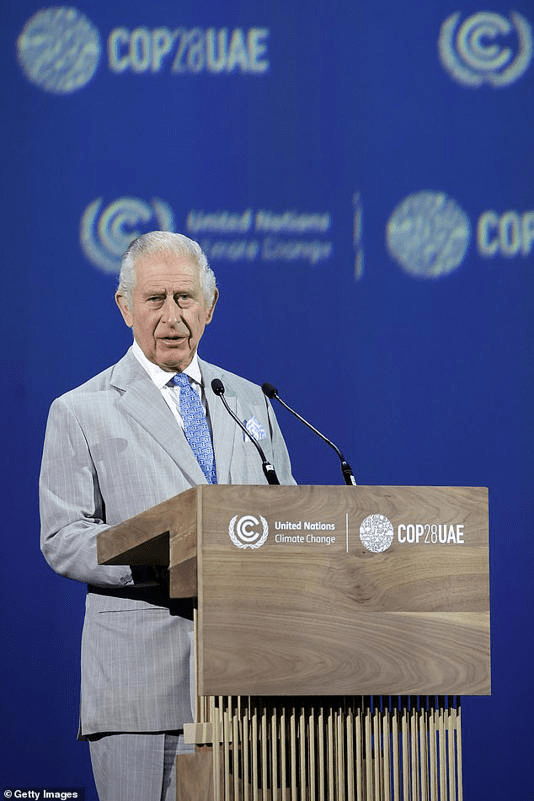
King Charles warned yesterday that man is carrying out a ‘vast, frightening experiment’ on the planet and our grandchildren ‘will be living with the consequences of what we did or didn’t do’.
In his opening speech to the Cop28 climate summit in Dubai, the monarch issued a call to arms, warning that the dangers facing us ‘are no longer distant risks’ and urging global leaders to commit to ‘transformational action’
Photo – Getty Images.
The King was the only head of state to be independently invited to address the gathering of world leaders in recognition of his lifelong environmental campaigning.
Once derided as a green eccentric, many of his beliefs such as organic farming and campaigning against plastics in the ocean have become mainstream policy.
Speaking to more than 60 prime ministers, politicians and presidents, Charles said: ‘I have spent a large proportion of my life trying to warn of the existential threats facing us over global warming, climate change and biodiversity loss.
We try to avoid using the word “miracle” in our newsletter and social media posts, even though there are plenty of times when we’re tempted to use it–when we thought a cut was too deep, the cancer too advanced, the damage from maggots too pervasive for the animal to heal. But we usually choose not to say “her healing was a miracle” because we feel it discounts all the effort and hundreds of combined hours of human help that make the healing possible. But yet, there is something more than the sum of its parts, taking place in the relationships that make everyone coming together to help animals a family, a team, a group of friends, whose affection is sealed by our shared love of animals.
And now we want to use that very word: the miracle of friendship. There is an unspoken understanding between all who care for animals, many who have sometimes been deeply misunderstood. Your love, our love of animals, is not casual. It hovers within us at all times. An animal’s smile turns our hearts to mush; the abuse of an animal astonishes and ignites us. These are what forge this miracle of friendship we experience together.
May all the blessings of peace rain down upon us all as we continue rescuing these vulnerable animals from injuries, illnesses, and abuse, and may our hearts, too, find deep happiness in their recoveries. Thank you for your gifts of help, and for your gifts of friendship to Animal Aid and to the thousands of others weaving this beautiful blanket of compassion.
A mere rubber band almost ended Chicky’s life.
We were stunned to see that a rubber band could so horribly injure this puppy’s neck. The rubber band penetrated deep into the tissue and caused a horribly painful and deep wound.
As soon as we had Chicky on the treatment table of course we cut the rubber band off, and although the removal stung a bit, we suspect that relief was almost immediate. We then treated the wound like any other serious laceration, and supported her with antibiotics, a hydration drip, food and–yup, cuddles! It took her a couple of weeks to no longer need the bandage, but we were thrilled at how quickly her little body healed.
Turned out, to no one’s surprise, that Chicky is a huge love bug, eager to forget her weeks of pain, ready to leap into a long happy life ahead.
Help us say “We can fix this!” – make a donation today for street animal rescue.
Pihu’s sparkling eyes say “I survived cancer!”
If you’d just looked at Pihu’s eyes, you wouldn’t know she was dying. But the advanced cancerous tumor on her backside was slowly taking this beautiful street dog’s life. The cancer type is called a Transmissible Venereal Tumor, (TVT) and it usually affects the reproductive areas.
A several months’ course of weekly chemotherapy was necessary to shrink the tumor. But such therapy is not always successful, and the more advanced the tumor is, the more difficult the recovery. If a dog’s overall condition has been greatly weakened by the cancer, he or she cannot always be saved. But Pihu is as strong as she is sweet, and she inspires love to last a lifetime–and hers, we hope, will be a long one.
For the ones who need so much more than just medicine to recover – Make a donation today.
Haldi’s tail thumped in hope, just when her life was in gravest danger…
Beyond Haldi’s huge neck wound, her tail wagged, as if pleading for help. When our rescue team arrived, we found her unbelievably gentle despite her terrible pain. She would need surgery as soon as possible, so once back in our hospital we cleaned and put on a temporary bandage at the site of the worst of her wounds (she also had a less serious wound on her hind leg).
Once the operation was complete, Haldi’s rapid healing simply galloped along. And Haldi made her wound dressings a breeze, she was just so full of trust and love. All healed, meet the strong, radiant Haldi now!
When surgery is their only hope, let’s be there. Please donate.
…These are a few of your fav-o-rite things….
Your purchase is a gift to your friends, yourself, and best of all, to animals.
100% of the proceeds go to our street animal rescues.














 World Animals Voice