Day: February 12, 2024

Hong Kong: Hong Kong poachers are leaving more illegal traps in nature areas to catch wildlife, with stray dogs paying the price.

Hong Kong poachers are leaving more illegal traps in nature areas to catch wildlife, with stray dogs paying the price: animal rights group (msn.com)

Hong Kong poachers are leaving more illegal traps in nature areas to catch wildlife, with stray dogs paying the price: animal rights group

Story by Lo Hoi-ying  • 9h

Poachers place traps on quiet mountain trails, targeting animals such as foxes, porcupines and wild boars

Wild boar concern group says current penalties for illegal poaching aren’t tough enough to deter culprits

More illegal traps have been found in nature areas across Hong Kong as poachers find it easier to obtain and set them up, according to an animal rights group.

The Society for the Prevention of Cruelty to Animals (SPCA) said it found 31 illegal traps last year, up from 24 in 2022 and 20 in 2021. Last month alone, it found 21 traps at various places.

The society’s chief inspector, Desmond Tsang Ka-lun, said poachers usually placed traps on mountain trails less popular with hikers, targeting wild animals such as foxes, porcupines and wild boars.

Do you have questions about the biggest topics and trends from around the world? Get the answers with SCMP Knowledge, our new platform of curated content with explainers, FAQs, analyses and infographics brought to you by our award-winning team.

Stray dogs often end up trapped and most are found alive but injured, he said. SPCA vets tended to the rescued animals and assess whether they were suitable for adoption after they healed.

The Post accompanied the group on a rescue mission on January 30, after it received a report of a stray dog trapped in the hills near Shing Mun Reservoir in Tsuen Wan.

Two SPCA officers abseiled down a slope to rescue the mongrel, which had its right front paw caught by a wire trap. It was whimpering with its right front leg swollen.

The team also found shredded bread, dried squid and fish hanging on a tree nearby, which it believed was left by poachers to attract wild boars.

On January 17, two dogs were found trapped within 10 metres (32.8 feet) of each other in Sha Tau Kok in northeastern New Territories, both with paws caught in traps.

SPCA officers rescued the dogs and found 12 illegal traps in the area, including many with metal wires and snares.

Tsang said the illegal traps were not only available online but also easy for poachers to carry and set up.

“The traps have become more minimal and can easily be bought online and hidden in their bags,” he said. “The new ones, which trap the animals’ legs, only require some metal springs, wires and worm gears to construct.

“It is not illegal to buy these parts, but when they are put together and built into a trap to cause hurt to animals, they breach the law.”

He believed the poachers’ main targets were wild boars, which they wanted for their meat.

Media reported last month that a villager in Loi Tung East Village was seen butchering wild boars believed to have been trapped illegally.

Last March, the Agriculture, Fisheries and Conservation Department found 11 cage traps on a hillside near Po Lam Estate in Tseung Kwan O.

A leopard cat was discovered ensnared in one of the cages and sent to the Kadoorie Farm and Botanic Garden.

A department spokesman said it had seized more than 750 hunting appliances in the past five years, including 137 last year.

The department prosecuted eight cases in 2021 with fines ranging between HK$400 (US$51) and HK$2,400, while five cases were prosecuted and ended in convictions in 2020, resulting in fines between HK$300 and HK$1,000, he said.

The department prosecuted two cases last year, and investigations were ongoing.

Unless a resident holds a special permit, it is illegal to possess any hunting appliance and hunt wild animals in Hong Kong, with offenders facing a maximum fine of HK$50,000.

The hunting of wild animals listed as protected species carries a maximum fine of HK$100,000 and one year’s jail time. Possessing and using hunting appliances are banned at country parks, and offenders face a maximum fine of HK$2,000 and three months in prison.

Porcupines, muntjac deer and leopard cats are considered protected wild animals, but not Hong Kong’s estimated 2,500 wild boars, said Roni Wong Ho-yin of the Wild Boars Concern Group.

The Agriculture, Fisheries and Conservation Department began euthanising wild pigs in November 2021 after a spike in incidents of boars attacking people and entering urban areas. It has culled 895 boars since then.

Wong, whose group objects to culling, said villagers in rural areas had long been known to hunt boars, but the situation had worsened since the department action.

“We feel that since the government rolled out the wild boar cull, people have been taught to see them as our enemies and feel it is all right to take action against them,” Wong said.

“Of course in rural areas, there has been a tradition of farmers or villagers hunting wild boars for food, or trapping them to prevent them from digging up crops.”

He said villagers usually hunted wild boars for their own consumption or sold the meat to other villagers or local eateries that served wild game illegally.

Wong felt current penalties were not enough of a deterrent. “The government must raise the penalties, step up patrolling and actually enforce the law to target these illegal hunters,” he said.

The conservation department said it had not received reports of restaurants selling boar meat hunted locally.

Ibrahim Elsohaby, an assistant professor at the department of infectious diseases and public health at City University, said that wild pigs were a significant source of diseases transmitted from animals to humans.

They were known to carry about 30 viral and bacterial diseases and almost 40 parasites, posing the risk of transmission to people, pets, livestock and other wildlife, he said.

Eating undercooked wild boar meat was a common way for disease-causing viruses and parasites to pass to people, causing swine flu, salmonella and some life-threatening conditions.

The health risks multiplied when poachers retrieved trapped animals long after they had died and begun decomposing, he said.

Regards Mark

England: London; Are You An Animal Lover ? Or Just Some Really ?.. – So Make The Connection.

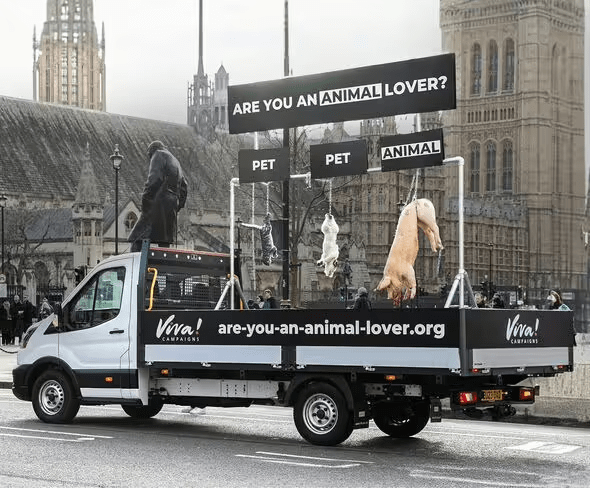
Animal rights activists staged a protest in London (Image: SWNS)

WAV Comment – Completely behind this protest; it is about time that people opened their eyes to what goes on with meat production and the killing of animals involved.   As Juliet says – Tens of millions of people in the UK eat factory farmed animals but very few are happy to look at them dead, see how they are farmed or witness how they are killed.

Well now they can see them dead; so MAKE THE CONNECTION !

———————————————–

Animal rights activists launch horrific protest as they hang dead dog, cat and pig on van

The awakening call was carried out by farm investigations group Viva! across various London landmarks – including the London Eye, Trafalgar Square and Parliament Square

Continue reading at:  Animal rights activists launch horrific protest as they hang dead dog, cat and pig on van | UK | News | Express.co.uk

Juliet Gellatley, said: “As a society we treat cats and dogs as part of our families but see animals such as pigs, chickens and cows as commodities. Tens of millions of people in the UK eat factory farmed animals but very few are happy to look at them dead, see how they are farmed or witness how they are killed.

Regards Mark

Picture – WAV Archive

Driving Change: Women In Non-Animal Research. International Day of Women and Girls in Science – 11/02/24.

11 February 2024

February 11 was International Day of Women and Girls in Science, a reminder that women play a critical role in science and that their participation should be strengthened. We are celebrating one of the women who help change science for the better by delivering humane science through the exploration of non-animal approaches; the winner of our grant to attend the European Commission’s Joint Research Centre (JRC) summer school.

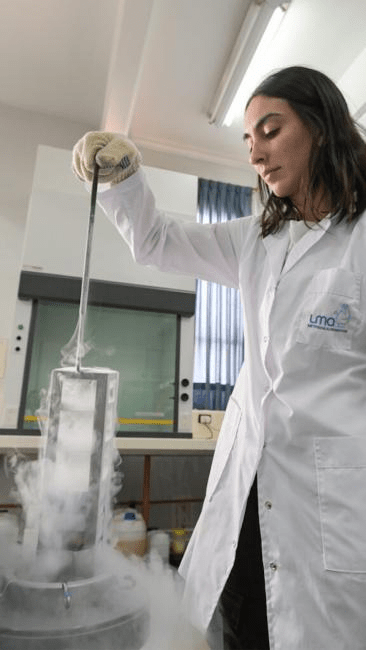
Martina Benedetti is a PhD student working in the pioneering laboratory for alternative methods in Argentina.

Can you tell us more about yourself and your journey as a PhD student?

Our primary mission in the research group is to pioneer the introduction of validated methodologies, a significant first for Argentina. This initiative aims to provide non-animal testing services to the local industry. Beyond that, our focus extends to the development of new methodologies and the refinement of strategies, all geared towards gradually replacing the reliance on animal testing that regulatory bodies still mandate. Of course, being part of a pioneering laboratory in my country has been challenging but also very rewarding. Overall, I think my journey is led by a strong desire to contribute to the advancement of humane and effective scientific practices in Argentina. So far, it has been a very fulfilling experience!

What are the main goals of your research?

My research focuses on modelling the eye using in vitro techniques to assess the reversibility of potential damage when the eye is exposed to a toxic substance. 

More into detail, my project consists of designing a model to help replace animal use on ocular toxicity testing implementing stem cells as well as 3D culture. We are studying the cornea architecture and function in vitro to test different chemicals and evaluate the damage they produce on the organ and its potential damage reversibility. This is important because the available alternative methods do not allow documenting the reversibility of the damage, let alone the time necessary for such reversibility to occur, as required by the UN GHS classifications. 

Last year, you won the travel grant offered by Eurogroup for Animals and the RSPCA to attend the JRC Summer School. What are the main things you learned from this event?

As a participant in the JRC Summer School, I gained valuable insights into in vitro methods and computational modelling that were new to me. The program allowed me to gain a comprehensive understanding of innovative techniques through expert presentations, which was very valuable for me as there are no scientific activities in Argentina that deal with these topics. The debate sessions were also very interesting for me, as we focused on real issues that are being discussed today by the experts in the field (In our case, we had to argue that setting an annual cap on the number of animals used for research is the best way to reduce the use of animals in science).

I should also mention that the visit to the EURL-ECVAM laboratories was great! It provided a practical dimension that allowed me to experience first-hand the application of the methods available. I am particularly grateful that the summer school also provided me with an excellent platform for exploring career paths and building a professional network, which enhanced my overall understanding and connections in the field.

What inspires you to use your scientific expertise to advance non-animal science?

My inspiration stems from a commitment to ethical research practices and a desire to contribute to more sustainable and humane scientific advances. Ethically, I am motivated to contribute to research practices that meet modern standards of compassion and responsibility. Scientifically, I am driven by the prospect of developing and implementing methods that not only eliminate the need for animal testing, but also provide more accurate and relevant results for humans. In addition, I think it is particularly motivating to make progress in this area in Argentina, as in my country we are taking the first steps towards researching non-animal methods, which of course motivates my work even more.

On International Day of Women and Girls in Science, what message would you like to send to women who, like you, want to accelerate the transition to human-based, non-animal science?

I want to encourage and empower my fellow women. Let your passion for innovation guide you and bring your unique perspectives to the field. Seize the opportunities to collaborate, learn and lead, because our collective efforts can make a meaningful difference. I think we can all agree that advances in research should go hand in hand with compassion for all living beings. So, let’s strive together for ethical and sustainable scientific practices. Your commitment can make a significant contribution towards a more humane and effective scientific landscape.

Happy International Day of Women and Girls in Science!

Regards Mark