Month: March 2024

Netherlands: Animal Rights Groups Slam “Better Life” Meat Label.

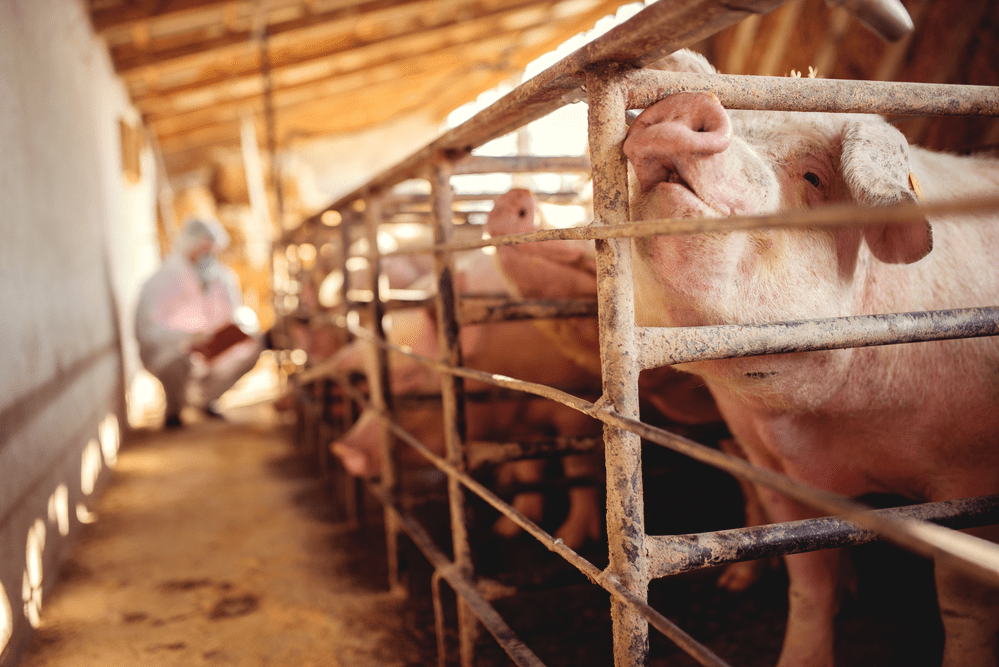
Pigs on a factory farm. Photo: Depositphotos.com

The meat label Beter Leven (better lives) is misleading consumers and needs a complete overhaul, several animal rights groups have told the AD newspaper

The label, which consists of one, two or three stars, was developed by animal protection group Dierenbescherming but does little more “than make meat eaters feel better about themselves”, the paper said after an investigation.  

Animals producing one-star meat are supposed to have a little more room and things to do than those on unregulated factory farms. Two star animals can go outside and three star are either organic or kept in an animal-centric system. 

But, according to Niko Koffeman, chairman of wildlife protection group Faunabescherming, the system rests on ‘marginal welfare improvements” and wrongly gives the impression the meat is raised in an animal-friendly setting. 

In reality, the animals are “locked in, exploited and slaughtered in a most gruesome manner,” he said. 

Campaign group Animal Heroes said the label is, however, leading to a change in mentality. “As long as people eat meat we should cherish every improvement, no matter how small,” spokeswoman Mony de Roos told the paper.

Varkens in Nood (pigs in need) said it did not want to stop use of the label either but expressed major doubts about the “one star” system. “When it comes to pigs, it is pretty standard in factory farming. Tails are still burnt off, sows are confined to cages. That is nothing to do with a quality label.” 

Militant campaign group Animal Rights, however, says people use the labeling system as an excuse to continue eating meat and dairy. The label’s inventor Dierenbescherming is on the wrong side of the debate, the organisation says. “They have become part of the livestock industry and that conflicts with the interest of animals. They only protect dogs and cats.”

Dierenbescherming told the paper it had no intention of stopping with the label but that it is assessing what improvements could be made to the criteria for inclusion. “Questioning the label is protecting the mainstream livestock industry,” the organisation said. “They can happily go on their way producing mainstream, animal-unfriendly meat.”

The label has been often criticised since it was introduced in 2007 and in 2021 the advertising standards authority ordered a radio advert by Dierenbescherming to promote “three star beef” off air for being misleading.

Recent research by national statistics agency CBS showed that just 5% of the population eat no meat but the number of people eating vegetarian meals regularly has gone up. One in four meals on Dutch dinner tables is now meat free. 

Regards Mark

Animal rights groups slam “better life” meat label – DutchNews.nl

UK: ‘Cruel’ Test Which Sees Animals Forced To Swim Until They Are Exhausted Could Be Banned.

Ministers have stepped in to tackle a scientific test which has been branded as “worthless cruelty”. The forced swim test sees animals placed in small jars of water and then left to swim until they are exhausted.

Some scientists have claimed it gives valuable insight into depression however animal rights campaigners have long fought for it to be banned saying it gives no valuable results. Animal rights charity Peta, on its website said it was “worthless cruelty”.

Now the Home Office has said it is to restrict the use of the test – and will seek to ban it completely. In 2022 the Home Office asked The Animals in Science Committee to investigate the test and after it drew up a list of recommendations the government has issued its response. In a letter Lord Sharpe of Epsom, Parliamentary Under Secretary of State for the Home Office, said their advice was being accepted.

He said: “As the Minister responsible for the regulation of animals in science in Great Britain, I accept the committee’s recommendations. The Home Office will further restrict the use of the forced swim test, as recommended by the committee, and apply enhanced scrutiny to any proposal to use the forced swim test.

“I have requested the animals in science Regulator to implement the relevant recommendations to regulation through making changes to operational processes and guidance to applicants and regulated establishments, as appropriate. However, I intend to go further. I aim to completely eliminate the use of the forced swim test.

“This will require the validation of suitable appropriate alternatives. I have therefore written to the Minister for Science, Research and Innovation at the Department for Science, Innovation and Technology (DSIT) and the Chief Executive of UK Research and Innovation (UKRI) to request that they consider what actions they can take to enable a complete ban on the use of the forced swim test in the near future. He added most actions would be in place by the end of March this year.

The move comes as measures were signed into law top ban people keeping primates – animals such as monkeys, apes and lemurs – as pets. The legislation brings in a licensing scheme setting strict rules to ensure that only private keepers who meet new welfare and licensing standards will be able to keep primates, delivering on a manifesto commitment and Action Plan for Animal Welfare pledge to provide greater legal protection for pet primates.

The measures come into force from April 6, 2026 when all primates in England will need to be kept to these zoo-level standards – in effect banning the practice of keeping primates as pets. It is estimated that up to 5,000 primates are currently kept in domestic settings as pets in the UK.

These wild animals have complex welfare and social needs and, according to most experts, cannot be properly cared for in these environments. The new measures will improve the welfare of potentially thousands of these intelligent animals.

RSPCA Head of Public Affairs David Bowles said: “Meeting the needs of monkeys and other primates is practically impossible to do in a household, domestic environment. That’s why this legislation will be a really important moment for animal welfare – ensuring primates can only be kept in an appropriate environment, as we all strive to create a better world for every animal.

“Too often, our dedicated officers are called to properties where monkeys live in the wrong surroundings, eat totally inappropriate diets and are at risk of suffering behind closed doors. This new law has the potential to change that.”

Under the law all private primate keepers will be required to hold a licence, issued by their local authority, with failure to comply with licence conditions resulting in an unlimited fine or removal of the primate. Defra will work closely with local authorities to make sure that they have the appropriate tools and guidance to ensure that enforcement will be carried out effectively.

Regards Mark

‘Cruel’ test which sees animals forced to swim until they are exhausted could be banned (msn.com)

EU Policies Need To Support Dietary Shifts, Sustainable Farming To Tackle Climate Change.

13 March 2024

Press Release

As a new report stresses that Europe is not prepared for rapidly growing risks related to climate change, the EU action plan should include concrete policies that reduce the number of animals farmed for food, prioritising resilient farming practices with higher animal welfare and supporting a shift to plant-based diets.

In response to the publication of the first-ever European Climate Risk Assessment by the European Environment Agency (EEA), which analysed the risks of climate change in the EU and the areas which need to be imminently addressed, the European Commission (EC) has issued a Communication putting forward suggestions for actions in six impact clusters, among which are ecosystems and food.

Among the most severe risks that Europe is facing are the ones related to crop production: two-thirds of the EU’s agricultural land is used for animal production, of which most is for the production of crops for intensively farmed animals. Future-proof and nature based solutions can only be achieved by raising fewer animals with higher welfare conditions. This is supported by a Harvard Law School study, published today, that clearly states that emissions from livestock production should fall rapidly as of 2025. 

While the EEA report clearly highlights that current EU policies fail to address climate risks effectively, the future of important EU legislative commitments that would improve resilience, such as the revision of the animal welfare legislation and the sustainable food systems framework, remain uncertain. 

The EC Communication recognises that actions towards sustainable agriculture and fishing will not be enough to address climate risks, and there is a need for long-term policies that support dietary shifts, making healthy and sustainable food affordable and accessible. It is therefore disappointing that the recently published 2040 climate target does not sufficiently recognise the role of shifting diets, or the significant impact of agricultural emissions from animal farming

With growing evidence that systematic shifts are required to address climate risks to food production, ecosystems and health, increased EU efforts and binding policies that can support this transition are imperative.

Repeatedly, science shows us that maintaining the status quo is not an option. Only by raising fewer animals with higher welfare conditions and creating food environments that support dietary shifts can the EU truly address imminent climate risks. Unfortunately the proposed derogations in the CAP’s environmental measures will lead us further away from climate change adaptation and resilience. To support the transition and investments in future-proof solutions, the EC must come forward with the promised legislative proposals on animal welfare and the framework for sustainable food systems, without further delays.
 

Camilla Björkbom, Food Policy Political Adviser, Eurogroup for Animals.

Regards Mark

USA: Persistent Animal Welfare Violations’: Aquarium That Housed Lolita The Orca Faces Eviction.

‘Persistent animal welfare violations’: Aquarium that housed Lolita the orca faces eviction (yahoo.com)

‘Persistent animal welfare violations’: Aquarium that housed Lolita the orca faces eviction

Freida Frisaro And David Fischer

Fri, 8 March 2024

The Miami Seaquarium, an old-Florida style tourist attraction that was home to Lolita, the beloved Orca that died last year, is being evicted from the waterfront property it leases from Miami-Dade County.

County Mayor Daniella Levine Cava cited a “long and troubling history of violations” in a lease termination notice sent on Thursday to the chief executive officer of The Dolphin Company, which owns the Seaquarium. The company was told to vacate the property by 21 April, according to the letter from the mayor’s office.

“They have been the subject of continuous violations, including decaying animal habitats, lack of veterinary staff and a lack of other experienced staff,” Levine Cava said during a news conference Thursday.

“Our number one priority continues to be the safety and wellbeing of the animals,” the mayor said.

Seaquarium deemed ‘unsustainable and unsafe’

Seaquarium officials sent a letter last month to Levine Cava, inviting her to visit the park so she could witness the animals’ wellbeing for herself. The county had advised the park in January that they were looking to terminate the park’s lease following a review from the US Department of Agriculture, which regulates the treatment and care of captive animals.

Eduardo Albor, CEO of The Dolphin Company, showed up at the news conference and told reporters he doesn’t understand why the mayor has refused invitations to the Seaquarium.

“How can she say that she’s concerned about the animals when she has never come to the Miami Seaquarium in two years?” he asked.

Levine Cava said during the news conference that representatives of the county’s parks department have made regular visits to the park over the past year and a half.

“The current state of the Miami Seaquarium is unsustainable and unsafe,” Levine Cava said.

The Seaquarium could fight the eviction

The Seaquarium could still fight the eviction. A judge would need to declare the park in compliance with their lease.

Albor said on Thursday that he plans to let his lawyers respond to the eviction notice.

“I will just let our lawyers defend our rights because it is offensive to speak about my people,” Albor said.

The action follows a series of federal inspections that found multiple problems at the Seaquarium, including unsafe and structurally deficient buildings.

“The US Department of Agriculture’s reports since 2022 also consistently identified that several structures have not been maintained properly, and that creates dangerous conditions and in many cases have resulted in injury,” the mayor said.

The Seaquarium was home to Lolita the orca

The Dolphin Company, based in Mexico, had agreed to help move Lolita to a natural sea pen in the Pacific Northwest when it took over ownership of the Seaquarium in 2022. Lolita, also known as Tokitae, or Toki, died on 18 August at age 57.

Animal rights activists had sought Lolita’s freedom for years. The orca spent much of her life in tank a that measures 24 meters by 11 meters and is six meters deep, and stopped performing in shows at the Seaquarium in 2022.

A coalition that included Indianapolis Colts owner Jim Irsay worked on the plan to move Lolita back to the Pacific Northwest.

A necropsy cited kidney failure as the cause of Lolita’s death. The necropsy also found Lolita suffered from acute and chronic bronchointerstitial pneumonia and renal degeneration, as well a chronic condition of the heart implying the degeneration of the cardiac valves.

At long last, authorities are taking action against the persistent animal welfare violations at Miami Seaquarium.

“At long last, authorities are taking action against the persistent animal welfare violations at Miami Seaquarium,” says Dr Naomi Rose, senior scientist in marine mammal biology for the Animal Welfare Institute’s Marine Life Program.

“This run-down facility has been a blight on Miami for too long. We hope the zoo and aquarium community steps up to the plate to ensure all of the animals – the mammals, birds, fish – find acceptable homes in US facilities.”

The Seaquarium opened in 1955 overlooking Biscayne Bay and was among the first theme parks devoted to marine life. It garnered international attention in the 1960s when the television series ‘Flipper’ was filmed there.

Regards Mark

Belgium: GAIA exposes cruelty towards calves in Belgium’s dairy industry.

11 March 2024

GAIA

Je veaux de l’amour – le triste sort des veaux issus de l’industrie laitière on Vimeo

In the dairy industry, cows are repeatedly inseminated to stay pregnant in order to produce milk. Their calves are considered by-products, and are taken from their mothers to be reared in lonely environments. Each year, over 300,000 calves are raised and slaughtered in Belgium.

GAIA’s campaign dives into the Belgian dairy industry, revealing how calves are badly treated, isolated, and reared in unhygienic and depressing conditions. 

Their video provides a glimpse of some of the biggest problems faced by calves:

  • Taken from their mothers only a few hours after birth, causing intense emotional distress to both mother and child 
  • Locked in tiny, individual pens for the first weeks of their lives, where they have barely any room to play, exercise, or interact with others 
  • Transported to fattening sheds two weeks after being born, while their immune systems are still vulnerable 
  • Fed unbalanced diets, causing sickness and digestive issues which then contributes to a filthy environment due to the amount of waste produced
  • Slaughtered while they are still very young

Video Link:

https://player.vimeo.com/video/911155338?autoplay=0 A closer look at Belgium’s cruel treatment of calves

Though cows have a life expectancy of around twenty years, a huge number of calves in Belgium’s dairy sector are sent to slaughter when they are only between the ages of six to eight months, cutting their lives incredibly short. 

Some are killed in Belgium, while others are transported abroad to be fattened and slaughtered – but around 12% of them die even before they reach the slaughterhouse, exceeding the average mortality rate for all livestock combined (3 – 5%), according to GAIA

These deaths can be linked to the poor conditions in which they are reared and the physical and emotional stresses of being transported alive.

Looking to a brighter future for calves 

In Norway, Sweden and the Netherlands, organic farmers let calves stay with their mothers, or “foster cows”, for much longer periods than those allowed in Belgian factory farms – sometimes several months.

Change could also be inspired in the industry if there was a widespread dietary shift across Europe, which would have numerous knock-on benefits for animals, people and the planet in Member States and beyond. 

GAIA’s campaign re-emphasises further the critical need for the European Commission to deliver the full revision to the animal welfare legislation. Current laws for animal welfare are vague, unenforceable and outdated, allowing for farming practices such as those explored above that cause countless sentient beings to suffer. We need species-specific laws in place for all sentient beings to ensure their welfare. 

The fate of the EU’s animals rests with its policy-makers… so it’s important that those elected to the European Commission this year care about their welfare! Tell your local candidates that you’ll be voting for those committed to animal protection here.

Regards Mark

(CN) Life Education

Certainly an overdue development in a country so lacking in compassion and respect for life – Animal and Human.
“Let children know from an early age what life and death mean. Foster respect, cherish, and revere life, promoting the value of life and fostering love for others and animals.”

As we’ve shown recently, the perpetrators within the Cat Torture Groups are very often Minors, who clearly have never learnt the value of life, the meaning of cruelty, and the concept of compassion is utterly missing from every aspect of their lives.

We at WAV therefore applaud Mr. Zhao Wanping’s efforts to introduce educational programmes aimed at remedying this situation among China’s young people, and hope this will also result in the establishment of Animal anti-cruelty legislation.

Petitions

UK – England: Chinese Cat Torture Petition – Please Support Thank You. – World Animals Voice

Germany – English Version of Petition “China: Cat Torture Ring” – World Animals Voice

China: China Cat Farm – Why Chinese Farmer Raises Millions Of Cats For Meat?

Comment left with WAV:

The entire Asian communities throughout the world are the sickest humans on earth. From Rhino horn to eating anything and everything that flys, swims or walks are something to kill and eat.

we should all boycott everything that they manufacture or sell. Money is the only thing that they care about.

Please keep supporting the petitions below, thank you.

Petitions

UK – England: Chinese Cat Torture Petition – Please Support Thank You. – World Animals Voice

Germany – English Version of Petition “China: Cat Torture Ring” – World Animals Voice

Links to WAV Posts:

(CN) Cat Torture Groups – Many Participants Are Shown To Be Minors – Disturbing ! – World Animals Voice

The Killer On My Doorstep; Down The Road; Across The River; Anywhere !! – World Animals Voice

England: Breaking – Cat Killer and Murderer of Jorge Martin Carreno Jailed for a Minimum of 24 Years.  – World Animals Voice

China: ‘Crush’ Information. – World Animals Voice

China: Did You Hear the One About the Sick Pervert of a Doctor Who Lures Teenage Girls Into Pornography and Then Uses Them In An Animal ‘Crush’ Video Website ? – World Animals Voice

China: INVESTIGATION: Inside the sadistic world of the gruesome cat torture craze, campaigners call on Chinese authorities to act NOW. – World Animals Voice

EXPOSING AND COMBATING CAT TORTURE NETWORKS. 6/1/24. – World Animals Voice

China: Cat Torture Actions Follow Up – No. 1 – World Animals Voice

China – Cat Torture – Major Information and Actions – Follow Up No. 2 – World Animals Voice

And this is why … – World Animals Voice

(US) NEW YORK CITY March 8, 2024: Protest Cat Torture Rings – World Animals Voice

Regards – Diana and Mark

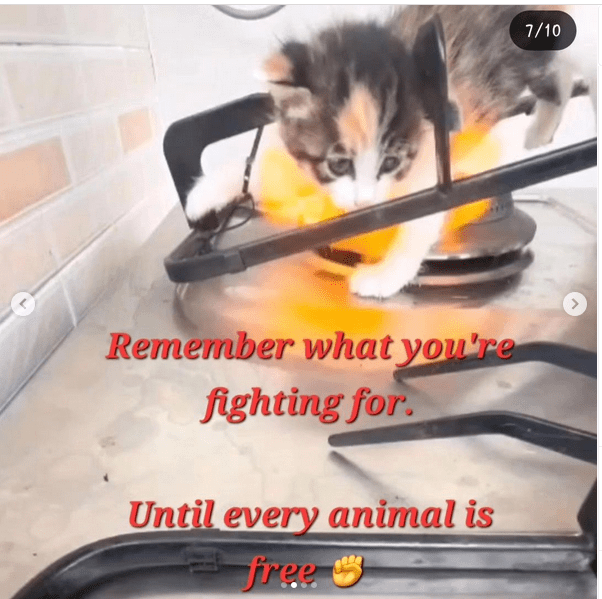
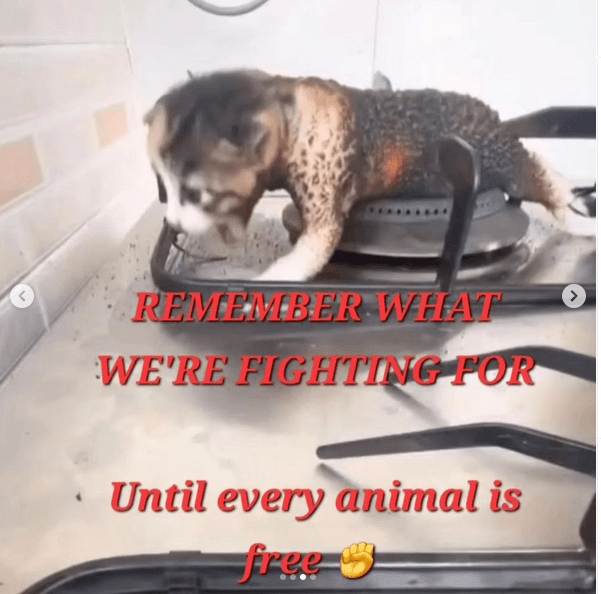
(CN Cat Torture Groups) Remember What You Are Fighting For…

The Irish tell the story of a man who arrives at the gates of heaven and asks to be let in

St. Peter says, “Of course, just show us your scars.”

The man says, “I have no scars”.

St. Peter says, “What a pity – was there nothing worth fighting for”?

Petitions

UK – England: Chinese Cat Torture Petition – Please Support Thank You. – World Animals Voice

Germany – English Version of Petition “China: Cat Torture Ring” – World Animals Voice

Links to WAV Posts

(CN) Cat Torture Groups – Many Participants Are Shown To Be Minors – Disturbing ! – World Animals Voice

The Killer On My Doorstep; Down The Road; Across The River; Anywhere !! – World Animals Voice

England: Breaking – Cat Killer and Murderer of Jorge Martin Carreno Jailed for a Minimum of 24 Years.  – World Animals Voice

China: ‘Crush’ Information. – World Animals Voice

China: Did You Hear the One About the Sick Pervert of a Doctor Who Lures Teenage Girls Into Pornography and Then Uses Them In An Animal ‘Crush’ Video Website ? – World Animals Voice

China: INVESTIGATION: Inside the sadistic world of the gruesome cat torture craze, campaigners call on Chinese authorities to act NOW. – World Animals Voice

EXPOSING AND COMBATING CAT TORTURE NETWORKS. 6/1/24. – World Animals Voice

China: Cat Torture Actions Follow Up – No. 1 – World Animals Voice

China – Cat Torture – Major Information and Actions – Follow Up No. 2 – World Animals Voice

And this is why … – World Animals Voice

(US) NEW YORK CITY March 8, 2024: Protest Cat Torture Rings – World Animals Voice

Please check out the ‘Kill Counts’ given in each of the following:

Diana and Mark

EU: European Commission To Visit Fur Farms In Finland.

8 March 2024

As part of the evaluation for a ban on fur farming following the successful European Citizens’ Initiative Fur Free Europe, representatives of the Directorate-General for Health and Food Safety will visit Finnish fur farms between 8 – 15 March.

The visits are part of a wider fact-finding mission on pandemic preparedness and control, with a focus on non-foodborne zoonotic disease agents.

Photo – Jo-Anne McArthur / Djurrattsallianses / We Animals Media

They aim to collect and assess information on the level of surveillance in mink farms for zoonotic infections with zoonotic agents such as SARS-CoV2 and avian influenza. The visits may also include a review of the animal welfare conditions. 

These assessments of public health and animal welfare are part of the follow up on the European Citizens’ Initiative Fur Free Europe, where over 1.5 million European citizens called for a EU wide ban on fur farming and the sale of farmed fur products due to animal cruelty and public safety risks. 

Finland is one of the EU’s biggest fur producing countries, and avian influenza spread widely in the country in 2023, on 71 of 400 farms.

Some organisations have criticised the timing of the visits during breeding season, where the farms will be void of young animals being reared for the next season, as breeding animals will typically give birth from May. 

The visits are also pre-announced, giving farmers the opportunity to present the best possible conditions to inspectors. 

Even when visiting these farms under the best possible conditions, inspectors will be able to see how standard housing on fur farms fails to meet the behavioural needs of wild animals such as mink and foxes.

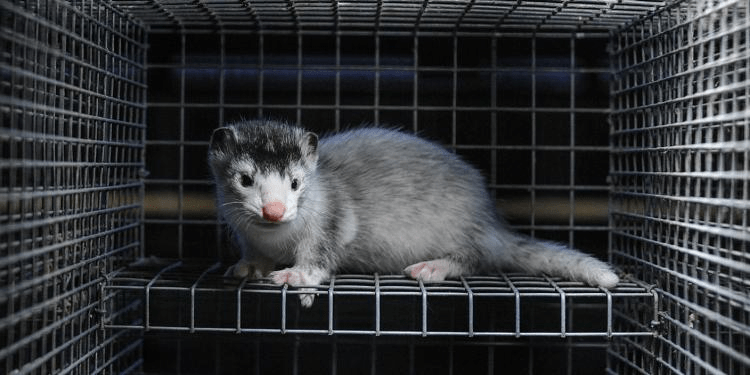
A typical mink cage on European fur farms has a floor area of only 4 sheets of A4 paper, and denies the animals the opportunity to perform natural behaviours such as swimming, climbing and jumping.

Mink and foxes are also solitary animals who would choose to live alone in their natural habitats, whereas fur farms see them housed in rows of cages in extremely close proximity. 

The Fur Free Europe network awaits news on the outcomes of these visits, which we expect to support the need to move ahead with an outright ban on farming animals for their fur in the European Union.

Regards Mark

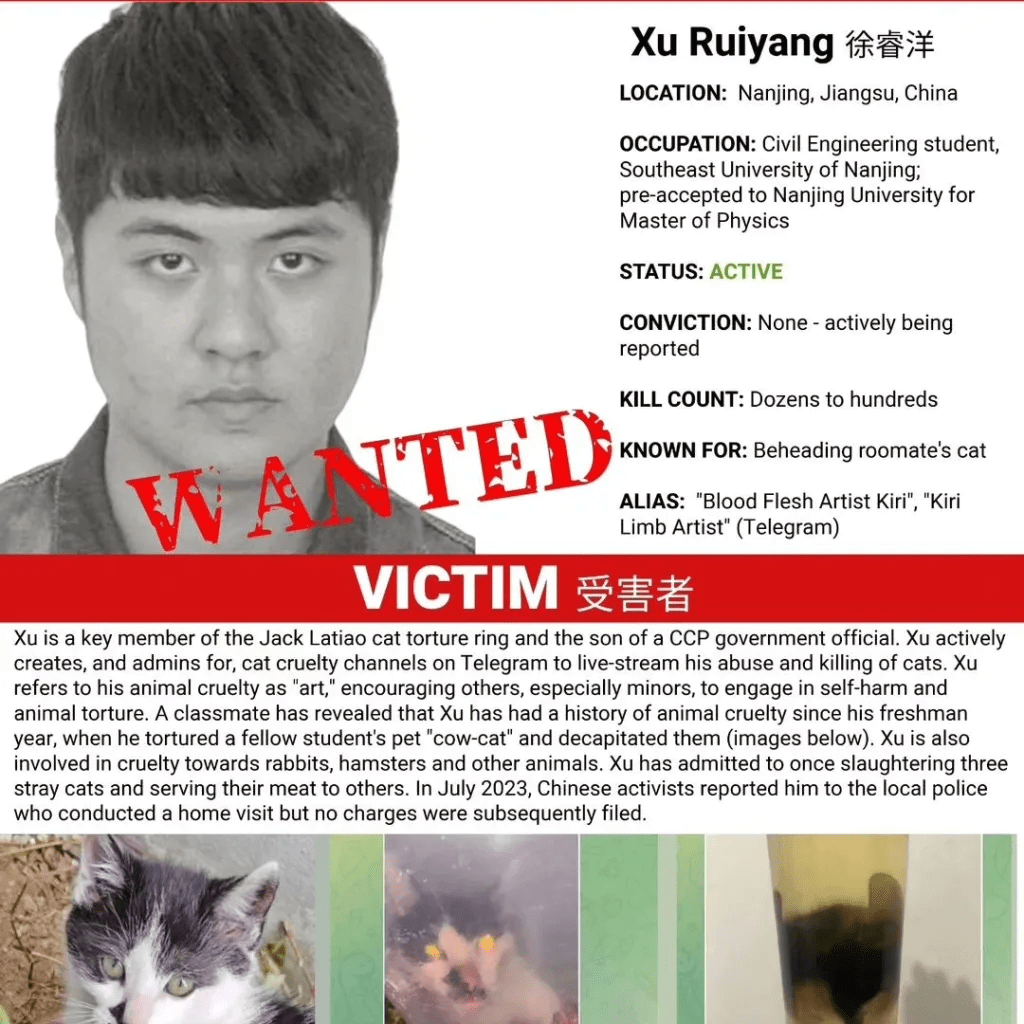
(CN) Cat Torture Groups – Many Participants Are Shown To Be Minors – Disturbing !

@feline_guardians

This is a worrying development, but no surprise really. It reinforces what was said earlier, that youthful individuals engaging in animal abuse pose a high threat to Humans in adult life. A taste for cruelty developed in early life, and at a time when a personality is impressionable and as yet to be formed, tends to take firm hold, and influence a person’s conduct in later life.

This is why the activity of these “Cat Torture Rings” is so dangerous, and must be dealt with severely – they must be destroyed wherever they are found. Once and for all.

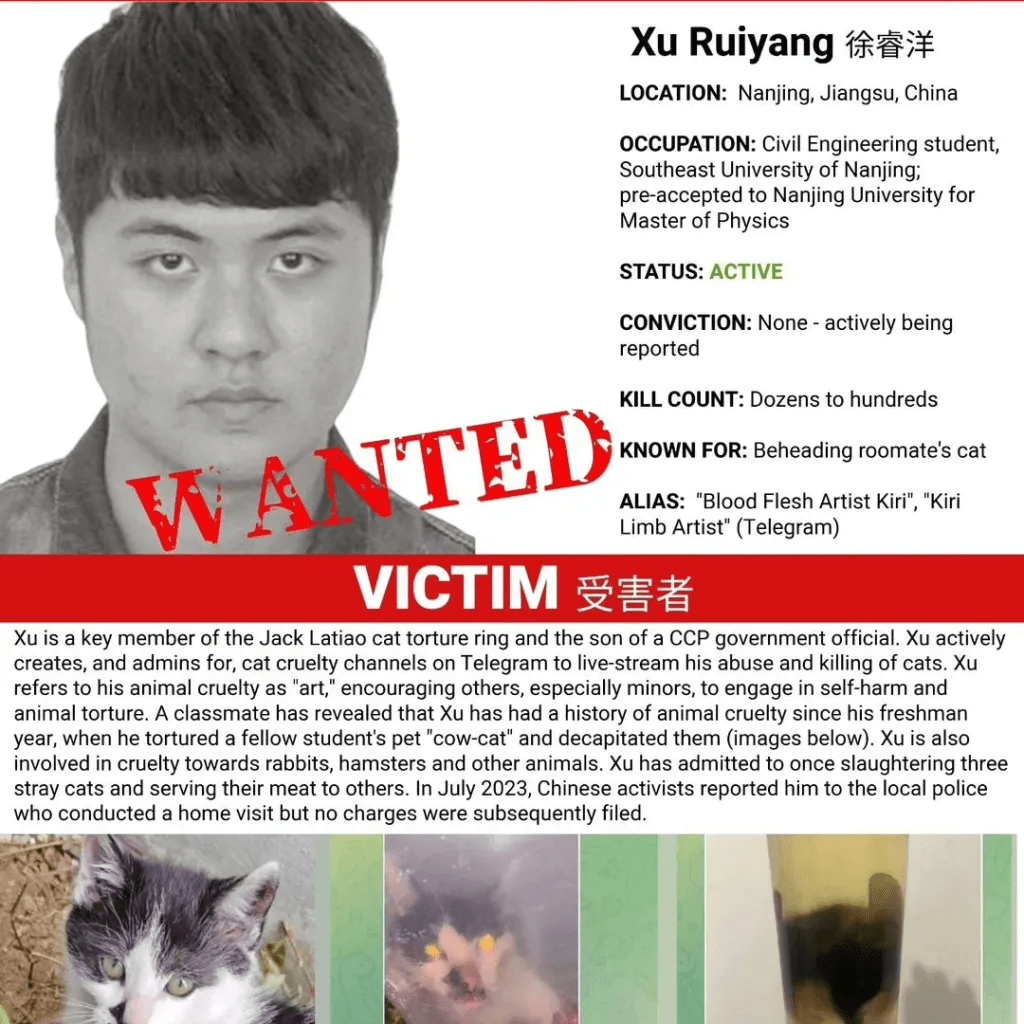
The above is very disturbing. Young kids of school age appear to be the primary members of many of these groups. As we have said before, and it is shown many times over, people often start as animal killers and then move on to being human killers. SO WHAT IS CHINA ACTUALLY DOING ABOUT THIS ? – Very little it appears.

We think you only have to look at the photographs of many of these ‘head of sites’ abusers to see that they are young in years – we are presenting the evidence; why do Chinese authorities not follow up and act ?:

Kill Count – Dozens to Hundreds of Animals.

Kill Count – Dozens to Hundreds of Animals.

Kill Count – 5,000 to 10,000 Animals Estimated.

Kill Count – Thousands of Animals Estimated.

Kill Count – Dozens to Hundreds of Animals.

Post reference is:

Protest against the torture in New York City today – 83/24. When we have information we will publish.

Regards Diana and Mark

Ongoing Petition Links Please ensure you sign, then pass on to all your contacts – Thank you.: