The incredible ways that animals impact the earth.
https://www.msn.com/en-gb/news/world/the-incredible-ways-animals-impact-the-earth/ss-AA12GYVb?ocid=msedgdhp&pc=DCTS&cvid=c49340c11a0b49ffa895eea6217c5a39&ei=30#image=9
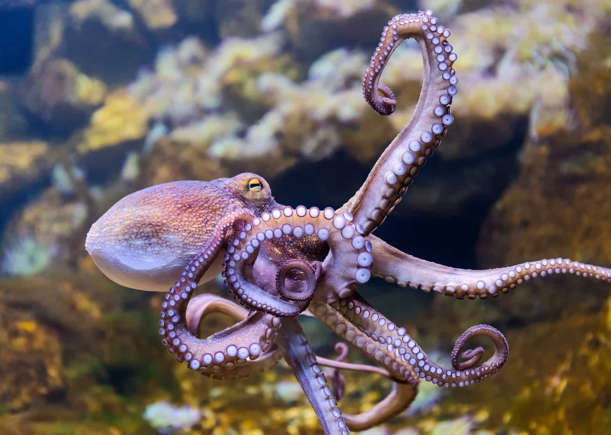
The incredible ways that animals impact the earth.
One comment – well said: Human beings are the worst!!!! These beautiful beings are super intelligent, sentient, friendly and must be respected. You do not “FARM” sentient beings. You farm tomatoes!!!!!!!
18 July 2024
Currently, all octopus products available on the market are wild-caught, as octopuses have never been commercially farmed at scale. This is not due to a lack of trying.
In Europe, particularly in Spain, octopus farming has so far been confined to fattening young wild-caught octopuses in ocean cages, in order for them to reach market weight. These cages were typically anchored to the sea floor, or simply suspended from rafts being used to farm mussels. In an attempt to prevent aggression and cannibalism, ocean cages included individual, compartmentalised octopus shelters made of pvc pipes or other plastic cylinders.
After having some success in the early 2000s, most octopus fattening systems have since shut down due to stricter fisheries regulations, unstable yearly catches, variations in octopus mortality rates, and expensive feed requirements. Raising wild-caught octopuses in on-land aquaculture tanks has also been attempted in Mediterranean countries as well as Australia and Latin America. However, efforts have not progressed past the experimental level as there are limited options for scalability.
Research and investments have more heavily focused on breeding octopuses in captivity. These efforts have been ongoing since the 1970s with major hurdles linked to cannibalism, containment issues, inadequate feed options and low survival rates among pregnant and young octopuses.
A new milestone was reached in 2019 when Spanish multinational seafood company Nueva Pescanova announced that they had successfully closed “the octopus reproduction cycle in aquaculture”, meaning they had bred and raised octopuses through every stage of their life cycle in an artificial environment. The company is now applying for permits to open the world’s first industrial octopus farm, aiming to farm and slaughter one million octopuses annually for introduction to the market by 2027.
Although the first, Spain is not the only country interested in the prospect of this new industry. Similar plans to factory farm octopuses are unfolding across the globe, including in Portugal, Greece, Mexico, Chile, Australia, China and Japan.
Octopuses have a complex life cycle and are particularly ill-suited to farming conditions, making it challenging to raise them in captivity. Here are some significant issues associated with octopus farming:
1. Dietary needs
Octopuses are carnivorous animals and require live food during the early stages of development. Providing a natural diet in a farming environment can be resource-intensive, unsanitary and costly. Feeding octopuses at the industrial scale is also environmentally unsustainable due to its reliance on wild-caught fish ingredients.
2. Solitary nature
Naturally solitary, octopuses may become overly stressed and resort to aggression and cannibalism in crowded farming conditions. Their need for space and isolation makes intensive farming impractical and inhumane.
3. Physical vulnerability
Without an internal or external skeleton, octopuses have fragile skin that can easily be damaged in farm tanks. This issue is exacerbated with their tendency to use jet propulsion to move quickly about their environments.
4. Unsuitable slaughter method
No humane slaughter method exists to kill octopuses for human consumption. Nueva Pescanova’s plans propose using ice slurry, which involves plunging the octopuses into freezing water. This method is known to cause a painful, stressful and slow death.
A study by the London School of Economics found that octopuses feel pain and pleasure, leading to their recognition as sentient beings in the UK’s Animal Welfare (Sentience) Act 2022. Professor Jonathan Birch and his co-authors argue that high-welfare octopus farming is impossible and that killing via ice slurry “would not be an acceptable method of killing in a lab“. They also recommended the UK government consider a pre-emptive ban on farmed octopus production and imports.
“Large numbers of octopuses should never be kept together in close proximity. Doing this leads to stress, conflict and high mortality. A figure of 10-15% mortality should not be acceptable for any kind of farming.” – Professor Jonathan Birch, London School of Economics.
Globally, there are also mounting concerns around octopus farming. The world’s first legislative ban on octopus farming was signed into law in Washington state in March 2024. Several other US states are introducing similar legislative proposals, with some such as California extending to ban imports of farmed octopus.
While it may be possible to farm octopuses, Eurogroup for Animals remains steadfast in its conviction that octopuses are unsuited to farming conditions and should not be farmed.
Uncovering the horrific reality of octopus farming
Exposing the environmental risks of octopus farming
Regards Mark
 World Animals Voice