https://animalequality.org/news/dangers-of-brazils-self-control-law/

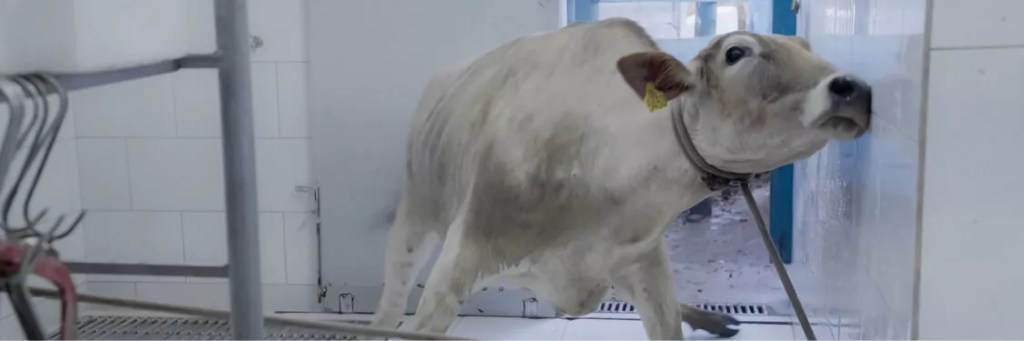
- In 2024, Animal Equality found major violations in São Paulo slaughterhouses, where cows and chickens were mistreated under Brazil’s Self-Control Law.
- In 2022, an earlier investigation revealed cruelty at pig and cow slaughterhouses in Minas Gerais and Pará, warning about the dangers of the Self-Control Bill.
- Workers were seen twisting animals’ tails, kicking them, and using electric shocks on sensitive areas like the head and genitals.
- Some animals were skinned and dismembered while still alive.
- These findings point to a global problem as U.S. slaughterhouses speed up production lines, increasing risks for animal cruelty.
Animal Equality’s investigation reveals the impact of Brazil’s 2022 Self-Control Law, which reduced government oversight of slaughterhouses. The findings uncover rampant cruelty and violations, with profits prioritized over animals, public health, and transparency.
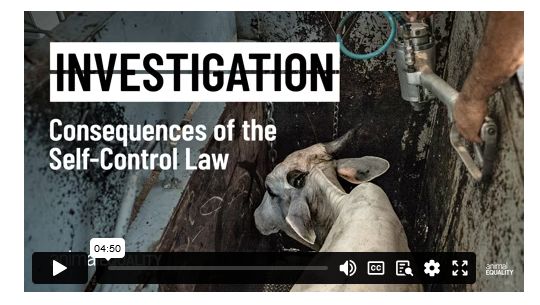
Video on page or VIMEO Link: https://vimeo.com/1047226914
2024 investigation: São Paulo slaughterhouses
The latest investigation, featuring never-before-seen footage, uncovers significant failures in cow and chicken slaughterhouses in rural São Paulo.
These facilities were already following a state-level version of the Self-Control Law before it was implemented across the country. Investigators found widespread violations of handling and slaughter rules set by Brazil’s Ministry of Agriculture and Livestock.
2022 investigation: Early warnings ignored
In 2022, Animal Equality issued an urgent warning about the risks of the Self-Control Bill. Investigating pig and cow slaughterhouses in the states of Minas Gerais and Pará, the team uncovered a critical shortage of government inspectors.
Without proper oversight, workers were left to enforce safety and animal protection rules on their own, resulting in widespread violations. Despite these findings, the bill became law.

Between the 2022 and 2024 investigations, Animal Equality documented:
Intentional cruelty:
- Tail twisting and kicking animals in the face.
- Use of high-frequency electric shocks on prohibited areas, including the head, tail, genitals, and anus.
Stunning failures:
- Animals were tied with ropes instead of being secured in proper stunning boxes, making effective stunning nearly impossible.
- Captive bolt pistols were used incorrectly, leading to failed attempts to stun animals.
- Broken stunning tools were not fixed, forcing some animals to endure up to seven failed stunning attempts.
- No staff were assigned to ensure stunning was effective. When animals showed signs of consciousness–such as eye movement or lifting their heads–workers often did not repeat the stunning unless the animal became too agitated to manage.
Delayed slaughter:
- Stunned animals were left for over two minutes before slaughter, exceeding legal limits meant to prevent them from regaining consciousness:
- Non-penetrating captive bolt pistols deliver a blunt impact to the head, causing a concussion without breaking the skull. Animals must be slaughtered within 30 seconds, as this method loses effectiveness quickly.
- Penetrating captive bolt pistols use a bolt to penetrate the skull, causing deeper and longer-lasting unconsciousness. This method allows up to 60 seconds before slaughter must take place.
- Delays beyond these limits caused animals to regain consciousness, leading to extreme suffering.
Mutilations while conscious:
- Workers did not wait the required three minutes after slaughter to ensure animals were dead before mutilating them. This resulted in animals being skinned and dismembered while alive.
Poor facility conditions:
- Overcrowded pens with more animals than recommended.
- Animals left in extreme heat without shade or water.
- Slippery floors causing frequent slips and falls.

 World Animals Voice