MP proposes new legislation to licence rescue centres in a move supported by a major animal charity.
New legislation has been proposed which could lead to the introduction of a formal licensing regime for animal rescue centres in England and Wales.
The move has also been backed by a leading welfare group while tens of thousands of people have separately signed an online petition calling for licensing and regulation.
The Animal Shelters (Licensing) Bill was introduced to Parliament by the Conservative MP Richard Holden last week.
He said recent cases, including one in his own Essex constituency where dozens of dogs were found dead, had shocked the public and “exposed a dangerous gap in the law”.
Closing loophole
He added: “The Bill will bring rescue and rehoming centres under the same statutory framework that already applies to kennels and breeders, closing the loophole that leaves animals unprotected.
“Mandatory licensing will drive up welfare standards, weed out rogue operators and give the public confidence that every organisation caring for dogs is properly equipped and held to account.”
A 25-year-old man is currently in custody on animal welfare and fraud charges following the discovery of 37 dead dogs at premises in Billericay in May.
A second man remains on bail, while a 25-year-old woman was arrested earlier this month. The remains of four more animals were found following a new search of the site.
Mr Holden said he had worked with both Dogs Trust and the RSPCA in developing his Private Members’ Bill.
‘Proper oversight’
Dogs Trust chief executive Owen Sharp said: “Good intentions aren’t enough. We need laws in place to make sure all rescue dogs are safe, cared for, and treated with the respect they deserve.
“Without proper oversight, these organisations cannot guarantee that they are operating in the best interests of the animals in their care.”
More than 50,000 people have also signed an online petition, launched prior to the Essex case, which demands licensing and regulation of rescue centres.
In its response, Defra said it would outline more details of its “overarching approach” to animal welfare in due course, but stressed that rescue groups must meet existing legal requirements.
Sea Shepherd is cracking down on illegal fish-trapping devices off the coast of Sicily (Credit: Sea Shepherd)
Off the coast of Sicily, Sea Shepherd and its volunteers are hunting down illegal fish traps and working with Italian authorities to crack down on this environmental crime.
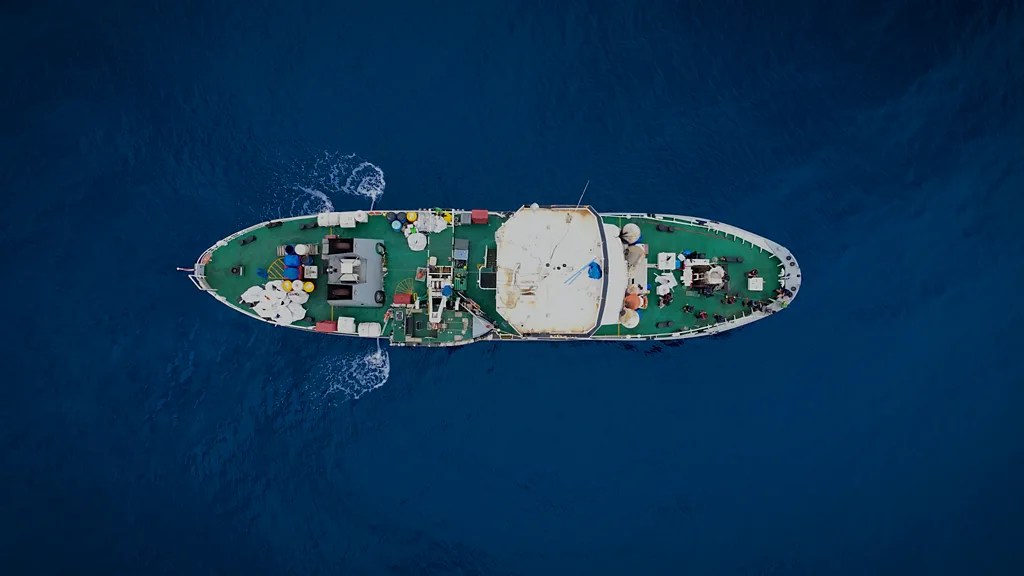
The flat water melts into the teal-coloured sky as a former pilot vessel, the Sea Eagle, sails through the calm Tyrrhenian Sea surrounding the Aeolian Archipelago of Sicily.
The ship is operated by Sea Shepherd, an international marine conservation non-profit. Today, the team is searching for fish aggregating devices (FADs), man-made plastic structures used to attract fish. They float in the water, anchored to the seafloor, with hanging nets to catch fish. FADs made from plastic, without GPS tracking devices attached, are illegal in Italy.
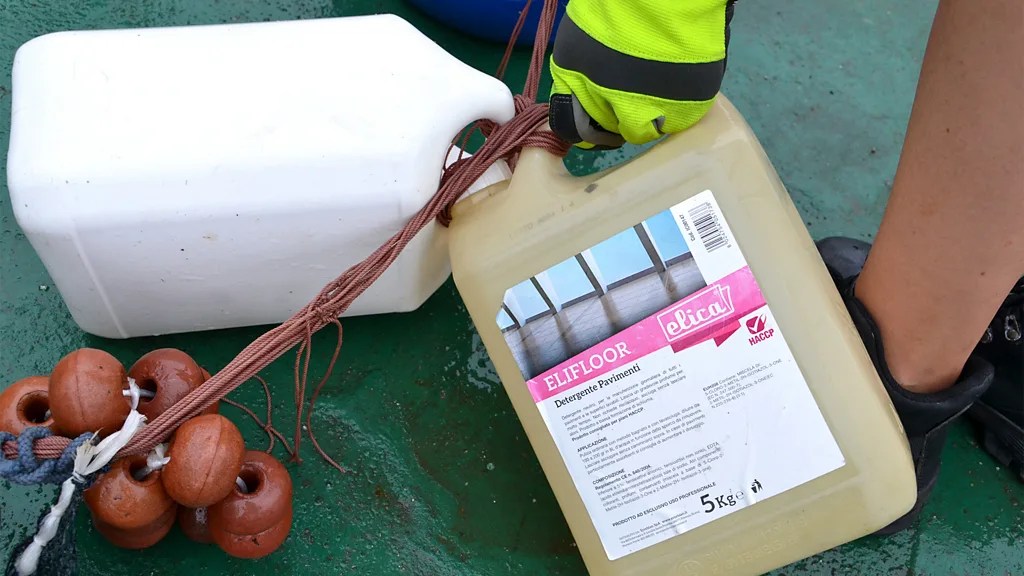
While listening to techno music, a group of volunteers uses a winch to detach one of the FADs from the seafloor. A large plastic container labelled “corrosive” emerges from the sea.
“The [techno] rhythm gives us the right energy,” says James* (the crew do not wish to use their full names for safety reasons), a young Canadian volunteer who is running the operation and whose arms are covered in ocean-inspired tattoos. The volunteers work tirelessly to extract the plastic FADs from the sea and pile the tangled trash heaps into big bags. The retrieved plastic will be turned into plastic crates for sea turtle rescue operations.
FADs are used worldwide by fishermen to attract pelagic fishes into surrounding nets. These fish-trapping devices are typically composed of used fuel, pharmaceutical and other chemical containers among other types of plastic waste, dark plastic nets and rocks, all of which is held together by a few miles of nylon thread. Marine wildlife is attracted to the shade provided by FADs.
FADs are typically composed of old plastic containers held together by nylon thread (Credit: Sea Shepherd)
The material the FADs are made of matters too. FADs are required by Italian law to be biodegradable. All the FADs removed by the Sea Shepherds from the South Tyrrhenian Sea are illegal and made of plastic, says Nicola Silvestri, frigate captain and head of the Fishing Control Centre area in Western Sicily. They also lack markings which allow them to be traced back to the fishing boat that used them, he says.
“Illegal FADs are very cheap to produce, but at the same time highly dangerous for ecosystems,” says Andrea Morello, president of Sea Shepherd Italy. “These devices are installed by fishers in the month of August, then they catch fish around them in summer. Eventually, winter storms remove the devices, creating tonnes of hazardous and plastic waste floating in the sea.”
In this stretch of sea around Sicily’s Aeolian Archipelago, the target fishing species in the summer are juvenile ricciola, bluefin tuna, juvenile swordfish and pilot fish. FADs can damage the entire population, by preventing juveniles from maturing and reproducing.
The Sea Shepherd mission is part of the organisation’s ongoing Siso operation in Sicily to combat these illegal fishing devices.
“We are witnessing the biggest marine environmental disaster ever,” says Morello. “The sea is like a minefield full of FAD lines in every direction, placed by fishers who split the sea surface among them, threatening biodiversity.”
The Sea Shepherd volunteers remove the long nylon threads attached to the FADs which can harm fish, turtles, humpback whales and dolphins by trapping and suffocating them. According to Sea Shepherd, there are more than 36,000 FADs, each one composed of almost 1.2 km (0.7 miles) of nylon lines in the South Tyrrhenian Sea, part of the Mediterranean Sea.
It takes the volunteers one hour to extract almost 2km (1.2 miles) of a FAD line, it’s the first out of seven removed that day. Not far away, a police coast guard boat is monitoring the work: later it will seize the illegal plastic materials. The use of FADs made from plastic waste, without GPS trackers, is an environmental crime in Italy.
Sarah, a young German volunteer, rings the bell installed on the deck of the vessel, to celebrate and notify the crew that another FAD has successfully been extracted from the seabed. In total, the volunteers haul seven FADs onto the deck that day – their combined mass is the same size as a small car.
The Sea Shepherd volunteers are collaborating with Italian maritime authorities to crack down on FADs (Credit: Sea Shepherd)
organisation maps the FADs using deep-sea radar technology and binoculars and removes them in collaboration with national maritime authorities.
Between 2017 and 2024, the organisation removed 676 FADs from the Mediterranean Sea, says Morello. “We define ourselves as FAD hunters: here to protect the sea. We are also carrying out the first census of FADs ever realised in the Mediterranean Sea,” he says.
The data collected during this mission will be analysed as part of a research project that Sea Shepherd runs with the National Biodiversity Future Centre of the University of Palermo in Sicily and the Cima Research Foundation, based in Liguria, Italy. Using statistical analysis, Sea Shepherd has been producing maps since 2017 to identify for the first time the extent of this ghost labyrinth created by FADs anchored to the seabed.
“With the information provided by Sea Shepherd, we were able to have a precise mapping of the location and composition of these devices,” says Alberto Sechi, a marine biologist at Cima Foundation. “Since 2017, the plastic lines (mostly polypropylene) used to anchor the FADs exceeds 2,500km (1,553 miles): that corresponds to the distance between Paris and Moscow.”
In a single night, Morello says the Sea Shepherds discovered around 912 FADs in the waters surrounding the Sicilian island of Alicudi, each one composed of more than 1km (0.6 miles) of nylon threads. “Multiplying the number of FADs we found by the medium length of each thread, the total length of lines used in this area is a staggering 43,200 km (26.284 miles) of nylon: this is more than the circumference of the entire planet Earth,” says Morello.
Sea Shepherd’s work involves removing as many FADs as possible, but then, the disposal problem arises. In 2022, the non-profit started collaborating with iMilani, an Italian company that specialises in building plastic crates from recycled materials. Together, they have created the Sea Turtle Crates project, which aims to transform the FADs into plastic crates for sea turtle rescue operations. After the entangled turtles have been freed from the FADs, they are put into the crates which Sea Shepherd uses to transport them to veterinarians. Six loggerhead turtles have been rescued to date and 100 turtle recovery boxes have been created from FADs, says Roberto Milani, founder of iMilani and a freediver.
The company is hoping to design other items with FADs waste in future, including pens and other gadgets, which can be sold to finance Sea Shepherd’s activities, says Milani.
Sea Shepherd is creating the first-ever census of FADs in the Mediterranean Sea (Credit: Sea Shepherd)
big bags full of plastic lines extracted from the FADs. In one day at sea, the crew removed seven FADs composed of 6.5km (4 miles) of nylon lines and plastic containers. Their labels reveal their previous lives: from hospital waste and corrosive liquids, to oil, gas and detergent jerrycans. Using radar, the Sea Shepherds map more than 100 FADs throughout the day.
The crew’s work begins early in the morning, and continues until sunset, with brief breaks for meals. Tuti, 23, an Israeli volunteer, prepares a vegan buffet each day. Today’s menu is inspired by Latin American foods, such as empanadas, chimichurri, black beans mole and corn tortillas, which Tuti learned to cook during a Sea Shepherd mission in the Gulf of California, where she worked to protect the last vaquita dolphins.
Onboard are 20 volunteers, from four continents with different ages and backgrounds: from Willie, a 20-year-old German student, to retired engineer and sea captain Gigi, 63, who joins Sea Shepherd’s missions several times a year.
“We are here because we want to be part of the solution. We are sort of part of it, by removing all those plastics from the seas,” says Zafar from Pakistan, who is in charge of measuring and cataloguing each FAD for the database. “I don’t understand people’s insensitivity towards the sea and its inhabitants,” he says.
Many FADs are anchored to the seafloor with stones or buckets full of cement, says Teresa Romeo, director of the Sicily Marine Centre at the Anton Dohrn Zoological Station in Naples, Italy. She has been studying FADs since the 1990s. “They modify the seabed environment and affect all the species living there,” she says.
Romeo says a mandatory recovery of all FADs should be implemented. “We need to establish a spatial management plan to define a specific area [for FADs] and replace floating materials with biodegradable ones, in order to have a more sustainable fishing practice in the Mediterranean Sea,” says Romeo.
Sea Shepherd makes “a great contribution to the mapping actions of FADs and their efforts are useful for monitoring impacts, but in my opinion the aim cannot be drastic removal, but to regulate their use,” she says.
The retrieved plastic FADs are turned into crates for sea turtle rescue operations (Credit: Sea Shepherd)
But creating biodegradable devices from materials such as hemp is difficult due to the high cost, according to Sechi. “Creating a completely biodegradable FAD is a significant challenge, and so far, no one has come up with a solution,” he says. “One alternative could be hemp, but kilometres of hemp thread are very expensive, and no angler would spend that much.”
Experts such as Romeo say that the transition to biodegradable and non-toxic materials would be an important part of the solution to reduce marine pollution from fisheries based on FADs. As well as breaking down in the ocean, biodegradable materials may contain fewer toxins and heavy metals, compared to plastic, says Romeo, though she agrees that cost is a major barrier for materials such as hemp.
In the meantime, the Sea Shepherds continue to sail the seas to map and remove illegal fish-trapping devices, collaborating closely with the local coastguard, researchers and private enterprises to crack down on this environmental crime.
“This alliance is a solution to protect the deep sea,” says Morello.
A judge has once again determined that public ‘shelters’ will violate laws that protect animals if left unchallenged.
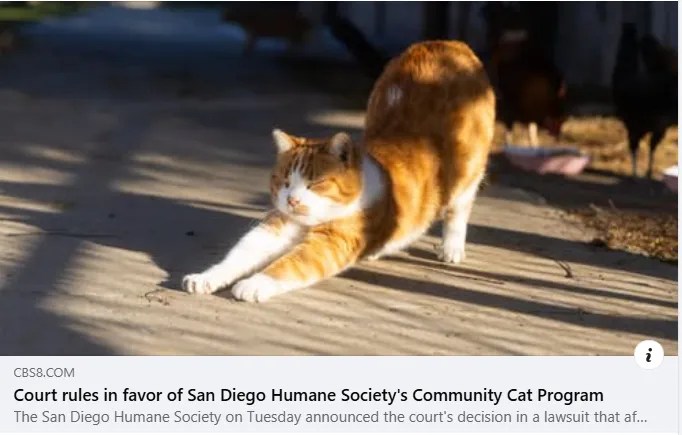
In a victory for animals and those who care about them, a California Court issued a permanent injunction prohibiting the San Diego Humane Society from refusing to provide shelter and care to kittens and lost cats and instead abandoning them on the street.
While the ruling supports the legality of community cat programs, including for feral cats, it requires shelters to comply with state laws regarding abandonment and animal care.
In a bid to recast the Court’s ruling against it, the San Diego Humane Society claimed victory in the case — a claim echoed by apologists for “shelter” malfeasance — even though the Court ruled gainst SDHS and prohibited them from making any changes to the program that would reduce protections for kittens and for adult cats who are social with people.
CBS originally wrote an article regurgitating SDHS’s false claim of winning:
They quickly removed the article when presented with the truth:
CBS subsequently reported that “A judge found the Humane Society’s Community Cat Program violated state law…” In fact, it wasn’t a community program; it was a program that turned its back on kittens and lost or abandoned friendly cats.
What the ruling means:
California “shelters,” like SDHS, are guilty of abandonment if they release, rather than admit, friendly cats with indications of ownership.
These include:
Sterilization (without an ear-tip);
Microchip (even if unregistered);
Wearing a collar, clothing, or accessories;
Signs of recent medical treatment; or,
Abandonment witnessed or credibly described by a finder.
The Court also ruled that kittens under 12 weeks old and social kittens aged 12 weeks to six months must be admitted into the shelter. It imposed a permanent injunction prohibiting SDHS from instituting changes that would reduce protections for cats and kittens.
The ruling prohibiting release does not apply to feral cats, sterilized cats found with ear tips, or friendly adult cats who do not exhibit any of the above criteria.
It wasn’t a complete victory. For example, “shelters” still have some discretion to determine which kittens must be admitted. They can also continue to kill them after admission, something that many California “shelters” do.
We need to continue insisting on — and passing laws that mandate — No-Kill policies.
The case is Pet Assistance Foundation, et al. v. San Diego Humane Society, Case No. 37-2021-00007375-CU-MC-CTL. The ruling can be found here.
Together, we will create a future where every animal is respected and cherished, and every individual life is protected and revered.
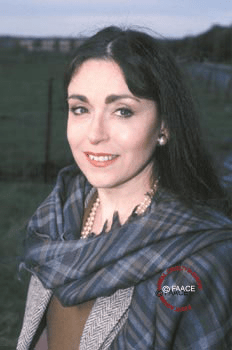
This article below, written for The Independent (UK) national newspaper, by Danny; a well known journalist and AR campaigner himself, is a very well written account of events in Spain, Summer 1995, when campaigner Vicki was undercover filming and taking recordings of the ‘Bull Run’ held in the town of Coria.
Tragically, she was gored by one of the very same Bulls being tortured by locals and drunk tourists that day; one of the very same animals she was attempting to obtain footage of, in her campaign to get the Bull Runs STOPPED.
Vicki suffered terrible injuries as a result of her encounter with the Bull. Tossed into the air 10 times, and gored 11 times in the chest, back, groin and legs. She also suffered a punctured lung, had 8 badly smashed ribs, and lost one of her kidneys. She was in a coma for around 4 weeks.
Her husband Tony, said that she ‘burst into tears for the Bull’ when told that her attacking Bull has been shot and killed, as he was considered ‘too dangerous’.
Vicki died on 6th February 2000. Thanks to her work exposing the Blood Fiestas and Bullfighting; major changes have happened in Spain much to the benefit of animals.
Her biography, called ‘Life on the Line’, has been written and is available now.
Now, of course this is what it is .. the killing of animals. Which most, if not all of us, reject. For whatever reason. Where it gets really difficult is when stuff is hidden, done illegally, behind closed doors – often with animal abuse being rife. Here at least people are open about what they do, how they do it – even if faced with people they know think differently. In the end everyone has to make up their own mind. I have cats of my own, and nature made them meat eaters. Every commercial pet food contains meat, fish, offal, and often stuff that does not belong in there at all. In most cases the source materials are low quality, and as good as never do you know what animals they came from – meaning not the species, but how they lived and were killed. If chicken in a tin comes from Asia, you can imagine … I always read labels attentively.
So, I feed fresh often, where I can trace the source, and can be relatively sure I do not support animal abuse.
The Dover protest days; which lasted decades actually; along with many other protests at other ports in SE England at various times, united the British people; who turned out in massive force against this abhorrent business. We cried long and hard at what we were witnessing with every shipment; but despite the utter feeling of being so helpless; there were some good times – you have to have them sometimes; right ??
In the first video you can see us all being held by the police in order to get the livestock transporters down to Dover port as quickly as they can. But as the video also shows; if you cannot stop them near to the port; then you actually go to the port to take action.
As you can see; the trucks sped through as quickly as they could. Being England; weather conditions were often foggy, raining and just dangerous with 40 plus tonnes of livestock transporter rushing past. The police attempted to intimidate protestors by filming them anywhere and everywhere as you can see; but really they had ‘lost the plot’ and had no real control. I Mark was proud to be part of all this; if there were no live animals needing our support then we would have been at home with loved ones watching tv or something ?
It was risky given the trucks speeds and the weather conditions; to this day I an still amazed that nobody was killed; unlike our beautiful Jill who was killed by a truck whilst protesting against live calf exports out of Coventry Airport. She was too lovely a person to have had her life cut short by a calf carrying transporter.
Unfortunately; today, 2025, the export of live, sentient beings across the world is still a massive business. but, the reality and cruelties of the trade are being exposed more and more all the time; take a look:
Here are all of our site links to the live animal export business:
Phil; a personal friend, and Global CEO at London based Compassion In World Farming – https://www.ciwf.org/ often came to Dover to give us all his support.
Very recently, Phil wrote an article for ‘the Scotsman’; and asking the simple question – Why, after 100 years of refrigeration, are animals STILL being transported live ? I can only guess that money is involved a lot more than animal sentience. Here is a link to the article – a great read !
So; here we are today, June 2025; still fighting hard for a global ban on the live animal export issue. Like in the UK, it was a very long campaign; but in the end, 2024 saw all UK live exports STOP. And so may this result continue across the entire planet.
Regards Mark.
Things changed for me when i was a little boy aged 8 years:
My beautiful dog ‘Sheba’; given to me by my parents when I was five years; started me down the long road of having full respect FOR ALL living creatures.
In my personal opinion; this was, is, and forever will be; a good fight, worth fighting for 110%. Glad to have been involved !
Despite these hardworking animals being so essential to survival, they’re often the last to receive the little water that’s available, writes actor Jim Broadbent
In the 1960s, my father, who was a sculptor, joined the group Free Painters and Sculptors where he met a brilliant woman, Nina Hosali, who co-founded animal charity Society for the Protection of Animals Abroad (SPANA) with her mother Kate in 1923.
Together, Nina and Kate would travel across North Africa to understand the difficulties facing local communities and their working animals. My father was very impressed by Nina and they became great friends, leading to my own support of the charity since the early nineties.
At that time, it was very unusual for two women to travel independently across North Africa and to be actively working with communities. It’s hard to imagine now how difficult it must have been and how brave they were. I can’t imagine the struggles they must have gone through venturing out into the desert to help working animals.
My wife Anastasia and I took a trip in 2006 to see the extraordinary work being done in Morocco by SPANA, and I felt privileged, in some small way, to follow in their footsteps some 80 years later. I remember visiting one of the centres the charity continues to run, where I saw donkeys being treated and animal owners receiving advice on animal welfare. We also travelled to more remote areas, where hardworking animals were helped by mobile vet clinics. We learned how working animals are vital to families and communities, particularly in low-income countries and the importance of their welfare.
Growing up in rural Lincolnshire, I was surrounded by friends with farms. They were mostly dairy farms, with fairly large herds of milking cattle. These animals were all appreciated and well looked after in a part of the world where we’re lucky enough to have largely clement weather and where animals benefit from access to clean water, nutritious diets and proper medical care. This standard of care was for me the norm.
The circumstances facing the people and animals we met in Morocco were very different. Working animals like donkeys, mules, horses and oxen are used much more widely, for tasks such as ploughing fields, transporting goods to market and collecting water – they are a real lifeline for their communities.
Obviously, it’s much hotter in Morocco, particularly in the summer months. We saw animals pulling heavy loads in extreme heat with little rest, which can lead to health issues such as dehydration, heatstroke and fatigue. At that time, animal owners had limited access to proper harnesses and, as a result, we saw animals suffering from wounds caused by ill-fitting and makeshift equipment.
Globally, the climate crisis is now making life harder for working animals and their owners. Many countries at the sharp end of the climate crisis are already experiencing more frequent droughts and water scarcity. The situation is worse for the most vulnerable, who are less likely to have access to clean running water because of inadequate water infrastructure.
The climate crisis is affecting every corner of the globe, with Morocco among the most hard-hit regions. There, they’ve experienced six consecutive years of drought due to record temperatures caused by climate change. This has led to increased evaporation and threats to water supplies.
And it’s working animals who many communities around the world desperately rely on at times of water crisis. They play a vital yet often overlooked role helping people carry huge amounts of clean water over long distances, often in the most challenging conditions.
It’s animals that help communities endure these desperate circumstances. But, despite being so essential to survival, they’re often the last to receive the little water that’s available.
That’s why, this International Working Animal Day, SPANA is urging governments around the world to prioritise inclusive water services that meet the needs of working animals and the people who depend on them, to ensure fair and reliable access for all. Having witnessed how central these animals are to the communities they support, and the suffering they endure, I’m proud to wholeheartedly add my voice to this call.





















 World Animals Voice