










Friday, June 13, 2025
In 2023, UC Berkeley student and activist Zoe Rosenberg removed four severely ill chickens from a slaughterhouse truck in Petaluma, California, and brought them to an animal sanctuary. Now, she’s facing over five years in prison. Rosenberg’s trial is scheduled for later this year, and her allegations tell a story of horrific conditions at ostensibly “free-range” chicken farms, as well as the steep uphill battle activists face in convincing law enforcement to even investigate allegations of animal cruelty on factory farms.
Rosenberg is an activist with Direct Action Everywhere (DxE), a Bay Area-based animal rights organization. In addition to supporting ballot propositions and hosting conferences, DxE carries out undercover investigations of slaughterhouses and factory farms. In some cases, its activists rescue ill and imperiled animals from such facilities; this is what’s known as “open rescue,” a popular tactic among some animal rights activists.
The prospect of risking prison time for saving a few chickens, who are routinely sold for less than $20 apiece, may seem outlandish. But DxE activists like Rosenberg see it as a necessary risk to accomplish their ultimate goal: the complete abolition of slaughterhouses and factory farms.
“I think that if people don’t take action and don’t risk their freedom to create change, nothing will ever change,” Rosenberg, who’s currently wearing an ankle monitor while out on bail, tells Sentient. “We’ve seen time and time throughout history that it has been the sacrifices of the very few that have changed the world.”
Petaluma Poultry did not respond to Sentient’s request for comment on this story, but a company spokesperson denied DxE’s claims to the San Francisco Chronicle, characterizing the group as “extremist” and its efforts as “theft.”
What Is Open Rescue?
In essence, open rescue is the act of removing animals from dangerous or harmful environments without permission from the person, company or facility that oversees said animals. Those who carry out open rescues don’t hide what they are doing, and often publicize their actions. Animals that are removed via open rescue are typically provided with medical care and/or taken to animal sanctuaries.
The goal of open rescues, which date back to at least the early 1980s, is not only to provide relief for the animals in question, but also to highlight the conditions in which farm animals are held, and to normalize the act of rescuing them. But it’s a controversial practice, even among activists, and law enforcement officials generally treat open rescues as acts of theft, trespassing or other crimes.
This often leads to prosecution, but in the eyes of open rescue advocates, this isn’t entirely a bad thing. Prosecutions often bring media attention and publicity to both the topic in question and the relevant laws surrounding that topic. Rosenberg’s case, for instance, draws attention not only to the conditions of factory farms, but also to the fact that removing a few sick animals from a slaughterhouse can get you a half a decade in prison.
Do People Usually Go to Prison for Open Rescue?
Although charges are often brought in open rescue cases, they’re frequently reduced or, in some cases, dropped entirely before trial. It’s not uncommon for open rescuers to be acquitted, either; in a verdict that drew international headlines, DxE founder Wayne Hsiung and another defendant were facing 60 years in prison for rescuing two sick piglets from a Smithfield Farms facility in Utah, only to be acquitted of all charges.
That said, Hsiung did recently spend 38 days in Sonoma County jail for an open rescue in which he participated, so it’s not unheard of for activists like Rosenberg to serve time for carrying out open rescues.
he Incident in Question
On June 13, 2023, Rosenberg entered a Petaluma Poultry slaughterhouse partially disguised as an employee. A truck delivering chickens to the facility was parked outside, and Rosenberg spotted four chickens in the back of the truck who she says were “covered in scratches and bruises.” She took them from the truck, left the slaughterhouse and both she and DxE publicized her actions on social media.
Rosenberg says that she intentionally took the chickens that “seemed like they most needed medical attention.” Subsequent examinations found that all four birds were infected with Coccidia parasites; one of them also had a respiratory infection and an injured toe, while a third had a foot infection.
Five months later, Rosenberg was arrested and charged with five felonies relating to the June 13 rescue. These charges were later reduced, and as of this writing, she faces one felony conspiracy charge, two forms of misdemeanor trespassing charges, one misdemeanor theft charge and one misdemeanor charge of tampering with a vehicle. Her trial is scheduled for September 15, 2025.
The chickens she rescued were all treated for their illnesses, and are now living at an animal sanctuary.
A History of Animal Neglect At Petaluma Poultry
Petaluma Poultry, a subsidiary of the chicken giant Perdue, presents itself as a humane operation where, in the words of its website, “chickens are free to be chickens.”
“Our houses are spacious, with room for birds to move about and exhibit normal behaviors in a low-stress environment open to fresh air,” the company’s website says. “Our outdoor spaces are at least half the size of the poultry house, and typically as big as the barn itself.”
But Petaluma Poultry’s advertising is a classic example of humane-washing, when companies try to appeal to animal welfare-minded consumers by depicting their products as more humanely produced than they actually are.
Petaluma Poultry and its contractors have been accused of criminal animal cruelty on a number of occasions, and footage filmed by undercover investigators in the company’s farms and slaughterhouse paints a much different picture than the company’s marketing.
In 2018, a whistleblower provided DxE with footage from McCoy’s Poultry, a factory farm contracted by Petaluma Poultry, that showed chickens collapsed on the ground, unable to stand or walk and surrounded by the corpses of other chickens. Shortly thereafter, Sonoma County Animal Services seized 15 chickens from McCoy’s Poultry; six were already dead, while the other nine were injured, malnourished, unable to stand and exhibited signs of distress, according to a subsequent medical report. The facility was later shut down.
In 2023, another activist who infiltrated Petaluma Poultry’s slaughterhouse said that she saw workers cutting into chickens while they were still alive, as well as evidence that chickens had been abused, tortured and boiled alive during the slaughter process. They also obtained documents showing that, on a single day in April, over 1,000 chickens were deemed unfit for human consumption after they were slaughtered due to suspicion that they had blood poisoning.
Prior to her arrest for the June incident, Rosenberg herself was involved in a separate DxE investigation of a Petaluma Poultry facility in 2023, where she recorded footage of more chickens suffering in the facility.
“I documented chickens who were collapsed on the floor of their factory farms, too weak to stand, unable to get to food and water, and slowly dying of starvation and dehydration,” Rosenberg says. She ended up rescuing two of those chickens as well, both of whom required extensive medical care.
It remains unclear whether authorities prosecuting or investigating these allegations of criminal animal cruelty? And if not, how come?
Rosenberg Raised Allegations of Animal Welfare Abuses
Poultry is the most widely consumed meat in the U.S. and the world, yet there are no federal laws that protect livestock chickens from mistreatment on the farm. The Humane Slaughter Act establishes some baseline requirements for the treatment of livestock, but it specifically exempts chickens from these protections.
In California, however, livestock chickens are protected under a number of different laws. In addition to Proposition 12, which requires poultry producers to give egg-laying hens a specific amount of living space, Section 597(b) of California’s penal code makes it a felony to subject an animal to “needless suffering” or deprive them of access to sufficient food or water, among other things.
This law would appear to be relevant in the context of Petaluma Poultry. If a chicken at a factory farm is physically unable to stand (let alone walk), they will be unable to reach the feeding trays and water, and will eventually die of thirst or starvation. If a chicken is boiled alive because they were improperly stunned beforehand, it has suffered needlessly.
The aforementioned investigations uncovered evidence of both of these things happening at Petaluma Poultry and its contracted facilities. Both DxE and Rosenberg claim they’ve presented multiple law enforcement agencies with this evidence, only to be rebuffed or ignored.
“The most common thing we’ve had is agencies directing us to another agency, directing us to another agency, directing us back to the place where we started, and just kind of sending us around in circles,” Rosenberg says. “We didn’t get any helpful response. No one took action.”
It was this inaction that led Rosenberg to take the four chickens from the back of the truck in June, she says. After doing so, she again presented her findings to law enforcement, specifically the Petaluma Police Department. This time, she got a response.
“They said they had a detective who wanted to have a call with me, and so I had like a 15-minute call with a detective from the Petaluma Police Department,” Rosenberg says. “She very much approached the call from an angle of, you know, ‘I’m concerned about the reports you are making.’ And so I told her about the animal cruelty that has been documented there.”
But Officer Corie Joerger, the detective in question, didn’t follow up with her after their call, Rosenberg claims, and ignored her subsequent attempts at communication. A couple of weeks later, Joerger handed Rosenberg a warrant for her arrest regarding the June rescue.
In the preliminary hearing for Rosenberg’s case, Joerger acknowledged that Rosenberg had made allegations of animal cruelty, but stated that she did not investigate the matter.
This inaction by law enforcement wasn’t an isolated incident. When the investigation at McCoy’s Poultry facility uncovered dead birds on the farm floor and others that were unable to move, Sonoma County Animal Services referred the matter to the county sheriff’s office for potential prosecution. But no prosecution followed then, either.
Sentient has reached out to the Sonoma County Sheriff’s Office, the Petaluma Police Department and Joerger for clarification on these reports, but as of this writing, none have offered any comments.
Petaluma Poultry Is More the Rule Than the Exception
The allegations against Petaluma Poultry might sound extreme. But in fact, many are par for the course on factory farms, and chicken farms in particular.
For instance, the USDA estimates that every year, around 825,000 chickens are boiled alive at slaughterhouses. This is not standard protocol, but rather, the result of standard protocol gone wrong.
At poultry slaughterhouses, chickens are typically hung upside down by their feet and pulled through an electrified pool of water, which is meant to stun them. After that, workers slit the chickens’ throats, and after they’ve bled out, they’re placed into boiling water. This is to soften the skin and make it easier to defeather them.
That’s how it’s supposed to work, at least. In actuality, though, one or both of those first two steps often fail; chickens are either inadequately stunned before their throats are cut, or their throats aren’t fully slit, or both. When both of these processes fail, the chicken is inadvertently boiled alive, and feels every bit of pain associated with this.
Similarly, the fact that those chickens at Petaluma Poultry couldn’t stand up or walk isn’t an accident. Over the decades, farmers have selectively bred chickens to be as fat as possible, as this maximizes the amount of meat they can sell. According to the National Chicken Council, farmed chickens now grow to be over twice as large as they were 100 years ago in less than half the time.
This unnatural rate of growth has wrought havoc on their internal biology, however, and farm chickens now routinely suffer from a number of illnesses and adverse health conditions as a result, including bone deformities, heart attacks, chronic hunger, ruptured tendons and, most relevantly to Petaluma Poultry, difficulty standing up or walking.
Finally, Petaluma Poultry is far from the only chicken producer to make questionable use of the “free-range” label, which is ostensibly regulated by the USDA. In 2023, undercover footage taken from a Tyson Foods-contracted chicken farm in Virginia depicted employees of both the factory and Tyson freely acknowledging that the “free range” label doesn’t actually mean anything, and that “free range” birds often “don’t go outside.”
Why Wasn’t Petaluma Poultry Investigated by Law Enforcement?
Though it’s unclear why local law enforcement hasn’t pursued any investigations into the allegations against Petaluma Poultry, DxE’s director of communications has some ideas.
“It would be a massive undertaking for any government agency, no matter how well-staffed they actually might be, to suddenly address the systemic animal cruelty that we know is happening in factory farms,” Cassie King, director of communications at DxE tells Sentient. “If they put their foot in the door and acknowledge that it’s their responsibility to address these crimes, then there’s a landslide of new cases they need to take on, and it’s just a huge amount of work.”
It also bears mentioning that chicken farms are an enormous part of Petaluma’s local economy, and have been for quite some time. Once referred to as “the egg basket of the world,” Petaluma was the birthplace of several egg-related technologies at the turn of the century, and pumped out over a half a billion eggs every year at its peak in 1945.
Although the city isn’t quite the egg powerhouse it once was, chickens are still big business in Petaluma. Though official estimates are difficult to come by, the city is home to at least seven chicken farms large enough to qualify as factory farms, and those facilities collectively house around 1.8 million chickens at any given time, according to a 2024 analysis by an activist group that opposes factory farms.
To be clear, there’s no evidence that the poultry industry’s strong presence in Petaluma has played any role in law enforcement’s response to allegations of cruelty at the city’s chicken farms. But the fact that the Petaluma Police Department publicly celebrates the city’s poultry industry, and participates in the annual Butter and Eggs Day festival in a non-law enforcement capacity, is not lost on DxE activists.
Rosenberg Awaiting Trial
For her part, Rosenberg maintains that her actions were legal. She cites the doctrine of necessity, a legal theory holding that it’s sometimes permissible to break a law if doing so prevents even greater harm from occurring.
“For example, if a kid is drowning in your neighbor’s pool and no one is helping that kid, you have the right to trespass into your neighbor’s yard to rescue the kid,” Rosenberg says.
How this defense plays out in court remains to be seen, but it’s essentially the same argument Hsiung’s attorneys successfully used in the Utah case. In the meantime, Rosenberg says she’s been encouraged by the public reaction to her case (Paris Hilton is a prominent supporter), and doesn’t regret her actions even if they do land her in prison.
“A few years of my freedom is worth significantly less than even one animal’s entire life, and certainly less than four animals’ entire lives,” Rosenberg says. “And so it’s absolutely worth it to me on that level.”
*************
Animal Welfare Coalition
https://www.dailymirror.lk/breaking-news/Animal-cruelty-still-punishable-by-Rs-100-fine/108-311404
Coalition (AWC) has raised concerns over the outdated legal framework governing animal cruelty offences in Sri Lanka, calling for swift legislative reforms to better protect animals.
According to Charuka Wickremesekera, an executive member of the AWC, the country’s current penalties for animal cruelty offences remain based on the Animal Cruelty Act of 1907, enforced through the Cruelty to Animals Ordinance. Under this ordinance, individuals found guilty of most animal cruelty offences can be fined up to 100 rupees, imprisoned for up to three months, or both. In cases involving the killing of an animal in an unnecessarily cruel manner, the maximum imprisonment term extends to six months.
Wickremesekera said that while the Sri Lanka Police continue to make efforts to tackle animal cruelty cases, the absence of robust, modern laws hinders their ability to impose adequate punishments and raise public awareness through legal action.
“It’s time to improve the legal system and protect animals better,” Wickremesekera said.
He also highlighted the growing role of social media in raising public consciousness about animal welfare issues. The sharing of videos exposing acts of animal abuse has not only discouraged such behaviour but also empowered the public to report incidents more readily.
“People now think several times before harming animals after seeing these videos online,” he said. “In the past, there may have been many cases of animal cruelty, but there were no proper organizations where people could complain. Now, many animal welfare groups receive a large number of complaints from the public.”
The AWC believes that alongside stronger laws, public engagement and awareness will play a critical role in eradicating animal cruelty in the country.
And once again, .. what we already knew. An interesting read nonetheless.

European consumers quite rightly, are a fairy switched on bunch when it comes to knowing what goes into the food that they eat. Yes or no ?
But, as animal campaigners; we question what we consider to be ‘adequate’ information relating to certain issues re animals and the food chain.
Lets take the humble egg as an example. There are more than 350 million laying hens in the EU. All these hens combined produce close to 6.7 MILLION TONNES of eggs each and every year.
The EU is rather good when it comes to standards and labelling for eggs purchased withing the EU (and still including the UK even after Brexit); of course; the UK was once an EU member state; so labelling was a regulatory requirement.
With EU / UK egg labelling; there is a Regulation – https://eur-lex.europa.eu/legal-content/EN/TXT/?uri=celex%3A32008R0589 which defines the regulations for standards in egg production. Organic production methods; Free Range; Barn or Cage – the labelling system clearly provides the consumer at the supermarket with full details of their eggs – what system was used in their production – so that THE CONSUMER IS FULLY INFORMED AND CAN MAKE A CLEAR CHOICE of whet they are purchasing.
There is no confusion; to the point that every single egg is stamp marked as shown below to include the production method used; the country of origin; and a unique ‘farm ID’ in case of any specific issues relating to the production farm.
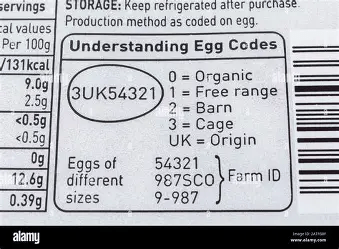
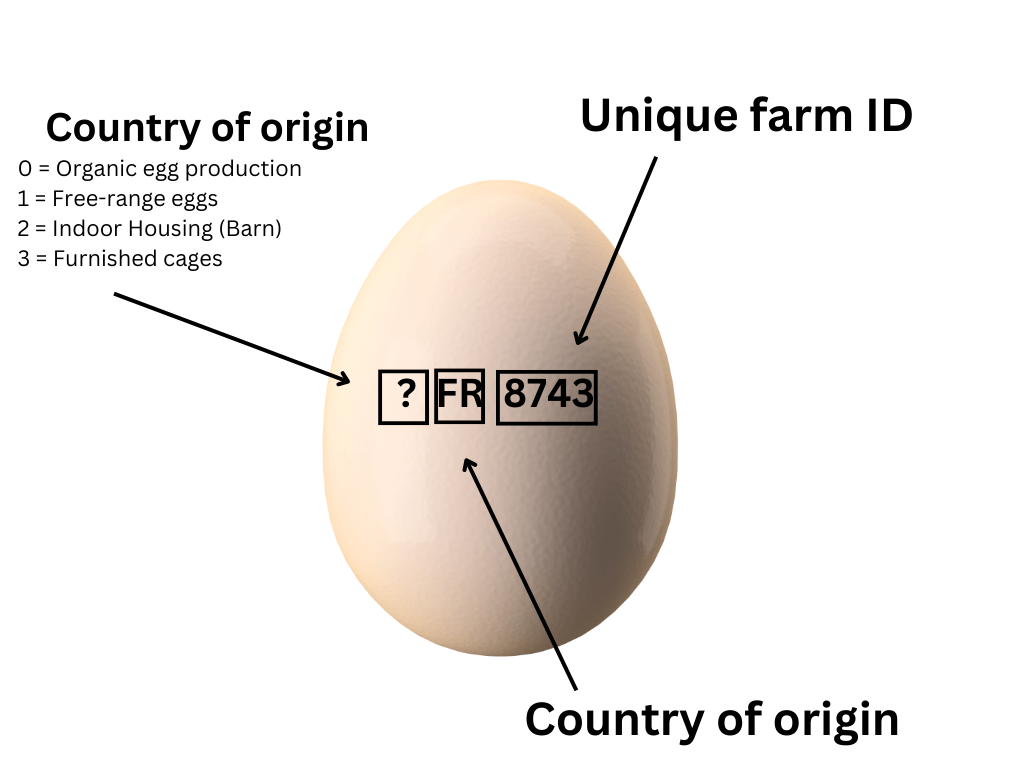
Pretty good well monitored and consumer informed system throughout the EU; which we as animal welfare campaigners fully support. The consumer is informed and they make their individual purchases accordingly.
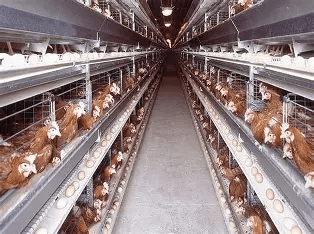
Above – Caged Hens – NO
Below – Free Range – YES.
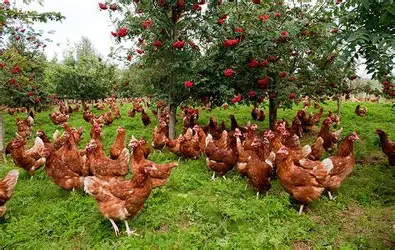
As welfare campaigners we say there is only one way for consumers to purchase their eggs – if they want to eat eggs – GO FREE RANGE. Compare the free range hens plumage above to that of battery hens below – is that image simply not enough alone to make egg eaters buy NON CAGED eggs.
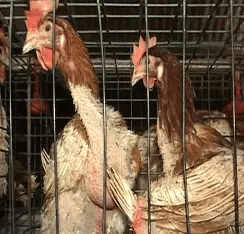
So ok; there you basically have it – Consumer clear labelling relating to egg production, which allows them to make their independent clear choices.
So for this post; the heading basically says ‘when it comes to meat products, is the EU really telling the consumer what they would like to know?’. We don’t think so; if the labelling system is good for eggs; why the shortfalls for meat products in labelling ?
Cards on the table; I [Mark] have been a non-meat eater for 35+ years. Anything ‘that ever had a face’ is not part of my diet; but I accept there are still lots of carnivores out there. One question though I would ask them is simply; if EU legislation attempts to provide you with accurate labelling on your eggs, and how they were produced; then why not clear and precise labelling on how your meat was reared; AND ESPECIALLY HOW IT WAS KILLED !
Many EU and British citizens; when asked, simply abhor the thought of live animals being ritually slaughtered. But, unlike the ‘egg labelling system’; are EU consumers being led up the garden path when it comes to specific meat labelling?. There are two main methods of ritual slaughter which does not involve pre-stunning an animal before its death; – Shechita (Kosher) – the Jewish method; and Halal which is the Muslim method. Here is more reading from the UK Government about this:

Above – Kosher method Beef Slaughter
Below – Halal method Chicken Slaughter
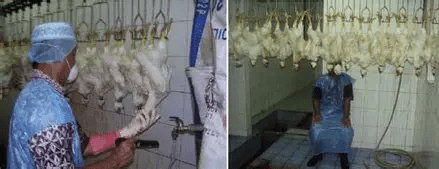
EU law requires that all animals being slaughters for the food chain are stunned and made unconscious prior to killing so that death should be ‘painless’; – hmm; ‘painless’ ? – we say ask the animals going through the process !
But within the EU there are exceptions for religious slaughter as detailed above. Jews and Muslims represent around 6% of the EU population.
Data from Ireland; an EU Member State (MS) showed that around 2010, showed that with just a 1% Muslim population; 6% of cattle, and 34% of sheep were slaughter without stunning. In a 2006/7 survey, it was seen that in France, another MS; 40% of Calves; 25% of Bovine cattle; and no less than 54% of Sheep were slaughtered without stunning.
The EU market for Kosher meat was worth around 5 Billion Euros in 2008.
THE REAL EU MEAT LABELLING ISSUE.
The following is very informative reading for reasons why there is NO standard legislation throughout the entire EU member states when it comes to meat produced by pre-stunning or religious specific methods. We especially suggest looking at the the data on ANNEX 7 – The Practice of Religious Slaughter In Every EU Member State.
Then we can unfortunately understand the EU reluctance, or refusal, to publish concise EU consumer – wide labelling about meat and meat products. When you enter an EU supermarket and are opposed to ritual animal slaughter; does the ‘EU labelling system’ express YOUR animal welfare concerns as a consumer ? – WE WOULD SUGGEST A BIG ‘NO’ !!
But then after all; religion never caused any wars; did it ?
And who in their right mind would want the EU to end up with Egg on its face ?

https://www.independent.co.uk/news/uk/home-news/chickens-gas-chamber-video-tesco-b2760844.html
Exclusive: World-first footage exposed of birds past their egg-laying days being suffocated for supermarket meat
Monday 09 June 2025 17:26 BST
Secretly recorded footage reveals hens apparently writhing in distress and desperately trying to escape as they are suffocated to death to provide meat for supermarkets including Tesco.
In what’s thought to be the first-ever video of its kind, the birds are seen twisting their necks as they are killed with carbon dioxide. They are also heard gasping for breath and emitting high-pitched shrieks.
The recording – which activists say was made at an abattoir endorsed by RSPCA Assured – shows hens being lowered into the gas chamber and dying over the course of several minutes.

Hens were filmed apparently trying to escape from the crates before flopping back in; at times their eyes were open and they were calling (Joey Carbstrong)
Critics said the scenes laid bare the “horrors” behind egg production in the UK, including the fate of even free-range and organic hens.Hens whose egg production has declined are dubbed “spent”, before they are killed and their carcasses are packaged for meat.
Animal-lovers have for years objected to the gassing of pigs with carbon dioxide, warning the animals “burn from the inside out” and suffer immensely in the last minutes of their lives.
Last year 99 per cent of “spent” hens were stunned and slaughtered with CO2; and 77 per cent of meat chickens were killed this way, according to government figures.
In recent years carbon dioxide as a slaughter method has gradually replaced electrical water bath stunning, which raised concerns over the inconsistency of stuns.
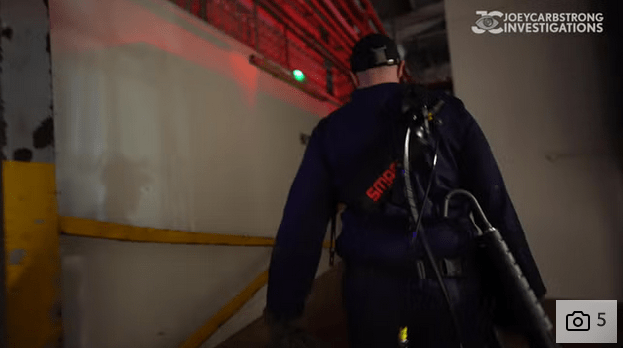
Activist Joey Carbstrong said the footage highlighted the discrepancy between images of egg production and the reality (Joey Carbstrong)
The footage, taken with hidden cameras, shows hens – female chickens used for laying eggs – twisting in distress as they die, and some birds apparently trying to escape.
The floor of the gas chamber was littered with dead birds that had jumped out of the crates, according to activist, filmmaker and vegan advocate Joey Carbstrong, who installed the cameras.
Mr Carbstrong and other activists say they shot the video at an abattoir in West Yorkshire run by HCF Poultry. The company denies it was shot at its premises.
HCF supplies Cranswick Foods, one of the UK’s largest meat producers, which processes the hens into chicken-meat products widely sold in Britain.
There is no suggestion of wrongdoing by either Cranswick or the abattoir as using CO2 is an entirely lawful way to slaughter chickens. However, Mr Carbstrong said the video exposed “the callous treatment of free-range hens when they are no longer profitable”.
“This footage dismantles the industry’s carefully curated image of ‘happy hens’ and reveals the horrifying truth of how these sensitive birds are discarded,” he said.

The footage included a paper label with HCF’s name and address on it (Joey Carbstrong)
“The public are being misled by labelling and have a right to know the reality behind what they are buying.”
Mr Carbstrong added: “Egg-laying hens have been genetically manipulated to produce around 300 eggs per year – far beyond the 10 to 15 eggs naturally laid by their ancestor, the red junglefowl.
“This excessive egg production takes a severe toll on their bodies in multiple ways. Regardless of whether they are free-range, barn-kept or caged, most hens are crammed by the tens of thousands into filthy sheds, where disease runs rampant and cannibalism of dead and dying birds is widespread.
“After just 18 months of relentless exploitation, they are forced to experience a terrifying and agonising death, before being processed into food products.”
The Independent has previously revealed one case of hens being kept in “cruelly overcrowded” cages with insufficient water and another when sick and dying hens were found alongside living ones at a free-range egg farm supplying leading supermarkets as well as Marks & Spencer.
Around 35 million “spent” hens a year are killed for their meat, figures show. HCF can process 10,500 birds per hour, according to a document from 2018, the latest available.

Even free-range hens are put into gas chambers, activists say (Getty/iStock)
Jenny L Mace, an associate lecturer in animal welfare at the University of Winchester, wrote in a report on the footage that the most concerning findings were the high-pitched shrieks, gasping, collisions with equipment, and chickens falling against one another and out of the crates.
“Without use of a significantly less aversive gas or gas mixture, it is difficult to see how this method equates to a viable (high-welfare) replacement to the former slaughter method of shackling chickens upside down and stunning in a water bath, and a humane death,” she wrote.
She said CO2 caused respiratory distress, adding that describing it as an anaesthetic “may be misleading” because of the distress inhaling it causes.
“There is no suggestion of this case being a ‘bad apple’; this is standard practice and in accordance with legislation,” she wrote.
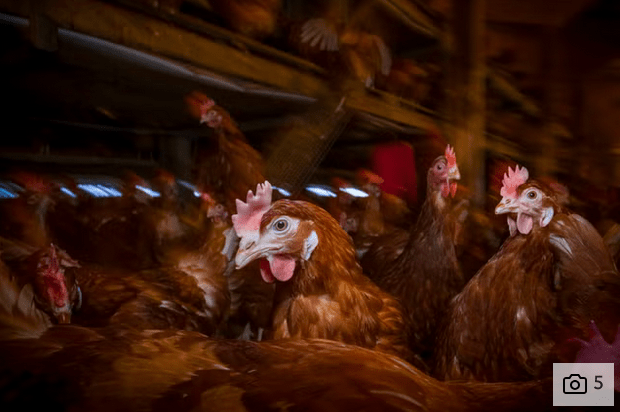
Egg-laying hens have been genetically manipulated to produce around 300 eggs a year, Joey Carbstrong said (Getty/iStock)
Andrew Opie, of the British Retail Consortium, said on behalf of Tesco and other supermarkets:“Our members know how important animal welfare is to their customers and take their responsibilities to animal welfare very seriously to ensure that expected standards are being met.”
RSPCA Assured said the birds in the footage were already unconscious and were not in pain.
A spokesperson said the footage was deeply upsetting but that carbon dioxide was permitted under RSPCA welfare standards, adding: “However, RSPCA standards set requirements that go above the law to ensure a more humane process.
“Due to their physiology, when birds lose consciousness their brains no longer have control over their bodies, which can cause involuntary movements as seen in the footage. This can be incredibly difficult to watch but the birds are actually unconscious when this happens, and are not experiencing pain.”
Cranswick Foods did not respond to a request to comment.
This course provides an introduction to the problem of wild animal suffering. It covers the situation of animals in the wild as individuals, including the many harms they suffer, and ways of improving their situation, including some of the ways this is already being done.
This is the opening video for the course. It gives an overview of the topics that will be addressed in the videos of the course.
Concern about the suffering of wild animals and the ways we can help them has increased a lot in the past decade. A growing number of people are now aware that the lives of animals in the wild are not idyllic, and that they face threats that dramatically impair their wellbeing. There is more awareness now that this affects not just a few animals, but large numbers of them. While in the past, concern for wild animals was mostly focused on their ecological roles or their conservation status, many people now are concerned about what happens to them as individuals, as sentient beings.
Some people may think that it is unfortunate that wild animal suffering occurs, but be unsure about how widespread or how serious it is. Others may think this is an important issue, but not know how tractable it is, or what we can do to address it.
This course sheds some light on these questions and helps give a more clear understanding of the reality of wild animal suffering and, what is more important, of what can be done about it. It is intended to provide an introduction to this question for anyone interested in it, and to be especially useful to those involved in animal advocacy who want to know what can be done to help wild animals. The course will also benefit people working in natural sciences with an interest in learning how their work can help animals.
The course will include three parts.
Part I has been completely published already. It explains the ways that wild animals suffer and how we can help them. Part II details the arguments about the moral consideration of animals, and Part III explores the scientific study of the situation of animals from the point of view of their wellbeing. This new field of study has been called welfare biology.
Each part will consist of a set of videos, around 10 minutes each, focused on some specific problems. The entire course contains 28 videos including this one, which you’ll see listed in the course table of contents.
The first part begins with a general presentation summarizing the question of wild animal suffering. Following this, we will clarify in more detail what the concept of “wild animal suffering” entails. The following videos will then explain the different ways in which animals suffer in the wild. We will see the impacts of harmful weather conditions, natural disasters, diseases, parasitism, hunger, psychological stress, conflicts between animals, and accidents. We will also see how the prevalent reproductive strategies significantly increase the proportion of suffering among wild animals. Then, we will see some of the ways to provide help to these animals, including rescues and vaccination programs. Finally, we will see the kinds of things that each of us can do to make a difference for wild animals.
Some people think that we shouldn’t worry about wild animals because we shouldn’t be concerned about what happens to animals at all. We will believe this if we think, for instance, that only humans matter. In order to asess this concern, and to understand better how we can argue for the moral consideration of animals, the second part of the course presents an overview of contemporary debates about ethics and animals. The part will begin by explaining the concepts of speciesism, as well as related concepts like moral consideration. We will next examine the main defenses of the idea that human interests matter more than equally strong interests of other animals. We will then see the main arguments against this view. After that, we’ll cover how the moral consideration of animals relates to different ethical theories. We will then examine the differences between the views defending the moral consideration of animals and those defending other criteria, such as the ones held by some positions in environmental ethics. In the last part of this part, we will see what sentience is, and consider some indicators of its presence in different animals, especially invertebrates.
Finally, the third part of the course will examine the ways to promote research in academia about how to best help wild animals. In the videos of this part, we will examine the concepts of wellbeing, animal welfare, and wild animal welfare. We will also discuss welfare biology, the study of the situation of animals with regard to their wellbeing. We will see how it is different from other fields that currently exist. We will then see reasons to promote academic research in welfare biology, and what some promising lines of research for this field are. We will see how welfare biology can benefit from work in other cross-disciplinary fields. In light of the work welfare biology could carry out, we will see responses to objections to helping wild animals.. Finally, we will share some ideas concerning the advance of this new field of research, and its importance, especially in the long term.
We hope this course will be interesting to you. Our intention is to help you become familiar with the issues discussed in it, and to share some tools that enable you to do further research on them. We provide information about how to take action in defense of wild animals and to help you make informed decisions about which efforts to support or promote.
If you want to learn more, you can visit our website, where you’ll find much more detailed information about many of the issues addressed in the course.




 World Animals Voice