Category: Environmental

‘Filthy bloody business:’ Poachers kill more animals as coronavirus crushes tourism to Africa.

GP: Africa poaching Rhinos Black Mamba Anti–Poaching Unit

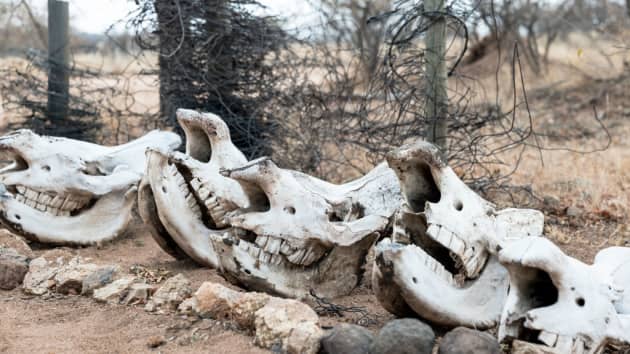
File photo of skulls of White Rhinos and the snares that have entrapped them stand as a stark reminder of the ongoing battle in South Africa to protect these majestic, gentle giants of the African bush.
Ilan Godfrey | Getty Images


‘Filthy bloody business:’ Poachers kill more animals as coronavirus crushes tourism to Africa


Key Points

As the coronavirus pandemic halts tourism to Africa, poachers are encroaching on land and killing rhinos in travel hot spots now devoid of visitors and safari guides.

In Botswana, at least six rhinos have been poached since the virus shut down tourism there. In the northwest South Africa, at least nine rhinos have been killed since the virus lockdown.

“It’s a bloody calamity. It’s an absolute crisis,” said Map Ives, founder of Rhino Conservation Botswana, a nonprofit organization.


Ryan Tate is supposed to be in South Africa right now helping to fight off poachers who hack horns off rhinos and kill elephants for their ivory tusks.

But since the country announced a national lockdown in March to slow the spread of the coronavirus, Tate is stuck in the U.S. He can’t join his team out in South Africa’s wilderness and can’t meet with private donors in the U.S. for his anti-poaching nonprofit organization, which is seeing donations dry up.

“It’s a helpless feeling,” said Tate, a 35-year former Marine and the founder of VetPaw, a group of American military veterans who fight poachers in a remote private reserve in the far north of South Africa.

“Poaching doesn’t stop just because there’s a virus — if anything, it picks up,” he said.

Although poaching is not uncommon in Africa, poachers during the coronavirus pandemic have encroached on land they wouldn’t normally visit and killed rhinos in tourism hot spots now devoid of visitors and safari guides.

In Botswana, at least six rhinos have been poached since the virus shut down tourism. Botswana’s security forces in April shot and killed five suspected poachers in two incidents. In northwest South Africa, at least nine rhinos have been killed since the virus lockdown. All the poaching took place in what were previously tourism areas that were safe for animals to roam.

“It’s a bloody calamity. It’s an absolute crisis,” Map Ives, founder of Rhino Conservation Botswana, a nonprofit organization, said of poaching across the continent.

There are still rangers in the African reserves, but the loss of tourist vehicles in parks provide poachers a significant advantage.

“The poachers have been emboldened because the playing field is in their favor and they won’t have as many problems moving around,” said Ives, who has lived on the Okavango Delta in northern Botswana for four decades but is stranded in South Carolina due to travel restrictions.

Highly organized illegal poaching threatens to send black and white rhinos, elephants and other African wildlife into extinction over the next several decades. The black rhino population has plummeted 97.6% since 1960 and the lion population is down 43% in the last 21 years, according to the World Wildlife Fund. At least 35,000 African elephants are killed each year and roughly only 1,000 mountain gorillas and 2,000 Grevy’s zebras remain on the continent.

“They are professional and adept at running off with rhino horns in minutes and dodging security forces. They are masters at evading detection,” he said. “It’s a filthy bloody business.”

Since Botswana’s booming tourism industry collapsed because of the virus lockdown, Ives has seen an anecdotal rise in rhino and bush meat poaching incidents. His company is running short of cash as donations dry up amid the global lockdown, and that may result in reduced patrols as a result.

“We lost hundreds of sets of eyes and ears in the delta,” Ives said. “I’m sure poachers know this — they watch these camps closely and see tourism activity.”

Africa’s $39.2 billion tourism industry is also vital in funding wildlife conservation efforts across the continent.

Africa received 62.5 million visitors, creating 9.1 million direct jobs in travel and tourism sectors in 2015, according to estimates from the African Development Bank.

Funding from sources like national park fees and safari rides are vital to wildlife conservation in Africa.

But now people working in tourism are being laid off because of the pandemic and national parks that provide wildlife a safe place from poachers are losing revenue. All three national parks in Rwanda have temporarily closed, along with Virunga National Park in the Democratic Republic of the Congo and Kruger National Park in South Africa.

“There’s a lot of people struggling in Africa, a lot of private reserves that have helped save a few species including rhinos,” said Tate. “Now they don’t have that ecotourism they depend on, it’s gone. There’s going to be a lot of damage done from this.”

There’s also a major concern that as the coronavirus harms African economies and sharply raises unemployment levels, people will become desperate for income streams and pursue poaching to make a living.

Africa reported a 43% jump in coronavirus cases over the last week, according to Africa Centers for Disease Control and Prevention. The World Health Organization has warned that the continent of 1.3 billion people could become the next epicenter of the outbreak, potentially pushing 30 million people into poverty.

Conservationists expect that in addition to professional poachers killing more animals, countries across Africa will experience a massive surge in bush meat poaching by average people since it’s cheaper to kill animals for meat than to buy it.

“Why do criminals commit acts of crime? They do it because they’re desperate and it’s a quick easy means for money,” Ryan said. “Poaching is no different. There’s a lot of desperate people out there because of the virus and [poaching] will absolutely pick up.”

https://www.cnbc.com/2020/04/24/coronavirus-poachers-kill-more-animals-as-tourism-to-africa-plummets.html

England: Exposing the Pig Business – USA and Poland. And Legal Threats If Broadcasted !

gemalt-england-flagge-5d


A factory farm near Wieckowice in Poland, owned by US pork giant Smithfield Foods, the biggest pig factory farming corporation in the world, has been infected with African Swine Fever. The Guardian reported on 8th April 2020 that over 10,000 piglets on the farm would be culled.

I went to Wieckowice to film my (2009) Channel 4 documentary Pig Business where I met local residents and workers suffering from respiratory, neural and intestinal diseases because of toxic emissions from this very same pig factory that has closed today. I climbed factory farm perimeter fences to film suffering pigs and interviewed Smithfield Foods’ US lawyer and local directors, EU bankers and EU bureaucrats to hear their excuses for their destruction of rural culture, health and economies.

Meanwhile on 16 April 2020, 700+ workers at a Smithfield Foods processing plant in South Dakota, were tested positive for COVID-19, representing 55% of all confirmed cases in the state.

In this uncensored version of the 2009 film Pig Business you will hear pork processing workers describing their cramped, dangerous and unsanitary conditions in Smithfield’s slaughter and packing plant at Tar Heel, North Carolina. Though most of the meat is now sent to China and the workers have union representation, most of the workers are undocumented migrants whose rights are undermined. So it is not surprising that during this pandemic Tar Heel is still open and slaughtering 34,000 pigs per day.

In 2009, the censored version of Pig Business was broadcast by Channel 4. We have now posted the uncensored film that includes footage of local doctors, workers and of Robert F Kennedy Jr that had to be taken out of the Channel 4 broadcast version because of threats of defamation from Smithfield Foods.

The competitive imperative for livestock farms to ‘get big or get out of the industry’ is threatening the health of people, animals and ecosystems around the world. What hope of curbing the possible vector of viruses in the UK if pig and poultry factory farms continue to grow ever bigger?

The launch of the Pig Business, The Full Tail – an uncensored version of Pig Business (2009) comes as US pork giant Smithfield Foods – featured in the documentary – slaughters 10,000 pigs stricken with African Swine Fever in a factory farm in Poland, and closes its packing facility in South Dakota where 700+ workers tested positive for COVID-19. Where Smithfield Foods sowed bad karma of cruel treatment of pigs and sick workers and neighbours, so they now reap the consequences.

When I first heard about the outbreak of COVID-19, one emotion I didn’t feel was surprise.

No measures were taken to prevent the root cause of swine flu, mad cow disease and avian flu, and so it was only a matter of time before some new and deadly disease spread from animals to humans. This time it is COVID-19. Many scientists are again suggesting that the pig and poultry industries could be the vectors of the disease in its passage from bats to humans. So, instead of our governments only investing in cures and vaccines, we urgently need to prevent the outbreaks of zoonotic diseases by ending factory farming.

My film Pig Business, exposes the true costs of the corporate takeover of the pig industry focusing on US pig giant Smithfield Foods’ invasion of Poland. It was broadcast on Channel 4 in 2009, during the global pandemic H1N1 (swine flu) that killed approximately 253,000 people worldwide, though some sources report much higher.

Smithfield Foods’ takeover of pig farming and processing in Poland has come home to haunt it. They were in the headlines earlier this month when African Swine Fever struck their factory pig farm in Wieckowice, Poland, 93 miles from the German border, and all 10,000 piglets had to be slaughtered.


A week later, Smithfield was in the news again when their packing plant in S. Dakota was closed due to a staggering 700+ confirmed COVID-19 cases among Smithfield employees and people associated with them. Smithfield-related infections account for 55% of the caseload in the state.


My film tells the story of neighbours living near the US-based (and now Chinese owned), Smithfield Foods, the world’s biggest pork producer, that had expanded into Poland in the late 1990’s thanks to a favourable loan from the European Bank for Reconstruction and Development.

Imported pork began flooding the Polish, European and UK markets undermining local smaller scale farms. Smithfield Foods pork is only cheaper because they are raised in cruel overcrowded and unhealthy conditions with hundreds of thousands of tons of waste polluting the surrounding countryside.


Pigs are raised in unhealthy, stressful conditions that cause such suffering to the animals that they have to be given prophylactic antibiotics to keep them alive. The sheds become a breeding ground for antibiotic resistant diseases that form part of the toxic brew, including ammonia, hydrogen sulphide from biodegrading faeces, that threatens the health of both workers and neighbours with respiratory, neural and intestinal diseases.


To compete with this global race to the bottom, EU and UK pig farms are still expanding and externalising their true costs, or facing bankruptcy.

When the BBC World rejected the film, Pig Business for fear of litigation, Channel 4 agreed to air it. But when Smithfield got wind of it in 2008, they instructed a London lawyer to threaten Channel 4 with a libel action if they dared go ahead with the broadcast. Channel 4 hired a specialist libel lawyer to alter the film to ensure it was protected from the very corporate-friendly libel laws that prevailed in the UK at the time. In 2013 the law was changed so that now a profit-making entity must prove serious financial loss before it can sue for damages.

Though Channel 4 did broadcast the film, Smithfield’s threats to sue them resulted in scores of important testimonials being removed.

I am now publishing the Pig Business ‘The Full Tail – uncensored version’ film that contains those powerful extracts as they are as relevant today as they were back in 2009. The arrival of African Swine Fever in their farm in Poland and the rates of COVID-19 in their processing house proves that their dangerous businesses practices have not changed despite the suffering and diseases that locals have complained about for decades.

Below are some of the statements that have returned into the Director’s cut.

  1. Polish Minister for Agriculture; ‘Often they try to keep the inspectors out of the farms altogether. The owners use various legal loopholes and tricks……to stop vets entering the farms’

Why was this removed? In a libel court in the UK we would have to prove that this happened repeatedly and on specific farms on specific dates’


Smithfield former farm worker; ‘The doctor asked where I worked before… and I said on the pig farm… He said I simply breathed all those fumes and my lungs couldn’t cope. He said my lungs had shrunk day by day. I’ve damaged my lungs and there was no cure.’

‘When there was an inspection, we were told to remove all the treatment charts and when they’d gone we hung them up again. If the inspectors should ask us questions we were instructed to say we were only cleaners…and that the vet was doing all the treatment not us.’

Why was this removed? No workers were allowed to be used in the film


Smithfield former farm worker ‘Most people are sick but hide it for fear of losing their jobs. They come from local villages. The problem is the microclimate… which contains concentrated… hydrogen, sulphate, nitrogen… and other poisonous substances.’

‘…because of the large amount of pigs, we found many sick pigs during our routine rounds, so we would give medicines all the time”

Why was this removed? No workers were allowed to be in the film. Smithfield might argue that we cannot prove specific cases with medical records, although 25%-30% of factory pig farm workers suffer permanent lung damage.


Neighbour of the Wiekowice pig factory; ‘The gasses from the farm have been tested. A certified company called Atma conducted the research. This was paid for by the county mayor. The results showed the pollution was up to 30 times above the recommended guidelines’.

Why was this removed? They had to be able to prove that these gasses are emitted every day.
Each day’s test cost £1,100 so the local mayor could only afford one test


Robert F Kennedy Jr: ‘They can’t raise hogs with this kind of cruelty unless they give them lots of antibiotics, sub-therapeutic antibiotics. The United States dept of agriculture just made a study that said that every one of these facilities puts out 1 billion antibiotic-resistant bacteria every day that crosses the property line and threatens the health of people who live down-wind of those facilities and the herds of animals that live down-wind of those facilities’.

‘They can’t produce a pork chop cheaper than a family farmer without breaking the law.’

Why was this removed? Can’t use Robert Kennedy unless he is speaking in the senate


With global trade, pig farming has to compete with global ‘vertically integrated’ giants like Smithfield Foods that own both pig production and processing to reap the profit from the entire system. Their monopoly enables them to push down the prices of pork and so bankrupt independent pig producers and their contract farmers and externalise their true polluting costs onto the broader community. Local diseases are now proving to be global. The power is in our hands. We can prevent these diseases by only buying meat from local small scale family farms where animals are treated as sentient beings not industrial raw materials.


The good karma of only eating meat with a high welfare label will reap the reward of less animal-to -human diseases. The health of our animals is integral to our own survival. Look for the high welfare labels RSPCA Assured, Free Range or best of all, Organic or go direct to your farmer via farmers market, websites like Big Barn or your local box delivery scheme to find high welfare. Please sign and share our petition asking the government not to sign a trade deal with the US that allows imports of pork raised in conditions that are illegal in the UK.


Best wishes,

Tracy Worcester, Director


England: Crazy Fundraising for Gorillas -On the Streets of London.

gemalt-england-flagge-5d


We have been covering a lot of serious, bad things recently; so here is a light break which I hope you enjoy.


London – Sadly the Coronavirus has put a current halt to the massive fundraising ‘Gorilla Run’ which takes place in London each year to raise big funds for the protection of our close and very endangered cousins – the Gorillas.

Fingers crossed that this fantastic fundraising event will soon be back on the streets of ol’ London town.

Here is a video of one of the recent fundraisers – Take a Break and Enjoy !

Regards Mark


England (London): Farms Not Factories – Big Pig Business !

gemalt-england-flagge-5d

Factory farms, like wet markets, provide the ideal conditions for diseases such as the Covid-19 coronavirus to mutate, multiply and spread. A number of different coronaviruses have decimated pig populations in recent years, and it has been shown that some of these viruses could have (or have already) made the jump to humans (see below). This is deeply concerning, particularly amidst this global pandemic we are currently facing.


In March, the campaign group Pause the System took to the streets in front of Downing Street urging the UK government to ban factory farming amongst a set of measures to prevent any future pandemic outbreaks. Since then, many newspapers, journalists and writers have been speaking out about the links between public health, epidemics, pandemics and factory farming. We have a responsibility to put a halt to all the broken systems that contribute to viral pathogens, to reduce the possibility of this happening again. We need to ban factory farming. However, last month we were met with the devastating news that, in the UK, pig and chicken factory farming is actually continuing to rise.


Please read and share widely our blog article that discusses the link between factory farming and viruses. We can all help bring factory farming to an end by only buying high welfare pork from small scale high welfare farms. Look for high welfare labels like RSPCA Assured, Free Range or best of all, Organic – Or go direct to your farmer via farmers markets, box schemes and online.


Read the full article here:

https://farmsnotfactories.org/articles/if-you-want-pandemics-build-factory-farms/


Farms Not Factories – About Us:

https://farmsnotfactories.org/about-us/


https://youtu.be/vwmJmVH6pXY


https://youtu.be/VxgNE5KgSvg


Farms Not Factories
28, Halsey Street,
London, SW3 2PT


Coronavirus: WHO urges China to close ‘dangerous’ wet market as stalls in Wuhan begin to reopen.

UNations


Coronavirus: WHO urges China to close ‘dangerous’ wet market as stalls in Wuhan begin to reopen


’75 per cent of emerging infections come from the animal kingdom… It’s partly the markets, but it’s also other places where humans and animals are in close contact,’ says Dr David Nabarro


The World Health Organisation is urging countries across the world to close “dangerous” wet markets amid warnings about the risks posed by environments where humans are in close contact with animals.

Wet markets in Wuhan, the city where the coronavirus outbreak first emerged, have begun to reopen following the lifting of lockdown restrictions. This move comes despite the virus being linked to the city’s Huanan Seafood Wholesale Market.

But WHO, as well as other public health organisations and campaigners, have said the markets pose a “real danger” as pathogens can spread easily and quickly from animals to humans.

Dr David Nabarro, a WHO special envoy on Covid-19 and special representative of the United Nations secretary general for food security and nutrition, said the world health body “pleads with governments and just about everybody” to be respectful of how viruses from the animal kingdom are rife.

Speaking on BBC Radio 4’s Today programme, Dr Nabarro said while WHO is not able to tell governments what to do, their advice is to close wet markets.


He replied: “You know how WHO and other parts of the international system work – we don’t have the capacity to police the world. Instead, what we have to do is offer advice and guidance, and there’s very clear advice from the Food and Agriculture Organisation and WHO that said there are real dangers in these kinds of environments.

“75 per cent of emerging infections come from the animal kingdom. It’s partly the markets, but it’s also other places where humans and animals are in close contact. Just make absolutely certain that you’re not creating opportunities for viral spread,” added Dr Nabarro.

Traders sell fresh produce, fruit and vegetables in wet markets alongside wild and domestic animals mainly for consumption in wet markets, which are common in China, South Korea and southeast Asia. Not all wet markets sell exotic meats, but poor legal controls allow for the controversial product to enter the supply chain.


Last week, over 200 conservation groups across the world signed an open letter calling on WHO to force the closure of markets where wild meat is sold for consumption.

The joint letter calls on WHO to recommend to governments that they bring permanent bans to live wildlife markets and to exclude the use of wildlife from the organisation’s definition and endorsement of traditional medicine.


Dr Nabarro added: “We have similar concerns about bushmeat – be very very careful when you’re basically eating wild animal meat or killing wild animals. All these things are higher risk and we have to be on high alert these days for these problems.”

The Independent is calling for global action to impose tighter restrictions surrounding the trade of wild animals, in order to help reduce the risk of diseases like coronavirus from spreading.


There is some indication that Chinese authorities are heeding calls for more restrictions. Last month, Beijing banned the trade and consumption of non-aquatic wild animals, and shut down 20,000 farms raising animals such as peacocks, porcupines and ostriches.

Shenzhen became the first Chinese city to ban the sale and consumption of dog and cat meat, with central authorities declaring that dogs are companions and not for consumption.

Jinfeng Zhou, secretary general of the China Biodiversity Conservation and Green Development Foundation, told The Guardian that a universal closure of wildlife markets was justified.

However, the use of wild animal meat or byproducts are still being approved for use in medication and signs that regional Chinese authorities are not enforcing the recent ban on the sale of wild animals have emerged.


Source – Independent (London) – https://www.independent.co.uk/news/world/asia/coronavirus-china-cases-deaths-who-wet-market-wuhan-a9462286.html


England: Conservationist Jane Goodall calls for global ban on wildlife trade and end to ‘destructive and greedy period of human history’.

gemalt-england-flagge-5d


Jane Goodall calls for global ban on wildlife trade and end to ‘destructive and greedy period of human history’


Stop the Wildlife Trade: The renowned conservationist says we are putting economic growth ahead of environmental protections and destroying our children’s future


Read the entire article from the ‘Independent’ (London) by clicking on the following link:

https://www.independent.co.uk/environment/jane-goodall-interview-animal-markets-wildlife-trafficking-a9458611.html


Sea Shepherd: operation Jairo

sea shepeard logojpg

Operation Jairo is Sea Shepherd’s campaign to protect the world’s endangered sea turtles.

Of the seven species of sea turtles that exist, six are currently on the red list of endangered species. Sea Turtles are some of the oldest living creatures on earth and have called our oceans “home,” for over 500 million years. Of the seven species of sea turtles that exist, six are currently on the red list of endangered species.

schildkröte sea sheapardpgPhoto: © Hoarau Galice / Sea Shepherd

They are threatened by human interactions including pollution, coastal development, fishing gear, and poaching. Due to these threats, there has been an alarming decline in sea turtle populations around the world.

Since 2014, Sea Shepherd has conducted sea turtle protection campaigns at remote beaches around the world, helping defend mother sea turtles and their eggs from poaching.

These locations include Costa Rica, Honduras, Florida, Antigua, Barbuda, and Nicaragua. Our efforts have saved the lives of thousands of turtles from a variety of species including Hawksbill, Green, Olive Ridley, and Leatherback.

Operation Jairo honors the life and work of Jairo Mora Sandoval, a Costa Rican turtle defender. Jairo was brutally murdered on May 31, 2013 while attempting to protect leatherback turtle nests.

Our campaign continues his legacy, as we defend sea turtles in Nicaragua this Summer.

Find out more about our history, campaigns and successes at: https://www.seashepherdglobal.org/

And…We express our heartfelt thanks to the tireless activists of Sea Shepherd for their harf fight to protect our oceans and their inhabitants from unscrupulous criminals.

My best regards to all, Venus

Brazil: free beaches for baby turtles


Empty beaches – a blessing for baby turtles!

Because of Covid-19, the beaches in Brazil are almost deserted.
Good for these endangered turtles. Hundreds of babies hatch undisturbed.

Brasil pg

The corona pandemic is currently turning our everyday lives upside down. While we stay at home most of the day, are no longer allowed to travel or meet friends, and the economy has been shut down to a minimum, animals and nature breathe freely worldwide. In Italy you can see dolphins, in Europe the smog disappears and in Japan deer dare to enter the city (https://worldanimalsvoice.com/2020/03/20/we-are-the-real-virus/).

The spectacular sandy beaches of Brazil are therefore unusually empty despite tropical temperatures.

leere strände brasilien

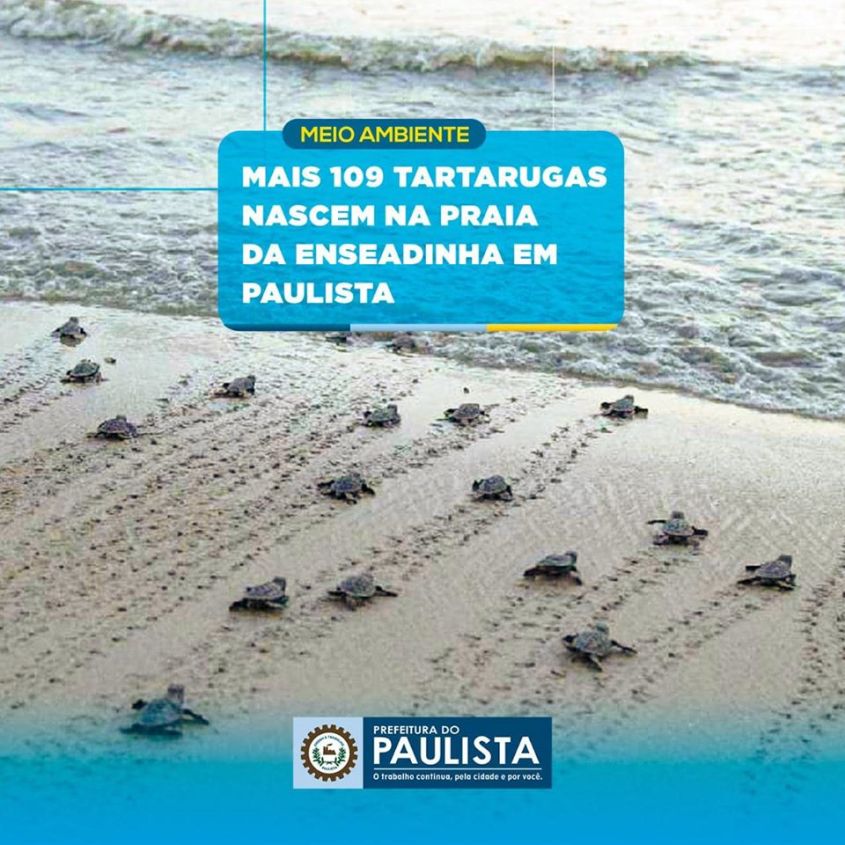
The measures also have unusual side effects: on the coast of the city of Paulista, almost 100 sea turtle babies of the species Hawksbill turtle hatched and were able to make their way into the sea almost undisturbed.

“A total of 400 sea turtles were born on the Paulista coast in 2020, including 87 green turtles and 313 hawksbill turtles. Due to the measures to prevent the spread of the new corona virus, almost no people were present … “, says the ministry website. There are said to be four more nests that are supposed to hatch between April and May.

schildkröter brasil

https://tierisch.heute.at/a/46079534/leere-str%C3%A4nde–ein-segen-f%C3%BCr-schildkr%C3%B6tenbabys


And I mean…That and many similar free walks of animals show how much the animals had to suffer among us humans.

Everyone stays at home! then everyone benefits from it!!

My best regards to all, Venus

If One Positive Thing Comes From Coronavirus; It Could Be That The Environment Improves ! – Whatever; Mankind Needs To Learn From This !

Dramatic fall in China pollution levels 'partly related' to ...

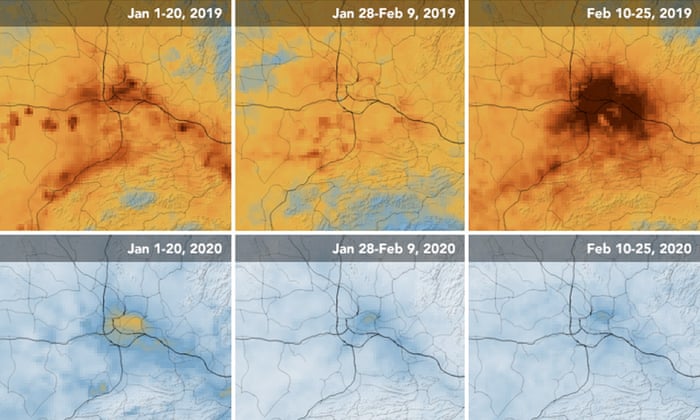
Nasa maps showing NO2 values over Wuhan during January and February. Photograph: Nasa Handout/EPA

https://www.theguardian.com/environment/2020/mar/01/dramatic-fall-in-china-pollution-levels-partly-related-to-coronavirus 


Mother Earth is having a bit of a Detox – and we think this is really fantastic. The Coronavirus / COVID has kept cars, planes and people, and their massive pollution off the streets and out of the towns and cities, and as a result, allowed the Earth to take some much needed ‘environmental medicine’ to help get itself and little better with regard the environment and cleaner air.

The pity is, that if and when it is all over; if it will ever be; huge numbers of humans will get back into their cars; board their planes, go back to their polluting jobs as if things never really changed much. If you can say one thing about the human race, it is that it never learns from its past mistakes.


Please click on the following link and read what some of the people have said.


https://www.boredpanda.com/himalayas-mountains-coronavirus-pollution-levels-drop/


People living in some parts of India are seeing the Himalaya mountains crystal clear for the first time in decades. This happened after the coronavirus quarantine reduced the amount of pollution in the country and helped the air clear up a bit.

Locals in the Jalandhar district in Punjab in Northern India, around 125 miles (just over 200 kilometers) from the mountains, are enjoying the majestic view. One of the people celebrating the unspoiled view is Indian cricket player Harbhajan Singh, with other Twitter users chiming in how pollution is a serious problem in India.

One person even said that this was the first time they could clearly see the Himalayas in nearly 30 years.


Researchers in New York told the BBC their early results showed carbon monoxide mainly from cars had been reduced by nearly 50% compared with last year.

Emissions of the planet-heating gas CO2 have also fallen sharply.

But there are warnings levels could rise rapidly after the pandemic.

With global economic activity ramping down as a result of the coronavirus pandemic, it is hardly surprising that emissions of a variety of gases related to energy and transport would be reduced.

Scientists say that by May, when CO2 emissions are at their peak thanks to the decomposition of leaves, the levels recorded might be the lowest since the financial crisis over a decade ago.

https://www.bbc.co.uk/news/science-environment-51944780


Melting Himalayan Glaciers: People, Environment, Economies | World ...