Category: Environmental

USA: Trump Administration Proposal to Remove Federal Protection for Gray Wolves Is Scientifically and Legally Flawed. Last Day for ACTION.

UNST0001


FOR IMMEDIATE RELEASE – July 15, 2019

Trump Administration Proposal to Remove Federal Protection for Gray Wolves Is Scientifically and Legally Flawed


Washington, D.C. Today is the final day to submit comments on the Trump Administration’s proposal to strip Endangered Species Act (ESA) protection for all gray wolves living in the lower 48 United States, except for the separately listed Mexican gray wolf.

Comments submitted by conservation groups The Rewilding Institute, Project Coyote and Wildlands Network point to substantial flaws and omissions in the U.S. Fish and Wildlife Service’s (USFWS) analysis of the relevant science and their interpretation of various ESA mandates.  The ESA requires that decisions to remove endangered species from federal protection under the ESA must be based on “the best scientific and commercial data” available at the time of the decision.  It also requires a determination that the species is no longer in danger of extinction “throughout all or a significant portion of its range.”

Wolves are as essential to the health of their ecosystems as they are reliant upon healthy ecosystems for their survival.  When allowed to exist at ecologically effective population densities and distributions, vital functions of wolves include keeping large herbivores from overgrazing their habitat and limiting populations of mid-sized predators.  Removal of wolves or other top carnivores from an ecosystem can unleash a cascade of responses that diminishes biodiversity and overall ecosystem health.  By disproportionate predation on the sick and weak, coursing predators such as wolves generate evolutionary selection for healthier, faster prey.  With Chronic Wasting Disease rapidly infecting big game herds across the country, scientific studies indicate that restoring wolves to vast areas of their former range could be an effective strategy for reducing the prevalence and checking the spread of this devastating disease and other wildlife diseases.

“The USFWS proposal erroneously claims that restoring gray wolves to the three Great Lakes states of Minnesota, Wisconsin, and the Upper Peninsula of Michigan plus the three Northern Rocky Mountain states of Idaho, Montana, and Wyoming at a minimum population of about 2,000 wolves will assure their long-term survival in the lower 48 United States throughout all or a significant portion of their range,” said David Parsons, a wildlife biologist who formerly led the USFWS’s Mexican Wolf Recovery Program and who is now the Carnivore Conservation Biologist for The Rewilding Institute and a science advisor to Project Coyote.  “It is hard not to conclude that the proposal to delist gray wolves represents a political decision in search of a science-based justification, rather than a well-reasoned decision that flows from a critical application of the best available science, as is required by the ESA.”

Gray wolves formerly ranged throughout all or parts of 42 states and historically numbered at least in the hundreds of thousands.  The USFWS has determined that the restoration of gray wolves to about 10 percent of their historic range and only a fraction of 1 percent of their historical abundance is sufficient to deem them recovered and no longer in danger of extinction.

“No credible conservation geneticist would consider the USFWS’s gray wolf recovery goals to be anywhere near adequate to ensure the long-term viability, ecological function, and evolutionary potential of gray wolves in the lower 48 states,” said Dr. Michael Soule, a Project Coyote science advisory board member and a founder of the discipline of conservation biology.

“The proposed rule ignores vast swaths of existing, highly suitable habitat, which will remain indefinitely impoverished by reduced biological diversity and impaired ecosystem health,” said Kim Crumbo, Senior Carnivore Expert for Wildlands Network. “Today, wolves inhabit only a small fraction of their historic range within the lower 48 states. But wolves have yet to recover in additional parts of the country—including the Pacific Northwest, northern California, the southern Rocky Mountains, the Grand Canyon ecoregion and the Northeast—where prime wolf habitat still exists.”

A peer review by independent scientists, commissioned by the USFWS, found demonstrable errors of scientific fact, interpretation and logic throughout the proposed gray wolf delisting rule and the accompanying biological report.  Substantive reviews by other conservation organizations and independent scientists corroborate and add to the findings of the commissioned peer reviewers.  For example, on May 7, more than 100 scientists and scholars sent a letter to Interior Secretary David Bernhardt stating that the proposal to remove Endangered Species Act protections for gray wolves across nearly all of the lower 48 states “does not represent the best-available science pertaining to wolf conservation.”

The peer reviewers’ recommendations leave the USFWS with two options:  1) produce a proposal that is consistent with the best available science as informed by the independent peer reviewers and others, or 2) retract the proposal altogether.  Ignoring the peer and public review findings and recommendations in part or in whole will be met with public outcry and most likely litigation.

Americans remain supportive of wolf conservation and of the ESA.  Recent research indicates three in five hold a positive attitude towards wolves.  Even those living in wolf range have a largely positive attitude toward these magnificent animals. In 2013, the last time the USFWS proposed a national delisting of wolves, approximately one million Americans stated their opposition to stripping endangered species protection from gray wolves, and it appears there will be substantially more public opposition this time.

###

Comments on the gray wolf delisting proposal are being accepted until midnight July 15.  Click here to submit comments. 

###


References:


See Project Coyote’s and The Rewilding Institute’s comments on the proposed rule here.

See Wildlands Network’s comments here.


Learn more about gray wolves here.


###


Project Coyote, a national nonprofit organization headquartered in Northern California, is a North American coalition of wildlife educators, scientists, ranchers, and community leaders promoting coexistence between people and wildlife, and compassionate conservation through education, science, and advocacy. For more information, visit ProjectCoyote.org.

The Rewilding Institute’s mission is to develop and promote ideas and strategies to advance continental-scale conservation in North America, particularly the need for widely distributed and ecologically effective populations of large carnivores and effective landscape corridors for their movement.  TRI offers a bold, scientifically credible, practically achievable, and hopeful vision for the future of wild Nature and human civilization in North America. Visit Rewilding.org to learn more.

Wildlands Network is a western-based, national organization whose mission is to reconnect, restore and rewild North America so that the diversity of life can thrive. We envision a world where nature is unbroken, and where humans co-exist in harmony with the land and its wild inhabitants. Visit WildlandsNetwork.org to learn more.

Portugal: Putting pigs in the shade: the radical farming system banking on trees – or, How It Used to be Before Intensive Factory Farming !

PORT0001


Putting pigs in the shade: the radical farming system banking on trees

A farm in Portugal is showing how the ancient art of silvopasture – combining livestock with productive trees – may offer some real answers to the climate crisis

The land to the north of the village of Foros de Vale Figueira in southern Portugal has been owned and farmed through the centuries by Romans, Moors, Christians, capitalists, far rightists, even the military. It has been part of a private fiefdom, worked by slaves as well as communists.

Now this 100-hectare (247-acre) patch of land just looks exhausted – a great empty grassland without trees, people or animals, wilting under a baking Iberian sun.

But look closely and you can just see the future: tips of thousands of tiny oak and nut trees following the contours and poking through thick mulches of grass and leaves.

“This will be the new montado,” says Alfredo Cunhal, referring to a pre-medieval Portuguese system of farming. He is an agricultural scientist whose great-grandfather cleared the cork and olive trees that were once scattered around, and whose family then overworked the land by dosing it with chemicals and growing monocultures of cereals.

The montado system combines herds of animals with productive trees and shrubs. Cunhal’s vision is to create an oasis-style abundance on land where there is often no rain for nine months of the year and where temperatures can reach 49C (120F

“Imagine tall trees, like 40-metre tall walnuts, putting down leaves, letting light through, drawing up water. Below them, cork oaks giving shade, and a line of citrus and olive trees; and then imagine vines climbing the trees. The fruit and nuts will provide the food for the pigs, chickens, cows and other animals who graze there,” he says.

“Animals are the key,” he says. “They are important for the whole ecosystem, as well as part of the food chain. They must be balanced with the tree system. Pigs provide digestion, and are good for the soil, they disturb the ground and fertilise the land. The natural fertility cycles work better with them. The pig is not a meat machine but a friend of nature.”

The “new montado” at Herdade do Freixo do Meio farm will take years to mature but will repay itself many times over with the variety of food produced and healthier soils, he says. “It offers resilience against fires and global heating and it soaks up the carbon,” he says.

‘The pig is not a meat machine but a friend of nature,’ says Cunhal

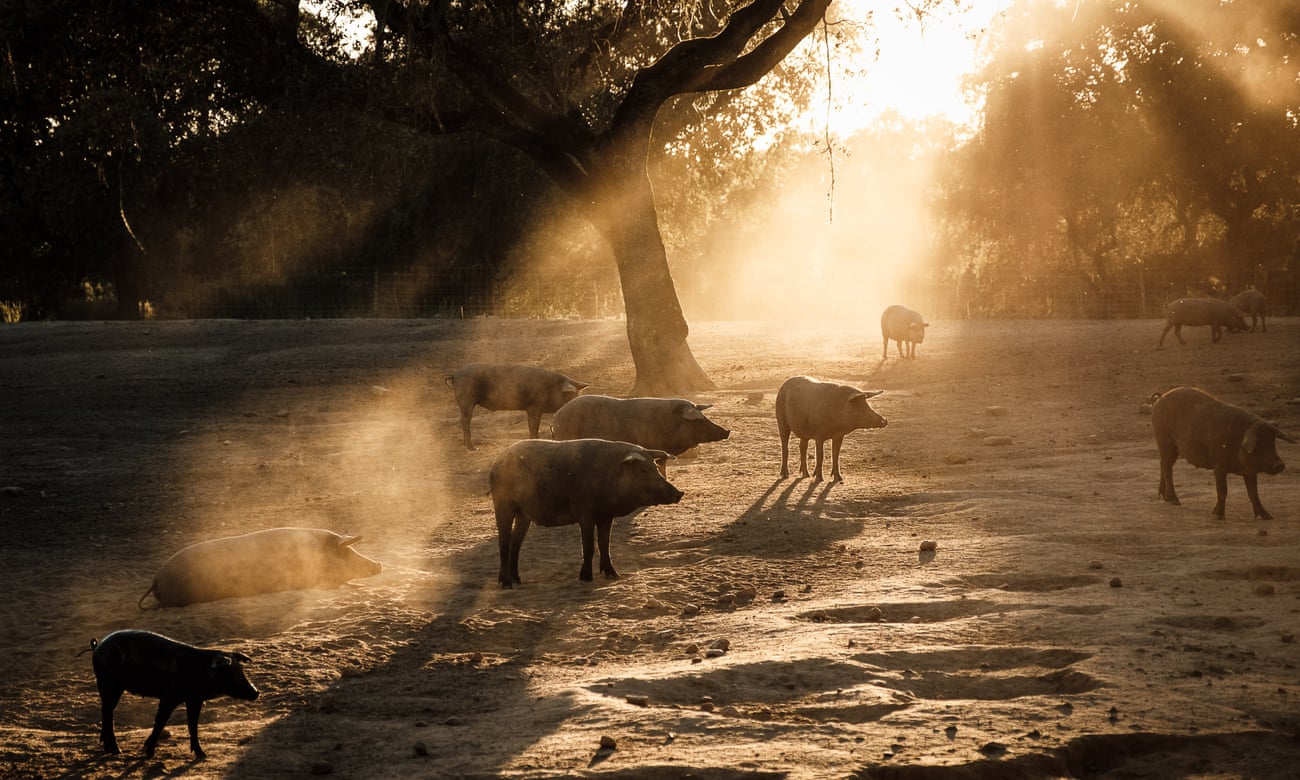
Animals are free to roam under the shade of trees and shrubs at a co-operative farm in Portugal.

“We are aiming to go from zero to abundance in a few years. We can put chickens on the land soon, pigs and sheep will follow, cows come later. We invest now, and the next generation sees the real benefits,” he says.

Cunhal, who comes from a large landowning family related to Portugal’s legendary communist leader Álvaro Cunhal, says he has had to reject much of what he was taught about farming at college.

“I spent five years studying agriculture and I never heard the word ecology. We were taking more and more from the land but we were farming monocultures. We were eating the system. I was managing 7,000 hectares for my family but I never noticed the trees. I really didn’t know anything. I produced a lot but I needed so many inputs. I needed carbon, energy, chemicals. I could do nothing efficiently. The land was eroded, the soil damaged.”

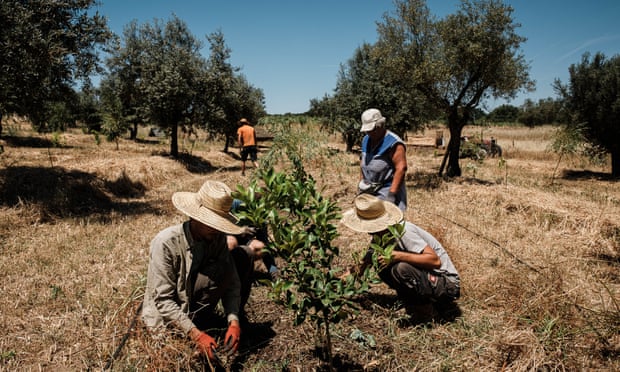
Demoralised, he gave up managing the family estate in 1990, took a share of the land, and started to run 600 hectares on organic, co-operative lines with a collective of 35 people, many of whom had worked on the estate for years. Together, these “partners” are converting the whole farm into a full montado system.

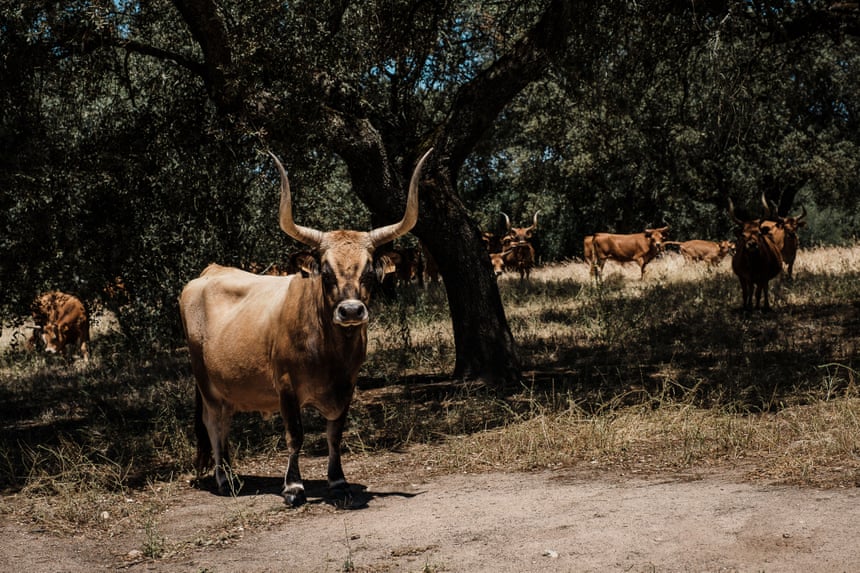
The results are beginning to show. Wild boar, lynx and deer roam freely, while old varieties of pig, cattle, chickens and turkeys are rotated among the established oak and olive trees and in newly planted orchards. The farm grows almost every type of Mediterranean food among the trees, as well as 40 varieties of fruit and nut.

“We can grow water,” says Cunhal. “By planting trees whose roots go deep we are drawing moisture up and building soils, creating the possibility to grow even more.”

The complexity of the system baffles conventional farmers who mostly specialise in a handful of crops or products. But Cunhal dismisses monocultures as “the end of life” and insists there is resilience and safety in diversity.

Cows at Herdade do Freixo do Meio

The variety of food produced is astonishing. The farm grows dozens of fruit and vegetable crops and makes and sells 600 different products, ranging from eight kinds of oak flours and breads, to meats, wine and olive oils.

“It’s far more than any normal farm would ever consider. This used to be a cork oak farm. Now cork is just 5% of the turnover. Four years ago we were 100% dependent on the open market and wholesalers. Now nearly 50% of what we grow is sold directly to consumers. We have a butchery, bakery, olive oil press, smoker,” he says.

A montado system also demands a new social approach. “It’s not right that a system of farming as complex as this should be run by one person. Far better that a whole community should propose how it works. Eventually we want consumers to be part of the farm, too,” says Cunhal, who says he intends to eventually hand the land over to the co-operative.

“It works because the risks and the benefits are shared. Together we are resilient to shocks. We employ more people. We produce variety. It’s a different approach.”

Partners working at Herdade do Freixo do Meio

“It is very exciting. This is the meeting place of trees, crops and animals,” says Ricardo Silva, a trained biologist who switched to forestry before coming to Herdade do Freixo do Meio. “The results are measured not just in profits, but in the social and ecological benefits created. We cannot say exactly, but our hypothesis is that we can double, even treble production without taking away from the land.”

Twenty years ago, an approach like this might have been dismissed as marginal, perhaps as an ecological experiment to be conducted by wealthy landowners. But that idea is changing fast as the needs of the environment are recognised, says Patrick Caron, chair of the UN’s high-level panel of experts on food security and nutrition and a former head of Cirad, the French food research agency.

“We need a transformation of our food systems. It does not involve a return to the way our grandparents farmed – that would be a catastrophe. But we must take stock of the principles of what they were doing, and their knowledge.

“Change is happening. The big companies know it, too. The meat industry used to laugh, but now they are preparing for change. It is possible to move from mass production to quality.”.

“Farmers became fascinated by the baubles of technology in the 1930s. They tried to simplify everything,” says Patrick Worms, senior science policy advisor at the Nairobi-based World Agroforestry Centre.

“What Cunhal is doing is the opposite – using more animals, growing more crops, making everything more complex. He is supported by the science, which shows that you get much greater production when you mix things up, and when animals and plants interact.”

Studies from Africa, Brazil, Europe, Sri Lanka and elsewhere all show conclusively that interspersing trees, animals and crops can boost food production, but also build soil, increase biodiversity and sequester CO2 from the atmosphere, he says.

“Agro-forestry isn’t a ‘no man’s land’ between forestry and agriculture,” says Maria Helena Semedo, deputy director of the UN Food and Agriculture Organization. “We know it can help diversify and sustain food production and provide vital social, economic and environmental benefits for land.”

But even as scientists and policy-makers wake up to the potential of silvopastoralism as both a better way to grow food and as a way to respond to the climate crisis, the speed and the scale of change challenges the farm.

“We are more resistant to climate than our neighbours who farm conventionally, but a 3C rise in temperature here, which is where we are heading, means everything is lost. Higher and more extreme temperatures are a death threat to the animals. The land will go to desert. I am really worried. I have no doubt the climate crisis is happening. I feel it every day … Now we get more irregular summers and temperature increases every year,” says Cunhal.

He is one of eight Europeans trying to sue the EU over its climate change policies, which they argue are inadequate. “We had 49C last year. We are used to 43C. In 2017-18 we had an eight-month drought. Then in mid-December we had 100mm of rain in two hours. I have lived here for 30 years. It’s more unpredictable now; we risk stopping almost all the biological process.”

Barring disaster, Cunhal says he will continue to plant trees and rear animals. “We don’t want a square metre without shade. We must treat the farm as a common good. The satisfaction is in creating something beautiful.

I want to leave a landscape where everyone – humans and animals – feel good.”

https://www.theguardian.com/environment/2019/jul/13/pigs-radical-farming-system-trees-climate-crisis


…… and what system would you prefer ? ……

σψηςειν ιν Καστεν 3jpg

England: London – Interview With Founder of Save the Asian Elephants – Duncan McNair.

England


Watch the Interview with Save the Asian Elephants Founder Duncan McNair

Asian elephants are kidnapped as babies in the wild and tortured in unimaginable ways just to entertain tourists for human profit. That’s why prominent attorney and hero for the elephants Duncan McNair founded Save the Asian Elephants, an organization working to stop the cruelty.

Watch him discuss the plight of Asian elephants in the latest episode of LFT’s Activists in Action video series.

https://stae.org/


Holland: Bus stop as bee houses!


bienen dacht Utrechtpg

In the Dutch city of Utrecht, 316 bus stops have now become an oasis for bees and other pollinators. These bus stops not only look good and help prevent bee mortality, but also provide better air quality in Utrecht.

The fact that something has to be done to tackle pollution in the cities has already arrived in many countries.
Not yet in Germany !!

netherlands-flag -2

The bus stops are now covered in sedum plants – succulents that can purify the air – and these attract bees whose populations have declined, as well as butterflies. The roofs also absorb fine dust and store rainwater.

Utrecht-Bienen pg

Bee mortality is increasing alarmingly worldwide – and also in the Netherlands.

In the Netherlands, a Bee Foundation has been set up, which has been working for bees since 2010, protecting them from extinction.

massensterben von Bienenjpg

The best known pollinators are the honey bee and the bumblebee, which together make up between 80 and 90% of the total pollination in agriculture.

Many are of the opinion that the bumblebees are not affected by species extinction. After all, they see bumblebees flying through their garden. However, of the 29 different species of Dutch bumblebee, 21 have already shrunk. Many of them are rare today and six species have already completely disappeared from the Netherlands.

-hummel-jpeg

If bee mortality does not end soon, it could have serious consequences for food supplies worldwide, because not only in Europe, but also in other parts of the world there is a mass extinction of bees.

Bees not only produce honey, they pollinate more than 90 vegetables and fruits. Apples, nuts, avocados, soybeans, asparagus, broccoli, celery, pumpkins and cucumbers are likely to be rare without bees. Sweet things like citrus fruits, peaches, kiwis, cherries, blueberries and strawberries and a variety of melon varieties depend on the fertilization of the flying workers.

bienejpg

The bus stops are now covered with sedum plants that can also purify the air. They attract bees and butterflies. The roofs of the bus stops are cared for by urban workers driving around in electric vehicles.

As part of its plan to become more environmentally friendly, Utrecht is also planning to introduce 55 new electric buses powered by wind energy.

Busse.hollandjpg.jpg

Sedum plants are robust and winter resistant. This plant is a subspecies of succulents. Like the succulents, sedum plants can live everywhere due to the very robust construction of the leaves and thus also on roofs.

Honeybees are the world’s most important pollinator, but they and many other bee species are declining worldwide due to human activity. Utrecht hopes to be able to further increase the bee population with its new bus roofs.

The citizens of Utrecht are also invited to turn their own roofs into “green roofs” and they can apply for special subsidies. The city suggests residents replace their worn-out roofs with green roofs instead of having them traditionally renovated.

https://netzfrauen.org/2019/07/13/bees-


My comment: A great idea that every city and every country should implement!

Everyone talks about the climate, nobody does anything.
The last media manipulation with the “climate Greta” is known, and except for the tremendous media attention this campaign received, something else did not work.
The Dutch have started to protect the climate in practical areas, and that is effective and useful.
People do not learn from lectures, people learn from examples that come from governments in the form of organized solutions.

We can hope to report from here soon about the green roofs of private houses in Holland.

My best regards to all, Venus

“A child who dies of hunger today is being murdered. “


we feed the world 2pg


No! multi corporations do not feed the world. They feed the rich countries.

Why do not food exports go to the poor of the world? When it comes to world hunger, corporations like the GMO Seed and Pesticide Giants are called Monsanto and DuPont. These corporations advertise with the slogan “We feed the world” .

But the opposite is the case, economic interests dominate world politics, and in poor countries the greed for profit only comes down to capturing their raw materials or growing soybean, corn, palm oil, cotton or even bananas on their precious arable land.

Landgrabbing.j Afrika we feed the worldpg

That`s modern colonialism in Africa – the new way of enslavement in the 21st Century with the EU, US, UK, World Bank and Bill & Melinda Gates FoundationIndustrial farms claim to end hunger in the poor countries of the world – but most of the food is exported to rich countries!

Hunger33 Afrika

Equally absurd is the idea that about 35% of the world’s grain harvest is fed to livestock or landed in biogas plants, while hunger is still the leading cause of death worldwide.

The subsidized injustice and the increasing industrialization of agriculture are due to the ever-increasing globalization in food production.

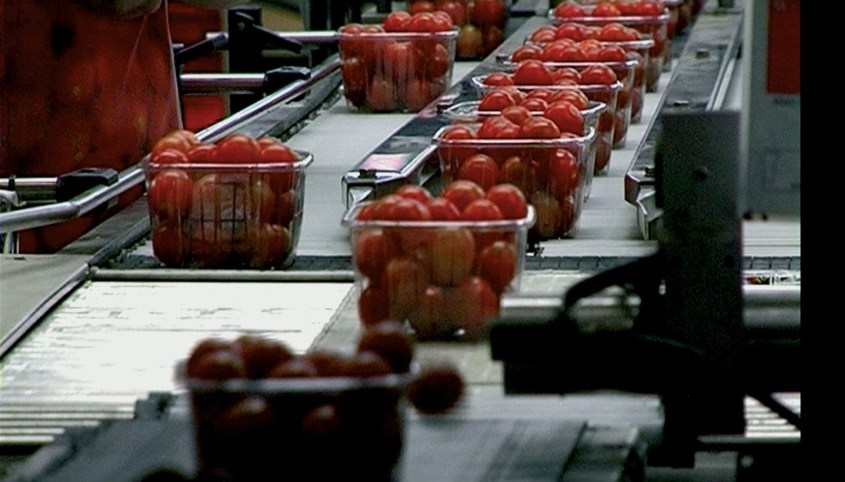
The result was the world’s largest greenhouse landscape in Almería, southern Spain, which will supply Europe with fresh tomatoes.

There is now a large landing plain, which is only a single plastic sea. 2.8 million tonnes of fruit and vegetables are produced each year in 32,000 greenhouses. Large quantities of pesticides and fertilizers are used. The region is slowly running out of water.

Tons of toxic pesticides, plant fertilizers, plant substrates, rock wool, plastic wrap and the exploitation of African migrants allow us to enjoy fresh tomatoes from Spain in our salad.

WE-FEED-THE-WORLD_01

The European Union is making a lot of money to produce very large quantities of fruit and vegetables in Almeria and elsewhere. So much so that some of it even comes to market in Africa, because it should not be thrown away. The EU vegetables are sold in Africa at bargain prices.

Local farmers have to charge three times as much for their home-grown vegetables to avoid starvation. But because the higher prices in poor countries do not want to pay anyone, the EU is driving African farmers to ruin their cheap vegetables.

So should the hunger in Africa be overcome?

For decades, corporate multinationals have been dominating and stealing their smallholders’ land and thus their livelihoods. And despite abundance of natural resources, these countries remain poor – who profits from hunger?

Afri.ka Monsantojpg

After all, even a corporation like Monsanto will become a world savior instead of an annihilator!!

Example Ethiopia:

In Ethiopia, millions of people have relied on food aid for decades. While the population is starving, the government offers foreign investors the conditions that could hardly be cheaper. This benefits not only Turkey, but also Saudi Arabia.

While people are starving in Ethiopia, Saudi Arabia gets its food from Ethiopia, so the people do not starve, though Ethiopia is still one of the poorest countries in the world!!

Example Tanzania:

Tanzania has changed the laws to get development aid. which allows commercial investors to get faster and better access to agricultural land. It also strengthened the protection of intellectual property in the seed sector.

The Tanzanian peasants are now awaiting a prison sentence of at least 12 years or a fine of more than € 205,300 or both if they sell seed that has not been certified. The beneficiaries of these laws are Bayer / Monsanto, Syngenta and BASF.

tansania monsantojpg

Example Brazil:

Brazil is one of the largest producers of genetically modified soybeans.

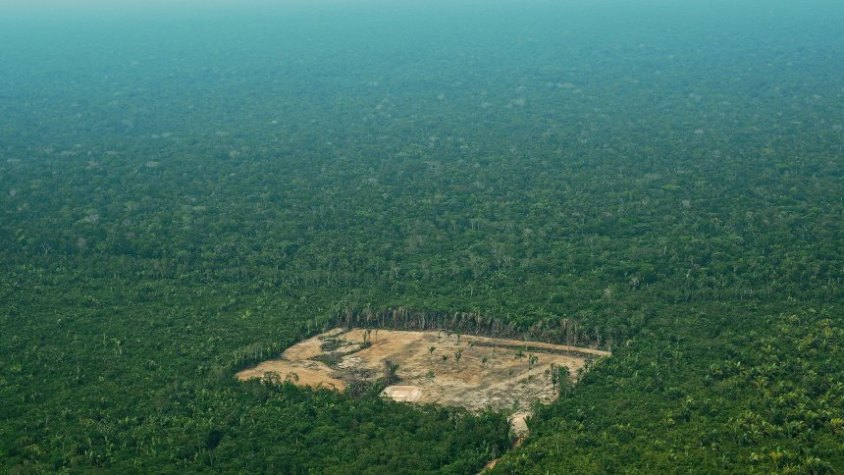
Brazil is the fifth largest country in the world, where a lot of soy is grown. Soy is one of the most important forage plants in our factory farms. Rainforest is cleared for the soya plantations. The soils of the rainforest are actually not suitable for soy cultivation, because they lack the appropriate nutrients. They are therefore supplied chemically.

burnt-tree-and-tractor. brasilienjpg

After a few years nothing will grow on the former primeval forest floor. The big farmers then cut down the next trees and thus continue to destroy the green lung of our earth.

Is the price we pay for our cheap meat in the discounter at the end more expensive?

DOUNIAMAG-FILES-BRAZIL-ENVIRONMENT-ENERGY-CLIMATE-CONSUMERS-POLL

In November 2016, the Federal Ministry of Economics in Germany wrote:
“Tanzania has one of the biggest economic potentials in East Africa. It is an important transit country and has huge fertile lands that can be used for agriculture. Enormous natural gas reserves can help build a chemical industry.

Mega-infrastructure projects and a construction boom offer further extensive business opportunities. The big question, however, is about the timing: politics and bureaucracy easily reach their limits. ”

In 2015, Germany delivered agricultural machinery, including farm tractors, to Tanzania for € 290,000 (EGW846).

In February 2015, during a visit to the EU in Brussels, Bill Gates and Melinda Gates pointed to innovations in agriculture in Africa to get rid of food dependence and malnutrition.

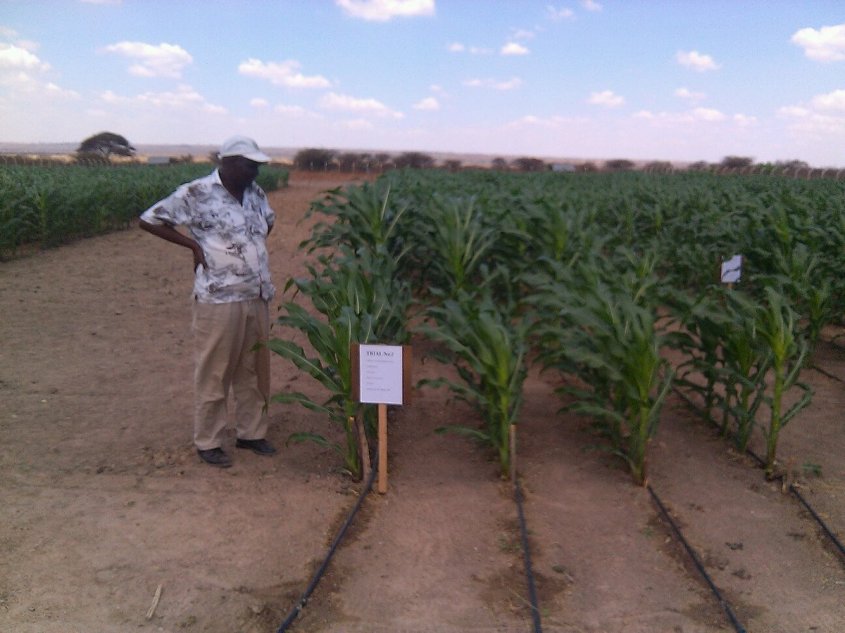
“With a drought resistant corn variety genetically modified, an African farmer, male or female, could get 20 to 30 percent more from the farm. We think it’s up to Kenya and Tanzania and South Africa to decide if that’s right for the economy, ” said Melinda Gates, co-chair of the Bill and Melinda Gates Foundation.

In Germany, too, corn is referred to by the genetic engineering industry as “a corn for Africa: good yields even in drought”.

In the meantime, DTMA seed has been distributed to about three million small farmers in 13 African countries – Ethiopia, Angola, Benin, Ghana, Kenya, Malawi, Mali, Mozambique, Nigeria, Tanzania, Uganda, Zambia and Zimbabwe – covering an area of ​​two million hectares – six percent of the corn in the region – cultivate.

In Europe, wheat farming pays off for farmers only because they receive subsidies from the EU. Rich Switzerland has already bought 80 percent of its wheat in India. Above all, the bread rolls of the major bakeries we eat every day are made almost exclusively from Indian wheat. The bad thing is that in India, eight out of ten people do not have enough to eat.

So… why are not our food exports going to the poor countries of the world? The answer is that about half of the exports to the top 20 countries are meat and dairy or animal feed. 

hühner we feed the worldjpgAnd meat is a luxury product. And the reason, why millions of people die of hunger in Africa and other poor countries.

Much remains to be done to actually alleviate hunger in the world as the world’s population grows, and with the effects of agriculture on agriculture, which are increasingly devastating, and that are being devastated by climate change.

However, this can not be achieved by the large-scale cultivation of soybeans in Brazil or the eradication of the Indonesian forests for palm oil.


https://netzfrauen.org/2018/01/28/africa/


My comment: In an interview with UN Special Rapporteur on the Human Right to Food, Jean Ziegler, he put it very aptly: “World agriculture could easily feed 12 billion people, but only half as many people live on Earth. That is, a child who dies of hunger today is being murdered. “

Yes! that’s right!
By whom murdered? Of all those who are involved in this system, that is to say exactly of the consumers who support this criminal system through the consumption of meat.

In 122 Third World countries 43,000 children die from hunger every day. The statistics are a bit old, today the number is even higher. All who participate in this daily mass murder are the second-hand killers of these children.

Kinder_armut_Hungerjpg

My best regards to all, Venus


Footage of Huge Manta Ray Asking Diver To Remove Fish Hooks From It.

Click on the following to see the video footage:

https://www.telegraph.co.uk/news/2019/07/12/extraordinary-footage-shows-manta-ray-appealing-diver-help/


Extraordinary footage shows manta ray appealing to diver for help

Image result for manta ray


A giant manta ray has been filmed in Western Australia appearing to appeal a diver to help unlodge dangerous fish hooks that have become embedded in her right eye.

The extraordinary footage of the moving encounter between the injured sea creature and human divers was taken by Monty Halls, a British marine biologist who was part of a freediving group exploring Ningaloo Reef off Australia’s north west coast. Mr Halls called it “one of the best things I’ve ever seen underwater.”

The three-metre-wide manta, which is known affectionately to locals as Freckles, is seen swimming up to Jake Wilton, a snorkeling guide, and flipping over in the water, in what seems to be an attempt to show him her plight.

“You could see she trusted us because she was unrolling and showing us the hooks,” said Mr Wilton in the video. “I went down for a few dives to see how she’d react to us being close to her.”

The footage was released on Thursday by Ningaloo Marine Interactions, the tour company Mr Wilton works for.

He told the Independent: “I’m often guiding snorkellers in the area and it’s as if she recognised me and was trusting me to help her,” he said.

“She got closer and closer and then started unfurling to present the eye to me. I knew we had to get the hooks out or she would have been in big trouble.”

The footage seems to show the manta ray resting perfectly still to allow Mr Wilton to gently remove the painful spikes.

Mr Wilton described the interaction as “incredible behaviour” and believes the manta understood that he was trying to help her. “I went [back] down to say goodbye and she stopped and waited there,” he said.


Picture: 4Media Group/ Tourism Western Australia Moment wounded manta ray approaches humans for help

USA: Demand Real Leadership at the EPA. Action Link.

us-flagge_ml

Demand Real Leadership at the EPA

Bill Wehrum—assistant administrator of the U.S. Environmental Protection Agency and the architect of President Trump’s unconscionable attacks on clean air and climate regulations—has resigned. Wehrum oversaw efforts to roll back safeguards that limit air pollution and attempted to dismantle the landmark Clean Power Plan. Now is the time for the public to mobilize and tell the EPA’s leaders to start upholding the agency’s mission of protecting the American people and our environment.

President Trump’s Assistant EPA Administrator Bill Wehrum — the chief architect of Trump’s unconscionable attacks on landmark climate regulations — has resigned amid scrutiny over possible ethics violations.

Wehrum, along with EPA Administrator Andrew Wheeler, is responsible for attempting to dismantle many lifesaving protections for our environment and health, including EPA’s clean car standards and the Clean Power Plan, our two most important federal efforts to reduce carbon emissions in the US.

This is a critical moment for the EPA — and our best chance to mobilize a massive public outcry demanding real leadership at the agency.

Take action now: Tell Trump and the EPA to reverse course and fulfill its mission to defend the fundamental regulations that protect our environment, our health, and our climate.


Take action now – click here:

https://act.nrdc.org/letter/epa-leadership-190701?source=act_nrdcnewsletter&tkd=1402806&utm_source=newsletter&utm_medium=mainlink&utm_campaign=email&t=5&akid=5426%2E1402806%2EaCurSz


Austria: decides total glyphosate ban!


-Austrian_Flag

The request of the Social Democratic Party of Austria (SPÖ) finds a majority, the consequence: In Austria comes a glyphosate ban.

The dangerous weed killer must not be sold in the future.

monsantoland1-1

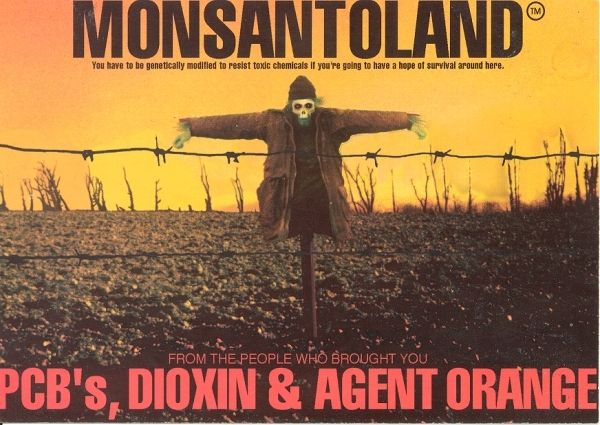
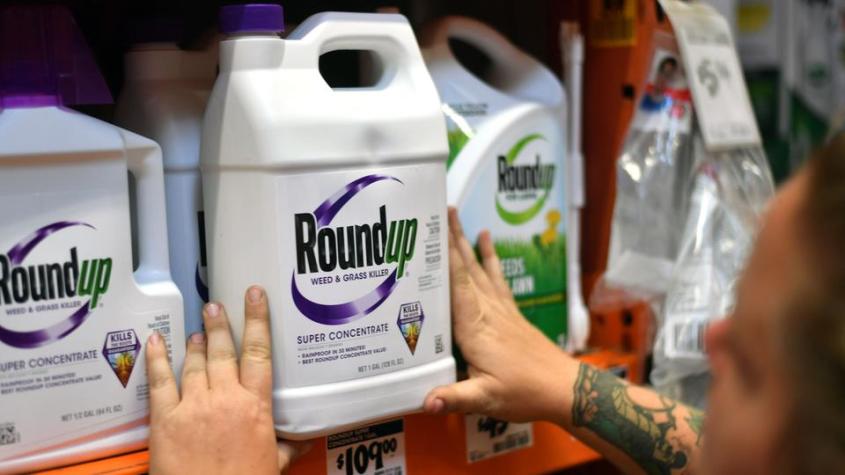
Glyphosate is the world’s most used weedkiller. It has been used in agriculture, industry, horticulture and private households since the mid-1970s. Monsanto sells the herbicide under the name “Roundup” and has been making billions in sales since the 1970s. No wonder then that Monsanto lobbyists claim that glyphosate is so harmless that it can even be safely drunk!!!

glyphosat-253pg

US courts think otherwise

In three separate cases, they have ruled that the glyphosate drug Roundup from Bayer subsidiary Monsanto is a “significant factor” in the onset of the cancer.

A Californian court last ordered Monsanto to pay $ 250 million in damages to a cancer patient in August 2018. He blamed the plant poison glyphosate for his cancer – and the jury proved him right.

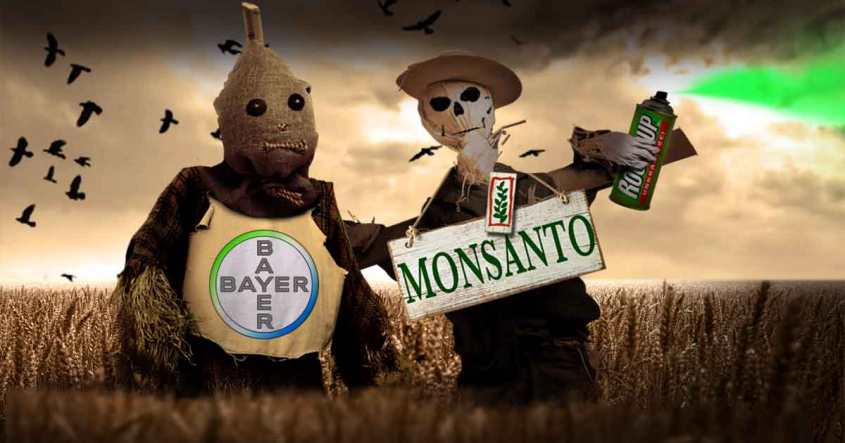
monsanto -Bayer karikatur

Among other things, because during the negotiation of emails came to the language, which weigh heavily on the company.
ÖVP (Austrian People’s Party) and FPÖ (Freedom Party of Austria) were already in the European Parliament against glyphosate ban.

For some time, there has been a suspicion that glyphosate is potentially carcinogenic. Nevertheless, in November 2017, the EU approved the potentially carcinogenic plant toxin for another 5 years.
Also FPÖ and ÖVP did not support the resolution for a glyphosate ban.

Now comes total glyphosate ban!!

On 12 June 2019, the parliament adopted a so-called deadline application by the SPÖ for the majority of the ban. The Freedom Party had signaled to agree to the total ban on the plant poison. Until the end, however, it was unclear whether the libertarians actually agree. On 2 July 2019, the Socialist Party finally pushed for a ban.

The People’s Party is still against it. It wants agriculture and forestry to be exempted from the ban – although this sector is responsible for 80 percent of pesticide use.

The Bayer chemicals group, whose subsidiary Monsanto produces glyphosate, said it was expected that the decision of the Austrians would be “critically questioned and legally challenged by the EU Commission” (!!!). According to Bayer, the decision of the Austrian National Council is “in contradiction to extensive scientific results on glyphosate”.

monsanto-glyphosat2

https://kontrast.at/glyphosat-verbot-oesterreich/


My comment: Congratulations Austria!
Good decision. Finally, a country has the courage to go against the lobby of the Bayer Group.
Here in Germany, we are still sleeping and, as always, we remain groundlessly optimistic about the future of our planet and in solidarity with the decisions of the Monsanto / Bayer lobbyists, also known as the EU – Commission!
Let’s hope that we will soon come to such a progressive decision as the Austrians.

Best regards, Venus

‘Precipitous’ fall in Antarctic sea ice since 2014 revealed.

‘Precipitous’ fall in Antarctic sea ice since 2014 revealed

Plunge is far faster than in Arctic and may lead to more global heating, say scientists

The vast expanse of sea ice around Antarctica has suffered a “precipitous” fall since 2014, satellite data shows, and fell at a faster rate than seen in the Arctic.

The plunge in the average annual extent means Antarctica lost as much sea ice in four years as the Arctic lost in 34 years. The cause of the sharp Antarctic losses is as yet unknown and only time will tell whether the ice recovers or continues to decline.

But researchers said it showed ice could disappear much more rapidly than previously thought. Unlike the melting of ice sheets on land, sea ice melting does not raise sea level. But losing bright white sea ice means the sun’s heat is instead absorbed by dark ocean waters, leading to a vicious circle of heating.

Sea ice spreads over enormous areas and has major impacts on the global climate system, with losses in the Arctic strongly linked to extreme weather at lower latitudes, such as heatwaves in Europe.

The loss of sea ice in the Arctic clearly tracks the rise in global air temperatures resulting from human-caused global heating, but the two poles are very different. The Arctic is an ocean surrounded by continents and is exposed to warming air, while Antarctica is a freezing continent surrounded by oceans and is protected from warming air by a circle of strong winds.

Antarctic sea ice had been slowly increasing during the 40 years of measurements and reached a record maximum in 2014. But since then sea ice extent has nosedived, reaching a record low in 2017.

“There has been a huge decrease,” said Claire Parkinson, at Nasa’s Goddard Space Flight Center in the US. In her study, published in the journal Proceedings of the National Academy of Sciences, she called the decline precipitous and a dramatic reversal.

“We don’t know if that decrease is going to continue,” she said. “But it raises the question of why [has it happened], and are we going to see some huge acceleration in the rate of decrease in the Arctic? Only the continued record will let us know.”

“The Arctic has become a poster child for global warming,” Parkinson said, but the recent sea ice falls in Antarctica have been far worse. She has tracked Antarctic sea ice for more than 40 years. “All of us scientists were thinking eventually global warming is going to catch up in the Antarctic,” she said.

Kaitlin Naughten, a sea ice expert at the British Antarctic Survey, said: “Westerly winds which surround the continent mean that Antarctic sea ice doesn’t respond directly to global warming averaged over the whole planet.”

“Climate change is affecting the winds, but so is the ozone hole and short-term cycles like El Niño. The sea ice is also affected by meltwater running off from the Antarctic ice sheet,” she said. “Until 2014, the total effect of all these factors was for Antarctic sea ice to expand. But in 2014, something flipped, and the sea ice has since declined dramatically. Now scientists are trying to figure out exactly why this happened.”

Prof Andrew Shepherd at Leeds University in the UK said: “The rapid decline has caught us by surprise and changes the picture completely. Now sea ice is retreating in both hemispheres and that presents a challenge because it could mean further warming.” He said it would also be important to find if the ice’s thickness has changed, as well as its extent.

The new research collated microwave satellite data from 1979 to 2018, providing excellent measurements of sea ice as the different signals from ice and ocean are very distinct and microwaves can be detected day or night and usually through clouds.

Sea ice expands in winter and retreats in summer every year, so Parkinson used annual averages to assess the long term trends. The biggest single year fall was in 2016, when an El Niño boosted human-caused warming to result in record global temperatures.

She said rates of decline after 2014 were three times faster than the most rapid melting ever recorded in the Arctic. Sea ice extent had a small uptick in 2018, but in 2019 so far there had been a further reduction, she said.

Parkinson said the dramatic plunge was a strong piece of evidence that scientists could use to narrow down the causes of the change. “As a Nasa scientist, my key responsibility is to get the satellite data out and I hope others will take this 40-year record and try to figure out how these dramatically rapid decreases since 2014 can be explained,” she said.

From: https://www.theguardian.com/world/2019/jul/01/precipitous-fall-in-antarctic-sea-ice-revealed


Japan: 5 Whaling Vessels Have Now Set Off For A Hunt.

Japan

We first covered the issue of the Japanese return to whaling a few days ago – see our post:

https://worldanimalsvoice.com/2019/06/30/japan-is-about-to-resume-catching-whales-for-profit-in-defiance-of-international-criticism/


Well now the whaling fleet has set sail:

https://www.bbc.co.uk/news/world-asia-48821797


Japanese whalers set sail for commercial hunting


whale 1

Five Japanese whaling vessels have set sail for the country’s first commercial hunt in decades, in defiance of international criticism.

The whaling ships have a permit to catch 227 minke, Bryde’s and sei whales this year in Japanese waters.

Japan’s last commercial hunt was in 1986 but it has continued whaling for what it says was research purposes.

It has now withdrawn from the International Whaling Commission (IWC) so is no longer subject to its rules.

IWC members had agreed to an effective ban on whale hunting, but Japan has long argued it is possible to hunt whales in a sustainable way.


Enthusiasm among whalers

The fisheries ministry has set a kill cap for the season of 52 minke, 150 Bryde’s and 25 sei whales.

“The resumption of commercial whaling has been an ardent wish for whalers across the country,” the head of the agency, Shigeto Hase, said at a departure ceremony in northern Kushiro for the small fleet.

He said the resumption of whaling would ensure “the culture and way of life will be passed on to the next generation.”

“My heart is overflowing with happiness, and I’m deeply moved,” Yoshifumi Kai, head of the Japan Small-Type Whaling Association, said. “People have hunted whales for more than 400 years in my home town.”

“I’m a bit nervous but happy that we can start whaling,” one whaler told news agency AFP before setting sail.

“I don’t think young people know how to cook and eat whale meat any more. I want more people try to taste it at least once.”

Criticism by conservationists

According to the IUCN Red List of Threatened Species, minke and Bryde’s whale are not endangered. Sei whale are classified as endangered but their numbers are increasing.

Conservationist groups like Greenpeace and Sea Shepherd remain critical of Japan’s resumption of whaling but say there are no concrete plans for action against the country.

Japan “is out of step with the international community”, Sam Annesley, executive director at Greenpeace Japan, said in a statement when Tokyo announced its whaling plans last year.

Like other whaling nations, Japan argues hunting and eating whales are part of its culture.

A number of coastal communities in Japan have hunted whales for centuries but consumption only became widespread after World War Two when other food was scarce.

Didn’t Japan kill whales all along?

Whales were brought to the brink of extinction by hunting in the 19th and early 20th Century. In 1986, all IWC members agreed to a hunting moratorium to allow whale numbers to recover.

Whaling countries – like Japan, Norway and Iceland – assumed the moratorium would be temporary until everyone could agree on sustainable quotas. Instead it became a quasi-permanent ban.

Since 1987, Japan has killed between 200 and 1,200 whales each year under an exemption to the ban allowing scientific research.

Critics say this was just a cover so Japan could hunt whales for food, as the meat from the whales killed for research usually did end up for sale.

In 2018 Japan tried one last time to convince the IWC to allow whaling under sustainable quotas, but failed. So it left the body, effective July 2019.

whale 4