Category: Farm Animals

USA (California): Restrictions on size of CAFO animal farms in Sonoma County to be decided by voters.

 
NORTH BAY NEWS 

Sonoma County voters will be asked this November if they want to restrict the size of animal farms.

The county clerk and registrar of voters approved the measure for the ballot last Wednesday after animal rights and environmental activists gathered more than enough signatures to meet the required 19,746.

The petition drive was led by the group Coalition to End Factory Farming, who want to end large-scale concentrated animal feeding operations, or CAFOs, in Sonoma County.

The initiative calls for a three-year phase-out of one classification of animal farms — large CAFO. It does not affect farms classified by the U.S Environmental Protection Agency as medium CAFO or smaller.

According to Coalition spokesperson Samantha Faye in a statement released Monday, the ordinance could affect two dozen sites that classify as Large CAFOs, which she said are only about 2.4% of animal farms in the county.

“Across these two dozen facilities, there are approximately 2.9 million animals confined,” she said. “These facilities disproportionately affect animals, our water, our air quality, our public health, and the sustainability of agriculture in Sonoma County.”

The group uses the EPA definition of CAFO, which differs depending on an animal’s species, their quantities and the way the farm handles animal waste. For example, a duck farm is classified as a “large CAFO” if it confines 5,000 ducks and uses a liquid manure handling system that washes their waste into a holding pond or lagoon on site. If it disposes of manure some other way, it doesn’t become a large CAFO until it has 30,000 ducks.

The potential ordinance would state that CAFOs disproportionately affect low-income and disadvantaged communities, and that the county intends to provide a retraining and employment assistance program for workers at CAFOs to facilitate the transition to safer forms of work.

“We are against the very vague language in the proposed ballot initiative put forth by the Coalition to End Factory Farming, and the group behind them, Direct Action Everywhere,” said Jennifer Reichardt of Sonoma County Poultry, Liberty Ducks in an email. “This will not save family farms. The goal of this initiative is to put farms out of business.”

Reichardt said that if the measure is passed, residents in the Bay Area will have to pay a higher price for meat, dairy, and eggs, because they will need to be imported.

“If it is passed, it will increase greenhouse emissions from trucking in products from further away, increase the cost of food, and shut down local, often multi-generational, businesses. It will put hundreds of employees out of work, and force the import of other meat, dairy, and eggs from outside the county and state,” Reichardt said.

Sonoma is one of four California counties where the highly pathogenic avian flu was detected among commercial flocks last year, prompting the board of supervisors to declare a local state of emergency in December 2023.

The Coalition to End Factory Farming includes animal rights groups, small farm advocates, and Direct Action Everywhere, an organization that, among other things, wants to make legal the right of people to enter places such as factory farms to remove animals they say are in distress. Their activism includes trespassing to obtain video footage inside farms and rescuing animals. 

Their co-founder, San Francisco attorney Wayne Hsiung, was arrested in November and sentenced in Sonoma County to 90 days in jail and two years of probation last year for felony trespassing at chicken and duck farms in 2018 and 2019.

At a press conference Monday, Cassie King of Direct Action Everywhere said they watch farms from public property or may use satellite imagery to decide to enter a facility. For example, they may see if birds never go outside in a facility that’s supposedly free range.

“Sometimes they find animals who are on the brink of death, who are clearly ill or injured and can’t get themselves up, can’t get themselves to food and water,” she said. “If they leave them behind, they will surely die, either die slowly from starvation or dehydration. In many cases, facility employees will come and kill the individuals who are too sick or weak to feed themselves to survive.” 

Restrictions on size of CAFO animal farms in Sonoma County to be decided by voters – CBS San Francisco (cbsnews.com)

Regards Mark

Workers Mercilessly Stab Ducks, Slit Their Throats, and Cut Their Feet Off While They’re Still Alive.

https://secure.peta.org.au/page/145838/action/1?locale=en-AU&utm_source=peta-au::e-mail&utm_medium=alert&utm_campaign=0324::skn::peta-au::e-mail::moncler-down-aa::::aa-em

Italian fashion company Moncler Group – which owns Moncler and Stone Island – is tied to horrific duck slaughter.

The brand is connected to duck farms and abattoirs in Vietnam that have been exposed by PETA. As seen in the footage, workers mercilessly stab ducks, slit their throats, and cut their feet off while they’re still alive.

Demand That Moncler Group Stop Selling Down

Demand That Moncler Group Stop Selling Down | PETA Australia

Ducks and geese feel fear and pain, just as humans do. They’re happiest with their families and don’t want to spend their life imprisoned on a filthy farm.

A growing number of clothing companies now use entirely animal-free fabrics to create top-notch fashion, and many companies – including Napapijri and ASOS – have ditched feathers. Moncler Group must do the same.

Please use PETA’s new action alert to urge Moncler Group to spare birds suffering and a painful death by banning down.

TAKE ACTION HERE:

Demand That Moncler Group Stop Selling Down | PETA Australia

Thanks for all you do for birds.

Sincerely,

PETA

Regards Mark

Italy: The Disgusting Suffering On Innocent Sentients To Produce An Easter Roast.

Photo – EA.

This is the disgusting suffering to produce an Easter roast.

I am publishing this post as you know, getting a ban on live animal transport has been a personal goal of mine for the last 35 years.

It was sent to me by our campaigner friends at Essere Animali; who are based in Italy.

I wish to help them as much as possible by asking you please to support their petition – the link is provided in this article.

Also, please watch the investigation video provided in their first link below.

This is the disgusting suffering to produce an Easter roast.

Regards Mark

Click here to access all of our Live transport posts:

Search Results for “live animal transport” – World Animals Voice

You can see more about animals carried by sea in our post:

——————————–

From Essere Animali

Lamb transports: we have documented more suffering and violations

Watch the investigation video be clicking here:

Sign for a revision of the legislation on animal transport (essereanimali.org)

As has been customary for some years now, a few days before Easter, our investigative team returned to the motorways on the border between Italy and Slovenia to monitor trucks loaded with lambs arriving from Eastern Europe, heading to slaughterhouses in Tuscany, Lazio and Puglia.

On the monitored vehicles, coming from Hungary, Romania, Slovakia and Poland, several problems and violations of the rules were once again found: overcrowding, presence of unweaned animals on vehicles not suitable to feed them and transported for a longer period than that required by the regulations, ventilation and watering systems not working, inadequate or unreachable drinking bottles for all lambs, insufficient space above the animals’ heads to be able to travel in a natural position.

And all this for long and exhausting journeys, which can last up to 30 hours.

This activity was carried out in collaboration with Animals’ Angels, Enpa and the Animal Welfare Foundation. 

Of the 20 trucks targeted by the associations, 8 were checked by the police and 4 received fines of thousands of euros.

Already on the first day, a truck was fined €6,500 due to malfunctioning ventilation and drinking system and document irregularities. The situation was such that the truck was not fit to continue its journey.

OUR REQUESTS

The revision of Council Regulation (EC) No 1/2005 of 22 December 2004 “on the protection of animals during transport and related operations” is a unique opportunity for the European Commission and the EU co-legislators to ensure greater and better protection of animals and to take action on the most serious issues in order to spare animals avoidable suffering.
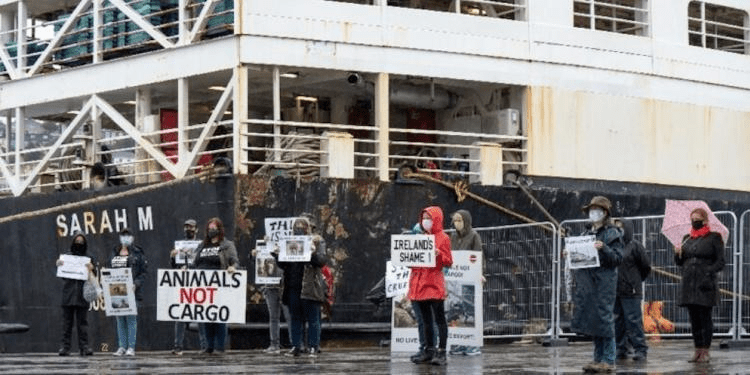
That is why we ask:

an immediate ban on the export of live farmed animals to third countries;

limiting travel times for the transport of live animals to a maximum of eight hours and 4 hours for poultry and rabbits (which must be transported in specific containers);

the prohibition of the transport of animals:
• unweaned;
• in an advanced state of pregnancy (who have exceeded 40% of the gestation state);
• at the end of their productive life;

the prohibition of the transport of live animals if the expected outside temperatures are below 5°C or above 25°C, subject to clear definition of the following parameters:
• specific species – and categories – conditions for the suitability of animals for transport;
• minimum and maximum outdoor temperatures;
• availability of space;
• availability and method of administration of food and water;

to limit intra-EU maritime transport as much as possible and to allow it only where it is strictly necessary, with the suitability of the vessels approved by an EU Authority that verifies compliance with strict technical and mandatory requirements;

to develop a clear definition of ‘journey time’, which is to be understood as the time that elapses from the ‘start of the journey’ to the ‘end of the journey’, including the loading and unloading of animals. In the case of sea transport, the “journey time” includes the time that the animals spend along the road journey from the farm to the port and from the port to the “final destination”, as well as the time that the animals spend on the boats and during embarkation and disembarkation operations;

the reduction and replacement of the transport of live animals with that of meat and carcasses, and seeds and embryos, as also recommended by FVE, OIE, and EFSA.

We also call for stricter enforcement of EU legislation, which must also be accompanied by more controls and inspections and strict penalties for infringements.

Continue reading at:

Sign for a revision of the legislation on animal transport (essereanimali.org)

Inside another truck there was a lamb unable to stand on its legs, which was entrusted to the associations. The lamb is now under the care of a veterinarian. Again, the truck was not fit to continue its journey.

In December 2023, the European Commission published a proposal to revise the legislation on the transport of live animals. The European elections in June are a unique opportunity to continue the work: it is crucial that the new Parliament and the new Commission commit to better regulation and controls.

It is equally important that the Ministry of Health in Italy is ready to give precise indications that make controls more efficient throughout the country and that our government works with other member states to improve legislation at European level.

And this umpteenth investigation, with the sanctions that have arisen and the great media attention it is generating, is one more tool to make the problem visible and bring it once again to the tables of the institutions!

Ps: this transport monitoring activity has once again brought to light a very serious situation for animals. A serious reform of this practice by the EU is urgently needed. Ask yourself:

➡️ SIGN THE PETITION

From all of us; thank you for your support.

EU: Seven EU Citizens Who Started The ECI — Launch A Ground-Breaking Legal Action Against The European Commission For Failing To Act For Caged Animals. 

Despite a clear commitment from the European Commission in 2021 to deliver proposals to ban caged animal farming by the end of 2023, it has failed to deliver on its promise.

As a result, last week, the End the Cage Age Citizens’ Committee — a group of seven EU citizens who started the ECI — launched a ground-breaking legal action against the European Commission for failing to act. 

Funded by Compassion in World Farming, this historic case could result in the Commission being compelled by the court to set out a clear timescale for the legislation. 

It is the first legal action to hold the Commission to account over its failure to act on an ECI — an important test case for both animal welfare and democracy.

Despite overwhelming support, animals continue to suffer

Back in 2021, Compassion in World Farming, along with millions of European citizens, celebrated the news of the European Commission’s clear commitment. 

It followed the first ever successful European Citizens’ Initiative (ECI) to ‘End the Cage Age’, which was signed by an overwhelming 1.4 million EU citizens and supported by a coalition of 170 NGOs led by Compassion. 

ECIs were introduced with the specific purpose of giving citizens more influence over EU decision making and the tool is described by the European Commission as “a way for you and other Europeans to take an active part in EU policy-making”.

Pregnant sows are forced to nurse their piglets in crates so small they can’t even turn around; chickens can’t spread their wings, and along with countless rabbits and quail will spend all their lives in barren cages.

In October last year, the European Commission’s own Eurobarometer survey revealed that an overwhelming nine out of ten, or 89% of EU citizens — around 400 million people — believe animals should not be farmed in individual cages. 

The Commission’s own scientific advisers, the European Food Safety Authority, have also backed the phasing out of cages on welfare grounds for pigs, dairy calves, laying hens, ducks, quail and rabbits.

Meanwhile, more than 300 million pigs, hens, rabbits, ducks, quail and geese continue to suffer confinement and misery in cages across the EU each year.

Pregnant sows are forced to nurse their piglets in crates so small they can’t even turn around; chickens can’t spread their wings, and along with countless rabbits and quail will spend all their lives in barren cages. 

Ducks and geese are caged for force-feeding to produce foie gras.

How did the ban get derailed?

In September, we hoped to hear European Commission President Ursula von der Leyen set out the plans to deliver the ban in her State of the Union speech. 

Instead, what we heard were words that echoed the letter she received from the farming federation Copa Cogeca. It seems she caved into pressure from the agriculture lobby to put the ban on hold.

Together with my colleagues in End the Cage Age Citizens’ Committee, we have made repeated requests to meet with the president on behalf of the millions of EU citizens who support the cages ban, without success. 

The cages ban — part of the Commission’s excellent Farm to Fork strategy to meet climate and nature obligations — also has the chance to provide wider environmental and socio-economic benefits.

Yet, last October, an investigation from Lighthouse Reports revealed that “an increasingly assertive meat industry helped derail a historic democratic demand to improve animal welfare standards in the EU”.

We simply cannot allow the powerful farming lobby to have preferential access to decision-makers to influence them to backtrack on promises they have made to citizens. 

This is particularly unjust when those citizens have followed the very process designed to give them more influence over EU decision-making. As a result of this injustice, both animal welfare and democracy are now at stake.

Above – Duck breeders load ducks into a truck to bring them to a slaughterhouse at a poultry farm in Saint Aubin, May 2017 AP Photo/Bob Edme© Provided by Euronews (English)

Above – walk past a truck with live chickens on sale in an informal market in central Athens, May 2012 Thanassis Stavrakis/AP© Provided by Euronews (English)

We can’t wait any longer

There is simply no justification for any further delay. All the appropriate preparation, assessments and consultations have already been carried out by Commission officials and the proposals make strong provision for financial support to help farmers transition to cage-free systems during a phase-out. 

This measure is backed by the animal welfare movement who believe public subsidies should be redirected to reward farmers for transitioning to high welfare and nature-positive systems that benefit society.

Pursuing legal action is not a choice we have taken lightly, but we cannot allow the European Commission to break its promises to citizens, making a mockery of democracy in the process.

The cages ban — part of the Commission’s excellent Farm to Fork strategy to meet climate and nature obligations — also has the chance to provide wider environmental and socio-economic benefits. 

A report from the Institute for European Environmental Policy found that the ban would have greater sustainability benefits. 

These art installations reveal the sad truth about keeping animals in cages

European Parliament overwhelmingly backs ban on caged animal farming

In addition, it concluded that the current discrepancy between legislation in member states was leading to uneven market conditions across the EU, and that a level playing field should be created.

Democracy is not to be mocked

Pursuing legal action is not a choice we have taken lightly, but we cannot allow the European Commission to break its promises to citizens, making a mockery of democracy in the process. 

Most importantly, we cannot stand by silently while millions of animals continue to suffer in cages. Caving into the big agriculture lobby and continuing to use taxpayer funds to prop up this damaging sector is not helping citizens, or the majority of small-to-medium-scale farmers.

The hope is that this ground-breaking legal action — launched on behalf of millions of supportive EU citizens as well as the voiceless 300 million animals still suffering every day in cages — will speed up the ban and ensure that every cage is an empty cage.

We will not rest until we end the Cage Age.

Olga Kikou is Head of Compassion in World Farming EU, the leading farm animal welfare organisation dedicated to ending factory farming and achieving humane and sustainable food production.

Full article and pictures at:

To protect caged animals, we are suing the European Commission (msn.com)

We are 110% behind the actions now taken;

Regards Mark

More reading https://www.ciwf.org.uk/our-campaigns/end-the-cage-age/

Vast Majority Of Animal Transport Ships Deemed Unseaworthy. Ancient Rust Bucket Bathtubs As We (WAV) Call Them.

All photos – WAV Archive.

26 March 2024

AWF

64 animal transport vessels are allowed to cross European waters, but only 6 of them meet international safety standards.

Former ferry or cargo vessels that had their security clearances revoked are commonly used to transport live animals, meaning the average animal transport vessel in the EU is several decades old, and very unsafe to operate.

Animal Welfare Foundation, together with the French environmental organisation Robin Des Bois, published a comprehensive report on the true state of these sea vessels, concluding that urgent measures must be taken to stop their use.

Sea vessels for animal transport are far from welfare-friendly

Among the 64 animal transport vessels approved for use in the EU currently,  only 4 vessels were originally built for the purpose of transporting animals. All other vessels were retrofitted after around 30 years at sea. 

As this film documents, these vessels are filled with hazards, from sharp edges to rust and defective struts, creating a very high level of risk for both the animals and crew onboard.

With the majority of vessels being in such a dilapidated state, it’s not surprising that there have been a string of disasters during live animal transport by sea over the past years, such as in the case of the Karim Allah and Elbaik

Thousands of animals are spending weeks in these unseaworthy ships, where they are forced to stand knee-deep in their own excrement and are exposed to high temperatures, rough seas, crowded quarters, disease and more.

Nearly half of the EU’s live animal sea vessels are flying the black flag

AWF and RDB’s research also reveals that nearly half of the animal transport vessels approved in the EU flew the flag of a country marked by the Paris Memorandum of Understanding as a black flag (for example Togo, Sierra Leone or Tanzania). 

This flag indicates these vessels pose a high risk to maritime traffic, as well as to the animals, crew and environment. 

The fact these vessels continue to be used show there is a clear lack of concern for animal and human welfare within this transport sector. Three years ago, 17 vessels were identified as highly dangerous for use in transporting animals, but 15 of them are still operational today. 

Action must be taken to improve live animal transport at sea

Three years ago, the European Commission received an initial joint report by AWF and RDB on 78 animal transport vessels approved in the EU. This year’s report shows there has been continued inaction in regards to establishing the safety of these vessels and the welfare of animals in this industry, even against the recommendation of the Commission’s very own inquiry committees

If these vessels that are falling apart continue to be used, more transport disasters are inevitable. 

If the industry is not stopped entirely, sea vessels must at least fly the white flag and be IACS-standardised and fully functional, accommodating basic safety measures for the animals and personnel on board. Further, black and grey flags must be prohibited. Strict limits to journey times by sea must be included in the revised Transport Regulation, to mitigate the suffering of animals while they are transported across water.

EU legislation must finally confront the brutal reality of live animal transport by sea and take action. No animal belongs on a ship, [and the sector] cannot and must not continue like this.

Iris Baumgärtner, Animal Welfare Foundation Project Lead

Regards Mark

More reading – https://www.ciwf.org.uk/news/2024/03/governments-urged-to-end-live-exports-now

https://www.ciwf.org/resources/reports-position-papers-briefings/a-data-dump-of-eu-transport-suffering-exposed/?_gl=11otft50_gaNTQ0MTUzNzkyLjE3MTE1NDY1MTA._ga_RMC05PGGT7*MTcxMTU2NTg3Ny4yLjEuMTcxMTU2NjA1OS41My4wLjA.

EU: Opinion – Why MEPs and Spitzencandidaten should sign the Vote for Animals pledge.

25 March 2024

Opinion

Written by Reineke Hameleers

Read more content from this author

Having lived close to three European borders, between the Netherlands, Germany and Belgium, for most of my life, I consider myself a true European. Others might not feel the same. To a certain extent, this is understandable because European politics has so far failed to address some of the most pressing concerns of its citizens in crucial areas, such as animal welfare.

The upcoming EU elections present an opportunity to re-establish a much-needed connection between our citizens and the EU institutions, which many still perceive as abstract entities, far away from their everyday lives. Despite this, the past five years have seen unprecedented participation of European citizens in the democratic process, as shown by the enormous success of three European Citizens’ Initiatives (ECIs) on animal welfare, recently further confirmed by the results of the 2023 special Eurobarometer. Yet, despite all the promises the closing political term held, there has been no substantive progress on an issue that is so dear to citizens.

I feel proud whenever I remind myself that the EU recognised animals as sentient beings in the Treaty on the Functioning of the European Union (TFEU) since 1997. Animal sentience refers to the ability of animals to feel and experience emotions such as joy, pleasure, pain and fear. It is the animals’ capacity to feel both positive and negative states that drives the animal welfare movement. It is also the reason why animal protection laws exist. Such recognition should offer enormous legislative scope to create a Europe that truly recognises and values animals for what they are.  However, EU law continues to treat them as mere commodities, goods, and products. To all effect, EU policies are in stark contradiction to the TFEU as regards the treatment of animals.

This glaring discrepancy between the EU’s highest legislation and the reality on the ground is a political failure as it falls short of the expectations of European citizens. This message resonated loud and clear in the cross-party interventions during the recent European Parliament debate calling on the Commission to fulfil its promises and live up to its commitments on animal welfare. 

Will the candidate MEPs and the Spitzenkandidaten use the elections to genuinely listen to citizens and renew their commitment to improving the animal condition? Undeniably, discontent among farmers has been a significant hurdle to progress in this area. However, the causes of this discontent are rooted in our distorted food system and have little to do with animal welfare rules. 

We must dispel the notion that increased animal welfare measures will make farmers more vulnerable. On the contrary, higher animal welfare standards can prove immensely beneficial for creating new market opportunities in the European Union and driving higher standards globally while responding to societal expectations, as echoed by the recent debate in the European Parliament on this topic.

As the elections approach, we find ourselves at a critical juncture. The conditions of farm animals, animals used in science, traded wildlife, and pets demand immediate attention. While some initial steps were taken during the previous term, they are insufficient to meet European citizens’ expectations, not to mention their inadequacy in light of the most recent scientific evidence. 

For this reason, we created a pledge with ten points, which should guide public policy for the next political term, ensuring that European animal welfare legislation will look significantly different by 2029. 

See the pledges:

https://www.eurogroupforanimals.org/vote-animals-pledges

I am a firm believer in the European project, but I am often questioned by our member organisations and their supporters about my faith in the European institutions. Indeed, these are critical times. It is easy to lose hope when faced with indisputable evidence of a lack of political courage. Yet, the EU can and must rise to its fullest potential and continue building a sustainable and kinder future for all. 

Dear candidates, please consider the transformative impact you could achieve by signing our Vote for Animals pledge. This pledge embodies our collective aspiration for a Europe that respects and values animals as sentient beings. By signing it, you will send a clear message to European citizens confirming the European Commission’s commitment to improving the welfare of all animals and ensuring that the relevant legislation will look much different by 2029. 

Together, we can pave the way for a more compassionate Europe. 

Regards Mark

EU: MEPs Urge European Commission To Deliver On Animal Welfare Proposals.

Above – Foie Gras Force Feeding

Below – The Result

14 March 2024

News

In plenary today, Members of the European Parliament urged the European Commission (EC) to come forward with the outstanding legislative proposals on animal welfare, the future of which remains uncertain. They stressed that the delay is putting the credibility of European institutions in question, as citizens’ demands remain unanswered.

The EC had committed to publish four animal welfare proposals by the end of 2023, but backtracked from this promise by only publishing an unambitious Transport Regulation, and not putting forward the promised Kept Animals, Slaughter and Labelling regulations. The proposals were also set to include phasing out cages by 2027, in reply to the End the Cage Age ECI in which 1.4 million citizens asked for a transition to cage-free systems. 

During the plenary today, a record number of MEPs (41) intervened in the oral question tabled by Neils Fuglsang (S&D, DK). 30 MEPs stressed that while the EC continues to delay action, millions of animals continue to suffer in horrible conditions across all stages of their lives; from farm to transport to slaughter. They criticised the EC for doing “very little for animal welfare in the past legislative term, and questioned the democratic aspect of ECIs if policymakers do not react to the demands of the citizens. “You are letting down 3 million citizens,” many reiterated, making reference to the End the Cage Age and Fur Free Europe ECIs – both of which remain pending action by the EC.

They urged the EC to come forward with a concrete timeline and answer to the demands of millions of EU citizens.

Elisa Ferreira, Commissioner for Cohesion and Reforms, while admitting that more needs to be done for resilient food systems, said that work on these legislative files is “still ongoingand the EC “is analysing the best course of action”. She did not make any commitments on timeline

In the run-up to the European Elections, Eurogroup for Animals has launched the Vote for Animals campaign which encourages candidate MEPs to take a pledge for animals, while informing citizens about the importance of these elections for progress on animal welfare.

European citizens can send a message to their candidates asking them to commit to the pledge.

The EC broke its promise on presenting the animal welfare legislation package. And while we wait for a clear timeline, millions of animals continue to live in cages, male chicks continue to be gassed at a day old, while chickens are bred to grow so fast their bodies cannot keep up. These animals deserve a legislative proposal, but there is none. We call on the EC to present a concrete timeline.

MEP Neils Fuglsang (S&D).

What has happened to the promised legislation?

What about the ban on cages?

We have been fighting for years.

How long will these animals have to wait?  Not a day longer.

MEP Anja Hazekamp (The Left)

Not answering to the demands of ECIs would threaten the credibility of EU institutions – the animal welfare legislation should be a priority in the next mandate. We are disappointed – we need to see changes.

MEP Tilly Metz (Greens/efa)

The ECI is an excellent tool to improve democracy, but it only works if those who make the law react to what the citizens want. 1.4 million citizens asked for a ban on cages – more than four years have passed and 300 million animals continue to spend their lives in terrible conditions.

MEP Róża Thun Und Hohenstein (Renew).

Regards Mark

What ? – The omission of meat-eating reduction from ‘roadmap’ strategy set by UN.

I am not allowed to reproduce the article here, so can only give the link:

‘Bewildering’ to omit meat-eating reduction from UN climate plan (msn.com)

The omission of meat-eating reduction from proposals in a UN roadmap to tackle the climate crisis and end hunger is “bewildering”, according to academic experts.

The group also criticised the UN Food and Agriculture Organization’s report for “dismissing” the potential of alternative proteins, such as plant-based meat, to reduce the impact of livestock on the environment.

Regards Mark

Busking in London – Cocaine:

Hotel California

Australia: Farm Worker Allegedly Caught Having Sex With A Pig On Hidden Cameras Set Up By Animal Activists To Expose (Other) Mistreatment.

Farm worker allegedly caught having sex with a pig on hidden cameras set up by animal activists to expose mistreatment


An animal rights activist group using hidden cameras at a piggery captured an alleged act of bestiality (pictured)

Animal rights activists who broke into a piggery and installed hidden cameras to expose animal cruelty, found more than they bargained for when the checked the footage. 

Among the weeks of video, Farm Transparency Project’s cameras captured an alleged act of bestiality. 

Footage of the alleged animal cruelty and alleged bestiality in the Midland Bacon plant at Carag Carag in Victoria, 180kilometres north of Melbourne, was shown on ABC’s 7.30 show on Monday night.

See the full article here:

Farm worker allegedly caught having sex with a pig on hidden cameras set up by animal activists to expose mistreatment | Daily Mail Online

Regards Mark

India: ‘Animal Aid Unlimited’ March 2024 Newsletter and Rescue Videos.

Dear Mark,

Welcome to this week’s beautiful cast of characters representing the hundreds of animals we treat every day. Among them is a new horse, Gusto, we’ve admitted with a serious chest wound. Scroll down for a brief overview of Rajasthan’s traditional use of wedding horses. We thank you for being the reason we’re able to treat such a magnificent being.

Scrumptious little Tofoo couldn’t even stand. But that was then!

Night had fallen and the chill had set in. There in the road was an abandoned baby who couldn’t stand. Blinding headlights swept past him as he lay in pain and terror. One after another, cars zoomed by, not slowing, not stopping. But then, someone’s wheels slowed and a kind motorist came to a full stop. “What is it, little one?” she must have asked. She realized that this recumbent little bundle could not stand.

There was no blood, but he was absolutely helpless. She immediately took action and called Animal Aid’s ambulance to the spot, and we hurried him back to our hospital. We snuggled him in blankets and gave him hydration and medicine. 

We surrounded Tofoo with love from all sides– from other orphaned babies, grown-up cows, from our loving care-givers, and, we know, from you.

Turn “orphaned and abandoned” to loved and cherished – please donate.

Emergency surgery saved Bright-Eyes, and now those eyes shine with love! 

Dear Bright-Eyes had a huge tear just below his chest area. But he wagged his tail as if to say “Please. Help me.” We hurried him back to our hospital where we treated him for pain, trauma and wrapped the wounded area.

He needed surgery to save his life. Bright-Eyes even wagged his tail during the surgery preparation. When Bright-Eyes regained consciousness he had a wonderful appetite–and not just for food. He gobbled up love, too!  We felt so lucky to save him. After two weeks of healing, we neutered him, and as always, fully vaccinated him on admission. He’s one of the most charming, sweet and gentle boys we’ve ever met. Thank you for helping us give Bright-Eyes his life back.

For those who keep giving love, no matter what – please donate.

Above – Gusto

No more weddings for Gusto!

Already, Gusto is happier. He’s a beautiful boy recently admitted with a serious chest wound and severe malnutrition. Gusto is also very lame, and was apparently abandoned on the road, where a passer-by found him wandering. He is extremely gentle, and he’s making it easy for us to treat him with daily wound dressings, pain relief and plenty of nutritious food.

He is the Marwari breed used extensively in Indian weddings. It is tradition that the hired horse will be heavily draped in colorful cloth, blinkered and ridden by the groom from his home through the neighborhood so that friends and family can join the celebration. 

Commercially used wedding horses like Gusto are usually never pastured. If there is no wedding to serve, they are made to stand in one place for days in a row, often with front and back legs tied together, watered and fed in place from a feed bag hanging from their face. This inactivity is perhaps more difficult psychologically than the wedding itself.

The wedding causes immense stress because of sprays of fire crackers, traffic and music at high volume from speakers powered by a loud portable generator wheeled behind the procession on a wagon.  There are thousands of horses in this situation across the state. 

Even just days after admitting him, Gusto’s eyes have brightened and we can see him relaxing, interacting gently with the animals around him, and that all-over-sore affect is already gone. Being able to wander at will, safe among the cows and the people in the large animal treatment area must seem to him like a luxury of freedom. 

Mango’s feet are dancing to the rhythm of your beautiful compassion.

When we rescued Mango he had a large, painful neck abscess. But, thanks to your compassion and generosity, we were able to provide the care he so desperately needed, turning his pain to joy. This is the power of compassion in action, and we are endlessly grateful for each of you whose help means Mango’s little paws won’t stop dancing with the thrill of life itself.

Shimmer extra in the Spring Sunlight knowing your purchase saved a beautiful life!

Go shopping here:  https://shop.animalaidunlimited.org/

We thank you deeply for all you do, are, and inspire for animals.

Founding family Erika, Claire and Jim, and the Animal Aid Unlimited team.

Regards Mark