Category: Farm Animals

EU: The European Fur Industry May Now Be Facing the Same Fate as the Animals It Has Farmed: Restricted Conditions Followed By Certain Death. Bring It On, and Quickly !

Photo – Konrad Lozivfski – What a Beautiful Sight – A closed and rotting fur farm !

Skinning the fur industry

27 July 2022

The fur industry in Europe may now be facing the same fate as the animals it farms: restricted conditions followed by certain death. Twelve EU Member States have established a full ban on fur farming, three a partial ban, while a further five are considering a ban.

The laggards include Finland and Poland, the EU countries with the highest number of fur farms. Unfortunately, they will likely only be prodded into managing the closure of these businesses by a full ban instituted at EU level across all 27 Member States. Which is why that’s our goal!

Farms on their back paws

Meanwhile in Denmark, following the 2020 COVID-19 outbreak on several hundred mink farms, the Danish government moved to offset the danger to people and other wild animals by instituting a temporary ban on farming and ordering a controversial cull of millions of animals. 

The WHO recently confirmed that the infection and spread of SARS-CoV-2 in animal populations could lead to the emergence of new variants that are then passed back to humans. Despite this warning and the Danish public health institute in May highlighting the continued risk of mink farms as potential virus reservoirs, the ban in the country is only due to last until the end of the year. 

Fortunately, the vast majority of Danish mink farmers have decided against restarting their operations: 1,243 chose the government compensation on offer for shutting down completely, while only 15 opted for a temporary suspension. 
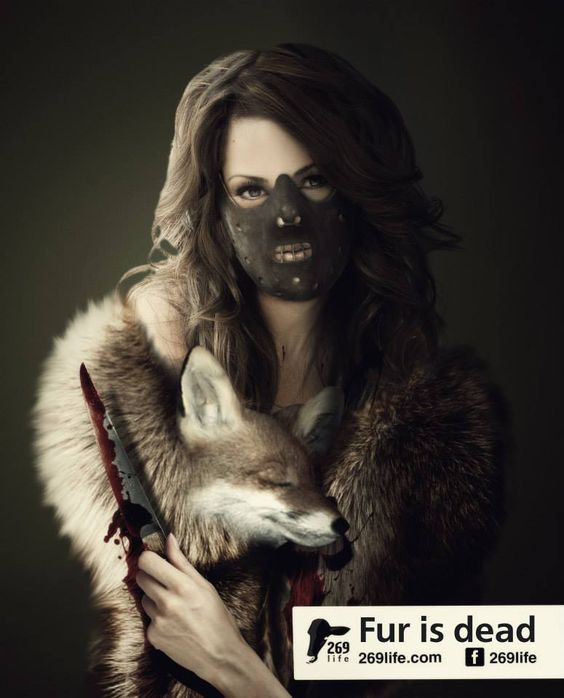
This overwhelming choice strongly indicates that the fur industry has lost a lot of its enthusiasm for what is increasingly seen as an abjectly cruel business that forces inherently wild species to spend their lives in cramped cages, unable to enjoy any natural behaviour.

But, even if Denmark is playing a much smaller role in EU exports of mink and fox skins, these still amounted last year to 4,557 tonnes, with a value of €696,586,228. These numbers are thankfully way down from 2019, when the EU exported over 8,000 tonnes worth nearly a billion. The figures for 2022 will no doubt be even lower, but we are looking forward to 0 tonnes and €0. 

In 2019, there were 2,900 mink farms in the EU. Now, there are well under 800. The fur industry is definitely in decline, but we need to bring it to a definitive end. 

Scraping the fur off European shelves 

Farming is, however, only one side of the fur industry; the other is products including fur from beyond Europe, which are, astonishingly, still on sale in every Member State. This is why our European Citizens’ Initiative Fur Free Europe is not just seeking a ban on keeping and killing animals on fur farms, but also pushing for legislation to make it illegal for any farmed fur to be sold throughout the EU. 

From an animal welfare point of view it makes little difference where an animal is bred for fur, as intensive farming of fur species in wire mesh cages is similar worldwide. This part of the business is also on the decline: EU imports of mink fur amounted to over 800 tonnes in 2019 but decreased to just 200 tonnes in 2021. But again, we’d like to see those numbers drop to zero.

Banning the fur trade in the EU would make Europe a worldwide role model alongside a growing number of American cities and states that have put an end to fur sales. 

So join us in making a global difference by adding your signature to the campaign. Let’s bring relief to countless animals whose suffering cannot be quantified.

You could say it is a very, very welcome, FUR OUT; hopefully forever.

Check out our other recent post on this issue – :

England: Friend or Foe ? – Fur or Faux Fur. – World Animals Voice

Regards Mark

Fur is what you wear: click ‘watch on You Tube’ to view

Italy: Roadside Checks Document Transport of Live Animals in Temperatures Over 36°C Without Water.

Roadside checks document transport of live animals in temperatures over 36°C without water

25 July 2022

Essere Animali

Roadside checks by Essere Animali investigators document trucks parked in the sun with pigs inside, gasping, visibly out of breath. These are dramatic scenes, but they do not constitute any violation of law, thanks to “an absolutely inadequate EU regulatory system in terms of concretely protecting animals” the organisation states.

Bologna, 21 June 2022 – In these days of extreme heat, the organisation Essere Animali carried out monitoring activities along the A1 motorway, between Lodi and Bologna, to document the conditions of the animals transported for food production.

The organisation’s investigators monitored trucks used for the transport of live animals, intercepting them en route and following them until they arrived at the slaughterhouse. The temperatures were detected through the use of a heat gun, with which it was possible to ascertain the exact temperature inside the compartment of the truck in which the animals were transported.

We have documented trucks that travelled with external temperatures of 36°-38°C and that, upon arrival at the slaughterhouse, stopped for 30 minutes in the sun before unloading the animals. In these cases, it was possible to verify that the pigs were forced to remain in the truck with internal temperatures above 40°C. Unfortunately, the current regulations do not provide for temperature limits inside or outside the vehicle for journeys with a duration equal to or less than 8 hours, merely requiring that the means of transport should be able to protect animals from ‘extreme temperatures’, and prohibiting them from being transported in conditions that expose them to ‘unnecessary injury or suffering’. The lack of objective parameters of reference therefore creates a vast unregulated grey area, which does not facilitate appropriate intervention when the welfare of the animals is not respected.

President of Essere Animali, Simone Montuschi

Regulation (EC) No. 1/2005 on the protection of animals during transport does not place any limit on journeys that last up to 8 hours (or 12 hours if an exemption is granted) with regards to either the temperature inside or outside the vehicle, or the possibility of accessing water; provisions are only in place for long journeys of more than 8-12 hours. In this case, it is specified that the ventilation systems on the means of transport must be designed, constructed, and maintained in such a way that, at any moment in the journey, regardless of whether the means of transport is stationary or in transit, they can maintain a temperature between 5°C and 30°C inside the vehicle, with a tolerance range of +/- 5°C depending on the external temperature.

In a note issued at the beginning of June addressed to the Direction of the Traffic Police and to the trade associations of lorry drivers and veterinarians, the Ministry of Health requires that the transport of live animals must not be carried out with atmospheric temperatures above 30 degrees at the start of or during the journey. However, the reality documented by the investigators of Essere Animali shows that these provisions are not effective in practice, and there is an urgent need for greater legislative protection during transport operations.

If we allow transport for several hours when the outside temperature touches or exceeds 30°C, the pigs inside the trucks, due to crowding and the body heat produced, will be forced to withstand temperatures around 40°C. But the scientific literature indicates that for adult pigs, the thermoneutral zone – that is the range of temperatures within which the animal is able to maintain its normal body temperature – is approximately between 8°C and 25°C. The animals transported in these days of high temperatures were therefore subjected to stress and suffering.

Simone Montuschi adds.

Essere Animali believes that new European laws are needed as soon as possible to better protect animals, as the current ones are too generic, and do not take into account various species-specific requirements and with serious shortcomings, such as the lack of regulatory protection for animals during trips lasting up to 8 hours.

Through the Farm to Fork strategy, the European Commission has set itself the goal of carrying out a complete review of the legislation on animal welfare, including transport and slaughter of animals raised for food, by autumn 2023.

Through the No Animal Left Behind campaign, coordinated by Eurogroup for Animals and supported by dozens of NGOs from all over Europe, Essere Animali calls for the transport of live animals over long distances (longer than 8 hours) to be prohibited. Furthermore, they request the introduction of a range of acceptable external temperatures between 5°C and 25°C, outside of which any transport is prohibited. Finally, fundamental parameters must be clearly defined, such as species-specific and categories-specific conditions for the suitability for transporting animals, as well as the availability of space and method for water administration.

Allowing the transport of live animals when the measured external temperature is 30°C or more, and not providing access to water, is equivalent to not guaranteeing the welfare of the animals. It is clear that the current European laws for the protection of animals are incomplete and inadequate, so we ask the European Union and the Italian government to align the new legislative proposal with current scientific and ethological knowledge.

Simone Montuschi concludes.

The transport conditions documented by Essere Animali are disturbing, and bring to light a reality completely ignored in Italy. A country which, not by chance, was not among the thirteen member states that — on the occasion of the Agrifish Council, among the Ministers of Agriculture and Fisheries on 18 July — came out in favour of an ambitious revision of the regulation on the transport of live animals, which is planned to be presented by the European Commission in 2023. The deafening silence of Minister Patuanelli on such an important issue as animal welfare is unacceptable. Italy once again shows total indifference towards this issue and, on the contrary, unconditional support for a food system based on profit at all costs, as well as on intensive and industrial farming practices that not only exploit other sentient beings as if they were commodities, but also destroy forests, pollute soil and water, increase greenhouse gas emissions, and bankrupt small farmers. This is an unsustainable model for the entire planet, so it is urgent to reverse course without wasting any more precious time.

Eleonora Evi MEP, member of the Committee of Inquiry on the Protection of Animals during Transport (ANIT)

Regards Mark

EU: Animal Welfare Included in Geographical Indications (GI) Revision Proposal.

21 July 2022

Eurogroup for Animals welcomes the European Commission’s proposal on the revision of the geographical indications scheme for agricultural products, which identified that consumer concerns about animal welfare and sustainability are not adequately protected at present.

In March, the European Commission adopted a legislative proposal on revising the EU geographical indications (GIs) scheme and quality schemes for agricultural products. This followed a commitment in the Farm to Fork strategy to revise the framework to improve its contribution to sustainable production and to strengthen the position of farmers and producers.

Eurogroup for Animals provided feedback on the proposed revision during a recent public consultation, in which we welcomed the proposal’s identification of the lack of sustainability and animal welfare considerations in the existing framework. This is an important recognition, as the current GI scheme’s exclusion of animal welfare standards means it does not cohere with the EU’s animal welfare or sustainability ambitions. 

The proposal aims to lay down requirements on animal welfare and environmental concerns in light of the growing integration of these issues in GI value chains, validating those producers who have already integrated sustainability actions into their product specifications. As the GI system has been promoted globally through EU trade policy, this could also lead to GI producers around the world incorporating animal welfare dimensions.

Increased attention to animal welfare can also help to protect the quality of GI products. Although GIs are commonly viewed as high quality by consumers, many producers do not even respect the EU minimum animal welfare standards.

Indeed, investigations into GI products have uncovered illegal practices, such as brutal violence on farms breeding pigs for Parma Ham (Essere Animali, 2018 investigation), cows farmed to produce Parmigiano Reggiano unable to graze on pasture (Compassion in World Farming, 2017 investigation), and dead calves and serious hygienic/sanitary neglect on farms producing Grana Padano (Essere Animali, 2021 investigation). 

Going forward, the references to animal welfare in the Commission proposal must remain. This includes a mention in the introduction and in the preamble, as well as the statement in Article 12 that producer groups can choose to adhere to sustainability undertakings higher than EU requirements. Crucially, the delegated acts that will have to be adopted to define the sustainability standards must include animal welfare requirements based on appropriate animal welfare schemes.

At a minimum, this should include enriched indoor conditions, no cages or restrictions, access to fresh air, lower than standard stocking densities, and an end to mutilations and forced early weaning. Where GIs do adopt animal welfare criteria, pressure must be applied to ensure that they are respected, and assistance should be provided to farmers to support this transition.

Regards Mark

England: Friend or Foe ? – Fur or Faux Fur.

Cats tread softly and gently. They can steal up on you without a sound. Before you know it, your feline friend is on your lap – wonderful. However, you may well not have noticed that sometimes it’s their fur which could be keeping your head or neck warm as hat, collar or hood trimmings, creeping up on the unwary consumer without the slightest hint of a meow. It is much less friendly.

Now, anything containing real cat or dog fur is already banned in the EU, or maybe it is better to say ‘officially it should be’. If you say ‘it is’ there will always be proof somewhere that ‘it is not’; so I tend to shy away from such statements usually. But regardless, products with fur from farmed mink, foxes, chinchillas and raccoon dogs are still ON the market. These additions are not necessarily advertised as such. Instead, they can be used by manufacturers to give low-cost garments a ‘high-end’ feel.

Please remember – It takes up to 40 dumb animals to die in making of a fur coat; but only one even dumber one to wear it for the sake of vanity.

Faux fur can be faking it

As activists and campaigners, you no doubt wouldn’t choose anything made of animal fur; it belongs on their back, not yours. But, while the price tag of a coat clearly indicates whether it’s a mink or a fink, it may well not alert you that the decoration on the bobble hat or hooded coat you’re looking at is not faux fur, but real fur.

This is why Fur Free Europe is not just seeking a ban on keeping and killing animals on fur farms, but also pushing for legislation to make it illegal for any farmed fur to be sold throughout the EU. That way, whenever a product takes your fancy, you’ll be sure it won’t contain anything that looked a lot fancier and in the right place – on its original owner. 

You will also be sure that you won’t be inadvertently supporting the abjectly cruel practice of forcing inherently wild species to spend their lives in cramped battery cages, unable to enjoy any natural behaviours. 

But there are also other issues which could arise from this .  If Europe does the bans, then for sure, we can see the Chinese attempting to flood the euro market with fur products which are produced using real fur and which have been produced under the most disgusting actions.  The importation of real fur from outside the EU, to be sold as faux within the EU is one issue that really has to be observed and monitored very closely.  Years ago I personally became involved with the EU when Russian seal pup fur was illegally making its way into the EU – dressed up and coloured to make the consumer think that it may not be ‘real fur’ that they were purchasing; but it was; fur of baby seals slaughtered in Russia.  (But the good news is after a lot of work, we stopped the Russian seal pup slaughter  – so, job done).

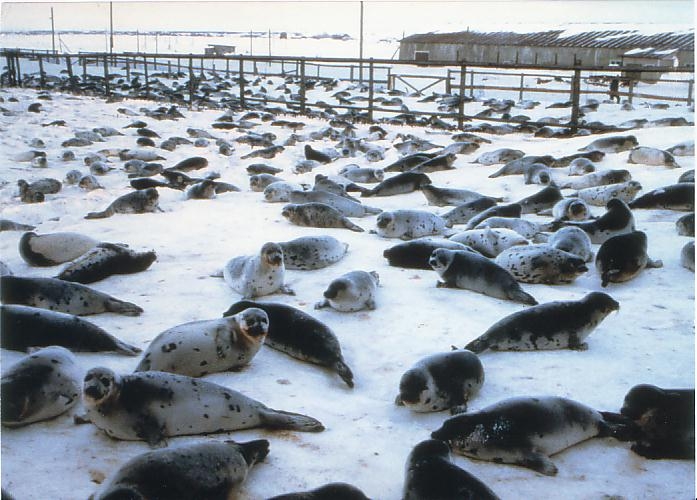
A seal pup ‘farm’ in Russia – fortunately, no longer used. (WAV)

A netted Russian seal pup destined for the farms – no longer – archive photo.
Bringing the Russian seal issue to Downing St, London. Mark (WAV) dressed as Sealer – on left.

Think what we say about China fur cruelty is over the top ? – then watch this

Click on ‘Watch on You Tube’ for both below.

Now want more ?

Herding the EU cats

Despite widespread ethical concerns – a sensible majority of people in every EU country consider breeding animals for fur unacceptable, let alone the associated public health risks, many Member States still allow fur farming to continue. This time last year, twelve Member States called on the European Commission “to undertake appropriate action leading to the end of fur farming in Europe”. There has been some progress, but far more is needed.  You could say a global ban on fur production is needed; this probably will not happen (when we talk China), but real fur product imports from China for example into the EU under the guise of fake fur can be tested, controlled, and closely monitored before they even get here.  This is where ‘eurolegislators’ need to come out of their cages, AND ACT.  The Chinese need to be held to account for their abuses in the fur trade.

The European Citizens’ Initiative Fur Free Europe is working hard to obtain the backing of a million EU citizens. If this goal is reached, the European Commission will be obliged to respond and take action.

If you too want to “Leave Fur Behind” and see a ban on fur farms and farmed fur products, then add your signature to the campaign. 

Let’s make sure there is only ever friendly faux fur on that hat or hood. No doubt the cat will purr too.

Regards Mark

EU: Finally, Decades Too Late, Have The Old Fossils At The EU Woken Up and Decided That Live Animal Transport Really Does Need A Major Overhaul ?

Photo – Mark (WAV)

Battleground Dover around 1990 – Photo – Mark (WAV)

WAV Comment:  Masses of EU and British animal welfare organisations, including us, have been calling for the introduction of a one off maximum 8 hour journey time for decades.  In our specific case, 35+ years. As part of this requirement, they also demanded that the industry change as much as possible to a (dead) meat and carcass only trade.  So why, only now, is the fossil called the EU just getting round to taking this issue seriously ?

EU citizens (and non EU citizens from the UK) are on the ball and want major change.  It is only the EU Commissions and their lobbyists who appear to want to stick with the status quo.  These days are now gone and people want, or demand change.  The EU should get a clear message of what will happen if it ignores the wishes of its own citizens.  MEP’s have woken up to the fact that they will be deselected if there is no change; so it is essential that they keep constant pressure applied on this issue, or they face the consequences.

We watch from the UK side lines now (having done Brexit and thus being allowed to change the live transport laws ourselves) to see if the EU fossil actually steps up to the plate and meets the demands of the EU citizens.  God forbid the EU if nothing changes !

AGRIFISH Council – Member States step up their game for animals

18 July 2022

Press Release

Today’s Agriculture and Fisheries Council discussed two key dossiers for animals, specifically live animal transport and aquaculture: 13 Member States call for an ambitious revision of the Transport Regulation including maximum journey times as well as a shift to a meat and carcass trade. Now it’s time for the European Commission to incorporate these views in the revision which is due at the end of 2023.

Eurogroup for Animals is pleased to see concrete demands from Member States that can effectively have an impact on the welfare of animals. Indeed, the Belgian, Danish, Dutch, German and Swedish delegations (Vught Alliance) presented an information paper which received the support of 8 other Member States (Austria, Bulgaria, Estonia, Finland, Malta, Luxembourg, Slovakia and Slovenia). 

The paper calls for a maximum of 8 hours for animals transported for slaughter, restricted journey times for unweaned animals, a ban on certain long journey exports, temperature intervals tailored for each species, specific rules for fish, amphibians, reptiles, dogs, cats, as well as transitioning to transporting meat, carcasses and genetic materials

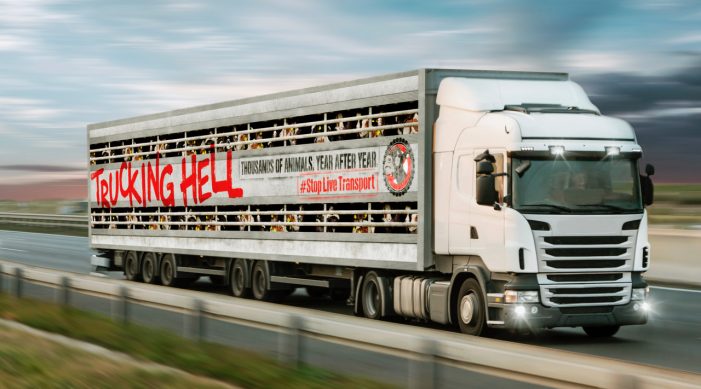
Trucking Hell – Part of the CIWF campaign to stop live animal exports.

.

Eurogroup welcome the introduction of species-specific maximum journey times and requirements for all animals, including cats and dogs, fish, and other vertebrate animals, 8 hour journey time for animals for slaughter as well as the acknowledgement that “it would be much more advantageous to transport meat, carcasses and breeding materials instead.” Clearly citizens expect even more ambitious changes but the paper is a step in the right direction

Reineke Hameleers, CEO, Eurogroup for Animals.

Despite the fact that the wording on certain key topics, such as live export and the transport of breeding animals, could have been much stronger, and while the specific needs of animals used for scientific purposes could have been better specified, Eurogroup for Animals believes this ministerial proposal is an important step towards the refinement, reduction and replacement of live animals transport. 

In January 2021, Eurogroup for Animals published a White Paper on the revision of the Transport Regulation, in which species- and category-specific provisions for the transport of terrestrial and aquatic farm animals, equids, cats and dogs, as well as animals used in science are presented. Eurogroup trust that the European Commission (EC) will take Eurogroup for Animals’ position into consideration for the preparation of the draft legislative proposal.

Eurogroup are pleased to see the support the Paper obtained at the Agri-Fish Council, this encouraging result should provide the EC with a green light to proceed in line with these recommendations and ensure that the revised Transport Regulation will deliver towards its objective: the protection of animals during transport, and that it will be coherent with the EU sustainability ambitions.

Photo – PMAF *France).

On fish welfare in aquaculture, Eurogroup welcome the Council supporting the objectives that the EC has established for Member States and for itself, including developing best practice guidelines and validated indicators for fish welfare in aquaculture, and providing training to operators and competent authorities. To meet these objectives, the EC needs to leverage its own resources, including the European Food Safety Authority, and to create an EU Animal Welfare Reference Centre for fish, while Member States need to prioritise these fish welfare objectives in their national aquaculture plans and distribution of EU fishery subsidies.

Regards Mark

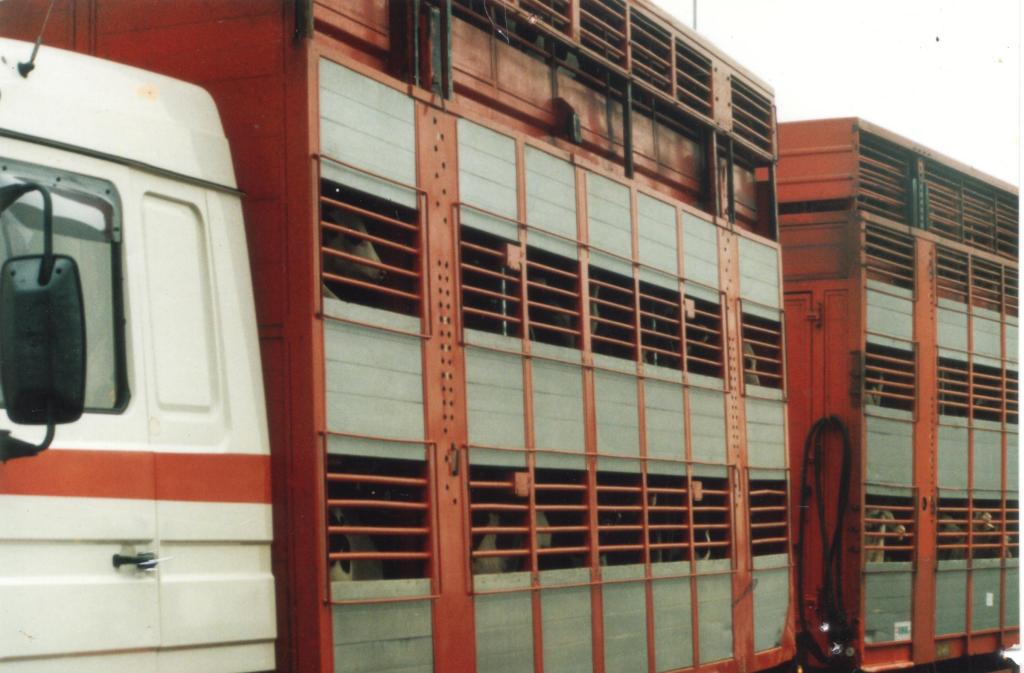
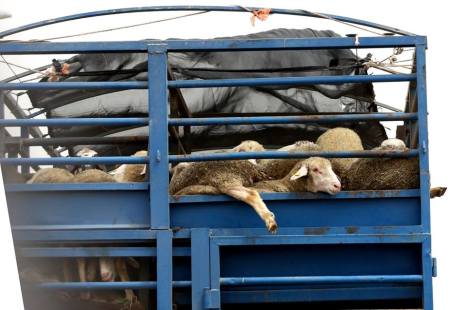
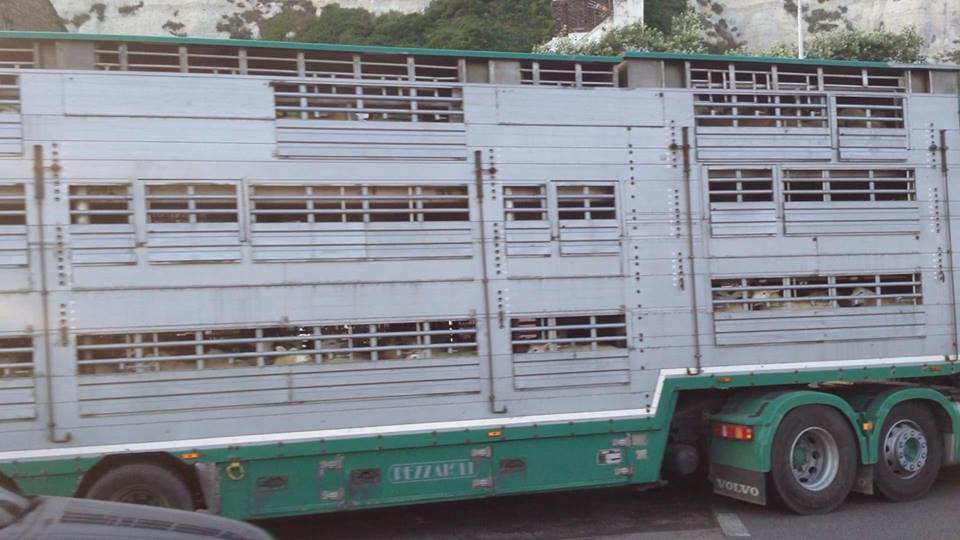
There are live sheep (yes !) in this box trailer.

Spain: New Investigation Exposes the Harsh Reality of the Spanish Aquaculture Sector. Disturbing Video.

19 July 2022

Investigation

The Franz Weber Foundation has released footage from an investigation carried out between 2020 and 2022 in 12 Spanish fish farms. Using a hidden camera and drones, images were taken at fish farms of the most commonly produced fish species in Spain: sea bream, sea bass, trout and turbot.

Suffocating in ice for an hour and a half, pressed hard in the stomach to extract their eggs, bled to death while still conscious, or sucked out of water by an industrial pump. 
This is the what thousands of fish on Spanish fish farms are exposed to every day. 

Spain is the EU’s second largest farmed fish producer and the EU’s top aquaculture producer by volume, with over 175.5 million finfish bred in hatcheries in 2019. 

The investigative footage shows slaughtering on ice, a widespread practice in most Spanish fish farms (and in other European and Mediterranean countries), which is undergone without prior stunning. It consists of immersing live fish in a mixture of ice and water, or in ice directly, which results in the slow death of the animals by hypothermia or asphyxia. When asked how long it takes for fish to die from ice slaughter, one of the workers at a trout farm in Granada replied that it takes an hour and a half.

The video also shows the overcrowding of fish in the tanks, premature deaths due to poor production conditions and inadequate handling of the fish by the fish farm staff. At one farm, a worker reported that 1,823 trout had died that day alone, and the previous day there had been 1,300 casualties.

Another practice shown in the investigative report is the process of forced spawning, where, every seven months, the animal is anaesthetised and its stomach is pressed hard to extract the eggs. The manager of one of the farms filmed explains that the spawning process can lead to injury or even death of the fish.

A very disturbing video – WAV.

Regards Mark

Bulgaria: Horrific Conditions Revealed On Mink Farm In Bulgaria.

13 July 2022

Anima International released a new investigation from the biggest mink farm in Bulgaria, carried out between the autumn and winter of 2021. The footage reveals filthy and inadequate conditions, mink escaped from their cages, and animals suffering from serious untreated wounds.

The farm investigated is located in Madzehito, a small town on the outskirts of the town of Stara Zagora in central Bulgaria. It is the biggest mink farm in Bulgaria and houses over 100,000 animals.

Farm representatives also reported that the facility has been certified by Welfur, a certification programme which claims to ensure that farms provide adequate welfare standards for animals farmed for their skins.

The investigators documented animals in horrible conditions with wounds that seemingly have never been treated on their tails and backs. It seems as if no one inspected the animal health sufficiently, to provide proper treatment for animals in need. Some animals were found dead in their cages, their companions not being separated from them, nor their bodies removed by farm workers. What can be observed in the footage is a general state of neglect: broken cages with leftover food on them, cobwebs and filth below and above the cages, some animals running freely around the perimeter of the farm.

Anima International

On 1 June, the Bulgarian Minister of Environment and Water Borislav Sandov announced a ban on breeding or importing American Mink in Bulgaria, following concerns over threats to native biodiversity from escaped animals.

The investigation clearly revealed mink had escaped from their cages and were freely roaming the facility, illustrating the very real threat of animals escaping from the farm and damaging surrounding ecosystems.

Whilst this is a positive step forward in addressing the issues uncovered in the investigation, farms all over Europe continue to farm mink in poor conditions. The European Citizens’ Initiative Fur Free Europe is calling for a ban on fur farming across the European Union, as well as a ban on farmed fur products. 

Note – This action is for EU member state citizens only

Help us achieve a Fur Free Europe by adding your name now.

Regards Mark

England: Hot Dogs; Hot Cats, Hot Wildlife and the Rest. Tips for Keeping Animals Well In the Heat.


PetsKeep paws off pavements (and don’t shave your dog)

It’s not just people who are going to have a hard time coping with the heat – pets also experience extreme discomfort. If their owners aren’t careful, heatstroke or burnt paws are very possible.

A lot of the guidance (you can read the Guardian’s here) is the same you’d follow for yourself: make sure your pet is in the shade and hydrated, only go for walks in the coolest parts of the day and avoid being barefoot on pavements.

Veterinarians, perhaps counterintuitively, also discourage shaving your pet’s fur as it actually helps keep them cool. There are even pet-safe sunscreen options that will keep your fur babies safe from the sun and prevent sunburn.

How to spot a too hot dog – and other pet care tips for a heatwave

Get ready for sweltering weather by learning what to do if you notice signs of heatstroke

Athird of people do not know what to do if their dog has heatstroke, research has found, and the RSPCA says it could be “a matter of life or death” if owners do not take extreme caution with their pets this weekend.

The pet charity has appealed to owners to take every possible precaution to keep their animals safe during the intense heat, including familiarising themselves with the signs of heatstroke in animals and swotting up on how to make frozen treats.

Esme Wheeler, a dog welfare expert at the RSPCA, said: “The hot weather has gone from glorious to extreme, and we can’t stress enough how vital it is that pet owners take the situation seriously. We’re urging anyone with a pet – whether it’s a dog or cat, a rabbit or guinea pig, and even chickens, horses and exotic animals – to put aside some time today to read up and make plans.”

Dogs

The signs of heatstroke include excessive panting, unusual breathing noise, lethargy or change in behaviour, stumbling, and a blue/grey tinge to the gums or tongue. Owners should contact their vet immediately if they spot any of these signs.

Move the dog into the shade or a cool space and offer water, although only in small amounts. Lie them in cool but not very cold water and/or pour water over them. A soaked, cool towel could be placed over the dog’s side, and replaced if it becomes warm.

To avoid getting to that stage, skip walks and travel, keep dogs indoors out of the heat and leave water available at all times. Owners could also consider making frozen treats to encourage their pets to keep hydrated.

If you must exercise your dog, aim to keep to gentle, slow walks on the lead, and do this in the very early morning or late evening when temperatures are cooler. If in doubt, don’t go out.

Cats, small furries, snakes, fish and pet chickens

The RSPCA has a video on how to keep cats cool in hot weather, with tips such as laying down a cool damp towel in case your cat chooses to lie on it, and using pet-safe suncream on ears and other exposed areas if necessary.

Small animals, poultry and other pets should be checked twice a day for flystrike (when flies lay their eggs on another animal, which then hatch into maggots). Guinea pigs can be kept cool and hydrated by making them a fresh vegetable treat.

“Ensure rabbits and guinea pigs have constant access to shade and fresh drinking water at all times, and remember that as the sun moves during the day so too does the shade,” said Wheeler. “Somewhere that was shaded in the morning could be in full sun by the afternoon.”

Owners could also freeze a semi-full plastic bottle of water and wrap it in a towel so their pets can lie against it. People with pet chickens can encourage them to stay in shaded areas by hanging up a homemade vegetable garland. Fish tanks should be kept out of direct sunlight.

Snake owners have been advised to be extra vigilant as hot weather can make the reptiles very active and more likely to scale their tank and escape, the RSPCA said.

The charity’s scientific officer, Evie Button, said: “Snakes are excellent escape artists and will take the opportunity of a gap in an enclosure door or a loose-fitting lid to make a break for it.

“We would urge all pet snake owners to be extra vigilant at this time of year, invest in an enclosure suitable for the particular species and make sure that enclosure is kept secure – and locked if necessary – when unattended.”

Horses and farm animals

Owners need to know the signs of dehydration in horses so they can contact a vet if needed.

Farm animals need their water troughs checked regularly to make sure they are working properly and any algae or debris has been removed.

With exercise and travel planned for either end of the day when temperatures are lower, horses stabled during the day might appreciate a “boredom buster” treat.

A non-toxic fly repellent spray and a fly mask can help keep horses protected from bugs, and pet-safe sunscreen can be used on horses’ muzzles if necessary.

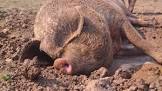
Make sure pigs have plenty of wet mud to wallow in, as well as shade.

Wildlife

Leave a bowl of fresh drinking water in your garden for birds and other wildlife. Top up water levels of ponds, and keep an eye out for wildlife when using lawnmowers or strimmers.

Regards Mark

With thanks to our friends at ‘The Guardian’, London.


England: Birds, Cockney and Cages. Oh, and ACTIONS !

England 17/7.  It is hot here today, and has been for most of the last week.  Tomorrow and Tuesday, the Met Office has put out Red alerts – the very highest heat conditions which could be expected – like 40+ C for England ! – come on man; no its true, conditions which have never reached these temperatures before are expected in the next few days.

Southern Europe, Spain, Portugal and France have experienced even higher temperatures.  Everyone is saying it is global waring causing this, but the other question is ‘anything being done abut it really ?’

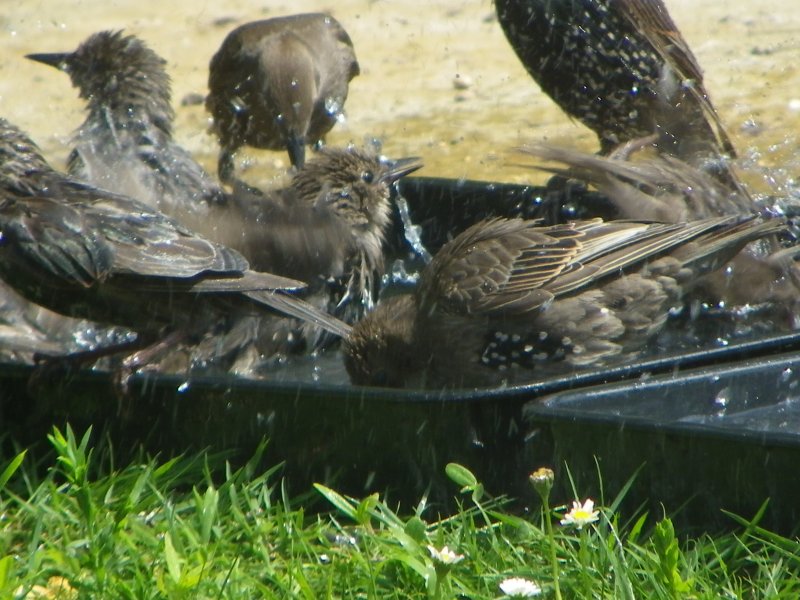
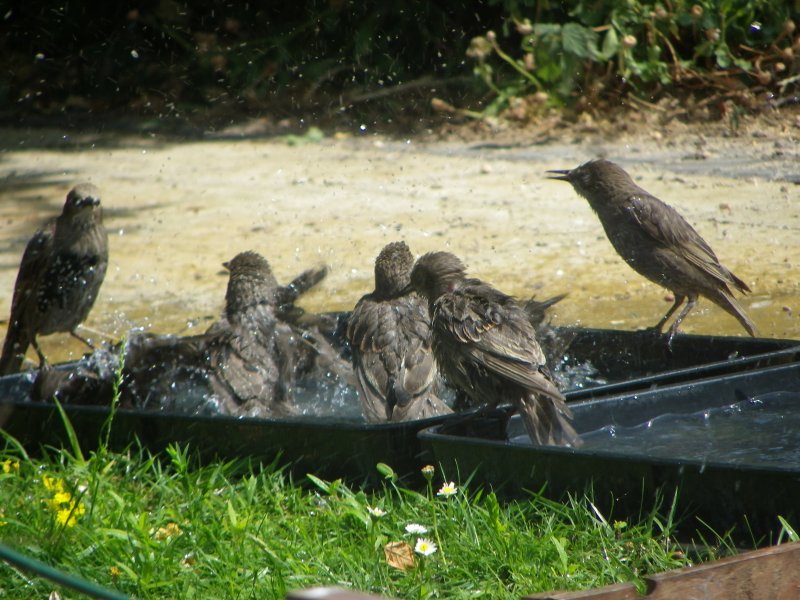
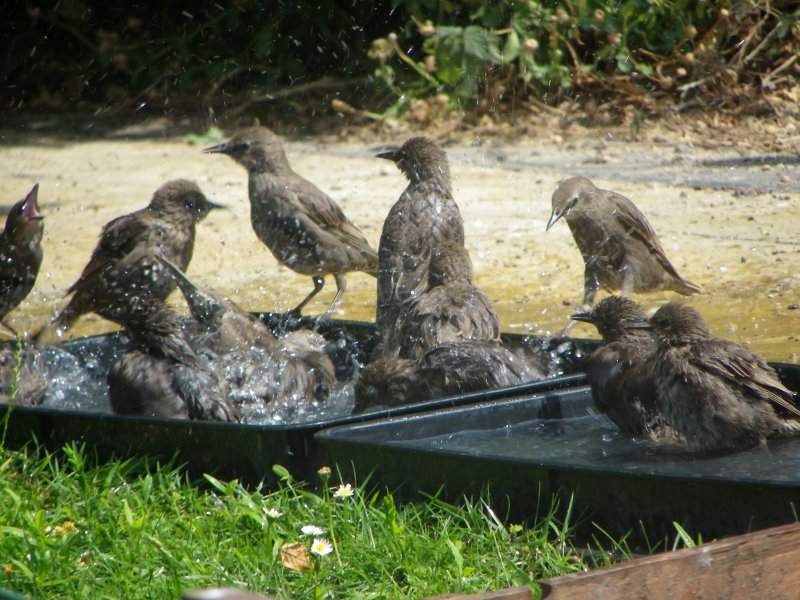
I went out this morning and put fresh water into all the water compartments that we have in the garden – currently about 7; in conditions like this especially everyone must ensure that animals have lots of fresh cool water to drink and bathe in.  I took these pictures of all the birds enjoying their morning bath earlier, cleaning their feathers down and ridding themselves of all the dust, whilst having a good drink at the same time.

A lot of people from overseas would probably not associate London and the South east of England with Parakeets; but there are thousands of them flying freely in and around the area.  Animal buddy Pauline sent me thee pictures of London area Parakeets – they don’t squark Cockney yet but I guess it is just a matter of time.

Talking of Cockney me old China’s, have a butchers at this and learn:

Joking aside, it is conditions like this, temperatures like this, which especially bring home the suffering that must be endured by crated animals all across Europe.  It is now time to break the cages and liberate all the animals – you can do this (if you live in an EU member state) by adding your name to the citizens charter to free all the caged animals.  Here is a link which provides all the details – watch the video and then take action:

England: Caged Conditions We Found in the EU Were Nothing Short of Hellish. Ban the Cage Age Now. – World Animals Voice

The birds in the garden are free; they can bathe and wash down in stifling conditions like we are currently experiencing.  Animals in cages do not have that pleasure; such is the want of man.  Speak for them, break the cages and set them all free now.  Please sign the petition (EU citizens) or pass to others that can.

Regards Mark

England: Caged Conditions We Found in the EU Were Nothing Short of Hellish. Ban the Cage Age Now.

WAV Comment – Stick the EU Commissioners and ‘Euro’ politicians into sow cages in Spain, being confined in a cage shut into a shed, suffering conditions and temperatures as they currently have, 44 degrees; lying in their own excrement unable to even turn round;  then load them onto a livestock trailer and haul them across Europe, defecating and urinating all over each other for days;

THEN SEE SUDDENLY HOW QUICKLY THE LAWS WOULD BE CHANGED.

Mark.

Do you expect all mother pigs farmed in countries which claim to be world leaders in animal welfare to be able to move freely and express their natural behaviours? To be free from pain and suffering?

Nothing could be further from the truth. We went undercover on pig farms across four EU countries, including suppliers for world-renowned products like Parma and Bayonne Ham. The caged conditions we found were nothing short of hellish.

This new investigation is yet more strong evidence that there is poor welfare in a cage and no animal should be imprisoned behind bars.

Please take action today and call on EU Ministers to End the Cage Age.

In 2019, we exposed the grim reality for thousands of sows in the UK who were forced to give birth and rear their young in farrowing crates. Today’s findings show this same suffering endured by animals across Europe. And, in the EU, many sows are also trapped in cramped stalls for four weeks of pregnancy.

Last year, the European Commission committed to introduce legislation to phase out caged farming. But they’ve been lobbied hard by opponents of a ban, and the support of all EU member states is vital if we really are to free over 300 million animals from cages. Britain is no longer in the EU, but suffering knows no boundaries so we must urge Ministers across the continent to End the Cage Age.

Ending caged farming in the EU is also crucial to set a precedent for other parts of the world. Not least for the UK, where the Government has promised action but so far not even launched consultations on cages for sows and hens.

Please speak out today to help lead the EU, and the world, out of the Cage Age.

It’s bad enough that, trapped in a space little bigger than their own bodies, caged sows can barely move. But our investigation also exposed other appalling suffering mother pigs can endure in cages. We saw:
Sows forced to lie in their own urine and faeces
Sows performing abnormal behaviours such as repetitively biting the cage bars and chewing without food in their mouth
Painful and preventable injuries
Sows unable to interact normally with their piglets

The European Union is closer than ever to becoming the first cage-free region if the Commission’s legislative proposal is implemented. Every year, hundreds of millions of animals – sows, hens, rabbits, calves, quail, ducks, and geese – could have better lives. But we must act now to defeat the powerful factory farm lobbyists who don’t want to End the Cage Age.

Please email the EU Ministers today. Together, we can achieve a world in which no farmed animal will suffer in a cage.

On behalf of the 300 million caged animals across the European Union you are giving voice to, thank you.

Mandy Carter

Global Head of Campaigns

SEND THIS MESSAGE TO THE EU AGRICULTURE MINISTERS* – URGE THEM TO LEAD THE WORLD AND END THE CAGE AGE!

Every year, caged farming systems cause needless suffering to around 300 million animals in the EU. From sows kept in stalls or crates so small they cannot even turn around, to rabbits unable to perform a single hop, caged animals are forced to endure cruel confinement in a system that does not respect their natural, behavioural needs.

There is no doubt that cages are cruel. An abundance of robust scientific evidence supports this fact and, as a result, over 140 influential scientists backed the End the Cage Age European Citizens Initiative (ECI). Compassion in World Farming’s recent undercover investigation* is yet more shocking evidence that caged farming cannot meet the welfare needs of sentient beings.

As you know, on 30th June 2021, the European Commission pledged to present a legislative proposal by 2023 to phase out cages progressively and definitively throughout the EU, possibly commencing in 2027.† This came as a response to the largest-ever ECI for animals, which collected a record 1.4 million certified signatures and was supported by more than 170 animal, environmental and consumer protection organisations. 

As a resident of the UK, I welcome the Commission’s historic decision, and am pleased that the EU is closer than ever to becoming the world’s first cage-free region for farmed animals. I urge you to support this commitment to phase out cages, and to set an example for the UK Government and governments globally. The cruelty of caged farming cannot continue.

Regards Mark

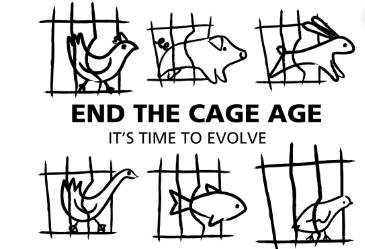
TIME TO EVOLVE