Category: Fur and Fur Farming

EU: Political Herds See Animal Welfare Votes In Europe’s Elections.

All pictures – WAV Archives.

This article is part of our special report Animal protection – in Europe and beyond.

Europe’s 340 million pets are unlikely to swing this year’s European elections, though with cats, one can never be sure. Jennifer Baker looks at Europe’s animal-related policy dynamics and how they could influence June’s electoral mix.

2024 is a bumper year for elections around the globe. In Europe, the cost of living, energy, environment, and migration are among the top concerns of voters at a national level. With the European Parliament, voting intentions can be a little different, allowing for broader areas of concern where local party-political questions tend to be less dominant. This means issues such as animal welfare can come to the fore.

According to the European Pet Food Industry Federation (FEDIAF), European households boasted 340 million pets in 2022 – including 127 million cats and 104 million dogs – across more than 90 million homes, so it would seem we are a continent of animal lovers, and yet animal welfare is not an issue that is routinely seen as a vote winner in national politics.

Dr Joanna Swabe, senior director of public affairs for Humane Society International/Europe, explained: “Animal welfare is one of those rare issues that is neither left nor right. Across the political spectrum and irrespective of nationality, you’ll always find politicians who care about the plight of animals. It is certainly not the exclusive domain of the Greens and the Left.”

Swade remarked that over the years she’s even encountered very conservative right-wing MEPs for whom animal welfare is paramount.

In the European Parliament, the Intergroup on the Welfare and Conservation of Animals brings together more than 90 MEPs to work together to advance animal welfare and conservation in EU policy making.

Recent issues under discussion include a proposal for a regulation on the welfare of dogs and cats and their traceability, protection of wolves in the EU, the use of animals in science and a new proposal for a regulation on the protection of animals during transport.

The intergroup also advocates for Cage-Free Farming and a Fur-Free Europe, while highlighting the importance of Animal Welfare Labelling.

Catalysts for change

MEPs can serve as catalysts to push for better animal welfare legislation,explained Danish S&D MEP, Niels Fuglsang.

Fuglsang is one of many European Parliament candidates in the upcoming elections to have signed the Eurogroup for Animals’ “Vote for Animals” pledge: a commitment to push the European Commission to put forward ambitious legislation in areas critical to animal welfare.

Some of the legislative proposals are obvious, such as fur labelling in the revision of EU textiles Regulation. Others are more indirect. For example, the European Green Deal sets out the ambition to reach zero pollution for a toxic-free environment. The so-called REACH revision could be an opportunity to promote non-animal testing.

Landmark opportunity

And it’s not only animals’ rights groups that support better legal protection for our furry friends. Cefic, the voice of the chemical industry in Europe, described the REACH revision as a “landmark opportunity to accelerate development, validation and regulatory acceptance of human-relevant, animal-free approaches to assess safety of chemicals.”

“By making every effort to identify where animal-based testing can reliably be replaced by non-animal methodologies and reflect latest advances in science, we will create a triple win for the industry, regulators, and animal welfare. This requires a paradigm shift in safety assessment towards Next Generation safety assessment, similar to moves seen in the area of cosmetics or pharmaceuticals,” said the organisation.

The EU Pharmaceutical Package currently under co-decision could also encourage new technologies to reduce testing on live animals.

One national outlier where animal – specifically bird – welfare and safety is a hot button issue is Malta. During the last European elections in 2019, Malta’s powerful pro-hunting lobby, FKNK, urged its supporters not to abstain, but to vote for its preferred candidates.

Cannot ignore agriculture

In Malta it is the hunting lobby that pressures political parties. Elsewhere in Europe the influential farming lobby holds sway. The protests of recent weeks have shown candidates that they cannot afford to ignore the rural, agricultural vote.

The Humane Society International/Europe’s manifesto, which aims to encourage policymakers to take a more ethical stance on animal welfare, has farm animals top of its agenda.

Swabe pointed out that many politicians are happy to loudly trumpet their support for legislative action to end the illegal puppy trade but are conspicuously quiet when it comes to pigs and poultry kept on Europe’s farms.

“We are told the Commission is currently assessing whether the transition to cage-free farming is sustainable for the agricultural sector and that further consultations on, amongst other things, the costs and length of transition periods are needed,” said Swabe.

She added that for the millions of laying hens still confined to enriched battery cages, and millions of pigs who continue to languish in individual sow stalls for a significant proportion of their gestation, “ […] what is truly unsustainable is this failure to take decisive action to provide them with housing systems that meet their welfare needs.”

[By Jennifer Baker I Edited by Brian Maguire | Euractiv’s Advocacy Lab ]

Political herds see animal welfare votes in Europe’s elections – Euractiv

Regards Mark

One day soon lets hope !

China: Skinned Alive In Public ! – FUR – Fashion Week New York.
Diana has been working on this:

Investigation: Horrific Cruelty on Chinese Fur Farms on Vimeo

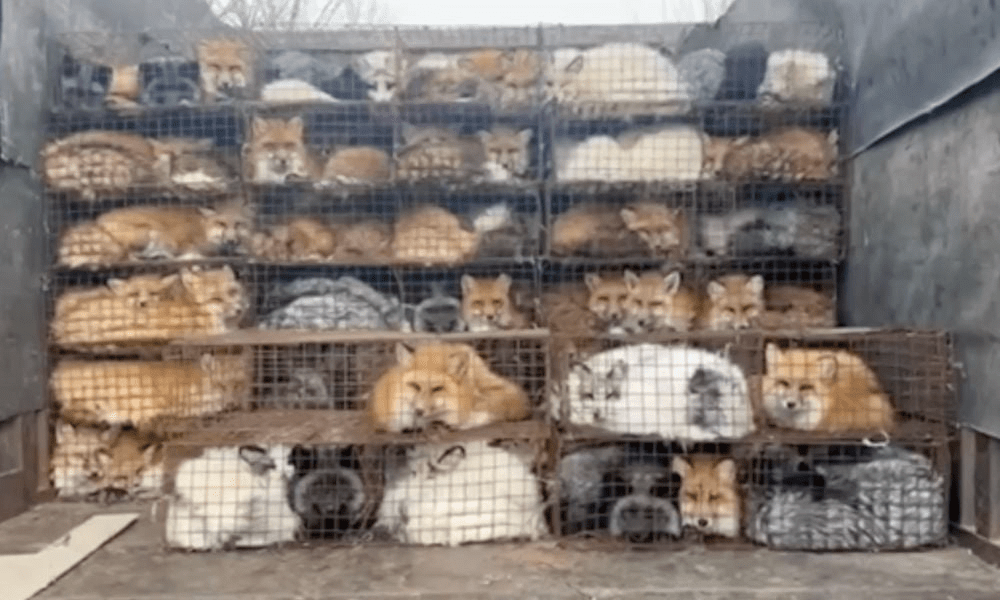
Animals Stacked in Cages on Truck (Lady Freethinker Investigation)

(Lady Freethinker Investigation)

Lady Freethinker Undercover Investigation Exposes Shocking Violence on Fur Farms

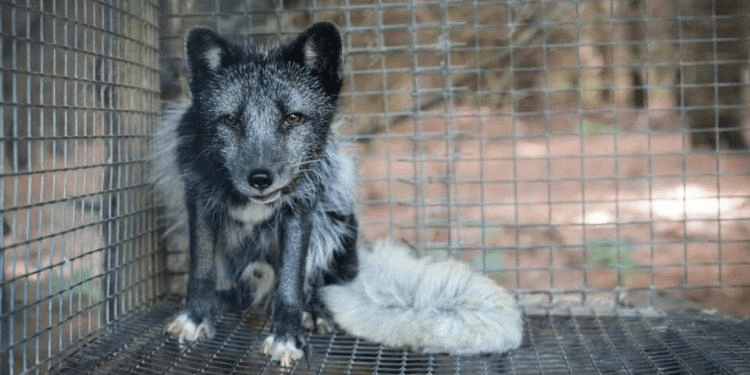
As fashion week descends on New York, a new investigation from Lady Freethinker and Paws of China reveals the hidden, horrific realities of fur. Foxes cowered in fear in filthy, wire cages where they waited to be skinned alive on Chinese fur farms so their fur coats could be used in luxury fashion.

Thousands of young foxes were seen suffering in horrific conditions before being pulled out of cages with iron tongs or metal poles and violently killed.

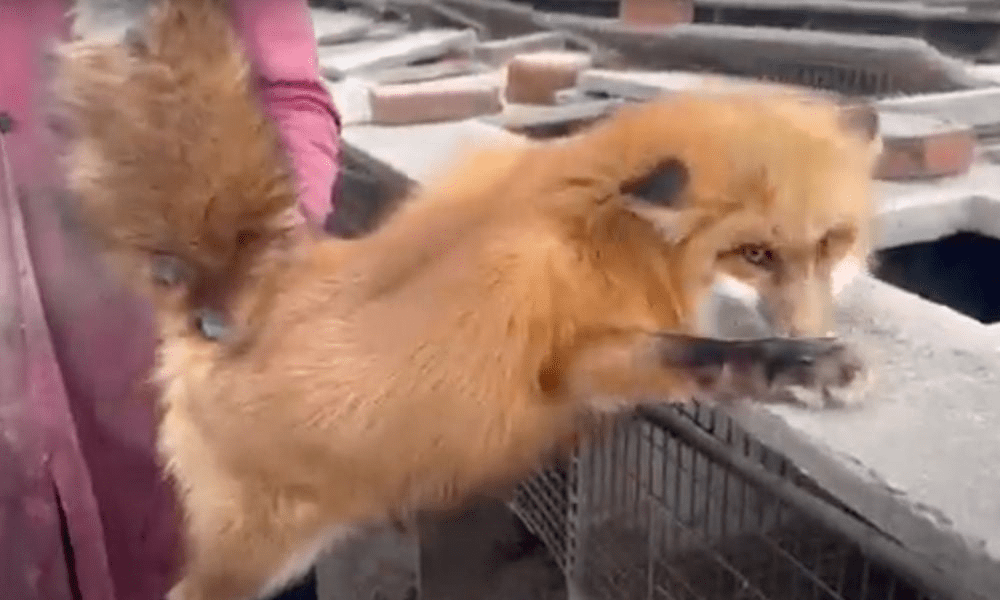
Fox Pulled From Cage By Tail (Lady Freethinker Investigation)

The undercover investigator documented:

A skinned fox who was documented blinking and moving his or her jaw for five minutes.

A fox who lashed around while being skinned alive by a worker.

Animals pulled from tiny cages with iron tongs or yanked by their tails.

These young animals – mostly juveniles under a year old – suffer terror and painful deaths because there is still a significant demand for their fur in fashionincluding from the United States.

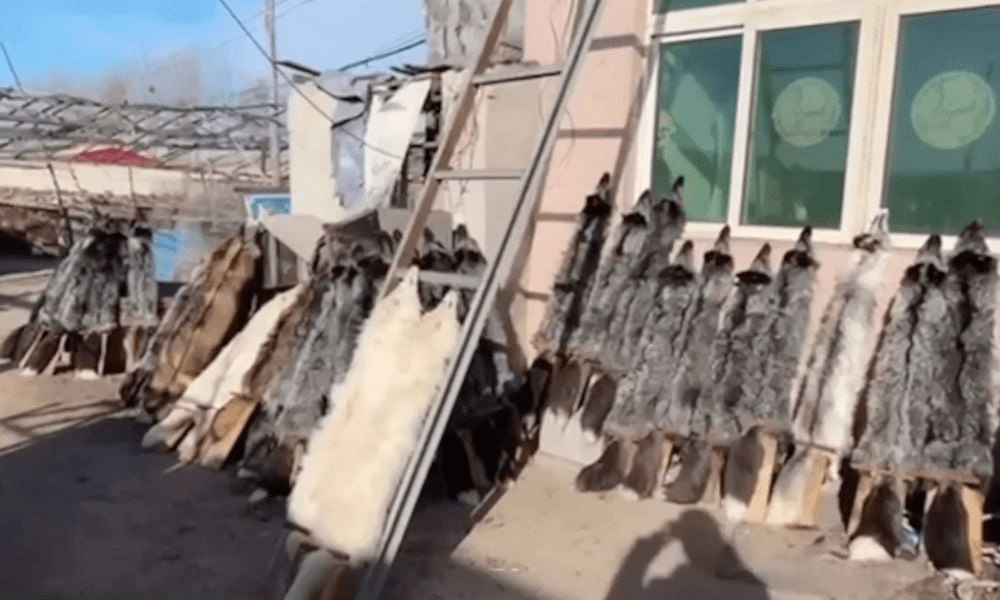
Animal Skins (Lady Freethinker Investigation)

We are demanding that retailers and designers stop funding this gruesome industry.

You can help by spreading the message that fur is cruel, by vowing to never purchase fur products, and by signing the petition to stop the sale of fur in the United States.Animal Skins (Lady Freethinker Investigation)

We are demanding that retailers and designers stop funding this gruesome industry.

You can help by spreading the message that fur is cruel, by vowing to never purchase fur products, and by signing the petition to stop the sale of fur in the United States.

Action – Please sign the petition here:

SIGN: Justice for Animals Crammed into Filthy Cages & Skinned Alive on Chinese Fur Farms (ladyfreethinker.org)

PETITION TARGET: Retailers that sell fur

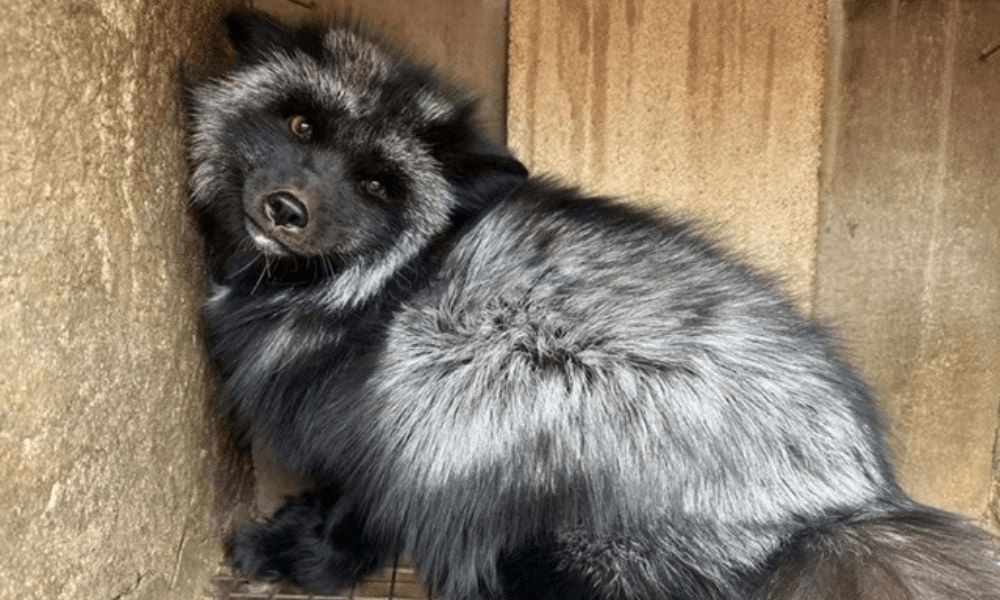
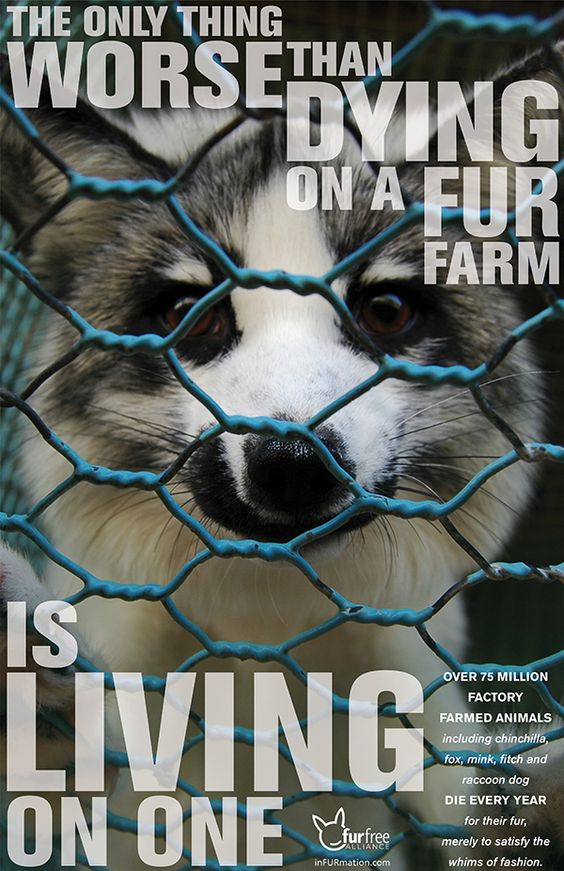
Thousands of terrified foxes and raccoon dogs were crammed in row after row of tiny, barren, wire cages. Some cowered in fear in the backs of enclosures; others paced back and forth or swayed.

That’s what an investigation into fur farms in Hebei and Jilin, China – conducted by Lady Freethinker and local Chinese organization Paws of China – revealed.

Animals were pulled out of enclosures using iron tongs or a metal pole. Others were yanked by their sensitive tails.

Then, the cages of petrified animals were carted to a different location on site to be killed. Others were thrown onto a truck and taken to an outdoor fur market where they would be skinned in public view, according to investigators.

Investigators documented one fox being skinned by a worker. The animal lashed around as the skin was pulled from his or her body. 

Another fox who had been skinned was documented blinking and moving his or her jaw, meaning the animal had been skinned while still alive and conscious.

The fox continued to struggle and show movement for 5-long-minutes before succumbing to an agonizing death.

The animals’ bloody carcasses are then sold for human consumption, according to investigators, while their fur is sold to the fashion industry.

With so many fashionable, durable, and warm alternatives to animal fur, there is absolutely no justification for torturing and killing animals for fashion.

Sign this petition urging retailers to stop selling fur immediately and remember to always leave animal fur and skins out of your wardrobe.

Investigation: Horrific Cruelty on Chinese Fur Farms on Vimeo

Regards Diana and Mark

Additional Link – Respect for Animals

China: ‘Crush’ Information. – World Animals Voice

China: Did You Hear the One About the Sick Pervert of a Doctor Who Lures Teenage Girls Into Pornography and Then Uses Them In An Animal ‘Crush’ Video Website ? – World Animals Voice

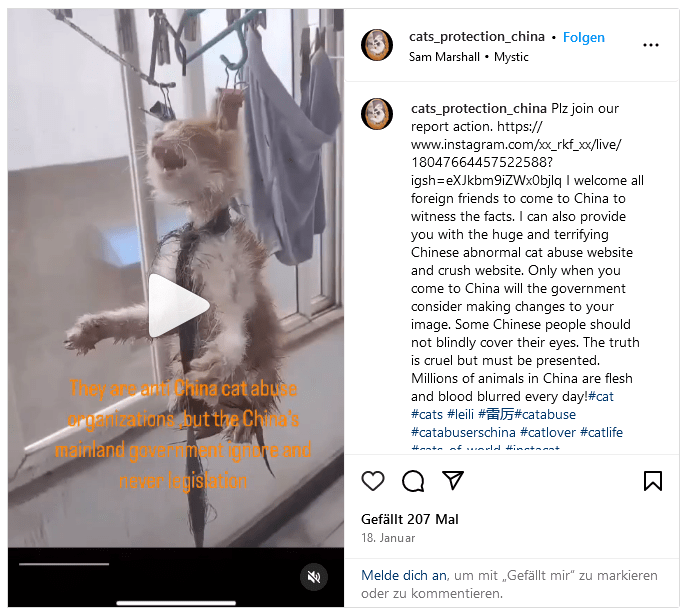
China: INVESTIGATION: Inside the sadistic world of the gruesome cat torture craze, campaigners call on Chinese authorities to act NOW. – World Animals Voice

EXPOSING AND COMBATING CAT TORTURE NETWORKS. 6/1/24. – World Animals Voice

China: Cat Torture Actions Follow Up – No. 1 – World Animals Voice

China – Cat Torture – Major Information and Actions – Follow Up No. 2 – World Animals Voice

New – A new Chinese cat torturer is identified and exposed:

Vote for Animals: placing animal welfare at the heart of the EU Elections.

1 February 2024

Press Release

The Vote for Animals campaign, launched by Eurogroup for Animals, aims to place animal welfare at the core of the upcoming EU Elections. The campaign encourages candidate MEPs to take a pledge for the animals, while informing citizens about the importance of these elections for progress on animal welfare in the EU, helping them to choose candidates that share their values and encouraging them to vote.

Candidate MEPs are being encouraged to sign a pledge stating a clear commitment to work to improve animal welfare if they are elected to the European Parliament (EP). The pledge, composed of ten asks, addresses live animal transport, imports of animal-based products, welfare of aquatic species, non-animal science and the conservation of wild animals, among others.

By taking the pledge, candidates commit to represent EU citizens’ demands for better animal welfare legislation. European citizens have been very vocal in demanding the EU to do better for animals. Six of ten successful European Citizens Initiatives are related to animal welfare, of which 1.5 million citizens have asked for a Fur Free Europe, and 1.4 million asked for a transition to cage-free systems. The last Eurobarometer, showed that over nine in ten Europeans believe that it is important to protect the welfare of farmed animals, while an overwhelming majority expressed the importance of better protection of kept animals during their entire lifetime.

Elected MEPs have the competence to drive animal welfare issues forward, by working to ensure it remains a priority on the EU agenda, being vocal on issues that need addressing, and voting in the interest of animals. During the current term, a significant number of MEPs have brought to light critical issues including the delay in the publication of the animal welfare legislation, the horrific nature of live animal transport and fur farming.

Elected representatives also have the opportunity to join the Intergroup on the Welfare and Conservation of Animals, which provides a cross-party platform for MEPs to discuss and exchange views on animal welfare issues and to initiate and promote related  initiatives  in the EP. 

The Vote for Animals campaign page is translated in all official EU languages, and citizens are encouraged to send a message to their representatives, asking them to sign the pledge. 

MEPs can serve as catalysts to push for better animal welfare legislation. The Vote for Animals pledge is our commitment to do our utmost to make sure the European Commission comes forward with ambitious legislation on critical issues that need much attention. If I am given the trust by the public, I promise to continue to place these issues at the core of my work, representing the demands of citizens to do more in this aspect. I encourage other candidate MEPs to take the pledge.

Niels Fuglsang, MEP (S&D, DK)

With so many EU citizens asking for more action on animal welfare, the European Parliament must be representative of these interests, to drive forward much-needed progress. This campaign provides both citizens and MEPs the opportunity to shape an institution that keeps animals at the core of their work.

  • Reineke Hameleers, CEO, Eurogroup for Animals

Elections

EU: EFSA stakeholder meeting on fur farming: first step towards ban?

23 January 2024

Under no circumstances can the welfare of animals in fur farms be protected, and a full ban is the only way forward, Eurogroup for Animals argued in the first stakeholder meeting of the European Food and Safety Authority (EFSA) to evaluate current practices on fur farms.

EFSA hosted the first stakeholder meeting to evaluate the current practices on fur farms, after it was asked by the European Commission (EC) to put forward a scientific opinion in reply to the Fur Free Europe European Citizens Initiative (ECI), in which 1.5 million citizens asked for a ban on fur farms and placement of fur products in Europe. 

In its official reply to the ECI in December, the EC mentioned a possible prohibition of fur farming and placement of farmed fur products on the European market, following EFSA’s opinion, which is to be put forward by March 2025. The technical meeting involved participation of representatives of animal protection NGOs, academics and the fur industry.

Scientists representing the fur industry openly admitted that the ‘Welfur’ certification system has evident shortcomings and questioned the fact that it has failed to identify inadequate conditions on fur farms in Europe. 

While the EC asked EFSA to “assess whether these welfare consequences can be prevented or substantially mitigated under current farming conditions”, animal protection NGOs stressed, once again, that EFSA’s opinion should start from the animals’ specific needs, as opposed to the infrastructure of the system, as scientific studies have consistently concluded that no level of cage enrichment can maintain animal welfare.  

It is difficult to assess positive welfare in a system which removes the agency of animals to act on their natural behavioural urges, such as foraging, seeking shelter or other natural motivations.

If we genuinely intend to discuss animal welfare, the species-specific needs of animals should be the only starting point to determine if and how we should continue keeping and killing sentient beings for commercial purposes.

Nicholas Clark, Wildlife Programme Leader, Eurogroup for Animals

There are inherent problems in fur farming that simply cannot be resolved. The fur industry’s so called ‘certification schemes’ mislead consumers, and are designed to reward the status quo. There are no changes that can be made – the welfare of wild animals on fur farms is severely compromised across all five domains, resulting in a life not worth living.

Mark Glover, Director, Respect for Animals

Around 7.7 million animals are currently kept and killed for fur production in the European Union. 20 Member States have already totally or partially banned fur farming, or implemented stricter measures on grounds of animal welfare, environment and public health.

While the fur industry has made an open invite to the European Commission to visit fur farms, Eurogroup for Animals stresses that any visits must be unannounced and randomly selected.

Regards Mark

Keep Fur Where It Belongs !!
USA: Iditarod Is Due To Start Very Soon – 39 Days To Be Exact – Take Action For Dogs NOW. – World Animals Voice

USA: Breaking News – County Officials Announce Intent To Shut Down Hellish Miami Seaquarium. – World Animals Voice

UK: Celebrity Stephen Fry Gives His Full Support To Welfare Campaigners Who Call For Bearskin Hats To Be replaced With Fake Fur.

We say – Leave the fur on the Bears; not on Guards hats !

Photo – Getty Images.

Our recent post on this issue:

UK: Leave the Fur On The Bears; Not On Guards Hats !! – Ministry of Defence (MoD) Still Refuses To Stop Killing Despite Faux Fur Now Available That Meets MoD Standards. – World Animals Voice

It is excellent that Stephen wants to now support the campaign to stop guards using real bear fur in their hats.

For non UK residents; Stephen Fry is primarily a television actor and celebrity; but also a broadcaster and writer, as well as being an incredibly intelligent man who has hosted a television show called ‘QI’ which has run for years and asks celebrities about different issues – take a look as he (quizmaster in middle with yellow tie) attempts to keep the rest of the celebrity rabble in order; and seriously fails !!

And now Stephen Fry wants King’s Guard to ditch bear fur in support of the bears and animal welfare campaigners who have campaigned about this for years.

Stephen Fry has called for an end to the use of real fur in the bearskin caps worn by the King’s Guard on duties such as guarding Buckingham Palace.

The actor has backed an animal welfare campaign calling for fake fur to be used rather than real bear fur.

Quite a big story from the BBC; read it in full here:

As campaigners we very much welcome the support given by Stephen – now this issue for many years may move on more with celebrity backing.

We say – Disgusting that beautiful bears are still being killed for soldiers hats. Ministry of Defence (MoD) you have a real fight on with us all now !

Regards Mark

See him on television:

Thanks to Diana for supplying the BBC link.

UK: Leave the Fur On The Bears; Not On Guards Hats !! – Ministry of Defence (MoD) Still Refuses To Stop Killing Despite Faux Fur Now Available That Meets MoD Standards.

The King’s Guards are still donning Canadian bearskin caps as ‘greenwashing’ defence officials have used a ‘meaningless’ ethics scheme to ignore suitable faux fur options, animal rights campaigners have claimed.

The Ministry of Defence, who pledged to drop fur once an alternative was found, have now revealed their use of a controversial fur industry marketing scheme to justify the continuing use of fur in the uniform.

People for the Ethical Treatment of Animals (PETA) have accused officials of using ‘Furmark’ a scheme branded ‘meaningless’ by former British Fur Trade Association CEO Mike Moser – ‘Luxury faux fur manufacturer ECOPEL has created the world’s first faux fur that looks identical to the animal-fur cap and is easily rendered 100% waterproof. It has met all of the MoD’s requirements. We urge for the MoD to adopt the new caps.

‘We believe there is no justification to continue using the fur of Canadian black bears for the ornamental caps, when an excellent alternative exists.

‘They cost the taxpayer hundreds of thousands every year and using real fur conflicts with public opinion on this issue.’

Luxury faux fur manufacturer ECOPEL has created the world’s first faux fur that looks identical to the animal-fur cap and is easily rendered 100% waterproof. It has met all of the MoD’s requirements. We urge for the MoD to adopt the new caps.

Read more:

Fur flies as animal rights activists accuse King’s Guards of ‘greenwashing’ | Daily Mail Online

Pathetic – Yes they still use the skins of real bears for the hats !

Regards Mark

Fur Free Europe ECI: Pending EFSA Opinion Too Far Away Fur Farms in Europe Could Finally Be Banned (sometime, if ever ? !!) – Read On – Disgusting.

WAV Comment – Here we go again; the gutless, spineless and many other ‘less’ European Commission fails to make a decision; and instead passes the buck over to the EFSA to undertake a ‘scientific opinion’ on the subject. The evidence is there – https://worldanimalsvoice.com/?s=fur – how much longer do we have to wait for opinions to tell us the bleeding obvious ???

So now what ? – ‘after evaluation of the EFSA opinion to be put forward by March 2025’. 2025, that equals another 18 months of animals being subjected to on going abuses on fur farms – https://worldanimalsvoice.com/?s=fur – before any wind down period is even started to be enforced. So how long in reality ? – 2030, 2035 ?? !!!

This gives full justification to the fact that the European Commission is nothing but an un elected body of complete and utter nothing who individually can do nothing, and then together decide that nothing can be done.

Mark

7 December 2023

Press Release

Fur farming and the placement of farmed fur products on the European market could finally be banned by EU law, but the European Commission (EC) failed to take a decision, instead opting to first await a scientific opinion by the European Food Safety Authority (EFSA).

The communication published by the European Commission comes in response to Fur Free Europe, in which more than 1.5 million citizens called on the EU to ban fur farming and the placement of farmed fur products on the European market once and for all.

The reply mentions a possible prohibition of fur farming and placement of farmed fur products on the European market, or alternatively other measures, after evaluation of the EFSA opinion to be put forward by March 2025.

The request for an EFSA opinion comes despite the fact that there is already a vast body of scientific evidence that concludes that the housing system in fur farms, cannot under any circumstances, meet the needs of species kept and killed for fur.  

However, we (not WAV) welcome the news of a consideration of a ban, and trust that the scientific opinion will reinforce the well-established scientific basis. 

While the Commission asked EFSA to “assess whether these welfare consequences can be prevented or substantially mitigated under current farming conditions”, the opinion should start from the animals’ specific needs, the main premise of this citizens’ call, as opposed to the infrastructure of the system, as several studies have concluded, consistently, that no level of cage enrichment can maintain animal welfare

Moreover, the mentioned EFSA mandate appears focused on the four main species kept and killed on EU fur farms: mink, foxes, raccoon dogs and chinchillas, while the ECI Fur Free Europe calls for a ban on keeping and killing all animals only or mainly for the purpose of their fur, regardless of the species. 

In conjunction with an EFSA opinion, the EC will evaluate several other areas which are impacted by the practice of fur farming, namely public health, environment, social, legal and economics. This comprehensive assessment will be conducted by March 2026, when a final decision is expected to be communicated.

The EC also plans an evaluation and assessment on the revision of the Textile Labelling Regulation, including a public consultation. Adopting labelling rules for fur products does not, in any way, catalyse any difference for the way animals are raised on fur farms and should not be considered as a solution to the welfare problems on fur farms. 

Since its peak in 2014, the fur industry in Europe has been in constant decline.

In 2022, around 8.5 million animals were kept and killed for fur production in the European Union. 20 Member States have already totally or partially banned fur farming or implemented stricter measures on grounds of animal welfare, environment and public health. The call to ban fur farms in the EU has been supported by MEPs from all political groups and Member States joined the call at the Agriculture and Fisheries Council (AGRIFISH) in 2021 and 2023.

Above – Fur Killing Boxes; Denmark.

It is disappointing that the European Commission failed to take a decisive decision today, while millions of animals keep suffering while this horrendous practice continues to be legitimate in a ‘progressive’ Europe. The welfare of animals on fur farms cannot be improved, and the only option is a full ban, as asked by more than 1.5 million citizens, and reflected in the decision of many Member States.

We trust that the EFSA opinion and the whole evaluation will reflect this, and that we will see a full prohibition, sooner, rather than later.

Reineke Hameleers, CEO, Eurogroup for Animals

Regards Mark

NO less than 57 animal rights organisations have for the first time made an official complaint to the European Ombudsman.

Animal rights organisations register European complaint (euroweeklynews.com) 

NO less than 57 animal rights organisations have for the first time made an official complaint to the European Ombudsman.

Basis of complaint

This complaint concerns the European Commission’s failure to fulfil its commitment to a European Citizens’ Initiative in which 1.4 million people demanded a ban on the cages used to house a number of different domestic animals.

In its response to the European Citizens’ Initiative published in June 2021, the European Commission confirmed that, by the end of 2023, it would present a legislative proposal to phase out and eventually ban the use of cages for chickens, calves, rabbits, ducks, breeding sows and other species.

The reason for this complaint is that the most recent agenda for the rest of the political legislature was missing the Regulation on Captive Animals, which the plan should have included.

According to one of the complainants, Spain’s AnimaNaturalis, before backtracking on its promise, the EC repeatedly confirmed that it was working towards the 2023 timeline, and Health and Food Safety Commissioner Stella Kyriakides made multiple public mentions of this date in EC responses to questions.

“ The EC has not acted in accordance with the rules governing European Citizens’ Initiatives after raising legitimate expectations among European citizens. These deficiencies present a case of maladministration, both in light of the EU Regulation and the very reason for being of the European Citizens’ Initiatives as an instrument of transnational democracy,” observed Cristina Ibáñez, lawyer and spokesperson for AnimaNaturalis .

Should fur be banned?

In addition to the cages, 1.5 million people also requested a ban on the fur industry and the marketing of fur products on the European market which legislation was expected to have been included in the Regulation on captive animals.

While regulation to phase out cages remains pending, an estimated 700 million farm animals continue to suffer in cages in Europe according to the complainants.

Regards Mark

EU: Wake Up Commission ! – The Figures Are Here – Special Eurobarometer on animal welfare: EU citizens give strong impetus to deliver all animal welfare legislation.

19 October 2023

Press Release

A new barometer on animal welfare shows an overwhelming majority of European citizens who demand better EU legislation that truly protects animals, with over nine in ten Europeans stating that it is important to protect the welfare of farmed animals, and an absolute majority deeming it very important. More than eight in ten Europeans believe that farmed animals in their countries should be better protected than they are now. These results should prompt the European Commission to follow through on its commitment to deliver all the proposals to revise the EU animal welfare legislation as promised.

The much awaited special Eurobarometer on Attitudes of Europeans towards Animal Welfare has finally been published today. The poll surveyed 26,376 citizens across all member states between 2 and 26 March 2023, and acts as an official tool that is used to advise the EU institutions when drafting reports and legislations.

The results confirmed the strong support from EU citizens towards animal welfare, confirming the previous survey from 2016, which had also sent a very strong message for the EU to better protect animals. 

Highlights from the survey:

Over 90% of Europeans consider that farming and breeding practices should meet basic ethical requirements, while two-thirds of respondents said that they would like to have more information on the conditions in which farmed animals are raised.

Nearly six in ten Europeans (57%) said that fur farms should be banned in Europe, in line with the 1.5 million citizens who made this call in the successful Fur Free Europe ECI 

Over nine in ten Europeans believe that farmed animals should have enough space to be able to move around, lie down and stand up, with 89% saying that animals should not be kept in individual cages, supporting the call by 1.4 million citizens who asked for a ban on cages. Currently in the EU, over 300 million farmed animals spend their lives confined in cages, which cause them immense suffering.

Nearly nine in ten Europeans (88%) said that it is important to improve the welfare of animals in slaughterhouses. 

89% of Europeans favoured a ban on mutilations, a practice that is still very common in the EU, despite the pain it causes. 

Three quarters of respondents found the practice of killing male chicks after birth to be unacceptable. In addition, eight in ten Europeans believe that ensuring sufficient skills and training in people handling animals is important.

On the issue of live animal transport, which the EC is expected to propose a revision on, 83% of respondents think that the travel time for the transport (for ‘commercial purposes’) of live animals within or from the EU should be limited.

When it comes to food imports from non-EU countries, over eight in ten Europeans (84%) believe that the current animal welfare situation should change, either by imposing import requirements or a very strict labelling system. 

60% of the respondents indicated that they would be willing to pay more for products sourced from animal welfare-friendly farming systems, despite the survey being carried out during high inflation periods.

74% believe that the welfare of companion animals should be better protected, and over eight in ten respondents said that good welfare conditions for horses, cats and dogs bred for commercial purposes is important.

These results come at a time when the European Commission comes under fire for failing to uphold its commitment to deliver the full proposals to revise the EU animal welfare legislation, and backtracking from its promises as part of the Farm to Fork Strategy.

The support of EU citizens for better animal welfare is enormous, with this Eurobarometer once again they made a clear call for better protection for animals on all fronts. We urge the European Commission to listen to this loud and clear message and come forward with a solid commitment and timeline for the Kept Animals and Slaughter Regulations

Reineke Hameleers, CEO, Eurogroup for Animals

Regards Mark

EU: Hopefully Positive – Clear call from MEPs in plenary: Fur Free Europe now.

Clear call from MEPs in plenary: Fur Free Europe now

19 October 2023

Photo – Jo Anne McArthur – We Animals.

MEPs from all political groups called for a full ban on fur farms and on the placement of farmed fur products on the European market at today’s European Parliament Plenary in Strasbourg.

A large number of MEPs from across the political spectrum called on the European Commission (EC) to respect European citizens’ demands from the Fur Free Europe European Citizens’ Initiative (ECI) and end this unnecessary, unethical and obsolete practice.

An official reply to the ECI is expected from the EC by the end of the year.

More than 1.5 million EU Citizens have asked for a ban on fur farms and on the placement of farmed fur products on the EU market, in one of the most successful ECIs on animal welfare. 20 Member States have already totally or partially banned fur farming on grounds of animal welfare and public health.

23 MEPs directly called for the ban on fur farms, stressing the immense suffering to animals: 37 million animals are killed in Europe each year for the sole purpose of fur production, which they called ‘unnecessary’.

An overwhelming majority of MEPs stressed that the EC simply cannot ignore the democratic call of the citizens, arguing that the time to end this practice is now and that the EU cannot remain silent and continue to ignore the cruelty of fur farms.

Numerous MEPs also brought up the severe threat that fur farms pose to public health, making reference to recent Covid-19 and avian influenza outbreaks, while they highlighted the serious consequences that fur farming has on biodiversity. 

Fur farming is unethical, a useless impractical practice that causes lifelong suffering in small cages. We hope the EC brings up a ban on production and imports. Tomorrow should be better than today.

Sirpa Pietikainen, MEP (EPP)

If it matters to Europeans, it matters to Europe. But what does this mean if the EC does not honour its own pledge, and act on the call of millions of Europeans. We need to ban the import of fur to prevent suffering elsewhere. How can we in Europe remain silent? Animals don’t deserve this. Citizens don’t want this. Will the Commission finally take the lead and show that it takes citizens’ initiatives seriously?

Anja Hazekamp, MEP (The Left)

We can no longer ignore the cruelty of the fur farming sector and the risks for public health. The pollution is immense, while it poses a risk to ecosystems. We say yes to a future with a fur free world.

Leszek Miller, MEP (S&D)

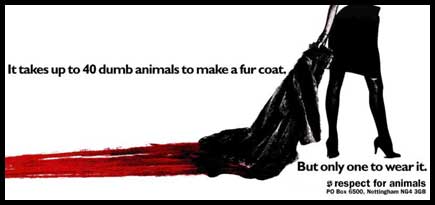
60 minks to be slaughtered for a single coat… 200 chinchillas… This is perverse and despicable that so many animals have to be killed for the sake of fashion.

Maria Noichl, MEP (S&D)

The time has come to end the infliction of suffering on these animals. This type of rearing of animals is in direct contradiction to animal welfare. It is unethical, unsafe and unsustainable.

Laura Ferrara, MEP (non-attached)

We cannot allow this to continue anymore. Breeding animals for their fur is unacceptable. What is the added value? How does this contribute to the wellbeing of society? This practice belongs in the past. We have to end this madness in which animals are being treated as objects.

Isabel Carvalhais, MEP (S&D)

Regards Mark