Three of the UK’s biggest supermarkets are sourcing chickens dosed with antibiotics by a poultry producer in Poland linked to the spread of deadly superbugs.
An investigation by ITV News, The Bureau of Investigative Journalism, and The Guardian has discovered Asda, Iceland and Lidl are buying frozen chicken products from SuperDrob – a major European meat supplier – who we’ve discovered was the source of an outbreak of antibiotic resistant Salmonella in the UK and Europe in 2020, which killed five people and infected around 1,300 others.
A letter obtained via Freedom of Information request from the UK’s Chief Veterinary Office Christine Middlemiss to her Polish counterpart in December 2020 stated her investigations “have now firmly linked the outbreaks with frozen, raw breaded chicken products imported from Poland, and to a specific poultry production company in Poland”. SuperDrob is then named in the letter as the company.
Two and half years on, we carried out tests of waste samples collected from different poultry farms in different locations in Poland which produce chickens for SuperDrob, to see if antibiotics are being given to the chickens. The results indicated they are.
The samples tested positive for bacteria – including E. Coli, a source of food poisoning in humans – resistant to fluoroquinolones, the same group of antibiotics used in humans to treat life threatening infections.
The tests were carried out at the University of Oxford by Professor of Medical Microbiology, Tim Walsh and his team. He told ITV News it is “extremely concerning” that the same antibiotics used to treat sickness in human beings are still being used in animals.
“There is a direct link between the use of antibiotics in farms and the resistance that occurs, and then what happens in the human population,” he said.
“We found enrofloxacin resistance, which would then give resistance to a drug that is a very similar drug we use in humans called ciprofloxacin. So, the use of enrofloxacin on the farms would actually mediate resistance to a human antibiotic, which is really important.
“We know that this shouldn’t be happening but regrettably it seems to continue.”
The samples also tested positive for colistin; an antibiotic of last resort used to treat very serious infections in humans.
“Colistin should be banned for use in animals per se,” argues Professor Walsh.
He likened the rise of antibiotic resistance to the whole human race “staring down the barrel of a gun”, or “a slow tsunami coming towards us.”
The World Health Organisation has declared antimicrobial resistance a top global public health threat, directly killing more than 1.2 million people and associated with five million deaths in 2019.
The United Nations estimates up to ten million deaths could be caused by superbugs and associated forms of antimicrobial resistance by 2050, matching the annual global death toll of cancer.
As a result, the use of antibiotics in farming is subject to strict rules.
Last year the European Union banned the excessive and routine use of antibiotics in farm animals as compensation for unhygienic cramped conditions where diseases like salmonella and E. coli can easily spread, often on factory farms.
The new regulations mean that only sick, individual animals may be administered antibiotics.
SuperDrob told us antibiotics are used in their chickens, and the company does not deny using the same groups of antibiotics used to treat human infection.
A spokesperson said: “SuperDrob has imposed a reduction policy of a minimum of 10% year-on-year, with a view to phasing out the use of enrofloxacin and colistin in poultry treatment by the end of 2025. This policy was initiated in 2020 and SuperDrob has achieved at least the minimum reduction each year.
“Antibiotics are only used in SuperDrob’s farms or in the farms of its suppliers when (1) recommended by a veterinarian, and (2) justified by presence of a disease and where administration of antibiotics would achieve therapeutic success. The whole treatment process is recommended, supervised, and coordinated by the Government veterinarian based on knowledge, case analysis, results of testing.”
SuperDrob declined to comment on the salmonella outbreak in 2020.
It’s much more difficult to BE harmed than to NOT harm …
JUNE 19, 2023
The “veganism is hard” is a myth started by the anag (animal agriculture) industry to continue indoctrinating a willfully ignorant billions-large population of humans who choose to participate in incalculable animal suffering. The “intellectually superior” humans desperately want to believe that violently using, commodifying, and killing animals is “humane” or “ethical” or based on “welfare” when there is nothing more humane, ethical, and true to welfare, than NOT exploiting animals. (And the same “intellectually superior” humans are unable to tell the difference between plant-based milk and milk stolen from suffering animals … )
Facts, not myths:
You cause animal suffering that you can EASILY not.
Harming animals does not benefit animals.
The actual definition of “humane slaughter” includes minimizing “unnecessary pain”, which basically establishes that “necessary pain” is inherent.
I’m still waiting for someone to share their “humane slaughter” footage that demonstrates animals willingly and peacefully being violently killed.
… and if you need to trivialize the exploitation of animals, exploitation that is ALL inherently abusive, as “humane/ethical/harvest/process/welfare/regenerative/etcetcetc”, you are euphemizing for YOUR comfort, not animals’ comfort: animals don’t benefit from human words that still require their suffering and violent death.
God did not give animals the capacity to suffer, experience pain and terror, and the desire to NOT want to die and then will humans to cause such, but God DID give humans plants to eat in Genesis 1:29, so why blame God for your faults? Why do so many “christians” choose to believe in an evil and malevolent god that demands the violent butchering of trillions of animals EACH YEAR?
If you think it’s ok to abuse animals because some humans have abortions, you’re neither concerned with animals NOR humans beyond the fetal stage.
Lions, and other predators, exist in a state of survival with no other choices. Humans do not and have. (And interestingly, the females – lionesses – do most the hunting, not the males.)
Cow abusers are always so quick to say that cows are happy to be milked (versus the need for relief, fear of punishment, or habit) but who experience zero emotion when being violated and killed.
My plant-based food does not require any disingenuous “humane” labels because plants are incapable of suffering.
Nobody grows crops JUST for vegans; animal consumers eat crops as do their animal victims.
Vegans minimize harm inflicted on animals. Animals are not required to die for crop harvesting. In a “vegan world”, crop casualties would diminish or be eliminated altogether.
84% of people were predominantly OMNIVORES; of the TOTAL 1313 participants, only 183 consumed a plant-based diet (for a study of “dietary habits” and NOT veganism) and the rest were vegetarians, ie., omnivores. In other words, 84% of mostly omnivore people on a diet, went off a diet.
But it’s vomitous that non/antivegans experience joy and fulfillment in what they believe to be maximum animal suffering.
Antivegans (subhumans who focus on and condemn vegans and NOT animal abuse), including carnivores and fake doctors, all of whom deceive and manipulate and that desperately need to co-opt “vegan”, are motivated by hatred, insecurity, and self-doubt because nobody is forcing you to NOT abuse animals.
The belief that you can abuse and kill animals is “privileged”.
Take PETA’s Cruelty-Free Shopping Guide along with you next time you head to the store! The handy guide will help you find humane products at a glance. Order a FREE copy HERE
Searching for Cruelty-Free Cosmetics, Personal-Care Products, Vegan Products, or more? Click HERE to search.
Free PDF of Vegan & Cruelty-Free Products/Companies HERE
I think that any of us in welfare who have been involved with live animal transport over one, two, or (in my case) around 40 years, we all know what a complete and utter farce the Regulation is for the ‘protection of animals during transport’ – Reg 1/2005 – EUR-Lex – 32005R0001 – EN – EUR-Lex (europa.eu) We know it well as part of our work, and yet despite overwhelming evidence and footage over decades showing endless suffering of animals during transport, and the non compliances with the EU legislation, the people in the EU who could change things just ignore and turn the other way.
The footage you see here from our friends at AWF is yet more examples of the EU gone wrong.
It has been time for change for decades; but now the EU Commission hopefully is really in last chance saloon. It happens all over the world, not just in Europe. The sooner we see legislators get off their butts and do something to actually protect animals in transport, is a day that cannot come soon enough. Until the ban the fight goes on; and the evidence continues to pile.
Mark
Photo – Mark
The Animal Welfare Foundation, released three reports on June 16 highlighting some of the horrific realities of the live animal transport industry. Coupled with their recent investigations into the sector, it’s clear change must happen – and that only the European Commission can bring on the scale of action needed.
The first report is concerned with which factors – including bedding, loading density, and distance – have the strongest impacts on the welfare of cattle during transport. It analyses 112 consignments of cattle on trucks that were inspected over a period of five years, between 2016 and 2021. Ultimately, their findings indicate that insufficient welfare provisions overwhelmingly impact an animal’s physical and emotional health, and can even shorten their lifespans.
The second report focuses on the long distance transport of lambs between the same time period. The findings are shocking – AWF records that out of the consignments they investigated:
100% had inadequate drinking devices for lambs
90% provided insufficient space for the lambs to move – in at least 44% of the vehicles, the space for each individual animal came only to 0.18m2
65% had issues that were likely to lead to injuries, such as sharp edges and loose dividers
At least 35% of the vehicles had been travelling for longer than permitted by law.
The third and final report follows a similar theme, and reports on the transport of unweaned calves between 2015 – 2021. As with lambs, it was found that the care these poor calves received was far from satisfactory, as in the consignments they investigated:
100% had inadequate drinking devices for unweaned calves
In at least 73%, animals were not fed after nine hours
At least 47% of the vehicles had been travelling for longer than permitted by law.
In both the second and third reports, AWF noted that well over half the animals being transported were showing acute signs of distress, including restlessness, biting and licking the metal bars they were trapped behind, and making loud noises.
Their insightful work makes the connection clearer than ever. The millions of sentient beings that are subjected to long journeys each year are not only being badly taken care of, but they are sensitive to the conditions in which they are transported as well. Measures must be taken to ensure these sentient beings are given adequate space to move, access to clean water, good nutrition and a comfortable environment to make these journeys as stress-free as possible.
Recent investigations by the Animal Welfare Foundation also stress the urgency of new live animal transport rules
Earlier this year, the Animal Welfare Foundation released heartbreaking footage of the journey of some young calves, which they followed from the Czech Republic to a fattening farm in Spain.
Their footage shows that these poor infants were starved for hours, and one calf in particular, which they named Marek, was not even able to get a quick drink of water.
Also this year, AWF’s investigative team intercepted trucks carrying lambs to Italy for Easter – resulting in over 20,000 EUR worth of fines for transport companies which were caught violating the EU’s transport legislation:
All the evidence points to a critical need for the European Commission to take action
AWF’s illuminating work complements a range of scientific evidence published by the likes of EFSA and the European Court of Auditors already that points to the necessity of better animal welfare provisions being made for animals that are transported.
The European Commission must use this wealth of information and data to make dramatic changes to this industry that causes so much suffering to millions of sentient beings each year. In particular, they must:
Ban ‘unfit animals’ from being transported, including unweaned animals and very young babies, like the lambs and calves recorded by AWF, for whom these journeys are even more difficult to bear
Place strict limitations on journey distances
Enforce any new animal welfare legislation written for live transport more effectively, to guarantee these stricter regulations are being followed.
It’s time for the welfare needs of transported animals to be honoured as seriously as they deserve.
We’re putting the spotlight on animal welfare this year through phase two of our No Animal Left Behind campaign! Learn more.
Eurogroup for Animals welcomes the recent vote in the European Parliament on the Commission’s proposal to strengthen geographical indications, a quality label for agricultural and wine products. The proposal identified that consumer concerns about animal welfare and sustainability are not adequately protected at present, which is welcome having in mind animal abuses previously denounced in the production of prestigious products like Parmigiano Reggiano or Jamon Serrano.
Last year the European Commission adopted a legislative proposal on revising the geographical indications scheme, aimed, among others, at strengthening the sustainability dimension of said scheme, notably by laying down requirements in light of the growing integration of these issues in GI value chains, validating those producers who have already integrated sustainability actions into their product specifications.
The amendments supported by the Parliament deviate from the Commission’s proposal in advantageous ways, notably by including language on animal welfare that was not originally present. Most notably, it expands the scope of EU rules that GI producers must comply with to include animal welfare and environmental rules, and specifies that compliance should be verified through appropriate controls.
The EU register of GIs currently contains almost 3500 entries, with a sales value of €74.8 billion, and the system is recognised worldwide as representing the excellence of the EU’s agri-food sector. Increased attention to animal welfare is therefore essential to protecting the quality of GI products.
While GIs are commonly viewed as high quality by consumers, many producers do not currently respect even the EU minimum animal welfare standards. Indeed, investigations into GI products have uncovered illegal practices, such as brutal violence on farms breeding pigs for Parma Ham (Essere Animali, 2018 investigation), cows farmed to produce Parmigiano Reggiano unable to graze on pasture (Compassion in World Farming, 2017 investigation), and dead calves and serious hygienic/sanitary neglect on farms producing Grana Padano (Essere Animali, 2021 investigation).
Eurogroup for Animals will follow this process, to ensure the schemes referenced in the legislation are appropriate and to avoid it leading to humane washing.
Like me, you’ve probably been horrified by images of New York lost in toxic smog and thousands of people left homeless by flooding in Italy.
As a Greenpeace supporter, you know how vital it is that we stop the fossil fuel industry decimating our future. That means getting the message out to everyone; young, old and from every walk of life.
So we’re releasing a song and short film – a remake of Fleetwood Mac’s Don’t Stop, made in collaboration with some of the best in the music and film industry. This is not your typical charity song. It’s a call to arms, an impassioned plea to take action today, for the sake of tomorrow.
Don’t Stop shines a light on the fight of our lives – to save our planet from climate breakdown. It exposes the grotesque behaviour of oil companies enjoying record profits while our world burns. But ultimately it is a story of hope: it points to the power in all of us to stop this madness.
I hope and believe this project will get people fired up, inspired and kick loads of people into taking on the oil industry. Can you take a short moment to watch the film and then to share it with your loved ones, so lots more people can see it?
Our message is clear – the fossil fuel party is over. It’s time to clean up. We need more people to hear this message and put pressure on our political leaders. Our politicians need to feel the heat so that they can finally stand up to climate wrecking oil companies.
In the words of Executive Producer Steve McQueen, “we have collective power to realise a different future. It’s imperative that people don’t forget, tomorrow is promised to no-one.”
Will you take a short moment to share it with your friends? I’d love to know what you think
Surprisingly, (global warming unfortunately), it has been very hot and dry for several week now; not a drop of rain here in the South East at all; although up the road in London there have been severe thunderstorms causing trouble.
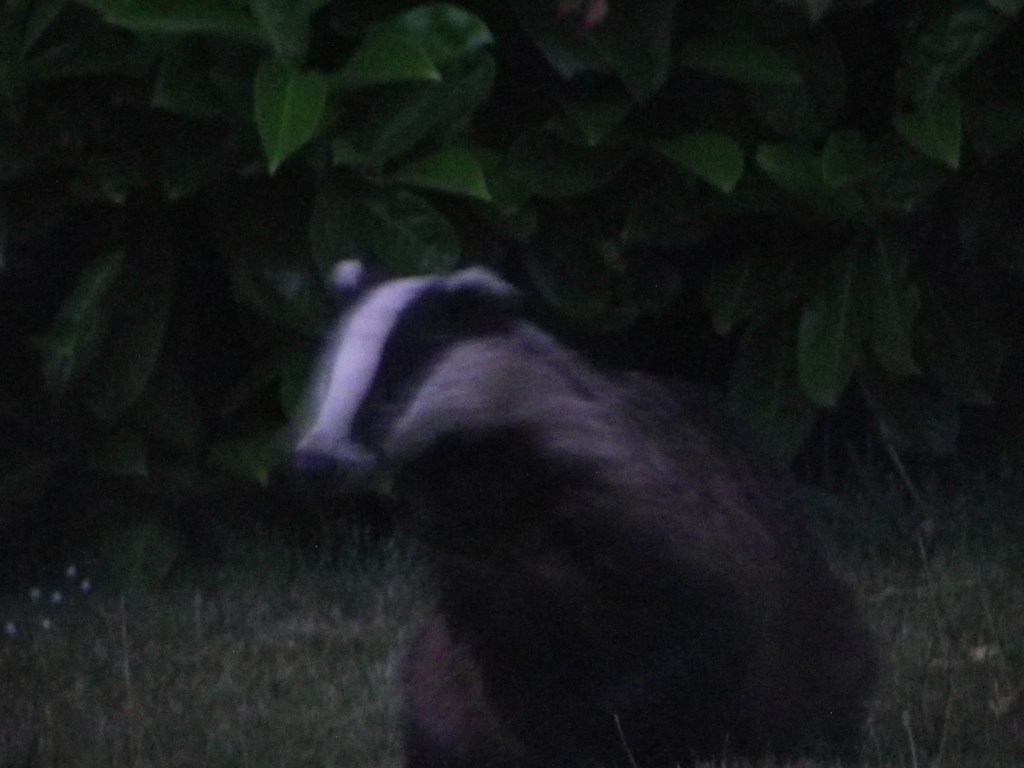
Anyway, cut to the chase; we get badgers visit every evening for a good scoff on things we put out for them. The main diet of badgers is primarily earthworms, which normally they would forage for in the damp or wet soil. But as I say, conditions now have been hot and dry for weeks; so our little friends need a tiny amount of help to get through the dryness. I think word has spread around the sett that there is plenty of tasty fruit (and more) up in my garden. We get 4 o5 5 turn up each night now, normally as a group, as if they are going on a day trip or something !
It is wonderful to see them all on the lawn eating.
So now they are being given loads of ‘wet’, tasty fruit(s) to keep them hydrated and get them through the day; in addition to a large water trough which they can always drink from if necessary – cut up apples, masses of tasty grapes; diced up plums and the usual of cheese nibbles and some smashed up biscuits; some with a little chocolate on.
I am really pleased to welcome them into the safety or my garden every night for a good ‘moisture meal’. Even at dusk you can still see them running around as their fantastic black and wite heads give a hint as to where they are.
So; fight the cull; if you want to cull anything then can I suggest a start of the human race and many politicians; although I know there are several doing their bit for animals; they are not all the same
Eurogroup for Animals welcomes the update to the OECD Guidelines for Multinational Enterprises, which for the first time includes an explicit mention of animal welfare.
On 8 June 2023, the OECD released a “targeted update” of the OECD Guidelines for Multinational Enterprises on Responsible Business Conduct, which for the first time calls on businesses to uphold animal welfare in their policies and practices. The guidelines, which are regarded as a global benchmark for ethical business practices, could have far-reaching positive implications for animals across the 38 member countries of the OECD.
Unlike the 2011 Guidelines, which did not discuss animal welfare, the updated Environment chapter calls on enterprises to respect international animal welfare standards and describes “good welfare” as requiring, among other things, that the animal is healthy, comfortable, and well nourished, provided a stimulating and appropriate environment, ensured humane handling, and subjected only to humane slaughter or killing:
85. Enterprises should respect animal welfare standards that are aligned with the World Organisation for Animal Health (WOAH) Terrestrial Code. An animal experiences good welfare if the animal is healthy, comfortable, well nourished, safe, is not suffering from unpleasant states such as pain, fear and distress, and is able to express behaviours that are important for its physical and mental state. Good animal welfare requires disease prevention and appropriate veterinary care, shelter, management and nutrition, a stimulating and safe environment, humane handling and humane slaughter or killing. In addition, enterprises should adhere to guidance for the transport of live animals developed by relevant international organisations.
While animal welfare has not consistently been considered a Responsible Business Conduct (RBC) issue, the new additions make clear that respecting animal welfare is part of due diligence and necessary to ensure RBC. The text allows civil society to file complaints via National Contact Point (NCP) mechanisms and engage directly with enterprises regarding their failure to ensure, through due diligence, good animal welfare for animals in their value chains. This marks a significant improvement on the previous Guidelines and we are grateful that civil society had the opportunity to provide input during the public consultation phase.
Nonetheless, the language on animal welfare leaves some room for improvement. First, the guidance to align with WOAH standards is disappointing, given that these are often much less ambitious than EU welfare standards. Further, in emphasising the necessity to comply with existing laws and regulations, the guidance overlooks the need to proactively minimise potential harms. Also, there is nothing about the need to strive for a good quality of life for animals, nor to decrease the amount of live animal transport journey time. The OECD is therefore urged to issue improved guidance moving forward.
This update is also highly welcome as it coincides with the preparation of mandatory due diligence legislation in the EU, which draws partly from the OECD Guidelines. The EU legislation will seek to embed sustainability in global value chains by ensuring EU companies identify, prevent or repair environmental and/or human rights adverse impacts. However, the legislative proposal makes no reference to animal welfare at present. Eurogroup for Animals therefore calls on the Council and the European Parliament to remedy this omission in the wake of this update, and to include robust and explicit language on animal welfare during the trilogue stage.
Around 1.5 million farm animals undergo long and gruelling journeys from Europe to other countries each year. Transported via land and sea, these poor sentient beings have few rules in place to ensure their welfare, especially when they are exported to countries outside the EU’s scope. Affecting so many species and in such great numbers, it’s vital the European Commission puts the live animal transport industry under the microscope while revising the animal welfare legislation.
In the best case scenario, the European Commission should aim towards phasing out live animal transport entirely – substituting it for a meat and carcasses trade, so that no animals should be forced to endure difficult journeys that are innately abnormal for them. At the very least, they should enforce much stricter laws within the sector to ensure these animals experience the highest possible welfare standards during transportation. We dig into the issues a little more below.
Some quick facts about live animal transport in the EU
The below was taken from our 2021 white paper, ‘Live Animal Transport: Time to Change the Rules’. Download it here for more insights.
In 2019:
1,618,275,545 ovines, bovines, poultry and pigs were transported alive across the EU and from the EU to non-European countries
Poultry made up 98% of total live animal exports, which made them the most traded farm animal species. The top EU exporters of poultry were Poland, Hungary, the Netherlands and France
57,523 tonnes of fish was reported as exported alive from the EU, with 93% of these destined for other Member States
87,817 horses, asses, mules and hinnies were transported alive across the EU and to the rest of the world.
These are not small numbers. Changes to the laws surrounding live animal transport would affect millions of lives and most kept species, making it arguably one of the most important sectors for the European Commission to address in their ongoing changes to the animal welfare legislation, especially as…
The live animal transport industry is riddled with problems
This sector is not in a good state. Current laws for live animal transport are not strong enough or go far enough to protect all the animals that are transported annually. As of this moment, the industry:
Does not have any strict limitations on journey times: Which means animals can be transported for days – or even weeks – before they get to their destination. Can you imagine being hungry, thirsty, sleepless and stressed for this long?
Permits ‘unfit animals’ to be transported: This includes heavily pregnant and injured animals, as well as babies. These sentient beings feel the burdens of live transport even more heavily than their ‘healthy’ counterparts. Sometimes, even sick animals are subjected to these journeys as well, as they are not inspected properly before being loaded onto transport vessels – which poses a big risk to both the animals they are travelling with and public health
Does not have any control over what happens to exported animals: The European Commission cannot regulate what happens to animals once they are transported beyond the EU’s borders. As a result, millions of animals ‘disappear’ beyond the scope of our welfare laws, and become the victims of potentially horrific treatment
Does not enforce good welfare conditions for transported animals: There are currently few measures in place to monitor the welfare of transported animals, meaning there’s little knowledge of what really goes on in the sector. What’s more, there’s evidence these oversights are being exploited – recent investigations by our members Essere Animali and the Animal Welfare Foundation report animals being neglected, injured and malnourished during journeys this year.
Across the world, live animal transport causes countless tragedies
The past few years have played host to a number of awful incidents related to the live animal transport industry, too.
In 2020, the Gulf Livestock 1 vessel sank off the coast of Japan while travelling to China, taking around 6,000 animals with it.
Similarly two vessels bound for Turkey – the Karim Allah and Elbeik – ended up being stranded at sea for over three months in 2020, resulting in the deaths of hundreds of cattle. We worked with the Animal Welfare Foundation to produce a report on this incident, concluding the welfare of the animals on these ships was seriously compromised from the start.
Travelling via land or sea in boats, lorries and otherwise is in itself an unnatural experience for non-human animals – and in the worst cases, it can be fatal. The European Commission must do everything it can to reduce the stress, discomfort and fear these poor beings feel while being transported alive, as well as to mitigate the potential loss of life that can be incurred through long distance exportations. It’s the least they can do.
Official bodies agree the live animal transport industry cannot be ignored – and some countries are already setting the standard for change
In 2022, the European Food Safety Authority published their recommendations to improve animal welfare during live transport, which included shorter journey times and more space for the animals to move.
Even more recently, in 2023, the European Court of Auditors released a review on the transport of live animals, concluding structural changes to the industry and more notice of welfare provisions were much-needed.
We welcome this support from these official bodies to change live transport for the better – and in fact, a lot of what they recommend echoes the steps we laid out in our 2021 white paper to improve the standards in this sector. When it comes to exports in particular, however, the Commission should go even further – by banning live animal exports to countries outside the EU entirely. Live animal exports by sea have already been banned in New Zealand, and a trial court in Brazil opted to make a similar move earlier this year. A little closer to home, Luxembourg banned the export of live animals to third countries for slaughter purposes in 2022. As the welfare of exported animals outside Member States can’t be guaranteed, and the risks are greater during these longer journeys, a full ban on this type of transport is the only move that makes sense.
The European Commission must not miss this opportunity to reform live animal transport for the better
This is a critical year for kept animals, as the European Commission continues to revise its animal welfare legislation. The only way for them to show they’re taking higher animal welfare standards as seriously as they deserve, however, is to make bold and enforceable changes to the laws related to live animal transport: an industry which influences the fates of so many sentient beings, and therefore wields enormous power over their welfare as a whole. Will you tweet in support of better animal welfare standards for all?
We’re putting the spotlight on animal welfare this year through phase two of our No Animal Left Behind campaign. Find out more about how we’re trying to change history for animals.














 World Animals Voice