Category: General News

Rescue the abandoned dog with duct tape around its mouth wandering around and unable to eat or drink.

Rescue the abandoned dog with duct tape around its mouth wandering around and unable to eat or drink

You can see just by the amount it drinks that it must have been suffering terribly – Mark


Hello all of you! In Vietnam, many people eat dog meat. People keep dogs to protect their homes and eat them Many people raise them and sell them to the slaughterhouse for money. On our way to the patrol residential area, we discovered and rescued them from being sold into the slaughterhouse. But those are the few that have been rescued, what about those who can’t be found? May everyone join hands to protect these pitiful and loyal animals. Spread the message “Don’t sell dogs! Dogs are friend !. They aren’t food!” to everyone! For every views, share, comments and subscribe from you was as a supporters are the most biggest motivation for us to continue this path as helping to save animal lives in this world. From the bottom of our heart, thank you! Warning: Each movie what you are watching will help a lot of poor homeless dogs and cats in Vietnam as well as another Asian countries. These scenes combine real rescue and edited real-life stories. Lack of constructive feedback will destroy human’s love for animals. If these images made you to be unhappy, so sorry. Thank you for supporting us, thanks so much. … Contact mail: Asian Pet Rescue Center ( asianpetrescuecenter@gmail.com ). –

DONATE Paypal: https://www.paypal.me/AdoptAPetCenter #petrescue #puppyrescue #asiapetrescuecenter

Northern Ireland (UK): Peter Toland: Man found guilty in animal cruelty case.

Peter Toland: Man found guilty in animal cruelty case

A man has been found guilty of animal cruelty after a dog he had neglected and beaten had to be put down.

The animal, called Luna, was found buried alive at Ballyarnett country park in Londonderry on 15 March 2023.

The dog, which was called Luna, was put down by a vet after being found in a park

The only options were that Peter Toland or someone else had done this, the judge at Londonderry Magistrates’ Court said.

Toland, 29, of Cornshell Fields in Derry, had denied causing unnecessary suffering to the dog.

Up to 30 animal rights activists protested outside Bishop Street Courthouse, before Toland was convicted of causing unnecessary suffering to Luna and four further animal welfare charges relating to other animals.

Animal rights activists protest outside Bishop Street Courthouse where Peter Toland was found guilty

He was released on bail and will be sentenced on 11 December.

The court was told that the American bull terrier was so emaciated when it was found that a vet believed it had been suffering for months as such a degree of emaciation would have taken more than weeks.

A vet told the court she had examined the animal after it was found in March.

The dog was “exceptionally thin” and had bruising on its body, she said.

Its teeth were broken and the vet said it would take “a lot of force to break a canine tooth”.

Luna had to be put down and a post-mortem examination found that it weighed 19kg.

The recent injuries were believed to have been caused by “blunt force trauma caused by a wide object”.

Toland told police he had left his house during the afternoon and last saw the dog around 09:30.

‘Terrible owner’

When he returned, he went looking for the dog.

The court was told that three other dogs in Toland’s care were also neglected.

Defence counsel Eoghan Devlin described Toland as a “terrible owner of animals” and said he would probably be banned from owning animals for life.

He argued that there was no evidence that Toland had been the person who buried the dog.

District Judge Ted Magill said that for someone to bury an animal alive was “incomprehensible” and the only options were that Toland or someone else had done this.

The judge said it was obvious that the dog had suffered over “a prolonged period of time” and “that had to be laid at the door of the defendant”.

He found Toland guilty of all charges and put the case back until 11 December to allow for a pre-sentence report.

However, he warned Told that he could face a custodial sentence.

Regards Mark

Peter Toland: Man found guilty in animal cruelty case – BBC News

Scotland: Stirling University students call for end to animal testing amid fish experiment worries.

Stirling University students call for end to animal testing amid fish experiment worries

Stirling university© Stirling Observer

Students at Stirling University have called for an end to animal testing at the institution’s aquaculture department.

The pressure has been put on by the ‘Vegan and Animal Rights Society’ based on campus and follows the university coming under fire for killing more than 18,000 fish meant for scientific experiments.

Continue reading at:

https://www.msn.com/en-gb/news/world/stirling-university-students-call-for-end-to-animal-testing-amid-fish-experiment-worries/ar-AA1iTQ6M

Regards Mark

China: The Dark Trade of Cat Meat in China: A Tale of Profit, Animal Rights, and Food Safety.

In the bustling city of Zhangjiagang, eastern China, a grim discovery was made. Police rescued around 1,000 cats from a truck, believed to be transporting them to a slaughterhouse. Local animal rights activists alerted the authorities to this horrifying practice, leading to the rescue of these innocent creatures. The rescued cats were transported to a nearby animal shelter, offering them a temporary safe haven. But the question remained: how could this happen?

The Dark Trade of Cat Meat in China: A Tale of Profit, Animal Rights, and Food Safety© Provided by BNN Breaking

Read in full at:  The Dark Trade of Cat Meat in China: A Tale of Profit, Animal Rights, and Food Safety (msn.com)

Regards Mark

EU / Australia: Last chance to embed animal welfare in the EU-Australia trade agreement.

25 October 2023

As negotiations for a free trade agreement (FTA) between the EU and Australia enter the final stage, Eurogroup for Animals, Australian Alliance for Animals and Animals Australia urge the two sides to include ambitious provisions on animal welfare in the agreement.

Improving animal welfare is strongly linked with the pursuit of sustainable food systems. However, current trade policies appear to be exacerbating rather than mitigating the adverse consequences of intensive livestock farming. This is the case with Australian beef exports, where 96% of exports to the EU originate from animals held in grain-fed feedlots; yarded areas that adversely impact animal health and welfare by causing respiratory and digestive issues, and contribute to increased water, soil and air pollution in Australia.

According to the EU’s own impact assessment, a trade agreement with Australia that grants expanded market access for Australian beef without attaching any animal welfare conditions would further incentivise beef production predominantly in feedlots. This would undermine the EU’s ongoing sustainable food systems transition. It is crucial for both parties to establish conditions for preferential tariffs on beef that originates from grass-fed systems, explicitly excluding beef produced within commercial feedlots, as the EU did with New Zealand.

Above – Conditions For Exported Australian Sheep.

Australia’s current rules on transporting live animals over long distances are minimal and virtually unenforceable, allowing animals to travel for up to 48 hours without food or water. Introducing a condition related to the protection of animals during transport in trade preferences related to ruminant meat would thus also have a positive impact. 

This trade agreement is also an opportunity to set up strong cooperation mechanisms to tackle other topics such as the lack of use of pain relief during procedures like sheep mulesing in Australia. 

Above — Mulesing.

It will be important to also use such a platform to share best practices and combine efforts to phase out live animal exports, especially since Australia has committed to phasing out its live sheep export trade and the EU is currently revising its legislation on the protection of animals during transport. 

The EU and Australia together represent 473 million citizens, many of whom believe more should be done to improve the life of farm and wild animals. According to a 2018 report, 9 out 10 Australians are concerned about the welfare of farmed animals, and nearly as much want a reform to address this.

In Europe, animal welfare is a great ethical concern. Seven out of the ten successful European Citizens Initiatives (ECI) have been dedicated to animal welfare issues. The recent support for the ECI End the Cage Age paves the way for both sides to cooperate as Australia has pledged to phase out the production of battery eggs by 2036.

We also urge the EU and Australia to address the large-scale, inhumane killing of kangaroos for commercial use. The EU is the main market for Australian kangaroo meat and leather, an industry which raises concerns about animal welfare, conservation and public health. Both parties must consider prohibiting the trade of kangaroo-based products primarily on ethical grounds. The EU and Australia both have a responsibility to solve this; in a recent survey, 67% of Australians stated that other countries should have a responsibility not to drive the commercial killing of kangaroos.

It is possible to strike a balance between economic interests and our shared commitment to ensuring the welfare of animals. We call upon political leaders of the EU and Australia to stand firm on their commitment to develop and safeguard high animal welfare standards.

Regards Mark

How the world might look if animals had legal rights.

Good article with many issues to consider and debate about.

Read in full at  How the world might look if animals had legal rights (yahoo.com)

From the article:

“When we try to imagine a world with animal rights, it turns out not to be so difficult after all. The concepts, technologies, and mechanisms needed are already in place, we just need to be brave enough to use them”.

Regards Mark

Above – Bosnian Stray.

Australia: Australians believe kangaroos should be protected from commercial killing as EU remains one of the biggest importers.

24 October 2023

Press Release

A new poll has found out that Australians want to protect kangaroos against commercial killing as non-profit organisations urge the EU, one of the biggest importers of kangaroo products, to ban imports.

98% of Australians think it’s important to protect kangaroos as part of a strategy to safeguard Australian ecosystems, while 64% believe that Australians should take a stance against commercial killing of kangaroos, a poll has found. More than 75% think it’s both unacceptable and inhumane how an estimated 400,000 of joeys are killed annually as part of this commercial killing.

Every year, approximately two million kangaroos fall victim to commercial slaughter for their skins and meat, with Europe wielding immense influence over what has become the largest commercial terrestrial wildlife slaughter on the planet. Kangaroo leather is used to produce football shoes, motorbike suits and other luxury fashion products while kangaroo meat is sold in European supermarkets, served in restaurants and used in pet food. 

Big businesses are however moving away from using kangaroo products, including Nike and Puma, who both announced that they will move on to synthetic materials instead.

67.3% of Australians agree that other nations should refrain from driving the commercial slaughter of Australian wildlife if it entails cruelty or ecological threats, akin to the EU’s ban on seal products. In addition, 64.2% believe that the trading of kangaroo body parts should stop. 

The EU has a key role to play to stop the massacre of millions of kangaroos, including dependent joeys. Just like the EU banned the import of seal products in 2009 because of cruel hunting methods, it is now time to act to end the suffering of these national Australian icons. This survey is a clear reminder that EU policy has an impact on animals and people beyond its borders and can champion a compassionate and sustainable movement.

Reineke Hameleers, CEO, Eurogroup for Animals

The Eurobarometer results that were published last week are unequivocal: Europeans want the EU to protect animals and their welfare. On behalf of all Europeans, we ask for ambitious animal welfare legislation now. This also means the end of kangaroo products imports. This cruel hunt does not align with the values of Europeans, nor Australians, and it is time for the EU to act.

Manuela Ripa, MEP (Greens/Efa)

This wildlife trade is poorly regulated, jeopardising kangaroo populations, and the brutal fate of countless healthy joeys is nothing short of barbaric. The Australian government is failing to protect our kangaroos from the legalised commercial wildlife trade, but this new national survey demonstrates that Australians genuinely care.

Mick McIntyre, Founder, Kangaroos Alive

The EU and Australia are nearing the end of negotiations for a free trade agreement, with both sides expecting talks to conclude soon. It is therefore critical that the partners take the opportunity of these final stages to achieve ambitious provisions on animal welfare in the agreement and put an end to cruel trade.

Nine out of 10 Australians said kangaroos should remain part of the Australian landscape and believe that co-existence is key, compared to a mere 9.7% that considers kangaroos to be a pest, mostly due to road hazards.

The survey was commissioned by Kangaroos Alive, a non-profit organisation committed to  campaigning nationally and globally for a moratorium on the killing of kangaroos. The organisation has been part of an ongoing campaign in Europe lobbying to stop kangaroo imports into the EU. 

Regards Mark

EU: The rules of the game: will the views of EU citizens make the Commission finally deliver the new animal welfare legislation?

23 October 2023

WAV Comment – In addition to making things a lot better, lets have EU wide legislation that gives stray (homeless) dogs and cats much more rights – they are homeless; not wild !

  • I could show you dozens more photos I have on file re EU strays, but I dont want photos, I want legislation.
  • Pack EU Commissioners in a livestock transporter for 2 days, urinating over each other – then see how quickly EU animal transport rules will change !

Opinion

Written by Reineke Hameleers

The past few weeks have been among the hardest in my position as the CEO of Eurogroup for Animals but also, in some respects, the most surreal. In the ten years I have proudly spent leading this organisation, I experienced many political hurdles. Together with my team and our member organisations, we went through long years of lobbying and campaigning that were met with political inaction on the part of the European Commission.

After hitting the rubber wall so many times, we were thrilled by the prospect of new and updated animal welfare legislation, which the European Commission promised to deliver in line with the aims of the EU Green Deal and in the wake of our incredibly successful citizens’ mobilisations. It was refreshing for us to finally collect all the science, prepare our concrete asks, and talk about change for billions of kept animals. 

This week it became clear that, at least for this political term, the European Commission does not intend to deliver all of the promised and much-needed reforms of animal welfare legislation. There are reasons why this is happening and I won’t analyse them in detail here. All I can say is that none of them holds water in a healthy democracy because this backtracking represents a betrayal of the trust millions of European citizens had put in the European Commission to take action for farmed animals. 

Today, the disconnect between civil society and European politics has become even more evident. For one, the plenary debate at the European Parliament in Strasbourg on the European Citizens’ Initiative “Fur Free Europe” demonstrated that there is incredible cross-party parliamentary support for a ban on fur farming. Secondly, the results of the latest special Eurobarometer on animal welfare, only just published, show once again and without a shadow of a doubt that European citizens deeply care for farmed (and domestic) animals and want their policymakers to act.  We know, however, that the pressure from the industrial agriculture lobby is immense and that the stakes are high due to the impending European elections in 2024. 

We had anticipated that any attempt at passing legislation to reform animal farming would encounter fierce opposition from our opponents. I do not think we were wearing rosy glasses. After engaging for years with all stakeholders in countless meetings and occasions, and with all the scientific and field evidence on our side, we thought there were solid bases on which to build a revised farmed animal welfare legislation. 

But then the pandemic hit, then war, causing international instability and an ongoing economic crisis. The promises of a greener, more sustainable food and farming system and good lives for animals became controversial in light of the events. As elections approach, one must be “realistic”. What was promised to millions does not count anymore when there’s a re-election on the line. These are the rules of the game. 

Now that European citizens have spoken again, loud and clear, directly and through their elected representatives, what will the European Commission do? I believe the European Commission still can (and should) do the decent thing and put forward all the planned legislative proposals on animal welfare. When it does, we will be there to ensure that the new laws really make a difference in the lives of billions of non-human animals. 

Regards Mark

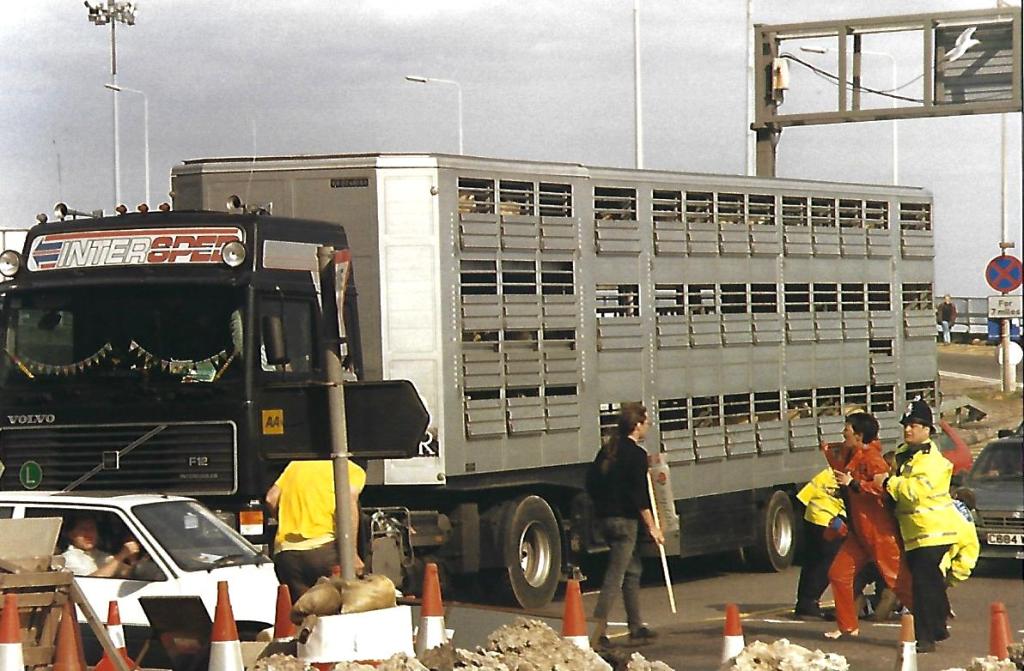
Younger days planning something ! – probably involving live animal exports.