
https://www.smaccoalition.com/copy-of-fake-rescue-content



(a new action in relation to this subject already covered extensively on this site)
https://www.idausa.org/campaign/animal-companions/latest/stop-online-cat-torture-groups/
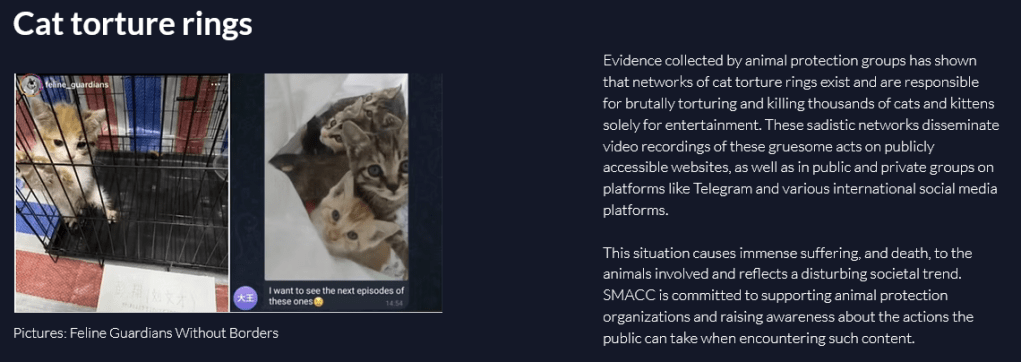
Many people scrolling through various social media sites are completely unaware of sinister channels and private groups that promote and distribute graphic and heartbreaking content of cats and other animals being sadistically maimed, tortured, and killed for views and money. Tell social media platforms to shut these accounts down!
Between July 2020 and August 2021, the Social Media Animal Cruelty Coalition documented 5,480 instances of animal cruelty content found on YouTube, Facebook, or TikTok, which didn’t even include private groups or conversations specifically set up to exchange cruelty content. However, just those few thousand videos were viewed a staggering 5,347,809,262 times.
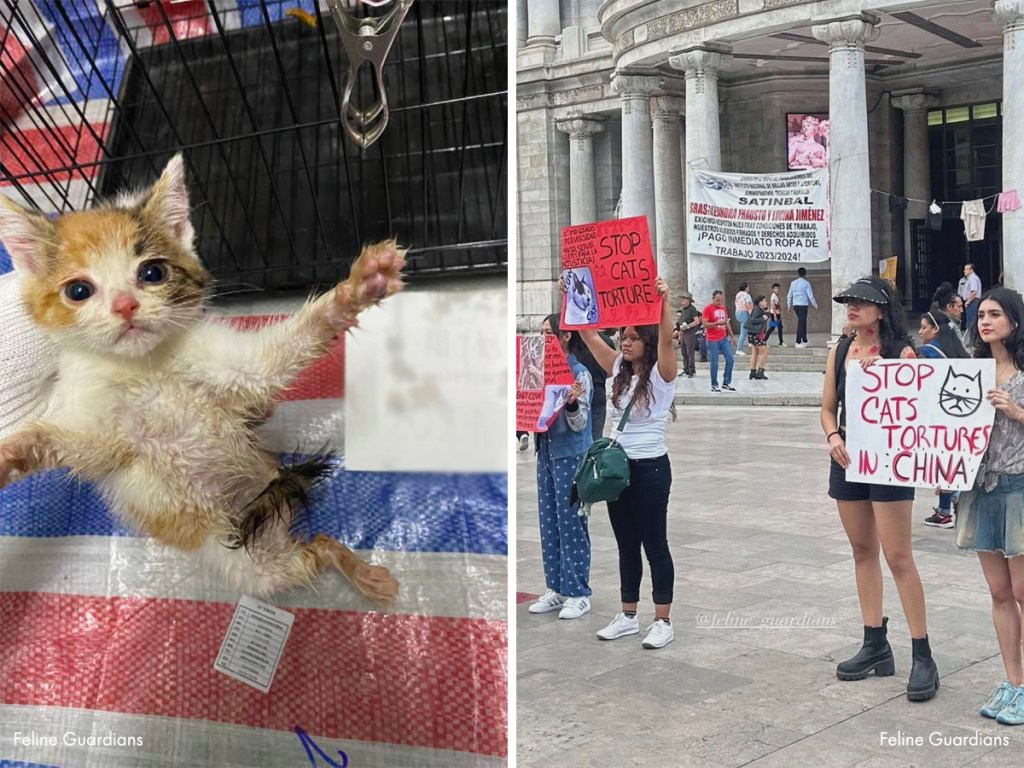
In 2023, multiple horrifying videos of cats being tortured appeared online, causing global outrage. Investigative work by Feline Guardians found that the virality of this content led to subsequent cat torture rings producing and distributing hundreds of new torture videos that circulated across Telegram and other social media platforms.
Between May 2023 and June 2024, an estimated 500 cats became victims of unspeakable cruelty at the hands of members of this cat torture network, with 31 cats killed by a single person.
Further data collected shows an alarming 300% increase in cat torture cases between December 2024 and early 2025, particularly originating from China.
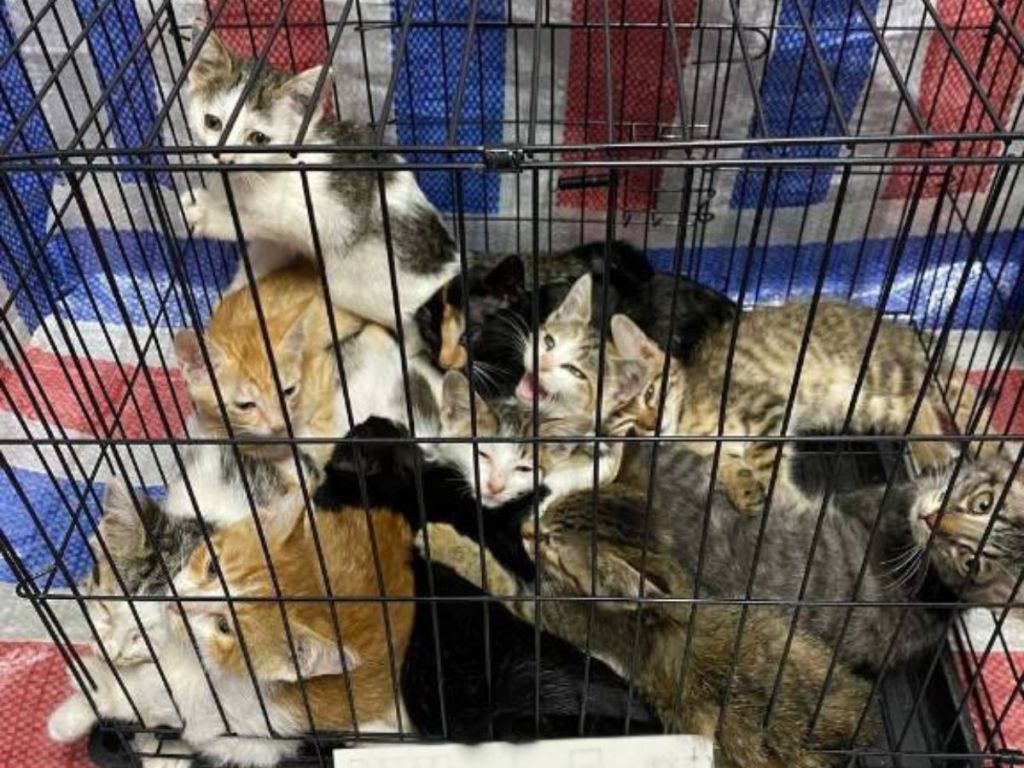
This organized group of criminals was found to be mass producing videos, largely in China, to take advantage of a lack of animal cruelty laws, sharing them on social media, creating websites on the dark net to distribute videos, and using Chinese social media sites to promote these websites and recruit members. To the frustration of Chinese activists and others working to shut this down, less than 1% of abusers have been investigated by authorities.
Dozens of groups on Telegram with thousands of participants are exchanging as much as 100+ of videos daily of horrifying content. More troubling still are the attempts to encourage children and young adults to watch and commit animal torture themselves.
Tragically, this has been found to be an international issue with cruelty content originating from many countries with multiple platforms involved, and it’s been linked to other criminal activity, such as child sex abuse material, terrorism, animal theft, and extortion.
Platforms that allow users to engage in the production and distribution of this content must take action to stop it.

… please refer to the page for contacts/suggestions …


An animal rights group is taking its case to the people with a new billboard depicting an activist who is facing prison for removing chickens from a Petaluma poultry farm.
The billboard on Highway 101 in Petaluma depicts activist Zoe Rosenberg who is accused of taking chickens from the farm. She could face up to five years in prison.
The billboard shows an illustration of Zoe with the words ‘Should she go to prison for rescuing a chicken ?’.
Zoe is charged with felony conspiracy and 4 misdemeanors stemming from an early morning protest outside Petaluma Poultry in June 2023. Zoe is accused of removing four 4 chickens from company vehicles.
Zoe is a member of Direct Action Everywhere (DAE) who paid for the billboard.
Bill Mattos, President of the California Poultry Federation described the incident as a ‘terrorist act’ – ‘you don’t break into a high quality poultry facility with the best biosecurity and humane conditions in California’ he said.
Members of DAE say they have a right to take action for animals in distress, and they have protested at many poultry farms.
Zoe’s trial, after being delayed, is now scheduled to begin on September 15th.
We at WAV naturally wish Zoe every success with her case; which is certainly NOT a case of terrorism, but rather one of compassion !
Ag Gag – https://en.wikipedia.org/wiki/Ag-gag



We have some really good news to share with you this Sunday.
Remember back in March this year we did a post re terrible abuses at a ritual slaughterhouse in Arley, Warwickshire – which showed terrible scenes of sheep suffering abuses before their throats were cut – here is our link at the time:

Well as investigations have been on going for the last few months by the Food Standards Agency (FSA) we have been restricted from further publishing; but now, today we can confirm that as a result of the investigation and abuses at Arley, which included staff playing Wolf noises to sheep, severe hadling as can be seen in this link https://www.independent.co.uk/news/uk/home-news/slaughterhouse-abattoir-sheep-meat-halal-warwickshire-b2705241.html ; and sheep still being alive FOUR MINUTES after their throats were cut, we can say with great pleasure that the entire facility has been shut down by the FSA and had its license revoked.
A lot of action in the way of demonstrations was undertaken by local people regarding this hell hole for animals; and we congratulate them on a very worthwhile victory !
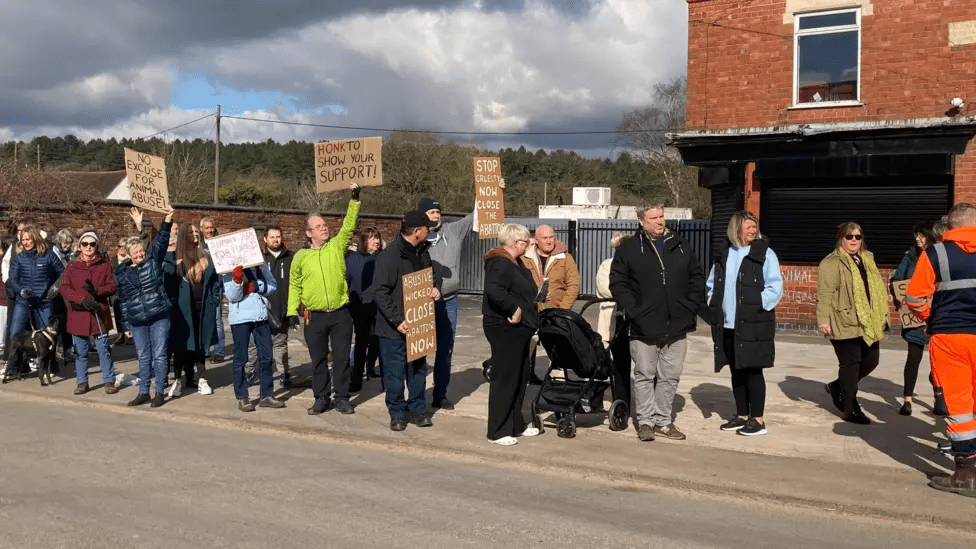
Above – Local residents campaign for the slaughterhouse to be closed.

In its report on findings, the FSA said that it lacked confidence in the abattoirs ability (shown above) to deliver ‘consistant compliance’.
We have always said, and will continue to say, that there is NO PLACE IN THE UK WHERE RITUAL SLAUGHTER SHOULD BE UNDERTAKEN.

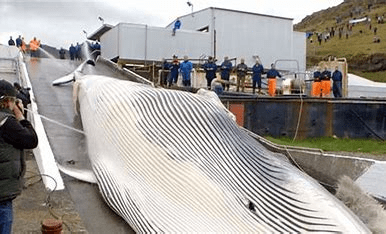
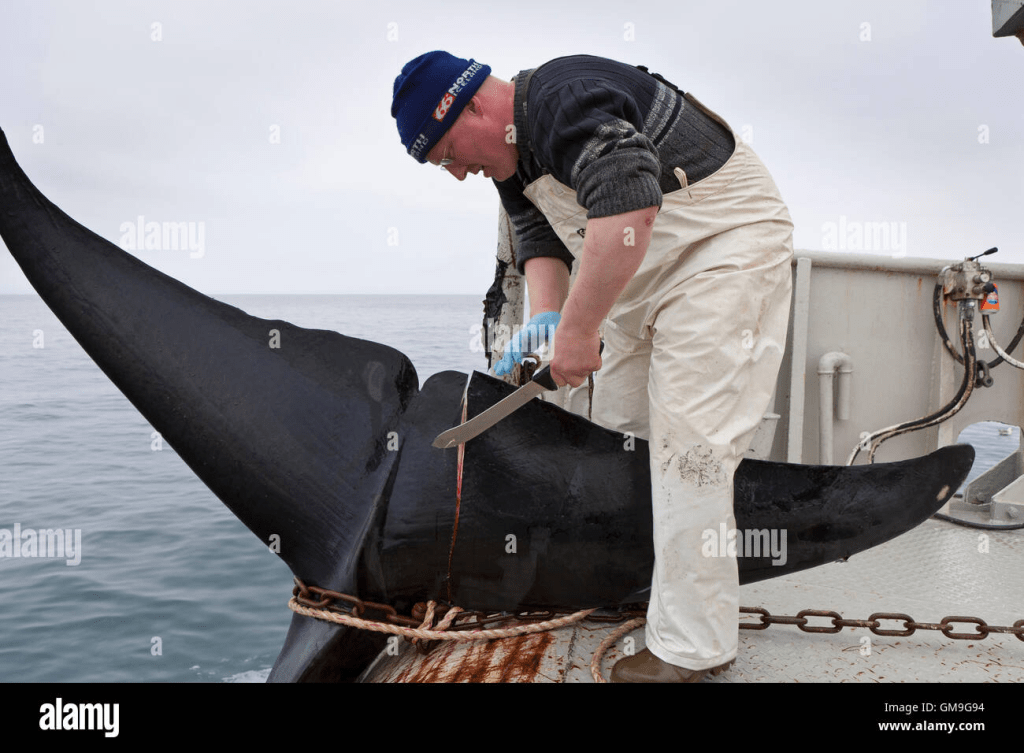
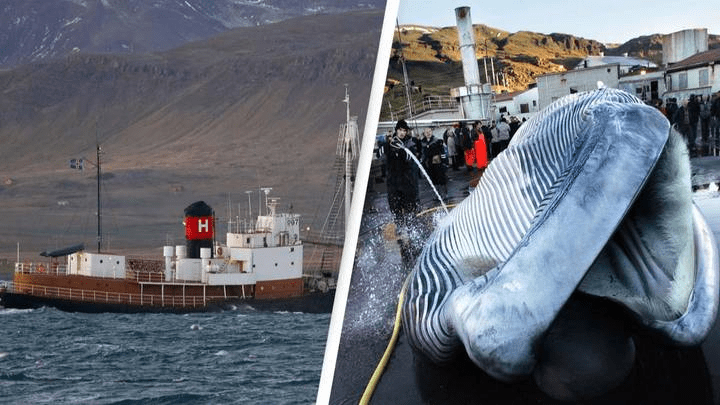
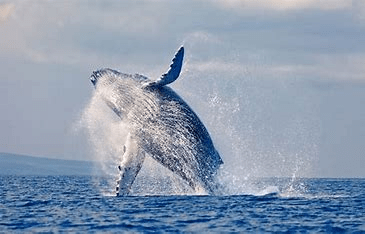
Since it stopped in 2021, an Icelandic company plans to hunt Minke whales once again.
Iceland, Norway and Japan are now the only 3 nations which still hunt whales.
Licenses issued last December were to two companies for the 2025 – 2029 period.
Annual catches of 209 Fin whales and 217 Minke whales could be hunted each year in a season running from mid June until September.
In 2018 six 6 Minke were hunted, and in 2021 one 1 Minke was hunted.
Icelandic whalers have not hunted Minke recently as it is not considered profitable.
But now the Tjaldtanji company said it intended to give it a try this summer – 2025.
They intend to hunt off northwest Iceland.
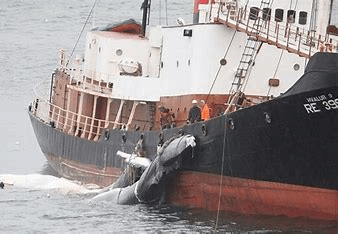
Iceland’s only other active Hvular, which only hunts fin whales, said in April it would not hunt for a second year because of a lack of profitability.
Animal rights activists, along with the Icelandic tourism industry, have both condemned the proposals.
The Icelandic Whale Watching Association recently proposed that some of the hunting grounds be defined as whale sanctuaries.
Whalers said that there is excitement amongst locals to get Minke meat in this summer.
WAV Comment – we suggest that there is a lot more incentive to business in the area by undertaking whale watching; combined with education and souvenirs; rather than the murder of these beautiful, intelligent creatures. Humankind could learn a lot from them if given the chance.



Published – April 30, 2025 09:00 am IST

A koala sits in a tree at a koala park in Sydney, Australia, May 2023. | Photo Credit: AP
Snipers in helicopters have shot more than 700 koalas in the Budj Bim National Park in western Victoria in recent weeks. It’s believed to be the first time koalas have been culled in this way.
The cull became public on Good Friday after local wildlife carers were reportedly tipped off.
A fire burned about 20% of the park in mid-March. The government said the cull was urgent because koalas had been left starving or burned.
ark in Sydney, Australia, May 2023. | Photo Credit: AP
Snipers in helicopters have shot more than 700 koalas in the Budj Bim National Park in western Victoria in recent weeks. It’s believed to be the first time koalas have been culled in this way.
The cull became public on Good Friday after local wildlife carers were reportedly tipped off.
A fire burned about 20% of the park in mid-March. The government said the cull was urgent because koalas had been left starving or burned.
Wildlife groups have expressed serious concern about how individual koalas had been chosen for culling, because the animals are assessed from a distance. It’s not clear how shooting from a helicopter complies with the state government’s own animal welfare and response plans for wildlife in disasters.
The Victorian government must explain why it is undertaking aerial culling and why it did so without announcing it publicly. The incident points to ongoing failures in managing these iconic marsupials, which are already threatened in other states.
Koalas live in eucalypt forests in Australia’s eastern and southern states. The species faces a double threat from habitat destruction and bushfire risk. They are considered endangered in New South Wales, Queensland and the Australian Capital Territory.
In Victoria, koala population levels are currently secure. But they are densely concentrated, often in fragments of bush known as “habitat islands” in the state’s southwest. Budj Bim National Park is one of these islands.
Over time, this concentration becomes a problem. When the koalas are too abundant, they can strip leaves from their favourite gums, killing the trees. The koalas must then move or risk starvation.
If fire or drought make these habitat islands impossible to live in, koalas in dense concentrations often have nowhere to go.
In Budj Bim, Victoria’s Department of Energy, Environment and Climate Action and Parks Victoria have tackled koala overpopulation alongside Traditional Owners by moving koalas to new locations or sterilising them.
But Budj Bim is also surrounded by commercial blue gum plantations. Koalas spread out through the plantations to graze on the leaves. Their populations grow. But when the plantations are logged, some koalas have to return to the national park, where food may be in short supply.
Animal welfare groups say logging is one reason Budj Bim had so many koalas.
It’s hard to say definitively whether this is the case, because the state environment department hasn’t shared much information. But researchers have found habitat islands lead to overabundance by preventing the natural dispersal of individuals.
So why was the culling done? Department officials have described the program as “primarily” motivated by animal welfare. After the bushfire last month, koalas have been left starving or injured.
Why shooters in helicopters? Here, the justification given is that the national park is difficult to access due to rocky terrain and fire damage, ruling out other methods.
Under Victoria’s plan for animal welfare during disasters, the environment department is responsible for examining and, where necessary, euthanising wildlife during an emergency.
For human intervention to be justified, euthanasia must be necessary on welfare grounds. Victoria’s response plan for fire-affected wildlife says culling is permitted when an animal’s health is “significantly” compromised, invasive treatment is required, or survival is unlikely.
For koalas, this could mean loss of digits or hands, burns to more than 15% of the body, pneumonia from smoke inhalation, or blindness or injuries requiring surgery. Euthanised females must also be promptly examined for young in their pouches.
The problem is that while aerial shooting can be accurate in some cases for larger animals, the method has questionable efficacy for smaller animals – especially in denser habitats.
It’s likely a number of koalas were seriously injured but not killed. But the shooters employed by the department were not able to thoroughly verify injuries or whether there were joeys in pouches, because they were in the air and reportedly 30 or more metres away from their targets.
While the department cited concerns about food resources as a reason for the cull, the state’s wildlife fire plan lays out another option: delivery of supplementary feed. Delivering fresh gum leaves could potentially have prevented starvation while the forest regenerates.
The state government should take steps to avoid tragic incidents like this from happening again.
Preserving remaining habitat across the state is a vital step, as is reconnecting isolated areas with habitat corridors. This would not only reduce the concentration of koalas in small pockets but increase viable refuges and give koalas safe paths to new food sources after a fire.
Future policies should be developed in consultation with Traditional Owners, who have detailed knowledge of species distributions and landscapes.
We need better ways to help wildlife in disasters. One step would be bringing wildlife rescue organisations into emergency management more broadly, as emphasised in the 2009 Victorian Bushfires Royal Commission and the more recent Royal Commission into National Natural Disaster Arrangements.
This latter report pointed to South Australia’s specialised emergency animal rescue and relief organisation – SAVEM – as an effective model. Under SA’s emergency management plan, the organisation is able to rapidly access burned areas after the fire has passed through.
Victoria’s dense communities of koalas would be well served by a similar organisation able to work alongside existing skilled firefighting services.
The goal would be to make it possible for rescuers to get to injured wildlife earlier and avoid any more mass aerial culls.
**************************
**************************
https://www.discoverwildlife.com/animal-facts/koala-cull-budj-bim-national-park-australia
**************************
**************************
**************************
**************************
https://www.thepetitionsite.com/293/450/038/

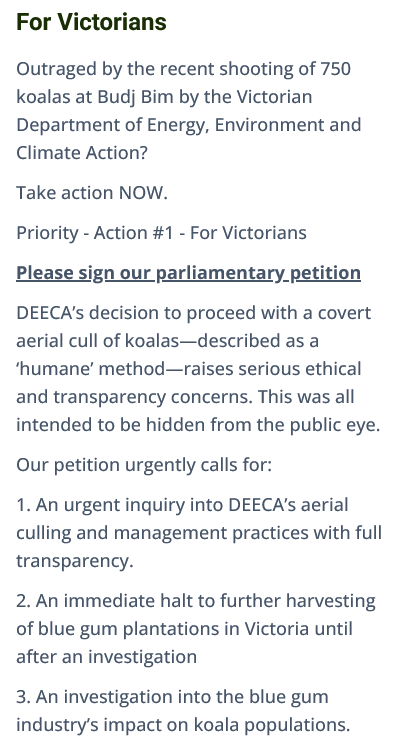
The tragic culling of over 700 koalas in Budj Bim National Park in Victoria is a horrifying reminder of how our wildlife is being failed by shortsighted policies. This decision to shoot these beloved creatures from helicopters, after a bushfire ravaged their habitat, was not only a shocking act of cruelty but also a devastating loss to the ecosystem.
Sign this petition to demand the Victorian government stop culling koalas and implement humane, science-based solutions to protect these populations!
Some of the koalas killed were mothers with joeys, leaving helpless young behind to face an uncertain future. The culling fails to address the underlying causes of koala population pressure – namely habitat destruction from logging, fires, and inadequate wildlife management.
Rather than resorting to mass extermination, there are more effective and compassionate ways to address these issues, including habitat restoration and wildlife corridors.
We cannot afford to continue taking such drastic measures when more humane solutions exist. We must push the Victorian government to adopt long-term, science-based approaches to koala conservation that focus on preserving their habitats, rescuing those in need, and ensuring a future where these iconic marsupials can thrive.
Sign now to demand that the Victorian government stop the culling and put in place real protections for koalas and their habitats.
**************************
https://koalaalliance.org.au/petitions
(PLEASE SIGN
>> SIGN HERE:

>> SIGN HERE:
Published: 20:33 BST, 1 May 2025 | Updated: 21:43 BST, 1 May 2025
A Florida couple took their elderly cat with them on a hike in Utah, but after ignoring warning signs only one of them made it out alive.
The bodies of Matthew Nannen, 45, and Bailee Crane, 58, were discovered Tuesday by park visitors in Bryce Canyon National Park after they fell about 380ft below Inspiration Point, according to the Garfield County Sheriff’s Office.
The couple, who appeared to be living out of a U-Haul truck, are believed to have fallen to their deaths on either Monday night or early Tuesday morning, police said.
Although there was a railing at the top of the cliff, police said Nannen and Crane climbed over it. There was also snow in the area that made for slippery conditions.
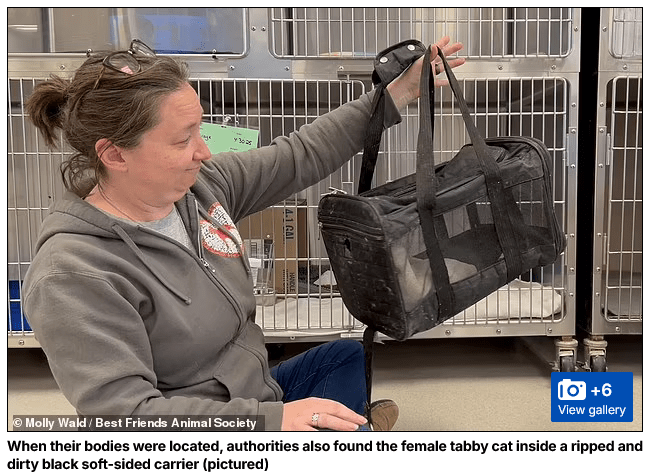
When their bodies were located, authorities also found a female tabby cat inside a ripped and dirty black soft-sided carrier, the Best Friends Animal Sanctuary said.
The cat, who has since been named Mirage, appeared to have fallen with her owners but ‘seemed to have weathered the fall fairly well,’ the no-kill shelter told the outlet.
When Mirage was brought to the shelter, she was ‘matted and a bit sore,’ but during her examination she was very friendly.
Judah Battista, the chief sanctuary officer with the shelter, told DailyMail.com Mirage suffered two fractured canines and two fractured ribs from the fall.


Right now, the team there is focused on ‘getting her well and providing a safe and loving space for Mirage.’
When asked if they would put her up for adoption down the road, Battista said the shelter plans to see if any of the couple’s extended family would like to take her in first. If not, they plan to have her adopted.
Video and images shared by the shelter showed several employees taking great care of Mirage and nursing her back to health.
Battista said they have taken animals in before that have been a part of horrible incidents, but the shelter has never seen anything ‘quite as dramatic as this.’
Nannen and Crane had just made their way to Utah from Arizona and are permanent residents of Florida, authorities said.
The exact cause of the incident remains under investigation.
‘Detectives are considering all possibilities, but preliminary investigations have not been able to definitively determine the cause of the fall,’ the sheriff’s office told KUTV.
DailyMail.com contacted the Garfield County Sheriff’s Office and Bryce Canyon National Park for more information.

Inspiration Point is known to give spectators a ‘birds-eye view of the world’s largest collection of rock spires called “hoodoos” found within the Bryce Amphitheater,’ according to the national park.
News of this tragedy comes just months after a beloved and heavily-pregnant California school teacher died after falling while on a hiking trip in Greece.
Clara Thomann, 33, had been traveling through Plakias, Crete, with her partner Elliott Finn when she fell during a hike and died on December 23.
Thomann, from Santa Barbara, was six months pregnant at the time, according to SFGate. She was also a teacher at the Dos Pueblos High School.
According to The Greek Reporter, she had slipped and tumbled 50 meters down a gorge from a hiking trail near the Preveli Monastery in the Rethymno region.


The outlet reported that she was pronounced brain dead less than a week after the fall, which caused her to suffer major injuries to her skull and chest.
Tragically Thomann lost her unborn child in the fall, with 21 firefighters and rescue teams battling to reach her from what was described as an inaccessible spot.
Her family traveled to the country to visit her before her death, with Veronica Katz writing on her CaringBridge page, seen by SFGate, that she ‘loved helping and teaching others.’
According to her social media, she had worked as a physics teacher. Her family have announced they would be donating her organs.
https://www.humaneworld.org/en/issue/trophy-hunting

Supporters claim trophy hunting helps communities and wildlife by putting money in local people’s hands and culling weak or old animals. But in reality, very little money — as little as 3%of trophy hunting revenue — reaches the areas where hunting happens, and trophy hunters often seek the biggest, strongest animals to kill.

Trophy hunters kill for bragging rights and animal parts. Banning or restricting the transport and trade of hunting trophies from species threatened by trade takes away these motivations. In the U.S., state and federal laws and regulations can reduce or stop the trophy hunting of native carnivores.


Dex Kotze
https://secure.humaneworld.org/page/165604/petition/1
 World Animals Voice