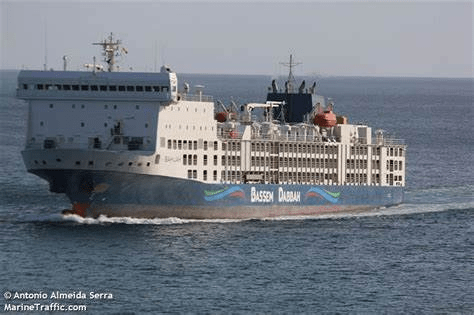
Two live animal transport vessels containing bulls from Portugal were detained for 19 days in the Moroccan port of Tangier-Med.
The bulls were confined in extremely unhygienic conditions, which only worsened over time. Forced to stand ankle-deep in their own excrement, many of them developed respiratory problems and inflamed eyes. It was reported that one bull died onboard, his corpse left to decompose inside the vessel where it was trampled on by the other animals.
The root of this suffering was bureaucratic, with the bulls apparently having been detained due to current import duties and high customs tariffs. Their clearance was said to be contingent on the adoption of new customs regulations. In the meantime, no thought was given to their welfare, with the Moroccan authorities appearing unconcerned with their rapidly-degrading state, and unmotivated to act in the best interest of these sentient beings (for instance, by unloading and quarantining them at their destination or in another stable).
Trade routes should not be entertained with third countries, as it is extremely difficult to influence how transported animals are treated once they leave the EU’s borders.
This incident further highlights the need for a robust revision to the Transport Regulation, as it is a reminder that transported animals are very vulnerable. Measures must be taken swiftly to ensure they experience the least amount of stress possible directly before, during, and after their journeys.
With a recent data leak showing the scale of suffering in the live animal transport industry is much vaster than is recognised by official records, the European Commission must not delay on making these critical sector changes happen.
This week, Eurogroup for Animals, together with four other animal protection organisations, sent a joint letter to the veterinary organisations highlighting the poor welfare experienced by animals during these long journeys, as well as the risk of inhumane slaughter on arrival.
Veterinary officials are tasked with inspecting the health of animals for export, but are often put in a difficult position as they have a contractual obligation to their employer, which might conflict with their ethical one to safeguard the wellbeing of animals.
The letter calls on the veterinary community to use their influence to ban the export of live animals to non-EU countries.
EU: What does the EU’s Transport Regulation proposal mean for animals used for scientific purposes?
19 January 2024
In December 2023, the European Commission published its proposal for a Regulation on the protection of animals during transport. The proposal explicitly recognises that animals transported for scientific purposes are covered by the Regulation. However, the lack of species-specific provisions addressing crucial factors such as fitness for transport and journey times raises deep concerns.
Since the implementation of Council Regulation (EC) No 1/2005, the European Commission has not taken specific actions concerning the welfare of animals transported for scientific purposes. Despite the stress, suffering, and elevated risk of injury that these animals may experience during transport, there has been a notable absence of measures to ensure their welfare.
Data on the transport of animals used for scientific purposes to and within the EU has been scarce, with only minimal information available in EC and Member State reports on statistics.
The Commission’s proposal now explicitly includes the transport of animals used for scientific purposes within the scope of the Transport Regulation. The proposal acknowledges that “while a distinction can be made with regard to the purpose for which these animals are transported, their welfare should be guaranteed”.
However, the Commission continues to leave these animals unprotected, arguing that “due to the strict requirements on the quality of animals needed for research and testing”, and because “scientific procedures may require the use of animals that can potentially be considered unfit for transport according to this Regulation”, “it would be neither coherent nor acceptable to include them completely in the scope of this Regulation”.
In particular, species-specific provisions relating to fitness for transport, watering and feeding intervals, journey times, temperatures and rest periods, and the assessment and recording of conditions of animals on arrival do not apply to the transport of animals used for scientific purposes. These exemptions are particularly alarming in the context of animals transported over long distances.
Regardless of the purpose for which animals are being transported, the needs and welfare concerns of a particular species remain the same. Whether they are categorised as farm animals, companion animals, or animals used for scientific purposes, individuals of the same species with comparable physiological conditions have common requirements in terms of journey times, resting periods, temperatures and access to water and food. The exception is made for vulnerable animals such as genetically altered animals, animals that have undergone surgery, animals that are disease ‘models’, pregnant animals, and lactating and newborn animals which require special provisions.
Proper assessment and recording of the condition of animals on arrival is also missing. These aspects include elements such as the number of animals that died and any health or physical problems, including injuries that occurred during the transport, which are crucial to increase the traceability and transparency of transport operations, and to enable the enforcement of the Regulation.
The proposal also lacks provisions addressing the air transport of animals, including non-human primates. Most non-human primates used for scientific purposes in the EU are born outside of the EU, mainly in Africa and Asia, and imported. These animals suffer long journey times by air and by road in small crates that leave little room for the animals to even turn around. Travel times of up to 58 hours are not uncommon, and in some cases may exceed 70 hours. Directive 2010/63/EU recognises that an increase in transport times may negatively impact on the welfare of animals used for scientific purposes bred outside the EU. Animals transported by air may face different challenges, including extended waiting periods with restricted access to water and food, exposure to high temperatures, stress-inducing loading and unloading, and the risk of incorrect handling by untrained staff.
While we recognise the positive step forward in bringing the transport of animals used for scientific purposes within the scope of the revised Transport Regulation, we are deeply concerned by the limited protection proposed.
Eurogroup for Animals calls for the following amendments:
All provisions outlined in the Transport Regulation, including fitness for transport, watering and feeding intervals, journey times, temperatures, rest periods, and assessment and recording of conditions on arrival, must apply to the transport of animals used for scientific purposes, providing for certain exemptions where necessary;
Species-specific provisions must be included in Annexe I;
The needs of vulnerable animals must be addressed;
Appropriate provisions for animals transported by air must be included.
The Belgian Presidency does not plan to address the proposal for animal transport in its term according to the programme of legislative files that will be worked on. The presidency of the Council is responsible for setting the agenda and facilitating dialogue between the Council and other EU institutions. It is now Belgium’s turn to take on the role until June of this year.
In December the European Commission published a proposal for the transport of live animals, but the proposed text failed to recommend actions that can make significant improvements for animal welfare, ignoring several EFSA opinions. Most strikingly, it still allows for animals to be transported live to non-EU countries, despite the ever growing concerns on the consequences of such journeys.
It was hoped that the Council could work on the topic and strengthen the proposal. However, with the Belgian Presidency deciding to kick the can down the road, the EU will not be in a position to adopt new welfare standards for the transport of live animals any time soon. The programme only mentions the drafting of a progress report on animal transport, and will only be worked on “if there is time”, which according to news reports, is highly unlikely.
At the beginning of its term in 2019, this Commission under President Ursula von der Leyen committed to improving the lives of farmed animals by coming forward with a number of proposals, of which transport is just one.
It was expected that this whole package could come into force and start improving the lives of millions of animals across the EU as soon as 2027. So far the Commission has only brought forward the proposal on transport, which could now be further delayed, and a proposed regulation on cats and dogs which the Council is expected to adopt a general approach on.
Photo – Mark (WAV) – A Dutch Horse Transporter heads out of Dover UK.
The Animal Welfare (Livestock Exports) Bill will have its Committee of the Whole House and Remaining Stages in the House of Commons on Monday 15th January.
This means if the Bill passes (WAV Comment – Sure it will as it has full Cross Party Support) it will be ready to enter the House of Lords to complete its passage.
This important Bill will ban the export of cattle, sheep, goats, pigs and horses for slaughter and fattening from Great Britain, stopping unnecessary stress, exhaustion and injury caused by exporting live animals. In doing so, it will deliver a key Conservative Manifesto commitment and part of Defra’s Action Plan for Animal Welfare.
During live export animals may end up in countries with far poorer welfare standards than our own, enduring practices which are illegal in the UK such as veal crates. Calves placed into the Dutch white veal pen systems, where they are unable to perform natural behaviour, are barely able to turn around.
UK ACTION – We are asking our supporters to contact their local MP and ask them to attend these important final stages of the Bill in the House of Commons. To make this easier for you, we have drafted a template below which you can copy and paste.
We hope you will join us in the mission to end live exports for fattening and slaughter.
With warmest wishes,
Email to: your MP
Dear (name of MP),
I am contacting you to ask you to support the Animal Welfare (Livestock Exports) Bill which will enter its final stages in the House of Commons on Monday 15th January. Ending live exports for fattening and slaughter was included in the Conservative Manifesto and Defra’s Action Plan for Animal Welfare.
With a General Election this year, I am keen to ensure this important Bill becomes law as soon as possible. I therefore ask you to attend and vote in favour of the Bill during its final stages on Monday, to prevent the cruelty of live exports from continuing in the future.
Historically the UK has exported thousands of sheep and calves abroad to France and as far afield as Spain. Overcrowding means that some cannot lie down at all, while those who do may be injured or trampled to death. They can be in transit for days, suffering extremes of temperature and often without sufficient food, water or rest. Please help to end live exports for fattening and slaughter for good.
Well folks, personally for me it has taken what ? – around 40+ years of campaigning to get to where we are now – read on below.
To be honest, the last four years or so have been a roller coaster of ‘yes it will be banned’ followed by ‘no it will not be banned’ statements. A few years back I did the official government consultation on the issue of live animal exports; and expectations were high as with past campaigning on this issue, I knew that almost all of the British people were against the trade, and at the time, in PM Boris Johnson, we had a PM who would push the legislation for a ban through Parliament.
Thins have changed now as we no longer have Boris at the helm and we have seen Bills such as the ‘animal kept Bill’ which would have banned the export trade, scrapped by the current government at the last minute.
But anyway, what fantastic news today, with the implementation of the ‘Animal Welfare (Livestock Exports) Bill 2023-24’ which will make it an offence to export from or through Great Britain live livestock for slaughter outside the British Islands, we have reason to celebrate as we now join up with campaigner friends in New Zealand; the only other nation that has officially banned the export of live animals.
As explained below, it is only through Brexit and getting free from the shackles of the EU that the UK has been able to do this. We as a nation have taken back control and are reverting to making law for our own citizens; without the dreg of EU legislation hanging over us.
I would suggest that you look at the following which gives a basic overview on the legislation and some of the basic reasons whilst it has gotten to the situation it has currently arrived at.
So where do we go now ? – Europe, to be basic. I / we have campaigned in Europe for decades on the issue of live animal transport. With the issue of caged animals and the need to set them free through the citizens initiative, the EU Commission is under huge pressure to act for the welfare of animals. The UK export ban issue is another thing that can be thrown at them as a reason why they need to act and act now. Thousands and thousands of live animals are trucked across every day; and they should not be; just as live EU animals should not be exported outside of the EU to meet the gruesome deaths that await them.
We have plenty to go on, and so the work continues. To ‘win’ after 40+ years of campaigning does not really seem true – we had a glass of wine lunchtime to celebrate what in reality is a massive victory; but also to remember all those who fought so hard for the cause here in UK but who are no longer with us. So this is for them, the Mike Tucker,
the Carla Lane, wonderful Barb
Below – Dover – Barb gives a hug to my dog ‘Golda’.
… and so many others who fought but have not seen this campaign get to where it is now – a ban on the export of slaughter and further fattening animals from the UK.
“John often used to hitch a ride in my car which I had taken to the Netherlands as part of the job. We shared many hours on the road; laughing, talking and generally trying to have a good time in work that we both knew the live animal export business caused immense suffering to – innocent, sentient beings”.
The Animal Welfare (Livestock Exports) Bill 2023-24 will make it an offence to export from or through Great Britain live livestock for slaughter outside the British Islands. It was introduced to the House of Commons on 4 December and the second reading was undertaken as scheduled for 18 December 2023.
The Animal Welfare (Livestock Exports) Bill 2023-24 was introduced to the House of Commons on 4 December 2023 as a bill to make provision to prohibit the live export of certain livestock, such as cattle, sheep and pigs, from Great Britain for slaughter. Second reading is scheduled for 18 December 2023.
The government has said that the UK’s departure from the EU gives it the freedom to implement such a ban. The Conservative Manifesto for the 2017 and 2019 General Elections included commitments to control the live exports of livestock.
Live animals have long been exported to EU countries from the UK for breeding, fattening, and slaughter. There have been long running campaigns, including the RSPCA’s Stop Live Exports campaign, to end such exports. This reflects concerns that animals transported to Europe suffer from unnecessarily long journeys, experiencing stress, exhaustion, thirst and rough handling.
Although, for practical reasons, the last exports for fattening or slaughter were in December 2020, the Bill will ban them permanently. It will make it an offence to send, transport, organise transport (or attempt to send, transport or organise transport) for livestock for export from or through Great Britain for fattening and slaughter outside the British Islands. The ban applies to a range of livestock including cattle, horses, sheep, goats, pigs and wild boar, but not poultry. Live exports, including of racehorses, will still be permitted for breeding, competitions and races.
The provisions do not apply to Northern Ireland and journeys within the island of Ireland are not covered. However, they do apply to journeys transiting through Great Britain to a destination outside the British Islands, for example to those that begin in Northern Ireland or EU Member States such as the Republic of Ireland, transit through Great Britain and are destined for a country or territory outside the British Islands.
The ban on exports may need to be defended against World Trade Organisation rules which require countries to apply non-discriminatory rules (so-called ‘most favoured nation’ rules) to trade. Case precedents indicate that exceptions under WTO rules may apply to ethical and animal welfare provisions, however this issue is not clear cut. Challenges can only be bought by other signatory countries. There has been no indication as to whether other countries may wish to challenge the government over the Bill’s measures.
Last week, the European Commission published its long-awaited proposal on animal welfare rules during transport. While the transport of terrestrial farm animals is a well-recognised issue, what are the key issues fish face during transport, and to what extent does the new proposal cover them?
Fish are particularly sensitive to disturbance and experience stress while being handled during farming, being moved with nets or pumps, or being transported between sites or to slaughter. Inappropriate transport of fish can result in injury, pain, distress and suffering. A brief period of stress for fish can result in long-lasting effects such as increased disease incidence, reduced appetite, impaired development, deformities and increased mortality.
The most critical aspects of welfare in the transport of fish are:
Handling and loading procedures;
Equipment for monitoring and maintaining water quality;
Feed withdrawal prior to loading;
Monitoring of fish after unloading.
Until now, EU transport legislation was very weak on fish transport, and implementation was difficult. Fish were included within provisions on planning and documenting journeys, but no standards or practices were set. Certain provisions were also detrimental to fish welfare, such as the requirement to inspect fish at border control points, which means increased light exposure, changes in ambient noise causing stress and stationary periods affecting water quality.
The new proposed legislation includes aquatic animals (fish, cephalopods such as octopuses, and decapods such as crabs and lobsters) in its scope. Unfortunately, it excludes fish used in aquariums or ornamental fish as “the transport of ornamental fish rarely represents a major risk for animal welfare“.
Annex two of the proposal outlines basic principles for the transport of aquatic animals, recognising that aquatic animals have specific welfare needs that have to be protected by law. For example, conditions for crowding and loading fish, ensuring that water quality is appropriate for the species, and reasons for considering aquatic animals as not fit for transport are included.
The aquatic annex provides positive recognition of the importance of aquatic animal welfare during transport. The proposal calls for specific provisions for aquatic animals to be set and updated based on new science when the relevant EFSA opinions are available. This follow-up work is essential to ensure specific and implementable requirements for fish and other aquatic animals.
Now that the European Commission has published the proposal, the European Parliament and the Council of the EU will have a chance to review and propose amendments to the text.
Eurogroup for Animals calls for the text to include deadlines for adopting the delegated acts with more species-specific requirements following the scientific opinions.
The long overdue proposal on animal transport is far from enough to protect the billions of animals transported each year, and fails to acknowledge several EFSA opinions on critical issues, presenting a missed opportunity by the European Commission (EC) to improve animal welfare.
Most notably, the proposal still allows for animals to be transported live to non-EU countries, on very long journeys, in which they are unable to benefit from the legal protection they receive in the EU. It is also deeply concerning that the proposed regulation allows for animals to be transported at sea, with no time limit, as, shockingly, sea journeys are exempted from any restriction on this.
The text does not provide sufficient protection for vulnerable animals such as pregnant ones and unweaned calves. These animals are still going to be transported when they are in very vulnerable states such as late pregnancies, or too young to be able to find food for themselves, or endure incredibly stressful situations like long journeys.
The text does not provide for adequate measures to protect animals in extreme temperatures and humidities, nor does it provide measures on actions required in the case of disruptions.
Another concern is that many animals are excluded from the new measures, including animals transported for scientific purposes, companion animals and aquatic ones, all of which should have legislation specific to their needs.
The proposal does have some positive aspects, notably, a commitment for real-time traceability for road journey times, updated space allowance and maximum journeys to up to nine hours, however this time limit only applies to animals being transported to slaughter. Animals transported for breeding and fattening can be transported for 42 hours over three days, a limit which is excessive and inconsistent with EFSA’s opinions. Moreover, ships flying “black flags” (severely sub-standard), which at the moment constitute 55% of the EU-approved livestock transport fleet, would no longer be allowed to operate.
For the first time, the EC made reference to the transition to meat and carcasses, in the objectives of the Regulation. This is particularly timely, following a recent report which shows that switching to this type of export, as opposed to live transport, would not only benefit the animals, but could save up to 2.5 times the costs, and reduce environmental externalities.
Despite its commitment to come forward with a full set of regulations to improve animal welfare by the end of this year, the EC has now failed to publish the three other legislative proposals, most notably the Kept Animals Regulation (KAR), through which the phase out of cages was promised.
Only updating the live transport rules, and publishing the new proposal on cats and dogs, leaves billions of animals at the mercy of outdated legislation, while it ignores the ask of millions of European citizens for better animal welfare.
This proposal comes only one week after the publication of a report that highlights how official records on live transport are often masked, and the suffering endured by billions of animals each year is much worse than imagined.
It is concerning that after such a long wait the European Commission comes forward with only one of the promised proposals, and one that lacks ambition and fails to protect the welfare of animals during transport, despite the ever-growing evidence of the immense suffering that they endure. The proposal evidently embraces a “business as usual approach” favouring economic benefits over the welfare of the animals. It is now time for the Council and the Parliament to truly reflect the wishes of EU citizens in the legislation.
Business case: the benefits of a carcass over a live animal tradeBusiness case: the benefits of a carcass over a live animal trade
9 November 2023
Report
Eurogroup for Animals commissioned Human Behaviour Change for Life (HBCL) to write this report: ‘Business case: the benefits of a carcass over a live animal trade’.
This document considers the business case for a change to the export of carcass meat instead of live animals from the European Union (EU) to third countries. It includes the current economic, environmental, and societal challenges and opportunities that these different approaches present.
The research provides a unique insight into the costs of the trade through the development and use of innovative modelling, frameworks, case studies and evidence-based approaches. It enables the consideration of how a move from live animal export towards a meat and carcass trade could be advantageous for the agricultural sector, the environment, and wider society.
A data dump of suffering: The EU’s long-distance trade in farm animals exposed
28 November 2023
Compassion in World Farming
Report
A cache of unpublished records obtained in summer 2023 reveals disturbing new evidence on the extent and nature of the EU’s trade in farm animals.
The data comprises official planning records relating to more than 180,000 consignments of animals, moving between EU countries and to non-EU countries between October 2021 – April 2023. It clearly shows that the rules for live transport are not robust or detailed enough to truly protect the welfare of animals in the sector.
A joint report by Eurogroup for Animals and Compassion in World Farming.