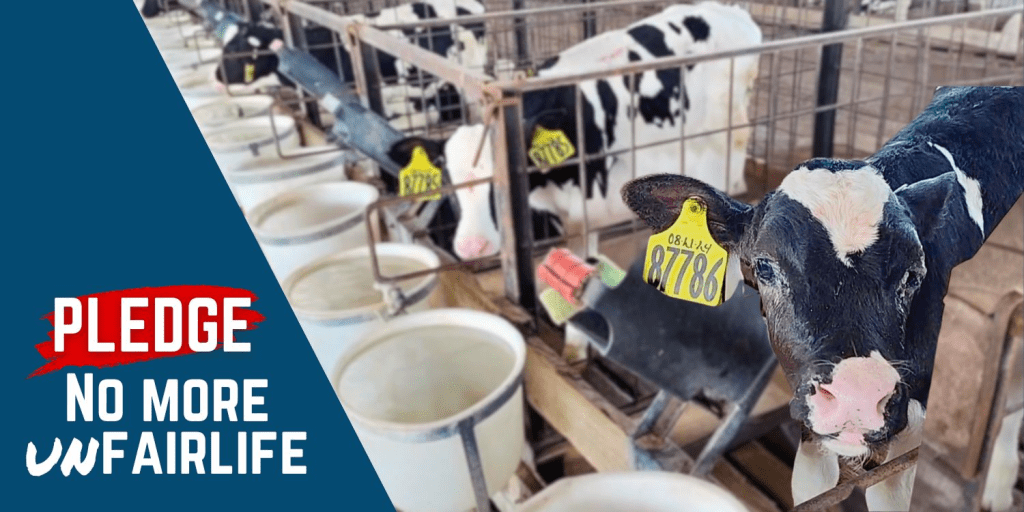
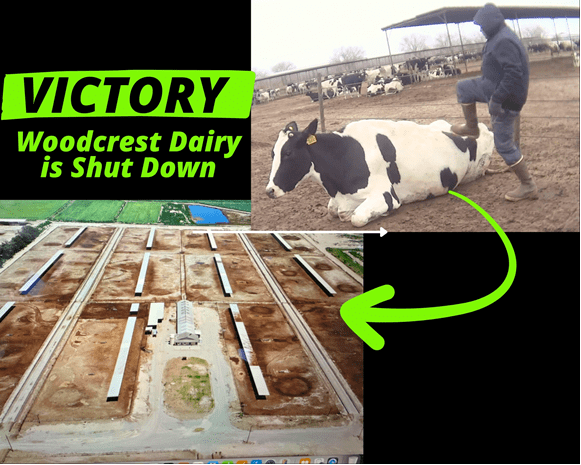
In 2024/2025 the Animal Recovery Mission – ARM – launched 2 new undercover investigations into Arizona’s main supplying dairy farms for COCA COLA OWNED ‘FairLife milk’.
Coke and FairLife promised reform after ARM exposed the cruelty in 2019 and 2023 investigations. THEY LIED as you can see in the video.
Essere Animali Undercover Investigator Marco shares the second part of his experiences working at a pig farm. Please click on the following link to read part of his diary and see video footage-
Warning – Disturbing images from the start. Click this link to read and view:
The Problem – you are not going to like what you see here about the suffering of animals, but in order to make positive changes for their future, you have to know the current situation and their suffering / how they are abused first – https://www.essereanimali.org/en/the-problem/
As our common international friends – working together to make positive changes for suffering animals of this world, we hope you have obtained a lot more information from the work of Essere Animali.
A lot of people simply wish to ignore the suffering of fish – but as seen here; and like the majority of most intensively reared farmed animals today, they, fish, are often raised and slaughtered in the most barbaric ways. It is hoped that by viewing the video below, views will change. The silent screams.
A new investigation is undertaken by Anima Naturalis, who undertake their work in Spain and Latin America, https://www.animanaturalis.org/en have revealed the immense suffering of Rainbow Trout at Spanish aquaculture facilities.
Spain is the largest producer of farmed fish in the EU; accounting for over 23% from figures obtained in 2023. An estimated 254 Million fish are raised and slaughtered EVER YEAR in the country.
Spain’s most farmed species is the Rainbow Trout, which accounts for around 30 Million animals per year.
With the support of photojournalist Aitor Garmendia and video photographer Linas Korta; the investigation https://www.fishfactory.org/es captures:
Extreme overcrowding, with fish forced to swim in waste filled water; struggling for space and oxygen;
Diseased and injured fish, suffering torn fins, gill damage and friction injuries caused by rough handling and suction machines.
Brutal slaughter methods; including the widespread use of thermal shock – submerging live fish into ice or ice chilled waters for up to 90 minutes; causing prolonger consciousness, hypothermia and suffocation.
Ineffective electrical stunning – resulting in fish being eviscerated alive; which is a clear breach of existing EU rules when it comas to ‘avoidable suffering’.
Exacerbated stress during transport including poor water quality, lack of oxygen, and jostling during both loading and unloading make the fishes final life stage an especially traumatic experience..
These acts of cruelty clearly goes against the EU Directive which protects farm animals; including fish – https://eur-lex.europa.eu/eli/dir/1998/58/oj/eng and which obliges Member States to ensure that farmed animals ARE NOT caused ant unnecessary pain, injury or suffering.
The situation here clearly shows that both stronger EU and national legislation is required.
AN’s campaign incudes a citizens petition https://www.fishfactory.org/es urging the EU to grant fish the legal protection they urgently need. Pleas sign it, and then pass the link to others – thank you.
The AN investigation coincides with the EU Commissions drafting of the first Code of Good Practice on Fish Welfare which serves as a practical document for aquaculture producers and the best practices for fish welfare. This is applicable across different life stages and production methods. This Code aims to fulfill the EU Strategic Aquaculture Guidelines strategy for 2030; https://eur-lex.europa.eu/eli/dir/1998/58/oj/eng ensuring that aquaculture progresses in a sustainable and ethical way within the EU.
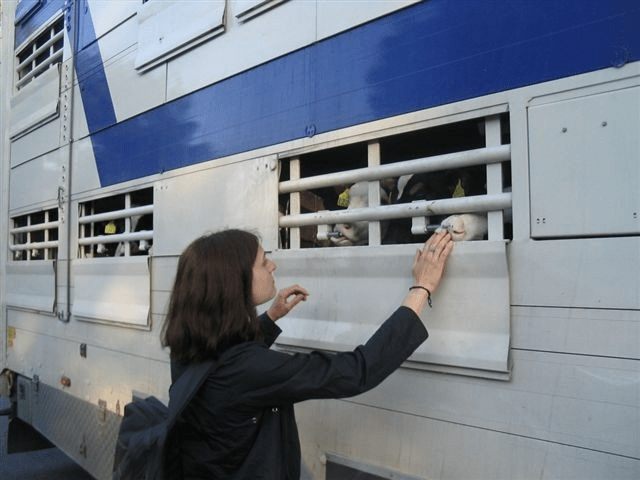
This year alone, 140,000 unweaned calves have been transported on the route between Ireland and France.
This is a journey that under normal circumstances takes around 18 hours; which breaches EU regulations as the calves ARE NOT fed a milk replacer as required. If weathers conditions are bad, then the journey can be even longer.
These very vulnerable calves, deprived of the milk from the mothers they will never see again, experience hunger, overcrowding, exhaustion and stress on these lengthy journeys. Following these sea journeys, their suffering continues as they are shipped on lengthy road journeys to the Netherlands, Spain, Italy and Poland.
Photos – PMAF / Welfarm
There is an EU Regulation that requires the unweaned calves that travel from Ireland to France; and deprived of their natural mothers milk; should be fed with a milk substitute. THIS IS NOT HAPPENING, meaning that EU rules are being BREACHED by these ferry companies.
The EU Commission also has the view that the shipment of the unweaned calves from Ireland to France BREACHES REGULATIONS.
Ask the ferry companies involved with this trade TO STOP NOW – they are Brittainy Ferries, Irish Ferries and Stena Line; all involved in these shipments of suffering. For the calves; please take action NOW – https://action.ciwf.org.uk/page/172354/action/2
We all worked together for the UK live animals export ban in 2024; and we will win this also with your help and support – Thank You.
The Dover protest days; which lasted decades actually; along with many other protests at other ports in SE England at various times, united the British people; who turned out in massive force against this abhorrent business. We cried long and hard at what we were witnessing with every shipment; but despite the utter feeling of being so helpless; there were some good times – you have to have them sometimes; right ??
In the first video you can see us all being held by the police in order to get the livestock transporters down to Dover port as quickly as they can. But as the video also shows; if you cannot stop them near to the port; then you actually go to the port to take action.
As you can see; the trucks sped through as quickly as they could. Being England; weather conditions were often foggy, raining and just dangerous with 40 plus tonnes of livestock transporter rushing past. The police attempted to intimidate protestors by filming them anywhere and everywhere as you can see; but really they had ‘lost the plot’ and had no real control. I Mark was proud to be part of all this; if there were no live animals needing our support then we would have been at home with loved ones watching tv or something ?
It was risky given the trucks speeds and the weather conditions; to this day I an still amazed that nobody was killed; unlike our beautiful Jill who was killed by a truck whilst protesting against live calf exports out of Coventry Airport. She was too lovely a person to have had her life cut short by a calf carrying transporter.
Unfortunately; today, 2025, the export of live, sentient beings across the world is still a massive business. but, the reality and cruelties of the trade are being exposed more and more all the time; take a look:
Here are all of our site links to the live animal export business:
Phil; a personal friend, and Global CEO at London based Compassion In World Farming – https://www.ciwf.org/ often came to Dover to give us all his support.
Very recently, Phil wrote an article for ‘the Scotsman’; and asking the simple question – Why, after 100 years of refrigeration, are animals STILL being transported live ? I can only guess that money is involved a lot more than animal sentience. Here is a link to the article – a great read !
So; here we are today, June 2025; still fighting hard for a global ban on the live animal export issue. Like in the UK, it was a very long campaign; but in the end, 2024 saw all UK live exports STOP. And so may this result continue across the entire planet.
Regards Mark.
Things changed for me when i was a little boy aged 8 years:
My beautiful dog ‘Sheba’; given to me by my parents when I was five years; started me down the long road of having full respect FOR ALL living creatures.
In my personal opinion; this was, is, and forever will be; a good fight, worth fighting for 110%. Glad to have been involved !
Sometimes, it feels like we’ll never learn. That our mistakes of the past are just waiting to resurface, to be repeated all over again. That our promises to do better are just window-dressing for a harsher reality. It seems particularly pertinent when anniversaries come round to remind us that something as wrong as exporting live animals over long distances, simply to be slaughtered at the other end, just aren’t necessary. And haven’t been for a long time.
And so, it was with a big sigh of disbelief that we heard the news earlier this year that Brittany Ferries was resuming live animal exports from Ireland to France. Dame Joanna Lumley and Pauline McLynn joined forces with over 120 high-profile individuals, experts and civil society organisations to condemn the decision.
Out of kilter
It seemed to particularly go against the grain as Britain had just banned live exports from Scotland, England and Wales to the continent only a year before. The ban from Britain in May 2024 finally enshrined in law the will of the people, many of whom had come out to protests around ports and docklands around the country for decades.
Finally, the voice of reason had been heard. Action had been taken to condemn a redundant and cruel trade to the history books where it belongs. Scientific evidence shows that when live animals are exported or transported long distances, they often suffer extremes of temperature and are deprived of rest, food or water.
It doesn’t take a scientist to know that putting sentient beings into lorries and taking them on journeys that can last days, causes them fear and distress.
While Great Britain introduced a ban on the live export of farmed animals last year, and Australia has announced the end of the live export of sheep by sea from 2028, the trade continues in the EU. It is a matter of shame that the EU’s current revision of its animal transport rules is appallingly weak. Journeys can last several days or even weeks, exposing animals to exhaustion, dehydration, injury, disease, and even death. Some 44 million farm animals annually have been found to be transported between EU member states and exported internationally, many of them on long distance journeys lasting eight hours or more.
The trade is flourishing owing to the rising demand for meat in some parts of the world: European companies are cashing in on the need to stock farms in countries such as Libya and Vietnam with breeding and fattening animals. For some countries – including Spain, Denmark, Ireland and Romania – livestock export is still seen as a key part of the farming economy.
Yet it is not only cruel, but also totally unnecessary.
Redundant for a Century
This year is the 100th anniversary of the invention of the first refrigerated truck. Made for the ice cream industry in 1925 by American inventor, Frederick McKinley Jones, it meant that chilled desserts, or carcases for that matter, could be transported over long distances and arrive in great condition.
From that day on, loading cattle, sheep and pigs into lorries to ship them abroad for slaughter was no longer needed. Instead, they could be slaughtered at a local abattoir and the carcases transported to wherever they are required. Refrigerated sea transport has an even longer history. In 1877, the French steamer Paraguay completed the first successful travel with its shipment of 5,500 frozen sheep carcases from Argentina arriving to France in reportedly excellent condition despite a collision that delayed the delivery for several months, thus proving the concept of refrigerated ships.
From that day on, we’ve never needed to subject live animals, often young animals just weeks old, to long distance sea journeys for slaughter or fattening again.
Blind persistence
Yet, we carry on despite clear evidence that doing so causes profound harm. Recommendations published recently by the European Food Safety Authority (EFSA), identified multiple welfare concerns in the transportation of live animals including “group stress, handling stress, heat stress, injuries, motion stress, prolonged hunger, prolonged thirst, respiratory disorders, restriction of movement, resting problems and sensory overstimulation”.
The EU is believed to be the world’s biggest live animal exporter. What fuels this outdated trade? Not need. Not compassion. Just cold, hard cash. A backward pursuit of an outdated economic model whereby animals are treated as inanimate objects and where farm specialisation has fuelled a trend towards fewer, but larger farms and slaughterhouses. Against this backdrop, meat producers aim to minimise production and slaughter costs, maximise revenues and optimise economies of scale by exploiting cost differences between member states.
spirit, innocence and blamelessness renders them defenceless in the face of unyielding, uncaring and backward-looking practices.
To throw another pertinent anniversary into the mix, this June sees the tenth International Ban Live Exports Day raising awareness of the scale and impact of these cruel journeys by land and by sea and sending a clear message to the companies that profit from this misery that it is totally unacceptable. Brittany Ferries, are you listening?
Philip Lymbery is Global CEO of Compassion in World Farming International, President of EuroGroup for Animals, a Board Member of the UN Food Systems Advisory Board, a former United Nations Food Systems Champion, an animal advocate and award-winning author. His latest book is Sixty Harvests Left: How to Reach a Nature-Friendly Future.
Environmentalist Zac Goldsmith has raised concerns about a “troubling commitment” in the Prime Minister’s deal with the EU.
Zac Goldsmith has slammed Keir Starmer (Image: Getty)
ac Goldsmith has slammed Keir Starmer’s UK-EU reset for risking the Tories hard-fought Brexit wins on animal welfare. The environmentalist warned that a “troubling commitment” in the agreement means any UK deviation from EU food standards must not “negatively affect European Union animals and goods being placed on the market” in the UK.
The former MP said: “This seemingly technical clause has profound implications for animal welfare and our ability to raise our own standards, something that we fought so hard to achieve with Brexit. “Among other things it likely means the UK cannot restrict imports of animal products that fail to meet our welfare standards – even when we’ve banned those same practices domestically.
He said around 50% of UK pork imports come from EU countries still using sow stalls – narrow metal cages Britain banned in the 90s because they were considered to be cruel.
A new sanitary and phytosanitary (SPS) deal was agreed last month to reduce red tape currently needed to import and export food and drink between the UK and the EU.
ut campaigners want the Government to clarify whether animal welfare measures fall outside the SPS agreement’s scope, or to negotiate explicit exceptions for welfare-based restrictions.
here were concerns before the deal was struck that Britain could weaken its post-Brexit animal protection laws to get a reset deal with Brussels.
But following the concerns, the Prime Minister said: “We are not involved in, nor will we be involved in, a sort of race to the bottom on standards.
“I think that British people are proud of the high standards that we have, and we want to maintain those standards.”
Sir Keir has pledged to strengthen ties with the EU since coming into office on July 4 last year.
As part of the agreement he signed, there will be more targeted checks on the movement of animals, animal products, plants and other products.
This will stop animals being held for excessive periods at the borders and lower any detrimental impact on animal health and welfare, and reduce the burden on the veterinary workforce.
There was also a commitment made on shared disease surveillance and data sharing, which will secure UK biosecurity and risk of imported diseases.
Animal welfare groups also welcomed the introduction of pet passports to replace Animal Health Certificates (AHCs), which increased burden on the veterinary workforce and hiked costs for animal owners since they came into force.
A Government spokesman said: “This government will always act in the national interest to protect Britain’s farmers and secure our food security. We have said we will uphold the highest agricultural standards and that is exactly what this deal does.”
By Lord Zac Goldsmith
Brexit undoubtedly delivered meaningful wins for animals, enabling policy changes that were previously impossible. We were able for example to ban the cruel live export of animals for slaughter and even more far reaching, we could change the way we subsidised farming to incentivise higher animal welfare and environmental stewardship. Neither of these changes could have happened without Brexit, which is one of the reasons I supported our EU exit in 2016.
And although of course I wish we had done more, the last Conservative Government did deliver a wide range of animal welfare measures, from an expanded ivory ban and banning glue traps, to much bigger sentences for animal cruelty and recognising sentience in law. Now in Opposition the Party is calling for among other things raising zoo standards.
Last month’s UK-EU Summit produced a ‘Common Understanding’ agreement which has been hailed by the Prime Minister as a significant step towards mending post-Brexit relations, generating economic benefits and streamlining trade. However, buried in the details lies a troubling commitment: any UK deviation from EU food standards must not “negatively affect European Union animals and goods being placed on the market in the United Kingdom”.
This seemingly technical clause has profound implications for animal welfare and our ability to raise our own standards, something that we fought so hard to achieve with Brexit. Among other things it likely means the UK cannot restrict imports of animal products that fail to meet our welfare standards – even when we’ve banned those same practices domestically.
Consider the immediate threats. Around 50% of UK pork imports come from EU countries still using sow stalls – narrow metal cages we banned in the 90s because they were considered to be cruel. The last Labour government prohibited fur farming in the UK, yet we continue importing it from the EU. Under the new agreement, banning such imports may be impossible, despite the stated wishes of the Government to deliver the biggest boost to animal welfare in a generation.
The agreement links UK standards to EU animal welfare rules with opt outs limited to public health and biosecurity – assessed case by case basis. So while we might still be able to ban puppy imports, as these present a public health risk, the agreement could block us from banning EU fur or even foie gras on welfare grounds alone.
This not only undermines domestic animal welfare standards but also places British farmers, who adhere to stricter regulations, at a competitive disadvantage. The problem is more acute with EU imports, our largest trading partner for food imports, not just the usual suspects like the USA or Australia.
Brexit gave us the chance to lead the world on animal welfare – to show that an independent Britain could set gold standards that others would follow. This is also about democratic sovereignty; British voters consistently support higher animal welfare standards, with 84% backing restrictions on low-welfare imports.
There’s still time to put this right, but it will require government to clarify that animal welfare measures fall outside the SPS Agreement’s scope, or to negotiate explicit exceptions for welfare-based restrictions.
While its proponents say the UK-EU reset agreement offers economic and diplomatic benefits, it’s imperative that animal welfare remains a priority. By addressing these concerns proactively, the UK can position itself as a global leader in animal welfare and ensure that progress is not achieved at the expense of the most vulnerable and the voiceless.