Two-month-old Doberman puppy was found abandoned in a park with infections caused by ear cropping
Updated: 11:51am, 17 Jun 2025
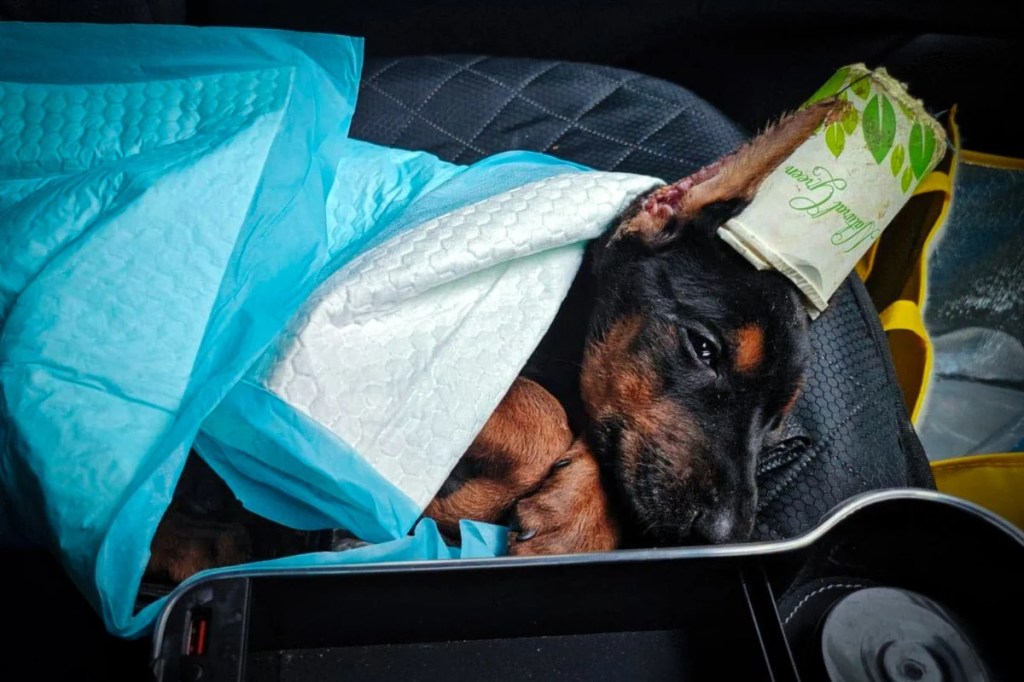

Two-month-old Doberman puppy was found abandoned in a park with infections caused by ear cropping
Updated: 11:51am, 17 Jun 2025
16 Jun 2025
MP proposes new legislation to licence rescue centres in a move supported by a major animal charity.

New legislation has been proposed which could lead to the introduction of a formal licensing regime for animal rescue centres in England and Wales.
The move has also been backed by a leading welfare group while tens of thousands of people have separately signed an online petition calling for licensing and regulation.
The Animal Shelters (Licensing) Bill was introduced to Parliament by the Conservative MP Richard Holden last week.
He said recent cases, including one in his own Essex constituency where dozens of dogs were found dead, had shocked the public and “exposed a dangerous gap in the law”.
He added: “The Bill will bring rescue and rehoming centres under the same statutory framework that already applies to kennels and breeders, closing the loophole that leaves animals unprotected.
“Mandatory licensing will drive up welfare standards, weed out rogue operators and give the public confidence that every organisation caring for dogs is properly equipped and held to account.”
A 25-year-old man is currently in custody on animal welfare and fraud charges following the discovery of 37 dead dogs at premises in Billericay in May.
A second man remains on bail, while a 25-year-old woman was arrested earlier this month. The remains of four more animals were found following a new search of the site.
Mr Holden said he had worked with both Dogs Trust and the RSPCA in developing his Private Members’ Bill.
Dogs Trust chief executive Owen Sharp said: “Good intentions aren’t enough. We need laws in place to make sure all rescue dogs are safe, cared for, and treated with the respect they deserve.
“Without proper oversight, these organisations cannot guarantee that they are operating in the best interests of the animals in their care.”
More than 50,000 people have also signed an online petition, launched prior to the Essex case, which demands licensing and regulation of rescue centres.
In its response, Defra said it would outline more details of its “overarching approach” to animal welfare in due course, but stressed that rescue groups must meet existing legal requirements.
https://news.nokilladvocacycenter.org/p/court-prohibits-shelter-from-dumping
A judge has once again determined that public ‘shelters’ will violate laws that protect animals if left unchallenged.


In a victory for animals and those who care about them, a California Court issued a permanent injunction prohibiting the San Diego Humane Society from refusing to provide shelter and care to kittens and lost cats and instead abandoning them on the street.
While the ruling supports the legality of community cat programs, including for feral cats, it requires shelters to comply with state laws regarding abandonment and animal care.
In a bid to recast the Court’s ruling against it, the San Diego Humane Society claimed victory in the case — a claim echoed by apologists for “shelter” malfeasance — even though the Court ruled gainst SDHS and prohibited them from making any changes to the program that would reduce protections for kittens and for adult cats who are social with people.
CBS originally wrote an article regurgitating SDHS’s false claim of winning:
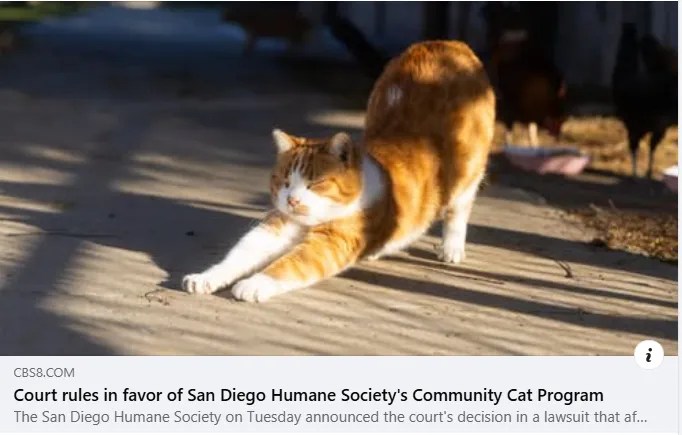
They quickly removed the article when presented with the truth:

CBS subsequently reported that “A judge found the Humane Society’s Community Cat Program violated state law…” In fact, it wasn’t a community program; it was a program that turned its back on kittens and lost or abandoned friendly cats.
What the ruling means:
California “shelters,” like SDHS, are guilty of abandonment if they release, rather than admit, friendly cats with indications of ownership.
These include:
The Court also ruled that kittens under 12 weeks old and social kittens aged 12 weeks to six months must be admitted into the shelter. It imposed a permanent injunction prohibiting SDHS from instituting changes that would reduce protections for cats and kittens.
The ruling prohibiting release does not apply to feral cats, sterilized cats found with ear tips, or friendly adult cats who do not exhibit any of the above criteria.
It wasn’t a complete victory. For example, “shelters” still have some discretion to determine which kittens must be admitted. They can also continue to kill them after admission, something that many California “shelters” do.
We need to continue insisting on — and passing laws that mandate — No-Kill policies.
The case is Pet Assistance Foundation, et al. v. San Diego Humane Society, Case No. 37-2021-00007375-CU-MC-CTL. The ruling can be found here.
Together, we will create a future where every animal is respected and cherished, and every individual life is protected and revered.
Set to open in 2026, the shelter will provide safe refuge for up to 150 animals during disasters, including goats, cows, pigs and dogs

Date: March 14, 2025
WAYANAD, Kerala—A pioneering emergency evacuation shelter designed to evacuate animals prior to disasters like floods and landslides, is set to be established in Kottathara panchayat in Wayanad district, Kerala. Situated in a region prone to multiple hazards including annual floods, cyclones and landslides, this commitment marks a significant step forward in disaster preparedness for animals in India. The collaborative project will bring together the Kerala State Disaster Management Authority, the Wayanad District Disaster Management Authority, Kottathara Grama Panchayat and Humane World for Animals India (formerly called Humane Society International India) to make India’s first such shelter for animals.
The shelter, set to begin operating in 2026, will have the capacity to accommodate up to 150 animals such as goats, cows, pigs, dogs and cats. The single-story structure is expected to include dedicated space for a veterinary clinic and a quarantine area, along with storage and equipment rooms. The shelter is intended to serve as a model for similar facilities across the country.
Praveen Suresh, disaster preparedness and response team manager at Humane World for Animals India, said: “This is an historic moment for Kerala and India from both an animal welfare and disaster preparedness point of view. It is especially significant for Wayanad district with its growing need for a dedicated facility to evacuate and care for animals during disasters like floods and landslides. While the shelter will provide immediate medical care and relief, it will also serve as a long-term resource to support animal welfare in the community. We are grateful to the Government of Kerala and the State Disaster Management Department for approving this important initiative. This animal shelter highlights the power of collaboration between multiple agencies to safeguard animals and their communities and to strengthen disaster management efforts in India.”
Over the last seven years, Humane World for Animals India has gained a notable presence in Kerala through its disaster preparedness, response and relief efforts. During the 2024 Wayanad landslides, the organization’s rescue team aided over 180 animals. Along with partner organizations, Humane World for Animals India is working to make Wayanad a disaster-resilient district for both humans and animals. Among other activities, the organization is conducting capacity building programs for the community through outreach to schools and self-help groups like Kudumbashree. Once constructed, the shelter will serve as a hub for efforts to safeguard animals and the families who depend on them during disasters and a catalyst for continued commitment to build community resilience in the face of future emergencies that put humans and animals at risk.
Please also refer to ..
13.06.2025

RSPCA rescue animal, Spotty, is one of hundreds of pets under the Darwin shelter’s care. (ABC News: Jayden O’Neill)

Bernadette Relos and husband, Nathan Calverley, are self-described animal lovers who live in a bustling house in Darwin’s outskirts suburb of Berrimah.
They have two cats and a one-year-old puppy, which they recently adopted from a shelter.
The South Australian couple who moved to the Top End for work said their “fur babies” brought chaos and destruction, but much-needed colour to their lives.
“They bring life to the household … you can be lonely, and one of the cats will jump on you, and then you’re not lonely anymore,” Mr Calverley said.

“You could walk in the front door, and everyone doesn’t say a word, but the dog will come running … and start licking you and saying hello.”
Ms Relos said they decided to adopt because they wanted pets that would grow up with their young family.
But as some are choosing to bring furry friends into their forever homes, animal shelters are seeing the opposite.
Charles Giliam, the Northern Territory’s RSPCA operations manager, said there had been an increasing number of surrendered pets due to people experiencing financial difficulties.
He said most pets being dropped on shelter doorsteps were mixed breeds, weighing around 20 to 30 kilograms, with backyard breeding worsening the situation.

“[People] bring pets to us that are often in need of veterinary treatment … and say, ‘We just don’t have the money’,” he said.
The RSPCA estimates most dog owners spend an average of $25,000 on their pet during its lifetime, while cat owners spend $21,000 on average.
The charity says that within the first year of cat ownership, people could face up to $3,500 of expenses on food, desexing, grooming, bedding, toys and treats.

Mr Giliam said the influx of surrendered pets was creating significant challenges for shelters.
“We probably got about 15 to 20 people on our waiting list who are wanting to surrender … but we are chock-a-block full,” he said.
RSPCA national data showed around 81,000 pets were surrendered in the 2023/2024 financial year, with only 27,000 finding new homes.
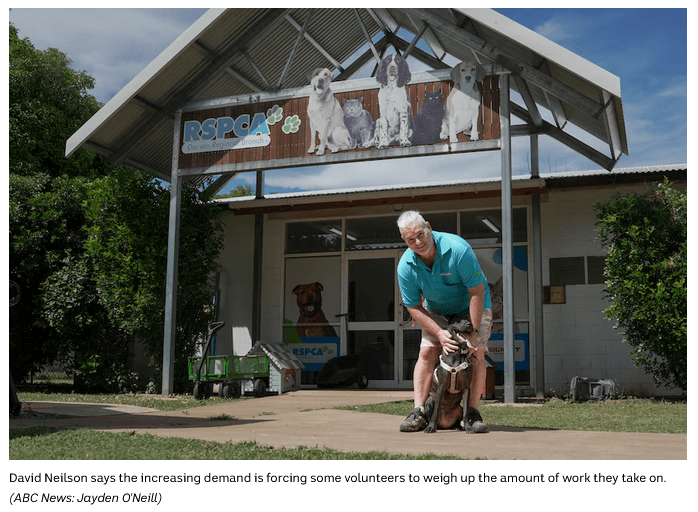
David Neilson, a volunteer at the Darwin RSPCA shelter, said the increasing demand was leaving some volunteers “overwhelmed”.
“There are so many volunteers that are here through the week to walk the dogs and sit with the cats and we are not getting through everything … it makes it difficult,” he said.
While many in the rescue sector are worried about the growing crisis, there are also concerns the NT’s animal rights laws are ineffective.
Unlike most other Australian jurisdictions, the NT does not have a formal dog breeder licensing scheme, however breeders are still expected to meet standards of care under the Animal Protection Act.
Melissa Purick, a licensed dachshund breeder, said it was “frustrating” to see people buy pets from unlicensed backyard breeders without considering the animal’s welfare.

“I would like to see that stopped to start with, where you can’t sell puppies at the markets or the side of the road,” she said.
Hannah Bohlin, an animal advocate, believes growing use of social media is glamorising pet ownership without highlighting its challenges.
She said if people adopted pets that were incompatible with their lifestyle, cost of living could become a “scapegoat” to surrender animals that were no longer valued.

She wants the NT to look at what other states and countries are doing to manage pet breeding and ownership.
“I would like to see a discussion around the possibility of introducing some kind of licence system [to own a pet],” she said.
“Some European countries do operate this kind of system to get a dog in the first place.”
The NT’s Agriculture and Fisheries Department, which oversees animal welfare, said a review of the Animal Protection Act was currently underway.
“The NT government takes animal welfare seriously and is committed to strengthening animal welfare laws,” a department spokesperson said.
Animal Welfare Coalition
https://www.dailymirror.lk/breaking-news/Animal-cruelty-still-punishable-by-Rs-100-fine/108-311404
Coalition (AWC) has raised concerns over the outdated legal framework governing animal cruelty offences in Sri Lanka, calling for swift legislative reforms to better protect animals.
According to Charuka Wickremesekera, an executive member of the AWC, the country’s current penalties for animal cruelty offences remain based on the Animal Cruelty Act of 1907, enforced through the Cruelty to Animals Ordinance. Under this ordinance, individuals found guilty of most animal cruelty offences can be fined up to 100 rupees, imprisoned for up to three months, or both. In cases involving the killing of an animal in an unnecessarily cruel manner, the maximum imprisonment term extends to six months.
Wickremesekera said that while the Sri Lanka Police continue to make efforts to tackle animal cruelty cases, the absence of robust, modern laws hinders their ability to impose adequate punishments and raise public awareness through legal action.
“It’s time to improve the legal system and protect animals better,” Wickremesekera said.
He also highlighted the growing role of social media in raising public consciousness about animal welfare issues. The sharing of videos exposing acts of animal abuse has not only discouraged such behaviour but also empowered the public to report incidents more readily.
“People now think several times before harming animals after seeing these videos online,” he said. “In the past, there may have been many cases of animal cruelty, but there were no proper organizations where people could complain. Now, many animal welfare groups receive a large number of complaints from the public.”
The AWC believes that alongside stronger laws, public engagement and awareness will play a critical role in eradicating animal cruelty in the country.
Published: 11 Jun 2025
https://euroweeklynews.com/2025/06/11/whats-up-with-spains-animal-welfare-law/

One of 500 abandoned dogs at AID – SHIN in Mijas, ready for adoption. Credit: EWN
being of pets across the country but has ended up, in the eyes of many, worsening an already bad situation. Since its introduction, animal abandonment has only increased, and animal rights are worse than ever.
Local management challenges, lack of consultation with professionals, and a perceived ideological bent: with more than 30 million pets in Spain, it was inevitable that a one-size-fits-all approach wasn’t going to work for everyone. One in three households owns at least one companion animal, and not everyone can afford the changes. In Spain, an estimated 6 million pets remain unregistered, posing potential public health risks. In 2023, 285,000 dogs and cats were abandoned, highlighting the need for stricter regulations. But at what financial cost?
The new law sets standards for pet ownership and treatment, including a ban on leaving pets alone for more than 72 hours (24 hours for dogs) and prohibiting their habitual confinement in spaces like terraces, balconies, storage rooms, or vehicles. Sales of dogs, cats, and ferrets are now restricted to authorised, licensed breeders, excluding some intermediaries and private individuals.
Breeds classified as potentially dangerous, such as Rottweilers, remain subject to strict handling rules, including licences, short leashes, and muzzles. Notably, exemptions exist for working animals, like the Spanish Legion’s goat, which can still parade on October 12, or mules and oxen in living nativity scenes, unless their owners register them as pets in the new mandatory pet registry.
Despite its intentions, the law faces hurdles that hurt. Councils are tasked with collecting stray and abandoned animals and providing 24-hour veterinary services, but many lack the funds and resources to comply. As well, local governments must manage feral cat colonies, requiring trained volunteers or staff to capture, vaccinate, deworm, sterilise, and return the cats – a costly mandate that many areas struggle to meet.
If a pet owner now wants help, they have to go to a vet. For many who already owned a pet from before the introduction of the law, vet prices are not an option. According to Fabienne Paques of AID – SHIN, an animal rescue in the Malaga Region with 500 abandoned dogs and 150 cats, ‘A dog needs a chip, and it needs a rabies shot. Before you could go to a hardware shop for that. Now, it costs a lot to go to a vet. Before it was €20, and now it’s €80. To get some dogs castrated or sterilised (as per the new law), it can cost up to €500. The new law considered pets things, items, not animals.’ The shelter has recently had an inordinate amount of pets abandoned at their gates. ‘People don’t know what to do with them. The new law brought a lot of negativity. They say it’s not true, but it’s an absolute disaster.’
A few kilometres away in the Miralmonte urbanisation, neighbours are up in arms about one of their neighbours who has several macaws and dogs which appear to be breeding amongst themselves. According to the neighbours, the animals make a terrible noise, and their droppings are attracting rats. The owner at the centre of the situation used to have a pet shop in nearby Coín but has been stopped from selling animals from the store she inherited from her parents. So, now, unable to afford to put them down, she keeps the animals at home. She cannot sell the animals by law, and the local police are reluctant to do anything as they can see both sides of the argument.
Critics of the law, including Professor Christian Gortázar, argue the law lacks scientific grounding and was driven by ideological motives, potentially threatening livestock industries by overly humanising pets. They also claim that there in no provision for pet owners with less resources to cope with the new rules.
José Luis López-Schümmer, president of the Artemisan Foundation, notes the law’s inconsistency with European legislation, which excludes wildlife from welfare regulations. The law also exempts animals raised for food, scientific experiments, bullfighting, or hunting, countering claims that it severely impacts the economy.
A year and a half after its enactment, the law’s limited consensus, even among its proposing parties, and incomplete framework have hindered its full application. Its true long-term impact – positive or negative – remains to be seen, as further data and regulatory clarity are needed to assess this polarising legislation. What is certain, in 2025, is that the situation with the welfare of animals is nowhere near being improved.
Now, unable to buy a dog from a pet shop, ACE – SHIN have a broad selection just looking for a home. Check out their website as they can arrange adoptions in may countries around Europe.
https://ace-charity.org/en/over/





 World Animals Voice