Tokyo politician released photographs from inside an ‘euthanasia centre’
Images show the procedure is anything but humane as dogs are gassed
Lawmaker hopes to highlight Japan’s stray policy and encourage debate
Published: 16:53 BST, 25 November 2015 | Updated: 21:41 BST, 25 November 2015
The streets of Tokyo may be free of prowling dogs since its zero-stray policy came into effect but the laws come at a heavy price as one politician has revealed.
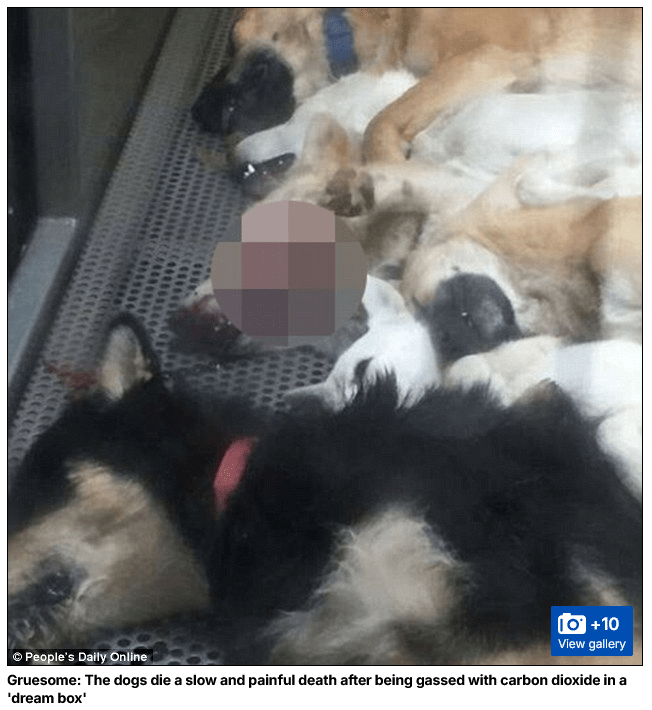
Ayaka Shiomura, a lawmaker in the Tokyo Metropolitan Assembly, recently went to visit an euthanasia centre in Japan and shown that the ‘dream box’ used to euthanise the country’s strays are anything but humane.
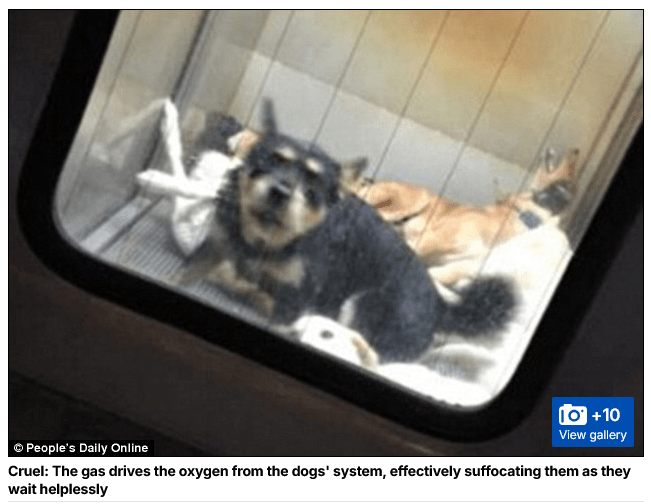
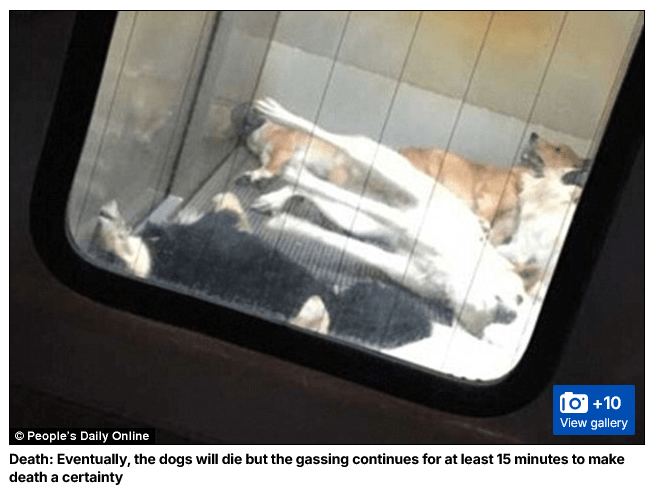
The excruciating procedure involves putting strays into a gas chamber where they are slowly suffocated with carbon dioxide and the whole process can last as long as 15 minutes, reported People’s Daily Online.
Ayaka Shiomura went to visit an unnamed facility, thought to be in Tokyo where the lawmaker is based, and posted about her experience on her website last month.
Euthanasia facilities like it are part of a zero-stray policy, which stipulates that all unclaimed cats and dogs must be euthanised in a set period of time according to Rocket News 24.
Shiomura explained in her introduction that any animals brought to the facility remains at the shelter for anywhere between three to seven days, depending on local policy.
After that time, if the animal is unclaimed, it will be disposed of.
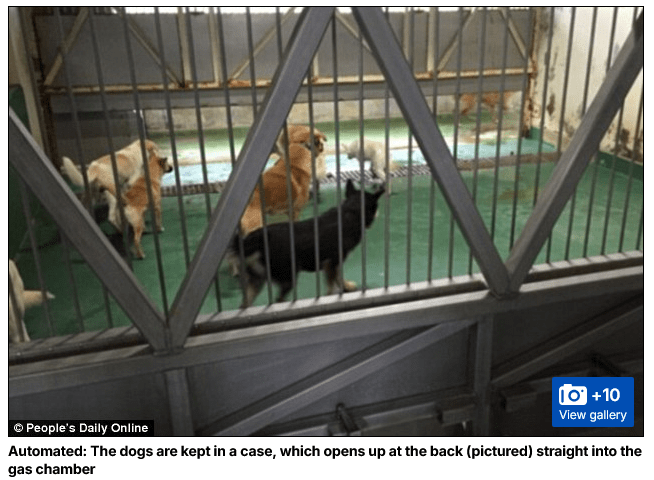
During Shiomura’s visit, 10 dogs were to be euthanised. Of those, some were thought to be pets as they still had collars on.
The dogs were kept in a cage, which has a back door leading straight into the ‘dream box’ – a romantic name that had little to do with the stark reality of the gas chamber.
The staff at the facility never have to touch the animals as they generally wander in on their own accord.
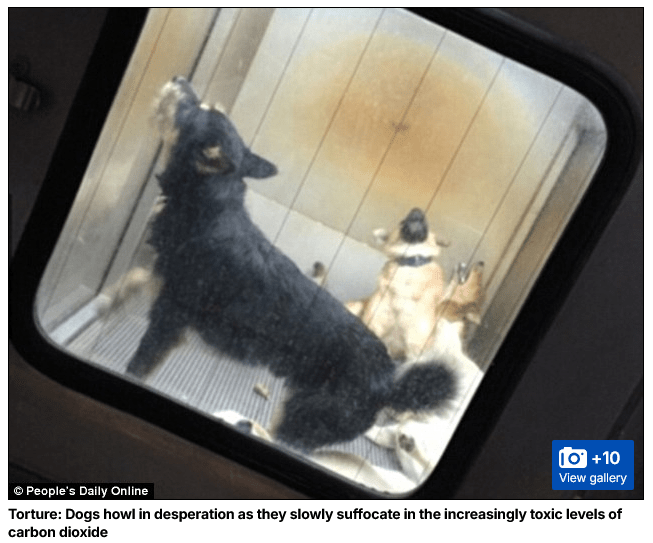
Once inside, the chamber is locked down and a button is pressed to disperse carbon dioxide into the chamber.
Elisa Allen, Associate Director at PETA, told MailOnline: ‘Death by carbon dioxide or carbon monoxide can be extremely distressing and painful.
‘Cats often slam themselves against their cages, desperately trying to escape. Dogs howl, cry and claw at the metal walls of the chambers while they’re slowly poisoned.’
The cramped gas chamber is equipped with a glass window, which allows the operator to check the procedure is complete.
Through this window, Shiomura captured the final moments of the dogs’ gruesome death through suffocation.
Shiomura described that the dogs were ‘trembling’ before the procedure but this soon became ‘panting’ and eventually ‘collapsing’.
The chamber is gassed for 15 minutes to ensure the dogs are completely dead.
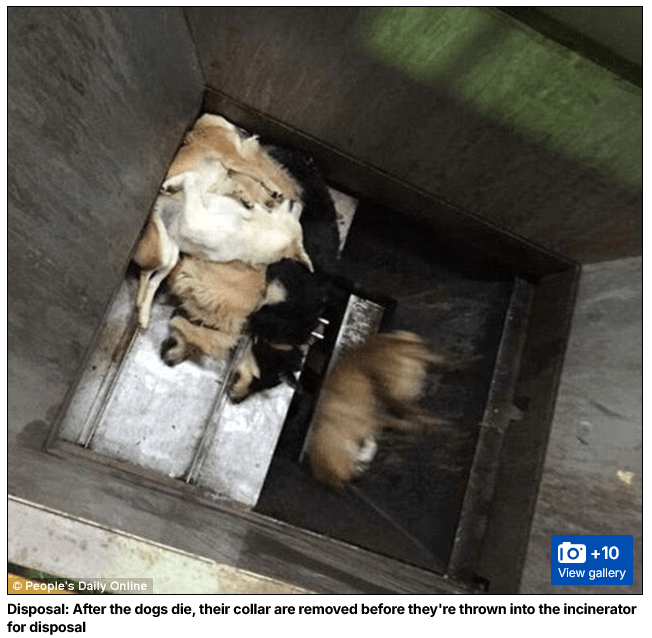
Finally, their remains are dumped into an incinerator to be disposed of.
According to news site TouTiao, Shiomura debated over whether to publish the post but felt that she needed to highlight the issue of animal culling.
She explained that in Japan, there’s around 170,000 stray dogs and cats that are euthanised in this way but the procedure is far from kind.
Shiomura hopes that more people in Japan would consider the consequences of buying a pet before making the purchase.
There are more humane ways to euthanise animals.
Elisa Allen informed MailOnline: ‘Animal shelters around the world condemn the use of such gases, choosing instead euthanasia (‘mercy killing’) by intravenous injection of sodium pentobarbital in the case of dogs, cats and animals of similar size, sometimes using other humane methods for smaller or larger animals.
‘When properly performed by caring, well-trained people – one who holds and comforts the animal and another who carefully injects the solution intravenously – euthanasia provides a painless, peaceful release.’
It can be ignored, or at least pushed aside, until one sees faces. Actual faces. We often deal with issues here that involve hundreds, thousands, of individuals – like live export, say – but when you finally look someone in the eye, it gets really difficult.
In the US, many shelters are still kill shelters, with a massive turnover, and with animals often just having a few days, before they are killed. I say killed, because the term “euthanasia” is far too widely used these days for all and sundry. Like the shooting of these 700 koalas in Australia (article on site). In my personal view, so-called euthanasia, certainly of young/healthy individuals without “need” (as in cutting short unbearable suffering), is murder.
Many shelters in the US also still “euthanise” by heart-stick and gassing. I’ve seen both, and believe me, you don’t want to know. When whole litters are places in a metal box, with expectant faces (is this a game??) and wagging tails, and the lid is closed, the gas turned on .. you’ll never again forget the screams .. as I cannot.
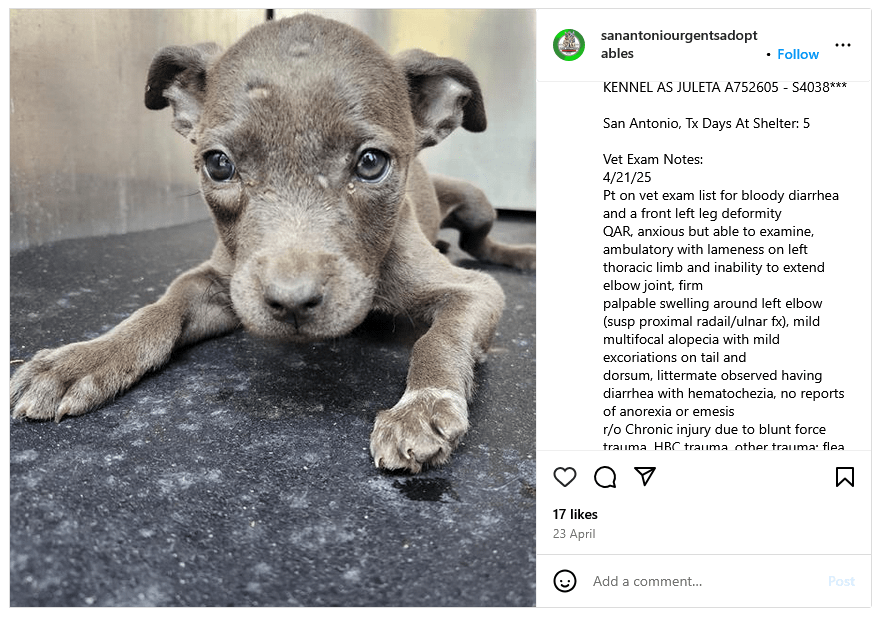
So, the “shelter” at San Antonio, TX, is but one of many, who daily kill. It serves as an example, and currently I am seeing the “Euthanasia Capacity List” several times every day, being updated every 15 mins. (!!).
Several of Parliament’s most active and committed supporters of animal welfare, from across the political spectrum, joined us in the House of Commons to learn how a number of outdated and unnecessary animal tests could be ended immediately, through our RAT (Replace Animal Tests) List.
In a productive roundtable discussion, the MPs were shown how six animal tests – which use approximately 80,000 animals every year – are still conducted in the UK despite the availability of appropriate non-animal replacements. The detailed and well-informed session covered what the six tests on animals involve, the barriers to progress, and practical steps for securing an end to the unacceptable practise of testing on animals where replacements are available.
Those present included Steve Race, a member of the Science, Innovation and Technology Committee; Alex Mayer, who played a leading role in our petition to the United Nations for a global ban on animal testing for cosmetics, in partnership with The Body Shop, which received eight million signatures to become the largest animal-related petition in history; and Irene Campbell, who Chairs the All Party Parliamentary Group on Phasing Out Animal Experiments in Medical Research, and led the recent debate on banning testing on dogs.
In recent years, the development of non-animal methods has increased significantly, and they can now replace, wholly or in part, a number of tests on animals across several product sectors.
However, our experience has been that actually replacing tests on animals takes much longer than it should. We have seen how non-animal methods available for assessing skin irritation, skin sensitisation and batch safety have taken years to be adopted and we know that tests on animals are still being conducted to provide this information. This is unacceptable.
In many cases, the problem lies with a lack of clarity from, and enforcement by, regulatory authorities, as well as the absence of a joined-up approach for acceptance of non-animal methods around the world. Since non-animal tests can be cheaper, faster and more accurate than the tests on animals they replace, it is in the interests of animal welfare and good science to speed up their acceptance and to expand their use.
Overcoming these remaining hurdles, so that these tests on animals can finally be fully replaced, is a matter of urgency.
The six tests we discussed were for the assessment of skin irritation, skin sensitisation and eye irritation; routine batch testing of veterinary vaccines; potency testing of Botox samples; and the production of antibodies.
Botox batch testing involves injecting Botulinum toxin into the abdomens of mice. Over three days they become increasingly paralysed, and if left the mice given the higher-level dose will slowly suffocate to death. Approximately half of the mice die during the test and all survivors are killed at the end of the test. Nearly 50,000 of these tests were carried out in the UK in 2023, despite the world’s major Botox manufacturers developing an alternative cell-based test.
For antibody production, animals – including mice, rabbits, sheep, and goats – are used as ‘factories’ to generate large numbers of antibodies. An injection stimulates the animal’s immune system to produce specific types of antibodies – but this often causes harmful side effects before their blood is taken to harvest the antibodies. Animals are killed when they are no longer useful. Phage display technology – awarded the 2018 Nobel Prize in Chemistry and endorsed in 2020 by the EU Reference Laboratory for alternatives to animal testing – can be used to produce a wide range of antibodies that are of higher quality, more stable, more relevant and more reproducible than the antibodies produced in animals. They are also much faster and cheaper to produce.
See the full RAT (Replace Animal Tests) List on our website.
Our Head of Public Affairs, Dylan Underhill, said: “People may assume that tests on animals which have non-animal replacements available are no longer conducted, or at least rarely – but the reality is that such tests can continue, and even increase long after the adoption of suitable alternative methods. It was great to see MPs engaging with the issues and statistics behind our RAT List – politicians can play a vital role in overcoming the problems which prevent the adoption of new non-animal tests. This isn’t just about science, it’s about political will too. With the government working on its manifesto commitment to phase-out animal testing, ending these six tests represents a significant but easily-achieved first step towards that aim.”
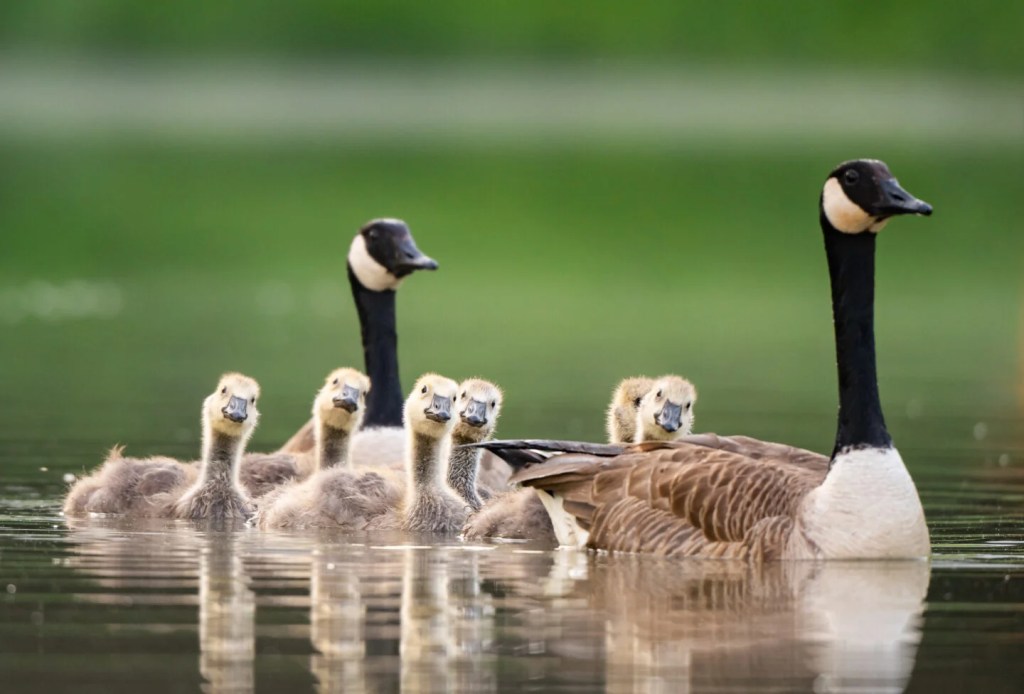
It’s getting closer to the time when the USDA comes into New Jersey to kill Canada geese. As we’ve mentioned in previous alerts, APLNJ has been reviewing USDA reports to see who contracts with them for geese management. This is the time of year when towns/businesses, etc. contract with the USDA, so writing NOW is critical.
We have reached out to all of them, sent information and visited the site with some. We’ve had success in steering some away from lethal towards nonlethal. But others are still hell-bent on allowing the killing (with a portable CO2 gas chamber).
The individuals you will be sending a letter to either allow the USDA, in partnership with Teterboro Airport in Bergen County, to come on their property, which lies in the flight path of airplanes, and round up and gas the geese OR have their own contract with USDA Wildlife Services to come in and kill.
Instead of allowing the USDA in year after year to kill, they all should be looking into habitat modification which is the clear winner when it comes to options for keeping geese out of a specific area. These methods are highly effective and provide better protection for air traffic areas. In fact, at best it’s irresponsible to not use the most effective methods, at worse, is can be dangerous, providing a false sense of security.
Please urge these entities to DENY THE USDA ACCESS to their property and schedule a site visit with Animal Protection League of New Jersey instead. Click here to send a letter.
And a second letter is going to those who have their own contract with USDA and we are asking them to CANCEL THE CONTRACT. Click here to send that letter.
Published: May 05, 2025 at 02:30 PM Author: PENNY EIMS
Santa Ana, CA – On April 23, Santa Ana Police executed a search warrant at the home of Alejandro Acosta Oliveros in the 2300 block of W. Wilshire Avenue. The 45-year-old man found himself facing felony animal cruelty charges for abducting and killing what police say are “a lot” of cats in the area.
Via Santa Ana Police Department
Though Oliveros had “evidence” of killing cats inside his home, AND he confessed to slaying felines, he was released from custody shortly after being apprehended.
People living in the area where Oliveros abducted and killed cats are outraged that this CONFESSED cat killer is once again on the loose after posting bail. There are even reports from an area cat rescue that Oliveros has ALREADY killed another cat after being released from custody.
Residents had been reporting the cruel incidents to the authorities for weeks with victimized families sharing their horror stories on various social media outlets, including the Nextdoor neighborhood platform.
Families said Oliveros lured cats and then tortured and killed them in various ways. One person said, “Hello! I’m near El Salvador Park, and my neighbor’s cat was killed by a man who injected it with some sort of substance.” Another person said they found their cat hanging from a tree. People who witnessed Oliveros committing crimes say he lured cats with food, then stepped on them when they got close to him.
Cats slain/screengrab via Fox 11 News
This man is clearly a danger to cats in the area, and a danger to society as a whole. Animal Victory needs your support to show court officials that the prosecution of this man MUST be taken seriously. The District Attorney’s Office has told Animal Victory that a case number has not yet been assigned, but we will be working to ensure that this does not fall through the cracks. Please add your name to the petition today!
Target: Orange County District Attorney’s Office
WHY THIS PETITION MATTERS:
We, the undersigned, demand Alejandro Acosta Oliveros be held accountable for his cruel actions, resulting in the deaths of more than a dozen innocent cats. We collectively insist that this man NOT receive a plea deal – he is a dangerous individual who MUST be brought to justice.
Research has consistently shown a strong link between animal cruelty and human violence. Individuals who commit such heinous acts against animals often pose a threat to society as a whole, as animal abuse is frequently a precursor to other violent crimes. Failing to hold this man accountable not only denies justice for the suffering and death he caused but also endangers the community at large. It is imperative that we send a clear message that such cruelty will not be tolerated.
Individuals are presumed innocent until found guilty in a court of law. Animal Victory relies upon the authorities and the court system to determine guilt or innocence.
Note: Statement released from the Santa Ana Police about Oliveros’ release from jail, “The suspect in the recent animal cruelty investigation was arrested last week and he later posted bail. We recognize the strong emotions this case has generated and ask the public to please allow the judicial process to take its course.
Kruger Park rangers on the poisoning scene. (Photo: EWT)
08 May 2025
Eighty-four vultures have been rescued after a mass poisoning event in the Kruger National Park, one of the largest incidents of its kind recorded in southern Africa.
An elephant carcass, laced with poison and surrounded by more than 100 dead vultures, marked one of the most devastating wildlife poisoning events yet seen in the Kruger National Park. Remote sensing triggered a scramble to save birds that were still alive.
In a coordinated emergency operation spanning helicopters, ambulances and nearly 24 hours of intensive care, 84 poisoned vultures were pulled back from the brink.
The operation this week was undertaken by a combined team of South African National Parks rangers and Endangered Wildlife Trust (EWT) officials in the park’s Mahlangeni Section, where the elephant carcass was found.
According to Gareth Tate, head of EWT’s Birds of Prey Programme, the organisation’s wildlife poisoning detection system triggered an alarm, flagging suspicious activity.
“The following morning, SANParks rangers conducted surveillance and uncovered a mass poisoning event involving more than 120 dead birds,” Tate said. “It was a shocking, gruesome scene.”
By 8.20am the joint team had arrived on site. They discovered 122 dead vultures, including 102 white-backed vultures, 20 Cape vultures and one lappet-faced vulture – all species listed as endangered or critically endangered. Several vultures were found alive but severely affected.
Tate described the rescue as a “world-class operation” involving two ground teams, helicopters, 12 vehicles and the EWT’s specialised Vulture Ambulance. Emergency treatment was administered in the field, including atropine to reverse the effects of the poison on the birds’ nervous systems, activated charcoal to bind toxins, fluid therapy and a procedure to flush and milk the vultures’ crops to remove ingested poison.
“We’ve developed a strict protocol over the years and we’ve achieved about a 98% success rate for birds found alive,” Tate explained. “Those first 24 hours are critical. If we can get them through that, they have a good chance of survival.”
Vultures were being deliberately targeted both to conceal illegal activities and to harvest body parts for the illegal wildlife trade and traditional medicine markets.
A total of 84 vultures were rescued alive. Of these, 45 were transported in the EWT’s mobile vulture ambulance and 39 were taken by helicopter to care facilities. Five of the rescued birds died despite treatment, but 83 remained alive as of the following morning, representing a 96% survival rate.
SANParks Pilot Bradford Grafton with one of the rescued vultures. (Photo: SANParks)
Eighty-four vultures have been rescued by a joint team of SANParks rangers and Endangered Wildlife Trust (EWT) following a devastating poisoning incident in the Kruger National Park. (Photo: EWT)
Reinforcements were swiftly deployed. Support teams from the Moholoholo Wildlife Rehabilitation Centre, Briner Veterinary Services and Wildscapes Veterinary Services were mobilised within hours and worked through the night to stabilise each bird and keep them alive.
“This was one of the largest and most coordinated vulture rescues ever conducted in the region,” Tate said. “The collaboration between SANParks, vets, NGOs and rangers was remarkable.”
This is intentional genocide of vultures. It’s absolutely malicious and a silent killer.
The poisoning involved agricultural toxins placed on an elephant carcass, a method increasingly used by poachers to kill vultures that might otherwise alert rangers to poaching sites by circling overhead. Tate said vultures were being deliberately targeted both to conceal illegal activities and to harvest body parts for the illegal wildlife trade and traditional medicine markets.
“Vultures are being systematically removed from the landscape,” Tate warned. “This is intentional genocide of vultures. It’s absolutely malicious and a silent killer.”
“They’re targeting vultures for their brains, heads and feet,” Tate said. “There’s even evidence that poisoned vulture parts are ending up in muti markets, meaning that toxic substances are being sold to unsuspecting users.”
Broader crisis
This incident forms part of a broader crisis facing vultures across southern Africa. The birds play a key role in ecosystems by consuming carcasses and reducing the spread of disease. Their absence leads to carcasses lingering longer in the environment, increasing the risk of disease transmission to other wildlife and humans.
The decline of vultures has been linked to knock-on effects seen in other regions: in India, the collapse of vulture populations due to veterinary drug poisoning led to a boom in feral dog numbers and a corresponding rise in rabies cases.
Kruger hosts at least five regular vulture species: the white-backed vulture (Gyps africanus), the most common; the Cape vulture (Gyps coprotheres), mainly found in the park’s north; the lappet-faced vulture (Torgos tracheliotos); the hooded vulture (Necrosyrtes monachus) and the rarely seen white-headed vulture (Trigonoceps occipitalis). Each species occupies a niche at carcasses, forming an efficient clean-up system.
Each adult vulture killed is not just an immediate loss – it’s a loss of future generations.
However, their numbers are declining due to a number of pressures. Many species breed slowly, raising only one chick per year. Their nesting habitats are shrinking as large trees along rivers are lost, often from increased elephant activity. Without sufficient nesting sites, reproductive success drops. Poisoning events exacerbate these losses, wiping out breeding adults and chicks alike.
Poisoning incidents targeting vultures have increased. Poachers use pesticides like carbofuran, a highly toxic agricultural chemical, to lace carcasses. Vultures that feed on the poisoned remains are removed as natural sentinels from the ecosystem. Other scavengers, including jackals, lions, hyena and ground hornbills, also fall victim.
“Unlike targeted poaching of individual animals, poisoning takes out entire species indiscriminately,” Tate said. “Each adult vulture killed is not just an immediate loss – it’s a loss of future generations.”
Efforts to address the issue include increased patrols, training poison response teams and establishing artificial feeding sites to provide uncontaminated food. Conservationists stress that long-term solutions will require stronger regulation of agricultural poisons, improved enforcement against wildlife crime and engagement with communities living near protected areas.
Community outreach initiatives by the Kruger Park have begun, aiming to reduce demand for vulture parts in belief-based practices and build support for conservation. However, scaling these measures to meet the size of the problem remains a challenge.
Tate emphasised the need for stricter penalties for those responsible. “These individuals need to be caught and the penalties must reflect the seriousness of the crime – they’re killing critically endangered animals.”
Natural waste disposers
The rescued vultures continue to recover under veterinary care and will be released once they are fit to return to the wild. “Some of them are so strong that we’re planning to release them this Saturday,” Tate said.
Conservationists hope the surviving birds will resume their vital ecological role as natural waste disposers, limiting the spread of disease in the ecosystem. The poisoning incident highlights the vulnerability of vultures to deliberate targeting, the ecological consequences of their decline and the urgent need for interventions.
“Without vultures, carcasses take longer to decompose, leading to increased risks of disease,” Tate said. “Their loss disrupts a delicate balance. We need to act now to protect them.”
As the surviving vultures recover, conservationists warn that the battle to save these birds is ongoing. Preventing future poisonings, preserving nesting habitats and raising awareness about their ecological importance will be essential to ensure that vultures remain part of Kruger’s skies. Each circling silhouette is a sign that the clean-up crew is still at work, maintaining the health of the ecosystem for wildlife and humans alike.
So – here we go. Found this truly wonderful publication serving the good people of Michigan, and their clearly totally derailed connection to nature and all that lives within her. Calls itself the “Michigan Enjoyer” (?????). Your average nutcases’ daily publication.
Far be it from us to give this filth a forum here, we think we need to show what happens out there in remote uncivilised corners of the North-American continent – the better to understand why it is the US is such a great, internationally respected leader of the free world ….
Right – tell you what’s cool: seeing these guys hang head down from a tree with a small fire underneath .. if they’re so keen on the Wilds, and bygone times of “Adventure” and all that “strong men” shit, bring back the scalpers and skinners of the white invader! Clearly it’s been too long …
And as if that wasn’t enough from lovely Michigan, here’s more: (Nuisance???)
A new lethal and legal way to deal with nuisance geese will be implemented in Michigan this year. As annoying and bullish as these Canada geese may be, I still don’t feel very good about this new method to remove them. Here’s what we know so far:
According to a report from MLiveMichigan is moving forward with the new pilot goose removal program– despite pushback. While the state isn’t exactly encouraging the gassing of nuisance Canada geese it will be permitted in certain circumstances.
Canadian Geese v. Canada Geese
There is a difference. I, like many, have referred to the black and brown geese spotted all throughout Michigan as “Canadian geese” in the past however that’s not quite accurate. The term Canada goose refers to a particular species, Branta canadensis, while grammatically, the phrase Canadian goose could refer to any goose from Canada. Get it?
The Michigan DNR has long offered help and relocation services to private landowners and has even adapted hunting regulations when it comes to Canada geese in particular, but what are landowners, businesses, and golf courses supposed to do when they exhausted every option? DNR Wildlife Biologist and Acting Waterfowl Specialist Kaitlyn Barnes told MLive,
Why is This Necessary?
Not only is the highly contagious bird flu a factor but think about all the nuisance geese that pester children and families at parks, loiter outside nursing homes, and leave so many droppings that beaches are forced to close due to E.coli. I hadn’t even considered this, but MLive mentions goose feathers and feces can clog pipes at local wastewater treatment plants.
Again, I understand why this would all be necessary but I really don’t think it’s fair to the geese and their young. I’m not for the killing of innocent animals and that’s exactly what they are!
********************
Update: More Animals Added to Michigan’s Year-Round Hunting List
The Michigan DNR has added the following animals to the state’s year-round hunting list. Land owners may kill these animals on their property with no special permits required.
Gallery Credit: Lauren Gordon
FOX SQUIRREL
According to the Michigan DNR nearly 70% of the state’s Fox Squirrel population can be found in southern Lower Peninsula of Michigan. You’ll see them everywhere from forest to farmlands to city parks– and everywhere in between.
GRAY SQUIRREL
Also called the Eastern Gray Squirrel, these critters typically nest and live the majority of their life within a single nest tree and is the least social of Michigan’s six squirrel species.
BEAVER
The majestic beaver was added to Michigan’s year-round kill list as their dams can cause flooding and block culverts.
MUSKRAT
It’s hard to tell a beaver from a muskrat, but the difference is in the tail! The Michigan DNR warns that muskrat burrows can weaken shorelines, dikes, and riverbanks.
COTTONTAIL RABBIT
Poor, Peter Cottontail. Much like squirrels, these rabbits are known to chew through structure or equipment wires.
Animals You Can Hunt All Year in Michigan
Gallery Credit: Maitlynn Mossolle
RUSSIAN BOAR
Uh…yeah…did you know these even exist here in Michigan because we sure didn’t until we saw the DNR say you can freely hunt these all year! According to Michigan.gov these are a highly invasive species that were only introduced either by “Intentional release” or “escape from captivity.” They are particularly dangerous which is why you are welcome to hunt them and encouraged to report when you do see them.
OPPOSSUM
While some may think these critters are pretty cute, they are also commonly known to be pests. That’s why, though people may not actively hunt these for their meat or for the “thrill of the hunt” but if you happen to kill one that’s been rummaging your trash, harassing your pets, etc. you are welcome to kill them as well.
FERAL PIGEONS
Now we’re not entirely sure what the difference is between regular pigeons and “feral” ones but the Michigan DNR says you can hunt the feral ones as you please. We assume there are some people keep for pets for some reason?
RED SQUIRRELS
Now, regular squirrels are pretty cute and pretty harmless (for the most part) but RED SQUIRRELS…well, they were put on this Earth for one purpose: Chaos. They get into everything, chew on electrical wires and just really do not know their place other than to ruin everything. The Michigan DNR says you are welcome to kill them as much as the day is long.
WOODCHUCK “How much wood could a woodchuck chuck if a woodchuck, could chuck…” Yeah, these critters may have inspired a fun little rhyme but at the end of the day, MSU Extension’s Fisheries and Wildlife division says you can kill them if they are causing damage to private property. And boy, can it be extensive.
HOUSE SPARROW
Now these birds may look all teeny and cute, but MLive reports they are known for displaying behavior that can threaten the survival of other birds. You can CLICK HERE to read more but long story, short, these little guys are actually kind of a**holes. You are welcome to shoot them all year, though, it may be easier to find some way to trap them instead.
PORCUPINES
We probably don’t have to go into too much detail about what is wrong with these animals and why you are able to hunt them year-round…however, a point we would like to make is that people had pet hedgehogs forever and they’re basically just mini porcupines, no?
GROUND SQUIRRELS
Am I missing something here, these are what we commonly refer to as “chipmunks” right? Has our entire lives been a lie? Should it really be “Alvin and the Ground Squirrels”? Anyways, here is yet another animal that probably needs no explanation as to why you can kill it year round with no interference from the Michigan DNR…just don’t get ridiculous with it…that could mean you have some deeper issues.
STARLING
Much like the house sparrows, Starlings also pose a threat to other native bird species. Michigan.gov says, “English sparrows, feral pigeons, and starlings may be taken by hunting statewide, year around except within state park and recreation areas from April 1 to September 14.”
WEASELS
While like other animals on this list, weasels are cute, but they are considered pests here in Michigan. Of course, with our state’s history in the fur trade it’s not all that surprising, yet it still somehow is. According to Michigan.gov, “Opossums, porcupines, weasels, red squirrels, skunks, ground squirrels, woodchucks, and feral swine may be harvested year-round, statewide with a valid Michigan hunting license. There is no bag limit for these species.”
SKUNKS
As mentioned with the previous critter, skunk is still part of Michigan’s fur trade which means you are open to kill them. However, I have to wonder, are they like stink bugs where if you kill them, it releases the stench? Someone please explain.
. and so forth …
It truly does make you wonder about the clearly highly disturbed mental health of the people of Michigan, or certainly a large portion. What, one cannot but wonder, do they do with themselves, if they do not go out and kill wildlife???
Little Dog Is Welcomed As Monastery’s Cutest New Friar
“All of the brothers love him very much.”
In Catholic tradition, St. Francis of Assisi is the patron saint of animals — so perhaps it’s only fitting that one of the newest followers to join his order is quite literally a dog.
The Franciscan monastery of Cochabamba, Bolivia, recently announced that a furry pup, named Carmelo, had joined its sacred fold, where he quickly distinguished himself as its cutest member.
In honor of his new position, the dog even earned a more formal title: Friar Bigotón (that’s Spanish for “mustache”).
He also got a tiny Franciscan habit to wear around his new home.
Prior to being adopted, Friar Bigotón lived as a stray. But now, as the monastery’s resident pet, things couldn’t be better.
“His life is all about playing and running,” Jorge Fernandez, a fellow friar, told The Dodo. “Here, all of the brothers love him very much. He is a creature of God.”
Apparently, running and playing aren’t the dog’s only duties.
Most importantly, though, Friar Bigotón’s biggest role is in helping other pups like him.
Carmelo’s adoption was made possible by a local animal rescue group, Proyecto Narices Frías (Cold Nose Project), which hopes his story will serve as an inspiration for more monasteries to open their doors to needy pets.
Image credits: Kasper Mariusz Kaproń Ofm
“If only all the churches of our country adopt a dog and care for him like Friar Bigotón,” the group wrote in a post on Facebook, “we are sure that the parishioners would follow his example.”
(The Franciscan Order, founded by S. Francis of Assisi, to this day, takes a keen interest in environmental issues – attends the COP Climate Change Conferences – and animal welfare, in accordance with the teachings of their founder)
The link has been established many times, with serial killers especially, who started with animals in their youth, and later migrated to people. We, and others working on the “Cat Torture” issue have warned against the perpetrators in China and elsewhere (as this material is spread globally via Social Media) eventually performing that same migration. Obviously, that does not mean the animal abuse is negligible so long as it stays there. Far from it. On the contrary – as, it has been said many times before, that the more helpless a creature, and so a victim, is, the more deserving it is of compassion. There can be no more helpless party, in a human society, that largely denies them any rights and/or equal consideration in respect to freedom from pain and suffering, than an animal.
One such example, which I remember well – as I have seen the material (meaning: videos) at the time – concerning a now 42-year old native of Canada, is one “Luca Rocco Magnotta”.
He came to fame, if that’s the phrase for what he did, when he murdered and dismembered his boyfriend in 2012. He was eventually apprehended in Berlin, and is currently imprisoned, for life. What I remember him best for, though, is …
.. which, in 2019, was the subject of a “True Crime Miniseries”, called, “Don’t F**k with Cats: Hunting an Internet Killer“
It cannot be stressed often enough that the nice guy next door carrying the little old ladies’ shopping upstairs might be a raving pervert, spending his time torturing animals, and hatching plans to do same to people. Not all of them are as obvious as this one last year ..