
https://apnews.com/video/animal-cruelty-mexico-city-e3c0eea62b1e450da47c42e71b18a2a6
Hundreds take to streets of Mexico City to advocate for better animal rights
Excellent folks, well done all of you for being a strong, united force !
Regards Mark
https://apnews.com/video/animal-cruelty-mexico-city-e3c0eea62b1e450da47c42e71b18a2a6
Hundreds take to streets of Mexico City to advocate for better animal rights
Excellent folks, well done all of you for being a strong, united force !
Regards Mark




24 June 2024
Press Release
As accession negotiations between the EU and Ukraine start this week, Eurogroup for Animals highlights the need to prioritise animal welfare in the discussions, to ensure that through the right support, Ukraine elevates its standards to match those envisioned in the Union.
The accession of Ukraine to the EU is an opportunity to improve the lives of millions of animals, given Ukraine’s substantial livestock agriculture. At present, Ukraine represents the second largest egg producer after France, and has the fourth largest poultry sector. Agricultural products account for 41% of Ukraine’s exports, with animal products estimated to make up almost a third of this, most of which are poultry and eggs. In 2023 alone, millions of animals were farmed and slaughtered in the country, of which 712 million poultry. Yet, current animal welfare standards in Ukraine fall below current EU standards.
While it is welcome that Ukraine is already taking steps to match EU standards through the adoption of rules on keeping farm animals, it is crucial that negotiations reflect upcoming EU standards, like cage free-farming. This will allow producers to make future-proof investments, avoiding additional changes and costs in the coming years, and ensuring that Ukraine is already aligned with standards in other Member States when accession is complete. The EU should support this transition by providing details on the upcoming animal welfare legislation and through adequate support to joining countries.
This should also apply to the implementation of other animal-related EU laws, such as protection of wildlife and biodiversity, which have been significantly threatened by Russia’s war in Ukraine, as well as animals used in science and companion animals.
These negotiations also offer a chance for the EU to rethink its farm policies, particularly in ensuring that funds are not supporting unsustainable farming practices.
Considering the scale of agriculture in the country, Ukraine would be eligible for a quarter of the CAP budget, sparking discussions on the current payment model based on hectares. These policies should include stronger conditionality to the improvement of animal welfare and supporting transitions from intensive farming to a resilient, sustainable one.
The accession negotiations coincide with the next legislative term, a crucial one for animal welfare: the European Commission must come forward with revised animal welfare legislation that provides adequate protection for all farm animals, from farm to slaughter, while a concrete timeline and action plan for ending cage farming should be a priority.
We welcome the start of negotiations with Ukraine to join the EU, and hope that the chance is used to elevate the lives of millions of animals in the country. Failing to support Ukraine to transition to anticipated EU animal welfare standards would lead to a two-speed Europe, which would not only be bad news for the animals but also for EU consumers and producers. It is therefore vital that the EU comes forward with revised legislation and an action plan to end cage farming across the continent, including in Ukraine, as soon as possible.
Reineke Hameleers, CEO, Eurogroup for Animals
Regards Mark
Years of campaigning against this infamous public “festivity” have sadly not yet resulted in it being closed down. Change, unfortunately, is slow in coming, and this year again many dogs and cats will be cruelly slaughtered.
However, there is hope. Increasingly Chinese activists and organisations stand up against this atrocity, and as we all know that is the most important part of it, as criticism coming from outside the country, and/or “the West” is often seen as ignorant of Chinese culture and customs.
So here some current news on what is happening on the ground.

Pigeons are unable to remove threads or human hairs from their own feet, and tangles can easily escalate to deadly or debilitating proportions (Credit: Paul Themis)

Paul Themis also rescued an albino crow, Albi, who was being bullied – by other crows (Credit: Paul Themis)

An ongoing fight between residents and animal rights activists over whether to cull pigeons in a small German town has led to an uproar — even though a majority of the residents voted in favor of culling the birds in a referendum earlier this month.
On Thursday, officials in the central German town of Limburg were still considering whether to proceed with the referendum results.
Click on Link above for full story
—————————

Meanwhile; in London;
Shit hot London firefighters rescue pigeon in distress.
There are some brilliant animal people in London.
Firefighters rescue tangled-up pigeon
Why you may have seen crews and a big ladder on the Holly Lodge Estate this week
A CROWD gathered as firefighters climbed an aerial ladder to save a pigeon tangled-up at the top of a tall tree.
There was a round of applause as teams from Kentish Town and Soho freed the squawking bird that had become snared to a branch by string wrapped around a foot.
It had been spotted “dangling and almost lifeless” in the Holly Lodge estate, Highgate, by Sabrina Bordin of the London Pigeon String Foot and Rescue group.
The group’s co-founder Karen Heath praised the “absolutely amazing” firefighters, adding that the pigeon had been named Aerial after the ladder used to rescue it. It is being nursed back to health in a member’s home before being released close to the spot it was found in the hope it can be reunited with its one true love.
https://www.camdennewjournal.co.uk/article/firefighters-rescue-tangled-up-pigeon


The bird has been named ‘Arial’ after the ladder used to rescue it.
Feral pigeons were made by humans.
Now we detest them. How did things go so wrong?
*This article contains details and images that some readers may find distressing.
I’m perched on the edge of a paving slab, watching as Lisa Davies produces a baby-pink manicure set from her rucksack, and opens it up on her lap. Inside is an assortment of tweezers and nail files, as well as a mysterious spoon that I’ve since learned is an ear pick. Like a surgeon arranging her instruments before an operation, she runs her hands over them, and selects a pair of nail scissors.
It’s a hot, sticky Sunday afternoon at St Anne’s churchyard, in London’s Soho district. Groups of teenagers are lounging on the grass, while shirtless men play table tennis in the background. But further into the park, a less typical summer scene is unfolding. A group of volunteers is clustered around a flock of 50 pigeons, watching their feet intently. One is limping.
The young pigeon’s feet are swollen, bound up in a tangle of long, dark human hairs and cotton threads – the detritus of city life, picked up over many months of walking alongside pedestrians. This is a classic case of “string foot”, and without human help, it will gradually cut off the blood supply to her toes and feet, until they fall off altogether. But she is one of the lucky ones. With impressive confidence and precision, Davies – a part-time student studying conservation education at the University of Chester, who has been volunteering with pigeons for the last 18 months – thrusts her arms forward and gently plucks the bird from the crowd. She secures it under her t-shirt which, fittingly, features a pigeon print, and pulls out a dinosaur-like foot. It takes around half an hour of careful tugging and snipping before the hairs have been removed, and the bird can be released in a flurry of feathers.

Many volunteers carry their pigeon de-stringing tools with them at all times, in case they happen upon a pigeon that needs help (Credit: Zaria Gorvett)
Davies is part of the London Pigeon String Foot and Rescue group, an organisation that aims to help the city’s approximately three million feral pigeons. The volunteers meet up every Sunday, all year long, to tend to the mangled feet of pigeons across the city. As I ponder this noble sacrifice, I’m snapped out of my reverie by a commotion – on the street below, a man is chasing a pigeon “for a joke”, sending a tempest of panicked birds into the air.
City pigeons are among the most detested animals on the planet. After a series of misunderstandings going back decades, they’ve become widely regarded as dirty, disease-addled and akin to “flying rats”. Horrific injuries are often accepted as a consequence of their desperate, downtrodden existence, and their penchant for life alongside humans is sometimes resented as annoying or unhygienic. But it hasn’t always been this way. For millennia, pigeons were viewed with respect and even reverence. One Mughal emperor was such a big fan, he carted around 20,000 of the birds wherever he went, while the Victorian scientist Charles Darwin – who at one point had a flock of 90 – was reportedly obsessed with them. How did our relationship with these creatures go so wrong?
A parallel existence
Along the rocky coastline in the Outer Hebrides, perched on top of cliffs and abandoned buildings, are familiar faces: grey heads with large orange eyes, peeking down at passersby. They belong to rock doves, Columba livia. But though these birds look almost identical to the feral pigeons found in cities, they are not the same. This remote Scottish outpost has one of the wildest populations of rock doves on the planet – it’s one of the last places where they have clung onto a substantial proportion of their original, ancestral genetics.
Feral pigeons, on the other hand, are an entirely different case. They belong to the subspecies Columba livia domestica, and are almost exclusively descended from domesticated birds, which have provided a steady trickle of escapees to hang around human settlements over the last 4,000 years. There are subtle variations in the ancestry of populations from one region to another, depending on the specific breeds traditionally kept in that part of the world – but at some point, the family tree of the vast majority of feral pigeons would lead back to birds bred by humans.
As a result of this lineage, feral pigeons are extraordinarily trusting of humans, and drawn to environments with a high density of people.
Paul Themis, known among the wildlife rescue community as Paul Leous Pigeon, is a pigeon rehabilitator from London. He has been helping pigeons in the city for the last 17 years, and co-founded the London Pigeon String Foot and Rescue group five years ago. So far he estimates that he has rescued more than 1,000 pigeons, and he now lives with at least 20 former patients – he won’t tell me exactly how many – who roam free around his house.

Feral pigeons can be extremely affectionate towards humans, and form strong bonds with the people that care for them (Credit: Paul Themis)
Themis has rehabilitated both wild and feral pigeons over the years, and explains that there’s striking difference in their behaviour. Take the common wood pigeon – a large, handsome bird with white and iridescent green splodges on its neck, which inhabits parks, gardens and woodland edges in the UK. The species is distinct from feral pigeons, but they are close cousins – and they show how truly wild pigeons view people.
“When you catch them, they can almost have a heart attack, they’re so scared,” says Themis. “They’re just like every other wild bird.” On the other hand, “feral pigeons are so used to humans, some of them are not even bothered if you pick them up.”
Feral pigeons even have different biology. Just like chickens, these domesticated birds breed more frequently than their wild counterparts and produce more eggs per clutch.
In fact, the lives of feral pigeons are intimately linked to those of people. They walk along human streets – they prefer to travel on foot – take shelter in the cosy nooks created by human architecture and eat scraps of human food. One study found that they tend to be drawn to man-made structures and places with human activity, while habitats more traditionally associated with wildlife, such as patches of dense forest, actively deter them.
As seed-eaters eking out a living in an urban world of concrete and steel, it can be challenging for feral pigeons to find enough food, says Themis. After a series of bans on pigeon feeding in London’s Trafalgar Square, beginning in 2007, government agency scientists confirmed to the Evening Standard newspaper that several birds had starved to death.
The feral pigeons that waddle and head-bob around the streets of London, New York, Singapore, Cape Town, and other major global cities were made by humans. They are utterly dependent on us. And yet, we have rejected them.
As my Sunday afternoon with the London Pigeon String Foot and Rescue group progresses, their activities receive reactions from onlookers that range from bemused curiosity – “err, what are you doing with that pigeon?” – to outright hostility. The volunteers are constantly on alert for the next torrent of verbal abuse, particularly when feeding pigeons, which many people object to.
Meanwhile, examples of indifference or even cruelty abound. Human pedestrians walk into pigeons as though they aren’t there, forcing whole flocks to fly out of the way. Children chase them, creating feathery panics that some adults seem to view as an acceptable sport.
Themis, who also co-founded the animal welfare organisation London Wildlife Protection in 2011, explains that given the widespread prejudice against pigeons, rescuers are extremely careful who they ask for help. Many vets will euthanise poorly or injured pigeons as a matter of course, he says, though the birds are remarkably resilient; it’s common to see healthy pigeons that have lost both feet entirely. And while the fire service often agrees to lend a hand where birds are trapped in netting, Themis explains that getting permission from building owners to extract the victims can be a diplomatic minefield.
A social mistake
Back in 2016, the irrational hatred that many people have for pigeons got Verónica Sevillano thinking. Today Sevillano works as an assistant professor of social and environmental psychology at Autónoma University of Madrid. But at the time she was working with Susan Fiske, a psychology professor at Princeton University, in New Jersey, who studies how people form prejudices against certain social groups. The researchers wondered: just as we have a clear, and usually flawed, image of the typical characteristics of, say, English or American people, could we have similar preconceptions about certain species of animals?
Together Sevillano and Fiske found that this was indeed the case. Like our views on different demographics of people, how animal species are perceived is based on two traits: how competent they seem (i.e. what their abilities are), and how warm they thought to be (i.e. how favourable we deem their intentions towards us). In essence, we apply the same rules of social judgement to pigeons that we do to people.
Unfortunately for pigeons, they tend to be seen as extremely low in both. “We don’t mind killing or persecuting these animals because the dimensions of warmth and competence in this case are pretty, pretty negative,” says Sevillano.
Sevillano explains that it’s important we are aware these underlying beliefs are being applied automatically and contributing to our feelings of contempt. This is especially true because, like the negative stereotypes about other marginalised groups, the common perception of pigeons is not based on reality.
As Themis explains, nearly every unfavourable assumption we hold about pigeons is a myth.
Take the idea that feral pigeons are stupid. This is particularly easy to refute, because they have been used extensively in behavioural studies, which have uncovered some remarkable abilities. For a start, pigeons have good memories: they can identify individual humans by their facial features, and are able to recall the directions for a particular journey for years after they have returned home.
Pigeons have complex inner lives and experiments have revealed that they are even able to get their heads around concepts such as space and time – a surprising feat given that they don’t have a cerebral cortex, the wrinkly outermost layer of the brain that humans use to grasp such abstract ideas. More recently, scientists discovered that domesticated pigeons solve certain problems in a similar way to artificial intelligence algorithms, using trial and error to learn to recognise patterns and predict the best solution to a given problem.
However, if these lofty intellectual pursuits make pigeons seem intimidating or unrelatable, we can rest assured that they do have some flaws. One study found that the birds gamble in a similar way to humans, falling into the familiar psychological trap of investing in winning big, rather than winning more overall.
Themis says pigeons often remind him of dogs – they are intelligent, sociable, and can be highly affectionate to people. In 2020, the animal rights nonprofit Peta launched a campaign to rebrand pigeons as “sky puppies”, since they “poop in public, beg for food, and recognise people who are nice to them“.
Perhaps the most damaging accusation against pigeons is that they are riddled with disease – but even here, the evidence does not stack up. For one thing, they are highly resistant to bird flu. They rarely catch the virus, and when they do, they tend to have low amounts in their bodies.
Pigeons can carry some diseases with the potential to spread to humans, though infections are relatively rare. One study found that, between 1941 and 2004, there were just 207 reports of pathogens transmitted from pigeons to humans – anywhere in the world. In all, there were 13 recorded deaths. The true number may be higher, but it would have to be off by several orders of magnitude to compete with the scale of infections from other domesticated animals – particularly some of those with more favourable reputations.
According to the World Health Organization, there are around 59,000 cases of rabies in humans every year, 99% of which are transmitted via dogs – and 100% of which are fatal. Even in countries without the virus, it’s thought that many other pathogens can be acquired from dogs and cats, including the superbug MRSA. Given these comparisons, Themis believes our squeamishness about pigeons is misplaced.
An unexpected twist
One of the strangest things about the current tendency to villainise pigeons is that it’s relatively new.
Nadira Faber, a professor of psychology at the University of Bremen and researcher in philosophy at the University of Oxford, explains how unfavourable attitudes towards pigeons could be interpreted as speciesism – a form of discrimination based on the idea that some species are morally superior to others. This psychological bias is usually linked to the categories we sort different animals into, such as “pet”, “food”, or “pest”. However, Faber suggests that pigeons are an interesting case.
Pigeons have long been associated with love, fertility, and heavenly beauty, by cultures ranging from the Babylonians to the ancient Greeks. In the 16th Century, the Mughal emperor Akbar the Great took pigeon fancying to the next level, with a vast population that was taught elaborate flying tricks such as somersaults and dramatic arcs. In Victorian Britain, the creatures again gained prominence, and pigeon clubs sprung up across the country – places where proud hobbyists could exhibit strange, “fancy” breeds, such as the English short-faced tumbler, with its squashed face and look of constant surprise.
During World War Two, pigeons garnered yet more public appreciation. In the UK, 32 of the most valiant pigeon-officers were awarded the Dickin Medal, an animal analogue of the Victoria Cross. An American pigeon, GI Joe, became famous across the world for his dramatic rescue of an entire village. Even today, white doves are symbols of peace and love the world over – while their close cousins are viewed as vermin. “It is fascinating that the very same species can, depending on the point in time and the culture we look at, be seen as belonging to different categories,” says Faber.
As my afternoon with the London pigeon rescue group winds down, we turn onto a side street where people experiencing homelessness are queueing for a meal from a charitable van. By now, the pigeon volunteers have helped at least 11 birds, including one whose blackened toe came off as it was being examined – leading to some confusion about what should be done with this macabre artefact. (In the end, someone claimed it for their collection).
We sit down on the kerb while a pigeon who was shuffling around with both feet tied together is painstakingly untangled. The sun is beating down, everyone is tired, and the job looks like it will take at least an hour. But here the pigeons – and the rescue group – receive their best reaction all day, from people who live in close proximity to them, on London’s streets. “You’re angels,” one homeless man beams at us, while another shares his dinner with a gathering crowd of cooing birds.
Why do people persecute city pigeons? – BBC Future

Live, help, and let live !
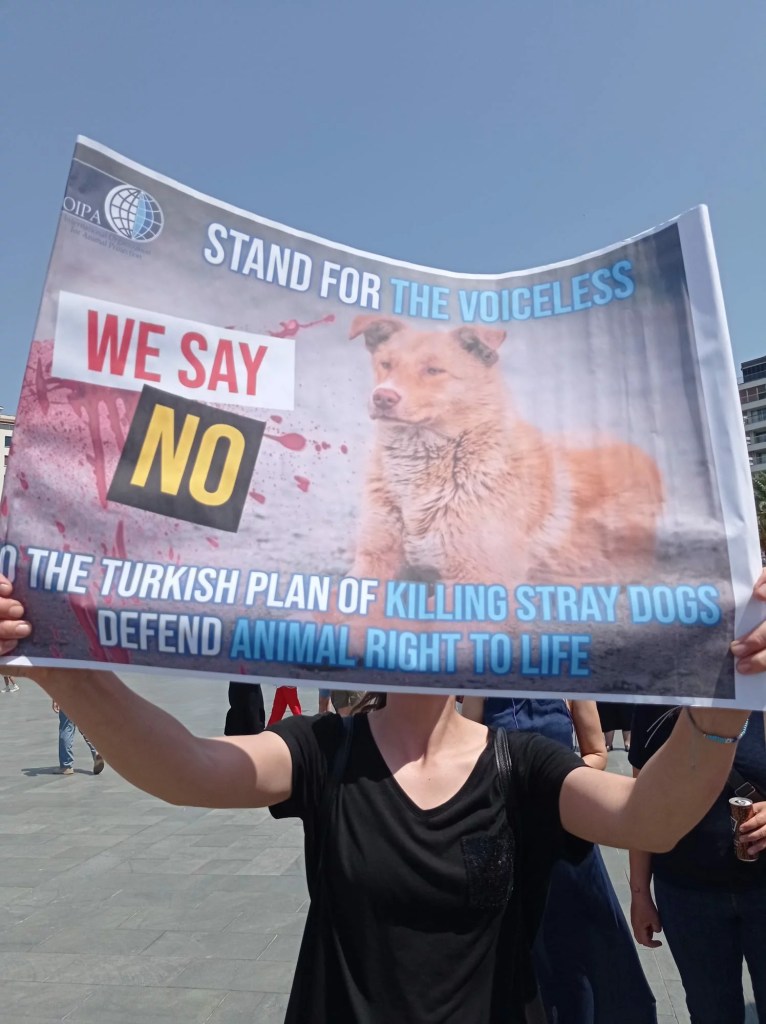
What “euthanasia” means in a country like Turkey we can all imagine. Seen it numerous times. So this plan must not be put into action.
Please sign the Petition on the page of OIPA below, thank you.
https://www.oipa.org/international/turkey-allow-euthanasia-to-stray
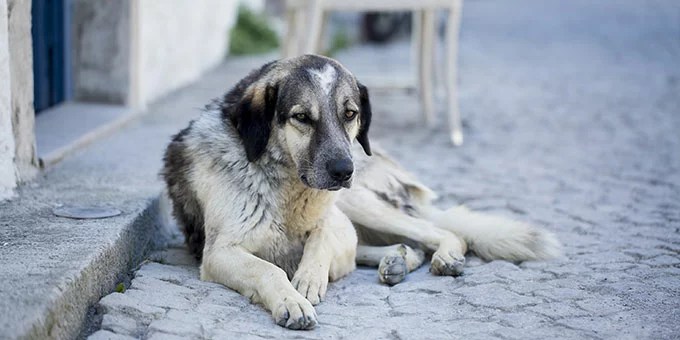
Posted by oipainternational | May 23, 2024
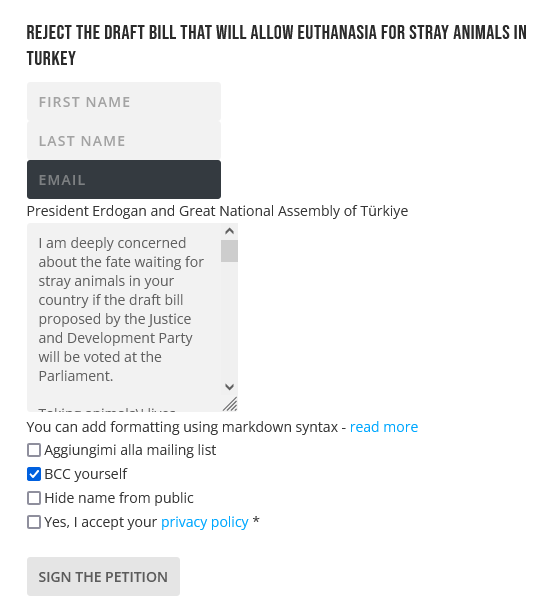
The Justice and Development Party (AKP) of Turkey drafted a bill that would amend the Animal Rights Law revised in 2021, after the issue of country’s stray dog population recently resurfaced alarming President Erdoğan to take urgent action.
Parliament will vote a law on Friday, May 24, which allows the capture and euthanasia of stray animals throughout the country.
The proposed draft law will require each municipality to collect strays and post photographs of dogs in their shelters on an adoption website. Dogs who are not adopted within 30 days will undergo euthanasia by lethal injection.
The incorrect and unproved idea that spaying and neutering method is ineffective, this proposal will justify a massacre of innocent beings.
The reality is that municipalities did not invest and do not want to allocate financial resources to sucessfully implement this sustainable and humane approach. An alternative that can save animals’ lives, while reducing stray dog population over time.
In addition, a considerable number of municipalities failed to meet the requirement to create a shelter, as outlined in the Animal Rights Law, which was revised in 2021.
The Animal Rights Law required municipalities to allocate 0.5% of their finalized budgets over three years for animal shelters and rehabilitation. They set this rate at 0.3% for metropolitan municipalities.
Humans should not take animals’ lives away due to their inability to properly manage a problem.
Read OIPA letter to the Grand National Assembly of Türkiye: Open Letter – OIPA Türkiye Büyük Millet Meclisi – Reject the amendment that will allow euthanasia for stray animals Throughout The Country
(Petition link on Page)

‘Dr Death’, ringleader of Essex dog-fighting gang, jailed along with accomplices for animal cruelty
https://www.lbc.co.uk/news/dr-death-dog-fighting-jailed/
Phillip Harris Ali, 67, of Chigwell, was given five years for his role in the repeated acts of animal cruelty. Two other men were also sentenced to prison time, while a woman was given community service.
The dogs were were starved before being put in bouts where they sometimes fought to the death, Chelmsford Crown Court heard on Monday.
They were kept in filthy conditions and were denied clean water and proper bedding.
Judge Jamie Sawyer said the gang showed “a shocking level of barbarism and callousness” for the dogs involved in the case.
He said the fights, which took place in England, Ireland and France, were “highly planned and without a care for the welfare of the animals in question”.
The judge told the defendants: “Dogs were treated as a commodity by each of you. They were playing pieces in your game.”
Much of the key evidence in the case came from a phone belonging to Ali, of Manford Way, Chigwell, Essex.
This included photos and videos of dogs and gruesome match reports detailing how the animals were set upon each other, sent via the encrypted messaging app Signal.
Many of the crimes were committed while Ali was still under licence conditions put in place after a 2007 conviction for attempted murder.
His “right-hand man”, Stephen Albert Brown, 57, of Burrow Road, Chigwell, Essex, was jailed for two years and six months after he was found guilty of five offences under the Animal Welfare Act.
As the fighting ring’s medicine man, he got illegal veterinary medication and equipment and was involved in training dogs and arranging fights.
Personal trainer Billy Leadley, 38, who had a dog fighting pit at his home in Bambers Green, Takeley, Essex, was jailed for four years for 12 different offences.
The judge said reading a match report about one 58-minute fight at which Leadley was referee, in which one of the animals suffered two broken legs, was “horrific”.
His wife, hairdresser Amy Leadley, 39, who was not directly involved in the ring, was sentenced for various offences linked to keeping a premises for dog-fighting and not caring for the animals properly.
She was given an 18-month community order, 200 hours of unpaid work and 25 days of rehabilitation activity.
The four defendants were banned from keeping dogs for ten years.
RSPCA chief inspector Ian Briggs said: “Dog fighting is a barbaric and horrific blood sport which has been illegal in this country for almost 190 years; yet there is a secretive and clandestine underworld where it continues to happen today.
“It has become a hobby, passion and source of entertainment for the people involved, but the reality is that the dogs involved suffer unimaginable pain, suffering, fear and distress.
“This gang dedicated their lives to breeding, preparing and training what they believed were champion fighting dogs.
“They enjoyed the build-up to a fight and the excitement of the bloody brawls, as well as trying to patch their injured and dying dogs back together after the event.
“Sadly, some of the dogs in this case suffered severe injuries and were never found but a mobile phone recovered as part of the investigation included match reports that detailed awful and fatal injuries suffered by some of the dogs involved.”
Mark


What does the evolution of animal welfare laws tell us about our society’s values and priorities?
The legal environment regarding animal welfare has seen a substantial change in the United States within the last ten years.
Driven by both public demand and evolving ethical standards, state and federal governments have enacted numerous laws aimed at protecting animals from cruelty and enhancing their living conditions. Let’s take a closer look.
Continue at https://business-review.eu/business/the-changing-face-of-animal-rights-and-legislation-in-the-us-261599
Regards Mark

 World Animals Voice