Category: Uncategorized

(Med) ‘The sea is like a minefield’: The web of illegal fish traps in Italy’s Mediterranean

https://www.bbc.com/future/article/20250609-the-illegal-web-of-fish-traps-in-the-italys-mediterranean

Sea Shepherd is cracking down on illegal fish-trapping devices off the coast of Sicily (Credit: Sea Shepherd)

Off the coast of Sicily, Sea Shepherd and its volunteers are hunting down illegal fish traps and working with Italian authorities to crack down on this environmental crime.

The flat water melts into the teal-coloured sky as a former pilot vessel, the Sea Eagle, sails through the calm Tyrrhenian Sea surrounding the Aeolian Archipelago of Sicily.

The ship is operated by Sea Shepherd, an international marine conservation non-profit. Today, the team is searching for fish aggregating devices (FADs), man-made plastic structures used to attract fish. They float in the water, anchored to the seafloor, with hanging nets to catch fish. FADs made from plastic, without GPS tracking devices attached, are illegal in Italy.  

While listening to techno music, a group of volunteers uses a winch to detach one of the FADs from the seafloor. A large plastic container labelled “corrosive” emerges from the sea.

“The [techno] rhythm gives us the right energy,” says James* (the crew do not wish to use their full names for safety reasons), a young Canadian volunteer who is running the operation and whose arms are covered in ocean-inspired tattoos. The volunteers work tirelessly to extract the plastic FADs from the sea and pile the tangled trash heaps into big bags. The retrieved plastic will be turned into plastic crates for sea turtle rescue operations.

FADs are used worldwide by fishermen to attract pelagic fishes into surrounding nets. These fish-trapping devices are typically composed of used fuel, pharmaceutical and other chemical containers among other types of plastic waste, dark plastic nets and rocks, all of which is held together by a few miles of nylon thread. Marine wildlife is attracted to the shade provided by FADs.    

Abandoned FADs are illegal. They can cause a wide range of adverse environmental impacts, including the entanglement of marine life (particularly sharks and turtles), act as a habitat for the spread of invasive species, and wash ashore on beaches or become stranded on coral reefs. Many lost or abandoned FADs sink, causing environmental harm to deep-sea habitats.
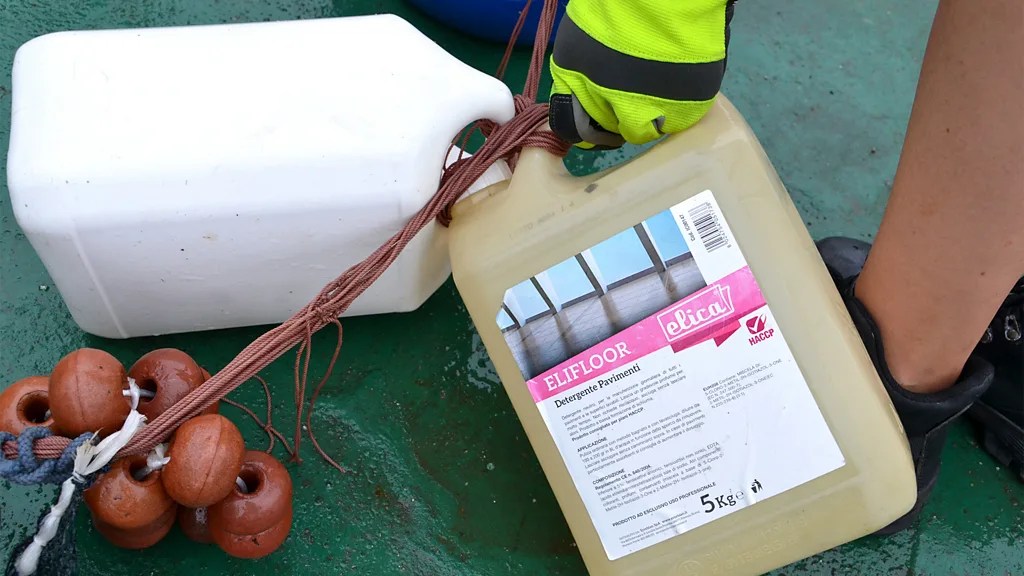
FADs are typically composed of old plastic containers held together by nylon thread (Credit: Sea Shepherd)

The material the FADs are made of matters too. FADs are required by Italian law to be biodegradable. All the FADs removed by the Sea Shepherds from the South Tyrrhenian Sea are illegal and made of plastic, says Nicola Silvestri, frigate captain and head of the Fishing Control Centre area in Western Sicily. They also lack markings which allow them to be traced back to the fishing boat that used them, he says.

“Illegal FADs are very cheap to produce, but at the same time highly dangerous for ecosystems,” says Andrea Morello, president of Sea Shepherd Italy. “These devices are installed by fishers in the month of August, then they catch fish around them in summer. Eventually, winter storms remove the devices, creating tonnes of hazardous and plastic waste floating in the sea.”

In this stretch of sea around Sicily’s Aeolian Archipelago, the target fishing species in the summer are juvenile ricciola, bluefin tuna, juvenile swordfish and pilot fish. FADs can damage the entire population, by preventing juveniles from maturing and reproducing.

The Sea Shepherd mission is part of the organisation’s ongoing Siso operation in Sicily to combat these illegal fishing devices.

“We are witnessing the biggest marine environmental disaster ever,” says Morello. “The sea is like a minefield full of FAD lines in every direction, placed by fishers who split the sea surface among them, threatening biodiversity.”

The Sea Shepherd volunteers remove the long nylon threads attached to the FADs which can harm fish, turtles, humpback whales and dolphins by trapping and suffocating them. According to Sea Shepherd, there are more than 36,000 FADs, each one composed of almost 1.2 km (0.7 miles) of nylon lines in the South Tyrrhenian Sea, part of the Mediterranean Sea.

It takes the volunteers one hour to extract almost 2km (1.2 miles) of a FAD line, it’s the first out of seven removed that day. Not far away, a police coast guard boat is monitoring the work: later it will seize the illegal plastic materials. The use of FADs made from plastic waste, without GPS trackers, is an environmental crime in Italy.

Sarah, a young German volunteer, rings the bell installed on the deck of the vessel, to celebrate and notify the crew that another FAD has successfully been extracted from the seabed. In total, the volunteers haul seven FADs onto the deck that day – their combined mass is the same size as a small car.

The Sea Shepherd volunteers are collaborating with Italian maritime authorities to crack down on FADs (Credit: Sea Shepherd)

organisation maps the FADs using deep-sea radar technology and binoculars and removes them in collaboration with national maritime authorities.

Between 2017 and 2024, the organisation removed 676 FADs from the Mediterranean Sea, says Morello. “We define ourselves as FAD hunters: here to protect the sea. We are also carrying out the first census of FADs ever realised in the Mediterranean Sea,” he says.

The data collected during this mission will be analysed as part of a research project that Sea Shepherd runs with the National Biodiversity Future Centre of the University of Palermo in Sicily and the Cima Research Foundation, based in Liguria, Italy. Using statistical analysis, Sea Shepherd has been producing maps since 2017 to identify for the first time the extent of this ghost labyrinth created by FADs anchored to the seabed.

“With the information provided by Sea Shepherd, we were able to have a precise mapping of the location and composition of these devices,” says Alberto Sechi, a marine biologist at Cima Foundation. “Since 2017, the plastic lines (mostly polypropylene) used to anchor the FADs exceeds 2,500km (1,553 miles): that corresponds to the distance between Paris and Moscow.”

In a single night, Morello says the Sea Shepherds discovered around 912 FADs in the waters surrounding the Sicilian island of Alicudi, each one composed of more than 1km (0.6 miles) of nylon threads. “Multiplying the number of FADs we found by the medium length of each thread, the total length of lines used in this area is a staggering 43,200 km (26.284 miles) of nylon: this is more than the circumference of the entire planet Earth,” says Morello.

Sea Shepherd’s work involves removing as many FADs as possible, but then, the disposal problem arises. In 2022, the non-profit started collaborating with iMilani, an Italian company that specialises in building plastic crates from recycled materials. Together, they have created the Sea Turtle Crates project, which aims to transform the FADs into plastic crates for sea turtle rescue operations. After the entangled turtles have been freed from the FADs, they are put into the crates which Sea Shepherd uses to transport them to veterinarians. Six loggerhead turtles have been rescued to date and 100 turtle recovery boxes have been created from FADs, says Roberto Milani, founder of iMilani and a freediver.

The company is hoping to design other items with FADs waste in future, including pens and other gadgets, which can be sold to finance Sea Shepherd’s activities, says Milani.
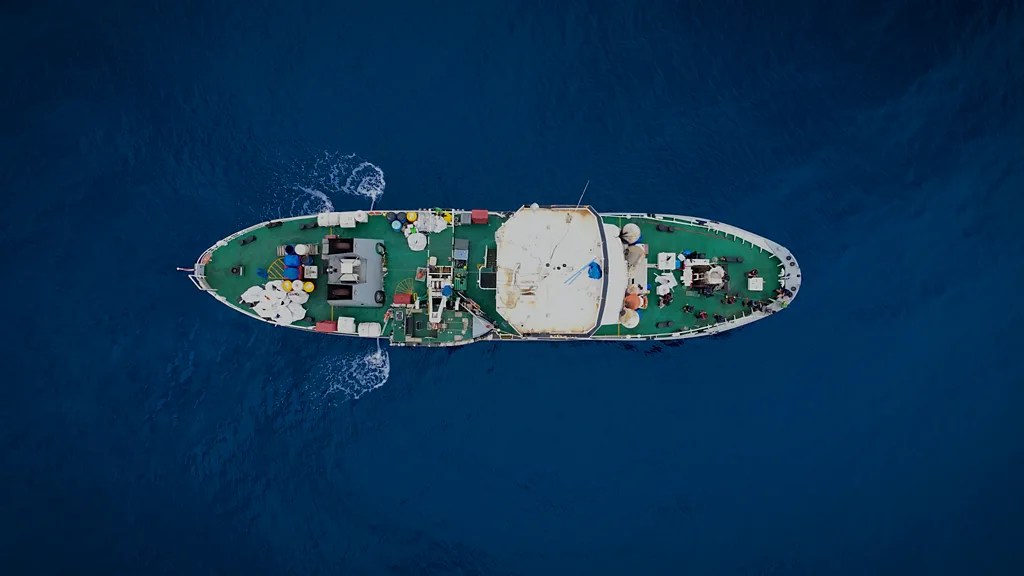
Sea Shepherd is creating the first-ever census of FADs in the Mediterranean Sea (Credit: Sea Shepherd)

big bags full of plastic lines extracted from the FADs. In one day at sea, the crew removed seven FADs composed of 6.5km (4 miles) of nylon lines and plastic containers. Their labels reveal their previous lives: from hospital waste and corrosive liquids, to oil, gas and detergent jerrycans. Using radar, the Sea Shepherds map more than 100 FADs throughout the day.

The crew’s work begins early in the morning, and continues until sunset, with brief breaks for meals. Tuti, 23, an Israeli volunteer, prepares a vegan buffet each day. Today’s menu is inspired by Latin American foods, such as empanadas, chimichurri, black beans mole and corn tortillas, which Tuti learned to cook during a Sea Shepherd mission in the Gulf of California, where she worked to protect the last vaquita dolphins.

Onboard are 20 volunteers, from four continents with different ages and backgrounds: from Willie, a 20-year-old German student, to retired engineer and sea captain Gigi, 63, who joins Sea Shepherd’s missions several times a year.

“We are here because we want to be part of the solution. We are sort of part of it, by removing all those plastics from the seas,” says Zafar from Pakistan, who is in charge of measuring and cataloguing each FAD for the database. “I don’t understand people’s insensitivity towards the sea and its inhabitants,” he says.

Many FADs are anchored to the seafloor with stones or buckets full of cement, says Teresa Romeo, director of the Sicily Marine Centre at the Anton Dohrn Zoological Station in Naples, Italy. She has been studying FADs since the 1990s. “They modify the seabed environment and affect all the species living there,” she says.

Romeo says a mandatory recovery of all FADs should be implemented. “We need to establish a spatial management plan to define a specific area [for FADs] and replace floating materials with biodegradable ones, in order to have a more sustainable fishing practice in the Mediterranean Sea,” says Romeo.

Sea Shepherd makes “a great contribution to the mapping actions of FADs and their efforts are useful for monitoring impacts, but in my opinion the aim cannot be drastic removal, but to regulate their use,” she says.

The retrieved plastic FADs are turned into crates for sea turtle rescue operations (Credit: Sea Shepherd)

But creating biodegradable devices from materials such as hemp is difficult due to the high cost, according to Sechi. “Creating a completely biodegradable FAD is a significant challenge, and so far, no one has come up with a solution,” he says. “One alternative could be hemp, but kilometres of hemp thread are very expensive, and no angler would spend that much.”     

Experts such as Romeo say that the transition to biodegradable and non-toxic materials would be an important part of the solution to reduce marine pollution from fisheries based on FADs. As well as breaking down in the ocean, biodegradable materials may contain fewer toxins and heavy metals, compared to plastic, says Romeo, though she agrees that cost is a major barrier for materials such as hemp.

In the meantime, the Sea Shepherds continue to sail the seas to map and remove illegal fish-trapping devices, collaborating closely with the local coastguard, researchers and private enterprises to crack down on this environmental crime. 

“This alliance is a solution to protect the deep sea,” says Morello.

(US – CA) Court prohibits ‘shelter’ from dumping kittens on the street

https://news.nokilladvocacycenter.org/p/court-prohibits-shelter-from-dumping

A judge has once again determined that public ‘shelters’ will violate laws that protect animals if left unchallenged.

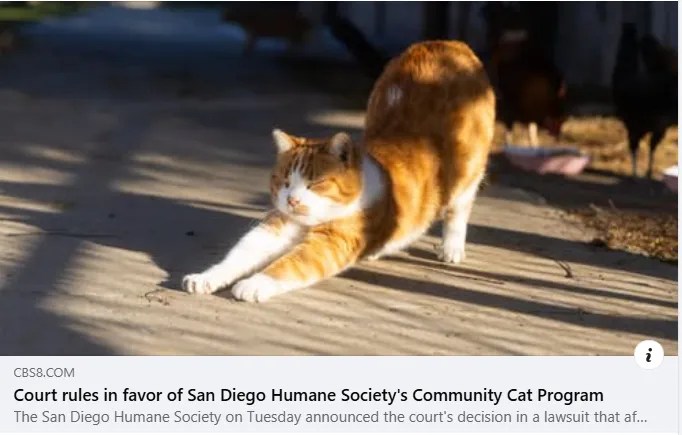
In a victory for animals and those who care about them, a California Court issued a permanent injunction prohibiting the San Diego Humane Society from refusing to provide shelter and care to kittens and lost cats and instead abandoning them on the street.

While the ruling supports the legality of community cat programs, including for feral cats, it requires shelters to comply with state laws regarding abandonment and animal care.

In a bid to recast the Court’s ruling against it, the San Diego Humane Society claimed victory in the case — a claim echoed by apologists for “shelter” malfeasance — even though the Court ruled gainst SDHS and prohibited them from making any changes to the program that would reduce protections for kittens and for adult cats who are social with people.

CBS originally wrote an article regurgitating SDHS’s false claim of winning:

They quickly removed the article when presented with the truth:

CBS subsequently reported that “A judge found the Humane Society’s Community Cat Program violated state law…” In fact, it wasn’t a community program; it was a program that turned its back on kittens and lost or abandoned friendly cats.

What the ruling means:

California “shelters,” like SDHS, are guilty of abandonment if they release, rather than admit, friendly cats with indications of ownership.

These include:

  • Sterilization (without an ear-tip);
  • Microchip (even if unregistered);
  • Wearing a collar, clothing, or accessories;
  • Signs of recent medical treatment; or,
  • Abandonment witnessed or credibly described by a finder.

The Court also ruled that kittens under 12 weeks old and social kittens aged 12 weeks to six months must be admitted into the shelter. It imposed a permanent injunction prohibiting SDHS from instituting changes that would reduce protections for cats and kittens.

The ruling prohibiting release does not apply to feral cats, sterilized cats found with ear tips, or friendly adult cats who do not exhibit any of the above criteria.

It wasn’t a complete victory. For example, “shelters” still have some discretion to determine which kittens must be admitted. They can also continue to kill them after admission, something that many California “shelters” do.

We need to continue insisting on — and passing laws that mandate — No-Kill policies.

The case is Pet Assistance Foundation, et al. v. San Diego Humane Society, Case No. 37-2021-00007375-CU-MC-CTL. The ruling can be found here.


Together, we will create a future where every animal is respected and cherished, and every individual life is protected and revered.

(UK) The Most Transparent Slaughterhouse On Earth

Now, of course this is what it is .. the killing of animals. Which most, if not all of us, reject. For whatever reason.
Where it gets really difficult is when stuff is hidden, done illegally, behind closed doors – often with animal abuse being rife. Here at least people are open about what they do, how they do it – even if faced with people they know think differently.
In the end everyone has to make up their own mind. I have cats of my own, and nature made them meat eaters. Every commercial pet food contains meat, fish, offal, and often stuff that does not belong in there at all. In most cases the source materials are low quality, and as good as never do you know what animals they came from – meaning not the species, but how they lived and were killed. If chicken in a tin comes from Asia, you can imagine … I always read labels attentively.

So, I feed fresh often, where I can trace the source, and can be relatively sure I do not support animal abuse.

Part I and II

My life-changing trip to visit donkeys in Morocco

Saturday 14 June 2025 10:43 BST

https://www.independent.co.uk/voices/jim-broadbent-donkeys-morocco-international-working-animal-day-b2767092.html

Despite these hardworking animals being so essential to survival, they’re often the last to receive the little water that’s available, writes actor Jim Broadbent

In the 1960s, my father, who was a sculptor, joined the group Free Painters and Sculptors where he met a brilliant woman, Nina Hosali, who co-founded animal charity Society for the Protection of Animals Abroad (SPANA) with her mother Kate in 1923.

Together, Nina and Kate would travel across North Africa to understand the difficulties facing local communities and their working animals. My father was very impressed by Nina and they became great friends, leading to my own support of the charity since the early nineties.

At that time, it was very unusual for two women to travel independently across North Africa and to be actively working with communities. It’s hard to imagine now how difficult it must have been and how brave they were. I can’t imagine the struggles they must have gone through venturing out into the desert to help working animals.

My wife Anastasia and I took a trip in 2006 to see the extraordinary work being done in Morocco by SPANA, and I felt privileged, in some small way, to follow in their footsteps some 80 years later. I remember visiting one of the centres the charity continues to run, where I saw donkeys being treated and animal owners receiving advice on animal welfare. We also travelled to more remote areas, where hardworking animals were helped by mobile vet clinics. We learned how working animals are vital to families and communities, particularly in low-income countries and the importance of their welfare.

Growing up in rural Lincolnshire, I was surrounded by friends with farms. They were mostly dairy farms, with fairly large herds of milking cattle. These animals were all appreciated and well looked after in a part of the world where we’re lucky enough to have largely clement weather and where animals benefit from access to clean water, nutritious diets and proper medical care. This standard of care was for me the norm.

The circumstances facing the people and animals we met in Morocco were very different. Working animals like donkeys, mules, horses and oxen are used much more widely, for tasks such as ploughing fields, transporting goods to market and collecting water – they are a real lifeline for their communities.

Obviously, it’s much hotter in Morocco, particularly in the summer months. We saw animals pulling heavy loads in extreme heat with little rest, which can lead to health issues such as dehydration, heatstroke and fatigue. At that time, animal owners had limited access to proper harnesses and, as a result, we saw animals suffering from wounds caused by ill-fitting and makeshift equipment.

Globally, the climate crisis is now making life harder for working animals and their owners. Many countries at the sharp end of the climate crisis are already experiencing more frequent droughts and water scarcity. The situation is worse for the most vulnerable, who are less likely to have access to clean running water because of inadequate water infrastructure.

The climate crisis is affecting every corner of the globe, with Morocco among the most hard-hit regions. There, they’ve experienced six consecutive years of drought due to record temperatures caused by climate change. This has led to increased evaporation and threats to water supplies.

And it’s working animals who many communities around the world desperately rely on at times of water crisis. They play a vital yet often overlooked role helping people carry huge amounts of clean water over long distances, often in the most challenging conditions.

It’s animals that help communities endure these desperate circumstances. But, despite being so essential to survival, they’re often the last to receive the little water that’s available.

That’s why, this International Working Animal Day, SPANA is urging governments around the world to prioritise inclusive water services that meet the needs of working animals and the people who depend on them, to ensure fair and reliable access for all. Having witnessed how central these animals are to the communities they support, and the suffering they endure, I’m proud to wholeheartedly add my voice to this call.

****************

Please also refer to …

(IN) Good news: India’s first-ever emergency animal evacuation shelter to be established in Wayanad

Set to open in 2026, the shelter will provide safe refuge for up to 150 animals during disasters, including goats, cows, pigs and dogs

https://www.humaneworld.org/en/news/indias-first-emergency-animal-evacuation-shelter-established-wayanad

Date: March 14, 2025

WAYANAD, Kerala—A pioneering emergency evacuation shelter designed to evacuate animals prior to disasters like floods and landslides, is set to be established in Kottathara panchayat in Wayanad district, Kerala. Situated in a region prone to multiple hazards including annual floods, cyclones and landslides, this commitment marks a significant step forward in disaster preparedness for animals in India. The collaborative project will bring together the Kerala State Disaster Management Authority, the Wayanad District Disaster Management Authority, Kottathara Grama Panchayat and Humane World for Animals India (formerly called Humane Society International India) to make India’s first such shelter for animals.

The shelter, set to begin operating in 2026, will have the capacity to accommodate up to 150 animals such as goats, cows, pigs, dogs and cats. The single-story structure is expected to include dedicated space for a veterinary clinic and a quarantine area, along with storage and equipment rooms. The shelter is intended to serve as a model for similar facilities across the country.

Praveen Suresh, disaster preparedness and response team manager at Humane World for Animals India, said: “This is an historic moment for Kerala and India from both an animal welfare and disaster preparedness point of view. It is especially significant for Wayanad district with its growing need for a dedicated facility to evacuate and care for animals during disasters like floods and landslides. While the shelter will provide immediate medical care and relief, it will also serve as a long-term resource to support animal welfare in the community. We are grateful to the Government of Kerala and the State Disaster Management Department for approving this important initiative. This animal shelter highlights the power of collaboration between multiple agencies to safeguard animals and their communities and to strengthen disaster management efforts in India.”

Over the last seven years, Humane World for Animals India has gained a notable presence in Kerala through its disaster preparedness, response and relief efforts. During the 2024 Wayanad landslides, the organization’s rescue team aided over 180 animals. Along with partner organizations, Humane World for Animals India is working to make Wayanad a disaster-resilient district for both humans and animals. Among other activities, the organization is conducting capacity building programs for the community through outreach to schools and self-help groups like Kudumbashree. Once constructed, the shelter will serve as a hub for efforts to safeguard animals and the families who depend on them during disasters and a catalyst for continued commitment to build community resilience in the face of future emergencies that put humans and animals at risk.

Please also refer to ..

(UK) 100 years of refrigeration – why are animals still transported live?

https://www.scotsman.com/news/opinion/columnists/100-years-of-refrigeration-why-are-animals-still-transported-live-5173637

Published 13th Jun 2025, 06:00 BST

Sometimes, it feels like we’ll never learn. That our mistakes of the past are just waiting to resurface, to be repeated all over again. That our promises to do better are just window-dressing for a harsher reality. It seems particularly pertinent when anniversaries come round to remind us that something as wrong as exporting live animals over long distances, simply to be slaughtered at the other end, just aren’t necessary. And haven’t been for a long time.

And so, it was with a big sigh of disbelief that we heard the news earlier this year that Brittany Ferries was resuming live animal exports from Ireland to France. Dame Joanna Lumley and Pauline McLynn joined forces with over 120 high-profile individuals, experts and civil society organisations to condemn the decision.

Out of kilter

It seemed to particularly go against the grain as Britain had just banned live exports from Scotland, England and Wales to the continent only a year before. The ban from Britain in May 2024 finally enshrined in law the will of the people, many of whom had come out to protests around ports and docklands around the country for decades.

Finally, the voice of reason had been heard. Action had been taken to condemn a redundant and cruel trade to the history books where it belongs. Scientific evidence shows that when live animals are exported or transported long distances, they often suffer extremes of temperature and are deprived of rest, food or water.

It doesn’t take a scientist to know that putting sentient beings into lorries and taking them on journeys that can last days, causes them fear and distress.

While Great Britain introduced a ban on the live export of farmed animals last year, and Australia has announced the end of the live export of sheep by sea from 2028, the trade continues in the EU. It is a matter of shame that the EU’s current revision of its animal transport rules is appallingly weak. Journeys can last several days or even weeks, exposing animals to exhaustion, dehydration, injury, disease, and even death. Some 44 million farm animals annually have been found to be transported between EU member states and exported internationally, many of them on long distance journeys lasting eight hours or more.

The trade is flourishing owing to the rising demand for meat in some parts of the world: European companies are cashing in on the need to stock farms in countries such as Libya and Vietnam with breeding and fattening animals. For some countries – including Spain, Denmark, Ireland and Romania – livestock export is still seen as a key part of the farming economy.

Yet it is not only cruel, but also totally unnecessary.

Redundant for a Century

This year is the 100th anniversary of the invention of the first refrigerated truck. Made for the ice cream industry in 1925 by American inventor, Frederick McKinley Jones, it meant that chilled desserts, or carcases for that matter, could be transported over long distances and arrive in great condition.

From that day on, loading cattle, sheep and pigs into lorries to ship them abroad for slaughter was no longer needed. Instead, they could be slaughtered at a local abattoir and the carcases transported to wherever they are required. Refrigerated sea transport has an even longer history. In 1877, the French steamer Paraguay completed the first successful travel with its shipment of 5,500 frozen sheep carcases from Argentina arriving to France in reportedly excellent condition despite a collision that delayed the delivery for several months, thus proving the concept of refrigerated ships.

From that day on, we’ve never needed to subject live animals, often young animals just weeks old, to long distance sea journeys for slaughter or fattening again.

Blind persistence

Yet, we carry on despite clear evidence that doing so causes profound harm. Recommendations published recently by the European Food Safety Authority (EFSA), identified multiple welfare concerns in the transportation of live animals including “group stress, handling stress, heat stress, injuries, motion stress, prolonged hunger, prolonged thirst, respiratory disorders, restriction of movement, resting problems and sensory overstimulation”.

The EU is believed to be the world’s biggest live animal exporter. What fuels this outdated trade? Not need. Not compassion. Just cold, hard cash. A backward pursuit of an outdated economic model whereby animals are treated as inanimate objects and where farm specialisation has fuelled a trend towards fewer, but larger farms and slaughterhouses. Against this backdrop, meat producers aim to minimise production and slaughter costs, maximise revenues and optimise economies of scale by exploiting cost differences between member states.

spirit, innocence and blamelessness renders them defenceless in the face of unyielding, uncaring and backward-looking practices.

To throw another pertinent anniversary into the mix, this June sees the tenth International Ban Live Exports Day raising awareness of the scale and impact of these cruel journeys by land and by sea and sending a clear message to the companies that profit from this misery that it is totally unacceptable. Brittany Ferries, are you listening?

Philip Lymbery is Global CEO of Compassion in World Farming International, President of EuroGroup for Animals, a Board Member of the UN Food Systems Advisory Board, a former United Nations Food Systems Champion, an animal advocate and award-winning author. His latest book is Sixty Harvests Left: How to Reach a Nature-Friendly Future.

*********

https://www.suecoe.com/artworks/categories/43-sheep-of-fools/

(US – California) Cal student faces prison for rescuing chickens // An Animal Rights Activist Rescued Four Sick Chickens From a Slaughterhouse. Now She’s Facing Five Years in Prison.

https://www.publicnewsservice.org/2025-06-13/animal-welfare/cal-student-faces-prison-for-rescuing-chickens/a97135-1

Friday, June 13, 2025

In 2023, UC Berkeley student and activist Zoe Rosenberg removed four severely ill chickens from a slaughterhouse truck in Petaluma, California, and brought them to an animal sanctuary. Now, she’s facing over five years in prison. Rosenberg’s trial is scheduled for later this year, and her allegations tell a story of horrific conditions at ostensibly “free-range” chicken farms, as well as the steep uphill battle activists face in convincing law enforcement to even investigate allegations of animal cruelty on factory farms.

Rosenberg is an activist with Direct Action Everywhere (DxE), a Bay Area-based animal rights organization. In addition to supporting ballot propositions and hosting conferences, DxE carries out undercover investigations of slaughterhouses and factory farms. In some cases, its activists rescue ill and imperiled animals from such facilities; this is what’s known as “open rescue,” a popular tactic among some animal rights activists.

The prospect of risking prison time for saving a few chickens, who are routinely sold for less than $20 apiece, may seem outlandish. But DxE activists like Rosenberg see it as a necessary risk to accomplish their ultimate goal: the complete abolition of slaughterhouses and factory farms.

“I think that if people don’t take action and don’t risk their freedom to create change, nothing will ever change,” Rosenberg, who’s currently wearing an ankle monitor while out on bail, tells Sentient. “We’ve seen time and time throughout history that it has been the sacrifices of the very few that have changed the world.”

Petaluma Poultry did not respond to Sentient’s request for comment on this story, but a company spokesperson denied DxE’s claims to the San Francisco Chronicle, characterizing the group as “extremist” and its efforts as “theft.”

What Is Open Rescue?

In essence, open rescue is the act of removing animals from dangerous or harmful environments without permission from the person, company or facility that oversees said animals. Those who carry out open rescues don’t hide what they are doing, and often publicize their actions. Animals that are removed via open rescue are typically provided with medical care and/or taken to animal sanctuaries.

The goal of open rescues, which date back to at least the early 1980s, is not only to provide relief for the animals in question, but also to highlight the conditions in which farm animals are held, and to normalize the act of rescuing them. But it’s a controversial practice, even among activists, and law enforcement officials generally treat open rescues as acts of theft, trespassing or other crimes.

This often leads to prosecution, but in the eyes of open rescue advocates, this isn’t entirely a bad thing. Prosecutions often bring media attention and publicity to both the topic in question and the relevant laws surrounding that topic. Rosenberg’s case, for instance, draws attention not only to the conditions of factory farms, but also to the fact that removing a few sick animals from a slaughterhouse can get you a half a decade in prison.

Do People Usually Go to Prison for Open Rescue?

Although charges are often brought in open rescue cases, they’re frequently reduced or, in some cases, dropped entirely before trial. It’s not uncommon for open rescuers to be acquitted, either; in a verdict that drew international headlines, DxE founder Wayne Hsiung and another defendant were facing 60 years in prison for rescuing two sick piglets from a Smithfield Farms facility in Utah, only to be acquitted of all charges.

That said, Hsiung did recently spend 38 days in Sonoma County jail for an open rescue in which he participated, so it’s not unheard of for activists like Rosenberg to serve time for carrying out open rescues.

he Incident in Question

On June 13, 2023, Rosenberg entered a Petaluma Poultry slaughterhouse partially disguised as an employee. A truck delivering chickens to the facility was parked outside, and Rosenberg spotted four chickens in the back of the truck who she says were “covered in scratches and bruises.” She took them from the truck, left the slaughterhouse and both she and DxE publicized her actions on social media.

Rosenberg says that she intentionally took the chickens that “seemed like they most needed medical attention.” Subsequent examinations found that all four birds were infected with Coccidia parasites; one of them also had a respiratory infection and an injured toe, while a third had a foot infection.

Five months later, Rosenberg was arrested and charged with five felonies relating to the June 13 rescue. These charges were later reduced, and as of this writing, she faces one felony conspiracy charge, two forms of misdemeanor trespassing charges, one misdemeanor theft charge and one misdemeanor charge of tampering with a vehicle. Her trial is scheduled for September 15, 2025.

The chickens she rescued were all treated for their illnesses, and are now living at an animal sanctuary.

A History of Animal Neglect At Petaluma Poultry

Petaluma Poultry, a subsidiary of the chicken giant Perdue, presents itself as a humane operation where, in the words of its website, “chickens are free to be chickens.”

“Our houses are spacious, with room for birds to move about and exhibit normal behaviors in a low-stress environment open to fresh air,” the company’s website says. “Our outdoor spaces are at least half the size of the poultry house, and typically as big as the barn itself.”

But Petaluma Poultry’s advertising is a classic example of humane-washing, when companies try to appeal to animal welfare-minded consumers by depicting their products as more humanely produced than they actually are.

Petaluma Poultry and its contractors have been accused of criminal animal cruelty on a number of occasions, and footage filmed by undercover investigators in the company’s farms and slaughterhouse paints a much different picture than the company’s marketing.

In 2018, a whistleblower provided DxE with footage from McCoy’s Poultry, a factory farm contracted by Petaluma Poultry, that showed chickens collapsed on the ground, unable to stand or walk and surrounded by the corpses of other chickens. Shortly thereafter, Sonoma County Animal Services seized 15 chickens from McCoy’s Poultry; six were already dead, while the other nine were injured, malnourished, unable to stand and exhibited signs of distress, according to a subsequent medical report. The facility was later shut down.

In 2023, another activist who infiltrated Petaluma Poultry’s slaughterhouse said that she saw workers cutting into chickens while they were still alive, as well as evidence that chickens had been abused, tortured and boiled alive during the slaughter process. They also obtained documents showing that, on a single day in April, over 1,000 chickens were deemed unfit for human consumption after they were slaughtered due to suspicion that they had blood poisoning.

Prior to her arrest for the June incident, Rosenberg herself was involved in a separate DxE investigation of a Petaluma Poultry facility in 2023, where she recorded footage of more chickens suffering in the facility.

“I documented chickens who were collapsed on the floor of their factory farms, too weak to stand, unable to get to food and water, and slowly dying of starvation and dehydration,” Rosenberg says. She ended up rescuing two of those chickens as well, both of whom required extensive medical care.

It remains unclear whether authorities prosecuting or investigating these allegations of criminal animal cruelty? And if not, how come?

Rosenberg Raised Allegations of Animal Welfare Abuses

Poultry is the most widely consumed meat in the U.S. and the world, yet there are no federal laws that protect livestock chickens from mistreatment on the farm. The Humane Slaughter Act establishes some baseline requirements for the treatment of livestock, but it specifically exempts chickens from these protections.

In California, however, livestock chickens are protected under a number of different laws. In addition to Proposition 12, which requires poultry producers to give egg-laying hens a specific amount of living space, Section 597(b) of California’s penal code makes it a felony to subject an animal to “needless suffering” or deprive them of access to sufficient food or water, among other things.

This law would appear to be relevant in the context of Petaluma Poultry. If a chicken at a factory farm is physically unable to stand (let alone walk), they will be unable to reach the feeding trays and water, and will eventually die of thirst or starvation. If a chicken is boiled alive because they were improperly stunned beforehand, it has suffered needlessly.

The aforementioned investigations uncovered evidence of both of these things happening at Petaluma Poultry and its contracted facilities. Both DxE and Rosenberg claim they’ve presented multiple law enforcement agencies with this evidence, only to be rebuffed or ignored.

“The most common thing we’ve had is agencies directing us to another agency, directing us to another agency, directing us back to the place where we started, and just kind of sending us around in circles,” Rosenberg says. “We didn’t get any helpful response. No one took action.”

It was this inaction that led Rosenberg to take the four chickens from the back of the truck in June, she says. After doing so, she again presented her findings to law enforcement, specifically the Petaluma Police Department. This time, she got a response.

“They said they had a detective who wanted to have a call with me, and so I had like a 15-minute call with a detective from the Petaluma Police Department,” Rosenberg says. “She very much approached the call from an angle of, you know, ‘I’m concerned about the reports you are making.’ And so I told her about the animal cruelty that has been documented there.”

But Officer Corie Joerger, the detective in question, didn’t follow up with her after their call, Rosenberg claims, and ignored her subsequent attempts at communication. A couple of weeks later, Joerger handed Rosenberg a warrant for her arrest regarding the June rescue.

In the preliminary hearing for Rosenberg’s case, Joerger acknowledged that Rosenberg had made allegations of animal cruelty, but stated that she did not investigate the matter.

This inaction by law enforcement wasn’t an isolated incident. When the investigation at McCoy’s Poultry facility uncovered dead birds on the farm floor and others that were unable to move, Sonoma County Animal Services referred the matter to the county sheriff’s office for potential prosecution. But no prosecution followed then, either.

Sentient has reached out to the Sonoma County Sheriff’s Office, the Petaluma Police Department and Joerger for clarification on these reports, but as of this writing, none have offered any comments.

Petaluma Poultry Is More the Rule Than the Exception

The allegations against Petaluma Poultry might sound extreme. But in fact, many are par for the course on factory farms, and chicken farms in particular.

For instance, the USDA estimates that every year, around 825,000 chickens are boiled alive at slaughterhouses. This is not standard protocol, but rather, the result of standard protocol gone wrong.

At poultry slaughterhouses, chickens are typically hung upside down by their feet and pulled through an electrified pool of water, which is meant to stun them. After that, workers slit the chickens’ throats, and after they’ve bled out, they’re placed into boiling water. This is to soften the skin and make it easier to defeather them.

That’s how it’s supposed to work, at least. In actuality, though, one or both of those first two steps often fail; chickens are either inadequately stunned before their throats are cut, or their throats aren’t fully slit, or both. When both of these processes fail, the chicken is inadvertently boiled alive, and feels every bit of pain associated with this.

Similarly, the fact that those chickens at Petaluma Poultry couldn’t stand up or walk isn’t an accident. Over the decades, farmers have selectively bred chickens to be as fat as possible, as this maximizes the amount of meat they can sell. According to the National Chicken Council, farmed chickens now grow to be over twice as large as they were 100 years ago in less than half the time.

This unnatural rate of growth has wrought havoc on their internal biology, however, and farm chickens now routinely suffer from a number of illnesses and adverse health conditions as a result, including bone deformities, heart attacks, chronic hunger, ruptured tendons and, most relevantly to Petaluma Poultry, difficulty standing up or walking.

Finally, Petaluma Poultry is far from the only chicken producer to make questionable use of the “free-range” label, which is ostensibly regulated by the USDA. In 2023, undercover footage taken from a Tyson Foods-contracted chicken farm in Virginia depicted employees of both the factory and Tyson freely acknowledging that the “free range” label doesn’t actually mean anything, and that “free range” birds often “don’t go outside.”

Why Wasn’t Petaluma Poultry Investigated by Law Enforcement?

Though it’s unclear why local law enforcement hasn’t pursued any investigations into the allegations against Petaluma Poultry, DxE’s director of communications has some ideas.

“It would be a massive undertaking for any government agency, no matter how well-staffed they actually might be, to suddenly address the systemic animal cruelty that we know is happening in factory farms,” Cassie King, director of communications at DxE tells Sentient. “If they put their foot in the door and acknowledge that it’s their responsibility to address these crimes, then there’s a landslide of new cases they need to take on, and it’s just a huge amount of work.”

It also bears mentioning that chicken farms are an enormous part of Petaluma’s local economy, and have been for quite some time. Once referred to as “the egg basket of the world,” Petaluma was the birthplace of several egg-related technologies at the turn of the century, and pumped out over a half a billion eggs every year at its peak in 1945.

Although the city isn’t quite the egg powerhouse it once was, chickens are still big business in Petaluma. Though official estimates are difficult to come by, the city is home to at least seven chicken farms large enough to qualify as factory farms, and those facilities collectively house around 1.8 million chickens at any given time, according to a 2024 analysis by an activist group that opposes factory farms.

To be clear, there’s no evidence that the poultry industry’s strong presence in Petaluma has played any role in law enforcement’s response to allegations of cruelty at the city’s chicken farms. But the fact that the Petaluma Police Department publicly celebrates the city’s poultry industry, and participates in the annual Butter and Eggs Day festival in a non-law enforcement capacity, is not lost on DxE activists.

Rosenberg Awaiting Trial

For her part, Rosenberg maintains that her actions were legal. She cites the doctrine of necessity, a legal theory holding that it’s sometimes permissible to break a law if doing so prevents even greater harm from occurring.

“For example, if a kid is drowning in your neighbor’s pool and no one is helping that kid, you have the right to trespass into your neighbor’s yard to rescue the kid,” Rosenberg says.

How this defense plays out in court remains to be seen, but it’s essentially the same argument Hsiung’s attorneys successfully used in the Utah case. In the meantime, Rosenberg says she’s been encouraged by the public reaction to her case (Paris Hilton is a prominent supporter), and doesn’t regret her actions even if they do land her in prison.

“A few years of my freedom is worth significantly less than even one animal’s entire life, and certainly less than four animals’ entire lives,” Rosenberg says. “And so it’s absolutely worth it to me on that level.”

*************

An Animal Rights Activist Rescued Four Sick Chickens From a Slaughterhouse. Now She’s Facing Five Years in Prison.