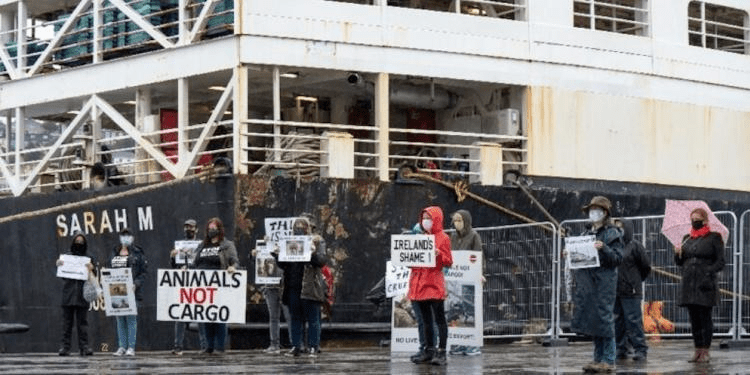
Ethical Farming Ireland succeeded in preventing a 45 year old transport vessel from coming into port at Greenore to collect Irish cattle for export.
The Sarah M was scheduled to dock at Greenore on Ireland’s northeast coast on April 30, to collect 2000 young bulls for export.
The ship had recently been classed with the Russian Maritime Register of Shipping, and was therefore subject to European Union sanctions which include denial of access to EU ports.
Ethical Farming Ireland alerted the Department of Transport of this breach, which resulted in the vessel being denied entry.
The organisation has long campaigned against live export from Ireland to mainland Europe and beyond, as thousands of animals are exported to countries as far afield as Libya, Jordan, Morocco, Lebanon, Israel, Egypt and Turkey each year.
The organisation has expressed disappointment that their intervention was necessary in order to ensure proper regulation of the vessel.
Such incidents are not uncommon amongst live transport vessels, as revealed in new research by Animal Welfare Foundation. Nearly half of the animal transport vessels approved in the EU are flying the flag of a country marked by the Paris Memorandum of Understanding as a black flag (for example Togo, Sierra Leone or Tanzania).
This flag indicates these vessels pose a high risk to maritime traffic, as well as to the animals, crew and environment.
A five year phase out plan and $107m support package has been promised by the Australian government, meaning live exports of sheep will end on 1 May 2028.
Agriculture Minister Murray Watt made the announcement on 11 May, noting that legislation will be introduced in this term of the Australian Parliament to end the trade in law.
The decision was taken after years of campaigning from animal welfare organisations, with polls revealing that the majority of Australian citizens want to see an end to the cruel trade.
The live sheep export industry has shown time and again that they are unable to meet the community’s expectations.
Murray Watt, Australian Agriculture Minister
Live export has also been in a long-term economic decline, and now accounts for only 0.1% of Australia’s agricultural exports.
This has directly corresponded with an increase in the trade of meat products, with trade in chilled sheep meat now 58 times the value of the live sheep export trade. Sales of chilled Australian sheep meat to the Middle East alone now represent $632 million, compared to only $77 million of profits from the entire live sheep export trade.
Decades of investigations have confirmed the stressful, dirty and overcrowded conditions that sheep are subjected to during long sea journeys from Australia. Heat stress can be fatal for animals aboard transport vessels, as tragically proven during the 2017 Awassi Express disaster where around 2,400 sheep died from heat stress whilst travelling between Australia and the Middle East.
While of course we wish it was sooner, we also recognise and respect the responsibility of the Government to consider all who are impacted by this historic decision… Considering the decades of dedicated effort and advocacy, it is understandable that some doubted whether this trade would end in their lifetime. Now we know differently.
But the abusers can run but no longer hide; as campaigners across the globe are now hunting them down, publishing their photographs and detailing their convictions for authorities across the world to use when bringing convictions. We are in the final stages of putting together all of our data which will be presented to the relevant authorities for actions.
You can see from the article below that despite the involvement of British and UK persons in these abuses; 2 people have also been imprisoned in Indonesia for same.
A very interesting article regarding UK animal torture. A British woman admits her role in monkey torture ring.
Click on link to see all photographs and a video of her arriving at court.
Copied from the article (link above) produced by The Sun – a UK newspaper.
Holly LeGresley today pleaded guilty to the charges Credit: Facebook
A probe found people were paying Indonesians to torture monkeys Credit: BBC
A BRIT known as The Immolator has admitted to her role in a monkey torture ring where fiends pay for the animals to be killed for sexual kicks.
Self-proclaimed animal lover Holly LeGresley, 37, led a secret life as a moderator in one of the global online groups.
She today admitted publishing an obscene article and causing unnecessary suffering to a protected animal.
Co-defendant Adriana Orme, 55, indicated no plea to the charges at Worcester Magistrates’ Court today.
The pair, from Kidderminster and Upton-upon Severn, were released on conditional bail.
LeGresley, who will be sentenced next month, published 22 images and 132 monkey torture videos to online chat groups, the charge sheet states.
She also made a payment of £17.24 to a PayPal account to encourage cruelty.
Orme allegedly uploaded one image and 26 videos of monkey torture between April 14 and June 16, 2022.
She is accused of encouraging or assisting the commission of unnecessary suffering by making a £10 payment to a PayPal account on April 26, 2022.
The court was told the women had “not carried out monkey torture themselves”.
West Mercia Police confirmed the charges are in relation to causing, consuming and facilitating the torture of monkeys.
It came after the BBC exposed a global monkey torture gang following a year-long investigation.
They discovered hundreds were paying Indonesians to kill infant long-tailed macaques on video.
Torture methods include setting the animals on fire and putting them in blenders.
LeGresley was known as The Immolator, meaning someone who practises sacrifice.
She once ran a poll on which torture method should be used on a baby monkey.
The bird lover describes her love of gore on Facebook – branding Hannibal Lecter and Pennywise the Clown “horror icons”.
She has even lashed out at films that portray animal cruelty before, including Suicide Squad spin-off Birds of Prey.
Complaining about a scene where an aviary is set alight, LeGresley wrote: “That’s sick. You don’t do that s***, even [with] computer graphics because it’s too far.
“Shouldn’t be allowed to put such gratuitous animal cruelty in a movie when it doesn’t even really serve the story. Sick twisted people who made this film.
“Won’t be spending any more of my money on the franchise. What a disappointment.”
Three people including suspected ringleader Michael Macartney have been charged in the US.
The 50-year-old, who went by the alias “Torture King”, ran several chat groups from around the world on encrypted messaging app Telegram.
The groups shared sick ideas for custom-made torture videos, which were then sent with payments to Indonesia.
According to US court papers, Macartney is accused of distributing videos depicting the “torture, murder, and sexually sadistic mutilation of animals, specifically juvenile and adult monkeys”.
The BBC reports he has agreed to plead guilty to conspiracy charges and faces up to five years in jail.
He previously described joining his first Telegram monkey group, saying: “They had a poll set up. Do you want a hammer involved? Do you want pliers involved? Do you want a screwdriver?”
Macartney, from Virginia, said it was the “most grotesque thing I have ever seen”.
At least 20 people have been investigated over the sick videos – including three women living in the UK who were arrested in 2022.
Two people have been imprisoned in Indonesia, while David Christopher Noble and Nicole Devilbiss have been charged in the US.
WAV Comment – Please use this link to see all the photographs and a video:
We are experiencing huge problems (like many others around the world) in being able to present our petitions to the Chinese authorities. Until we do, then the petitions remain.
Thousands of cats have fallen victim to Chinese cat abuse groups, including many mothers.
Some of them were tortured while they were still pregnant, others were tortured when they had just given birth, and some of them were tortured while their babies were tortured and others were forced to take their offspring or unborn children. Some had to watch themselves being eaten.
They were unable to provide their babies with the maternal love that their tormentors clearly never experienced.
Today, they and their babies are sleeping peacefully.
We offer this prayer in memory of the cat's mother and her children who lost their lives at the hands of Chinese torturers.

Posted @guardianes_felinos
En memoria de las madres gatunas y sus hijos que han perecido en manos de los torturadores chinos.
Thank you everyone for sticking with us; and a special welcome to all our new visitor friends from Australia and Singapore. Check out our visitors – https://clustrmaps.com/site/1a9kn
If some of you are new to the site and not aware, animal buddy Pauline often sends me a collection of her animal photos taken in and around South East London / Kent County.
Tonight I have a new set of photos which you can see below. Hopefully, Pauline and I will be meeting up for a coffee on Wednesday and a Veggie / Vegan Ruby (Ruby Murray – Curry) – https://youtu.be/XRVVCbXmYJo in the next few weeks; so really looking forward to it. Animal talk on the menu as always – her hedgehogs and birds in nesting boxes; and my badgers and foxes who come round for scoff every night; – below, a badger in my garden.
So here below are all of Pauline’s latest shots; which we are sure you will enjoy.
Regards Mark and Pauline.
Below – Spring Lamb
Above – Singing Whitethroat
Below – Whitethroat
Above – Male Blackbird
Below – Female Blackbird
Below – Oyster Catcher
Below – Peacock Butterfly
Below – Gray Herons At Nest – and Youngsters
Below – Gosling
Below – Canada Geese
Below – Young Grey Wagtail
Below – Grey Wagtail
Below – Goldfinch
Below – .. and Thirsty
Below – Swans Nesting – Can You See the Egg Within ?
New Delhi: After lodging an FIR against animal cruelty in east Delhi’s Jagatpuri, People for the Ethical Treatment of Animals (PETA) India has offered a reward of Rs 50,000 for the whereabouts of the abuser.
A video being circulated on social media showed a person, allegedly from Jagatpuri, beating a dog. The CCTV footage, which was a few weeks old, showed the dog being severely beaten with a stick, resulting in a broken leg and head injuries. PETA and local activist Divyansh Sharma registered an FIR on May 2 under Section 429 (animal cruelty) of Indian Penal Code 1860 and Section 11 of Prevention of Cruelty to Animals Act 1960.
After the attacker could not be traced, PETA decided to announce the bounty. “PETA India is offering a reward of up to Rs 50,000 to anyone who provides information leading to the arrest and conviction of the person responsible for torturing the dog,” stated the organisation.
It further said those who abused animals would often end up harming human beings. “PETA India recommends that perpetrators of animal abuse undergo psychiatric evaluation and receive counselling as abusing animals indicates a deep psychological disturbance,” said PETA India cruelty response coordinator Sunayana Basu.
“Research shows that people who commit acts of cruelty to animals are often repeat offenders who move on to hurting other animals, including humans. A study published in Forensic Research & Criminology International Journal stated that those who engage in animal cruelty were three times more likely to commit other crimes, including murder, rape, robbery, assault, harassment, threats and drug/substance abuse,” Basu added.
WAV Comment – we have been working a lot recently on the relationship between initial animal offenders then moving on to human violence. Here is our post and section link relating to this:
The scheme named The Animal Welfare Fund with an investment of €85,000 from the Government will provide financial assistance to animal shelters and voluntary or non-governmental organisations that care for animals. This was announced during a conference by the Minister for Agriculture, Fisheries, and Animal Rights Anton Refalo, together with the Parliamentary Secretary for Fisheries, Aquaculture, and Animal Rights Alicia Bugeja Said.
The Animal Welfare Fund is established with a commitment to support those organisations and shelters providing services to animals, with the aim of raising more awareness about the importance of domestic animals in our community and furthering animal rights in our country (Malta).
Minister Anton Refalo emphasised, “Through this government initiative, we continue to uphold our commitment outlined in the Electoral Manifesto ‘Malta Together.’ What we are witnessing today is the continuation of the diligent work we have already done in this field, with recent achievements such as the renovation of the Animal Hospital and the initiation of the veterinary course in the academic year ahead. This progress is a testament to the dedication we have shown in the field of animal rights through a series of measures implemented in recent weeks, months, and years, to ensure ongoing support for our partners.”
Schemes like these are incredibly important as they provide tangible evidence of the valuable work being done by shelters and animal welfare organisations, Bugeja explained.
“The Government acknowledges this work in favour of animal protection and rights being carried out by voluntary organisations and shelters. Without their work, we certainly cannot curb the number of animals being neglected currently,” continued the Parliamentary Secretary.
She concluded by stating that this scheme is merely a gesture of appreciation to continue supporting these organisations and shelters in their service provision, while easing their financial burdens.
The Director of the Department for Animal Welfare, Joseph John Vella, outlined the criteria for applying for these funds and how they will be allocated according to three defined priorities: education and awareness, medical expenses, and animal allocation.
Animal advocates are celebrating after parts of a controversial Ontario agriculture law that made it illegal to get a job on a farm under false pretences to expose conditions inside were deemed unconstitutional.
Justice Markus Koehnen struck down parts of Bill 156, the Security from Trespass and Protecting Food Safety Act, earlier this month after advocacy group Animal Justice, along with an activist and a journalist, launched a Charter challenge in 2021.
They argued the new law infringed on their freedom of expression because they could not tell the outside world what was happening inside a farm if they gained access to the property through a false pretence.
The act required consent from the owner to be on a property where animals are kept, raised or slaughtered. That consent was voided under the law if someone lied to get on the land.
“The act limits the mode of expression by preventing undercover exposes or even eyewitness descriptions of the conditions in which animals are raised or slaughtered if the person providing the description gained access to premises using false pretences,” the judge wrote in his decision.
“In light of the foregoing, I find that one of the purposes and one of the effects of the act and the regulation is to infringe on the applicants’ freedom of expression.”
The province enacted the legislation in response to demands from the agricultural industry and about 120 municipal resolutions calling on the government to do more to control trespassing, the decision said.
Ontario argued the legislation was aimed at “protecting animal safety, biosecurity, and the safety of farmers as well as preventing economic harm that can arise from threats to animal safety and biosecurity.”
Part of the case focused on lying.
“If lies can amount to protected speech in a context as odious as Holocaust denial, they should be equally protected when someone denies having a university degree or being affiliated with an animal rights group to obtain employment at or entry to an animal auction, petting zoo, rodeo, fair or circus,” the judge decided.
The judge agreed with animal rights activists
The news thrilled Camille Labchuk, executive director of Animal Justice.
“It’s a decisive victory over unconstitutional ‘ag-gag’ laws that were designed and had the effect of covering up serious animal cruelty on farms,” she said.
“In light of this ruling, we’re looking forward to getting back to doing investigative work in Ontario as soon as possible.”
The animal advocates had submitted undercover video of farms that were eventually aired on national television broadcasts and led to criminal charges and convictions in some cases. None of that would have happened without lying to get a job in the first place.
“The expression is of public interest,” Koehnen wrote.
“Publicizing the way in which animals are treated is an issue of interest to at least some members of the public. It is an issue about which the public is entitled to be informed if they want to be.”
The advocates who brought the case also argued undercover operatives would follow the rules on farms, only deviating to take pictures of video of what was happening with the animals.
The judge agreed.
“For a potential employee to deny any association with animal-rights groups in a job interview does not threaten biosecurity, the food supply chain or animal safety,” the judge wrote.
“Nor does the follow up act of such an activist communicating what they see in an agricultural facility.”
The bill also made it illegal to interact with animals inside transport trucks, a law seemingly designed to target one group in the province: Toronto Pig Save. The group is part of the large Save Movement whose members “bear witness” and hold vigils for animals en route to slaughter.
They often gave water to the pigs inside trucks stopped at intersections to “show kindness and compassion to animals in their final moments,” the decision noted.
The Ministry of the Attorney General may appeal
Two days after the bill came into force in June 2020, a truck hauling a load of live pigs ran over and killed Regan Russell, 65, who was protesting the new law outside a slaughterhouse in Burlington, Ont. The driver, Andrew Blake, pleaded guilty to the provincial offence of careless driving causing death. He was fined $2,000 and given 12-months of probation.
The Regan Russell Foundation intervened in this case, arguing the law interfered with both its constitutional right to protest and freedom of expression.
The judge disagreed and held up that portion of the act.
“The purpose of protecting freedom of expression is to do just that, allow people to express themselves,” Koehnen wrote. “It does not allow people to appropriate, even momentarily, the property of others as a means for that expression.”
Russell’s stepson, Joshua Powell, was disappointed with that part of the decision.
“It is upsetting, but we are very, very elated that the judge upheld the ability to hold vigils at these sites as a protected act,” Powell said.
“And, most important, we are really happy that undercover exposes, from journalists or activists, won’t be illegal anymore. It was one of the main reasons Regan was out there that day.”
The Ministry of the Attorney General said it is reviewing the decision and has not yet decided if it will appeal.