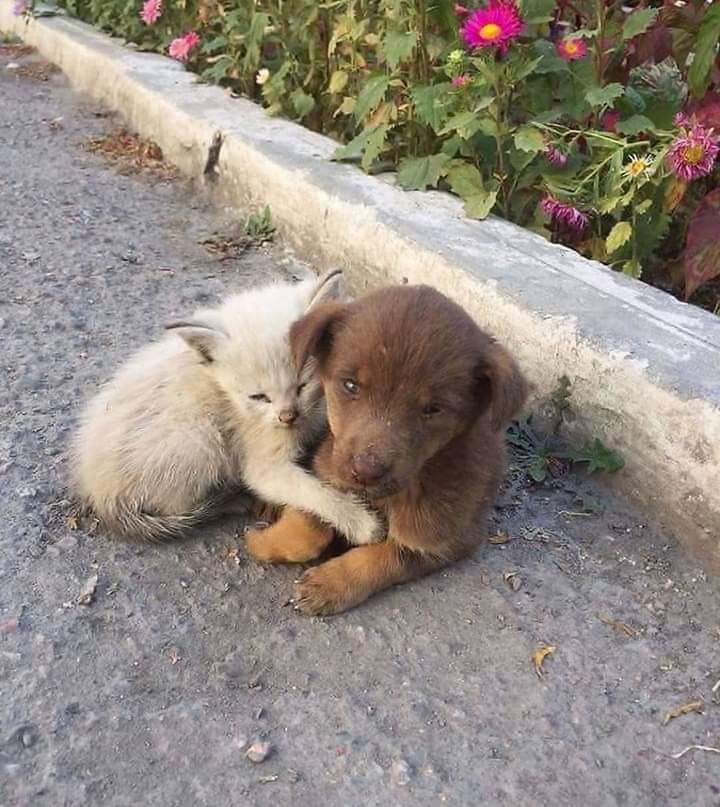
From now on we will walk together and grow up together.
We take care of each other❤️
regards, Venus

From now on we will walk together and grow up together.
We take care of each other❤️
regards, Venus
CAT MEAT – When Central Europeans’ favorite pet ends up on the plate in some countries
Many people around the world can no longer imagine life without the cat as a loyal companion.
In Central Europe, especially in Austria and Germany, the sweet velvet paws have even replaced the dog as the most popular pet.
They enrich our existence with their unmistakable nature, but their individual character and are pampered and looked after by us.

Not so in large parts of southern China, northern Vietnam, Korea and Peru.
There, cat meat is still seen as a natural food and remedy.
The cat has the same status there as dogs, which unfortunately are also consumed.
The keeping and the cruel slaughter of the animals look accordingly.
In southern China and northern Vietnam, cat meat is considered warming in winter.
The cat’s stomach and intestines are eaten, and the meat is often turned into meatballs while the head is thrown away.
According to a market analysis published in February 2020, 8% of the people living in Hanoi have consumed cat meat in their lifetime (!!!)
There are professional cat catchers in the Chinese city of Pukuo.
They regularly transport cats to the southern province of Guangdong, where they have become scarce since they were used as food.
In Korea, cat meat is sometimes cooked into a tonic for nerve pain and joint inflammation, but the meat itself is not very common as a food.
Cat cooking techniques will be demonstrated at the Peruvian Santa Efigenia Festival in a town in La Quebrada in September.
According to a report by “Four Pows” around 10,000,000 cats and dogs are slaughtered in Southeast Asia every year.
Four Pows published the market analysis “The Dog and Cat Meat Trade in Southeast Asia: A Threat to Animals and People” in February 2020 and, together with the “Change For Animals Foundation”, calls on the Vietnamese government to reinstate the previously applicable government laws that have specifically banned the trade in cat meat
In Germany, for example, the consumption of cat meat and its import and export is prohibited by the Food Ordinance, in Austria by the Animal Welfare Act.
In China, a nationwide dog and cat meat ban was enacted in May 2020, but this is hardly controlled, as can be seen from the fact that the largest annual dog massacre, the “Yulin” slaughter festival, took place unmolested despite the ban.
Dogs and cats are still being slaughtered and eaten, although many Chinese are against cats becoming increasingly popular pets and Chinese animal welfare organizations rioting.

Our position on this cruel issue is clear and precise: the slaughter of cats and dogs is globally prohibited and severe penalties are imposed if it is violated.
The same applies to the miserable attitude and lack of appreciation for living animals.
And we make one thing clear in advance: Before some people write that we should rather look at the slaughter of “farm animals” because they are also treated very cruelly, take a close look at our site !!!
We do that again and again because we don’t make any distinction between species.

For us, all animals are the same.
But this article is now devoted to the cat and the cruel ways it is treated in some places.
You can read about other animals in other articles.
We thank you for your understanding and ask you to sign the following petition on this topic:
https://help.four-paws.org/de-DE/stoppe-den-hunde-und-katzenfleischhandel-s%C3%BCdostasien
https://www.facebook.com/marschfuerdietiere/
And I mean…As soon as such articles (mostly accompanied by petitions) appear, the wave of outrage with comments in animal welfare groups immediately begins
They have dedicated themselves to the task of explaining to the Chinese and other Asians that instead of dogs they should finally eat the right animals: cattle, chickens, pigs … just like normal people.
And that’s because we Europeans are firmly convinced that our animal protection laws are way ahead and can therefore dictate to other countries which animals they are allowed to eat.
We often refer to our Animal Welfare Act. And that says:
“Nobody should inflict pain, suffering or harm on an animal without a reasonable cause”.
But the trick is that it is so cleverly worded that, in terms of animal welfare, it is not even worth the ink with which it was signed.
Otherwise, and if we should decide to take it seriously, it would really be forbidden in the end animals to torture and brutally murder in order to eat them.
We reserve the right to decide for ourselves who the “reasonable cause” is.
What does homo sapiens have that other animals don’t?
He has rights! And lots of it. The right of the fittest, for example.
So we use all rights and all kinds of ways to torture animals, to enslave them in order to eat them!
We can destroy any animal because we are stronger.
And we take this right seriously. So serious that we even consider it the duty of the strong to eat the weak ones for a “reasonable reason” (pleasure) under all suffering and torture.
Except for dogs and cats, of course.
It is now a very common fact that the pigs killed here are more intelligent than dogs (not that intelligence has to be a mandatory criterion in order to be murdered or not).
That is why the argument among animal rights activists seems to be particularly widespread that it is not the killing that is criticized, but only the torture. It’s about torturing!
So the outrage gets a rationalization.
In the future, outrages and petitions would completely fall through if Chinese, Koreans, Vietnamese … etc would refrain from eating dog meat.
That wouldn’t change the number of animals tortured and eaten, but it would at least be comforting to know that they are now eating the right animals, just like us.
My best regards to all, Venus
Danone converts its entire dairy factory to plant-based products from the Alpro brand!
As part of the global change in diet, Danone is converting one of its dairies to plant-based products from the Alpro brand
Danone recently announced that it will invest 43 million euros ($ 49 million) by 2022 to convert its dairy in Villecomtal-sur-Arros, southern France, into an Alpro-branded plant-based production facility.
This year, this was preceded by an investment of 16.5 million euros in the Alpro plant in Issenheim (Eastern France).
Danone, who also owns the Evian water and Activia yogurt brands, said the French plant-based food market has tripled in seven years and is expected to grow by another 50% by 2025.

“We are seeing growing consumer interest in plant-based foods in the country.
Many consumers are looking for herbal solutions to have a more varied and varied diet, ” said François Eyraud from Danone France.
The factory is to be rebuilt in autumn 2022 and will start producing the first Alpro brand beverages from the second quarter of 2023.
And I mean…This decision does not come as a surprise.
Consumer trends changed rapidly during the corona pandemic.
In any case, the company has complained of a drop in sales of 70% in Bavaria over the past ten years.
In the past two years, its coveted Quark yogurt cream, Greek yogurt, Danone Mars chocolate yogurt and Danone Disney fruit yogurt… suddenly fell into disrepute; Corona had destroyed the illusion of safe dairy products.
Danone, unlike its competition, was hit much harder by the corona pandemic.
The Danone plant near Würzburg (Germany) wants to respond more quickly to consumer wishes and, according to the French company, also invest in plant-based products.
Well, yes … The global pandemic has accelerated some aspects of the upheaval in the food sector and changed others.
The new head of Danone Richard Trechman said: “We have had a massive rethinking! We want to become an” Activist Company “, Danone’s vision is: “One Planet. One Health “….
Of course, within the framework of a capitalist system, because Danone already terminated the supply contract with 46 dairy farmers in Bavaria at the end of January 2019, which has consequently greatly reduced the number of dairy farmers in the region.
Some talk about job losses, we talk about less animal suffering.
Because if there are no more animal products on the shelf, then the consumer will not buy them.
And we would not mind if Danone increased its sales through plant-based products.
My best regards to all, Venus

Welcome to everybody and all our new supporters who we cannot mention by name individually.
See all our international visitors at:
https://clustrmaps.com/site/1a9kn
Please remember that we have a ‘translator’ section on the site, where you can read all the articles in many languages than English.
Just go to ‘Translate’ on the left hand side and select which language you would like to read in.
Regards Mark and Venus.

This is a 3 page post.
WAV Comment:
Thanks as always to supporter friend Stacey at ‘Our Compass’ for sending this link across.
Regards Mark

NOVEMBER 29, 2021
“Two turkeys — named Peanut Butter and Jelly — were pardoned by President Biden on Friday during this year’s annual turkey pardoning ceremony.” “I want to take a moment to recognize the brave turkeys that weren’t so lucky, who didn’t get to ride the gravy train to freedom,” Obama said from the Rose Garden in November 2016. “Who met their fate with courage and sacrifice and proved that they weren’t chicken.”

Continued on next page.

Source – Guardian, London.
NSW laws criminalising secret recordings of animal cruelty ‘too great a burden on speech’, high court hears
Animal rights group in legal fight against laws which provide no public-interest exemption for use of footage
Laws criminalising the use of secretly recorded vision of animal cruelty and abuse are posing “too great a burden on speech”, animal rights activists have told the high court.
The Farm Transparency Project, an Australian animal advocacy group, launched a case earlier this year arguing New South Wales laws restricting the use of covert footage were an unfair burden on freedom of political communication.
The state’s Surveillance Devices Act criminalises the use of footage or audio that was obtained using a listening device or hidden camera, but, unlike other states, gives no public-interest exemption.
The laws have been used to pursue activists on criminal charges and have prevented media outlets from using footage depicting cruelty or abuse in abattoirs and knackeries across the state.
Guardian Australia was recently prevented from showing secretly recorded footage of ex-racehorses being sent for slaughter at NSW pet food factories, a clear breach of industry rules.
In its written submissions to the high court, the Farm Transparency Project said the case was not about how activists were perceived by the general public.
“It is about the law that is challenged,” it said.
“Whether the plaintiffs are viewed as admirable activists, or vulgar vigilantes, or something in between, is irrelevant. If anything, the case is about the publishers whose freedom to publish is curtailed.”
The submissions point to similar laws in Victoria, the Northern Territory, South Australia and Western Australia, which contain carve-outs allowing the use of such footage that accommodates the implied right to freedom of political communication.
“That is essentially because the blanket prohibition is too great a burden on speech, having regard to the legitimate social interests in the publication of surveillance device material, especially to ‘blow the whistle’,” the transparency project argues.
“It is not to be overlooked that vigilantism cannot be condoned. But this is to highlight the importance of careful balancing – in each case – of where the public interest lies, which in turn, highlights the importance of a ‘public interest’ exemption.”
The submissions point to the greyhound live baiting scandal as an example of a public interest served by the publication of such footage. That video helped spark a public inquiry and a finding that the NSW industry had lost its social licence, prompting a proposed ban that was not implemented after a backlash.
‘Horrific scene’: more than 35 horses shot dead on outback Queensland property
The Farm Transparency Project executive director, Chris Delforce, has said previously the case has broader implications for so-called “ag-gag” laws across the country.
Delforce said challenging the validity of the law would help prevent other jurisdictions from enacting similar blanket bans.
“We’ve had enough – these industries need more transparency, not less,” he said. “The animals suffering in our nation’s farms, slaughterhouses and knackeries deserve to have their stories told, and the Australian public deserves the opportunity to hear them.”
Not all animal rights groups support the use of hidden cameras. The RSPCA is opposed to using unlawful means to fight for animal welfare.
The high court is expected to receive submissions from the NSW government this week, and Farm Transparency Project will be given a chance to reply next month.
Regards Mark


25/11/21
SEOUL, South Korea (AP) — South Korea on Thursday said it will launch a task force to consider outlawing dog meat consumption after the country’s president offered to look into ending the centuries-old practice.
Restaurants that serve dog meat are dwindling in South Korea as younger people find dog meat a less appetizing dining option and pets are growing in popularity. Recent surveys indicate more people oppose banning dog meat even if many don’t eat it.
In a statement, seven government offices including the Agriculture Ministry said they decided to launch the group comprising officials, civilian experts and people from related organizations to deliver recommendations on possibly outlawing dog meat consumption. It said authorities will gather information on dog farms, restaurants and other facilities while examining public opinion.
“As the number of families with pet animals has risen rapidly and public interest in animal rights and welfare has grown in our country, there have been increasing voices saying that it’s difficult now to see dog meat consumption as just traditional food culture,” Prime Minister Kim Boo-kyum, the country’s No. 2 official, said ahead of the statement’s release.
The government says the initiative, the first of its kind, doesn’t necessarily guarantee the banning of dog meat. The joint statement noted that “public awareness of the basic right (to eat preferred foods) and animal rights issues are tangled in a complicated manner” when it comes to dog meat consumption.
The seemingly vague stance drew quick protests from both dog farmers and animal rights activists.
Farmers say the task force’s launch is nothing but a formality to shut down their farms and dog meat restaurants, while activists argue the government’s announcement lacks resolve to outlaw dog meat consumption.
Ju Yeongbong, general secretary of an association of dog farmers, accused the government of “trampling upon” the people’s right to eat what they want and farmers’ right to live.
Lee Won Bok, head of the Korea Association for Animal Protection, called the government’s announcement “very disappointing” because it didn’t include any concrete plans on how to ban dog meat consumption.
“We have deep doubt about whether the government has a resolve to put an end to dog meat consumption,” Lee said.
About 1 million to 1.5 million dogs are killed each year for food in South Korea, a decrease from several millions about 10-20 years ago. Thousands of farmers currently raise a total of about 1 million to 2 million dogs for meat in South Korea, according to Ju’s organization.
Ju said the farmers, mostly poor, elderly people, want the government to temporarily legalize dog meat consumption for about 20 years, with the expectation that demand will gradually taper off. Lee said animal rights organizations want a quicker end of the business.
“South Korea is the only developed country where people eat dogs, an act that is undermining our international image,” Lee said. “Even if the K-pop band BTS and the (Korean drama) Squid Game are ranked No. 1 in the world, foreigners are still associating South Korea with dog meat and the Korean War.”
Lee accused many farmers of animal cruelty and other illegal activities when they raise and slaughter their dogs. Ju said that activists “exaggerated” such information, and that it only applies to a small number of farms.
According to Lee, dogs are consumed as food in North Korea, China and Vietnam as well as in South Korea.
In September, President Moon Jae-in, a dog lover, asked during a meeting with the prime minister “if it’s time to carefully consider” a ban on dog meat consumption, sparking a new debate over the issue.
Dog meat is neither legal nor explicitly banned in South Korea.
South Korea to launch task force on banning dog meat | AP News
Regards Mark

The UK Government is currently collecting evidence on mandatory method of production labelling. As part of our response, we will be submitting the signatures of everyone who has signed our petition. Please stand up for farmed animals by adding your name now.
Time to change food labelling
Hi,
Meat and dairy labels are confusing and can be misleading. They can hide animal cruelty. Join me in calling for all products to be honestly labelled by farming system:
Join 142,000 others demanding change:

Little time left – please sign immediately;
Thank you;
Regards Mark

Visitors in my garden today, stocking up with a good feed on this cold day. Should be a lot warmer tomorrow. Called ‘Red Legged’ for obvious reasons.
Regards Mark


“Why are so many people so cruel to their dogs?”
That is the question The Post’s Gene Weingartenset out to answer when he spent three days in the field with workers from PETA who investigate complaints of cruelty.
The closest he came to any kind of answer — after witnessing one instance after another after another of dogs chained or caged in truly horrific conditions — is because they can.
Hopefully, though, his searing exposé will wake up local and state officials to the need to ban the unattended tethering of dogs.
Dogs are naturally social beings.
They need interaction with humans and/or other animals, but it sadly is commonplace for owners to leave their dogs outside in all weather extremes, attached to some stationary structure or imprisoned in a pen.
“It occurs all over the country,” Mr. Weingarten wrote, “the pitiless 24-hour-a-day chaining of dogs to lifelong sentences of misery and madness.”
In addition to the psychological effects — otherwise friendly dogs becoming neurotic, unhappy, often aggressive — there are the physical ailments that result from being continuously chained.
Necks become sore and raw; collars can grow into their skin, and they are vulnerable to parasites and insects.

Often they are denied food and water. Four of the dogs rescued by PETA during the three days of Mr. Weingarten’s reporting were so damaged they had to be euthanized.
“I have been doing this for 25 years, and I still don’t understand it,” Daphna Nachminovitch, PETA’s senior vice president of cruelty investigations, told us about what she sees as the disconnect between someone deciding to own a dog and then utterly failing to understand its most basic needs.
While she acknowledged that “you can’t force people to love and respect and show kindness to animals,” Ms. Nachminovitch stressed that it is possible to impose and enforce some basic rules of decency and humanity.
PETA has led the effort to try to persuade state and localities to ban the brutal practice of leaving dogs unattended for hours on end tethered to a chain or trapped in a pen.

Twenty-two states and D.C. have laws that attempt to limit the number of hours or specifying what kind of collar or length of chain is allowed.
But those efforts have come up short.
None have banned unattended tethering entirely.
There has been some success at imposing prohibitions at the local level but, as Mr. Weingarten reported, they represent less than 1 percent of all cities, towns and counties in the country.
As Mr. Weingarten wrote, “There is a terrible power that comes with being human. But there is a potentially beautiful power in that, too. In this brutally unequal world, isn’t that part of the covenant with our pets?
Don’t we owe them that much dignity?”
Animals are helpless, but when it comes to making their lives more bearable, people are not.
https://www.washingtonpost.com/opinions/2021/11/25/animal-cruelty-dogs-hurt-because-they-can/
And I mean…“There is a terrible power that comes with being human. But there is also a potentially beautiful power in this … “
The Austrian animal ethicist Helmut Kaplan also has this theory treated:
“The all-important question is: Has there ever been something like an education for peace, a training for peacefulness, an introduction to being good?
Has a moral sensorium ever been developed here that one can address, that one can appeal to?
Is it possible to educate people about morality, to be good or at least to want to be good at all?
At least there is a glimmer of hope – albeit a paradox: it can be influenced, the motivation for morality, an education for discord is undoubtedly possible.
But if a negative moral shaping of the human being is possible, then positive attempts at influencing could also have a chance of success.
In the case of the education in torture and murder in the Third Reich, for example, one came up with a lot.
This “educational work” was impressive.
The successes in the negative shaping of the human being, however, also give cause for hope, as already mentioned: If the education to the monster can be carried out so efficiently, then the education to the human being, to the morally thinking and acting human being, should also be possible”.
Personally, however, I have little hope that the described process of training to torture and killing could also lead to significant successes in the opposite direction.
I think the development towards inhuman and immorality is much easier than the other way round.
Mainly because even the very best animal protection law does not grant animals any rights, but only restricts the power of disposition of humans. Humans have rights, animals suffer under the violence of those who have rights to it.

Therefore: without the recognition of animals as subjects of rights that has to exist without being asked for, fascism against ALL animals will never end.
My best regards to all, Venus