
Troopers Law and Dexters Law now signed – which protect dogs and other pets.
Troopers Law and Dexters Law now signed – which protect dogs and other pets.

European consumers quite rightly, are a fairy switched on bunch when it comes to knowing what goes into the food that they eat. Yes or no ?
But, as animal campaigners; we question what we consider to be ‘adequate’ information relating to certain issues re animals and the food chain.
Lets take the humble egg as an example. There are more than 350 million laying hens in the EU. All these hens combined produce close to 6.7 MILLION TONNES of eggs each and every year.
The EU is rather good when it comes to standards and labelling for eggs purchased withing the EU (and still including the UK even after Brexit); of course; the UK was once an EU member state; so labelling was a regulatory requirement.
With EU / UK egg labelling; there is a Regulation – https://eur-lex.europa.eu/legal-content/EN/TXT/?uri=celex%3A32008R0589 which defines the regulations for standards in egg production. Organic production methods; Free Range; Barn or Cage – the labelling system clearly provides the consumer at the supermarket with full details of their eggs – what system was used in their production – so that THE CONSUMER IS FULLY INFORMED AND CAN MAKE A CLEAR CHOICE of whet they are purchasing.
There is no confusion; to the point that every single egg is stamp marked as shown below to include the production method used; the country of origin; and a unique ‘farm ID’ in case of any specific issues relating to the production farm.
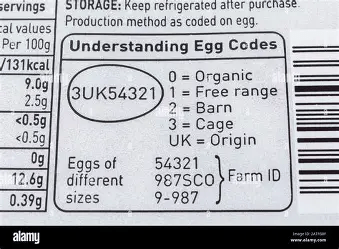
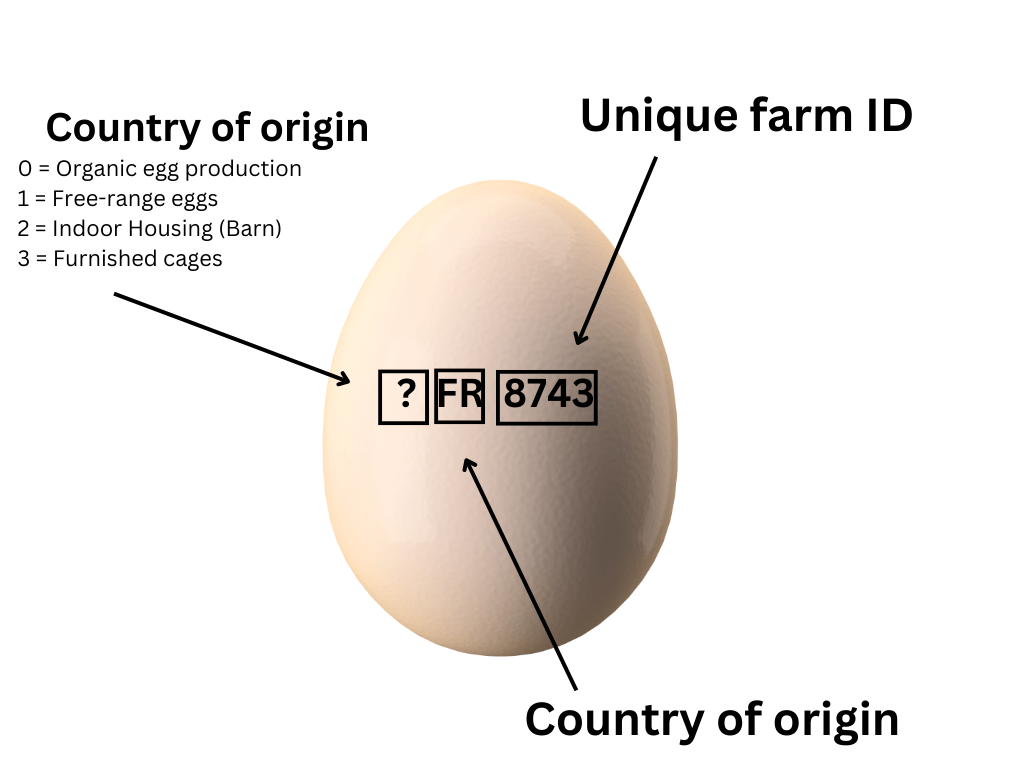
Pretty good well monitored and consumer informed system throughout the EU; which we as animal welfare campaigners fully support. The consumer is informed and they make their individual purchases accordingly.
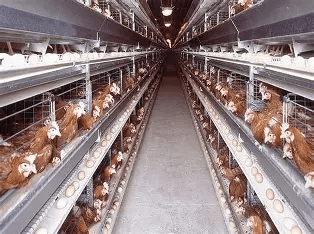
Above – Caged Hens – NO
Below – Free Range – YES.
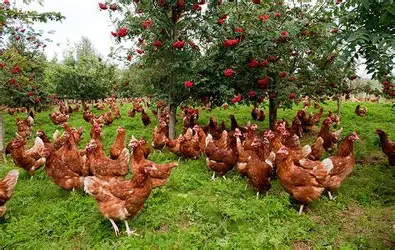
As welfare campaigners we say there is only one way for consumers to purchase their eggs – if they want to eat eggs – GO FREE RANGE. Compare the free range hens plumage above to that of battery hens below – is that image simply not enough alone to make egg eaters buy NON CAGED eggs.
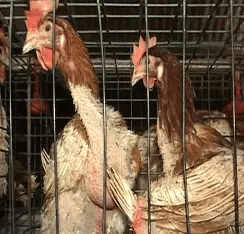
So ok; there you basically have it – Consumer clear labelling relating to egg production, which allows them to make their independent clear choices.
So for this post; the heading basically says ‘when it comes to meat products, is the EU really telling the consumer what they would like to know?’. We don’t think so; if the labelling system is good for eggs; why the shortfalls for meat products in labelling ?
Cards on the table; I [Mark] have been a non-meat eater for 35+ years. Anything ‘that ever had a face’ is not part of my diet; but I accept there are still lots of carnivores out there. One question though I would ask them is simply; if EU legislation attempts to provide you with accurate labelling on your eggs, and how they were produced; then why not clear and precise labelling on how your meat was reared; AND ESPECIALLY HOW IT WAS KILLED !
Many EU and British citizens; when asked, simply abhor the thought of live animals being ritually slaughtered. But, unlike the ‘egg labelling system’; are EU consumers being led up the garden path when it comes to specific meat labelling?. There are two main methods of ritual slaughter which does not involve pre-stunning an animal before its death; – Shechita (Kosher) – the Jewish method; and Halal which is the Muslim method. Here is more reading from the UK Government about this:

Above – Kosher method Beef Slaughter
Below – Halal method Chicken Slaughter
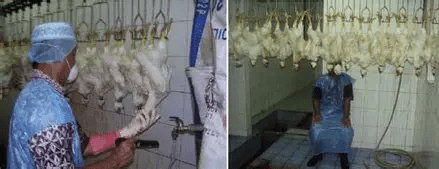
EU law requires that all animals being slaughters for the food chain are stunned and made unconscious prior to killing so that death should be ‘painless’; – hmm; ‘painless’ ? – we say ask the animals going through the process !
But within the EU there are exceptions for religious slaughter as detailed above. Jews and Muslims represent around 6% of the EU population.
Data from Ireland; an EU Member State (MS) showed that around 2010, showed that with just a 1% Muslim population; 6% of cattle, and 34% of sheep were slaughter without stunning. In a 2006/7 survey, it was seen that in France, another MS; 40% of Calves; 25% of Bovine cattle; and no less than 54% of Sheep were slaughtered without stunning.
The EU market for Kosher meat was worth around 5 Billion Euros in 2008.
THE REAL EU MEAT LABELLING ISSUE.
The following is very informative reading for reasons why there is NO standard legislation throughout the entire EU member states when it comes to meat produced by pre-stunning or religious specific methods. We especially suggest looking at the the data on ANNEX 7 – The Practice of Religious Slaughter In Every EU Member State.
Then we can unfortunately understand the EU reluctance, or refusal, to publish concise EU consumer – wide labelling about meat and meat products. When you enter an EU supermarket and are opposed to ritual animal slaughter; does the ‘EU labelling system’ express YOUR animal welfare concerns as a consumer ? – WE WOULD SUGGEST A BIG ‘NO’ !!
But then after all; religion never caused any wars; did it ?
And who in their right mind would want the EU to end up with Egg on its face ?

https://www.independent.co.uk/news/uk/home-news/chickens-gas-chamber-video-tesco-b2760844.html
Exclusive: World-first footage exposed of birds past their egg-laying days being suffocated for supermarket meat
Monday 09 June 2025 17:26 BST
Secretly recorded footage reveals hens apparently writhing in distress and desperately trying to escape as they are suffocated to death to provide meat for supermarkets including Tesco.
In what’s thought to be the first-ever video of its kind, the birds are seen twisting their necks as they are killed with carbon dioxide. They are also heard gasping for breath and emitting high-pitched shrieks.
The recording – which activists say was made at an abattoir endorsed by RSPCA Assured – shows hens being lowered into the gas chamber and dying over the course of several minutes.

Hens were filmed apparently trying to escape from the crates before flopping back in; at times their eyes were open and they were calling (Joey Carbstrong)
Critics said the scenes laid bare the “horrors” behind egg production in the UK, including the fate of even free-range and organic hens.Hens whose egg production has declined are dubbed “spent”, before they are killed and their carcasses are packaged for meat.
Animal-lovers have for years objected to the gassing of pigs with carbon dioxide, warning the animals “burn from the inside out” and suffer immensely in the last minutes of their lives.
Last year 99 per cent of “spent” hens were stunned and slaughtered with CO2; and 77 per cent of meat chickens were killed this way, according to government figures.
In recent years carbon dioxide as a slaughter method has gradually replaced electrical water bath stunning, which raised concerns over the inconsistency of stuns.
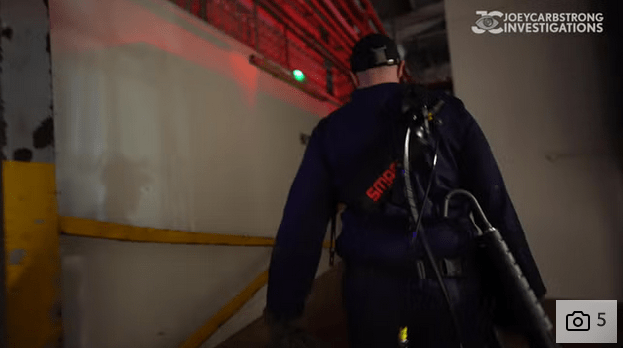
Activist Joey Carbstrong said the footage highlighted the discrepancy between images of egg production and the reality (Joey Carbstrong)
The footage, taken with hidden cameras, shows hens – female chickens used for laying eggs – twisting in distress as they die, and some birds apparently trying to escape.
The floor of the gas chamber was littered with dead birds that had jumped out of the crates, according to activist, filmmaker and vegan advocate Joey Carbstrong, who installed the cameras.
Mr Carbstrong and other activists say they shot the video at an abattoir in West Yorkshire run by HCF Poultry. The company denies it was shot at its premises.
HCF supplies Cranswick Foods, one of the UK’s largest meat producers, which processes the hens into chicken-meat products widely sold in Britain.
There is no suggestion of wrongdoing by either Cranswick or the abattoir as using CO2 is an entirely lawful way to slaughter chickens. However, Mr Carbstrong said the video exposed “the callous treatment of free-range hens when they are no longer profitable”.
“This footage dismantles the industry’s carefully curated image of ‘happy hens’ and reveals the horrifying truth of how these sensitive birds are discarded,” he said.

The footage included a paper label with HCF’s name and address on it (Joey Carbstrong)
“The public are being misled by labelling and have a right to know the reality behind what they are buying.”
Mr Carbstrong added: “Egg-laying hens have been genetically manipulated to produce around 300 eggs per year – far beyond the 10 to 15 eggs naturally laid by their ancestor, the red junglefowl.
“This excessive egg production takes a severe toll on their bodies in multiple ways. Regardless of whether they are free-range, barn-kept or caged, most hens are crammed by the tens of thousands into filthy sheds, where disease runs rampant and cannibalism of dead and dying birds is widespread.
“After just 18 months of relentless exploitation, they are forced to experience a terrifying and agonising death, before being processed into food products.”
The Independent has previously revealed one case of hens being kept in “cruelly overcrowded” cages with insufficient water and another when sick and dying hens were found alongside living ones at a free-range egg farm supplying leading supermarkets as well as Marks & Spencer.
Around 35 million “spent” hens a year are killed for their meat, figures show. HCF can process 10,500 birds per hour, according to a document from 2018, the latest available.

Even free-range hens are put into gas chambers, activists say (Getty/iStock)
Jenny L Mace, an associate lecturer in animal welfare at the University of Winchester, wrote in a report on the footage that the most concerning findings were the high-pitched shrieks, gasping, collisions with equipment, and chickens falling against one another and out of the crates.
“Without use of a significantly less aversive gas or gas mixture, it is difficult to see how this method equates to a viable (high-welfare) replacement to the former slaughter method of shackling chickens upside down and stunning in a water bath, and a humane death,” she wrote.
She said CO2 caused respiratory distress, adding that describing it as an anaesthetic “may be misleading” because of the distress inhaling it causes.
“There is no suggestion of this case being a ‘bad apple’; this is standard practice and in accordance with legislation,” she wrote.
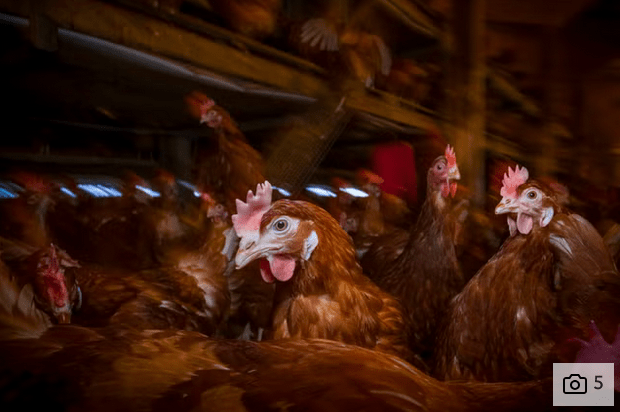
Egg-laying hens have been genetically manipulated to produce around 300 eggs a year, Joey Carbstrong said (Getty/iStock)
Andrew Opie, of the British Retail Consortium, said on behalf of Tesco and other supermarkets:“Our members know how important animal welfare is to their customers and take their responsibilities to animal welfare very seriously to ensure that expected standards are being met.”
RSPCA Assured said the birds in the footage were already unconscious and were not in pain.
A spokesperson said the footage was deeply upsetting but that carbon dioxide was permitted under RSPCA welfare standards, adding: “However, RSPCA standards set requirements that go above the law to ensure a more humane process.
“Due to their physiology, when birds lose consciousness their brains no longer have control over their bodies, which can cause involuntary movements as seen in the footage. This can be incredibly difficult to watch but the birds are actually unconscious when this happens, and are not experiencing pain.”
Cranswick Foods did not respond to a request to comment.
Save Ralph – A short film with Taika Waititi
Introducing Ralph, the spokes-bunny of Humane Society International’s global campaign to ban animal testing for cosmetics. #SaveRalph is a powerful stop-motion animation short film featuring an all-star multinational cast including Taika Waititi, Ricky Gervais, Zac Efron, Olivia Munn, Pom Klementieff, Tricia Helfer and more.
“Save Ralph” is a powerful stop-motion animation short film featuring Oscar winner Taika Waititi as the voice of Ralph, who is being interviewed for a documentary as he goes through his daily routine as a “tester” in a lab. “I’m a tester. My daddy was a tester, my mom, my brothers, my sisters, my kids. All testers,” he tells a documentary filmmaker voiced by actor and animal advocate Ricky Gervais. Ralph tells his interviewer that he is “doing it for the humans,” so long as “just one human can have the illusion of a safer lipstick or deodorant,” regardless of his own personal suffering.
….
Sunday 8 June 2025
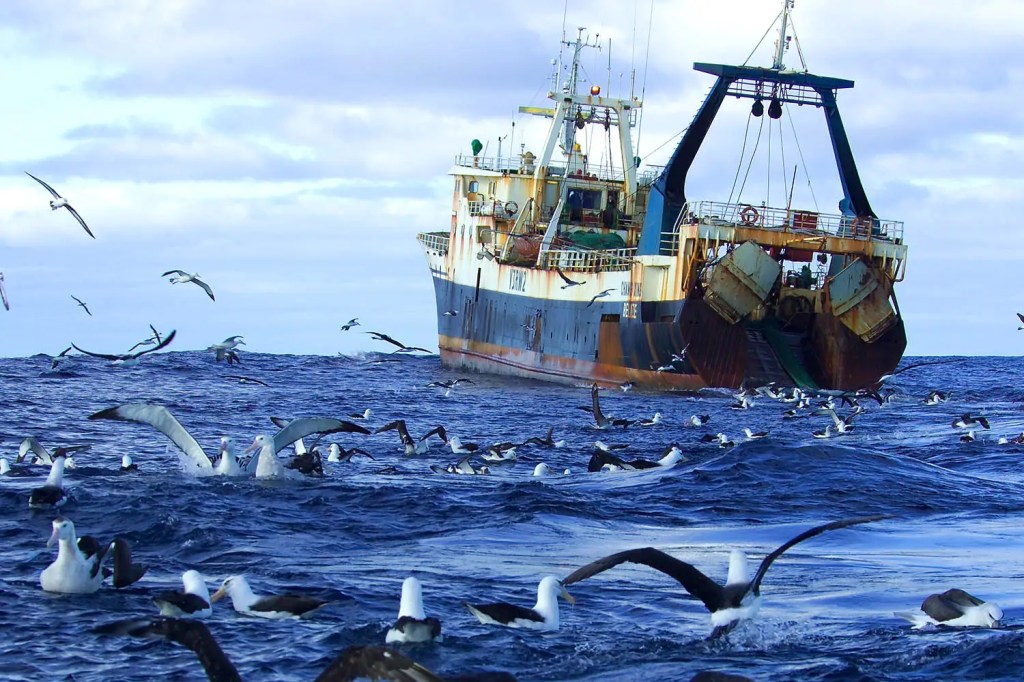
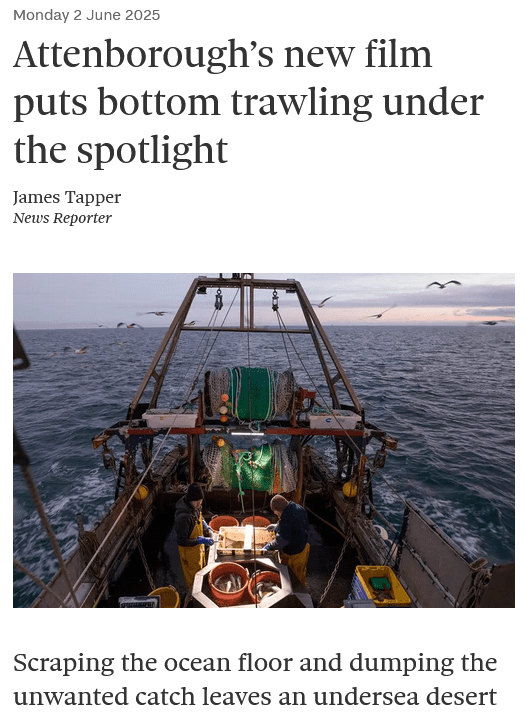
As David Attenborough warns of the damage being wreaked on the oceans by seabed trawling, the role of an army of mystery boats is in the spotlight.
The Ghanaian flag that droops from the mast of the Meng Xin 10 is one of the few African things about the fishing boat.
The deckhands are Ghanaian, and officially it is owned by a company in Accra. But the officers are Chinese, all the instruments and telemetry are in Mandarin, and the people who call the shots are based in the northeastern Chinese port city of Dalian.
For 10 years the blue-hulled vessel, one of at least 30 that investigators have linked to Dalian Mengxin Ocean Fishery, has meandered along Ghana’s coastline, dragging a heavy beam along the ocean floor about 200m below, bottom trawling for squid and cuttlefish.
Continue reading …
**************

**************
https://observer.co.uk/news/our-planet/article/time-is-running-out-for-our-oceans
**************
**************
**************
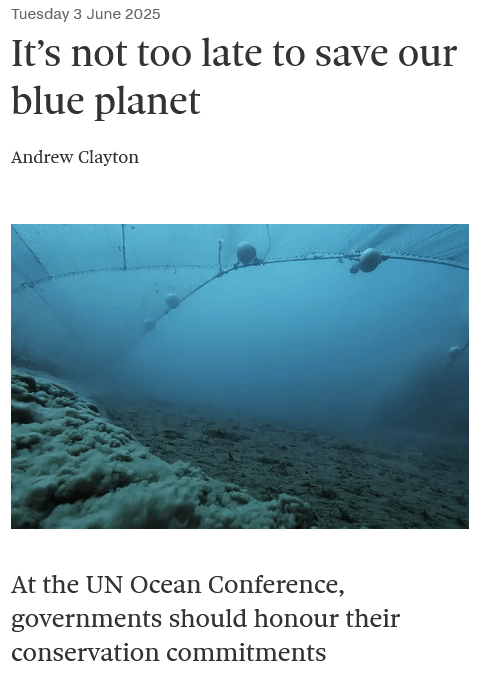
https://observer.co.uk/news/oceans/article/its-not-too-late-to-save-our-blue-planet
**************
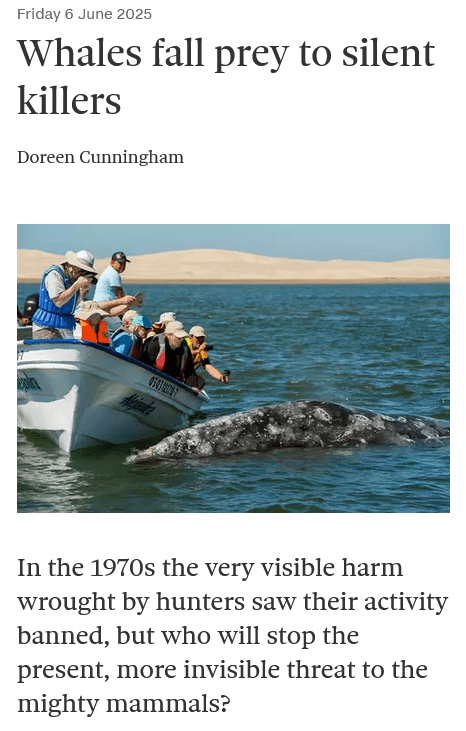
https://observer.co.uk/news/oceans/article/whales-fall-prey-to-silent-killers
This course provides an introduction to the problem of wild animal suffering. It covers the situation of animals in the wild as individuals, including the many harms they suffer, and ways of improving their situation, including some of the ways this is already being done.
This is the opening video for the course. It gives an overview of the topics that will be addressed in the videos of the course.
Concern about the suffering of wild animals and the ways we can help them has increased a lot in the past decade. A growing number of people are now aware that the lives of animals in the wild are not idyllic, and that they face threats that dramatically impair their wellbeing. There is more awareness now that this affects not just a few animals, but large numbers of them. While in the past, concern for wild animals was mostly focused on their ecological roles or their conservation status, many people now are concerned about what happens to them as individuals, as sentient beings.
Some people may think that it is unfortunate that wild animal suffering occurs, but be unsure about how widespread or how serious it is. Others may think this is an important issue, but not know how tractable it is, or what we can do to address it.
This course sheds some light on these questions and helps give a more clear understanding of the reality of wild animal suffering and, what is more important, of what can be done about it. It is intended to provide an introduction to this question for anyone interested in it, and to be especially useful to those involved in animal advocacy who want to know what can be done to help wild animals. The course will also benefit people working in natural sciences with an interest in learning how their work can help animals.
The course will include three parts.
Part I has been completely published already. It explains the ways that wild animals suffer and how we can help them. Part II details the arguments about the moral consideration of animals, and Part III explores the scientific study of the situation of animals from the point of view of their wellbeing. This new field of study has been called welfare biology.
Each part will consist of a set of videos, around 10 minutes each, focused on some specific problems. The entire course contains 28 videos including this one, which you’ll see listed in the course table of contents.
The first part begins with a general presentation summarizing the question of wild animal suffering. Following this, we will clarify in more detail what the concept of “wild animal suffering” entails. The following videos will then explain the different ways in which animals suffer in the wild. We will see the impacts of harmful weather conditions, natural disasters, diseases, parasitism, hunger, psychological stress, conflicts between animals, and accidents. We will also see how the prevalent reproductive strategies significantly increase the proportion of suffering among wild animals. Then, we will see some of the ways to provide help to these animals, including rescues and vaccination programs. Finally, we will see the kinds of things that each of us can do to make a difference for wild animals.
Some people think that we shouldn’t worry about wild animals because we shouldn’t be concerned about what happens to animals at all. We will believe this if we think, for instance, that only humans matter. In order to asess this concern, and to understand better how we can argue for the moral consideration of animals, the second part of the course presents an overview of contemporary debates about ethics and animals. The part will begin by explaining the concepts of speciesism, as well as related concepts like moral consideration. We will next examine the main defenses of the idea that human interests matter more than equally strong interests of other animals. We will then see the main arguments against this view. After that, we’ll cover how the moral consideration of animals relates to different ethical theories. We will then examine the differences between the views defending the moral consideration of animals and those defending other criteria, such as the ones held by some positions in environmental ethics. In the last part of this part, we will see what sentience is, and consider some indicators of its presence in different animals, especially invertebrates.
Finally, the third part of the course will examine the ways to promote research in academia about how to best help wild animals. In the videos of this part, we will examine the concepts of wellbeing, animal welfare, and wild animal welfare. We will also discuss welfare biology, the study of the situation of animals with regard to their wellbeing. We will see how it is different from other fields that currently exist. We will then see reasons to promote academic research in welfare biology, and what some promising lines of research for this field are. We will see how welfare biology can benefit from work in other cross-disciplinary fields. In light of the work welfare biology could carry out, we will see responses to objections to helping wild animals.. Finally, we will share some ideas concerning the advance of this new field of research, and its importance, especially in the long term.
We hope this course will be interesting to you. Our intention is to help you become familiar with the issues discussed in it, and to share some tools that enable you to do further research on them. We provide information about how to take action in defense of wild animals and to help you make informed decisions about which efforts to support or promote.
If you want to learn more, you can visit our website, where you’ll find much more detailed information about many of the issues addressed in the course.


https://www.dailymail.co.uk/news/article-13865257/peta-investigation-horror-abuse-animals-cairo.html

Published: 22 September 2024
Top tourist destinations in Egypt are blighted by animal abuse, with horses and camels starved, beaten and left to die in squalor, an investigation has uncovered.
MailOnline has seen exclusive footage revealing the extent of cruelty inflicted upon animals by guides offering visitors tours of historic sites, documented in harrowing detail by animal rights group PETA.
Investigators said they found the bodies of animals dumped behind the great Pyramids of Giza on a daily basis, with horses and camels worked to the bone in miserable conditions.
Horrific footage showed euthanised animals, broken by long hours in 35C heat, left out to rot as crows and stray dogs pick at their carcasses. Some – starved to the bone and exhausted – are visibly still breathing, but too weak to get up.
More than 14 million people visit the Pyramids of Giza every year, bringing trade and tourism to Cairo. But with this number set to double by 2030, rights groups are calling for tourists to avoid exploitative traps that come at the expense of many lives.


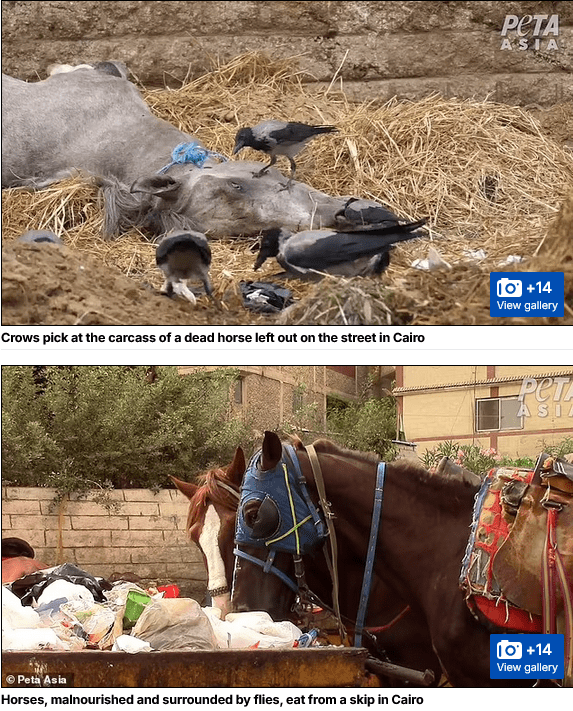
Unsettling video taken in Cairo between 2023 and 2024 showed horses eating rubbish from skips or the ground, not properly looked after by the tour operators
Many appeared thin, struggling to stand on their own and struggling under the weight and heat of thick saddles and blinkered masks.
Ribs protruded from animals with dirty manes and mottled skin, swarmed by flies in undisclosed areas around the city.
Across from them, about a dozen animals lined up to take the next group of tourists around historic sites.
Open wounds attracted midges, causing horses to squirm and writhe in pain with evidence of medicine or treatment.
Those filmed still had saddles on their back, expected to continue working under the strain.
Others twitched as they lay on the ground with ropes embedded in their skin, eyes half shut as they tried to brush off flies with limp gestures.
Bloodied ‘handles’ made from twine appeared to have been poked through the bodies of abused animals for easier control and manipulation.
PETA also documented how horses were whipped while being forced to pull carriages for tourists in Cairo.
Thin horses baring their teeth are seen outside the famous pyramids being beaten as tourists watch on unmoved.
Various draft animals are used to ferry visitors around the historic sites for a fee.
Jason Baker, PETA Senior Vice President, told MailOnline: ‘No decent person would dream of climbing onto a horse or camel if they knew that behind every ride is a disturbingly cruel industry that physically abuses these sensitive animals up until the moment their exhausted bodies give out.’
He said that their investigation had shown how ‘half-starved’ animals at the Giza pyramids are ‘literally worked to death’.
If they collapse first, they are ‘whipped mercilessly to force them to get up and pull carriages or carry tourists’.
‘Most suffer from wounds, mange, and painful scarring and receive no treatment, then when they’re no longer considered useful, they’re dumped like rubbish or dragged to a slaughterhouse, where their throats are slit while they’re fully conscious,’ he assessed.
‘PETA’s shocking findings – and the Egyptian government’s shameful attempt to cover them up – sends a clear message to all tourists: avoid all animal rides like the plague.’
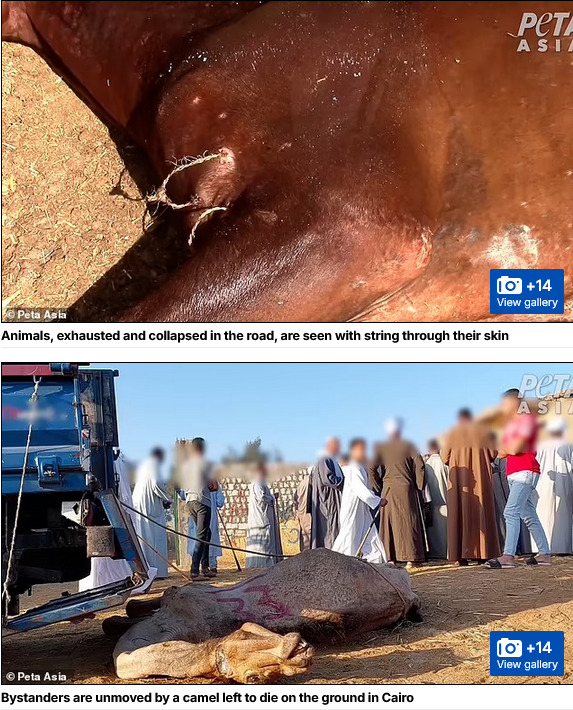
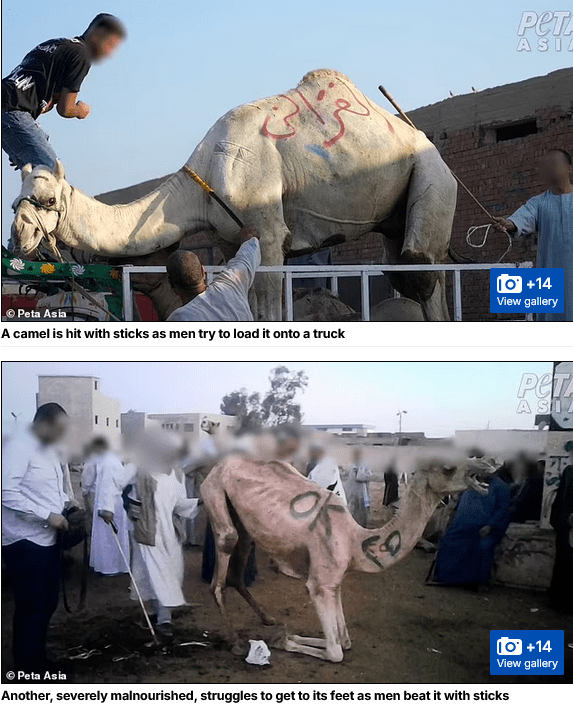
PETA’s investigation showed how camels, suffering from open wounds and infection, were also beaten in front of tourists.
Animals are seen with ropes through their faces and chains around their bodies, with loose skin hanging from bloodied lacerations.
The animal rights group said its investigators had come across dead camels with their throats ‘slashed’.
Footage showed camels limp or dead, some bleeding out, by the sides of roads as bystanders walked past reactionless.
One live animal was left to sit next to the corpse of another slowly bleeding into the street with a large gash in its neck.
Others, thin and weak from malnourishment, were seen being beaten with sticks to get up or dragged into trailers unwillingly on thick ropes.
Camels face a dire existence in Cairo; when no longer deemed useful, many are sold on to slaughterhouses.
Death in these abattoirs is a painful, grisly affair: footage showed live camels fully conscious as other working animals were slain, cut by the neck and left to bleed out on a cold, bare floor.
In an instant, another is approached from the front and slashed. But death takes some time. The animal cries out what it can as it writhes on the floor in pain.
One tries desperately to get up in its last act before collapsing and falling on its side. The chorus of screams continue around the building, bodies twitching for long, painful seconds before going limp.
For many thousands of animals, this will be the only life they know. Tourism contributes some 10-15 per cent of the Egyptian economy, incentivising keen entrepreneurs to cater their businesses to tourists.
But the scale and conditions of such abuse only exist due to lack of enforced regulation and the willingness of tourists to pay for such tours.

Video on Page
PETA revealed the lengths some guides will go to to stop the horrifying shadow of their operations coming out in their harrowing exposé.
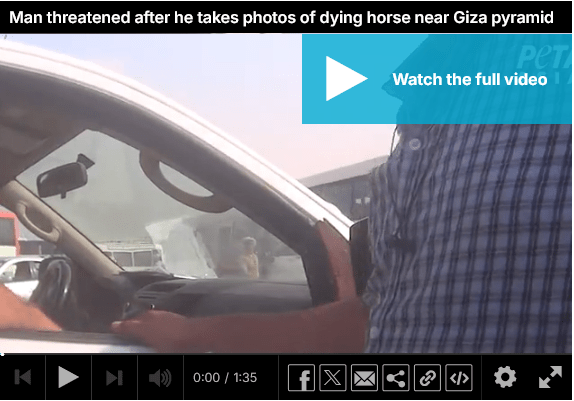
Video showed how a man organising camel and horse rides called the police on a visitor after he began taking photographs.
Police, along with a representative from the Ministry of Antiquities and Tourism, detained the man for nearly an hour and a half, PETA reported.
They allegedly ‘intimidated’ him, insisting he clear his memory card, before confiscating his camera.
On camera, the man is questioned over his documentation of the abuses.
Someone out of view says: ‘When you take photos coming to the pyramids, you can take photos of the pyramids, of the second… of the sphinx.
‘But it’s not allowed for anybody to take photos of the policemen, of the cart, of the camel, of the horses.’
The man apologises and is told: ‘Whether you are sorry or not, you did something wrong. You broke the law.’
They then tell him they are going to delete all of his photos ‘for the whole visit’ in a disturbing cover-up.
Egypt does have special rules about taking photos of historic sites due to potential damage from flash photography.
But the Ministry of Antiquities and Tourism relaxed more general laws about street photography in 2022 after tourists and influencers complained about officials shutting down their photo opportunities.
Taking photos of children is still not allowed, taking photos of adults requires written consent and taking photos of police or military is generally unadvised.
There is no clear law pertaining to the photography of animals.
The man is seen on camera asking where they are taking him. He is told he will be taken to the Ministry.
Another off camera denies working for the government, claiming to be a tour operator.


Millions travel to Egypt every year to enjoy a rich history today synonymous with the height of culture and civilisation.
But behind the scenes, a sinister reality exists in stark antithesis to the wonders of human brilliance all around.
New footage shows a pressing need for reform and awareness in a country where attempts to expose the truth are often repressed with force.
But until Egypt shows willing to tackle the issue, the industry will be propped up by tourists bringing demand.
**************
************
And yet some – indeed too many – are totally blind to what is going on right in front of them ..

https://www.theguardian.com/environment/2025/jun/08/manta-ray-last-dive-film
Sun 8 Jun 2025

A Pacific manta being photographed by tourists. Photograph: Johnny Friday
The Last Dive tells how a relationship with a giant Pacific manta ray turned a big game fish hunter into a conservationist
Located about 500km off the southern coast of Baja California lies a group of ancient volcanic islands known as the Revillagigedo Archipelago. Home to large pelagic species including whale sharks and scalloped hammerheads, the rugged volcanic peaks were also once the site of an unlikely friendship.
It began in December 1988 when Terry Kennedy, a now 83-year-old American sailor with a storied past, met a six-meter-wide giant Pacific manta ray off San Benedicto island’s rugged shore. He would go on to name him Willy.
Continue reading …
*********


https://www.thepetitionsite.com/163/887/397/?z00m=33472029
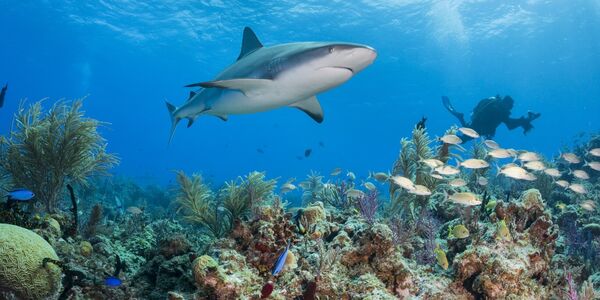

The smash-hit movie Jaws was filmed 50 years ago off the coast of New England, on the island of Martha’s Vineyard. It stirred up human fear of sharks, contributing to a popular misconception that sharks were supposedly villains and reckless human-eating monsters.
But of course, that is not true about sharks. In fact, humans are the real threat here. Every single day, we kill an average of 274,000 sharks. That amounts to approximately 100 million sharks each year. Today, many species – like the great white, sand tiger, great hammerhead, and others – are endangered or vulnerable to extinction.
That’s why famed athlete, 55-year-old swimmer Lewis Pugh, just completed a grueling 12-day swim around the island to help raise awareness about the importance of sharks.
Sign the petition to urge the U.S. government to protect sharks by expanding and creating more marine sanctuary areas!
The United Nations named Pugh a “patron of the oceans” due to his use of swimming as a way to raise awareness about marine wildlife and ocean conservation. He’s swum near volcanoes, near glaciers, and alongside polar bears, hippos, and crocodiles. He’s the first person ever recorded to have finished a long-distance swim in each one of the world’s 5 oceans, and to swim across the north pole itself.
And he’s worried about the future of sharks – just like we all should be.
Sharks help maintain a precious balance in marine ecosystems. Without them, the entire natural structure begins to deteriorate. They promote biodiversity and keep other species in check before they spiral out of control, and even keep the oceans healthy by scavenging injured, sick, or dead animals.
But today, humans target them for overfishing. They’re suffering from habitat loss and climate change. And, of course, being maligned by humans has only made their survival more difficult.
We must respect sharks – and we must demand more protections to keep sharks safe, alive, and healthy! One way to do that would be for the U.S. Congress to create and expand more shark sanctuaries. These are special areas or zones that would sharply curtail overfishing and destruction of habitats. Sign the petition to demand the U.S. protect sharks!
***********
Karenia mikimotoi algae can suffocate fish, cause haemorrhaging and act as a neurotoxin, one expert says

More than 200 marine species, including deepwater sharks, leafy sea dragons and octopuses, have been killed by a toxic algal bloom that has been affecting South Australia’s coastline since March.
Nearly half (47%) of the dead species were ray-finned fish and a quarter (26%) were sharks and rays, according to OzFish analysis of 1,400 citizen scientist reports.
Cephalopods – such as squid, cuttlefish and octopuses – accounted for 7%, while decapods – crabs, lobsters and prawns – made up 6% of species reported dead or washed up on beaches.
Continue reading …
 World Animals Voice