(UK) Major debate over halal slaughter ban as 100,000 Brits sign petition

https://www.express.co.uk/news/politics/2066081/mp-debate-halal-slaughter

UPDATED: 10:28, Mon, Jun 9, 2025

The debate will take place after a petition won widespread support from the public.

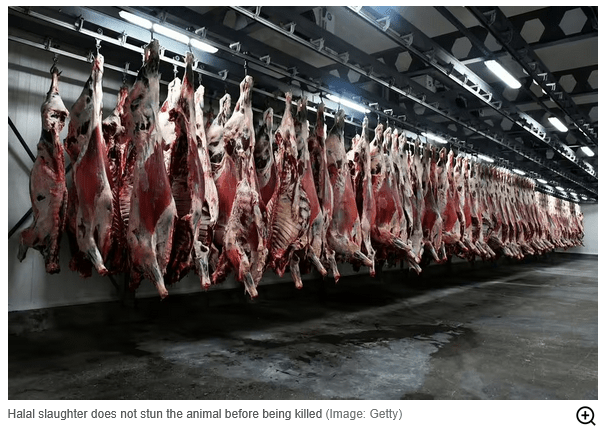
Ps will hold a major debate today on banning halal and kosher slaughter of animals, after thousands of Britons signed a petition demanding better animal welfare. The debate will be held in Westminster Hall at 4.30pm, meaning that while there won’t be a vote it will be the first debate of the religious practice in parliament for years.

The showdown was forced as a result of a public petition on the parliamentary website, entitled: “Ban non-stun slaughter in the UK”, which garnered 109,018 signatures. It read: “In modern society, we believe more consideration needs to be given to animal welfare and how livestock is treated and culled. We believe non-stun slaughter is barbaric and doesn’t fit in with our culture and modern-day values and should be banned, as some EU nations have done.”
In a landmark case, the European Court of Human Rights has ruled that a ban on the ritual slaughter of animals without prior stunning does not violate the ECHR.

“The Court considered that the protection of public morals, to which Article 9 of the Convention referred was not indifferent to the living environment of individuals covered by its protection and including animals.”

A Government response on January 10 defended the practice, arguing that while it would “prefer all animals to be stunned before slaughter… we respect the rights of Jews and Muslims to eat meat prepared in accordance with their religious beliefs.”

Ahead of today’s debate, Rupert Lowe MP said: “Big debate in Parliament today on non-stun/halal slaughter.”

“I’ll be speaking in favour of a full ban.”

Three days ago Mr Lowe tabled an Early Day Motion in Parliament also calling for a ban on nun-stun slaughter, arguing that there is a “substantial body of veterinary evidence indicating that pre-stunning significantly reduces animal suffering at the point of slaughter”.

He called on the government to “urgently review the legislative framework around non-stun slaughter, consider restricting or banning the practice, and introduce mandatory, clear labelling of meat products by method of slaughter so that consumers can make informed choices.”

It was also signed by Conservative MPs Thomas Bradley and Andrew Rosindell.

A 2019 poll suggested 83% of British adults believe the law should be changed to ensure animals killed for food production are stunned before being killed.

In addition 86% want all meat sold in the UK to be clearly labelled so they know how the animal died.

Around 114 million animals are killed using the halal method each year in Britain, and a further 2.1 million using the kosher method.

The RSPC backs a ban on non-stun killing, with head of public affairs David Bowles saying: “Non-stun slaughter can cause considerable suffering and as a result the organisation believes this practice should be banned once and for all.”

“While we believe religious beliefs and practices should be respected, we also feel strongly animals must be slaughtered under the most humane conditions possible.”

(UK) Keir Starmer risks shredding Tories’ hard-fought Brexit win on animals in EU deal

https://www.express.co.uk/news/politics/2068269/keir-starmer-risks-shredding-tories

UPDATED: 16:33, Fri, Jun 13, 2025

Environmentalist Zac Goldsmith has raised concerns about a “troubling commitment” in the Prime Minister’s deal with the EU.

Zac Goldsmith has slammed Keir Starmer (Image: Getty)

ac Goldsmith has slammed Keir Starmer’s UK-EU reset for risking the Tories hard-fought Brexit wins on animal welfare. The environmentalist warned that a “troubling commitment” in the agreement means any UK deviation from EU food standards must not “negatively affect European Union animals and goods being placed on the market” in the UK.

The former MP said: “This seemingly technical clause has profound implications for animal welfare and our ability to raise our own standards, something that we fought so hard to achieve with Brexit.  “Among other things it likely means the UK cannot restrict imports of animal products that fail to meet our welfare standards – even when we’ve banned those same practices domestically.

He said around 50% of UK pork imports come from EU countries still using sow stalls – narrow metal cages Britain banned in the 90s because they were considered to be cruel.

A new sanitary and phytosanitary (SPS) deal was agreed last month to reduce red tape currently needed to import and export food and drink between the UK and the EU.

ut campaigners want the Government to clarify whether animal welfare measures fall outside the SPS agreement’s scope, or to negotiate explicit exceptions for welfare-based restrictions.

here were concerns before the deal was struck that Britain could weaken its post-Brexit animal protection laws to get a reset deal with Brussels.

But following the concerns, the Prime Minister said: “We are not involved in, nor will we be involved in, a sort of race to the bottom on standards.

“I think that British people are proud of the high standards that we have, and we want to maintain those standards.”

Sir Keir has pledged to strengthen ties with the EU since coming into office on July 4 last year.

As part of the agreement he signed, there will be more targeted checks on the movement of animals, animal products, plants and other products.

This will stop animals being held for excessive periods at the borders and lower any detrimental impact on animal health and welfare, and reduce the burden on the veterinary workforce.

There was also a commitment made on shared disease surveillance and data sharing, which will secure UK biosecurity and risk of imported diseases.

Animal welfare groups also welcomed the introduction of pet passports to replace Animal Health Certificates (AHCs), which increased burden on the veterinary workforce and hiked costs for animal owners since they came into force.

A Government spokesman said: “This government will always act in the national interest to protect Britain’s farmers and secure our food security. We have said we will uphold the highest agricultural standards and that is exactly what this deal does.”

By Lord Zac Goldsmith

Brexit undoubtedly delivered meaningful wins for animals, enabling policy changes that were previously impossible. We were able for example to ban the cruel live export of animals for slaughter and even more far reaching, we could change the way we subsidised farming to incentivise higher animal welfare and environmental stewardship. Neither of these changes could have happened without Brexit, which is one of the reasons I supported our EU exit in 2016.

And although of course I wish we had done more, the last Conservative Government did deliver a wide range of animal welfare measures, from an expanded ivory ban and banning glue traps, to much bigger sentences for animal cruelty and recognising sentience in law. Now in Opposition the Party is calling for among other things raising zoo standards.  

Last month’s UK-EU Summit produced a ‘Common Understanding’ agreement which has been hailed by the Prime Minister as a significant step towards mending post-Brexit relations, generating economic benefits and streamlining trade. However, buried in the details lies a troubling commitment: any UK deviation from EU food standards must not “negatively affect European Union animals and goods being placed on the market in the United Kingdom”.

This seemingly technical clause has profound implications for animal welfare and our ability to raise our own standards, something that we fought so hard to achieve with Brexit. Among other things it likely means the UK cannot restrict imports of animal products that fail to meet our welfare standards – even when we’ve banned those same practices domestically.

Consider the immediate threats. Around 50% of UK pork imports come from EU countries still using sow stalls – narrow metal cages we banned in the 90s because they were considered to be cruel. The last Labour government prohibited fur farming in the UK, yet we continue importing it from the EU. Under the new agreement, banning such imports may be impossible, despite the stated wishes of the Government to deliver the biggest boost to animal welfare in a generation.

The agreement links UK standards to EU animal welfare rules with opt outs limited to public health and biosecurity – assessed case by case basis. So while we might still be able to ban puppy imports, as these present a public health risk, the agreement could block us from banning EU fur or even foie gras on welfare grounds alone.

This not only undermines domestic animal welfare standards but also places British farmers, who adhere to stricter regulations, at a competitive disadvantage. The problem is more acute with EU imports, our largest trading partner for food imports, not just the usual suspects like the USA or Australia.

Brexit gave us the chance to lead the world on animal welfare – to show that an independent Britain could set gold standards that others would follow. This is also about democratic sovereignty; British voters consistently support higher animal welfare standards, with 84% backing restrictions on low-welfare imports.

There’s still time to put this right, but it will require government to clarify that animal welfare measures fall outside the SPS Agreement’s scope, or to negotiate explicit exceptions for welfare-based restrictions.

While its proponents say the UK-EU reset agreement offers economic and diplomatic benefits, it’s imperative that animal welfare remains a priority. By addressing these concerns proactively, the UK can position itself as a global leader in animal welfare and ensure that progress is not achieved at the expense of the most vulnerable and the voiceless.

(EU) 2024 ECVAM Status Report: biotechnology boom accompanies continuous drop in animal testing

https://joint-research-centre.ec.europa.eu/jrc-news-and-updates/2024-ecvam-status-report-biotechnology-boom-accompanies-continuous-drop-animal-testing-2025-04-02_en

2 April 2025

The annual status report of the JRC’s EU reference laboratory for alternatives to animal testing (EURL ECVAM) highlights recent EU statistics on animals used for scientific purposes, which show an overall reduction of 5% of animal procedures in the EU and Norway from 2018 to 2022. 

In parallel, the biotechnology sector has experienced rapid growth, with cutting edge technologies and innovation transforming many domains including biomedical research, development of medicines and in vitro testing. Data show that in 2021, the global biotechnology market was worth €720 billion with an annual growth rate higher than 18%.

Statistics on the use of animals for scientific purposes for EU and Norway, including re-uses, in 2022. © EU, 2025

Establishing standards for in vitro biotech innovation

Standards are needed to foster a robust biotech ecosystem and facilitate technology transfer from research to industry.  

ECVAM’s work has been instrumental in driving standardisation efforts in the in vitro biotech sector, including contributing to the CEN-CENELEC Focus Group on Organ on Chip. The group delivered a roadmap identifying priorities for standardisation of this disruptive technology, which underpins a new generation of sophisticated non-animal models and methods set to transform research and regulatory testing.

Validation is essential for the development of standard tests using non-animal methods. To ensure an internationally recognised and harmonised approach, ECVAM is co-leading the project to revise the OECD Guidance Document (no. 34) on the validation and international acceptance of new or updated test methods for hazard assessment. 

Better protection of workers and consumers from mutagenic chemicals

The UN Globally Harmonized System of Classification and Labeling of Chemicals (GHS) was created by the United Nations to classify chemicals by the hazards they might pose to humans or the environment, such as being corrosive or acutely toxic. The GHS is used worldwide to facilitate trade, and to ensure safe packaging, transport and use.

ECVAM is leading an informal working group to update GHS classification criteria for identifying chemicals that can mutate the DNA of germ cells, which develop into ova in women and sperm in men, and thus can carry over health effects into future generations. This work is also considering options for adapting criteria to make better use of non-animal data and to provide more protection from cancer-causing chemicals. 

Supporting EU’s open science policy

Through PRO-MaP, an initiative Promoting Reusable and Open Methods and Protocols, ECVAM has been driving improvements in methodological reporting and transparency in scientific publications, capitalising on innovation and improving health outcomes.

This work has been recently highlighted in an editorial of the journal Nature Methods, recognising the ECVAM Pro Map initiative as very valuable to the field. 

Upcoming roadmap on phasing out animal testing

ECVAM is supporting the preparation of the European Commission “Roadmap towards phasing out animal testing for chemical safety assessments”, to be published in 2026. It will serve as an actionable plan for accelerating the path towards replacing animal testing in the safety assessments of chemicals, including pharmaceuticals. 

Alternatives in research and education

Finally, ECVAM has also made significant advances in promoting non-animal approaches in research and education, including the launch of its brand new Virtual Reality laboratory.

Other key initiatives include the development of the BioMedical Models Hub (BimmoH), an automated database that collects and organises information on non-animal models used in biomedical research, and the Student Ambassador Project, a self-sustaining movement to spread knowledge across European universities.

(AU) Animal shelters struggle with influx of surrendered pets, as owners face cost of living pressure

https://www.abc.net.au/news/2025-06-13/nt-darwin-animal-shelters-see-influx-surrendered-pets/105350000

13.06.2025

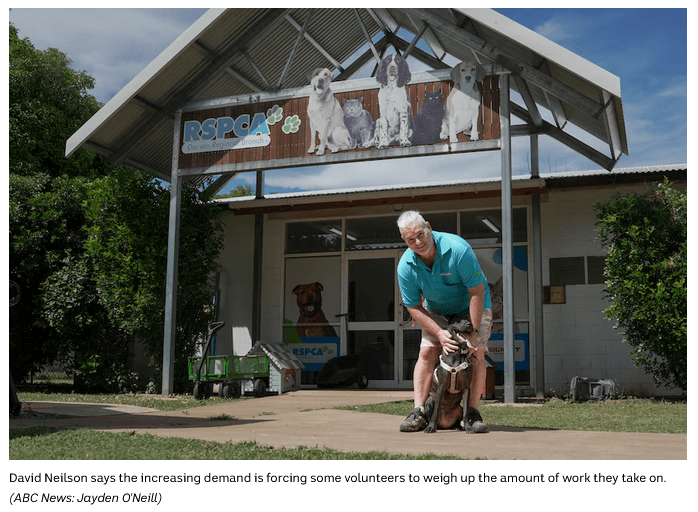
RSPCA rescue animal, Spotty, is one of hundreds of pets under the Darwin shelter’s care. (ABC News: Jayden O’Neill)

Bernadette Relos and husband, Nathan Calverley, are self-described animal lovers who live in a bustling house in Darwin’s outskirts suburb of Berrimah.

They have two cats and a one-year-old puppy, which they recently adopted from a shelter.

The South Australian couple who moved to the Top End for work said their “fur babies” brought chaos and destruction, but much-needed colour to their lives.

“They bring life to the household … you can be lonely, and one of the cats will jump on you, and then you’re not lonely anymore,” Mr Calverley said.

“You could walk in the front door, and everyone doesn’t say a word, but the dog will come running … and start licking you and saying hello.”

Ms Relos said they decided to adopt because they wanted pets that would grow up with their young family.

But as some are choosing to bring furry friends into their forever homes, animal shelters are seeing the opposite.

Shelters being pushed to breaking point

Charles Giliam, the Northern Territory’s RSPCA operations manager, said there had been an increasing number of surrendered pets due to people experiencing financial difficulties.

He said most pets being dropped on shelter doorsteps were mixed breeds, weighing around 20 to 30 kilograms, with backyard breeding worsening the situation.

“[People] bring pets to us that are often in need of veterinary treatment … and say, ‘We just don’t have the money’,” he said.

The RSPCA estimates most dog owners spend an average of $25,000 on their pet during its lifetime, while cat owners spend $21,000 on average.

The charity says that within the first year of cat ownership, people could face up to $3,500 of expenses on food, desexing, grooming, bedding, toys and treats.

Mr Giliam said the influx of surrendered pets was creating significant challenges for shelters.

“We probably got about 15 to 20 people on our waiting list who are wanting to surrender … but we are chock-a-block full,” he said.

RSPCA national data showed around 81,000 pets were surrendered in the 2023/2024 financial year, with only 27,000 finding new homes.

David Neilson, a volunteer at the Darwin RSPCA shelter, said the increasing demand was leaving some volunteers “overwhelmed”.

“There are so many volunteers that are here through the week to walk the dogs and sit with the cats and we are not getting through everything … it makes it difficult,” he said.

Industry voices want to see change

While many in the rescue sector are worried about the growing crisis, there are also concerns the NT’s animal rights laws are ineffective.

Unlike most other Australian jurisdictions, the NT does not have a formal dog breeder licensing scheme, however breeders are still expected to meet standards of care under the Animal Protection Act.

Melissa Purick, a licensed dachshund breeder, said it was “frustrating” to see people buy pets from unlicensed backyard breeders without considering the animal’s welfare.

“I would like to see that stopped to start with, where you can’t sell puppies at the markets or the side of the road,” she said.

Hannah Bohlin, an animal advocate, believes growing use of social media is glamorising pet ownership without highlighting its challenges.

She said if people adopted pets that were incompatible with their lifestyle, cost of living could become a “scapegoat” to surrender animals that were no longer valued.

She wants the NT to look at what other states and countries are doing to manage pet breeding and ownership.

“I would like to see a discussion around the possibility of introducing some kind of licence system [to own a pet],” she said.

“Some European countries do operate this kind of system to get a dog in the first place.”

The NT’s Agriculture and Fisheries Department, which oversees animal welfare, said a review of the Animal Protection Act was currently underway.

“The NT government takes animal welfare seriously and is committed to strengthening animal welfare laws,” a department spokesperson said.

(EU) REACH revision could increase animal testing, says humane group

https://www.euractiv.com/section/economy-jobs/news/reach-revision-could-increase-animal-testing-says-humane-group/

Animal rights group, Humane World for Animals, says it fears a revision of Europe’s regulations for chemical testing in Europe could lead to more animal testing.

Jun 13, 2025

A revision of the EU’s REACH regulation covering the ‘Registration, Evaluation, Authorisation and Restriction of Chemicals’ must clean up the chemicals risk assessment and the chemicals market, falling in line with the Clean Industrial Deal, argue animal rights advocates.

With decarbonisation and boosting competitiveness priorities for the EU, within the chemical testing industries, it should create a ‘simplified legislative framework to reduce the administrative burden for the industry, while still maintaining the safety of human health and the environment’.

While a revision of REACH is welcomed by animal advocacy groups, particularly the opportunity to introduce more non-animal testing methods, the proposals to date have not been met with glee.

CEFIC, the forum of chemical companies across Europe, has produced a 10-point action plan to simplify REACH. One pressing point for Humane World for Animals is its call for the last resort requirement to be put under a microscope and refined in greater detail.

“We really need to see a much better leveraging of the last resort requirement, which is already built within REACH, where, in theory, animal testing should only be done as a last resort. But we, along with a number of our collaborators, published a paper last year which indicated that this wasn’t really happening,” says Jay Ingram, Managing Director, Chemicals, R&T, Humane World for Animals.

“This really needs to be strengthened, there needs to be a lot more specificity around what “last resort” actually means and how it is demonstrated, both by registrants (industry), who are going to be proposing tests, but also by the regulatory bodies themselves, who will be requesting additional data.”

“It needs to be much stronger in terms of how we actually determine whether this last resort threshold has been reached – we really need to see strengthening on the enforcement of that last resort requirement,” he says.

Testing in complex areas

Ingram has also expressed his concerns that the revision of REACH could lead to an increase in testing on animals in some complex areas.

“We are also insisting that this revision of REACH doesn’t bring in new or expanded animal testing. There’s been a revision to the CLP regulation last year, which brought in new classification categories for endocrine disruption, amongst other things,” says Ingram.

“The issue is endocrine disruption is an extremely complex topic from a toxicological perspective, and we fear that this change to CLP will have a knock-on change to REACH, where they will be asking for a huge amount more animal testing to be done to determine the endocrine disruption potential of chemicals,” he explains.

“And not just new chemicals, but also ones that have already gone through the REACH process, and that all of this new data will be generated without a clear idea of how or whether it can be used to make safer decisions about chemicals.”

“There are non-animal methods for endocrine disruption that are available and are of good quality,” says Ingram as he explains how complex the topic of endocrine testing is and that we must better understand the use of the data from such testing before there is a call for an increase on animal testing – technology can play a role as a safe alternative here.

New approach methods

One of CEFIC’s action plans to simplify REACH includes the introduction of a new safety assessment scheme that supports an increased uptake of reliable animal-free safety assessment methods – New Approach Methodologies, or ‘NAMs’.

CEFIC’s suggestion is to ‘reduce the hazard focus of REACH, allowing more flexibility in achieving a high degree of safety’ and to remove ‘default requirements for animal testing wherever possible.’

It wants regulators to give greater justification on ‘why concerns cannot be addressed using exposure-based approaches or NAMs, such as when rejecting proposals for read-across, grouping, or NAMs to avoid animal tests.’ It also seeks to ‘adapt data requirements to utilise NAMs together with exposure considerations: a chemical can only cause harm if it can reach a target and interact with it.’

Could we see a rise in the use of NAMs in chemical testing with the correct revisions to REACH?

“On a positive side, the Commission is also working on the roadmap for phasing out animal testing, which is the result of Save Cruelty Free Cosmetics/End Animal Testing European Citizens’ Initiative (ECI),” says Antigoni Effraimidou, a senior strategist at Humane World for Animals.

She added: “We can see there’s already movement, which we feel is very positive to see, because it marks a landmark opening for the advanced chemical safety assessment, and it can also bring this cultural change in the scientific world that we are looking for, and hopefully also regulatory transformation.”

“There are some complex endpoints which the Commission feels that there will be a need also to develop new non-animal methods, but we do see this attitude from the policy makers, the willingness to go through that,” she said.

(UK) Murder accused killed pet cat before 20-minute spree of violence, court told

https://www.independent.co.uk/news/uk/crime/monzo-court-trial-daniel-anjorin-b2769732.html

Monzo said he ‘received guidance and communication’ in his head that the cat ‘was being used against me by negative forces’

Friday 13 June 2025

Marcus Arduini Monzo with a samurai sword that was shown to the jury in his trail at the Old Bailey (Metropolitan Police/PA) (PA Media)

An alleged sword attacker tried to cook and eat his pet cat, but claimed to have no memory of killing a schoolboy during a rampage in London.

Prosecutors say Marcus Arduini Monzo, 37, skinned and deboned his cat Wizard before launching a 20-minute spree of violence in Hainault, east London, while allegedly under the influence of cannabis on 30 April last year.

Monzo is accused of murdering 14-year-old Daniel Anjorin, as well as mowing down pedestrian Donato Iwule with a van and attacking two police officers and a couple in their home on April 30.

At the Old Bailey on Friday, Monzo cried as he said he did not intend to harm anybody.

Monzo said he tried to cook it, but became “panicked and rushed”, believing an event “like an Armageddon” was happening.

Continue reading …

***************

Clearly a nut, the guy. But again, the link between violence towards Animals and Humans .. as if more proof were needed.

Please refer to ..