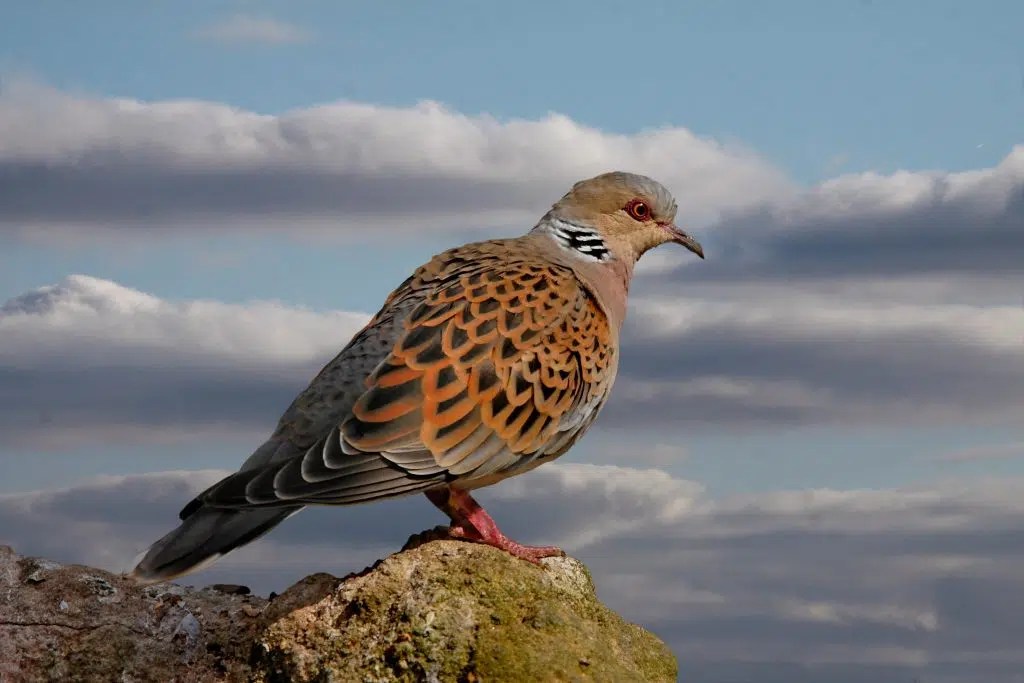
European Turtle-dove by: Tony Brindley/Shutterstock
The European Commission has announced EU countries may re-open the hunting season for the European Turtle-dove (Streptopelia turtur) in parts of Western Europe if they choose to do so. The reopening follows a three-year hunting pause despite the species’ ongoing decline and weak enforcement of hunting laws.
Hunting of iconic species paused since autumn 2021 will continue pushing species to brink.
European Turtle-dove (Streptopelia turtur) in parts of Western Europe if they choose to do so [1]. The reopening follows a three-year hunting pausedespite the species’ ongoing decline and weak enforcement of hunting laws. The moratorium, introduced in 2021, had halted hunting in Spain, France, Portugal, and northwest Italy (Western Flyway) and in 2022 for Austria, Bulgaria, Greece, Italy, Malta, Romania, and Cyprus (Central-Eastern Flyway). Hunting is a major driver of the species’ decline, yet instead of strengthening protections, the Commission is opening the door to more killing.
The hunting pause worked. Data shows that after years of decline, the Turtle-dove population in the Western Flyway has started to recover [2]. But in the Central-Eastern Flyway, where hunting bans have not been properly enforced, no recovery has been observed. The species continues to be classed as ‘Vulnerable’ on the IUCN Red List due to habitat loss and food shortages from intensive farming and pesticide use, and unsustainable hunting.
Despite these fragile gains, the European Commission has recommended resuming hunting in the Western Flyway for the 2025/2026 season, allowing hunters to kill up to 1.5% of the population. The Commission’s recommendation to end the moratorium was based on three conditions:
A population increase for at least two consecutive years
A rise in survival rates
Effective monitoring, control, and enforcement systems
But one of these conditions has still not been met. While population numbers have improved, the enforcement systems remain weak and unreliable [3]. The Commission is relying on a 1.5% hunting quota, assuming it will be sustainable, but there is no way to ensure that hunters will stick to this limit. The risk is clear. Without proper controls, overhunting will resume, and the species will start declining again.
Barbara Herrero, Senior Nature Conservation Policy Officer at BirdLife Europe, said: “The Turtle-dove did its part. Left alone, it started to recover. But governments failed to uphold their end of the deal. Instead of fixing weak enforcement and protecting habitats, they’re rushing to lift the ban. This is reckless and shortsighted. We know where this path leads – straight back to the brink. The European Commission should have stood firm and kept the moratorium.”
Meanwhile, in the Central-Eastern Flyway, illegal and unsustainable hunting continues unchecked. The Ionian Islands in Greece remain a hotspot for illegal killing during migration. Malta also continues its unlawful spring hunting of Turtle Doves. BirdLife Europe urges these countries to enforce the hunting ban before it’s too late.
The Turtle-dove is not safe. Without strong protections, we risk another devastating population crash. The European Commission must act responsibly and put nature before politics.
Now, Germany is a Speed Maniacs’ paradise. This is commonly known. All the time terrible accidents happen, caused by people racing their fast cars on motorways without speed limits. Increasingly even in traffic-calmed areas inside cities, with speed limits of 50 km/h. The German automobile industry has no interest in any speed limits ever being established, and due to successful political lobby work things remain as they are. Being a driver myself in this country, I daily encounter reckless drivers, and their often aggressive behaviour.
Sadly a huge number of animals fall victim to their unthinking, uncaring, and often intentional conduct on the roads. And also, sadly, the German “ADAC” (“Allgemeiner Deutscher Automobil Club” – General German Automobile Club) advises its numerous members accordingly … against due consideration for the (smallest and) most vulnerable animal road users.
Two recent accidents reported in the news, with drivers trying to avoid hitting a pigeon and a squirrel, were commented accordingly by police/the ADAC.
“… The police point out that, even in road traffic, human life always comes before animal life. Braking for small animals such as rabbits or squirrels should only be performed if it does not endanger vehicle occupants or other road users, the police explain. “
Smaller animals (e.g., pigeons, rabbits, cats): Do not brake or swerve abruptly! The protection of human life takes priority – risky maneuvers can lead to serious accidents
Larger animals (e.g. deer, wild boars, dogs): Controlled braking is permitted and required to avoid a collision as far as possible – provided that other road users are not endangered.
(Source: ADAC)
Now, accidents happen – we are all aware of that. And the least one should do is stop and see if help can be given. Or, should that fail, to remove the body from the road – the decent thing to do – lest it be run over time and again by other drivers (once read an interview with one, German, who enjoyed aiming for the heads of prone animals on the road, alive and dead).
Should I just keep driving or stop? As harsh as it may sound, stopping to check on a hedgehog or squirrel that’s been run over makes little sense. Small wild animals are usually killed instantly after a collision with a car or are so severely injured that they can no longer be helped. These include, for example, foxes, hares, wild rabbits, squirrels, hedgehogs, songbirds, and game birds like pheasants. Well-intentioned rescue operations on the road, especially in poor visibility or darkness, are unlikely to be successful, according to ADAC traffic expert Christoph Hecht.
Well at least they advise, here, to look after a cat or a dog. But small wildlife clearly is screwed …
In the event of an accident involving a dog or cat, you should stop in a safe place, turn on your hazard lights, put on a high-visibility vest, and secure the accident scene with a warning triangle. Then you can go to the injured animal. If the animal is dead, you should pull it off the road. If the injured pet is still alive and injured, it must receive medical attention.
As regrettable as every dead hedgehog is, risky evasive maneuvers endanger people and are disproportionate. Car insurance companies also consider emergency braking that leads to an accident (a rear-end collision) to be disproportionate. This can lead to the loss of benefits.
Hedgehogs that have been hit by a car are usually beyond rescue. Anyone who still wants to try should be especially careful, especially in the dark and in areas with poor visibility, as there is an increased risk of accidents with even more serious consequences.
No one wants an attempt to save an animal life on the road to end in serious harm to other parties, or their property. However, personally, I disagree with most of this. And as regards property – and here the all-important car (to most Germans anyway) – that can never have priority over an irreplaceable life.
In my personal experience not all small animals involved in road accidents are necessarily dead or beyond saving. Sadly the ADAC seems to think that to try is not worth it – so potentially leave them to suffer and die slowly of their injuries.
As concerns wildlife that is listed in the hunting law in Germany, which goes for most species, it is strictly forbidden to remove an injured animal from the site of the accident, even with the intent of having it receive medical attention or for transport to a wildlife station. It is considered poaching, and the rule is to wait for the local hunting tenant to dispatch the animal – even IF it would otherwise have survived. For vets it is illegal to give such an animal medical attention, even to euthanise it!!
I have personally witnessed such an incident a few years ago, with a young wild boar, having fled a drive hunt in November, and running across a busy road in its panic, being hit by a car. The poor animal lay in the middle of the road, trying to rise and could not, while the accident driver looked on. I pulled the creature from the road onto the verge. Police arrived, and it was decided to summon the local hunter to deal with it. What followed was the longest half hour of my life. Being left alone with the animal, I tried to stand it up on its legs, so it could flee. I knew what was to come. However, the back injury was too severe, and I’ll never forget the panicked gasping, the rolling eyes seeking a way out …
The hunter arrived.
He shook everyone’s hand, pulled a pistol from his jacket, aimed and shot. Once, twice – in the chest. The poor animal screamed in agony, and with two bullets in its chest, was yet alive. Shamed with his inability to do the job right, the hunter grabbed the hind legs of the boar and pulled it out of sight, in the dark, to the verge of the field. No doubt, there, out came the knife …
We all stood there, no one reacted. The two police officers should have put a stop to this, but did not. After this, I swore to myself: never again will I watch such an “execution”. I’ll do whatever needs doing, fuck the law.
On many other occassions I also came upon animals injured on the road, or dead. Only yesterday, within a hundred yards of each other … a cat, and what, presumably, was a deer, judging by the amount of blood. The latter already removed by the hunting tenant. The cat, laid at the roadside by a lady who got out of her car in front of me. The accident driver had clearly kept going …
On another occasion, in the August of 2021, I travelled through a local village, and came past a hit squirrel in the middle of the road (speed limit!), with cars passing, but no one stopping. I parked, got out, and found the little guy still alive, twitching, with eyes open, and still having the hazelnuts it had carried in its bloody mouth. I took it and carried it to my car, with many passing in theirs, gloating ..
The local vet I saw could only euthanise it, so severe were the head injuries.
It’s a brutal world out there – and getting worse every day. The statement, “human life always comes before animal life.” and all that results of it, is, I think, THE main cause of most of what we see here on WAV being done to fellow animals.


 World Animals Voice