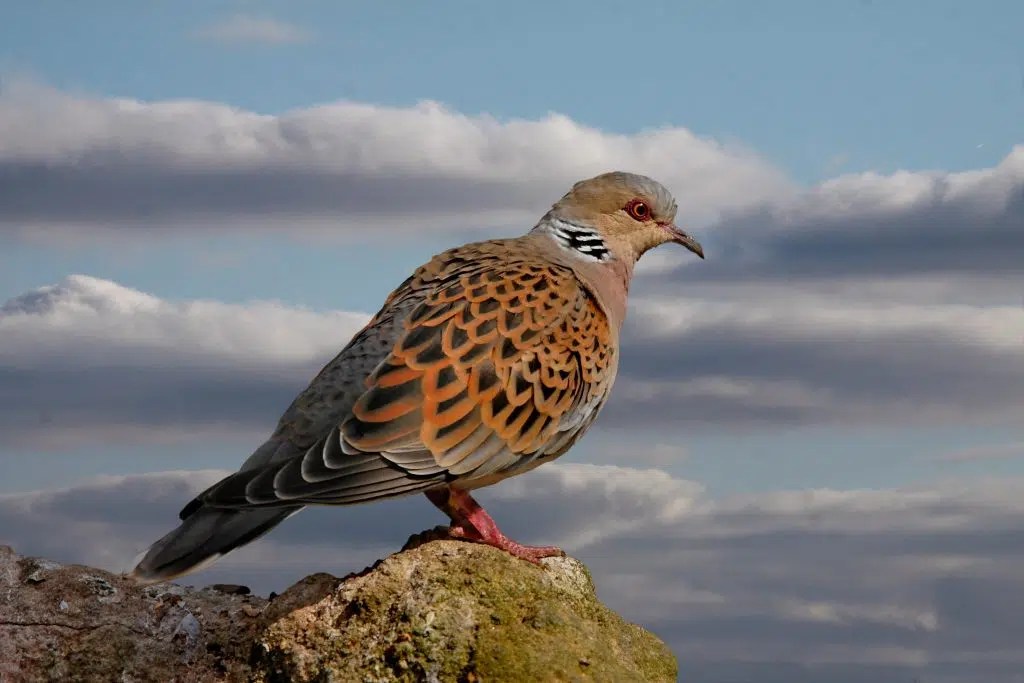
European Turtle-dove by: Tony Brindley/Shutterstock
The European Commission has announced EU countries may re-open the hunting season for the European Turtle-dove (Streptopelia turtur) in parts of Western Europe if they choose to do so. The reopening follows a three-year hunting pause despite the species’ ongoing decline and weak enforcement of hunting laws.
Hunting of iconic species paused since autumn 2021 will continue pushing species to brink.
European Turtle-dove (Streptopelia turtur) in parts of Western Europe if they choose to do so [1]. The reopening follows a three-year hunting pausedespite the species’ ongoing decline and weak enforcement of hunting laws. The moratorium, introduced in 2021, had halted hunting in Spain, France, Portugal, and northwest Italy (Western Flyway) and in 2022 for Austria, Bulgaria, Greece, Italy, Malta, Romania, and Cyprus (Central-Eastern Flyway). Hunting is a major driver of the species’ decline, yet instead of strengthening protections, the Commission is opening the door to more killing.
The hunting pause worked. Data shows that after years of decline, the Turtle-dove population in the Western Flyway has started to recover [2]. But in the Central-Eastern Flyway, where hunting bans have not been properly enforced, no recovery has been observed. The species continues to be classed as ‘Vulnerable’ on the IUCN Red List due to habitat loss and food shortages from intensive farming and pesticide use, and unsustainable hunting.
Despite these fragile gains, the European Commission has recommended resuming hunting in the Western Flyway for the 2025/2026 season, allowing hunters to kill up to 1.5% of the population. The Commission’s recommendation to end the moratorium was based on three conditions:
A population increase for at least two consecutive years
A rise in survival rates
Effective monitoring, control, and enforcement systems
But one of these conditions has still not been met. While population numbers have improved, the enforcement systems remain weak and unreliable [3]. The Commission is relying on a 1.5% hunting quota, assuming it will be sustainable, but there is no way to ensure that hunters will stick to this limit. The risk is clear. Without proper controls, overhunting will resume, and the species will start declining again.
Barbara Herrero, Senior Nature Conservation Policy Officer at BirdLife Europe, said: “The Turtle-dove did its part. Left alone, it started to recover. But governments failed to uphold their end of the deal. Instead of fixing weak enforcement and protecting habitats, they’re rushing to lift the ban. This is reckless and shortsighted. We know where this path leads – straight back to the brink. The European Commission should have stood firm and kept the moratorium.”
Meanwhile, in the Central-Eastern Flyway, illegal and unsustainable hunting continues unchecked. The Ionian Islands in Greece remain a hotspot for illegal killing during migration. Malta also continues its unlawful spring hunting of Turtle Doves. BirdLife Europe urges these countries to enforce the hunting ban before it’s too late.
The Turtle-dove is not safe. Without strong protections, we risk another devastating population crash. The European Commission must act responsibly and put nature before politics.
Shrinking tiger habitat has led to man-animal conflict in Assam state
A Royal Bengal tiger was killed and dismembered by a mob in India’s north eastern state of Assam, a forest official has said.
Angry residents from a village in the Golaghat district reportedly took the step because the tiger had killed livestock in the area and posed a threat to their lives.
The state’s forest department has registered a case.
Instances of man-animal conflict are not new to Assam. This is the third tiger killing that has been reported this year.
Top forest official Gunadeep Das told Times of India newspaper that the tiger had died from sharp wounds and not gunshots.
The carcass was later recovered in the presence of a magistrate, reports say.
Mr Das told a local newspaper that “around a thousand people had gathered to kill the tiger” and that some of them attacked the tiger with machetes. He added that the tiger’s carcass had been sent for an autopsy.
Mrinal Saikia, a lawmaker from Assam state condemned the killing on X. He shared a video that showed the purported dead body of the tiger with parts of its skin, face and legs missing.
The BBC has not independently verified the video.
“This is a very painful act. The Earth is not only for humans, it is for animals as well,” he said in the post, adding that strict action will be taken against those involved in the killing.
Another forest official, Sonali Ghosh told local media that the origins of the tiger were unclear. According to reports, the animal was killed about 20km (12 miles) away from the Kaziranga National Park.
Latest data by Assam’s forest department shows the population of tigers in the state has steadily increased from just 70 in 2006 to 190 in 2019 due to various conservation efforts.
However, instances of tigers being killed due to conflict with villagers have been often reported in the media, which could be because of shrinking habitat and lack of protection of tiger corridors between different national parks in the state.
Tigers are a protected species under India’s Wildlife Protection Act (1972), which prohibits poaching, hunting and trade of tiger parts.
Kruger Park rangers on the poisoning scene. (Photo: EWT)
08 May 2025
Eighty-four vultures have been rescued after a mass poisoning event in the Kruger National Park, one of the largest incidents of its kind recorded in southern Africa.
An elephant carcass, laced with poison and surrounded by more than 100 dead vultures, marked one of the most devastating wildlife poisoning events yet seen in the Kruger National Park. Remote sensing triggered a scramble to save birds that were still alive.
In a coordinated emergency operation spanning helicopters, ambulances and nearly 24 hours of intensive care, 84 poisoned vultures were pulled back from the brink.
The operation this week was undertaken by a combined team of South African National Parks rangers and Endangered Wildlife Trust (EWT) officials in the park’s Mahlangeni Section, where the elephant carcass was found.
According to Gareth Tate, head of EWT’s Birds of Prey Programme, the organisation’s wildlife poisoning detection system triggered an alarm, flagging suspicious activity.
“The following morning, SANParks rangers conducted surveillance and uncovered a mass poisoning event involving more than 120 dead birds,” Tate said. “It was a shocking, gruesome scene.”
By 8.20am the joint team had arrived on site. They discovered 122 dead vultures, including 102 white-backed vultures, 20 Cape vultures and one lappet-faced vulture – all species listed as endangered or critically endangered. Several vultures were found alive but severely affected.
Tate described the rescue as a “world-class operation” involving two ground teams, helicopters, 12 vehicles and the EWT’s specialised Vulture Ambulance. Emergency treatment was administered in the field, including atropine to reverse the effects of the poison on the birds’ nervous systems, activated charcoal to bind toxins, fluid therapy and a procedure to flush and milk the vultures’ crops to remove ingested poison.
“We’ve developed a strict protocol over the years and we’ve achieved about a 98% success rate for birds found alive,” Tate explained. “Those first 24 hours are critical. If we can get them through that, they have a good chance of survival.”
Vultures were being deliberately targeted both to conceal illegal activities and to harvest body parts for the illegal wildlife trade and traditional medicine markets.
A total of 84 vultures were rescued alive. Of these, 45 were transported in the EWT’s mobile vulture ambulance and 39 were taken by helicopter to care facilities. Five of the rescued birds died despite treatment, but 83 remained alive as of the following morning, representing a 96% survival rate.
SANParks Pilot Bradford Grafton with one of the rescued vultures. (Photo: SANParks)
Eighty-four vultures have been rescued by a joint team of SANParks rangers and Endangered Wildlife Trust (EWT) following a devastating poisoning incident in the Kruger National Park. (Photo: EWT)
Reinforcements were swiftly deployed. Support teams from the Moholoholo Wildlife Rehabilitation Centre, Briner Veterinary Services and Wildscapes Veterinary Services were mobilised within hours and worked through the night to stabilise each bird and keep them alive.
“This was one of the largest and most coordinated vulture rescues ever conducted in the region,” Tate said. “The collaboration between SANParks, vets, NGOs and rangers was remarkable.”
This is intentional genocide of vultures. It’s absolutely malicious and a silent killer.
The poisoning involved agricultural toxins placed on an elephant carcass, a method increasingly used by poachers to kill vultures that might otherwise alert rangers to poaching sites by circling overhead. Tate said vultures were being deliberately targeted both to conceal illegal activities and to harvest body parts for the illegal wildlife trade and traditional medicine markets.
“Vultures are being systematically removed from the landscape,” Tate warned. “This is intentional genocide of vultures. It’s absolutely malicious and a silent killer.”
“They’re targeting vultures for their brains, heads and feet,” Tate said. “There’s even evidence that poisoned vulture parts are ending up in muti markets, meaning that toxic substances are being sold to unsuspecting users.”
Broader crisis
This incident forms part of a broader crisis facing vultures across southern Africa. The birds play a key role in ecosystems by consuming carcasses and reducing the spread of disease. Their absence leads to carcasses lingering longer in the environment, increasing the risk of disease transmission to other wildlife and humans.
The decline of vultures has been linked to knock-on effects seen in other regions: in India, the collapse of vulture populations due to veterinary drug poisoning led to a boom in feral dog numbers and a corresponding rise in rabies cases.
Kruger hosts at least five regular vulture species: the white-backed vulture (Gyps africanus), the most common; the Cape vulture (Gyps coprotheres), mainly found in the park’s north; the lappet-faced vulture (Torgos tracheliotos); the hooded vulture (Necrosyrtes monachus) and the rarely seen white-headed vulture (Trigonoceps occipitalis). Each species occupies a niche at carcasses, forming an efficient clean-up system.
Each adult vulture killed is not just an immediate loss – it’s a loss of future generations.
However, their numbers are declining due to a number of pressures. Many species breed slowly, raising only one chick per year. Their nesting habitats are shrinking as large trees along rivers are lost, often from increased elephant activity. Without sufficient nesting sites, reproductive success drops. Poisoning events exacerbate these losses, wiping out breeding adults and chicks alike.
Poisoning incidents targeting vultures have increased. Poachers use pesticides like carbofuran, a highly toxic agricultural chemical, to lace carcasses. Vultures that feed on the poisoned remains are removed as natural sentinels from the ecosystem. Other scavengers, including jackals, lions, hyena and ground hornbills, also fall victim.
“Unlike targeted poaching of individual animals, poisoning takes out entire species indiscriminately,” Tate said. “Each adult vulture killed is not just an immediate loss – it’s a loss of future generations.”
Efforts to address the issue include increased patrols, training poison response teams and establishing artificial feeding sites to provide uncontaminated food. Conservationists stress that long-term solutions will require stronger regulation of agricultural poisons, improved enforcement against wildlife crime and engagement with communities living near protected areas.
Community outreach initiatives by the Kruger Park have begun, aiming to reduce demand for vulture parts in belief-based practices and build support for conservation. However, scaling these measures to meet the size of the problem remains a challenge.
Tate emphasised the need for stricter penalties for those responsible. “These individuals need to be caught and the penalties must reflect the seriousness of the crime – they’re killing critically endangered animals.”
Natural waste disposers
The rescued vultures continue to recover under veterinary care and will be released once they are fit to return to the wild. “Some of them are so strong that we’re planning to release them this Saturday,” Tate said.
Conservationists hope the surviving birds will resume their vital ecological role as natural waste disposers, limiting the spread of disease in the ecosystem. The poisoning incident highlights the vulnerability of vultures to deliberate targeting, the ecological consequences of their decline and the urgent need for interventions.
“Without vultures, carcasses take longer to decompose, leading to increased risks of disease,” Tate said. “Their loss disrupts a delicate balance. We need to act now to protect them.”
As the surviving vultures recover, conservationists warn that the battle to save these birds is ongoing. Preventing future poisonings, preserving nesting habitats and raising awareness about their ecological importance will be essential to ensure that vultures remain part of Kruger’s skies. Each circling silhouette is a sign that the clean-up crew is still at work, maintaining the health of the ecosystem for wildlife and humans alike.


 World Animals Voice