Tag: environment

(Med) ‘The sea is like a minefield’: The web of illegal fish traps in Italy’s Mediterranean

https://www.bbc.com/future/article/20250609-the-illegal-web-of-fish-traps-in-the-italys-mediterranean

Sea Shepherd is cracking down on illegal fish-trapping devices off the coast of Sicily (Credit: Sea Shepherd)

Off the coast of Sicily, Sea Shepherd and its volunteers are hunting down illegal fish traps and working with Italian authorities to crack down on this environmental crime.

The flat water melts into the teal-coloured sky as a former pilot vessel, the Sea Eagle, sails through the calm Tyrrhenian Sea surrounding the Aeolian Archipelago of Sicily.

The ship is operated by Sea Shepherd, an international marine conservation non-profit. Today, the team is searching for fish aggregating devices (FADs), man-made plastic structures used to attract fish. They float in the water, anchored to the seafloor, with hanging nets to catch fish. FADs made from plastic, without GPS tracking devices attached, are illegal in Italy.  

While listening to techno music, a group of volunteers uses a winch to detach one of the FADs from the seafloor. A large plastic container labelled “corrosive” emerges from the sea.

“The [techno] rhythm gives us the right energy,” says James* (the crew do not wish to use their full names for safety reasons), a young Canadian volunteer who is running the operation and whose arms are covered in ocean-inspired tattoos. The volunteers work tirelessly to extract the plastic FADs from the sea and pile the tangled trash heaps into big bags. The retrieved plastic will be turned into plastic crates for sea turtle rescue operations.

FADs are used worldwide by fishermen to attract pelagic fishes into surrounding nets. These fish-trapping devices are typically composed of used fuel, pharmaceutical and other chemical containers among other types of plastic waste, dark plastic nets and rocks, all of which is held together by a few miles of nylon thread. Marine wildlife is attracted to the shade provided by FADs.    

Abandoned FADs are illegal. They can cause a wide range of adverse environmental impacts, including the entanglement of marine life (particularly sharks and turtles), act as a habitat for the spread of invasive species, and wash ashore on beaches or become stranded on coral reefs. Many lost or abandoned FADs sink, causing environmental harm to deep-sea habitats.
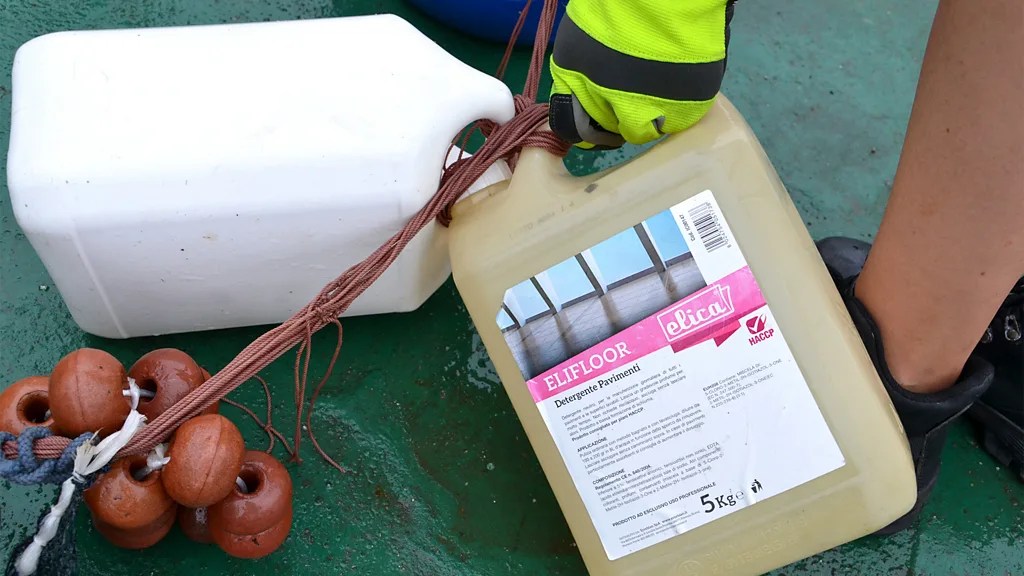
FADs are typically composed of old plastic containers held together by nylon thread (Credit: Sea Shepherd)

The material the FADs are made of matters too. FADs are required by Italian law to be biodegradable. All the FADs removed by the Sea Shepherds from the South Tyrrhenian Sea are illegal and made of plastic, says Nicola Silvestri, frigate captain and head of the Fishing Control Centre area in Western Sicily. They also lack markings which allow them to be traced back to the fishing boat that used them, he says.

“Illegal FADs are very cheap to produce, but at the same time highly dangerous for ecosystems,” says Andrea Morello, president of Sea Shepherd Italy. “These devices are installed by fishers in the month of August, then they catch fish around them in summer. Eventually, winter storms remove the devices, creating tonnes of hazardous and plastic waste floating in the sea.”

In this stretch of sea around Sicily’s Aeolian Archipelago, the target fishing species in the summer are juvenile ricciola, bluefin tuna, juvenile swordfish and pilot fish. FADs can damage the entire population, by preventing juveniles from maturing and reproducing.

The Sea Shepherd mission is part of the organisation’s ongoing Siso operation in Sicily to combat these illegal fishing devices.

“We are witnessing the biggest marine environmental disaster ever,” says Morello. “The sea is like a minefield full of FAD lines in every direction, placed by fishers who split the sea surface among them, threatening biodiversity.”

The Sea Shepherd volunteers remove the long nylon threads attached to the FADs which can harm fish, turtles, humpback whales and dolphins by trapping and suffocating them. According to Sea Shepherd, there are more than 36,000 FADs, each one composed of almost 1.2 km (0.7 miles) of nylon lines in the South Tyrrhenian Sea, part of the Mediterranean Sea.

It takes the volunteers one hour to extract almost 2km (1.2 miles) of a FAD line, it’s the first out of seven removed that day. Not far away, a police coast guard boat is monitoring the work: later it will seize the illegal plastic materials. The use of FADs made from plastic waste, without GPS trackers, is an environmental crime in Italy.

Sarah, a young German volunteer, rings the bell installed on the deck of the vessel, to celebrate and notify the crew that another FAD has successfully been extracted from the seabed. In total, the volunteers haul seven FADs onto the deck that day – their combined mass is the same size as a small car.

The Sea Shepherd volunteers are collaborating with Italian maritime authorities to crack down on FADs (Credit: Sea Shepherd)

organisation maps the FADs using deep-sea radar technology and binoculars and removes them in collaboration with national maritime authorities.

Between 2017 and 2024, the organisation removed 676 FADs from the Mediterranean Sea, says Morello. “We define ourselves as FAD hunters: here to protect the sea. We are also carrying out the first census of FADs ever realised in the Mediterranean Sea,” he says.

The data collected during this mission will be analysed as part of a research project that Sea Shepherd runs with the National Biodiversity Future Centre of the University of Palermo in Sicily and the Cima Research Foundation, based in Liguria, Italy. Using statistical analysis, Sea Shepherd has been producing maps since 2017 to identify for the first time the extent of this ghost labyrinth created by FADs anchored to the seabed.

“With the information provided by Sea Shepherd, we were able to have a precise mapping of the location and composition of these devices,” says Alberto Sechi, a marine biologist at Cima Foundation. “Since 2017, the plastic lines (mostly polypropylene) used to anchor the FADs exceeds 2,500km (1,553 miles): that corresponds to the distance between Paris and Moscow.”

In a single night, Morello says the Sea Shepherds discovered around 912 FADs in the waters surrounding the Sicilian island of Alicudi, each one composed of more than 1km (0.6 miles) of nylon threads. “Multiplying the number of FADs we found by the medium length of each thread, the total length of lines used in this area is a staggering 43,200 km (26.284 miles) of nylon: this is more than the circumference of the entire planet Earth,” says Morello.

Sea Shepherd’s work involves removing as many FADs as possible, but then, the disposal problem arises. In 2022, the non-profit started collaborating with iMilani, an Italian company that specialises in building plastic crates from recycled materials. Together, they have created the Sea Turtle Crates project, which aims to transform the FADs into plastic crates for sea turtle rescue operations. After the entangled turtles have been freed from the FADs, they are put into the crates which Sea Shepherd uses to transport them to veterinarians. Six loggerhead turtles have been rescued to date and 100 turtle recovery boxes have been created from FADs, says Roberto Milani, founder of iMilani and a freediver.

The company is hoping to design other items with FADs waste in future, including pens and other gadgets, which can be sold to finance Sea Shepherd’s activities, says Milani.

Sea Shepherd is creating the first-ever census of FADs in the Mediterranean Sea (Credit: Sea Shepherd)

big bags full of plastic lines extracted from the FADs. In one day at sea, the crew removed seven FADs composed of 6.5km (4 miles) of nylon lines and plastic containers. Their labels reveal their previous lives: from hospital waste and corrosive liquids, to oil, gas and detergent jerrycans. Using radar, the Sea Shepherds map more than 100 FADs throughout the day.

The crew’s work begins early in the morning, and continues until sunset, with brief breaks for meals. Tuti, 23, an Israeli volunteer, prepares a vegan buffet each day. Today’s menu is inspired by Latin American foods, such as empanadas, chimichurri, black beans mole and corn tortillas, which Tuti learned to cook during a Sea Shepherd mission in the Gulf of California, where she worked to protect the last vaquita dolphins.

Onboard are 20 volunteers, from four continents with different ages and backgrounds: from Willie, a 20-year-old German student, to retired engineer and sea captain Gigi, 63, who joins Sea Shepherd’s missions several times a year.

“We are here because we want to be part of the solution. We are sort of part of it, by removing all those plastics from the seas,” says Zafar from Pakistan, who is in charge of measuring and cataloguing each FAD for the database. “I don’t understand people’s insensitivity towards the sea and its inhabitants,” he says.

Many FADs are anchored to the seafloor with stones or buckets full of cement, says Teresa Romeo, director of the Sicily Marine Centre at the Anton Dohrn Zoological Station in Naples, Italy. She has been studying FADs since the 1990s. “They modify the seabed environment and affect all the species living there,” she says.

Romeo says a mandatory recovery of all FADs should be implemented. “We need to establish a spatial management plan to define a specific area [for FADs] and replace floating materials with biodegradable ones, in order to have a more sustainable fishing practice in the Mediterranean Sea,” says Romeo.

Sea Shepherd makes “a great contribution to the mapping actions of FADs and their efforts are useful for monitoring impacts, but in my opinion the aim cannot be drastic removal, but to regulate their use,” she says.

The retrieved plastic FADs are turned into crates for sea turtle rescue operations (Credit: Sea Shepherd)

But creating biodegradable devices from materials such as hemp is difficult due to the high cost, according to Sechi. “Creating a completely biodegradable FAD is a significant challenge, and so far, no one has come up with a solution,” he says. “One alternative could be hemp, but kilometres of hemp thread are very expensive, and no angler would spend that much.”     

Experts such as Romeo say that the transition to biodegradable and non-toxic materials would be an important part of the solution to reduce marine pollution from fisheries based on FADs. As well as breaking down in the ocean, biodegradable materials may contain fewer toxins and heavy metals, compared to plastic, says Romeo, though she agrees that cost is a major barrier for materials such as hemp.

In the meantime, the Sea Shepherds continue to sail the seas to map and remove illegal fish-trapping devices, collaborating closely with the local coastguard, researchers and private enterprises to crack down on this environmental crime. 

“This alliance is a solution to protect the deep sea,” says Morello.

(IN) Good news: India’s first-ever emergency animal evacuation shelter to be established in Wayanad

Set to open in 2026, the shelter will provide safe refuge for up to 150 animals during disasters, including goats, cows, pigs and dogs

https://www.humaneworld.org/en/news/indias-first-emergency-animal-evacuation-shelter-established-wayanad

Date: March 14, 2025

WAYANAD, Kerala—A pioneering emergency evacuation shelter designed to evacuate animals prior to disasters like floods and landslides, is set to be established in Kottathara panchayat in Wayanad district, Kerala. Situated in a region prone to multiple hazards including annual floods, cyclones and landslides, this commitment marks a significant step forward in disaster preparedness for animals in India. The collaborative project will bring together the Kerala State Disaster Management Authority, the Wayanad District Disaster Management Authority, Kottathara Grama Panchayat and Humane World for Animals India (formerly called Humane Society International India) to make India’s first such shelter for animals.

The shelter, set to begin operating in 2026, will have the capacity to accommodate up to 150 animals such as goats, cows, pigs, dogs and cats. The single-story structure is expected to include dedicated space for a veterinary clinic and a quarantine area, along with storage and equipment rooms. The shelter is intended to serve as a model for similar facilities across the country.

Praveen Suresh, disaster preparedness and response team manager at Humane World for Animals India, said: “This is an historic moment for Kerala and India from both an animal welfare and disaster preparedness point of view. It is especially significant for Wayanad district with its growing need for a dedicated facility to evacuate and care for animals during disasters like floods and landslides. While the shelter will provide immediate medical care and relief, it will also serve as a long-term resource to support animal welfare in the community. We are grateful to the Government of Kerala and the State Disaster Management Department for approving this important initiative. This animal shelter highlights the power of collaboration between multiple agencies to safeguard animals and their communities and to strengthen disaster management efforts in India.”

Over the last seven years, Humane World for Animals India has gained a notable presence in Kerala through its disaster preparedness, response and relief efforts. During the 2024 Wayanad landslides, the organization’s rescue team aided over 180 animals. Along with partner organizations, Humane World for Animals India is working to make Wayanad a disaster-resilient district for both humans and animals. Among other activities, the organization is conducting capacity building programs for the community through outreach to schools and self-help groups like Kudumbashree. Once constructed, the shelter will serve as a hub for efforts to safeguard animals and the families who depend on them during disasters and a catalyst for continued commitment to build community resilience in the face of future emergencies that put humans and animals at risk.

Please also refer to ..

Petition: Sharks Need Our Protection. Demand More Marine Sanctuary Areas Now! – ‘A horror movie’: sharks and octopuses among 200 species killed by toxic algae off South Australia

https://www.thepetitionsite.com/163/887/397/?z00m=33472029

The smash-hit movie Jaws was filmed 50 years ago off the coast of New England, on the island of Martha’s Vineyard. It stirred up human fear of sharks, contributing to a popular misconception that sharks were supposedly villains and reckless human-eating monsters.

But of course, that is not true about sharks. In fact, humans are the real threat here. Every single day, we kill an average of 274,000 sharks. That amounts to approximately 100 million sharks each year. Today, many species – like the great white, sand tiger, great hammerhead, and others – are endangered or vulnerable to extinction.

That’s why famed athlete, 55-year-old swimmer Lewis Pugh, just completed a grueling 12-day swim around the island to help raise awareness about the importance of sharks.

Sign the petition to urge the U.S. government to protect sharks by expanding and creating more marine sanctuary areas!

The United Nations named Pugh a “patron of the oceans” due to his use of swimming as a way to raise awareness about marine wildlife and ocean conservation. He’s swum near volcanoes, near glaciers, and alongside polar bears, hippos, and crocodiles. He’s the first person ever recorded to have finished a long-distance swim in each one of the world’s 5 oceans, and to swim across the north pole itself.

And he’s worried about the future of sharks – just like we all should be.

Sharks help maintain a precious balance in marine ecosystems. Without them, the entire natural structure begins to deteriorate. They promote biodiversity and keep other species in check before they spiral out of control, and even keep the oceans healthy by scavenging injured, sick, or dead animals.

But today, humans target them for overfishing. They’re suffering from habitat loss and climate change. And, of course, being maligned by humans has only made their survival more difficult.

We must respect sharks – and we must demand more protections to keep sharks safe, alive, and healthy! One way to do that would be for the U.S. Congress to create and expand more shark sanctuaries. These are special areas or zones that would sharply curtail overfishing and destruction of habitats. Sign the petition to demand the U.S. protect sharks!

***********

‘A horror movie’: sharks and octopuses among 200 species killed by toxic algae off South Australia

https://www.theguardian.com/environment/2025/may/13/a-horror-movie-sharks-and-octopuses-among-200-species-killed-by-toxic-algae-off-south-australia

Karenia mikimotoi algae can suffocate fish, cause haemorrhaging and act as a neurotoxin, one expert says

More than 200 marine species, including deepwater sharks, leafy sea dragons and octopuses, have been killed by a toxic algal bloom that has been affecting South Australia’s coastline since March.

Nearly half (47%) of the dead species were ray-finned fish and a quarter (26%) were sharks and rays, according to OzFish analysis of 1,400 citizen scientist reports.

Cephalopods – such as squid, cuttlefish and octopuses – accounted for 7%, while decapods – crabs, lobsters and prawns – made up 6% of species reported dead or washed up on beaches.

Continue reading …

(UK) MPs put on ‘Notice for Nature’ as charities warn Planning & Infrastructure Bill could demolish wildlife

https://www.buglife.org.uk/news/mps-put-on-notice-for-nature-as-charities-warn-planning-infrastructure-bill-could-demolish-wildlife/

Monday 19th May 2025

Small Tortoiseshell (Aglais urticae) © Charlotte Rankin

  • 28 environmental charities have served a spoof planning notice to MPs, warning that the Planning & Infrastructure Bill is an application to demolish wildlife 
  • The coalition is calling on Government to urgently fix the Bill with amendments to uphold wildlife protections and help nature recover at the same time as supporting sustainable development—to make the planning system ‘Wilder By Design’.
  • Writing to charities a year ago, the Deputy Prime Minister said the Government “will not legislate” to amend key nature laws if it would weaken them. In the opinion of the Government’s own nature watchdog, the current bill breaks that promise.
  • Nature loss in the constituencies of Ministers proposing the reforms is also highlighted today.  

MPs have today been served spoof planning notices warning that the Government’s proposed Planning and Infrastructure Bill will ‘bulldoze environmental protections and demolish nature and local greenspaces’ unless crucial changes are made. Conservationists are also highlighting examples of nature loss in the constituencies of key ministers, drawing attention to the wildlife losses that could be worsened by the Bill.

Charities met the Secretary of State, Steve Reed, last week (Thurs 15 May) where they warned that the Bill as it stands would break Government nature commitments. Following this, 28 charities, including the RSPB, the National Trust, The Wildlife Trusts, the Mammal Society, People’s Trust for Endangered Species, and Wildlife and Countryside Link have mailed the spoof notices to all English MPs and Ministers, including the Prime Minister and Secretaries of State, Steve Reed, and Angela Rayner.  Environmentalists are calling for MPs to support amendments that will deliver a planning system which works for nature, communities and sustainable development for generations to come.

In July 2024, the Deputy Prime Minister wrote to nature charities to say that the Government would not legislate to amend nature protections in a way that would weaken environmental law. According to the Office for Environmental Protection, environmental lawyers, and nature experts, the Government is now breaking that promise with the current version of the Bill and it must be amended.

England is currently facing a nature crisis, with 1 in 6 British species at risk of extinction, a 32% decrease in wildlife populations since 1970 and the UK among the worst 10% globally for nature loss, alongside 40% less greenspace in new developments compared to older housing. That crisis is being played out across the country. From Steve Reed’s Streatham and Croydon constituency seeing notable losses of butterflies and common birds like the blue tit, to Angela Rayner’s constituency in Greater Manchester seeing a 90% decline in recorded insect species, charities warn that the Bill risks speeding up the loss of nature and disappearance of community greenspaces.

  • In Chancellor Rachel Reeves’ Leeds West and Pudsey constituency just 1 out of 7 SSSIs in the area is in favourable condition. 1 in 5 species across Yorkshire have declined by more than 25% in the last 30 years: including swifts declining by 50% and red squirrels by 69%.
  • In Secretary of State Steve Reed’s constituency of Streatham and Croydon North, has seen records of Small Tortoiseshell Butterflies (Aglais urticae) drop to just 10 a year, compared to over 200 a year during the 1990s, and common bird species like Blue Tits (Cyanistes caeruleus) are down more than 10% in the last 20 years. Water voles have largely disappeared from this area and other London constituencies, with just a handful of river sites where they can be found.
  • In the Ashton-under-Lyne constituency of Angela Rayner, Secretary of State for Housing, Communities and Local Government: records of Great Spotted Woodpeckers (Dendrocopos major) have decreased by 68% since 2007 and Song Thrush (Turdus philomelos) by 68% since 2008. The last inspection of the Hollinwood Branch Canal SSSI protected nature sites found they were in a declining condition. The Huddersfield Narrow Canal SSSI was also found to be in an unfavourable condition.

Richard Benwell, CEO of Wildlife & Countryside Link, said: As it stands, the Planning Bill is set to demolish legal protection for nature and pave the way for destruction of wildlife. So far, the proposals are a mile away from the Government’s aim for a win-win for nature and development. Even the Government’s nature watchdog agrees that it would damage environmental protection.

 “It’s disappointing that Government rejected constructive amendments that could put the Bill back on firm foundations for nature protection and greener development. But we heard Ministers acknowledge the case for change and now we urge them to follow up with quick and decisive fixes for the Bill’s serious flaws. Without major improvements, Parliament should reject these damaging proposals.”

Beccy Speight, RSPB chief executive, said: This should have been a once in a generation opportunity to create a planning system that helps restore nature at scale while delivering for communities and the economy. Instead, promises from the UK Government have been kicked into the long grass and we’ve been left with a Bill that as currently drafted risks species extinction, irreversible habitat loss and threatens legally binding Environment Act targets. Handing developers a license to destroy precious habitats and species for a fee is not what was promised, and certainly not what our natural world and the people of this country need and deserve. If the UK Government is to maintain a shred of credibility on the environment we must see substantial amends to part three of this Bill without delay.”

Hilary McGrady, Director-General of the National Trust, said: “With the right planning laws in place, we can restore our dwindling wildlife, increase the green spaces near where people live and build much-needed new homes surrounded by great nature. But as it currently stands, the Bill risks doing the very reverse, as the Government’s own nature watchdog has pointed out.

“The question for the Chancellor and the Prime Minister is do they want to be remembered as the Government that brought nature back into millions of people’s lives? Or do they want to further deprive current and future generations of this essential, universal need?

James Cooper, Head of External Affairs at Woodland Trust, said: The Government’s Planning and Infrastructure Bill risks taking an axe to our natural environment. In its current form, it could fatally undermine decades-old protections, including those of ancient trees and woods, which are already in need of better protection.

 “Public outrage over the felling of treasured trees like the Sycamore Gap and Whitewebbs Oak shows just how important green spaces are to people. Nature is a necessity – not a blocker to be dealt with. The Government urgently needs to rethink its bill and put woods, trees and wildlife at the heart of its reforms, delivering the win-win it promised. This means embedding nature in planning so that everyone can benefit from it – regardless of where they live.”

Craig Macadam, Buglife Director of Conservation, said,The current Planning Bill could be disastrous for invertebrates and accelerate their already precipitous decline. For years we have seen important invertebrate sites lost to ill-thought-out developments and these proposals would only exacerbate the situation. It is more important than ever that we take crucial steps to help nature recover and deliver our existing commitments to protect and restore vital habitats. A Bill that sacrifices hard fought for environmental protections simply won’t deliver for wildlife or people.

The warning comes as the Planning Bill moves to Report Stage, a final opportunity for MPs to amend the bill before it progresses to the House of Lords. The coalition fears that the Bill in its current form would severely weaken existing environmental protections and lead to the decline or destruction of UK wildlife, wild places and green spaces in communities, with no guarantee of local environmental improvements in return for new development.

In their notice, the coalition reiterated their warning that the Government’s proposals would leave essential protection for wildlife and local neighbourhoods without the scientific safeguards, the delivery guarantees, or the positive plans for nature recovery that could justify such serious risks. Essential safeguards like the Habitats Regulations could be critically weakened. The Government’s own advisors, the Office for Environmental Protection recently concluded that the Bill constitutes regression on environmental legal protections.

In April, the coalition wrote to Secretary of State Steve Reed and Minister Mathew Pennycook warning of the urgent changes needed to the Government’s Planning and Infrastructure Bill to avoid complete extinction of species and destruction of the natural spaces that millions of people depend on for their health and wellbeing.

The organisations want to see the government commit to supporting amendments which will ensure that the Bill does not leave nature. This includes a commitment to: 

  • Guarantee results: The current law demands a high level of legal and scientific certainty for environmental outcomes. However the Bill only requires outcomes to be “likely”. Government must ensure benefits are delivered and clearly outweigh harm.
  • Avoid harm: Existing rules require developers to avoid damage to protected wildlife. The Bill drops this in favour of a “pay to pollute” model. Future planning rules must ensure that harm must be avoided wherever possible.
  •  Follow the science: Environmental Delivery Plans should only apply to new protected features where there’s solid scientific evidence they work.
  • Make planning Wilder By Design: We need a legal duty for Councils to help meet climate and nature targets, strong national and marine plans, and low-cost, nature-friendly design like bee and bird bricks in new developments.

(UK) Snails and slugs are not pests, nor are other animals

https://www.surgeactivism.org/articles/snails-and-slugs-are-not-pests-nor-are-other-animals-rhs

The Royal Horticultural Society, arguably the UK’s foremost gardening charity, has had a change of heart when it comes to our garden gastropods and whether we should be poisoning them. But what about other animals deemed pests, or those who simply don’t have a convenient role or value in our human lives? Claire Hamlett discusses.

Whenever it rains and snails dot the wet pavements, I watch my step, often pausing on walks to move snails to a place of greater safety. But not everyone takes such care over the slow-moving molluscs. Indeed, snails and their bare-backed cousins, slugs, have long been considered the bain of a gardener’s life. If you search for them on the internet, many of the results are about how to kill them or get rid of them. Garden centres are full of poison with which to dispatch them (and any other creature that mistakenly ingests it). But the Royal Horticultural Society (RHS) is now trying to redeem its image by no longer classing them as pests.

The RHS wants gardeners to see the ecological role that slugs and snails play, including eating decomposing matter and being a source of food for animals including birds and hedgehogs. This change of heart is part of the RHS’s broader campaign for ‘Planet-Friendly Gardening’, which it launched last year. While it’s good that an influential organisation like RHS is moving towards a more compassionate outlook, it also feels rather like it is having to do damage control for the prejudice that it has helped to create against these creatures. The current RHS page on snails, which will hopefully get an update soon, leads with an accusation that they “can cause a lot of damage in the garden” and has a whole section on controlling their numbers, including with pesticides. 

I do wonder why it took the RHS so long to start thinking about how it demonises species given that the serious trouble the UK’s wildlife is in has been known for many years. Now it has seen the light on slugs and snails, hopefully, it will soon also update its thinking or many other species it currently classes as pests, and work instead to educate people about their role in the ecosystem and how to keep a balance of species in gardens without resorting to chemicals.

Unfortunately, the murderous mindset that categorises some species as ‘pests’ does not end in people’s back gardens or with molluscs.  

Foxes are not only hunted illegally across the countryside but are persecuted for living their lives in and around the grounds of schools and businesses, as well as in the parks and on the streets of our cities. Fox cubs orphaned after their mother was killed were also shot at a school in North London last year for pooping in the playground and supposedly posing a risk to pupils’ health. There have been fox culls in London, where urban foxes are a common sight, especially after the Christmas period when there is more rubbish left out on the streets for longer. One ‘pest-controller’ interviewed by the Evening Standard said he had shot and killed thousands of foxes over his 30-year career.

But with public pushback, sometimes foxes’ lives are spared. A cull of foxes on a London golf course was halted in 2020 after campaigners including Animal Aid urged the golf club to choose an alternative humane solution. In 2021, hunt saboteurs raised the alarm about a planned fox cull on the grounds of Coca-Cola’s factory in Sidcup. The soft drink giant apologised for the upset and promised to use a humane alternative.

Rats and mice are among the prime ‘villains’ of the animal world in the minds of many people. While it’s understandable to not want rodents living in your house (though I did cohabit with a mouse for many months without any problems), these creatures are subjected to some particularly gruesome methods of ‘control’. Traps set with bait snap their spines. Poison can cause internal bleeding or death by dehydration. Some kill the animals slowly over days. There are humane, no-kill alternatives, but poison and traps sadly seem to be the most popular methods.

Sometimes an animal comes to be considered a pest simply because it disturbs the neat and tidy aesthetic that people prefer. One recent story I found particularly disturbing was a Guardian feature on a man called Jason Bullard in North Carolina, US, who kills armadillos for money. Driven north by climate change from their native habitat in South America, people in North Carolina were so “perturbed at their lawns being torn up by the newly arrived mammals” that they started paying Bullard to hunt and shoot them.

All too often animals are demonised for simply existing and trying to live their lives. Animal behaviour expert Marc Bekoff argues that calling these animals ‘pests’ “devalue[s] them as if they’re non-sentient objects.” Animals often find themselves in urban contexts because humans have taken over so much of what was once their habitat. Sometimes they benefit from living near us, such as by being more easily able to access food and shelter. As Bekoff writes, what we need is a “culture of coexistence”, in which killing is no longer the go-to option for resolving our conflicts with other species. With advocacy from organisations like the RHS, perhaps hearts and minds can finally start to change.

(EU) EU eases hunting restrictions on wolves after Ursula von der Leyen’s pony killed

https://www.telegraph.co.uk/news/2024/09/25/eu-vote-hunting-wolves-conservation/

25 September 2024 5:33pm BST

Predators were once virtually extinct in Europe, but thanks to conservation efforts their numbers have rebounded

Wolves face being hunted in greater numbers after the European Union voted to downgrade their protected status.

The European Commission’s proposal, backed by a qualified majority of EU ambassadors, would allow greater flexibility in organising hunts by downgrading the wolf from “strictly protected” to “protected”.

Ministers will meet to formally vote on the proposal on Thursday, with only Ireland and Spain expected to vote against it, diplomatic sources said. Other member states are expected to abstain.

Wolves were virtually extinct in Europe a century ago but, thanks in part to EU conservation efforts, numbers have rebounded, with more than 1,000 of the predators in some countries.

Amid a backlash against the burden of EU green rules triggered by the cost of living crisis, farmers have complained that rising numbers of the predators are endangering their livestock.

However, conservationists have criticised the “outrageous move” to ease the hunting restrictions.

Hunting of problem wolves is already allowed under exceptions to the EU protections. Limited legal wolf hunting is carried out in Finland, Norway, Lithuania, Latvia, Estonia, Bulgaria, Romania and Slovakia, but it could now become more widespread.

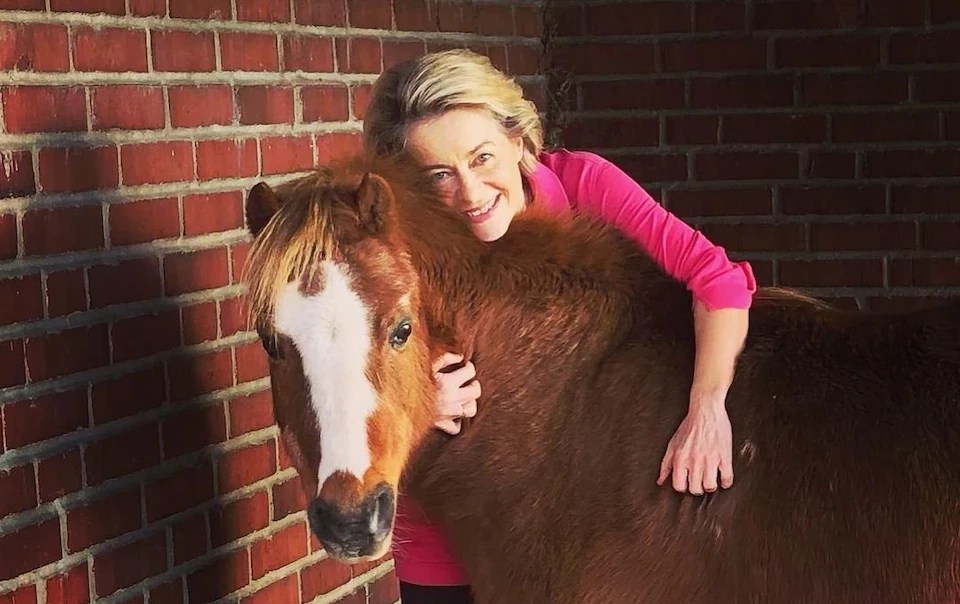
The vote comes after European Commission president Ursula von der Leyen’s favourite horse, Dolly, was killed by a wolf in September 2022 at her home in Germany.

Ursula Von Der Leyen with her pony ‘Dolly’ who was killed by a wolf Credit: Instagram

The keen equestrian and mother-of-seven said her family was “horribly distressed” by the loss of the 30-year-old horse at the lower Saxony compound.

The culprit was identified through DNA evidence as a wolf known as GW950m. But a permit to kill it expired before it could be hunted down, meaning it could still be at large.

The keen equestrian and mother-of-seven said her family was “horribly distressed” by the loss of the 30-year-old horse at the lower Saxony compound.

The culprit was identified through DNA evidence as a wolf known as GW950m. But a permit to kill it expired before it could be hunted down, meaning it could still be at large.

Brussels was forced to deny that Mrs von der Leyen had intervened in the permit process to take revenge for the death of Dolly. The permit was applied for before the horse was killed.

The Eurogroup for Animals said wolf populations had increased but had not reached “favourable” conservation status, as it decried a move that “seriously jeopardises the conservation efforts of the past decade and prioritises politics over science”.

‘Long-overdue’

“Wolves are our allies, not our enemies and it is crucial to protect them,” said Léa Badoz, of the Eurogroup for Animals. More than 300,000 EU citizens had signed a petition to stop wolf hunting.

“This is a very outrageous move and shows that member states are ignoring their citizens’ calls and science,” she said. “We urge the other parties to the Bern Convention to reject this proposal.”

Centre-Right MEPs from Mrs von der Leyen’s European People’s Party (EPP), which campaigned to loosen the protections before June’s EU-wide elections, said the decision was the start of a “long-overdue process” to bring wolf populations under control. 

“As these populations grow, their conservation status must evolve too,” said Alexander Bernhuber, an EPP member of the European Parliament’s environment committee.

Italy was among the most vocal countries demanding protections be weakened. The wolf was pushed to the verge of extinction in Italy by the 1970s, when the population dipped to just 100 individuals. Numbers are now estimated to be about 3,300.

“It is a step forward that fills us with satisfaction,” Paolo Borchia, an Italian MEP from the Right-wing League party, said on Wednesday. “It is unacceptable that it took years to come to terms with a situation that is clear for everyone to see.”

Emerging Animal Rights and Their Anthropo-, Zoo- and Ecocentric Justifications

April 23, 2025

https://www.ejiltalk.org/emerging-animal-rights-and-their-anthropo-zoo-and-ecocentric-justifications/

Written by Saskia Stucki

Editor’s note: This post is part of the EJIL:Talk! Symposium on ‘Expanding Human Rights Protection to Non-Human Subjects? African, Inter-American and European Perspectives.’

The idea of expanding the normative framework of human rights to nonhuman entities is not quite new, but ever-so topical in the age of AI, corporate human rights, and the rise of the global Rights of Nature movement. Although animals may be paradigmatic (non)human rights aspirants, animal rights proper have not yet been adjudicated, let alone recognized, by the ‘sister regional human rights courts’ or international human rights bodies.

In recent years, however, animal rights have increasingly become an issue before domestic courts, even highest courts, such as the Supreme Court of India, the Constitutional Court of Ecuador, the Islamabad High Court, or a lower court in Mendoza (Argentina). It is interesting to note that the judicial recognition of animal rights is so far more or less exclusively driven not by European or North American courts, but by courts from the Global South, which seems to refute the charge of “cultural imperialism” or Eurocentrism that is sometimes attached to the idea of universal animal rights. Given these contemporary developments in domestic animal rights law, and following a “bottom-up” approach to the future formation of a global animal rights law, the question seems not if, but when animal rights will advance to the world stage and eventually enter the halls of international (non)human rights courts.

Emerging animal rights and their pluralistic drivers

Since its inception, the idea of animal rights has had a mostly theoretical existence. In the absence of any legally institutionalized rights, the concept of animal rights typically relates to potential fundamental rights that (nonhuman) animals should have and that ought to be recognized and respected by human laws. Only recently, but with accelerating pace, have courts around the world started to deliberate and recognize actual legal rights of animals (see here for an overview of global animal rights jurisprudence).

One noteworthy difference between the ideal animal rights conceived by theorists and the real animal rights recognized in legal practice is the justificatory pluralism driving the emergence of the latter (as opposed to the justificatory monism – mostly of the naturalistic variant – that tends to ground the former). That is, while animal rights in theory are typically justified with reference to some morally relevant rights-generative natural quality of animals, animal rights in practice seem to be grounded in a broader and more heterogenous mix of divergent yet mutually complementing rationales.

Elsewhere, I have argued that there are both principled and prudential reasons that warrant institutional recognition of animal rights. In short, the principled argument for animal rights is of an ethical nature (a matter of justice or morality) and operates with intrinsic criteria, such as animals’ sentience, dignity, vulnerability, exploitability, or experiences of injustice. By contrast, the prudential argument for animal rights is of an instrumental nature (animal rights as a means of promoting other ends, e.g. the protection of humans or the environment) and relies on extrinsic considerations, such as social and environmental benefits that may result from cultivating animal rights-respecting practices.

Here, I will chart a slightly adapted, tripartite typology, based on the anthropocentric, zoocentric, and ecocentric justifications underpinning the recognition of animal rights in practice.

Anthropocentric underpinnings of animal rights

From an anthropocentric point of view, animal rights are justified instrumentally with their utility or benefits for human individuals or societies. Here, the recognition of animal rights is primarily motivated by and derivative of human interests, and functions as an indirect way of protecting or promoting certain human goods, such as human rights or health. Commonly invoked anthropocentric reasons for recognizing animal rights relate to:

  • The linkages between human and animal (in)justice: a growing body of research (see here for an overview) suggests a correlation between discriminatory (e.g. sexist, racist, speciesist) and rights-affirming social attitudes as well as empathy towards human outgroups and animals. Similarly, important links seem to exist between violence against humans and animals, both on the level of interpersonal (e.g. domestic or sadistic) and collective violence (e.g. animalistic dehumanization). Recognizing – and respecting – animal rights may thus concomitantly contribute to the protection of (vulnerable and marginalized) humans.
  • Animal exploitation as a major driver of environmental human rights and public health threats: the need to establish animal rights as a bulwark against extractive exploitation is also increasingly debated in the context of protecting humans against existential environmental risks. This is because animal exploitation (notably industrial animal farming and wildlife trade) is a major driver of global health threats (such as the emergence of zoonotic diseases and antimicrobial resistance) and of ecological human rights threats (such as climate change and biodiversity loss).
  • Cultural and religious reasons: certain (beloved or revered) animals are more equal than others, and are afforded special legal protections for cultural or religious reasons. For example, some courts, notably in Latin America, have recognized rights of companion animals (such as a dog in Colombia) as part of the protection of multispecies families and the affective bonds that humans have with their nonhuman family members. Another relevant example is the 2024 He Whakaputanga Moana Treaty (Declaration for the Ocean) – an Indigenous treaty that recognizes whales as legal persons, inter alia, because whales are considered ancestral beings and an integral part of a healthy ecosystem.

Zoocentric constructions of animal rights

Within a zoocentric frame of reference, animal rights are justified with intrinsic qualities of animals, such as their dignity or inherent value, sentience, personhood or subjecthood, or vulnerability. Here, the recognition of animal rights is primarily motivated by and centred on a legal concern for animals and their interests per se, irrespective of any instrumental or utilitarian considerations. In the words of the Constitutional Court of Ecuador, “animals should not be protected only from an ecosystemic perspective or with a view to the needs of human beings, but mainly from a perspective that focuses on their individuality and intrinsic value”. Courts typically arrive at zoocentric animal rights through two different legal avenues:

  • Subjectification of animal welfare laws: some courts have derived animal rights from existing animal welfare laws, by extracting therefrom subjective animal rights as implicit correlatives of explicit human duties. For example, in a landmark judgment from 2014 (which has since been somewhat relativized and reversed), the Supreme Court of India recognized a range of animal rights, such as the right to life and security, protection against pain, suffering, and torture, to food and shelter, based on the Prevention of Cruelty to Animals Act. It further elevated these statutory rights to the status of fundamental rights by reading them alongside the constitutional provision on animal protection and compassion (the “magna carta of animal rights”).
  • Animalization of fundamental (human) rights: other courts, notably in the Americas, have probed the possibility of extending certain human rights to animals, such as the prohibition of slavery, or the procedural right of habeas corpus and the underlying substantive right to freedom. In the USA, courts have thus far declined to enlarge the protective scope of fundamental rights to animals other than humans (of course, corporations are a different story). By contrast, courts in Latin America (e.g. in Argentina and Colombia) have recognized animal rights based on a dynamic and extensive reading of constitutional rights (notably the right to habeas corpus).

Ecocentric foundations of animal rights

From an ecocentric perspective, animal rights are recognized in an eco-constitutional legal context (e.g. a “sociobiocentric” constitution) and as part of a holistic approach to environmental protection and rights. Against the backdrop of exacerbating ecological pressures in the Anthropocene, the environmental dimension of animal rights (as well as, conversely, the animal dimension of environmental rights) has become increasingly important in recent years. Courts, too, have been responsive to the human-animal-environment nexus, by converging or integrating the rights of humans, animals, and nature.

  • (Wild) animal rights as part of rights of nature: one form of ecocentric animal rights is the recognition of (wild) animal rights as an integral (individual) dimension of the rights of nature. The integration of animal rights into the rights of nature framework has been elaborated at length by the Constitutional Court of Ecuador. In this context, some commentators observe a convergence between (animalized) rights of nature and (naturalized) animal rights, drawing on the obvious overlap and synergies between the two species of rights.
  • Ecological interdependence of human and animal rights: lastly – and this might be the clearest example of the confluence of anthropocentric, zoocentric, and ecocentric motives that are conjoined in the configuration of emerging animal rights – animal rights can be justified on the grounds of their ecologically mediated interrelation with human rights. For example, the Islamabad High Court has noted the “interdependence of living beings” and recognized animal rights alongside, and as an integral part of, the human right to life and environmental protection.

A win-win-win for humans, animals, and the environment

As this overview has shown, the recognition of animal rights in practice is only partially motivated by (intrinsic, ethical) concern for animals, and concurrently catalysed by instrumental concern for a variety of human interests and environmental considerations. It is this interplay of anthropocentric, zoocentric, and ecocentric rationales that is driving the emergence of animal rights alongside human rights and environmental rights. Some commentators contend that the anthropocentric and ecocentric reasonings that co-constitute real animal rights provide for a merely “weak grounding for animal rights”. Others dispute that these ulterior motives work to constitute “genuine animal rights” altogether. I would however argue, on the contrary, that this justificatory pluralism makes for a more diverse and democratic, resilient, rhetorically powerful, and thus ultimately stronger legal footing for animal rights in the real world. The pluralistic foundations of emerging animal rights indicate that they can be plausibly and palatably framed as a win-win-win situation. Simply put, animal rights are good for humans, animals, and the precious – and precarious – planet we all share.

(Sth. Africa) Mass Kruger Park poisoning — 84 vultures saved in ‘shocking, gruesome’ incident

https://www.dailymaverick.co.za/article/2025-05-08-mass-kruger-poisoning-84-vultures-saved-in-shocking-incident/

  Kruger Park rangers on the poisoning scene. (Photo: EWT)

08 May 2025

Eighty-four vultures have been rescued after a mass poisoning event in the Kruger National Park, one of the largest incidents of its kind recorded in southern Africa.

An elephant carcass, laced with poison and surrounded by more than 100 dead vultures, marked one of the most devastating wildlife poisoning events yet seen in the Kruger National Park. Remote sensing triggered a scramble to save birds that were still alive. 

In a coordinated emergency operation spanning helicopters, ambulances and nearly 24 hours of intensive care, 84 poisoned vultures were pulled back from the brink.

The operation this week was undertaken by a combined team of South African National Parks rangers and Endangered Wildlife Trust (EWT) officials in the park’s Mahlangeni Section, where the elephant carcass was found.

According to Gareth Tate, head of EWT’s Birds of Prey Programme, the organisation’s wildlife poisoning detection system triggered an alarm, flagging suspicious activity.

“The following morning, SANParks rangers conducted surveillance and uncovered a mass poisoning event involving more than 120 dead birds,” Tate said. “It was a shocking, gruesome scene.”

By 8.20am the joint team had arrived on site. They discovered 122 dead vultures, including 102 white-backed vultures, 20 Cape vultures and one lappet-faced vulture – all species listed as endangered or critically endangered. Several vultures were found alive but severely affected.

Tate described the rescue as a “world-class operation” involving two ground teams, helicopters, 12 vehicles and the EWT’s specialised Vulture Ambulance. Emergency treatment was administered in the field, including atropine to reverse the effects of the poison on the birds’ nervous systems, activated charcoal to bind toxins, fluid therapy and a procedure to flush and milk the vultures’ crops to remove ingested poison.

“We’ve developed a strict protocol over the years and we’ve achieved about a 98% success rate for birds found alive,” Tate explained. “Those first 24 hours are critical. If we can get them through that, they have a good chance of survival.”

Vultures were being deliberately targeted both to conceal illegal activities and to harvest body parts for the illegal wildlife trade and traditional medicine markets.

A total of 84 vultures were rescued alive. Of these, 45 were transported in the EWT’s mobile vulture ambulance and 39 were taken by helicopter to care facilities. Five of the rescued birds died despite treatment, but 83 remained alive as of the following morning, representing a 96% survival rate.

SANParks Pilot Bradford Grafton with one of the rescued vultures. (Photo: SANParks)

Eighty-four vultures have been rescued by a joint team of SANParks rangers and Endangered Wildlife Trust (EWT) following a devastating poisoning incident in the Kruger National Park. (Photo: EWT)

Reinforcements were swiftly deployed. Support teams from the Moholoholo Wildlife Rehabilitation Centre, Briner Veterinary Services and Wildscapes Veterinary Services were mobilised within hours and worked through the night to stabilise each bird and keep them alive.

“This was one of the largest and most coordinated vulture rescues ever conducted in the region,” Tate said. “The collaboration between SANParks, vets, NGOs and rangers was remarkable.”

This is intentional genocide of vultures. It’s absolutely malicious and a silent killer.

The poisoning involved agricultural toxins placed on an elephant carcass, a method increasingly used by poachers to kill vultures that might otherwise alert rangers to poaching sites by circling overhead. Tate said vultures were being deliberately targeted both to conceal illegal activities and to harvest body parts for the illegal wildlife trade and traditional medicine markets.

“Vultures are being systematically removed from the landscape,” Tate warned. “This is intentional genocide of vultures. It’s absolutely malicious and a silent killer.”

He noted that vultures are also being poisoned to supply the traditional medicine, or muti, trade.

“They’re targeting vultures for their brains, heads and feet,” Tate said. “There’s even evidence that poisoned vulture parts are ending up in muti markets, meaning that toxic substances are being sold to unsuspecting users.”

Broader crisis

This incident forms part of a broader crisis facing vultures across southern Africa. The birds play a key role in ecosystems by consuming carcasses and reducing the spread of disease. Their absence leads to carcasses lingering longer in the environment, increasing the risk of disease transmission to other wildlife and humans. 

The decline of vultures has been linked to knock-on effects seen in other regions: in India, the collapse of vulture populations due to veterinary drug poisoning led to a boom in feral dog numbers and a corresponding rise in rabies cases.

Kruger hosts at least five regular vulture species: the white-backed vulture (Gyps africanus), the most common; the Cape vulture (Gyps coprotheres), mainly found in the park’s north; the lappet-faced vulture (Torgos tracheliotos); the hooded vulture (Necrosyrtes monachus) and the rarely seen white-headed vulture (Trigonoceps occipitalis). Each species occupies a niche at carcasses, forming an efficient clean-up system.

Each adult vulture killed is not just an immediate loss – it’s a loss of future generations.

However, their numbers are declining due to a number of pressures. Many species breed slowly, raising only one chick per year. Their nesting habitats are shrinking as large trees along rivers are lost, often from increased elephant activity. Without sufficient nesting sites, reproductive success drops. Poisoning events exacerbate these losses, wiping out breeding adults and chicks alike.

Poisoning incidents targeting vultures have increased. Poachers use pesticides like carbofuran, a highly toxic agricultural chemical, to lace carcasses. Vultures that feed on the poisoned remains are removed as natural sentinels from the ecosystem. Other scavengers, including jackals, lions, hyena and ground hornbills, also fall victim.

“Unlike targeted poaching of individual animals, poisoning takes out entire species indiscriminately,” Tate said. “Each adult vulture killed is not just an immediate loss – it’s a loss of future generations.”

Efforts to address the issue include increased patrols, training poison response teams and establishing artificial feeding sites to provide uncontaminated food. Conservationists stress that long-term solutions will require stronger regulation of agricultural poisons, improved enforcement against wildlife crime and engagement with communities living near protected areas.

Community outreach initiatives by the Kruger Park have begun, aiming to reduce demand for vulture parts in belief-based practices and build support for conservation. However, scaling these measures to meet the size of the problem remains a challenge.

Tate emphasised the need for stricter penalties for those responsible. “These individuals need to be caught and the penalties must reflect the seriousness of the crime – they’re killing critically endangered animals.”

Natural waste disposers

The rescued vultures continue to recover under veterinary care and will be released once they are fit to return to the wild. “Some of them are so strong that we’re planning to release them this Saturday,” Tate said.

Conservationists hope the surviving birds will resume their vital ecological role as natural waste disposers, limiting the spread of disease in the ecosystem. The poisoning incident highlights the vulnerability of vultures to deliberate targeting, the ecological consequences of their decline and the urgent need for interventions.

“Without vultures, carcasses take longer to decompose, leading to increased risks of disease,” Tate said. “Their loss disrupts a delicate balance. We need to act now to protect them.”

As the surviving vultures recover, conservationists warn that the battle to save these birds is ongoing. Preventing future poisonings, preserving nesting habitats and raising awareness about their ecological importance will be essential to ensure that vultures remain part of Kruger’s skies. Each circling silhouette is a sign that the clean-up crew is still at work, maintaining the health of the ecosystem for wildlife and humans alike.

DM