The debate will take place after a petition won widespread support from the public.
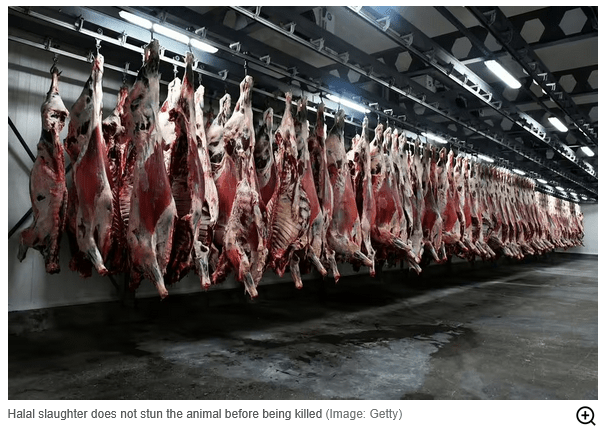
Ps will hold a major debate today on banning halal and kosher slaughter of animals, after thousands of Britons signed a petition demanding better animal welfare. The debate will be held in Westminster Hall at 4.30pm, meaning that while there won’t be a vote it will be the first debate of the religious practice in parliament for years.
The showdown was forced as a result of a public petition on the parliamentary website, entitled: “Ban non-stun slaughter in the UK”, which garnered 109,018 signatures. It read: “In modern society, we believe more consideration needs to be given to animal welfare and how livestock is treated and culled. We believe non-stun slaughter is barbaric and doesn’t fit in with our culture and modern-day values and should be banned, as some EU nations have done.”
In a landmark case, the European Court of Human Rights has ruled that a ban on the ritual slaughter of animals without prior stunning does not violate the ECHR.
“The Court considered that the protection of public morals, to which Article 9 of the Convention referred was not indifferent to the living environment of individuals covered by its protection and including animals.”
A Government response on January 10 defended the practice, arguing that while it would “prefer all animals to be stunned before slaughter… we respect the rights of Jews and Muslims to eat meat prepared in accordance with their religious beliefs.”
Ahead of today’s debate, Rupert Lowe MP said: “Big debate in Parliament today on non-stun/halal slaughter.”
“I’ll be speaking in favour of a full ban.”
Three days ago Mr Lowe tabled an Early Day Motion in Parliament also calling for a ban on nun-stun slaughter, arguing that there is a “substantial body of veterinary evidence indicating that pre-stunning significantly reduces animal suffering at the point of slaughter”.
He called on the government to “urgently review the legislative framework around non-stun slaughter, consider restricting or banning the practice, and introduce mandatory, clear labelling of meat products by method of slaughter so that consumers can make informed choices.”
It was also signed by Conservative MPs Thomas Bradley and Andrew Rosindell.
A 2019 poll suggested 83% of British adults believe the law should be changed to ensure animals killed for food production are stunned before being killed.
In addition 86% want all meat sold in the UK to be clearly labelled so they know how the animal died.
Around 114 million animals are killed using the halal method each year in Britain, and a further 2.1 million using the kosher method.
The RSPC backs a ban on non-stun killing, with head of public affairs David Bowles saying: “Non-stun slaughter can cause considerable suffering and as a result the organisation believes this practice should be banned once and for all.”
“While we believe religious beliefs and practices should be respected, we also feel strongly animals must be slaughtered under the most humane conditions possible.”
Environmentalist Zac Goldsmith has raised concerns about a “troubling commitment” in the Prime Minister’s deal with the EU.
Zac Goldsmith has slammed Keir Starmer (Image: Getty)
ac Goldsmith has slammed Keir Starmer’s UK-EU reset for risking the Tories hard-fought Brexit wins on animal welfare. The environmentalist warned that a “troubling commitment” in the agreement means any UK deviation from EU food standards must not “negatively affect European Union animals and goods being placed on the market” in the UK.
The former MP said: “This seemingly technical clause has profound implications for animal welfare and our ability to raise our own standards, something that we fought so hard to achieve with Brexit. “Among other things it likely means the UK cannot restrict imports of animal products that fail to meet our welfare standards – even when we’ve banned those same practices domestically.
He said around 50% of UK pork imports come from EU countries still using sow stalls – narrow metal cages Britain banned in the 90s because they were considered to be cruel.
A new sanitary and phytosanitary (SPS) deal was agreed last month to reduce red tape currently needed to import and export food and drink between the UK and the EU.
ut campaigners want the Government to clarify whether animal welfare measures fall outside the SPS agreement’s scope, or to negotiate explicit exceptions for welfare-based restrictions.
here were concerns before the deal was struck that Britain could weaken its post-Brexit animal protection laws to get a reset deal with Brussels.
But following the concerns, the Prime Minister said: “We are not involved in, nor will we be involved in, a sort of race to the bottom on standards.
“I think that British people are proud of the high standards that we have, and we want to maintain those standards.”
Sir Keir has pledged to strengthen ties with the EU since coming into office on July 4 last year.
As part of the agreement he signed, there will be more targeted checks on the movement of animals, animal products, plants and other products.
This will stop animals being held for excessive periods at the borders and lower any detrimental impact on animal health and welfare, and reduce the burden on the veterinary workforce.
There was also a commitment made on shared disease surveillance and data sharing, which will secure UK biosecurity and risk of imported diseases.
Animal welfare groups also welcomed the introduction of pet passports to replace Animal Health Certificates (AHCs), which increased burden on the veterinary workforce and hiked costs for animal owners since they came into force.
A Government spokesman said: “This government will always act in the national interest to protect Britain’s farmers and secure our food security. We have said we will uphold the highest agricultural standards and that is exactly what this deal does.”
By Lord Zac Goldsmith
Brexit undoubtedly delivered meaningful wins for animals, enabling policy changes that were previously impossible. We were able for example to ban the cruel live export of animals for slaughter and even more far reaching, we could change the way we subsidised farming to incentivise higher animal welfare and environmental stewardship. Neither of these changes could have happened without Brexit, which is one of the reasons I supported our EU exit in 2016.
And although of course I wish we had done more, the last Conservative Government did deliver a wide range of animal welfare measures, from an expanded ivory ban and banning glue traps, to much bigger sentences for animal cruelty and recognising sentience in law. Now in Opposition the Party is calling for among other things raising zoo standards.
Last month’s UK-EU Summit produced a ‘Common Understanding’ agreement which has been hailed by the Prime Minister as a significant step towards mending post-Brexit relations, generating economic benefits and streamlining trade. However, buried in the details lies a troubling commitment: any UK deviation from EU food standards must not “negatively affect European Union animals and goods being placed on the market in the United Kingdom”.
This seemingly technical clause has profound implications for animal welfare and our ability to raise our own standards, something that we fought so hard to achieve with Brexit. Among other things it likely means the UK cannot restrict imports of animal products that fail to meet our welfare standards – even when we’ve banned those same practices domestically.
Consider the immediate threats. Around 50% of UK pork imports come from EU countries still using sow stalls – narrow metal cages we banned in the 90s because they were considered to be cruel. The last Labour government prohibited fur farming in the UK, yet we continue importing it from the EU. Under the new agreement, banning such imports may be impossible, despite the stated wishes of the Government to deliver the biggest boost to animal welfare in a generation.
The agreement links UK standards to EU animal welfare rules with opt outs limited to public health and biosecurity – assessed case by case basis. So while we might still be able to ban puppy imports, as these present a public health risk, the agreement could block us from banning EU fur or even foie gras on welfare grounds alone.
This not only undermines domestic animal welfare standards but also places British farmers, who adhere to stricter regulations, at a competitive disadvantage. The problem is more acute with EU imports, our largest trading partner for food imports, not just the usual suspects like the USA or Australia.
Brexit gave us the chance to lead the world on animal welfare – to show that an independent Britain could set gold standards that others would follow. This is also about democratic sovereignty; British voters consistently support higher animal welfare standards, with 84% backing restrictions on low-welfare imports.
There’s still time to put this right, but it will require government to clarify that animal welfare measures fall outside the SPS Agreement’s scope, or to negotiate explicit exceptions for welfare-based restrictions.
While its proponents say the UK-EU reset agreement offers economic and diplomatic benefits, it’s imperative that animal welfare remains a priority. By addressing these concerns proactively, the UK can position itself as a global leader in animal welfare and ensure that progress is not achieved at the expense of the most vulnerable and the voiceless.
“Thugs do not suffer any sanctions, even when a report is filed, there is no reaction from the authorities and that is the problem.”
Photo: Reuters
((Disclaimer: The translations are mostly done through AI translator and might not be 100% accurate.))
28.09.2024
The text contains disturbing details
A man from East Sarajevo shot a dog, then dragged it wounded along the street with a tractor, a pensioner from the village of Stajkovce, in the south of Serbia, beat a mare with a hammer and a pole, a six-year-old boy from Niš threw a kitten and ran over it with a scooter, a man from Leskov tortured a poisonous snake – these are just some of the creepy headlines lately that disturb people in the Balkans.
Some of the adult perpetrators are prosecuted or convicted, but as a rule, the punishments are mild or none, and that is why there are more and more cases like this, says Milica Ranković from the Feniks Animal Protection Association.
“People who have these kinds of mental problems are increasingly relaxed, because they see that there is no adequate punishment.
“Thugs don’t suffer any sanctions, even when a report is filed, there is no reaction from the authorities and that’s where the problem lies,” Ranković told the BBC.
And when there is a reaction, it is slow, and punishments are often conditional or just a warning, he adds.
The situation is similar in Bosnia and Herzegovina, where because of the case from East Sarajevo, although the suspect was detained, protests were organized in Sarajevo and Banja Luka, demanding tougher sentences.
“There is enough violence against the weak, against women, children, animals… Enough!
“Monsters move freely among us, today it was a dog, and tomorrow it will be someone’s child,” said Mila Šarić, employed at the Veterinary Institute of the Republika Srpska, one of the two entities of Bosnia and Herzegovina. transmissions H1.
What motivates people to be violent towards animals?
–Analysis by Marija Branković, professor at the Faculty of Media and Communications, Singidunum University*
Science today understands animals as sentient beings, which absolutely have the capacity to experience pain, fear and many other emotions.
Because of all this, violence against animals should alarm us as much as violence against people.
Based on psychological research, we know that there are complex explanations for violent behavior, it is impossible to attribute it to just one cause.
At the basic level, there are differences in people’s capacities for empathy, so we are talking about the expression of certain personality traits, which we call “dark traits” – psychopathy, narcissism, Machiavellianism and sadism – which are associated with a tendency to aggressive and antisocial forms of behavior.
Research conducted in Serbia shows that these four personality traits are clearly related to a negative attitude towards animals.
However, this should not be understood as something that will necessarily manifest itself, because it always depends on whether this behavior is encouraged or punished in the environment.
Furthermore, we know for sure that aggressive and violent behavior is learned by model and not only in the family, but social beliefs and norms are also very important, therefore, the general climate in society.
And we live in a so-called post-conflict society.
These are societies of fear, in which people live with a sense of threat, insecurity, and mistrust, which all make fertile ground for violence.
Moreover, violence is justified and applied in the public and political sphere, especially towards dissenters, which means that at the highest and most visible level of society you have clear models of violent behavior.
It is not an exaggeration to say that violence is promoted and even rewarded, and it is certainly punished insufficiently and unsystematically.
* Marija Branković is Frpsychologist and research associate at the Institute for Philosophy and Social Theory and author of the book Psychology of humans and (other) animals
What penalties are threatened?
Bosnia and Herzegovina: The laws in the two entities differ – Republika Srpska (RS) i Federation of Bosnia and Herzegovina. Anyone who severely abuses an animal or destroys animal habitats in a wider area will be fined or imprisoned for up to six months in the Federation of Bosnia and Herzegovina, and up to two years in the RS. For more serious forms, when a material benefit has been obtained or a protected species has suffered, the prison sentence can be up to one year in the Federation, and up to five years in the RS.
Montenegro: Anyone who kills, injures or tortures an animal in violation of the regulations will be fined or imprisoned up to one year, and in the case of protected species, imprisonment from six months to five years.
Croatia: Whoever kills an animal without a justified reason or abuses it more severely, causes it unnecessary pain or exposes it to unnecessary suffering, will be punished with a fine imprisonment for up to two years or in more severe cases up to three years. In Croatia, the criminal offense of abandoning animals was recently introduced, which carries a penalty of up to one year.
North Macedonia: Torturing and killing animals is punishable by a fine and a sentence of up to six months in prison, and carelessness is also punished – if the animal is left without food and water, it can be obtained three months in prison.
Serbia: Abuse and torture of animals is punishable by a fine or a prison sentence of up to two years, writes in Criminal law, and for more severe forms up to three years and a higher fine. It is a criminal offense to organize animal fights and bet on them out of self-interest, for which the prison sentence is from six months to three years. Rulebook exact punishments for abuse of animals are also prescribed, for example, for a brown bear it is one million dinars, for a griffon vulture or a black eagle 500.000, for a wolf or lynx 300.000, for an otter 250.000, up to certain types of snails or frogs where the penalty is 1.200 dinars.
Associations are looking for a register of abusers
Legislation is completely fine in Serbia, but the problem is that it is not enforced, Milica Ranković points out.
“The same problem is in the entire Balkans,” she adds.
At the beginning of September, for the second time, the Feniks Association, together with ten other animal protection organizations from all over Serbia, sent an official letter to the competent ministries with a proposal to create a database on abusers and killers of animals.
They also request that systematic work be done on education and prevention of such cases from the earliest age – through creating empathy, but also to encourage reporting.
The state representatives were approached for the first time last year after the May tragedies, when the neighbors of Uroš Blažić, accused of mass murder in the villages of Dubona and Malo Orašje, claimed that mistreated animals.
However, the authorities never responded.
“It is devastating for our society, because it shows that it is not interested in dealing with violence.
“All associations from all over Serbia have the same experiences, we are all aware that such a database is necessary, the problems are the same and nothing has changed,” says Ranković.
Whether the introduction of such a register is being considered at all and what it would look like, the BBC did not receive an answer from either the Ministry of Justice or the Ministry of the Interior.
TOMS KALNINS/EPA-EFE/REX/Shutterstock
A worldwide problem
In the past decades, there were many monstrous cases that filled the columns of the domestic black chronicle.
From Kerusha Mila, whose paws were cut off, to a video of a cat being doused with gasoline and burned alive, to individuals who kill dogs with a knife, sometimes petting them beforehand, and that’s how it is in the world.
The shocking number of cruelty to animals, which are found daily in the media or on social networks, are only the tip of the iceberg, because most are never reported, according to the website of the American association. Humane society.
Puppies, cats, horses and domestic animals are the most common targets.
According to their data, animal abusers are more often men under the age of 30, and sick collecting of animals, which is more often done by women over 60, is also considered abuse.
Cruelty to animals is strongly related to other crimes.
People who mistreat animals are five times more likely to be violent towards people, according to an American study by Northwestern University in Massachusetts.
Behavioral profiles of criminals by the US Federal Bureau of Investigation (FBI) regularly show that many serial killers and rapists tortured animals as children, writes the British association Peta.
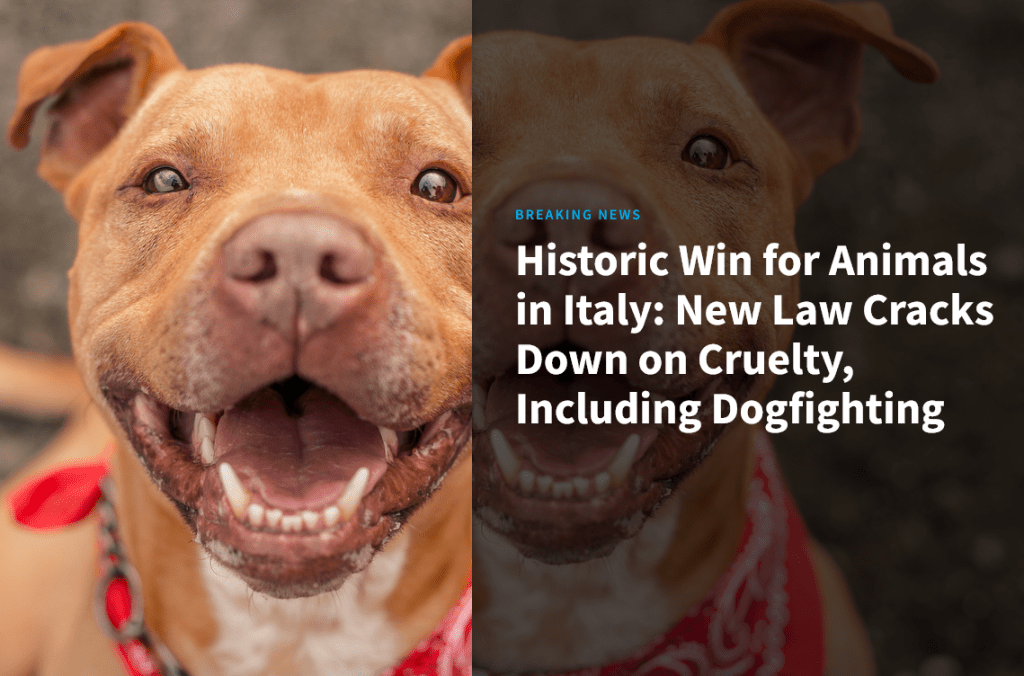
The Italian Senate has officially passed Bill AS 1308, a significant legislative advancement aimed at reinforcing animal protection across the country. The bill, previously approved by the Chamber under the name AC 30, introduces comprehensive amendments to the criminal code, criminal procedure code, and related provisions to address and deter crimes against animals, including the brutal practice of dogfighting.
One of the key aspects of the new law is the redefinition of the criminal code’s Title IX bis, replacing the outdated concept of “Crimes against the human sentiment toward animals” with the clearer and more progressive “Crimes against animals.” This change reinforces the idea that animals are deserving of legal protection in their own right, as sentient beings, not merely as subjects whose suffering might offend human sensitivity.
The bill also significantly increases penalties for acts of cruelty, including the killing of animals without necessity, mistreatment, and violations of the ban on unauthorized animal fighting or competitions. In particular, sentences for organizing or participating in animal fights have been increased, aiming to better deter those involved in these violent and illegal activities.
Additionally, the law introduces harsher penalties for crimes committed in aggravating circumstances, such as in the presence of minors or against multiple animals, as well as for the dissemination of videos or images of such acts via digital platforms. This is a critical step in tackling the spread of animal cruelty content online.
“The final approval of AS 1308 represents another important step in the protection of animals in Italy. We’ve made further progress towards the full recognition of non-human animals as sentient beings and victims of crimes, finally overcoming the outdated concept of exclusively protecting the ‘human sentiment’ towards them. We are pleased with the increase in penalties for dogfighting, a criminal activity that we have been combating for years through the ‘Io non combatto project,’ and the expansion of penalties to anyone participating in dogfighting in any capacity,” said Alessandro Fazzi, institutional relations consultant for Humane World for Animals Italy.
“We hope that it will soon be possible to intervene to offer even greater protection for minors, and also to introduce specific social rehabilitation programs for all those who commit crimes against animals, starting with those who participate in dog fights,” continued Fazzi. “By combining these requests with what has been approved today, our country will be able to take truly significant steps toward a more advanced legal civilization.”
A notable provision also addresses the management and recovery of animals seized in criminal proceedings. Under the new legislation, these animals can now be permanently assigned to certified organizations that can provide care and rehabilitation, helping to ensure they are not left in limbo during often-lengthy legal processes. The bill further includes a nationwide ban on keeping dogs chained, a practice often linked to dogfighting, except in strictly defined health or safety circumstances.
“The recently approved bill marks a significant step forward for all those who dedicate themselves every day to the protection of animals. It is a strong signal that strengthens the recognition of animals as sentient beings, deserving of direct protection. It also represents a concrete evolution on an operational level, particularly for the management of animals who are victims of crimes, taken from criminal circuits, and placed under judicial seizure,” said Federica Faiella, president of Fondazione Cave Canem, “I’m especially thinking of the dogs involved in fighting: this law finally recognizes their right to be immediately placed on a path of psychological and physical recovery and, where possible, welcomed into a family setting. This avoids the paradox of animals saved from abuse who remain trapped in the judicial system for years, confined to detention facilities.”
Although some proposed amendments, such as dedicated funding for law enforcement training or the ban on the import and export of hunting trophies from endangered species, were not included in the final version, the bill nonetheless marks a decisive move forward. It modernizes Italy’s approach to animal welfare by aligning legal language and enforcement practices with contemporary views on animal rights and ethical treatment.
By recognizing animals as victims of crime and ensuring stronger legal and institutional tools to protect them, this bill lays the groundwork for more robust animal welfare policies in the future. It sends a clear message that cruelty against animals will be met with serious consequences and that animal protection is a core part of a civilized, humane society.
Editor’s note: This post is part of the EJIL:Talk! Symposium on ‘Expanding Human Rights Protection to Non-Human Subjects? African, Inter-American and European Perspectives.’
The idea of expanding the normative framework of human rights to nonhuman entities is not quite new, but ever-so topical in the age of AI, corporate human rights, and the rise of the global Rights of Nature movement. Although animals may be paradigmatic (non)human rights aspirants, animal rights proper have not yet been adjudicated, let alone recognized, by the ‘sister regional human rights courts’ or international human rights bodies.
In recent years, however, animal rights have increasingly become an issue before domestic courts, even highest courts, such as the Supreme Court of India, the Constitutional Court of Ecuador, the Islamabad High Court, or a lower court in Mendoza (Argentina). It is interesting to note that the judicial recognition of animal rights is so far more or less exclusively driven not by European or North American courts, but by courts from the Global South, which seems to refute the charge of “cultural imperialism” or Eurocentrism that is sometimes attached to the idea of universal animal rights. Given these contemporary developments in domestic animal rights law, and following a “bottom-up” approach to the future formation of a global animal rights law, the question seems not if, but when animal rights will advance to the world stage and eventually enter the halls of international (non)human rights courts.
Emerging animal rights and their pluralistic drivers
Since its inception, the idea of animal rights has had a mostly theoretical existence. In the absence of any legally institutionalized rights, the concept of animal rights typically relates to potential fundamental rights that (nonhuman) animals should have and that ought to be recognized and respected by human laws. Only recently, but with accelerating pace, have courts around the world started to deliberate and recognize actual legal rights of animals (see here for an overview of global animal rights jurisprudence).
One noteworthy difference between the ideal animal rights conceived by theorists and the real animal rights recognized in legal practice is the justificatory pluralism driving the emergence of the latter (as opposed to the justificatory monism – mostly of the naturalistic variant – that tends to ground the former). That is, while animal rights in theory are typically justified with reference to some morally relevant rights-generative natural quality of animals, animal rights in practice seem to be grounded in a broader and more heterogenous mix of divergent yet mutually complementing rationales.
Elsewhere, I have argued that there are both principled and prudential reasons that warrant institutional recognition of animal rights. In short, the principled argument for animal rights is of an ethical nature (a matter of justice or morality) and operates with intrinsic criteria, such as animals’ sentience, dignity, vulnerability, exploitability, or experiences of injustice. By contrast, the prudential argument for animal rights is of an instrumental nature (animal rights as a means of promoting other ends, e.g. the protection of humans or the environment) and relies on extrinsic considerations, such as social and environmental benefits that may result from cultivating animal rights-respecting practices.
Here, I will chart a slightly adapted, tripartite typology, based on the anthropocentric, zoocentric, and ecocentric justifications underpinning the recognition of animal rights in practice.
Anthropocentric underpinnings of animal rights
From an anthropocentric point of view, animal rights are justified instrumentally with their utility or benefits for human individuals or societies. Here, the recognition of animal rights is primarily motivated by and derivative of human interests, and functions as an indirect way of protecting or promoting certain human goods, such as human rights or health. Commonly invoked anthropocentric reasons for recognizing animal rights relate to:
The linkages between human and animal (in)justice: a growing body of research (see here for an overview) suggests a correlation between discriminatory (e.g. sexist, racist, speciesist) and rights-affirming social attitudes as well as empathy towards human outgroups and animals. Similarly, important links seem to exist between violence against humans and animals, both on the level of interpersonal (e.g. domestic or sadistic) and collective violence (e.g. animalistic dehumanization). Recognizing – and respecting – animal rights may thus concomitantly contribute to the protection of (vulnerable and marginalized) humans.
Animal exploitation as a major driver of environmental human rights and public health threats: the need to establish animal rights as a bulwark against extractive exploitation is also increasingly debated in the context of protecting humans against existential environmental risks. This is because animal exploitation (notably industrial animal farming and wildlife trade) is a major driver of global health threats (such as the emergence of zoonotic diseases and antimicrobial resistance) and of ecological human rights threats (such as climate change and biodiversity loss).
Cultural and religious reasons: certain (beloved or revered) animals are more equal than others, and are afforded special legal protections for cultural or religious reasons. For example, some courts, notably in Latin America, have recognized rights of companion animals (such as a dog in Colombia) as part of the protection of multispecies families and the affective bonds that humans have with their nonhuman family members. Another relevant example is the 2024 He Whakaputanga Moana Treaty (Declaration for the Ocean) – an Indigenous treaty that recognizes whales as legal persons, inter alia, because whales are considered ancestral beings and an integral part of a healthy ecosystem.
Zoocentric constructions of animal rights
Within a zoocentric frame of reference, animal rights are justified with intrinsic qualities of animals, such as their dignity or inherent value, sentience, personhood or subjecthood, or vulnerability. Here, the recognition of animal rights is primarily motivated by and centred on a legal concern for animals and their interests per se, irrespective of any instrumental or utilitarian considerations. In the words of the Constitutional Court of Ecuador, “animals should not be protected only from an ecosystemic perspective or with a view to the needs of human beings, but mainly from a perspective that focuses on their individuality and intrinsic value”. Courts typically arrive at zoocentric animal rights through two different legal avenues:
Subjectification of animal welfare laws: some courts have derived animal rights from existing animal welfare laws, by extracting therefrom subjective animal rights as implicit correlatives of explicit human duties. For example, in a landmark judgment from 2014 (which has since been somewhat relativized and reversed), the Supreme Court of India recognized a range of animal rights, such as the right to life and security, protection against pain, suffering, and torture, to food and shelter, based on the Prevention of Cruelty to Animals Act. It further elevated these statutory rights to the status of fundamental rights by reading them alongside the constitutional provision on animal protection and compassion (the “magna carta of animal rights”).
Animalization of fundamental (human) rights: other courts, notably in the Americas, have probed the possibility of extending certain human rights to animals, such as the prohibition of slavery, or the procedural right of habeas corpus and the underlying substantive right to freedom. In the USA, courts have thus far declined to enlarge the protective scope of fundamental rights to animals other than humans (of course, corporations are a different story). By contrast, courts in Latin America (e.g. in Argentina and Colombia) have recognized animal rights based on a dynamic and extensive reading of constitutional rights (notably the right to habeas corpus).
Ecocentric foundations of animal rights
From an ecocentric perspective, animal rights are recognized in an eco-constitutional legal context (e.g. a “sociobiocentric” constitution) and as part of a holistic approach to environmental protection and rights. Against the backdrop of exacerbating ecological pressures in the Anthropocene, the environmental dimension of animal rights (as well as, conversely, the animal dimension of environmental rights) has become increasingly important in recent years. Courts, too, have been responsive to the human-animal-environment nexus, by converging or integrating the rights of humans, animals, and nature.
(Wild) animal rights as part of rights of nature: one form of ecocentric animal rights is the recognition of (wild) animal rights as an integral (individual) dimension of the rights of nature. The integration of animal rights into the rights of nature framework has been elaborated at length by the Constitutional Court of Ecuador. In this context, some commentators observe a convergence between (animalized) rights of nature and (naturalized) animal rights, drawing on the obvious overlap and synergies between the two species of rights.
Ecological interdependence of human and animal rights: lastly – and this might be the clearest example of the confluence of anthropocentric, zoocentric, and ecocentric motives that are conjoined in the configuration of emerging animal rights – animal rights can be justified on the grounds of their ecologically mediated interrelation with human rights. For example, the Islamabad High Court has noted the “interdependence of living beings” and recognized animal rights alongside, and as an integral part of, the human right to life and environmental protection.
A win-win-win for humans, animals, and the environment
As this overview has shown, the recognition of animal rights in practice is only partially motivated by (intrinsic, ethical) concern for animals, and concurrently catalysed by instrumental concern for a variety of human interests and environmental considerations. It is this interplay of anthropocentric, zoocentric, and ecocentric rationales that is driving the emergence of animal rights alongside human rights and environmental rights. Some commentators contend that the anthropocentric and ecocentric reasonings that co-constitute real animal rights provide for a merely “weak grounding for animal rights”. Others dispute that these ulterior motives work to constitute “genuine animal rights” altogether. I would however argue, on the contrary, that this justificatory pluralism makes for a more diverse and democratic, resilient, rhetorically powerful, and thus ultimately stronger legal footing for animal rights in the real world. The pluralistic foundations of emerging animal rights indicate that they can be plausibly and palatably framed as a win-win-win situation. Simply put, animal rights are good for humans, animals, and the precious – and precarious – planet we all share.
The Federal election campaign is over – and for sheep, the outcome could not be more significant.
With the re-election of the Albanese government in the 2025 Federal Election, one of the most important animal welfare reforms in our nation’s history is now secure: the legislated phase-out of live sheep export by sea.
Thanks to the incredible efforts of supporters who helped amplify this issue – through donations, by fuelling our ad blitz in battleground seats, and via direct engagement with candidates – a candidate who backs the phase-out was elected in nearly every seat we campaigned in. This is a powerful reminder that while animals cannot vote, caring Australians will do so on their behalf.
We are so grateful to everyone who donated to our billboards declaring Australian sheep have suffered enough, and to the hundreds of our supporters who helped lobby candidates in battleground seats.
The Coalition ran on a platform of keeping this unpopular trade alive. The landslide outcome – especially in Western Australia where the live export lobby campaigned fiercely against the ban – can only be seen as a definitive rejection of policies that promote animal cruelty. This moment solidifies the turning of the tide.
There are other policies that the Albanese government committed to, which will ensure animals are a key priority for the new parliament, including:
Full implementation of the national Animal Welfare Strategy to improve standards and review outdated systems that entrench suffering for pigs, chickens and other farmed animals.
Inclusion of animal welfare protections in international trade agreements.
Expansion of the trophy hunting import ban to cover more protected species.
We are eager to work with the re-elected government – and the overwhelmingly animal-friendly crossbench – to ensure these and other much-needed reforms for animals are realised.
We are so grateful to our friends at the Australian Alliance for Animals and Stop Live Exports for uniting with us to ensure as many people as possible understood what was at stake for animals this election. While in many ways, the ‘real’ work starts now, we could not have a stronger foundation upon which to build the reforms that animals need and deserve.
the day no animal is forced onto a live export ship. But today, we celebrate one of the most significant animal welfare reforms ever achieved globally.
Today, we celebrate a victory for compassion thanks to our supporters and everyone who kept animals front of mind at the ballot box.
We can now count down to 1 May 2028 with certainty – knowing from that day onwards not a single Australian sheep will set foot on a live export ship. While of course we wish this end date was much sooner, we also recognise the need to consider all who may be affected by this historic decision.
As the trade winds down, fewer Australian sheep will suffer at its hands. Since our very first investigation, the number of sheep exported live by sea each year has dropped by the millions – from 6 million annually, to less than 500,000.
Now, we can safely say that within three years, this number will be zero.
Trump’s FDA and EPA are phasing out animal testing
Published April 13, 2025 11:47am EDT
The Trump administration is receiving an outpouring of support from animal advocacy groups, lawmakers and others for recent announcements to end animal testing within programs at the FDA and EPA.
“PETA applauds the FDA’s decision to stop harming animals and adopt human-relevant testing strategies for evaluating antibody therapies,” Kathy Guillermo, PETA senior vice president, said in a statement.
“It’s a significant step towards meeting the agency’s commitment to replace the use of animals – which PETA has worked hard to promote. All animal use, including failed vaccine and other testing on monkeys at the federally-funded primate centers, must end, and we are calling on the FDA to further embrace 21st-century science,” the PETA statement continued.
PETA’s statement followed the Food and Drug Administration announcement on Thursday that it is phasing out an animal testing requirement for antibody therapies and other drugs in favor of testing on materials that mimic human organs, Fox Digital first reported.
“For too long, drug manufacturers have performed additional animal testing of drugs that have data in broad human use internationally. This initiative marks a paradigm shift in drug evaluation and holds promise to accelerate cures and meaningful treatments for Americans while reducing animal use,” FDA Commissioner Martin A. Makary, said in comments provided to Fox News Digital.
“By leveraging AI-based computational modeling, human organ model-based lab testing, and real-world human data, we can get safer treatments to patients faster and more reliably, while also reducing R&D costs and drug prices. It is a win-win for public health and ethics.”
Dogs, rats and fish were the primary animals to face testing ahead of Thursday’s announcement, Fox Digital learned.
The phase-out focuses on ending animal testing in regard to researching monoclonal antibody therapies, which are lab-made proteins meant to stimulate the immune system to fight diseases such as cancer, as well as other drugs, according to the press release.
Instead, the FDA will encourage testing on “organoids,” which are artificially grown masses of cells, according to the FDA’s press release.
Environmental Protection Agency chief Lee Zeldin announced on the same day that the agency would reinstate a 2019 policy from the first Trump administration to phase out animal testing at that federal agency. The EPA said in comment that the Biden administration moved away from phasing out animal testing, but that Zeldin is “wholly committed to getting the agency back on track to eliminating animal testing.”
“Under President Trump’s first term, EPA signed a directive to prioritize efforts to reduce animal testing and committed to reducing testing on mammals by 30% by 2025 and to eliminate it completely by 2035. The Biden administration halted progress on these efforts by delaying compliance deadlines. Administrator Zeldin is wholly committed to getting the agency back on track to eliminating animal testing,” EPA spokesperson Molly Vaseliou told the Washington Times.
The EPA’s and FDA’s recent announcements also received praise from animal rights groups, including the White Coat Waste Project, which reported in 2021 that the National Institute of Allergy and Infectious Diseases spent hundreds of thousands of dollars under Dr. Anthony Fauci’s leadership to test beagle dogs with parasites via biting flies.
“Thank you @DrMakaryFDA for your years of advocacy & outstanding leadership to eliminate FDA red tape that forces companies & tax-funded federal agencies to conduct wasteful & cruel tests on dogs & other animals!” the group posted to X last week.
“White Coat Waste made historic progress under Trump 45 to cut wasteful and cruel animal testing at the EPA and FDA, some of which was undone by the Biden Administration,” Justin Goodman, senior vice president at White Coat, told Fox News Digital on Sunday.
“We applaud Administrator Zeldin and Commissioner Makary for picking up where Trump left off and prioritizing efforts to cut widely-opposed and wasteful animal tests. This is great news for taxpayers and pet owners as it sends a message to big spending animal abusers across the federal government: Stop the money. Stop the madness!”
Other animal rights groups and lawmakers praised the Trump administration for its recent moves to end animal testing.
“We’re encouraged to see the EPA recommit to phasing out animal testing – a goal we’ve long championed on behalf of the animals trapped in these outdated and painful experiments,” Kitty Block, president and CEO of Humane World for Animals, said in a press release. “But promises alone don’t spare lives. For too long, animals like dogs, rabbits and mice have endured tests that inflict suffering without delivering better science. It’s time to replace these cruel methods with modern, humane alternatives that the public overwhelmingly supports.”
Other groups have come out and warned that there is not yet a high-tech replacement for animals within the realm of biomedical research and drug testing, and that humane animal testing is still crucial to test prospective drugs for humans.
“We all want better and faster ways to bring lifesaving treatments to patients,” National Association for Biomedical Research President Matthew R. Bailey said in a press release provided to Fox Digital. “But no AI model or simulation has yet demonstrated the ability to fully replicate all the unknowns about many full biological systems. That’s why humane animal research remains indispensable.”
Under his first administration, Trump took other steps to protect animals, including signing the Preventing Animal Cruelty and Torture Act into law in 2019, which made intentional acts of cruelty a federal crime.
***************************
NIH Just Declared a Scientific Revolution! Here’s How PETA’s Been Leading the Charge
Published April 29, 2025 by Keith Brown. Last Updated April 30, 2025.
The National Institutes of Health (NIH) just lit a fire under scientific research, declaring a fundamental change in its funding away from cruel and outdated experiments on animals and shifting both money and focus toward non-animal research methods. In short, what PETA has been working for and advocating for years.
This move cannot be understated. It is a fork in the road, a 180-degree turn, a tectonic shift with far-ranging implications for humans and other animals that will ripple through science and biomedical research for generations. Finally recognizing that humans will never kill enough animals to treat the panoply of human maladies will free time and billions of wasted taxpayer dollars to pursue human-based solutions to human problems.
Animals benefit. Patients benefit. Taxpayers benefit. But make no mistake, PETA has been offering NIH the matches and kerosene for this well-deserved bonfire for years.
PETA has called on NIH to abandon the cruel, invasive, and deadly use of animals in experiments—practices that are not only ethically indefensible but scientifically backward. Animal experiments have repeatedly failed to produce effective cures or treatments for humans, wasting billions in taxpayer dollars and delaying progress in medical research. This has been a boondoggle of the highest order.
But a boondoggle that appears to be close to an end.
“By integrating advances in data science and technology with our growing understanding of human biology, we can fundamentally reimagine the way research is conducted—from clinical development to real-world application,” said NIH Director Dr. Jay Bhattacharya. “This human-based approach will accelerate innovation, improve healthcare outcomes, and deliver life-changing treatments. It marks a critical leap forward for science, public trust, and patient care.”
We could scarcely have said it better ourselves. In fact, we have. Repeatedly, daily, loudly, and to anyone who would listen and many who would not. PETA scientists have been touting our Research Modernization NOW—a roadmap to phase out pointless and deadly animal experiments.
NIH has adopted several recommendations from Research Modernization NOW in the announcement, including expanding funding, training, and infrastructure for non-animal methods and mitigating bias towards experiments on animals in NIH grant review panels, a problem that PETA scientists recently exposed in a first-of-its-kind study.
NIH’s announcement ushers in a new era of science—one rooted in relevance, compassion, and innovation. It’s major progress for every person who cares about animals, values human health, and demands the U.S. lead the world in scientific excellence. PETA looks forward to supporting this transformative shift and ensuring it results in real, lasting change for both humans and other animals.
PETA understands that taking this bold stance will inevitably invite criticism from entrenched interests who have long profited from the misery and the failure of animal experimentation. PETA thanks Dr. Bhattacharya for his—our—conviction that the path forward is compassionate, scientific, and animal-free. It is.
There is still more work to do. One key step is to close the seven failed National Primate Research Centers have harmed and killed hundreds of thousands of monkeys and are an anchor on taxpayer dollars and science, failing to deliver promised vaccines or cures for 60 years.







 World Animals Voice