Tag: russia

(UA) Ukraine Brings First-Ever War Crimes Case to Court for Harm to a Natural Reserve

https://globalrightscompliance.org/ukraine-brings-first-ever-war-crimes-case-to-court-for-harm-to-a-natural-reserve/

The first war-related environmental crime against a natural reserve has been formally brought before a court by Ukrainian Prosecutors. Kherson prosecutors have filed an indictment against the Russia-appointed head of the Askania-Nova Biosphere Reserve for the illegal transfer of rare and specially protected animals to Russia. A total of seven reserve-protected animals were removed from the Ukrainian territory as a result of the illegal transfer. This case sets a global precedent, demonstrating that crimes committed against the environment during war will not go unpunished.

The Specialised Environmental Prosecutor’s Unit of the Prosecutor General’s Office and Kherson Regional Prosecutor’s Office, with the support of Global Rights Compliance’s Environmental Mobile Justice Team, began conducting an investigation into the case. Following the Russian occupation of Askania-Nova, a UNESCO-protected biosphere reserve, the reserve was unlawfully re-registered under Russian law and the legitimate Ukrainian administration was replaced. On 1 December 2023, the new administration illegally transferred rare and endangered animals (which remain Ukrainian property despite the illegal re-registration) to Russian-controlled zoos without Ukraine’s consent. Among the animals at issue were Chapman’s zebras, American bison, Przewalski’s horses, and one David’s deer, the last of which died during the transfer.

Under international humanitarian law, Russia, as an occupying power, must respect Ukrainian legislation, including Askania-Nova’s protected status. Article 55 of the 1907 Hague Regulations allows an occupier to act only as a temporary administrator of property, not an owner. Additionally, Article 56 prohibits the destruction or seizure of institutions dedicated to the arts and sciences, granting Askania-Nova special protection.

The war crime of pillage is not just about looting artefacts or property belonging to civilians—it extends to Ukraine’s natural treasures as well. The unlawful transfer of these protected animals is a direct violation of international humanitarian law and must be prosecuted,” said Nataliia Pavlovych, Legal Adviser and Deputy Team Lead of the Environment MJT at Global Rights Compliance.

The suspect in this case is Dmytro Mesheryakov, the Russia-appointed head of Askania-Nova, who is responsible for organising the transfer of protected animals in violation of international law.

While war crimes such as pillage and destruction of cultural heritage have been prosecuted before national courts and international tribunals, this is the first time criminal charges stemming   solely from war-related environmental damage to a natural reserve have been brought to court. Ukraine’s legal action, supported by GRC’s legal team, sends a strong signal that environmental destruction will be treated with the same gravity as other war crimes.

“By initiating these proceedings, prosecutors are both beginning to fill this void and sending the message that harm committed to the environment during wartime will no longer go unpunished.  They are at the forefront of developing precedent in this area of the law,” added Donna Cline, Lead of the Environment MJT, at Global Rights Compliance.

GRC’s Mobile Justice Team is a part of the Atrocity Crimes Advisory (ACA) Group for Ukraine. The ACA is a multilateral initiative established by the United States, the European Union, and the United Kingdom to support and assist Ukrainian law enforcement and prosecutors in investigating and prosecuting international crimes committed during the full-scale war.

Explosive-Loaded Animal Carcasses Used by Russians in Drone Attacks

https://militarnyi.com/en/news/explosive-loaded-animal-carcasses-used-by-russians-in-drone-attacks/

June 4, 2025

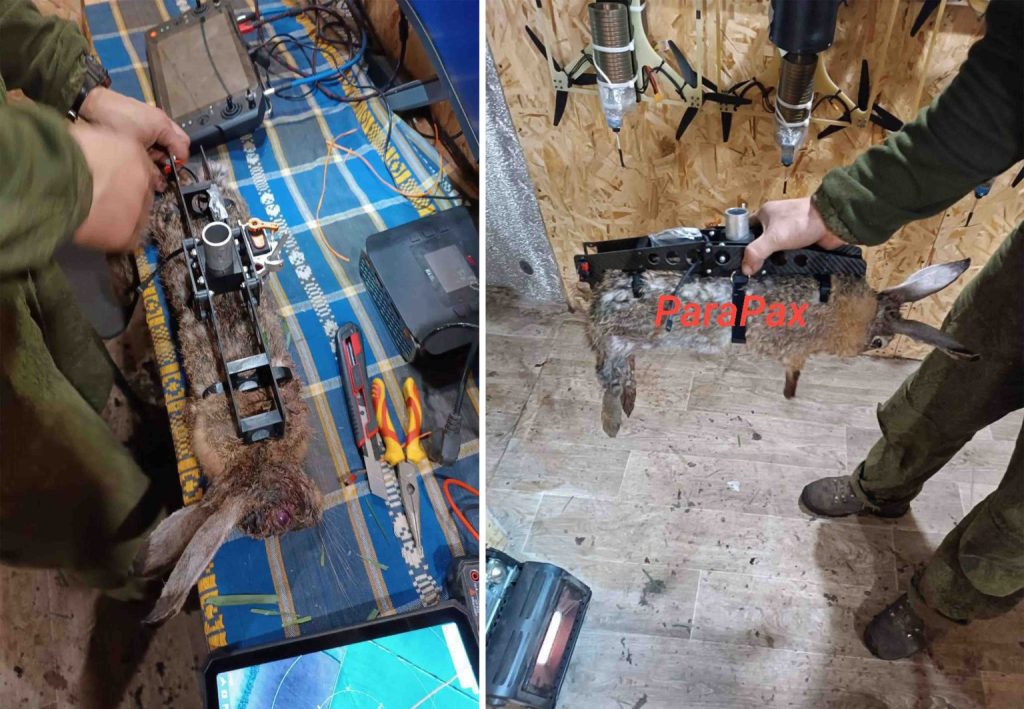
Russian troops have begun using wild animal carcasses as containers for explosives — they are dropped from drones.

The Para Pax Telegram channel published video and photos of this process.

According to the footage, a pre-assembled explosive charge is inserted into the carcass of a wild animal, then carefully concealed with fabric and the animal’s internal organs before being deployed via drone.

According to the post’s author, these “loaded” carcasses are later dropped from drones, both to mine areas and to carry out targeted strikes on specific positions.

The carcass of a hare with explosives. Photo credits: Para Pax

The use of animal carcasses as explosive devices significantly complicates their detection, posing an increased threat to personnel and potentially leading to unintended casualties.

An image of a drone already equipped with a prepared carcass, ready for transport and deployment, was also published.

It is worth noting that similar cases of booby-trapping objects and animal carcasses have been taking place since the beginning of Russia’s full-scale invasion of Ukraine.

In addition to using animal carcasses, the enemy has also booby-trapped the bodies of its own soldiers and abandoned equipment, aiming to inflict further losses on the Ukrainian Defense Forces.

The carcass of a hare with explosives. Photo credits: Para Pax

In addition to using animals as containers for explosives, Russian forces have also employed animals for logistics and the transportation of military equipment.

Militarnyi previously reported that certain Russian military units have begun receiving donkeys to be used as pack animals for transport purposes.

This may indicate that the donkeys have been assigned to frontline units to support logistics, both directly on the front line and in nearby areas.

Such a drastic measure is likely driven by a shortage of vehicles and unmanned ground platforms capable of performing logistical tasks.

NAWALNY

Today, we at WAV, join many in the world in mourning for

Alexei Anatoljewitsch Nawalny

murdered in a Russian State prison. There is nothing, in what news there is coming from Russia, and the way Mr. Navalny has been treated by the Russian regime, to suggest otherwise.

He was a man of exceptional courage, integrity, humour – a beacon of humanity in a darkening world.

While our focus on WAV is and remains with the animals of this world, we recognise the link between Human and Animal oppression, Human and Animal torture, and Mr. Navalny was a champion of Freedom, Democracy, and Truth – for all that is right, and must remain so, and against all who would trample those values, and subject those they are taken from to Imprisonment, Torture and Death.

Evil must never prevail, not in Russia, nor anywhere else in the world.
Where Evil is allowed to thrive no being can live in Peace and Freedom.

For us personally, and our continued struggle for the welfare and rights of non-Humans worldwide,
Mr. Navalny, as a voice of Compassion, Justice and Truth, and above all, an example of singular courage, will be a source of inspiration. We may not be fighting the same fight – although Human Freedom and Human Rights are as important to us as those of Non-Humans, as issues clearly linked – and Russia’s political landscape was Mr. Navalny’s chosen ground of battle, where he, for his people and his country, sought to bring about much-needed change.
We seek to see the principles of humanity applied to all species sharing our world with, worldwide. In the end, it is our common struggle for a better world, and all that makes us – positively – human, that unites us.

One light has gone out, millions of others will burn the brighter now.

The fight will go on.

Rest in Peace, friend.

Mark & Diana