https://apnews.com/article/morocco-stray-dogs-neuter-rabies-fifa-d8452e6aa0005e0cd71462ab7daf9bf5

Updated 9:04 AM CEST, May 18, 2025
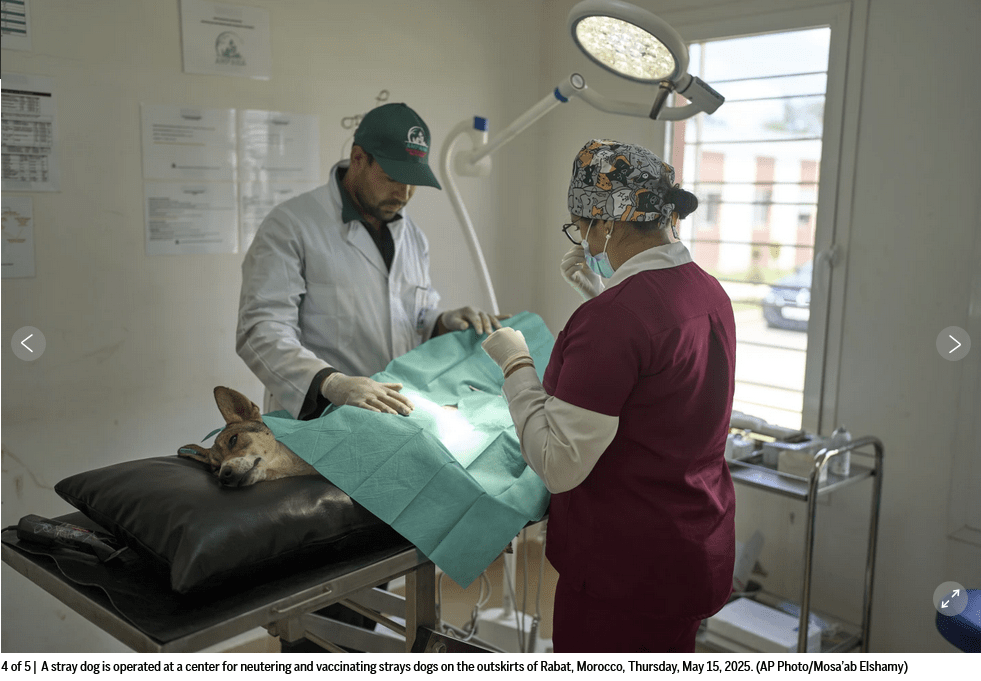
EL AARJATE, Morocco (AP) — A mutt with a blue tag clipped to her ear whimpers as she’s lifted from a cage and carried to a surgery table for a spay and a rabies vaccine, two critical steps before she’s released back onto the streets of Morocco’s capital.
The “Beldi,” as Moroccan street dogs are called, is among the hundreds taken from Rabat to a dog pound in a nearby forest. As part of an expanded “Trap, Neuter, Vaccinate and Return” program, dogs like her are examined, treated and ultimately released with tags that make clear they pose no danger.
“We have a problem: That’s stray dogs. So we have to solve it, but in a way that respects animals,” said Mohamed Roudani, the director of the Public Health and Green Spaces Department in Morocco’s Interior Ministry.

Trying to balance safety and animal well-being
Morocco adopted “Trap, Neuter, Vaccinate and Return,” or TVNR, in 2019. One facility has opened in Rabat and more are set to be launched in at least 14 other cities, aligning Morocco with recommendations from the World Organization for Animal Health. The government has spent roughly $23 million over the past five years on animal control centers and programs.
Roudani said Morocco’s updated approach balanced public safety, health and animal well-being. Local officials, he added, were eager to expand TVNR centers throughout the country.
Though population estimates are challenging, based on samples of marked and tagged stray dogs, Moroccan officials believe they number between 1.2 to 1.5 million. Some neighborhoods welcome and care for them collectively. However, others decry their presence as a scourge and note that more than 100,000 Moroccans have needed rabies vaccinations after attacks.
A draft law is in the works that would require owners to vaccinate pets and impose penalties for animal abuse.
Inside the center
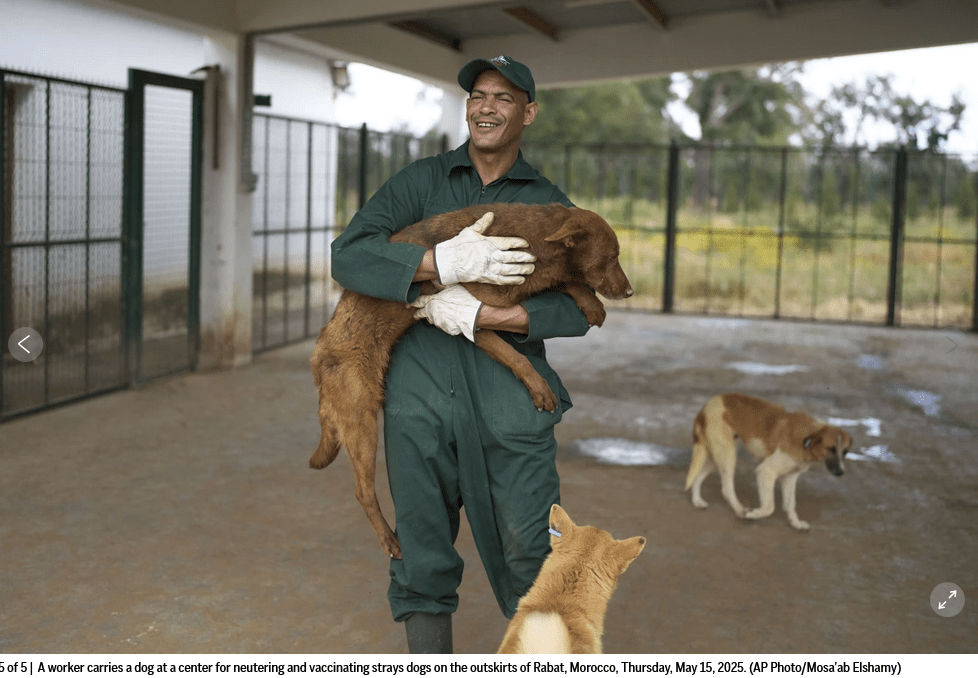
On a visit organized for journalists to a TNVR center in El Aarjate, enclosures for dogs appear spacious and orderly, with clean floors and the scent of disinfectant. Food and water bowls are refreshed regularly by staff who move between spaces, offering gentle words and careful handling. Some staff members say they grow so attached to the dogs that they miss them when they’re released to make space to treat incoming strays.
Veterinarians and doctors working for the Association for the Protection of Animals and Nature care for between 400 and 500 stray dogs from Rabat and surrounding cities. Dogs that veterinarians deem unhealthy or aggressive are euthanized using sodium pentobarbital, while the rest are released, unable to spread disease or reproduce.
Youssef Lhor, a doctor and veterinarian, said that aggressive methods to cull dogs didn’t effectively make communities safer from rabies or aggression. He said it made more sense to to try to have people coexist with dogs safely, noting that more than 200 had been released after treatment from the Rabat-area center.
“Slaughtering dogs leads to nothing. This TNVR strategy is not a miracle solution, but it is an element that will add to everything else we’re doing,” he said, referring to “Treat, Neuter, Vaccinate, Return.”
It’s designed to gradually reduce the stray dog population while minimizing the need for euthanasia.
It’s a program that Morocco is eager to showcase after animal rights groups accused it of ramping up efforts to cull street dogs after being named co-host of the 2030 FIFA World Cup last year.
Animal rights groups protest
Animal rights groups routinely use large sporting events to draw attention to their cause and similarly targeted Russia in the lead-up to the 2018 FIFA World Cup there.
Citing unnamed sources and videos it said were shot in Morocco, the International Animal Welfare and Protection Coalition claimed in January that Morocco was exterminating 3 million dogs, particularly around cities where stadiums are being built. The allegations, reported widely by international media lacking a presence in Morocco, triggered anti-FIFA protests as far away as Ahmedabad, India.
“These dogs are being shot in the street, often in front of children, or dragged away with wire nooses to die slow, agonizing deaths,” Ian Ward, the coalition’s chairman, said in a statement.
Moroccan officials vehemently deny the claims, say they’re implementing the very programs that activists propose, including TNVR. They rebuff the idea that any policy is related to the World Cup. Still, critics see their efforts as publicity stunts and are skeptical such programs are as widespread as officials claim.
Instances of mistreatment and euthanasia by gunshot have been reported in local media but Moroccan officials say, despite international attention, they’re isolated incidents and don’t reflect on-the-ground reality nationwide.
**************
Morocco’s Successful Stray Dog Program is Saving Lives. Turkey Must Do the Same!
https://www.thepetitionsite.com/704/461/921/?z00m=33472142

In Morocco, a groundbreaking approach to managing stray dogs has proven successful and humane. The government implemented the “Trap, Neuter, Vaccinate, and Return” (TNVR) program in 2019, investing $23 million in animal control centers and offering a better, more compassionate alternative to culling. Through TNVR, stray dogs are neutered, vaccinated, and returned to their territories, reducing the population while ensuring the health and safety of both the animals and the people in the community.
This news comes at a time when Turkey is still using its brutal approach to managing its stray dog population. The country has legalized the culling of stray dogs, raising serious concerns about animal cruelty. Research shows culling creates more problems and suffering, whereas programs like Morocco’s TNVR provide a safer, more sustainable solution.
Sign the petition to urge Turkey to follow Morocco and implement a TNVR program to solve its stray dog problem!
Morocco’s program has shown amazing results, with the stray dog population decreasing in a way that promotes animal welfare, public safety, and disease control. Now, local dog populations are monitored and kept healthy, without the need for cruel and deadly methods.
The evidence is clear – culling does not solve the problem of stray animals. It only perpetuates suffering and creates new issues, as the void left by killed animals is quickly filled by others.
By adopting Morocco’s model, Turkey can provide a humane solution for stray animals while improving the safety and health of its citizens. Let’s urge the Turkish government to follow Morocco’s lead and implement a comprehensive program that prioritizes the well-being of both people and animals.
Sign the petition to demand Turkey end the culling of stray dogs and adopt a humane solution for animal control!
 World Animals Voice