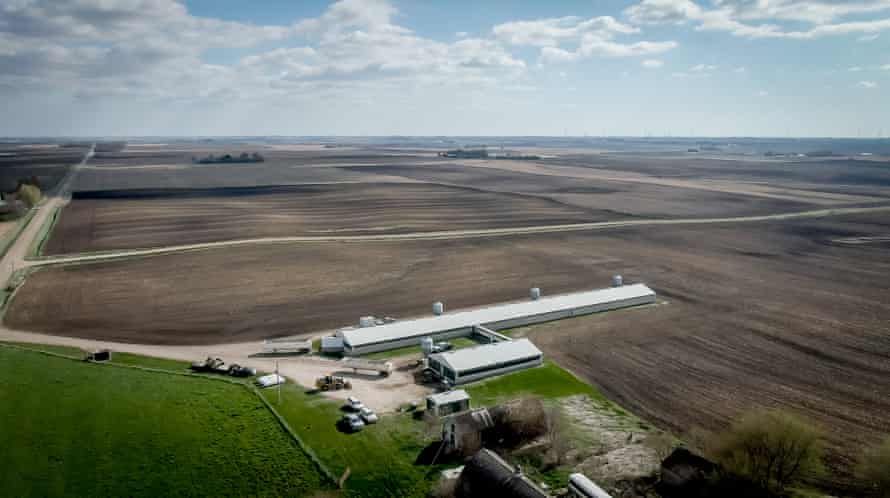
In undercover footage captured by Johnson in May 2020, which was published by the Intercept, the pigs can be heard shrieking in distress. These revelations immediately made headlines and sparked a PR crisis for Iowa Select, which stopped practicing ventilation shutdown after it was brought to light – a rare and solid win for animal rights activists. “Matt’s investigation of ventilation shutdown is probably the most important [factory farm] investigation in more than a decade,” said Justin Marceau, an animal law scholar and professor at the University of Denver.
A surprise in the courts
Prosecutions of activists such as Johnson have been on the rise in recent years. Last month, Wayne Hsiung, the DxE co-founder who for years has had criminal charges against him pending across multiple states, was convicted for the first time of two felonies in North Carolina for removing a sick goat from a farm. But on Wednesday, the day before Johnson’s trial, all charges against him were dismissed, an outcome that surprised reporters and activists alike. An earlier set of charges pertaining to Johnson’s ventilation shutdown investigation in Iowa had already been dismissed in January 2021, a few days before trial, because Iowa Select Farms didn’t want to testify. The charges dismissed this week, which included Johnson’s rescue of a sick two-week-old piglet whom he named Gilly, was the second case involving his activity at Iowa Select facilities.
The case’s prosecutor, Joe Corrow, Wright county assistant attorney, on Tuesday filed to dismiss the charges “in the interest of justice”, a vague legal phrase that doesn’t provide much insight into his reasoning. “It’s basically a catch-all to say ‘Yeah, we don’t think we should go forward any more,’” said Adam Junaid, one of Johnson’s attorneys. The motion to dismiss came 15 minutes before a hearing on news media recording of the trial, which is usually permitted in Iowa, was supposed to begin. Neither Corrow nor Iowa Select Farms responded to multiple requests for comment for this story.
Johnson’s was one of the most highly anticipated farm animal rights cases in recent history, and the outcome is undoubtedly a victory for DxE, a group that since 2013 has been taking animals from factory farms and daring law enforcement to come after them – a practice they call “open rescue”. That has sparked debate over whether activists have the “right to rescue” animals from suffering.
“We are setting a precedent that rescuing animals from situations where they’re in distress is the right thing to do. It’s not a crime,” said Johnson, speaking after the charges were dismissed. But Johnson had hoped to make it to trial. Some might question the wisdom of inviting criminal convictions, but for DxE, breaking laws in order to change them is part of the point. “I think when people see activist repression, it’s actually very positive for movements because you get that sympathy, you get that attention, and people see you as someone who’s suffering unjustly,” said DxE lead organizer Almira Tanner. “And then of course there’s the opportunities for concrete legal victories
Marceau, the animal law scholar, believes there’s value in pushing unjust animal treatment laws to trial. If a jury votes to acquit in such a case, he said, that would be a bad outcome from the state’s perspective – making prosecutors reluctant to bring similar cases to trial, and opening up space for activists to do more rescues.
But it’s a high-risk strategy. “Prison is terrible,” Marceau said. Alongside the personal suffering, he wonders whether the incarceration of prominent activists such as Johnson could damage the morale of the movement.
Even if an activist has a sympathetic case, the jury aren’t certain to hear it. At Hsiung’s North Carolina trial, for example, the judge blocked most testimony on the health and suffering of the goat he had rescued. In Johnson’s case, the state had filed a motion arguing that showing ventilation shutdown would “appeal to the jury’s sympathies and arouse their sense of horror, and only serve to confuse the issues”.
Johnson did not want his case to be dropped. He had hoped to use the trial to try to persuade a jury that he was right to expose Iowa Select’s atrocities, create a precedent for the right to rescue suffering animals, and challenge the constitutionality of the ag-gag law he was charged under. Even a guilty verdict, he said, would help the movement. “I’m very at peace with the fact that sacrifice of this sort is going to be necessary,” he said before charges were dropped. He’d spent the last few weeks with his family in Iowa, preparing for the possibility of going to prison.
“Not really,” Johnson said when asked if he was relieved that he wouldn’t be locked up after the prosecutor moved to dismiss the case. His legal team then filed an objection to the dismissal, arguing that Johnson should be able to address the allegations against him and “to have the ‘right to rescue’ tested in a court of law”. At a final hearing on Wednesday, the judge seemed confused that Johnson was fighting for the right to risk prison. “The court cannot force the state to go to trial,” he concluded, before dismissing the case.
23/1/22
Further links:
https://worldanimalsvoice.com/?s=iowa+forced+ventilation
Regards Mark

