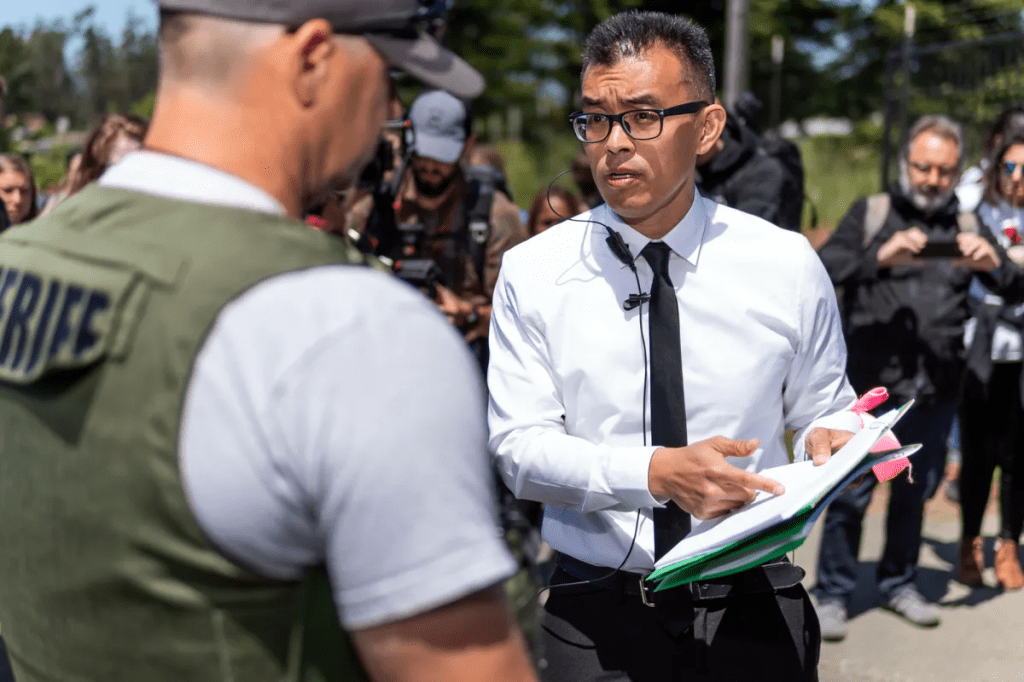
Lawyer, animal rights activist, and Direct Action Everywhere founder Wayne Hsiung speaks with an officer from the Sonoma County, California, Sheriff’s Office during an action at Reichardt Duck Farm in June 2019. Photo: Courtesy Direct Action Everywhere
The conspiracy charges against DxE’s Wayne Hsiung marked a troubling shift — and an overreach — by prosecutors in animal rights cases
ANIMAL RIGHTS ACTIVIST and lawyer Wayne Hsiung was found guilty of felony conspiracy and two misdemeanor charges on Thursday for rescuing ailing animals from factory farms in Sonoma County, California.
Hsiung and fellow activists with the animal liberation group he founded, Direct Action Everywhere, or DxE, have for years engaged in the public removal of sick and injured animals from farming facilities — a tactic known as “open rescue,” since they are publicized. The rescues regularly lead to criminal charges, which for the most part have been dropped or led to acquittals in court. Hsiung’s conviction marks the first time a DxE open rescue case has ended with an activist’s incarceration: He faces up to three years in prison.
“I could be going to jail for organizing others and trying to take sick and injured animals to the vet,” Hsiung said in a video posted on social media the day before his conviction. “That’s all I did.”
Following the guilty verdict, Hsiung was indeed put in jail, where he awaits his November 30 sentencing hearing.
After several trials of dropped charges and not-guilty verdicts for DxE open rescues, Hsiung’s felony charges suggest a shift in tactics by the authorities — and a troubling prosecutorial overreach. Past cases against DxE activists had often involved theft or burglary charges based on allegedly stolen animal property. Hsiung was convicted of felony conspiracy to commit misdemeanor trespass; the punishment for planning to trespass in this case is far heftier than for the trespassing itself.
Cassie King, an organizer with DxE, told The Intercept that, a week before Hsiung’s trial began, the government dropped theft and burglary charges, while pushing forward with felony conspiracy and trespassing.
“The prosecutor was very strategic. I’m sure he’d followed what happened in other cases that led to acquittal.”
“The prosecutor was very strategic,” said King, who has faced charges for open rescues. “I’m sure he’d followed what happened in other cases that led to acquittal.”
Hsiung’s charges stem from DxE mass actions in Sonoma County at two poultry farms: one at Sunrise Farms in 2018, one at Reichardt Duck Farm in 2019. Prior investigations by DxE and other animal welfare organizations had found rampant violations of animal cruelty law at the facilities, prompting the open-rescue plan. At both locations, over 500 activists demonstrated outside, while a smaller number entered the properties to identify and remove dozens of sick and injured animals, which were then brought to a vet.
Hsiung was convicted on misdemeanor trespass for both events; his felony conspiracy conviction relates only to the Sunrise Farms action, for which he was a lead organizer. The jury could not decide on a similar felony conspiracy charge for Reichardt Duck Farm rescue, leading to a mistrial on that charge.
While hundreds of demonstrators were initially arrested, many faced misdemeanor charges and chose to enter diversion programs to see the charges removed; six people were charged with felonies, four of whom took plea deals, while one person’s charges were dropped. Hsiung was the only remaining defendant.
Prosecutorial Overreach
The practice of open rescue is an end in itself — saving individual, suffering animals — but the broader aim is to bring attention to the brutalities of factory farming, especially farms that brand themselves as cruelty free. Sunrise Farms, for example, is a major egg supplier to Whole Foods.
Hsiung and others welcomed the opportunity to bring their cases to trial, with the aim of shifting legal precedent around animal cruelty and the rights of nonhuman animals in the legal system.
In a number of recent cases, DxE activists have been successful: Juries in St. George, Utah, and Merced, California, found open-rescue participants not guilty. Hsiung was a defendant in the Utah case and, in his capacity as an attorney, led the legal defense in the Merced case. Other activists had charges dropped in various jurisdictions.
In 2021, Hsiung was convicted of larceny and breaking and entering for his rescue of an ill baby goat from a North Carolina farm but was given a six-to-17 month suspended sentence, a year’s probation, and no prison time. His conviction and expected prison sentence this time marks a potentially troubling shift in prosecutorial approaches to these cases.
In both the Utah and California acquittals, the activists faced theft or burglary charges — for taking animals that the farming corporations considered property. Since the rescued animals were sick or injured, however, the defendants were able to show that the animals had no value, as understood by agribusiness; their removal could not be shown to be a loss of value to the company. Prosecutors in the Sonoma County trial avoided the question of theft and property all together, relying instead on trespassing charges, which were then trumped up with a vague felony conspiracy statute.
Hsiung’s defense was in many ways stymied from the jump. The judge barred almost all photo and video evidence of animal cruelty from the trial, as has been the case in a number of previous DxE trials. As I’ve previously noted, the decision to disallow such evidence is usually made to benefit a defendant — not showing gruesome images of a murder victim, for example. Such logic has been flipped in DxE cases, including Hsiung’s most recent, to the benefit of powerful agribusiness.
Meanwhile, the judge also barred Hsiung from making a so-called necessity defense, based on the right to aid animals who were being subjected to criminal animal cruelty. DxE has long hoped to bring a necessity defense in court. The activists argue that the legal justification that allows a person to break into a car to save a suffocating dog should apply in open rescue cases; the logic is the same, and the only difference lies in the power of the agriculture industry.
“Judge Laura Passaglia prohibited the defense from showing the jury photo and video evidence of animal cruelty.”
Judge Laura Passaglia denied Hsiung’s use of a necessity defense but did permit him to make a “mistake of law” defense: the argument that the defendant had a good faith belief that their actions were legal. Under California’s animal cruelty statute, a person is permitted to trespass onto private property to aid ailing animals. Hsiung claimed that he believed DxE’s actions to be legal, as extensive research had provided evidence that animal suffering and illness was rife at both farm facilities. Since almost all video and photo evidence of animal cruelty was banned from the trial, however, the defense was kneecapped.
“Throughout the trial, Hsiung encountered numerous judicial obstacles, including a gag order barring him from speaking with the media about the case,” said a statement from DxE, adding that the judge did not respond to the American Civil Liberties Union’s argument that the order violated Hsiung’s First Amendment rights. “Although prosecution witnesses repeatedly testified that the treatment of the animals at their facilities is humane, Judge Passaglia prohibited the defense from showing the jury photo and video evidence of animal cruelty that disproved these testimonies, except on a few limited occasions for direct impeachment.”
Hsiung plans to appeal, citing what he believes were prejudicial rulings and significant error on the part of the judge. The animal liberation movement is hopeful too that an appeal provides another opportunity to raise a necessity defense and fundamentally change case law around animal welfare.
“Activists have won and will continue to win cases based on a legal right to rescue animals from abuse,” said University of Denver law professor and civil rights attorney Justin Marceau. “No legal strategy ever works 100 percent of the time, but this conviction is less a setback than an opportunity to litigate the legal status of animals in the appellate court and in the court of public opinion.”
Regards Mark
Animal Rights Activist Convicted of Felony for Rescuing Sick Chickens (theintercept.com)



 World Animals Voice