PETITION TARGET: Congresswoman Nancy Pelosi and Senator Mitch McConnell
Every year, an estimated 73 million sharks worldwide are cruelly butchered and killed for the shark fin industry.
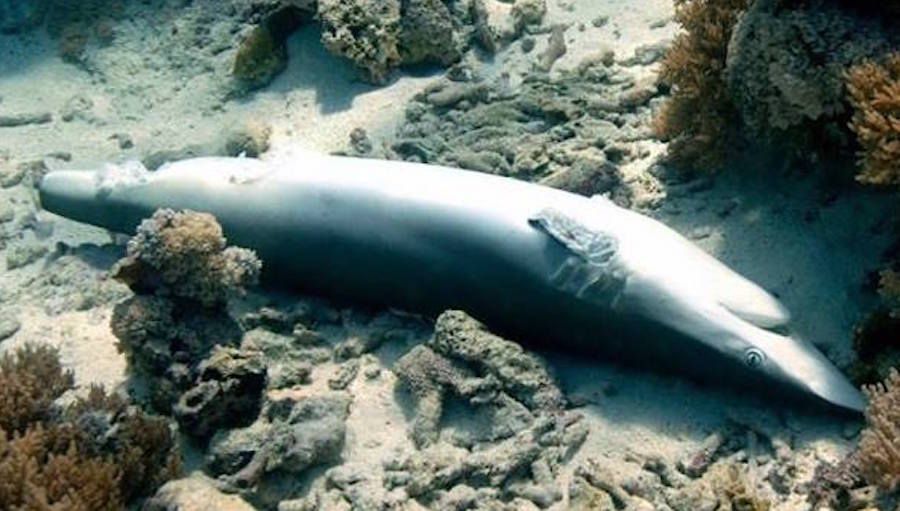
It’s a brutal process; these majestic apex predators are hauled from the ocean and their fins barbarically sliced off before being thrown back into the water.
Sharks must be able to swim in order to get enough oxygen as the water filters through their gills. Once they lose their fins, they are helpless. Unable to move, they sink to the bottom of the ocean, dying slowly from suffocation and blood loss — if another predator doesn’t attack them in the meantime.
This mass slaughter of sharks is pushing many species towards extinction, with more than 70 percent of the most common species used in the trade considered to be at critically low population levels.
Now, hope is on the horizon with a new bill introduced by Rep Gregorio Sablan and Rep Michael McCaul. The Shark Fin Trade Elimination Act of 2019 has enormous bipartisan support and is backed by a variety of conservation organizations.
While shark finning has been illegal in U.S. waters since 2000, the trade in fins throughout the country is still legal; fins are currently imported from countries that have no regulations protecting sharks. Twelve states have state-wide bans on the trade, but even so, many restaurants in these states still feature shark fin on the menu.
Sign the petition urging Senator Mitch McConnell and Congresswoman Nancy Pelosi to support this bill’s passage through Congress, and send a message to the rest of the world that the U.S. is a leader in shark conservation.
We’ve made this video for you to celebrate all the amazing things we achieved together for whales and dolphins in 2018 – our 30th anniversary year. You should feel extremely proud – we couldn’t have done any of this without our fantastic supporters.
I hope you’ll stay with us in 2019 as we need your support more than ever to fight the continuing threats to whales and dolphins and create a world where every whale and dolphin is safe and free.
With very best wishes on behalf of all of us at WDC,
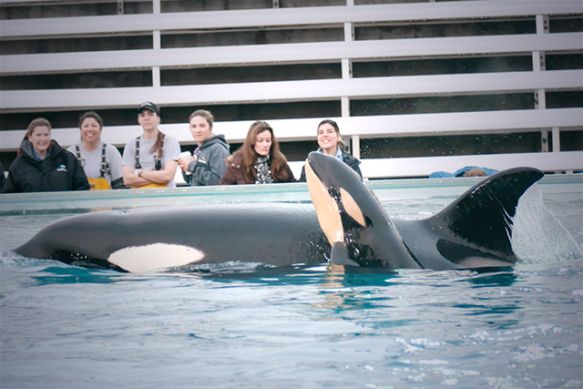
A 30-year-old orca has died at SeaWorld’s Orlando Park in Florida.
The orca, named Kayla, died on Monday after a brief illness, SeaWorld officials said.
Veterinarians began treating Kayla on Saturday, following a physical exam, after she showed signs of discomfort. Her condition worsened Sunday and she was given around-the-clock care until her death, park officials said.
The cause of death will not be known until a post-mortem examination is conducted.
Kayla was one of the last remaining orcas at SeaWorld’s Orlando park after the company announced in 2016 that it was stopping its orca breeding programme.
In a statement, SeaWorld officials said: “The entire SeaWorld family is deeply saddened by the loss. While today is a difficult day for all of us at SeaWorld, Kayla inspired generations of guests and employees to care and learn more about this amazing species.”
SeaWorld’s orca shows came under criticism following the 2013 documentary Blackfish, which depicted orca Tilikum’s life in captivity. Before his death in 2017, Tilikum was involved in the deaths of three people, including SeaWorld trainer Dawn Brancheau.
In 2017, the company ended orca shows in California, with plans to phase out the shows at parks in Florida and Texas in 2019.
WAV Comment
We suggest that the SeaWorld statement should have been:
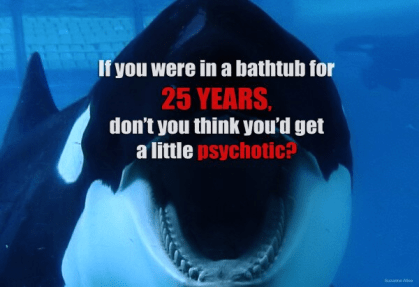
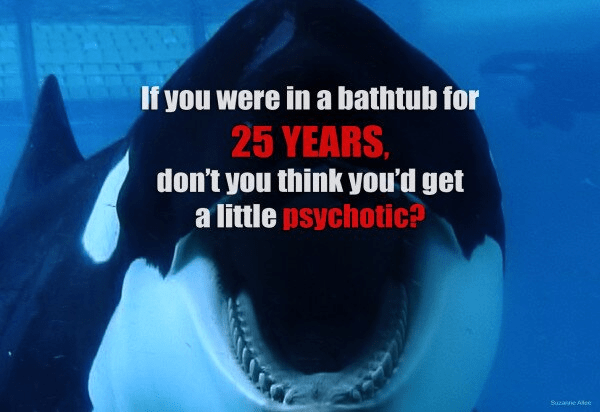
“The entire SeaWorld family is deeply saddened by the fact that we will not be making money out of animals that belong in the oceans performing stupid tricks in our undersized tanks instead. Today is a difficult day for all of us at SeaWorld due to the loss of future funds from members of the public who have still not got a grip that animals should not be doing pathetic tricks to satisfy their dismal demands to be ‘entertained’ by animal abuse. Kayla inspired generations of guests and employees who simply ignored the fact that wild animals belong in the wild, not bathtubs such as those at SeaWorld.”
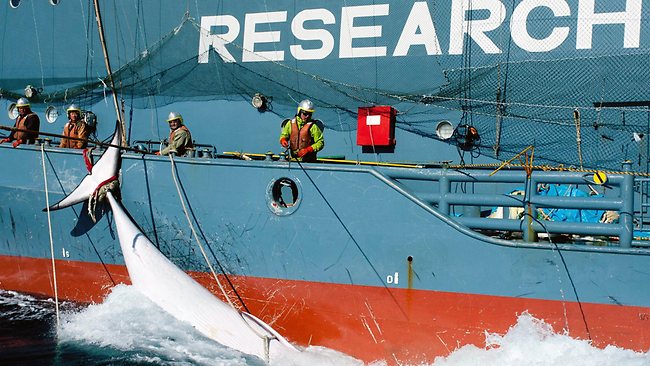
Born Free anger Japan crafty pulling out of IWC – International Whaling Commission of free killing whales assembly march Japan Embassy, 26 January 2019, London, UK.
All photographs in this post are for educational reference only. No copyright infringement is intended and no financial gain made by WAV rom the showing of these images.
Religious texts set down traditional methods of slaughter; simply using a knife to kill the animal. The right to continue using these methods is strongly contested between members of the Jewish and Muslim faiths and animal rights / welfare activists.
Opponents of the practice feel that animals should be stunned before slaughter – stunning; which is a standard industry practice worldwide – if undertaken properly, this makes animals unconscious and reduces the pain as they are cut (stuck / sticking) and bled to death. We say ‘if undertaken properly’; because there is a lot of evidence and undercover footage in existence which shows that in the ‘stun usage’ environment; many animals are not being stunned correctly or for long enough; thus regaining consciousness before their throats are cut.
However, there is no definitive scientific evidence that an animal does not feel pain whilst unconscious. Indeed, a counter argument put forward by ritual slaughter advocates is that stunning may only stop an animal from displaying pain.
While the Jews accept absolutely no stunning, some Muslims have accepted it as long as it can be shown that the animal could be returned to normal living consciousness.
EU law requires animals for the food chain to be stunned (made unconscious) prior to killing, so that death should be ‘painless’. Is any slaughter ‘painless’ we ask ?
Saying this, there are within the EU exceptions to stunning prior to slaughter for religious reasons, notably for Shechita (the Jewish method of killing animals for food – Kosher meat) and Muslim Halal. The Muslim and Jewish communities, totalling nearly 25% of the world population, have similar philosophies in this regard.
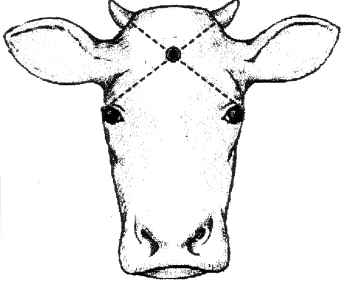
The recommended position which a captive bolt gun should be located on cattle’s head.
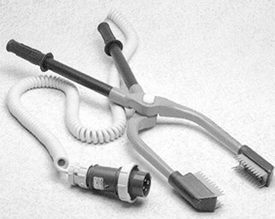
Stunning tongs deliver an electric charge. They must be positioned either side of the head to be effective.
Conventional Slaughter
Animals are generally made unconscious by stunning and then killed by cutting their main blood vessels; the carotid arteries in the neck.
Just prior to slaughter, individual animals are supposed to be separated as they are walked into a stunning box. Within seconds an operator stuns the animal. Separation is not as common as the industry would like people to think.
There are three different methods of stunning, each used for specific animals.
Captive bolt: a gun-like device delivers a concussive blow to the skull. Usually used for adult cattle and sometimes sheep and calves,
Electrical: A current is applied across a sheep’s (or sometimes cattle’s) brain allegedly rendering it senseless. Electrical stunning is undertaken using ‘tongs’ held by the slaughterman. It is essential that to produce the required result, the tongs are positioned correctly on the animals head. Again; a lot of video evidence shows that tongs are either positioned incorrectly in the first place; and / or they are not held in position for long enough time to render the animal unconscious.
There is very much a risk that some cattle, pigs and sheep may not be stunned effectively, causing them to regain consciousness before they die from blood loss during sticking Therefore, for stunning to be effective it is vital that:
the stunning equipment such as tongs are working properly – they should be regularly checked and maintained
the stunning equipment is positioned correctly on the animal’s head/head and back. In large processing facilities; this is not always correctly undertaken.
during electrical stunning, enough current is applied for a long enough period
during captive bolt stunning, the correct charge cartridge is used to fire the captive bolt
the time between stunning and sticking (cutting) is not too long to prevent an animal regaining consciousness
A sheep is electrically stunned using tongs.
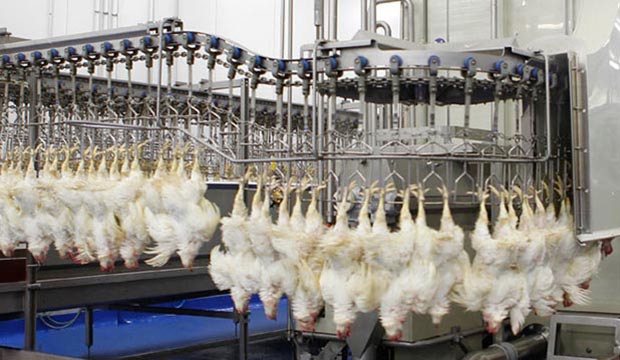
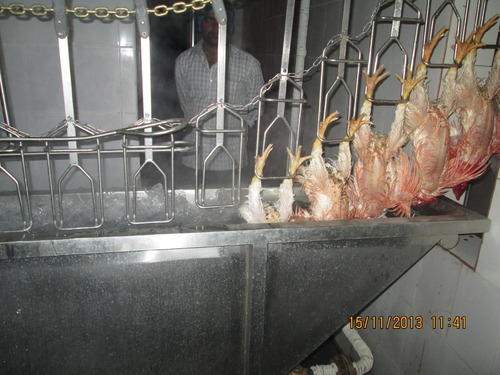
Waterbath: Used for the killing of chickens. Birds are hung by their feet in metal holders (shackles) on a moving belt and their heads are supposed to be dipped into electrified water.
Above and Below – Chickens hanging on shackles.
The problems involved with the stunning of poultry are complex. Welfare concerns include the following:
the shackling of live birds – which is painful.
Waterbathing can result in some birds raising their heads and subsequently missing the water bath stunner.
Can result in the birds receiving painful pre-stun shocks as they enter the stunner.
Can result in an insufficient electrical current flowing through the bird’s body to ensure the bird is unconscious (effectively stunned).
Can be designed so birds passing through an automatic neck cutter only receive a single cut to the neck, which reduces the rate of blood loss.
Can result in birds accidentally missing the automatic neck cutter. If these birds are not noticed by the slaughter person, they may still be alive when entering the scalding tank – a tank of boiling water that helps to loosen the feathers prior to plucking.
Chickens going through the scalding tank.
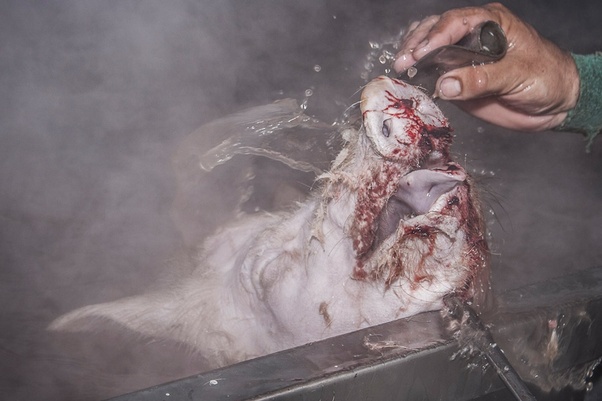
Above and below – A pig still alive within the scalding tank.
Gas: carbon dioxide or other inert gases are used, mainly for poultry; but also for pigs.
Stunning with CO2 gas is in our opinion terrible, but it offers some benefits over electric stunning including the ability to stun animals in groups, with minimal restraint, less handling, and therefore potentially less stress before stunning. There is also less reliance on the skills of the people operating the equipment.
However, recent studies have revealed a number of welfare issues with CO2 stunning. These include:
the gas is very unpleasant for pigs (who are highly aversive animals)
there is variability between individual pigs’ responses to CO2
pigs are not rendered unconscious immediately
high concentrations of CO2 gas can cause significant pain and distress to pigs when inhaled (by causing acute respiratory distress)
Studies of pigs’ behaviour have found that most pigs will avoid high concentrations of CO2 gas if possible, and that almost 90% of pigs preferred to go without water for 72 hours than experience exposure to CO2 gas.
Further research is urgently needed to develop stunning systems which retain the benefits of CO2 stunning while minimising the disadvantages. Evidence suggests that potential alternatives to be investigated may include:
non-aversive (not unpleasant and do not cause pain) gas mixtures such as argon, nitrogen, or nitrous oxide
a combination of argon with CO2
anaesthesia with non-aversive gases, followed by killing by CO2 or electrical methods
genetic selection for pigs which do not find CO2 to be painful.
The RSPCA (in the UK) recommends that stunning/killing pigs with high concentrations of CO2 should be phased out quickly, and replaced with a more humane alternative. The development of more humane gas mixtures and suitable equipment should be urgently prioritised.
Pigs being killed by the use of CO2.
Bleeding out comes from having at least both carotid arteries in the animal’s neck severed (“sticking”) to ensure maximum blood loss.
Cutting actions required
In poultry and sheep the throat is cut behind the jaw.
The knife cut for chicken cuts muscle, trachea, oesophagus, carotid arteries, jugular veins and major nerves.
For cattle, the skin is opened at the neck through a 30cm longitudinal cut. A clean knife is then used and inserted at a 45° angle to cut the jugular and carotid blood vessels.
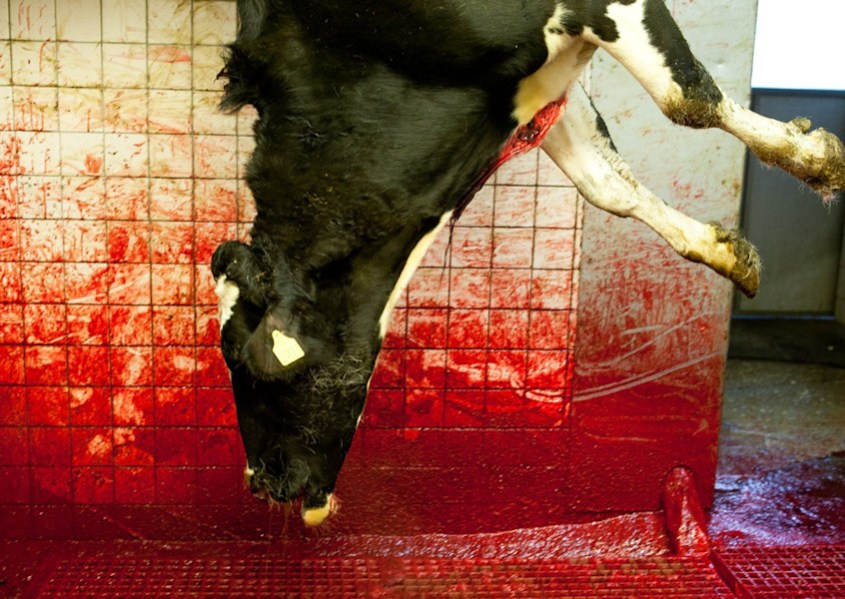
Slaughtered Cattle hung and bleeding out.
According to the ‘system’, the knife should be ‘very sharp’, without blemishes or damage and be at least double the width of the neck. It should be used in a fast, aggressive cut across the throat with the least number of strokes in order to bring about immediate and massive blood loss.
The animals are then inverted, having been shackled by a back leg – attached using a metal fastener – just after stunning (except poultry which are already inverted), to allow the blood to drain away faster.
Religious
Halal slaughter
For cattle there was no stunning in Italy and most Belgian and French slaughterhouses, unlike in Germany and the UK. Cattle were restrained upright in Italy, the UK and 80% of abattoirs in Belgium, but turned on their back in a pen in Spain. The most common stunning method was the penetrating captive bolt.
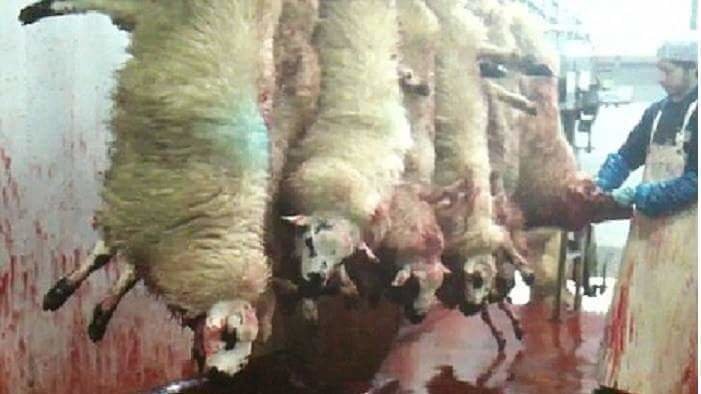
For sheep, there was no stunning in Belgian, Dutch and most of the Italian, French and Spanish abattoirs surveyed, whereas stunning was the most common practice in the UK and Germany. The animals were upright in the UK, on their sides in Belgium, France and Italy and mainly hoisted in Spain. The most common stunning method was head-only electrical stunning,
Sheep hoisted for Halal slaughter.
Poultry were not stunned in Italian abattoirs surveyed, but stunned in Germany, Spain and the UK. The stunning method used was the waterbath.
Shechita slaughter
Data from French, Italian, Spanish and UK abattoirs showed that no stunning (pre- or post-cut) was used. For cattle, slaughter was in the upright position in Italy and the UK and with animals on their backs and restrained in Spain and France. For animals such as sheep, they were turned on their sides in the UK, but hoisted in Italy.
Of importance for any slaughtering, but more so for Halal and even more for Shechita, is secure restraining. This particularly relates to the head and neck since movement results in a poor cut, slowing death, reducing meat quality and possibly retaining blood and ‘spoiling’ meat.
Religious customs
Muslim
The Qur’an sets out the rules with respect to animals and slaughter and teaches that animals should be well treated:
Restraining equipment should be comfortable for the animal, whatever ‘comfortable’ is for an animal about to die !
Invoking the name of Allah immediately before the slaughter is either compulsory or highly encouraged, although (in the UK) it is known that the name of Allah is simply continuously played via a tape during the daily process.
The cut must sever at least three of the animal’s trachea, oesophagus and the two blood vessels on either side of the throat,
Multiple acts of slaughter on one animal are allegedly prohibited, so the knife must not be lifted off the animal during the act of slaughter: a single continuous back and forth motion is required, and animals should not be shackled and hoisted before bleeding, and further actions on the carcass must wait until there are no more signs of life.
It has been claimed that the Qur’an contains nothing forbidding the consumption of stunned animals. However, there is no single authoritative body that can definitively rule as to the Muslim law on the issue of stunning before slaughter. Some Muslim authorities have approved stunning so long as the animal can regain consciousness and eat within five minutes.
Jewish
Jewish rules are set out in the Talmud and Midrash:
Shechita slaughter, necessary for orthodox Jews, always requires no pre-stunning. This reflects a need for animals to be healthy and without injury at the time of slaughter. No pre-stunning for the Shechita method has yet been accepted,
Appropriate animals must only be slaughtered by a specially trained person, and traditionally slaughter has been with the animal on its back, but an upright position has been approved.
Animal suffering
Correctly performed conventional slaughter procedures (stun then cut) results in animals rapidly becoming unconscious, and remaining so during cutting, until their death by bleeding out.
However, animals can feel stress when being prepared for slaughter, for example during restraining, and in the case of poultry there are concerns about their shackling before stunning.
In large, high-volume slaughterhouses with a focus on fast, cost-effective throughput; some personnel can be poorly trained and animal welfare regulations simply ignored, with low levels of inspection. Religious slaughter brings extra challenges to these abattoirs since it requires more attention in animal handling, specialised equipment, greater slaughtering skill and overall the process is slower.
In practice, animals may suffer pain, a slower death and stress through procedures in religious slaughter not being carried out as laid down:
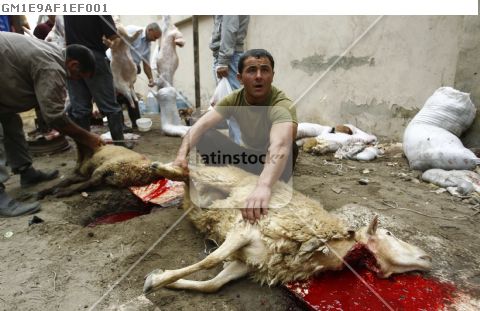
A sheep is slaughtered on the street during Muslim Eid.
Stunning procedures in ‘normal’ slaughter procedures are also not always performed correctly,
During slaughter, operator and general factory competence is very important,
A lack of experience or skill may mean that more than the required one or two movements of the arm for cutting. There have been reports of 3.2 cuts being required for Jewish and 5.2 for Halal slaughter.
Death for the animal takes longer where arteries were not correctly severed (generally reported as occurring for one out of ten animals).
Pain
The determination of the exact point; if any; when an animal becomes insensible to pain is the key animal-welfare issue. Though it is clear that animals do not lose sensitivity to pain immediately on stunning, the state of consciousness of an animal and its level of insensibility cannot be quantitatively measured.
One side argues that although science cannot provide a definitive position no-stunning slaughter is more likely to cause pain given the many nerve receptors in the neck and time taken to bleed whilst the animal is not unconscious.
However, some counter arguments put forward are that stunning:
may only paralyse an animal, preventing it from displaying pain,
Does not always work – due to operational problems, and
May be painful and the process cause stress to the animal involved.
Certainly, most people observing the process would suffer less discomfort through seeing animals first stunned.
Consciousness
A concern is that after stunning, animals regain (some) consciousness. This is particularly so for electrical stunning. Periods of less than one minute are considered desirable for “stun-to-stick”, though the UK’s Farm Animal Welfare Council considers the maximum legal interval should only be 15 seconds.
In ritual slaughter, non-stunned animals can be conscious after neck-cutting for up to 2 minutes for cattle, 20 seconds for sheep and 2.5 minutes for poultry, according to the European Food Safety Authority.
If correctly and properly performed, Shechita results in calm cattle collapsing within 10 to 15 seconds. Observation shows in 30% of cases however, that animals remain conscious for more than 30 seconds.
Alternatives
Most people would never want to witness and animal being slaughtered; yet meat eaters are seemingly happy to let someone else do the job for them behind high walls.
Fortunately, many people in the Western world especially have now decided to ditch meat for a plant based diet instead. Religious slaughter is one reason why so many people are opposed to live animal exports – all Australian sheep exported live to the Middle East are slaughtered using the Halal method. The general treatment of live animals is another.
A Major Cause of Concern – Australian sheep on a ship destined for the Middle East.
According to PETA, 198 animals are saved each year, per vegan person, but technically, none are. Animals are not saved or spared due to the amount of vegans in the world. However, less animals are “produced” to be slaughtered. So, maybe 198 animals per vegan are not produced to be killed is a very reasonable statement.
And get this: One person who goes vegan can save approximately 219,000 gallons of water a year. It takes 1,000 gallons of water to produce just one gallon of milk, and beef has an overall water footprint of roughly 4 million gallons per ton.
So, make the change to a plant based diet and do not have this terrible suffering on your conscience.
SIGN: Justice for Tiger Brutally Punched in the Face by Poacher
Image Credit: The Freeland Foundation
PETITION TARGET: Thai Ministry of Natural Resources and Environment
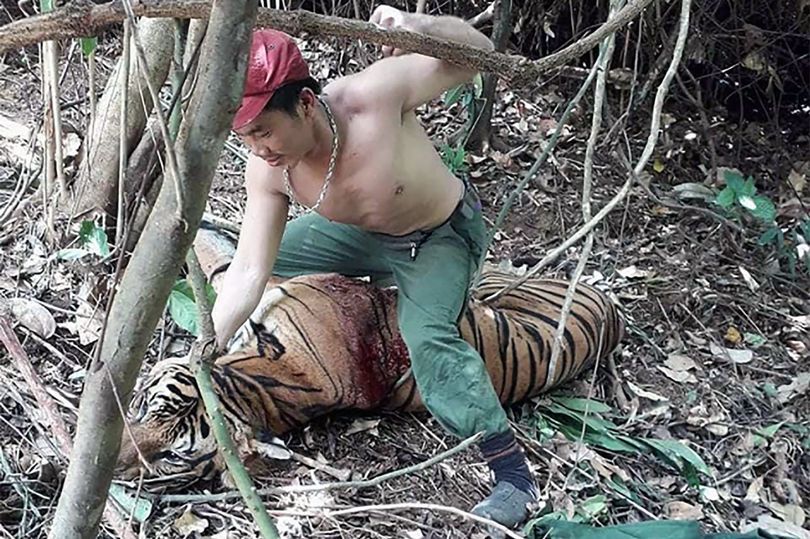
Thai authorities have arrested two poachers and are on the hunt for more after discovering a shocking photo documenting an illegal tiger kill.
The image shows a man straddling a tiger as the animal lies helplessly on the ground covered in blood. One hand is around the animal’s throat, the other is raised in a fist behind the man’s shoulder — as if he is about to viciously punch the head of this majestic big cat.
It is unclear if the tiger was already dead when this photo was taken, but after a three-month investigation, Thai police uncovered a wildlife trafficking organization that was responsible for the deaths of many more animals.
The poaching gang — originating in Vietnam — has been operating across Thailand, Malaysia and possibly Myanmar, slaughtering these critically endangered big cats and selling them on the black market. Most are destined for use in traditional Chinese health remedies.
According to the Freeland Foundation, a Thai organization working to stop poaching, Thai authorities are still searching for the man in the photo, along with the masterminds behind the poaching organization.
Sign this petition urging Thai wildlife officials to use all possible resources to hunt down these men and seek justice for every animal slaughtered at their hands — before any more have to suffer and die.
A new report has found that US carbon dioxide emissions rose by 3.4% in 2018 after three years of decline.
The spike is the largest in eight years, according to Rhodium Group, an independent economic research firm.
The data shows the US is unlikely to meet its pledge to reduce emissions by 2025 under the Paris climate agreement.
Under President Donald Trump, the US is set to leave the Paris accord in 2020 while his administration has ended many existing environmental protections.
The US is the world’s second largest emitter of greenhouse gases.
And last year’s spike comes despite a decline in coal-fired power plants; a record number were retired last year, according to the report.
The researchers note that 2019 will probably not repeat such an increase, but the findings underscore the country’s challenges in reducing greenhouse gas output.
In the 2015 climate accord, then President Barack Obama committed to reducing US emissions to at least 26% under 2005 levels by 2025.
Now, that means the US will need to drop “energy-related carbon missions by 2.6% on average over the next seven years” – and possibly even faster – to meet that goal.
“That’s more than twice the pace the US achieved between 2005 and 2017 and significantly faster than any seven-year average in US history,” the report states.
“It is certainly feasible, but will likely require a fairly significant change in policy in the very near future and/or extremely favourable market and technological conditions. ”
What’s behind the rise?
Analysis by Matt McGrath, Environment correspondent, BBC News
There are a number of factors behind the rise in US emissions in 2018, some natural, mostly economic.
Prolonged cold spells in a number of regions drove up demand for energy in the winter, while a hot summer in many parts led to more air conditioning, again pushing up electricity use.
However economic activity is the key reason for the overall rise in CO2 emissions. Industries are moving more goods by trucks powered by diesel, while consumers are travelling more by air.
In the US this led to a 3% increase in diesel and jet fuel use last year, a similar rate of growth to that seen in the EU in the same period.
All this presents something of a problem for the Trump administration which has been happy to point to declining US emissions as a reason to roll back many of the environmental protection regulations put in place by his predecessor.
The figures also show that the President’s efforts to boost demand for coal have not succeeded yet, with electricity generated from this fossil fuel continuing to decline.
Despite this, there is little to cheer in the US data for those concerned with climate change on a global scale.
Many had hoped that carbon cutting actions at state or city level could in some way keep the US on track to meet its commitments made under the Paris climate agreement.
The latest emissions data indicate that this is unlikely to happen.
What has changed in the US?
The last time the US saw such an increase in emissions was in 2010, as the country recovered from its longest recession in decades.
Part of last year’s spike is also the result of economic growth, but new policies have exacerbated the effects of increased industry production.
Mr Trump has rolled back a number of his predecessor’s environmental regulations since taking office, appointing climate change sceptics and industry leaders to head US environmental agencies.
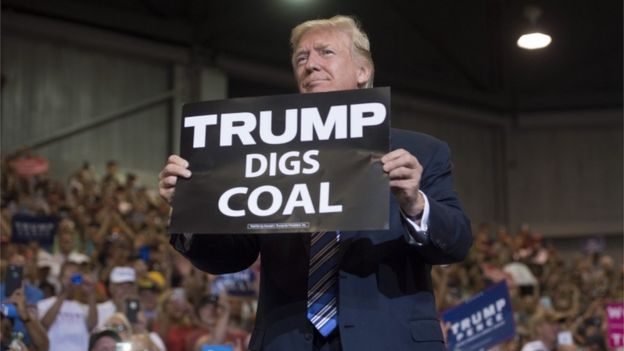
As a part of undoing what he called a “war on coal”, in 2017, Mr Trump rescinded the Clean Power Plan, which required states to slash carbon emissions to meet US commitments under the Paris accord.
In December, the Environmental Protection Agency (EPA) pressed ahead with plans to lift restrictions for carbon emissions from new coal plants and asked for public comment on redefining the phrase “causes or contributes significantly to” air pollution.
Under Mr Trump’s administration, the federal government has also opened up once-protected lands for oil and gas drilling across the US and has proposed ending regulations on fuel standards for cars and trucks after 2021.
“The big takeaway for me is that we haven’t yet successfully decoupled US emissions growth from economic growth,” Rhodium climate and energy analyst Trevor Houser told the New York Times.
The US jump also marks a worldwide trend: 2018 saw an all-time high for global CO2 emissions and was the fourth warmest year on record.
Since 1958, the research observatory at Mauna Loa in Hawaii, has been continuously monitoring and collecting data on the chemical composition of the atmosphere.
In the years since they first started recording, the observatory has seen a 30% increase in the concentration of CO2 in the atmosphere caused by emissions of fossil fuels and deforestation.
Scientists argue that the increase would have been even larger without the ability of the forests, land and seas to soak up around half of the gas emitted by human activities.
This ability however, varies with the seasons.
In the summer, CO2 levels in the atmosphere fall as the trees and plants soak up more of the carbon as they grow. In the winter, when they drop their leaves, they soak up less and atmospheric levels rise.
But when temperatures are warmer and drier than normal, trees and plants grow less and absorb less. This natural variation is compounded in years when there’s an El Niño event, which sees an upwelling of heat from the Pacific into the atmosphere.
“The warm sea surface conditions now will continue over the next few months and that will lead into the vegetation response,” said Dr Chris Jones from the Met Office.
“Around the world this heat has different impacts. In some places, it’s hotter and drier and you get more forest fires. In a tropical rainforest, for instance, you reduce the natural growth of the vegetation.”
According to the Met Office, these limits on the ability to absorb CO2 will see a rise in concentrations this year of 2.75 parts per million, which is higher than the 2018 level.
They are forecasting that average CO2 concentrations in 2019 will be 411ppm. Carbon dioxide concentration exceeded 400ppm for the first time in 2013.
This year’s predicted rise won’t be as big as in the El Niño years of 2015-16 and 1997-98. However, there have only been increases similar to this year’s about half a dozen times since records began.
Researchers say the long-term trend is only going in one direction.
“The year-on-year increase of CO2 is getting steadily bigger as it has done throughout the whole of the 20th Century,” said Dr Jones.
“What we are seeing for next year will be one of the biggest on record and it will certainly lead to the highest concentration of CO2.”
Other researchers say the Met Office findings are worrying.
“The increases in CO2 are a function of our continued reliance on fossil fuels,” said Dr Anna Jones, from the British Antarctic Survey (BAS).
“Some tempering in the rate of increase arises from the Earth’s ability to absorb CO2 from the atmosphere, but that can change year-on-year as the Met Office forecast shows.
“What’s critical, however, is that the persistent rise in atmospheric CO2 is entirely at odds with the ambition to limit global warming to 1.5C. We need to see a reduction in the rate of CO2 emissions, not an increase.”
The Met Office scientists say that it doesn’t always follow that a record CO2 concentration will lead to a record global temperature in 2019, as there are many natural factors that can impact the final figure.
The researchers there are pleased that observations over the past four years show that their model is accurate. They believe it can be used in the future to help countries accurately attribute increases in emissions to their actions or to natural factors.
The ongoing government shutdown, now the longest in American history, is not only imposing hardship on millions of families across the country, it is also having devastating impacts on our environment.
And while national parks go unstaffed, hazardous chemicals go unmonitored, and our food goes uninspected,the Trump administration is bringing back furloughed employees at the Department of Interior for the sole purpose of approving oil and gas drilling permits.
With our government in disarray, Trump and his allies are seizing this moment to charge ahead with their assault on our environment.
As we prepare ourselves for the next two years of President Trump’s term, there’s one thought I can’t shake: The stakes for our environment have never been higher.
Our climate, our air, our water, our public lands, our treasured wildlife — it’s all at grave risk.
But I’m not ready to admit defeat. To the contrary: NRDC and their determined, dedicated staff give me great optimism. They have a bold plan to protect our environment from every attack we face — but they need our help to carry it out.
For nearly half a century, NRDC has been at the forefront of the environmental movement: safeguarding our public lands, protecting our wildlife, and fighting to stop the impacts of climate change for all citizens… no matter which party they belong to.
More than any other group I know, they have the focus, the expertise, and the drive to protect the environment from the most pressing attacks. I put all my trust behind this organization.
But they depend upon our support to keep this vital work going. It’s only with our help that NRDC can continue to mobilize millions of Americans in fierce opposition when the environment is threatened… to lead efforts at the national, state, and local levels to win breakthrough policies… to hold the government accountable, and enforce the protections we’ve fought so hard for.
I have supported NRDC for the last 45 years for one simple reason: they know what it takes to win. They’ve gone to court with the Trump administration 70 times in the last two years, and have won an astounding 85 percent of the cases that have been resolved — each one of them a victory for our environment, and our future.
When you make your gift right now, I promise you that the impact you make will be felt for months, years, and generations to come. Thank you for standing with the environment, and with NRDC.
Don’t Let Them Die. They are Iconic American Horses !
Petition to SIGN: TO STOP THE SLAUGHTER OF AMERICA’S WILD HORSES
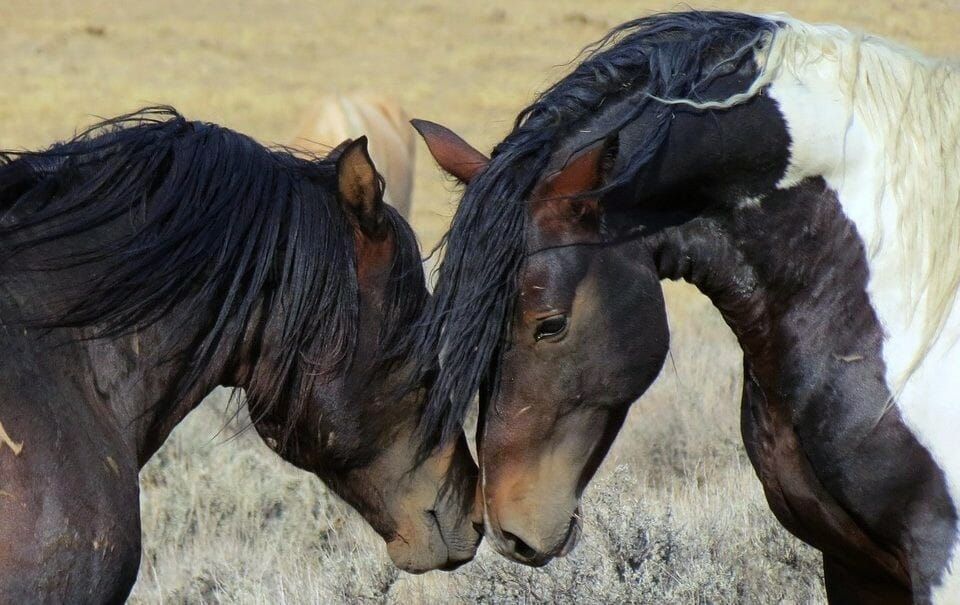
America’s iconic wild horses are in grave danger of being sold off to meat slaughterhouses in Mexico and Canada to face torture and brutal death.
U.S. Forest Service has just built a corral for wild horses, and it’s holding 260 animals rounded up from Modoc National Forest in Northern California. The horses’ fates hang in the balance as they may soon be shipped off to foreign slaughterhouses and butchered for meat.
Then, email Forest Service Chief Vicki Christiansen at vcchristiansen@fs.fed.us and urge her to stop the killing.
Instead of brutally killing America’s horses, the government should enact cruelty free population control efforts, like reducing births — as well as protect the public land on which these majestic creatures roam free.
PETITION TARGET: Thailand Ministry of Natural Resources and Environment
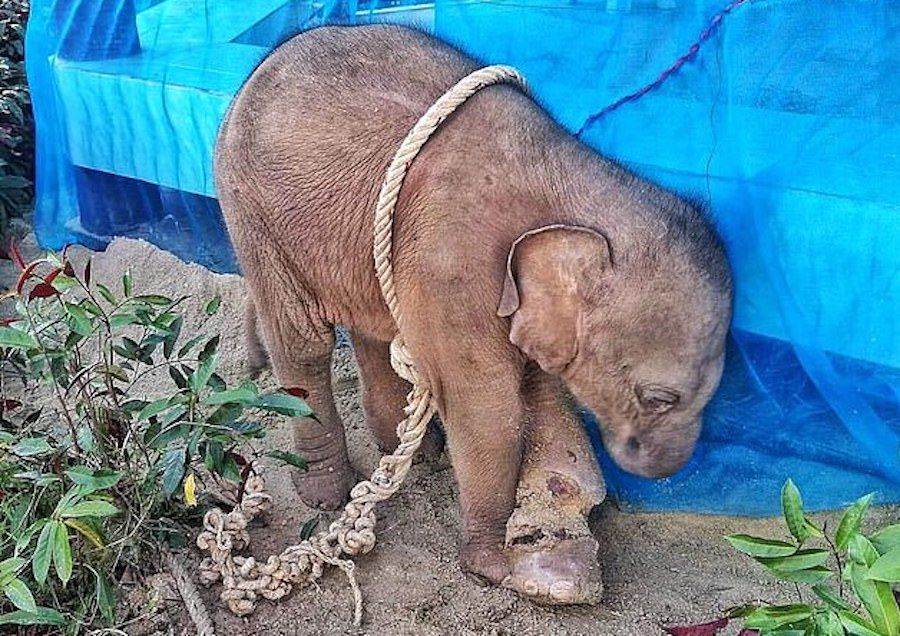
In a ruthless display of cruelty, a hunter in Rayon, eastern Thailand, tied a one-month-old elephant up with rope and abandoned the helpless animal to die, slowly and excruciatingly.
By the time villagers found the baby, she was starving and could barely stand. The rope cut so deep into her ankle, the skin was dead and the bone exposed. She had gone days or more without a drop of her mother’s milk. Nobody knows how long she was left to suffer, terrified, alone and hungry.
Rescuers — who named the baby Baitong — cut off her foot in a desperate attempt to stop the infection, and tried every other measure to save the weak, injured animal. Sadly, nothing could undo the damage, and Baitong died.
Such brutal treatment of an animal is unacceptable, and authorities must make it clear that committing acts of cruelty and murder against elephants will not be tolerated. Elephants are an endangered species that must be protected — and neither hunters nor anyone else should get away with such vile acts of abuse.
Sign this petition to urge officials of Thailand to investigate this case thoroughly and prosecute all parties involved in the torture and death of this beautiful baby elephant.