Category: Environmental

EU: European Parliament to vote on two major climate and nature laws this July.

European Parliament to vote on two major climate and nature laws this July

9 July 2023

Two plenary votes are coming up at the European Parliament that could have a huge impact on the planet; one on the Industrial Emissions Directive and the other on the Nature Restoration Law. It’s critical that policymakers vote in favour of nature, as well as for an ambitious threshold for animal agriculture, so that we can get to work on the urgent task of mitigating our impact on the climate and natural landscapes.

Find out below why these laws are so important, what impact these two plenary votes could have and what we, along with some of our members, have to say about them. 

What is the Industrial Emissions Directive?

The Industrial Emissions Directive (IED) has been designed to stop and/or control industrial emissions. 

Adopted in 2010, it’s currently the main policy in Europe to regulate pollutant emissions from industry, including from air pollution and wastewater discharge. 

In 2022, the Commission adopted proposals to make the IED stronger by including emissions from large cattle farms within its scope, in addition to the large pig and poultry farms that were already covered.

Any installation controlled by the IED is forced to reduce emissions, and needs a permit to operate. The original Commission proposal suggested including more industrial-size animal farms, with a threshold of 150 or more livestock units (LSU). 150 LSU corresponds to, as examples, a large farm with 500 pigs, 150 dairy cows, 10,700 laying hens or 21,400 broiler chickens. 

The goal of this revision was to bring the Directive more closely in-line with the goals set out in the European Green Deal, and other relevant policies. The debate around it has also put the intensification of EU animal farming in the spotlight

On July 10, the European Parliament will vote on the Commission’s proposal. If they vote in favour of it, amazing steps could be taken to reduce our industrial emissions – especially from agriculture.

If they vote against it, however, these systems will continue to cause great damage to nature and the climate – which they’re already doing at an alarming rate.

What is the Nature Restoration Law?

Last year, the European Commission adopted a proposal for a Nature Restoration Law, which focuses on how we can recover and protect our ecosystems. Among its targets, the proposal aims to restore at least 20% of the EU’s land and sea areas by 2030 and all ecosystems in need by 2050. 

There are plenty of positive examples of where nature restoration strategies have been successful. Deploying these kinds of strategies at EU level, then, would have sweeping impacts on biodiversity, land and marine ecosystems, the health of our soils (which is critical for food security) and more. As with the Industrial Emissions Directive, it’s extremely important that policymakers acknowledge the necessity of this move and vote in its favour.

What are the stakes?

The 2020 State of Nature in the EU report states that only 14% of habitats and only 27% of non-bird species currently have good conservation status. Moreover, the 2021 assessment for the EU Red List of Birds showed that 1 out of 3 bird species declined over the last few decades. These numbers demonstrate that, beyond species’ populations, wild animal individuals in the EU are suffering from a decline in the quality of their habitats. Habitat loss is a major source of stress for wild animals, restraining their movements and threatening their access to food, water and shelter.

These issues clearly can’t be allowed to develop any further. Only action at EU level will help us to mitigate our impacts on the climate and environment in a meaningful way. That’s why we’re working with our members to call on the European Parliament to address these plenary votes with the seriousness they deserve. 

It’s time for our policies to meet our planet’s needs!

We’re looking to the European Parliament to redefine ‘climate change’ -by changing the course of the climate crisis, instead of letting it continue – and using their power for the planet’s good. 

Farming should look far different by 2050. 

Regards Mark

Breaking: UK – Three of the UK’s biggest supermarkets are sourcing chickens dosed with antibiotics by a poultry producer in Poland linked to the spread of deadly superbugs. Great Investigation Work.

Breaking – Three UK supermarkets sell antibiotic dosed chickens linked to deadly superbug outbreak

Three UK supermarkets sell antibiotic dosed chickens linked to deadly superbug outbreak | ITV News

Three of the UK’s biggest supermarkets are sourcing chickens dosed with antibiotics by a poultry producer in Poland linked to the spread of deadly superbugs.

An investigation by ITV News, The Bureau of Investigative Journalism, and The Guardian has discovered Asda, Iceland and Lidl are buying frozen chicken products from SuperDrob – a major European meat supplier – who we’ve discovered was the source of an outbreak of antibiotic resistant Salmonella in the UK and Europe in 2020, which killed five people and infected around 1,300 others. 

A letter obtained via Freedom of Information request from the UK’s Chief Veterinary Office Christine Middlemiss to her Polish counterpart in December 2020 stated her investigations “have now firmly linked the outbreaks with frozen, raw breaded chicken products imported from Poland, and to a specific poultry production company in Poland”. SuperDrob is then named in the letter as the company. 

Two and half years on, we carried out tests of waste samples collected from different poultry farms in different locations in Poland which produce chickens for SuperDrob, to see if antibiotics are being given to the chickens. The results indicated they are.

The samples tested positive for bacteria – including E. Coli, a source of food poisoning in humans – resistant to fluoroquinolones, the same group of antibiotics used in humans to treat life threatening infections. 

The tests were carried out at the University of Oxford by Professor of Medical Microbiology, Tim Walsh and his team. He told ITV News it is “extremely concerning” that the same antibiotics used to treat sickness in human beings are still being used in animals. 

“There is a direct link between the use of antibiotics in farms and the resistance that occurs, and then what happens in the human population,” he said. 

We found enrofloxacin resistance, which would then give resistance to a drug that is a very similar drug we use in humans called ciprofloxacin. So, the use of enrofloxacin on the farms would actually mediate resistance to a human antibiotic, which is really important. 

“We know that this shouldn’t be happening but regrettably it seems to continue.” 

The samples also tested positive for colistin; an antibiotic of last resort used to treat very serious infections in humans. 

“Colistin should be banned for use in animals per se,” argues Professor Walsh. 

He likened the rise of antibiotic resistance to the whole human race “staring down the barrel of a gun”, or “a slow tsunami coming towards us.” 

The World Health Organisation has declared antimicrobial resistance a top global public health threat, directly killing more than 1.2 million people and associated with five million deaths in 2019. 

The United Nations estimates up to ten million deaths could be caused by superbugs and associated forms of antimicrobial resistance by 2050, matching the annual global death toll of cancer.  

As a result, the use of antibiotics in farming is subject to strict rules. 

Last year the European Union banned the excessive and routine use of antibiotics in farm animals as compensation for unhygienic cramped conditions where diseases like salmonella and E. coli can easily spread, often on factory farms. 

The new regulations mean that only sick, individual animals may be administered antibiotics.  

SuperDrob told us antibiotics are used in their chickens, and the company does not deny using the same groups of antibiotics used to treat human infection. 

A spokesperson said: “SuperDrob has imposed a reduction policy of a minimum of 10% year-on-year, with a view to phasing out the use of enrofloxacin and colistin in poultry treatment by the end of 2025.  This policy was initiated in 2020 and SuperDrob has achieved at least the minimum reduction each year.   

“Antibiotics are only used in SuperDrob’s farms or in the farms of its suppliers when (1) recommended by a veterinarian, and (2) justified by presence of a disease and where administration of antibiotics would achieve therapeutic success. The whole treatment process is recommended, supervised, and coordinated by the Government veterinarian based on knowledge, case analysis, results of testing.” 

SuperDrob declined to comment on the salmonella outbreak in 2020. 

Wow, what a surprise (I dont think)– Mark

UK: Greenpeace – Don’t Stop – Sign and Add Your Name.

Don’t Stop Thinking About Tomorrow! (greenpeace.org.uk)

Hi Mark,

Like me, you’ve probably been horrified by images of New York lost in toxic smog and thousands of people left homeless by flooding in Italy.

As a Greenpeace supporter, you know how vital it is that we stop the fossil fuel industry decimating our future. That means getting the message out to everyone; young, old and from every walk of life.

So we’re releasing a song and short film – a remake of Fleetwood Mac’s Don’t Stop, made in collaboration with some of the best in the music and film industry. This is not your typical charity song. It’s a call to arms, an impassioned plea to take action today, for the sake of tomorrow.

Don’t Stop shines a light on the fight of our lives – to save our planet from climate breakdown. It exposes the grotesque behaviour of oil companies enjoying record profits while our world burns. But ultimately it is a story of hope: it points to the power in all of us to stop this madness.

Don’t Stop Thinking About Tomorrow! (greenpeace.org.uk)

I hope and believe this project will get people fired up, inspired and kick loads of people into taking on the oil industry. Can you take a short moment to watch the film and then to share it with your loved ones, so lots more people can see it?

Our message is clear – the fossil fuel party is over. It’s time to clean up. We need more people to hear this message and put pressure on our political leaders. Our politicians need to feel the heat so that they can finally stand up to climate wrecking oil companies.

In the words of Executive Producer Steve McQueen, “we have collective power to realise a different future. It’s imperative that people don’t forget, tomorrow is promised to no-one.”  

Will you take a short moment to share it with your friends? I’d love to know what you think

Thanks for doing something about tomorrow. 

Debbie O’Dowd 

Greenpeace

Don’t Stop Thinking About Tomorrow! (greenpeace.org.uk)

Please sign

Thanks, Mark

England: Keeping Them Hydrated In Unusual Conditions.

14/6/23 Kent, England

Surprisingly, (global  warming unfortunately), it has been very hot and dry for several week now; not a drop of rain here in the South East at all; although up the road in London there have been severe thunderstorms causing trouble. 

Anyway, cut to the chase; we get badgers visit every evening for a good scoff on things we put out for them.  The main diet of badgers is primarily earthworms, which normally they would forage for in the damp or wet soil.  But as I say, conditions now have been hot and dry for weeks; so our little friends need a tiny amount of help to get through the dryness.  I think word has spread around the sett that there is plenty of tasty fruit (and more) up in my garden.  We get 4 o5 5 turn up each night now, normally as a group, as if they are going on a day trip or something !

It is wonderful to see them all on the lawn eating.

So now they are being given loads of ‘wet’, tasty fruit(s) to keep them hydrated and get them through the day; in addition to a large water trough which they can always drink from if necessary  – cut up apples, masses of tasty grapes; diced up plums and the usual of cheese nibbles and some smashed up biscuits; some with a little chocolate on.

I am really pleased to welcome them into the safety or my garden every night for a good ‘moisture meal’.  Even at dusk you can still see them running around as their fantastic black and wite heads give a hint as to where they are.

So; fight the cull; if you want to cull anything then can I suggest a start of the human race and many politicians; although I know there are several doing their bit for animals; they are not all the same

Regards Mark

Underground Labyrinth Of Badgers | Natural World: Badgers – Secrets Of The Sett | BBC Earth – YouTube

England: Setts, Drugs and Rock n Roll. Dr Brian May Speaks In Defence of Badgers at Oxford University. – World Animals Voice

Animal Welfare Included in the OECD Guidelines Update.

13 June 2023

Eurogroup for Animals welcomes the update to the OECD Guidelines for Multinational Enterprises, which for the first time includes an explicit mention of animal welfare.

On 8 June 2023, the OECD released a “targeted update” of the OECD Guidelines for Multinational Enterprises on Responsible Business Conduct, which for the first time calls on businesses to uphold animal welfare in their policies and practices. The guidelines, which are regarded as a global benchmark for ethical business practices, could have far-reaching positive implications for animals across the 38 member countries of the OECD.

Unlike the 2011 Guidelines, which did not discuss animal welfare, the updated Environment chapter calls on enterprises to respect international animal welfare standards and describes “good welfare” as requiring, among other things, that the animal is healthy, comfortable, and well nourished, provided a stimulating and appropriate environment, ensured humane handling, and subjected only to humane slaughter or killing:

85. Enterprises should respect animal welfare standards that are aligned with the World Organisation for Animal Health (WOAH) Terrestrial Code. An animal experiences good welfare if the animal is healthy, comfortable, well nourished, safe, is not suffering from unpleasant states such as pain, fear and distress, and is able to express behaviours that are important for its physical and mental state. Good animal welfare requires disease prevention and appropriate veterinary care, shelter, management and nutrition, a stimulating and safe environment, humane handling and humane slaughter or killing. In addition, enterprises should adhere to guidance for the transport of live animals developed by relevant international organisations.

While animal welfare has not consistently been considered a Responsible Business Conduct (RBC) issue, the new additions make clear that respecting animal welfare is part of due diligence and necessary to ensure RBC. The text allows civil society to file complaints via National Contact Point (NCP) mechanisms and engage directly with enterprises regarding their failure to ensure, through due diligence, good animal welfare for animals in their value chains. This marks a significant improvement on the previous Guidelines and we are grateful that civil society had the opportunity to provide input during the public consultation phase.

Nonetheless, the language on animal welfare leaves some room for improvement. First, the guidance to align with WOAH standards is disappointing, given that these are often much less ambitious than EU welfare standards. Further, in emphasising the necessity to comply with existing laws and regulations, the guidance overlooks the need to proactively minimise potential harms. Also, there is nothing about the need to strive for a good quality of life for animals, nor to decrease the amount of live animal transport journey time. The OECD is therefore urged to issue improved guidance moving forward.

This update is also highly welcome as it coincides with the preparation of mandatory due diligence legislation in the EU, which draws partly from the OECD Guidelines. The EU legislation will seek to embed sustainability in  global value chains by ensuring EU companies  identify, prevent or repair environmental and/or human rights adverse impacts. However, the legislative proposal makes no reference to animal welfare at present. Eurogroup for Animals therefore calls on the Council and the European Parliament to remedy this omission in the wake of this update, and to include robust and explicit language on animal welfare during the trilogue stage.

Regards Mark

EU: The time is now – animal protection organisations and MEPs urge the European Commission to uphold its commitment on animal welfare.

8 June 2023

Photo – Mark

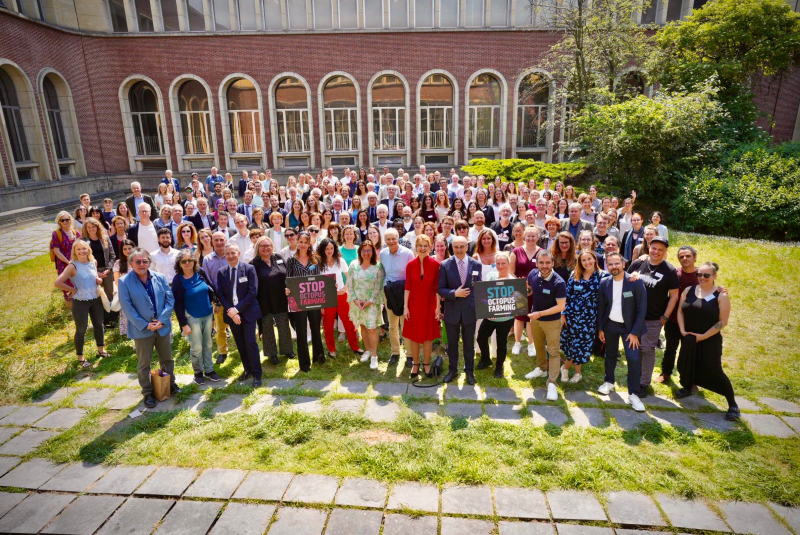
The importance of a comprehensive and ambitious revision of the animal welfare legislation took centre stage at Eurogroup for Animals’ annual conference in Brussels.

Yesterday, over two hundred guests from all over Europe came together in Brussels and more than one hundred participants followed the online streaming for Eurogroup for Animals’ annual conference, just months before the European Commission (EC) is set to unveil its revised legislation on animal welfare. 

This conference comes at a critical moment in time and animal protection organisations, along with MEPs, are calling on the European Commission to uphold its commitment to animal welfare, and to ensure a bold new legislation that allows for the true protection of animals. 

Held at the Royal Library of Belgium, the event hosted Eurogroup for Animals’ member organisations from 26 Member States, MEPS, representatives of the European Commission, and other stakeholders.

The organisation was honoured to welcome Peter Singer, Professor of bioethics and author of ‘Animal Liberation Now’, The book is a revised version of the classic ‘Animal Liberation’, which was one of the foundations of today’s animal protection movement. 

I am delighted to be able to present my new book, ‘Animal Liberation Now’, at the annual conference of Eurogroup for Animals. This book renews and brings fully up to date the ideas I presented in 1975 in Animal Liberation. Since that time, there has been a significant improvement in the conditions in which hundreds of millions of animals live in Europe, especially those in factory farms, and Eurogroup for Animals has been leading the way in its advocacy of these changes. Nevertheless, these reforms still fall far short of what is required for us to treat animals ethically, and without speciesism. What happens in Europe is important not only for animals in Europe, but worldwide, as it sets an example of what’s possible. The EU institutions have the opportunity to be a leader

Peter Singer

Peter Singer at Eurogroup for Animals’ Conference

During the event, Tilly Metz MEP (Greens, LU) insisted that the revision should not be further delayed because of the Regulatory Scrutiny Board that failed to analyse the long-term impact of such policies:“The science is clear, there is enough data, it is incomprehensible that this is delayed any further,” she said.

Niels Fugslang MEP (S&D, DK) expressed the strong desire among MEPs to have an Animal Welfare Commissioner, a significant role that will ensure more accountability and which has been widely supported by citizens. 

The importance of securing a budget to protect farmers and support them in transitioning to cage-free systems was put forward by Andrea Gavinelli, Head of the Animal welfare and Antimicrobial Resistance Unit (EC), a remark supported by Joanna Stawowy, Member of the Cabinet of the European Commissioner for Agriculture.

“2023 is a critical year for the animals – after ten years, change is in sight, as the EC is set to revise its animal welfare legislation which is seriously outdated when it comes to science and civil societies’ demands. Over 20 EFSA opinions have not been incorporated in actual legislative provisions. This has resulted in a dire situation for the animals across the board. With 5- soon to be 6- European Citizens Initiatives calling for better animal welfare, the institutions can’t ignore this any longer. We trust the European Commission will uphold its commitments”, commented Reineke Hameleers, CEO, Eurogroup for Animals. 

“Factory farming is the biggest cause of food waste in the world, it undermines the very thing we all need – healthy soil. Not addressing the meat and dairy industry will mean that climate, biodiversity and food security talks will fail. Regenerative farming is the only way forward, we simply cannot afford not to change,” added Philip Lymbery, President of Eurogroup for Animals.

Keynote speaker Melanie Challenger, writer, researcher and broadcaster on environmental history, philosophy of science and bioethics added: “This is both an exciting and a testing time for our relations with other animals. Our exploitation of non-human animals has increased at the same time as our moral sensitivity, and those two shifts are out of sync. Exceptional times require exceptional responses. I believe we need to recognise the dignity of other species and find ways to allow them to be heard in the political arena.”  

During the event, Eurogroup for Animals presented its awards, which aim to acknowledge the efforts of member organisations and corporates in their fight for animal welfare. Djurens Rätt was awarded the Campaign for Animal Award for their campaign “The World’s Best Animal Welfare”, which featured an animated short movie that reflects the life of broiler chickens, and was streamed across cinemas in Sweden. 

The Corporate Campaign Award was presented to IKEA Belgium for offering innovative solutions to the substitution of animal products and the use of animals in their products. GAIA, which submitted the candidature, welcomed the award: “We nominated IKEA Belgium for its commitment and approach. This is highly visible to both staff and customers in their restaurants where plant-based alternatives are given priority and are also offered at lower costs. This is the way forward for other businesses”, commented Ann De Greef, CEO at GAIA. 

Participants at conference

Regards Mark

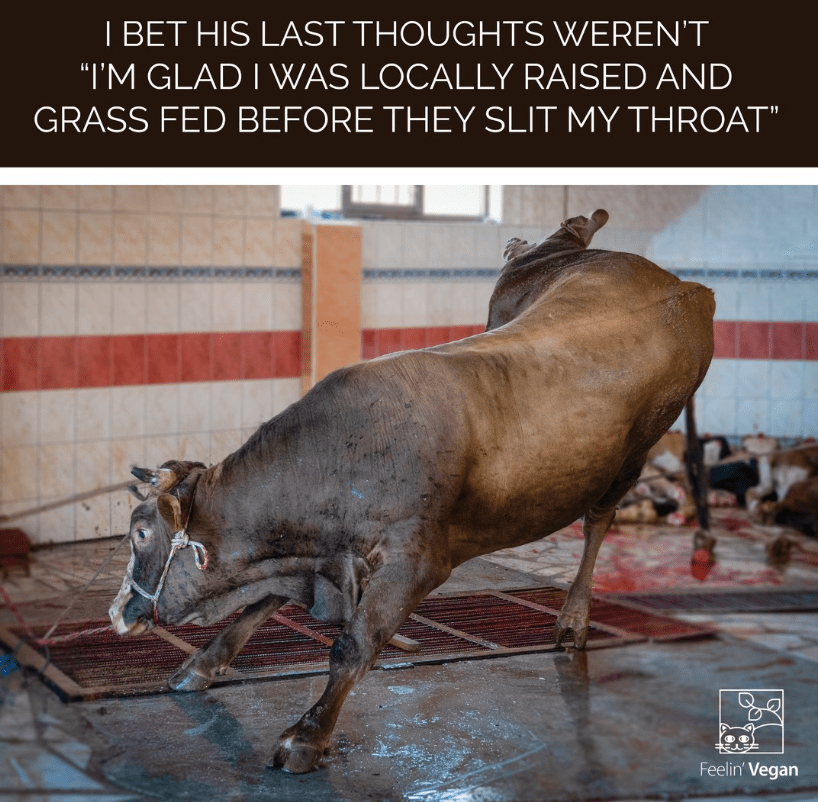
You support killing animals so you can boast they ate grass before they were killed?

You support killing animals so you can boast they ate grass before they were killed? | Our Compass (our-compass.org)

The fact of the matter is, it doesn’t matter how nice a life an animal has, the moment we exploit them for what is rightfully theirs and eventually take them to the slaughterhouse or to the yard to kill them, that is abuse. Animals don’t want bigger cages or larger barns, they don’t care whether or not they’re grass-fed, or organic. All the animals want is to be free, truly free. Not free-range, not free to pasture months of the year. Free to live their lives in their entirety, without fear of human inflicted pain, suffering or exploitation. Earthling Ed

Do remember that small farms are largely defunct due to the global demand for cheap flesh; while there are still small farms in existence, they are the exception, and even though everyone in the multiverse claims to be opposed to factory farms, given their dominance “producing” 99% of animals consumed in the USA and >75% according to one source and >90% according to another, of animals consumed globally, each year, someone’s lying. Case in point: I recently came across a person who vehemently defended his position as being opposed to factory farms … while admitting he eats factory-farmed animals. This is why a welfarist position is meaningless: it requires animal suffering and death, and for many humans is 100% verbal and includes 0% actual concern and action FOR THE ANIMALS. (And the discrepancy in factory-farmed numbers is likely because the numbers of animals violently killed globally each year is so mind-numbingly high, it’s difficult for humans, the “intellectually superior species”, to count.) SL

Download Your FREE Vegan PDF HERE

Order a FREE vegan kit HERE

Dairy-Free Info HERE

Take the Dairy-Free Challenge HERE

Click HERE for more Dairy-Free

Fish alternatives can be found HERE

Learn about eggs HERE

Find bacon alternatives HERE and HERE

Take PETA’s Cruelty-Free Shopping Guide along with you next time you head to the store! The handy guide will help you find humane products at a glance. Order a FREE copy HERE

Searching for Cruelty-Free Cosmetics, Personal-Care Products, Vegan Products, or more?
Click HERE to search.

Free PDF of Vegan & Cruelty-Free Products/Companies HERE

Click HERE for clothing without suffering

Click below for nominal, or no, fees to vegan literature that you can use to convince others that veganism is the only humane:

PETA HERE

Vegan Outreach HERE

Get your FREE Anti-Speciesism Activist Kit from PETA HERE

Click HERE for Well-Fed World’s Free Climate Food Guide PDF

Thanks Stacey – Regards Mark

World Food Safety Day: what’s at stake for animals?

5 June 2023

Food safety is a matter of growing concern for the health of EU citizens: how we produce and consume food has an impact not only on animals but also on public health, environment, people and climate.

Kangaroos

60-75 % of human disease comes from wildlife disease transmitted to humans, in part by the wildlife trade and consumption. After they are shot in remote areas, the carcasses of kangaroos are eviscerated and transported in unrefrigerated open trucks, sometimes all night long, and under very high temperatures. In order to tentatively prevent Salmonella and E.coli contaminations, the carcasses are washed with lactic acid, although this isn’t an allowed practice for fresh game meat in the EU and does not fully eliminate contamination risks. Russia has banned imports of kangaroo meat based on these hygienic issues. Lead poisoning from the bullets is another health concern, also posing a serious environmental risk, as highlighted by recent ECHA reports on the restriction of lead ammunition in the EU. In this context, Eurogroup for Animals calls on an EU ban on imports of kangaroo products, including meat. You can sign our petition to support this call.

The EU must stop imports of kangaroo products

BROWSE TO THIS PUBLICATION

Horse meat

Despite the 2013 horse meat scandal, little has been done to prevent such food safety issues. In the EU, horses can be excluded from the food chain when they are administered substances making the consumption of their meat unsafe. However, recent Europol investigations revealed massive frauds with horses excluded from the food chain slaughtered and their meat distributed throughout the EU, highlighting the insufficiencies in the implementation of traceability requirements. We call on the EU to ensure the proper implementation of traceability requirements and to introduce Country of Origin Labelling for horse meat, indicating the country where the animal has been born, reared and slaughtered.

Besides horse meat produced in the EU, EU audits, NGO investigations, also summarised in the Stable to Fork report, and academic papers (see, for example, Weber et al., 2023),   reveal severe shortcomings in the traceability and identification of horses slaughtered in third countries whose meat is imported into the EU. Veterinary medical treatments are not properly recorded leading to horses that were administered banned drugs, such as phenylbutazone, to enter the food chain. It is important to note that equine traceability requirements implemented in the EU do not apply to animals whose products are imported.

From stable to fork: EU Horse Meat Imports (updated version)

BROWSE TO THIS PUBLICATION

Reducing meat and dairy consumption

Highly contagious diseases, either emerging or endemic, in animal populations such as Avian Influenza, African Swine Fever or, more recently, COVID-19 stress the need to build more resilient and sustainable societies. 

How we produce and consume food has an impact not only on animals but also on public health,environment, people and climate.

An increased focus on animal welfare can play a key role in finding solutions to many of the current global food safety challenges we are facing. De-intensifying animal production by reducing the numbers of animals coupled with better animal welfare will improve animal health and welfare and contribute to reducing the risk of future pandemics.

Regards Mark

EU: Fear mongering will not stop the transition to a better world for farmed animals.

5 June 2023

Impact study by lobby organisation on the phasing out of cages contradicts scientific findings.

The impact study on transitioning to cage-free farming presented by Copa-Cogeca, the largest industry body representing the biggest farming entities, is a far stretch from EFSA’s scientific conclusions. The assumptions by the lobby organisation uses fear mongering to paint a picture that is far from the truth.  

In this assessment, Copa-Cogeca starts from the premise that EU producers would need to adhere to standards mostly higher than those applied in third countries. This would turn the EU, currently a net exporter of animal products, into a net importer of such products. Moreover, it ends on the unsubstantiated assumption that the European Commission could be considering a “shock scenario” in their revised animal welfare legislation. This vision does not match the numerous commitments made by the European Commission to consider introducing import requirements in the new legislation. 

Copa-Cogeca put forward calculations of welfare consequences which are strikingly different from those presented by EFSA in their scientific opinion on pig welfare, claiming a rise in piglet mortality and sow injuries, increased aggressive behaviour in sows and increase of culling. 

Numerous scientific sources included in the EFSA opinion point to the opposite conclusions: that cage-free systems and free farrowing do not increase piglet mortality and generally improve the welfare of the animals. 

Sows are calmer when they are free to move around and the satisfaction of staff is improved when they interact with animals with lower levels of stress. With the correct management, free-farrowing systems can be beneficial to both animals and staff, contrary to claims by the industry.  The lobbying industry continued to ignore scientific basis, claiming that rabbits are impossible to farm commercially without cages, ignoring the fact that numerous farmers have been doing this for years. The basis of the revised animal welfare legislation, which is also looking into the ban of cages for rabbits, is based on scientific evidence and industry experience.  

The economic analysis also contradicts the findings of existing studies on the matter. While Copa-Cogeca claims that cage-free systems are less profitable, existing studies establish that the most profitable system to the farmer is indeed free-range. The Best Hens Practice project has also demonstrated to farmers that there will be no difference in income when they transition from cages. Furthermore, the number of eggs produced in all EU Member States is growing despite the increase of cage-free systems being adopted. 

Conveniently, the massive animal welfare consequences resulting from the current farming practices in caged systems were completely left out of the presentation. Scientists around the globe concur that cages are detrimental to animal welfare, and EFSA scientific opinions are very clear about the need to phase out cages for all farmed species. Consumer preferences were also absent from the presentation, despite the fact that millions of European citizens support the transition to cage-free farming and have high expectations when it comes to protection of animal welfare in the EU.

Despite the numerous claims of the report that contradict reputable welfare and economic studies, we agree with one of the conclusions: financial support from the EU is crucial for farmers to transition sustainably and keep farmers in the profession. We are pleased to see that this call is being echoed among all stakeholders in this debate, together with the ask to apply the same animal welfare standards to domestically produced products and imported goods.  

The transition to cage-free will ensure a level-playing field across Europe, safeguarding the livelihoods of farmers. With that in mind, the shift should be swift to avoid creating more disparity among Member States and incurring any negative impacts, such as those that the industry encountered when the ban on barren cages came into force in 2012. As indicated in the report on the fitness check of the current animal welfare legislation, the long transition period to enriched cages led some producers to wait until the last possible moment before changing their infrastructure, which unnecessarily increased egg prices and created a situation of unfair competition among Member States. Such a situation can be avoided by setting short but realistic transition periods. 

In the European survey of farmers’ experiences, early adopters of this transition encouraged others to do the same, and to look at how different animal farming can be, when based on best practices and backed up by science. As one of the farmers interviewed for our report said: “To sum up, it is worth it. I think we all agree on that”.

Regards Mark

England: Trust A Government ? – No, I Will Take the Kick In the Teeth Thanks.

A few years ago I took part in a government consultation which aimed to move on and stop live animal exports – a campaign which I had personally been involved with for around 30 years.

In my response to the consultation I submitted around 40 pages of answers and evidence as to why there should be a ban on live animal transport.  Exports were just one part of the Animal Welfare (Kept Animals) Bill, which you can read more about below.

By scrapping the Bill now, the Conservatives are showing their true colours.  There was lots of talk on the issue by Boris when he became leader; but now the excuse is being used that Labour was ‘seeking to widen its scope’.  So what is wrong with that ? – improving animal welfare issues even more ?

I think the reality is that the Conservatives are not that concerned about this legislation; it has been running around the corridors of Whitehall for a long time now, the result being that it has not become lawful legislation.  In theory, for live exports, this does open up the chance that someone may decide to try and operate a service out of England once again.  By scrapping the Bill, we are now back in a position where transporters from Ireland use the UK as a ’land bridge’ to transport Irish livestock into Europe; something which the Bill would have stopped.

I could go on and on about this, giving you a lot more, especially as the Bill also aimed to prohibit puppy farming and puppy smuggling.  We have a General Election here in the UK in the next 18 months (or earlier);  and so this scrapping of potential legislation will NOT go down well with voters when the time comes.

And the lesson, which I think many of us voters are fully aware of, is never trust what a government says.  Lets see what the next election brings; but this is something we can remind Tory MP’s of when they come knocking on our doors asking for me and you to vote for them.

Mark

———————————————————-

Legislation designed to protect pets, livestock and wild animals has been scrapped, the government has confirmed.

Environment minister Moark Spencer said the Animal Welfare (Kept Animals) Bill, which had almost completed its passage through the Commons, will no longer go ahead over concerns that Labour was seeking to widen its scope.

The Bill sought to tackle puppy smuggling by reducing the number of pets (dogs, cats and ferrets) that can travel under pet travel rules and see a ban on the export of live animals for slaughter and fattening.

Ministers scrap animal welfare bill designed to protect pets, livestock and wild animals | ITV News

Other policies within the Bill would have banned the keeping of primates as pets, protect livestock from dangerous and out of control dogs and ensure zoos are doing more to contribute to conservation.

Mr Spencer insisted the government remained “fully committed to delivering” on those promises but would do so by taking the measures forward individually rather than collectively.

But Labour said the move is “further proof that you can’t trust the Tories to deliver on animal welfare”.

Shadow Environment Secretary Jim McMahon added: “The government’s decision to scrap the Kept Animals Bill demonstrates that it has lost the ability to get its own legislation through Parliament.”

Battersea Dogs and Cats Home tweeted to say it was “deeply disappointed” about the Bill being withdrawn.

“This is a major setback for both animal welfare and our community of animal lovers,” it said.

Explaining why the Bill was being scrapped, Mr Spencer said: “Unfortunately this multi-issue nature means that there has been considerable scope creep.“The Bill risked being extended far beyond the original commitments in the manifesto and the action plan. “And in particular, Labour is clearly determined to play political games by widening the scope of this Bill.”

He said “enormous progress” on animal welfare has already been made with “single-issue” legislation, adding: “Therefore we will be taking forward measures in the Kept Animals Bill individually during the remainder of this Parliament.

“We remain fully committed to delivering our manifesto commitments. And this approach is now the surest and quickest way of doing so, rather than letting it be mired in political game-playing.”

Labour’s shadow Commons leader Thangam Debbonaire said the move was “shocking”.

Speaking in the Commons before the legislation was scrapped, she asked: “Is this prime minister so weak he can’t even bring himself to stand up against evil puppy smugglers? What a way to run a government.”

The Bill had already suffered long delays since it was first introduced in June 2021.

Senior director of campaigns and public affairs at Humane Society International/UK, Claire Bass, said: “The government’s decision to abandon the Kept Animals Bill is an astonishing betrayal of both animals and public trust.”

Regards Mark