
https://viva.org.uk/?paged1=2#bodyPage
https://viva.org.uk/about-us/who-we-are/
https://viva.org.uk/about-us/staff/juliet-gellatley-founder-and-director/
https://viva.org.uk/lifestyle/
Especially worth visiting – The Vegan Recipe Club:
https://viva.org.uk/?paged1=2#bodyPage
https://viva.org.uk/about-us/who-we-are/
https://viva.org.uk/about-us/staff/juliet-gellatley-founder-and-director/
https://viva.org.uk/lifestyle/
Especially worth visiting – The Vegan Recipe Club:

STAKEHOLDERS HAVE UNTIL 1ST AUGUST TO SUBMIT FEEDBACK.
The Commission would like to hear your views:
https://www.eurogroupforanimals.org/news/fur-free-europe-call-evidence-opened
https://www.four-paws.org/campaigns-topics/topics/animals-abused-for-fashion/animals-used-for-fur
https://www.four-paws.org.uk/our-stories/blog-news/the-frightening-reality-of-the-fur-industry
https://respectforanimals.org/category/news/
https://respectforanimals.org/
The UK MUST NOT compromise higher animal welfare standards by allowing LOWER US standards such as chlorine washed chicken to be part of any trade deal –


Essere Animali Undercover Investigator Marco shares the second part of his experiences working at a pig farm. Please click on the following link to read part of his diary and see video footage-
Warning – Disturbing images from the start. Click this link to read and view:
https://emails.essereanimali.org/f7v3e8r6z2/2783540126012146919/s6a6/
The Problem – you are not going to like what you see here about the suffering of animals, but in order to make positive changes for their future, you have to know the current situation and their suffering / how they are abused first – https://www.essereanimali.org/en/the-problem/
Essere Animali – About Us https://www.essereanimali.org/en/about-us/
Timeline https://www.essereanimali.org/en/timeline/
Contact Us https://www.essereanimali.org/en/contacts/
Support the excellent work of Essere Animali with funding https://www.essereanimali.org/en/support-us/
As our common international friends – working together to make positive changes for suffering animals of this world, we hope you have obtained a lot more information from the work of Essere Animali.
Regards Mark – WAV.
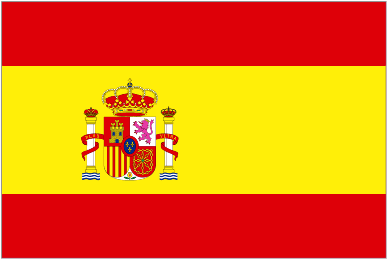
A lot of people simply wish to ignore the suffering of fish – but as seen here; and like the majority of most intensively reared farmed animals today, they, fish, are often raised and slaughtered in the most barbaric ways. It is hoped that by viewing the video below, views will change. The silent screams.
A new investigation is undertaken by Anima Naturalis, who undertake their work in Spain and Latin America, https://www.animanaturalis.org/en have revealed the immense suffering of Rainbow Trout at Spanish aquaculture facilities.
Spain is the largest producer of farmed fish in the EU; accounting for over 23% from figures obtained in 2023. An estimated 254 Million fish are raised and slaughtered EVER YEAR in the country.
Spain’s most farmed species is the Rainbow Trout, which accounts for around 30 Million animals per year.
With the support of photojournalist Aitor Garmendia and video photographer Linas Korta; the investigation https://www.fishfactory.org/es captures:
Extreme overcrowding, with fish forced to swim in waste filled water; struggling for space and oxygen;
These acts of cruelty clearly goes against the EU Directive which protects farm animals; including fish – https://eur-lex.europa.eu/eli/dir/1998/58/oj/eng and which obliges Member States to ensure that farmed animals ARE NOT caused ant unnecessary pain, injury or suffering.
The situation here clearly shows that both stronger EU and national legislation is required.
AN’s campaign incudes a citizens petition https://www.fishfactory.org/es urging the EU to grant fish the legal protection they urgently need. Pleas sign it, and then pass the link to others – thank you.
The AN investigation coincides with the EU Commissions drafting of the first Code of Good Practice on Fish Welfare which serves as a practical document for aquaculture producers and the best practices for fish welfare. This is applicable across different life stages and production methods. This Code aims to fulfill the EU Strategic Aquaculture Guidelines strategy for 2030; https://eur-lex.europa.eu/eli/dir/1998/58/oj/eng ensuring that aquaculture progresses in a sustainable and ethical way within the EU.

Thanks to Diana for forwarding.
THESE ABUSERS HAVE GOT A REAL PERSONAL PROBLEM WHICH THEY TAKE OUT ON INNOCENT SENTIENT BEINGS !!!!
,,,, and then, after a busy day abusing on the farm, they all go home to their children.

Dozens of animals, including pet cats, dogs, alpacas, horses and donkeys were chased and attacked during the most recent hunting season, anti hunt campaigners say.
In addition, they also harassed sheep, pheasants and reindeer according to a new analysis of reports by anti hunt organisation ‘Protect The Wild’.
In all, 89 animals were said to have been caused distress by hunt hounds over a 10 month period.
Read the full story with pictures by clicking here: https://www.msn.com/en-gb/news/uknews/hunt-hounds-chased-and-attacked-pet-cats-dogs-horses-donkeys-and-alpacas-report-says/ar-AA1Hf3xW?ocid=msedgdhp&pc=DCTS&cvid=520a186feded43e8bb3b17433dc4aea2&ei=12

Hunts chased or killed at least 239 deer reposts suggest – Wildlife Crime Action.

June 9th 2025.
Members of Parliament (MPs) will hold a major debate on the practice of ritual slaughter – Kosher and Halal – on animals; as over 109,000 Brits signed a petition demanding better animal welfare at slaughter, along with a much clearer food labelling system informing the public on which slaughter method was used to produce their meat.
The debate is a direct result of a Government Petition for the public; which reads ‘In a modern society, we believe more consideration needs to be given to animal welfare, and how livestock is treated and culled. We believe that non-stun slaughter is barbaric and doesn’t fit with in with our culture and modern day values; and should be banned, as some EU nations have done’. Here is the link to the petition, WHICH IS NOW CLOSED – https://petition.parliament.uk/petitions/700557

Halal slaughter does not stun the animal before it is killed – Photo Getty images.
In a landmark case, the European Court of Human Rights has ruled that a BAN on the ritual slaughter of animals without prior stunning DOES NOT VIOLATE the ECHR. In other words, a ban could be imposed.
The court case considered that the protection of public morals, to which Article 9 of the Convention referred, was not indifferent to the living environment of individuals covered by its protection, and including animals.
A Government response issued on 10th January defended the current practice, arguing that ‘it would prefer to see all animals stunned before slaughter, but respecting the rights of Jews and Muslims to eat meat prepared in accordance with their own religious beliefs’.
Mr Rupert Lowe MP very recently tabled an Early Day Motion in Parliament also calling for a ban on non-stun slaughter. he argued that there was a substantial body of veterinary evidence arguing that pre-stunning greatly reduces the amount of animal suffering at the time of slaughter.
He called on the Government to urgently review the legislative framework around non-stun slaughter; consider restricting or banning the practice, and introduce mandatory clear labelling of meat products by the method of slaughter used so that the public can make an informed choice.
A 2019 poll suggested that 83% of British adults believed the law should be changed to ensure that animals killed for food production ARE stunned before they are killed.
Additionally, 86% want all meat sold in the UK to be clearly labelled stating how the animal died.
Around 114 million animals are slaughtered each year in the UK using the Halal method; and around 2.1 million using the Kosher method. Although the polls taken in 2019 give impressive figures for the implementation of change, we suggest that despite this, the Government WILL NOT make legislative changes especially regarding religious minorities and their preferred methods of killing.
As to clear public meat labelling stating its slaughter method; why not ? – food labelling in many sectors has failed the consumer in being able to make an informed choice for decades. It is now time for change.
ASSOCIATED LINKS
This year alone, 140,000 unweaned calves have been transported on the route between Ireland and France.
This is a journey that under normal circumstances takes around 18 hours; which breaches EU regulations as the calves ARE NOT fed a milk replacer as required. If weathers conditions are bad, then the journey can be even longer.
These very vulnerable calves, deprived of the milk from the mothers they will never see again, experience hunger, overcrowding, exhaustion and stress on these lengthy journeys. Following these sea journeys, their suffering continues as they are shipped on lengthy road journeys to the Netherlands, Spain, Italy and Poland.

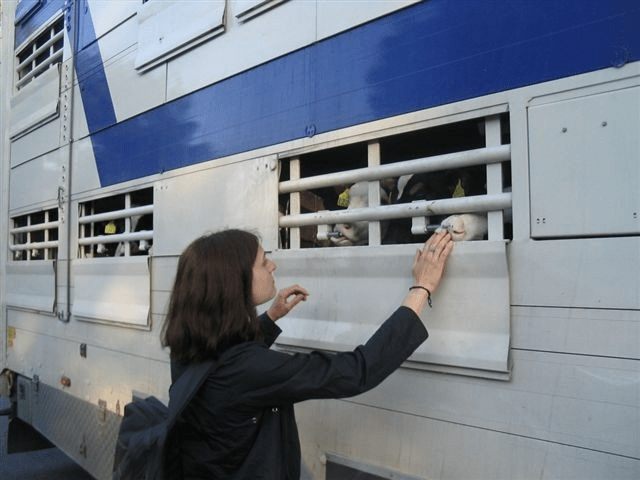
Photos – PMAF / Welfarm
There is an EU Regulation that requires the unweaned calves that travel from Ireland to France; and deprived of their natural mothers milk; should be fed with a milk substitute. THIS IS NOT HAPPENING, meaning that EU rules are being BREACHED by these ferry companies.
The EU Commission also has the view that the shipment of the unweaned calves from Ireland to France BREACHES REGULATIONS.
Ask the ferry companies involved with this trade TO STOP NOW – they are Brittainy Ferries, Irish Ferries and Stena Line; all involved in these shipments of suffering. For the calves; please take action NOW – https://action.ciwf.org.uk/page/172354/action/2
We all worked together for the UK live animals export ban in 2024; and we will win this also with your help and support – Thank You.

 World Animals Voice