Pamela Anderson Urges Danish Prime Minister To ‘Protect’ Public Health And Ban Fur
‘I hope you’ll respond by banning fur farms in Denmark, which would protect public health and spare countless animals miserable lives and violent deaths’
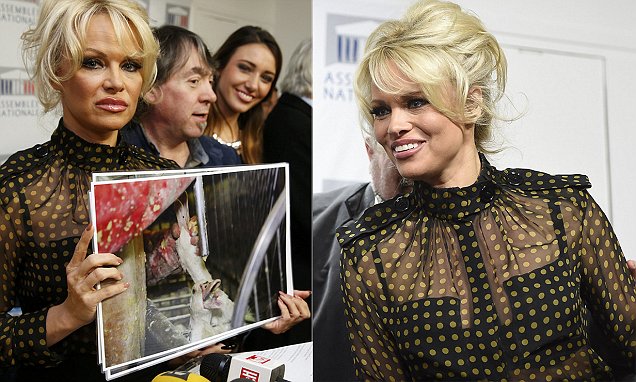
Celebrity actor and vegan advocate Pamela Anderson is urging the Danish Prime Minister to ban fur.
The Baywatch star’s demand follows multiple COVID-19 outbreaks on mink fur farms across Europe and the States. Moreover, the COVID-19 mink variant found on a Danish fur far could spark a new coronavirus pandemic, experts warn.
Anderson’s letter
Anderson has therefore written Mette Frederiksen a letter, saying ‘now is the time for action’.
She wrote: “Like many people around the globe, I was alarmed to hear that a new, mutated strain of the novel coronavirus—one that could have ‘devastating consequences worldwide’ as you rightly pointed out—has been found in minks on Danish fur farms and that this strain has infected several humans.
“I hope you’ll respond by banning fur farms in Denmark, which would protect public health and spare countless animals miserable lives and violent deaths.”
‘Out of favor’
Anderson continues, describing fur as ‘out of favor’ even before the current pandemic. She says most designers and retailers such as Prada, Gucci and Ralph Lauren have already banned mink fur.
“Now is the time for action,” the star added. “Please, for everyone’s sake, ban [these] cruel, dangerous fur farms.”
Boris Johnson to unveil Brexit ban on ‘barbaric’ live animal exports on Thursday 3/12/20.
MINISTERS will begin the abolition of cruel live animal shipments tomorrow — a ban only made possible by Brexit.
Under strict European Union Single Market rules that guarantee free movement of goods, no member state can ban livestock being transported across borders alive.
But with Britain finally cutting ties with Brussels in 29 days time, the controversial process will be outlawed to the delight of campaigners.
Boris Johnson has repeatedly vowed to use the “the opportunity of Brexit” to “champion animal welfare” and will unveil plans for new legislation on Thursday.
In 2018 Mr Johnson hit out: “I cannot believe that this barbaric trade is still going on — but it is. Every year this country sends thousands of live calves overseas for slaughter, and some of them are enduring nightmare journeys as far as North Africa.
“They are jammed together in the dark. They are terrified. They slip and slide in their own excrement as the boats buck in the swell.”
Then a backbencher, he wrote in The Sun: “They travel for more than 100 hours in conditions of such extreme discomfort that campaigners have been protesting for decades.
“The animals know they are going to die — and they are going to die far from home.”
HERE COMES THE BAN
The Sun can reveal the Department for Environment, Food & Rural Affairs are to reveal the ban plan to the farming industry, launching a formal consultation on Thursday.
Last night a No 10 source said: “The Prime Minster has always been a passionate supporter of animal welfare, and as part of his plans to build back better and fairer, he is determined to make sure that the UK continues its proud tradition of protecting animals.
The insider added: “Free from EU red tape, we can now do away with the cruel practice of exporting live animals for slaughter and fattening – setting an example to other countries with our world-leading standards.”
Yesterday talks between the EU and the UK over a post-Brexit trade deal continued.
Video shows mink pulled from cages and thrown ‘like rubbish’ into gas chambers on Dutch fur farms
Old news from 23 November 2020
Mink were pulled from cages by their tails or hind legs and hurled into mobile gas chambers on fur farms in the Netherlands, video footage has revealed. The rough handling of the animals breaks EU animal-welfare regulations.
Animal rights campaigners said the video shows a behind-the-scenes view of the cruelty of the Dutch industry, which is closing next year. It also highlights the need for the UK to stop sales of real fur, they added.
The footage, secretly shot on two farms last week by Dutch group Animal Rights, shows the animals being pulled roughly from cages and thrown one after the other towards mobile gas chambers, sometimes from a great distance.
In one clip, the mink are heard screeching with alarm or pain.
And workers are seen with their anti-coronavirus masks below their noses.
Claire Bass, executive director of Humane Society International/UK said: “Live mink are seen being yanked from their cage by the tail or hind leg, in clear breach of EU regulations, and tossed like trash into the mobile gas chamber one after the other in quick succession.
The speed with which these sentient animals are thrown in together means they will almost certainly be dying in front of each other, again in breach of the rules.”
After PETA published an undercover disclosure about the alpaca industry at the end of May, Tchibo, Columbia Sportswear, and the Ascena Retail Group have now announced, after talks with PETA and their international partner organizations, that they will discontinue the animal quality product.
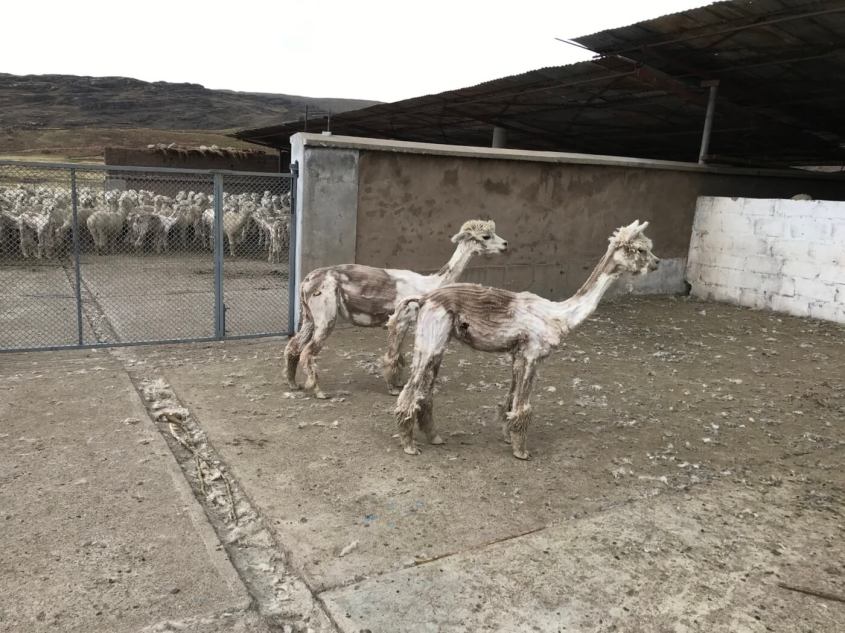
PETA USA’s research on Mallkini, the world’s largest privately-owned Peruvian alpaca farm, revealed workers holding desperate screaming alpacas by the ears while roughly shaving the animals.
The material shows some alpacas spitting in fear.
Workers smashed the animals, some of them pregnant, onto tables and fixed them in devices that looked like the Middle Ages – pulling them so hard that their legs almost dislocated.
“We are very pleased that Tchibo has decided this year not to use alpaca wool in the future. Many alpacas are spared the agony of wool production and slaughter, ” says Frank Schmidt, Head of Corporate Affairs at PETA Germany. “We appeal to all fashion and textile companies to follow this groundbreaking example and, for the sake of animals and the environment, to discontinue alpaca wool and to switch to vegan, sustainable fibers.”
The Ascena Retail Group will no longer use alpaca wool from the winter season of 2021. Columbia Sportswear also announced in October after talks with PETA USA that it would no longer buy alpaca wool.
The fashion giants Uniqlo, Esprit, Tom Tailor, Valentino, and Marks & Spencer had previously decided to phase out the use of the material.
Gap Inc and the H&M Group with its eight brands have also already broken off all business relationships with Mallkini’s parent company – the Michell Group.
PETA points out that the production of alpaca wool causes extreme animal suffering and is also harmful to the environment.
In the “Higg Materials Sustainability Index”, alpaca wool is the second most harmful material for the environment, just behind the silk.
Alpaca wool is six times as harmful as polyester and more than four times as harmful as modal, viscose, rayon, lyocell, and other vegan materials.
PETA’s motto is in part: Animals are not there to be attracted to them or to be exploited in any other way. The organization works against speciesism – a worldview that classifies humans as superior to all other living beings.
Perhaps we will soon no longer have to post this video, the list of companies that refrain from this product- and consequently from this cruelty to animals- is getting longer with every year.
We are very happy about it!
If the consumer can no longer find alpaca, fur, or leather in shops, then he’ll just buy something without animal suffering.
It’s that simple!
As a Vegan Englishman; I am glad we got away from all this EU junk at the beginning of this year. I find it a little odd that vegetarians are not allowed to use words like ‘milk’, but as part of this meat eating drive by the EU, people who eat Beef can be called ‘Beefatarians’. Are we soon going to see new EU legislation that says you cannot call someone who undertakes a plant based diet a ‘Vegetarian’ – as this infringes on the name ‘Beefatarian’ which now seems to be the ‘thing’ for beef eaters ! No doubt the EU will attack the plant eaters in every way they can; whilst supporting ‘he men’ who look the part by having a steak for lunch. And an additional beef eating thought – the World Health Organisation (WHO) says the strongest evidence for an association with eating red meat is for colorectal cancer. However, there is also evidence of links with pancreatic and prostate cancer.
Nuff said
Regards Mark
The EU has financed m
EU Backs Campaign Encouraging Public To Become ‘Beefatarians’
The EU has financed more than €3.5 million to help the Proud of European Beef initiative to run for three years
Acampaign encouraging the public to become a ‘beefatarian’ has been backed by the EU.
The Proud of European Beef initiative is spearheaded by corporations Provacuno and APAQ-W. It is a three-year-long campaign that aims to makes consumers ‘confident’ about their decision to eat red meat.
The campaign is set to cost €4.5 million (approximately $5.39 million) – with ads running across countries such as France, Belgium and Spain. It will receive 80 percent (€3.6 million) of its funding from the European Commission.
‘A refusal to eat meat’
“The scope of the project is not only to highlighting the benefits of the product but to make the consumer feel identified and supported in its choice regarding it,” the campaign’s site states.
“Consumer behavior may lead to a refusal to eat meat due to the multiple types of information presented nowadays.
“But even so, those consumers who choose to eat red meat should feel at ease should they wish to reaffirm their choice for this product.”
And from the NON animal eating side; there is this video:
Should the EU promote red meat?
Despite the campaign, The World Health Organization classifies red meat as a Group 2A carcinogen.
This means products such as pork, beef, and lamb ‘probably cause cancer’.
Moreover, the WHO says the strongest evidence for an association with eating red meat is for colorectal cancer. However, there is also evidence of links with pancreatic and prostate cancer.
WAV Comment – This should not be allowed to happen in ‘animal friendly England’. Please support – we need to find the big shits that did this; and then punish hard.
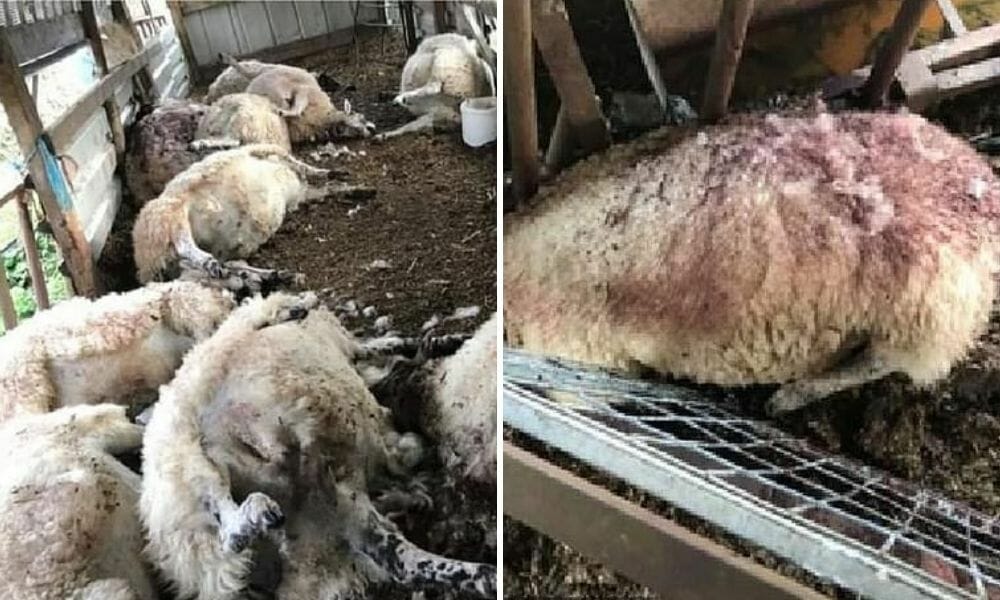
In the “worst case of animal cruelty” one top cop has ever seen, a flock of defenseless sheep had their throats slashed in South Derbyshire, England. Five of the innocent animals survived the attack despite their stab wounds, but 12 bled to death, according to Derbyshire Live.
Stephen and Carol Clamp’s 10-year-old, disabled grandson found the sheeps’ lifeless bodies butchered in the shed. Not realizing what had happened, he thought they were just sleeping.
Three men were arrested on suspicion of criminal damage but then released while the investigation continues.
The family is devastated and heartbroken, and whoever is responsible for this horrifying attack must answer for their crimes.
Sign this petition urging the Derbyshire Police to use all available resources to fully investigate this case, finding and charging the person(s) responsible for this senseless slaughter.
This is an ongoing investigation. Anyone with information about the attack is asked to contact the Derbyshire police quoting the reference 20*583541 by calling 101, calling Crimestoppers anonymously at 0800 555111, or reaching out via Facebook or Twitter. The name of the officer on this case is PC Leanne Bull.
We’re told that milk is important for a strong healthy body, and if you stop consuming dairy most people will turn around and say, “wait, how are you going to get your calcium?” But everything we’ve been led to believe about dairy is a product of marketing, advertising, and government collusion.
This is how the dairy industry lied to the world. Download my free 122 page e-book: http://earthlinged.org/ebook Make the switch to vegan & get all of the support you need: http://switchtovegan.co.uk (Please note that “non-dairy” is different from “dairy free” labels and can indicate a small amount of milk byproducts in foods.)
Free Vegan shopping listHERE Free Dairy-Free PDF: Download Your FREE Vegan PDFHERE Order a FREE vegan kit HEREDownload Your FREE Dairy-Free PDF HERE Take the Dairy-Free Challenge HEREClick HERE for more Dairy-FreeFish alternatives can be foundHERE Learn about eggsHERE Find bacon alternativesHERE Take PETA’s Cruelty-Free Shopping Guide along with you next time you head to the store! The handy guide will help you find humane products at a glance. Order a FREE copyHERE Searching for Cruelty-Free Cosmetics, Personal-Care Products, Vegan Products, or more? Click HERE to search. Free PDF of Vegan & Cruelty-Free Products/Companies HERE Click HERE to find outHow to Wear Vegan! Want to do more than go vegan? Help others to do so! Click below for nominal, or no, fees to vegan literature that you can use to convince others that veganism is the only compassionate route to being an animal friend: PETA HERE Vegan Outreach HERE Get your FREE Activist Kit from PETA, including stickers, leaflets, and guideHERE Have questions? ClickHERE
WAV Comment – the situation is not un expected; “Romania has been accused of “complete silence” over its investigation into the sinking of the Queen Hind last November, which resulted in the deaths of more than 14,000 sheep”.
Carmen Arsene, president of the National Federation for Animal Protection in Romania, Ruud Tombrock, Europe director of World Animal Protection and Dr. Marlene Wartenberg, animal welfare strategic consultant (Four Paws) discuss the situation in Romania, where corruption and criminal activities in connection with brutality is becoming a health threat to Romanians. Interviewed by EU Reporter’s Strasbourg correspondent, Peter von Kohl (DK).
Regards Mark
———————————
Romania accused of ‘silence’ over ship that capsized killing 14,000 sheep
An investigation into the Queen Hind sinking a year ago is yet to be published and the live export trade continues to boom
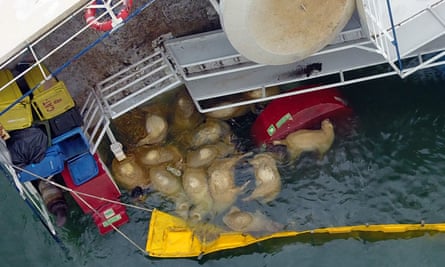
Romania has been accused of “complete silence” over its investigation into the sinking of the Queen Hind last November, which resulted in the deaths of more than 14,000 sheep.
Rescuers who rushed to the sinking Queen Hind vessel, which left Romania’s Black Sea port of Midia a year ago, managed to save just 228 sheep out of a total 14,600, but only 180 ultimately survived the ordeal.
Romania’s prime minister Ludovic Orban vowed on television last year to end live exports in the “medium-term”. However, since the Queen Hind disaster more than 2 million live animals have been exported from Romania – mostly to north Africa and the Middle East.
Romanian authorities have claimed the vessel was 10% below capacity and that the animals were “clinically healthy and fit for transport”. But campaigners say the vessel was overloaded and this ultimately led to the thousands of sheep drowning in the Black Sea.
The only information to emerge since the sinking has been the discovery of secret compartments onboard with dead animals inside, by the company hired to remove the ship from the water.
Romania’s transport ministry told the Guardian this week that investigations are concluded and said a summary of the report will be published on the ministry’s website. They also said that the purpose of the technical investigation was to establish maritime safety issues and to prevent future accidents, and “not to establish guilt in people involved”.
EU law stipulates that investigations into maritime accidents should be reported in full within 12 months, but that if a final report is not possible in that timeframe, then “an interim report shall be published within 12 months of the date” of the event.
“They promised a cross-check investigation to find out what happened, and since then – complete silence,” said Gabriel Paun, EU director at Animals International.
The Guardian contacted MGM Marine Shipping, the management company behind the Queen Hind, and they denied any knowledge of secret decks. They said company procedures hadn’t changed since the disaster.
“Nothing has changed, I don’t want to talk any more about this vessel – I want to forget about it,” a company representative said in a telephone call before hanging up.
A European commission audit on Romania between September and October last year, which aimed to evaluate animal welfare during transport by livestock vessels to non-EU countries, raised multiple concerns, including “a general lack of records in the system of controls to ensure animal welfare during transport by sea to non-EU countries”.
“There is no evidence of checks confirming that the animals are fit to continue the journey. The absence of documented procedures, records and support to official veterinarians in checking vessels provide little assurances on the effectiveness of most controls carried out,” the report said.
“The Queen Hind was an iconic example of the intrinsic failures of the system,” said Reineke Hameleers, CEO of Brussels-based Eurogroup for Animals, an EU umbrella group for animal advocacy organisations. “The EU likes to pride itself as a global animal welfare leader, but it still makes its hands dirty with this cruel industry.”
A Guardian investigation found that livestock vessels are twice as likely to suffer a “total loss” from sinking or grounding as standard cargo vessels. Livestock ships are often old and originally built for other purposes before being converted to carry animals. The Queen Hind was 39 years old at the time of the disaster.
Mary Pana, president of the association of cattle, sheep and pig breeders and exporters in Romania, said: “EU competition with Australia and New Zealand is acute.”
“Naval accidents have happened to us and to them. But these are accidents … I trust the EC [European commission] will find an efficient way to change the current legislation so that the animals have superior welfare conditions for breeding, transport, and slaughter,” Pana said.
Campaigners have complained that since the disaster little has changed to improve animal welfare standards for live exports.
“These are not five-star cruises,” said Paun. “I’ve spent time on cargo ships and conditions cannot be improved – there are always an enormous amount of problems that occur, and there is not one single [long-haul] shipment where there are no animals dying.”
Vasile Deac, a veterinarian and owner of a live export company, said a ban on live exports would harm the livelihoods of Romanian farmers.
“The live animal export trade is very important for Romanian farmers,” Deac said. “If there was no live export market farmers wouldn’t have anywhere to sell their animals and it would be a big loss for them.”
“As an exporter it’s very important for me to see the ships that the animals are exported on,” he said. “The Queen Hind was an accident, it wasn’t done intentionally.”