Category: Farm Animals

That is peasant love!

“We love our animals”
… Farmers always tell us this when another animal scandal is uncovered.


Then listen to this tiny baby goat cry out in pain as the farmer pushes a red-hot metal stick into her head.

It has nothing to do with love. In technical jargon, this is called “dehorning”.

It is done to prevent the horns from growing. Of course without anesthetics, of course without painkillers, in order to have no costs for an animal.

That is peasant love!
Their brothers and sisters crouch in the corner and witness the traumatizing process before their turn.
This procedure is standard around the world.

Rock the Natur, Germany


And I mean…The reason that the farm animal lives at all is for any kind of satisfaction of human animals: if an animal is needed to eat, it is allowed to live. But if it is no longer needed, then it must not live. The slaughter comes then.

And no! humans have no right to decide that animals must be tortured and killed for their consumption.
That has always been the cornerstone of any fascist system.

So … do the carnivores claim that they don’t have to give a reason why animals are forcibly impregnated, imprisoned, deprived of their children, exploited, tortured, and killed when they are not productive? Seriously?

This is what you get from raising consumers and system servants instead of compassionate people.

At birth, every person has only positive qualities, such as love, honesty, justice, etc.
But the system does not benefit from it and breeds its members to be indifferent racists, speciesists, in a word: the system breeds us to be fascists against the “other” animals.

My best regards to all, Venus

Germany: Slaughterhouse scandal turns into a political thriller!

Mr. H. is a farmer official, local mayor, and pig farmer in the district of Rottweil, in southern Germany.

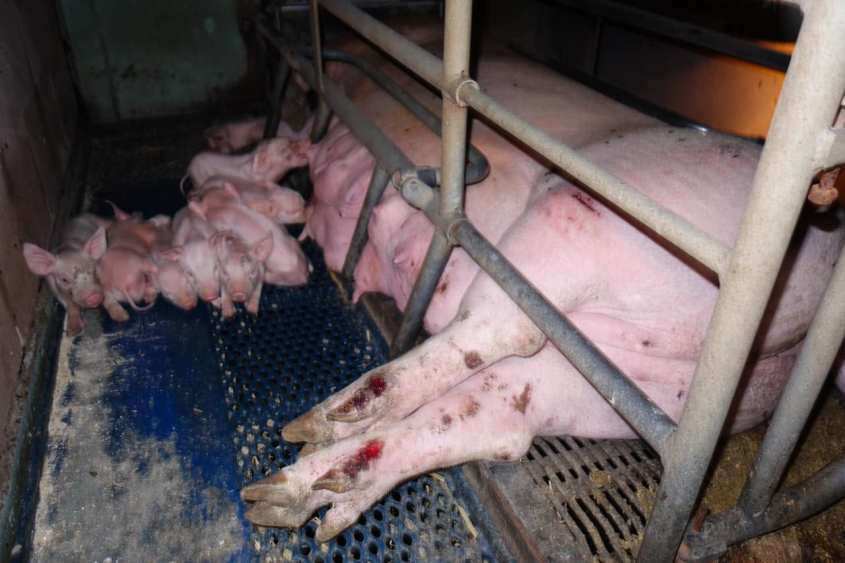
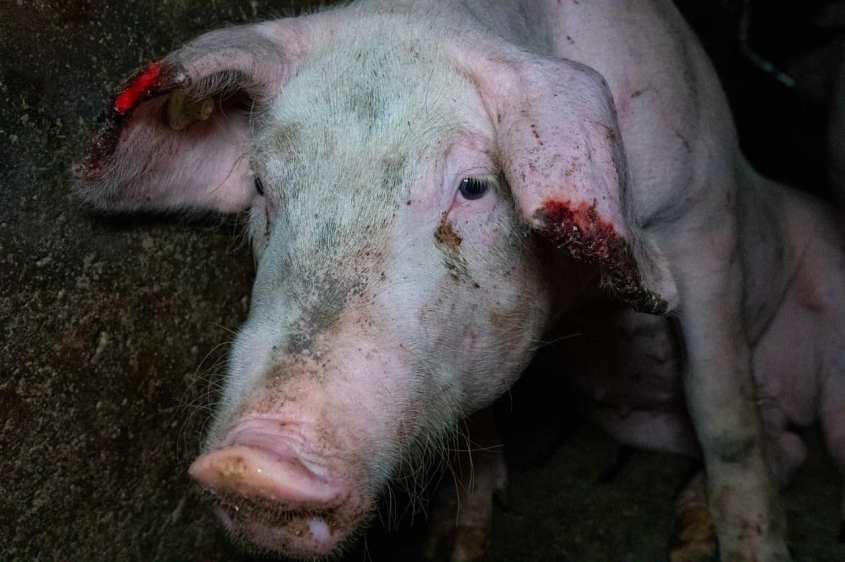
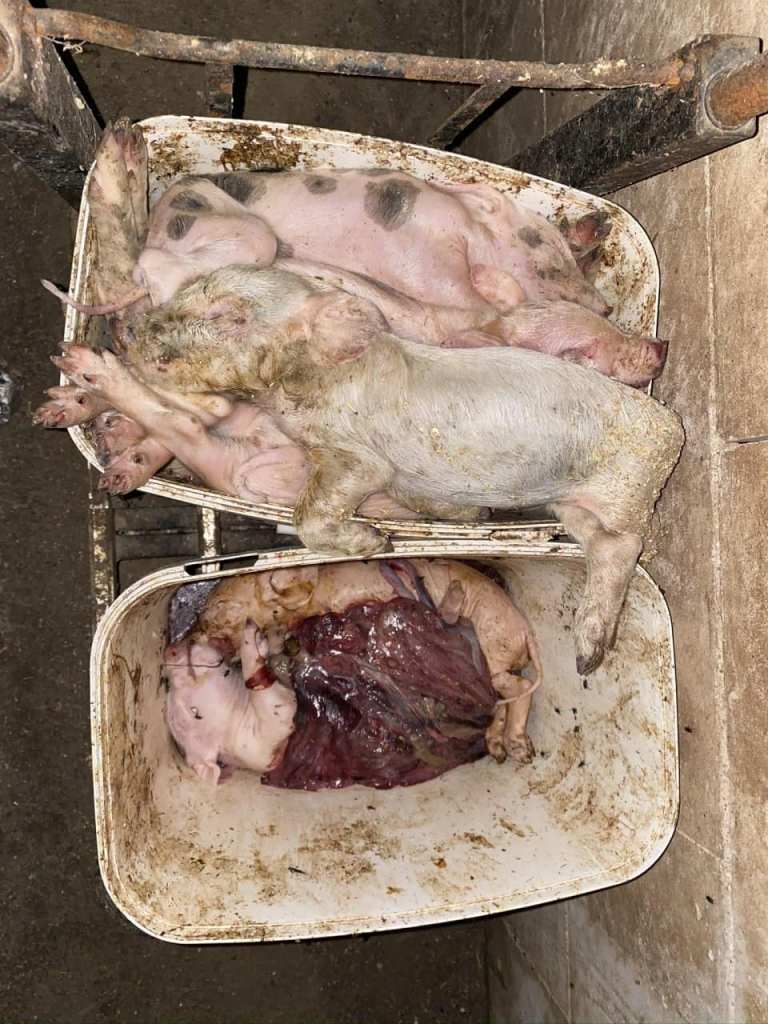
In his “animal welfare” breeding stables horrific conditions prevail: Hundreds of injured animals, many with the most severe mutilations, as well as countless sick animals – expressly not isolated.

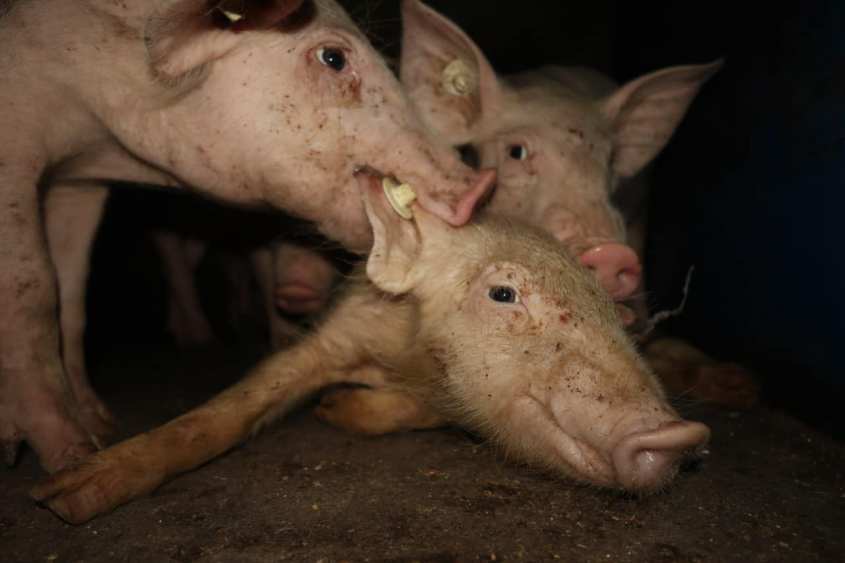
Weak animals are eaten alive by their stressed conspecifics, carcasses are torn to pieces and the dead bodies of the pigs are piled up in the barn.


In the area of ​​the breeding sows, animals were squeezed in cramped crates in a watery fecal broth.
In the barn, there were dying and very emaciated animals, such as piglets or a breeding sow covered in wounds, and seriously injured young pigs.


The farmer abused pigs he was captured by a hidden camera.
He carries them around on one foot, hits them, and throws the animals. The stable is filthy, full of flies and excrement.

The farmer’s lobbyist likes to appear in the media and especially to show up with prominent politicians like Agriculture Minister Hauk, Federal Agriculture Minister Klöckner, and also green politicians.

(In order to understand the extent of the animal suffering in this video, nobody needs the German language.
The horror pictures, the shameful grievances speak for themselves)


And here the political site!

The scenes of pigs awakening from the stupor and brutally abused in that slaughterhouse were almost unbearable and led to the slaughterhouse being closed at the beginning of September and massive criticism of the Böblingen district.
After the publication of the documents from the above-mentioned period, it was publicly proven that Minister Peter Hauk had stopped the measures ordered by the responsible veterinary office to remedy these abuses.

Minister Peter Hauk has thus been guilty of criminally relevant aid.
“He accepted animal cruelty in order to protect the slaughterhouse boss and party member Dengler,” said Mülln.

This view is also shared by the German Legal Society for Animal Welfare Law and announced in a press release on October 5th, 2020 that it had filed a criminal complaint against the Minister of Agriculture, Peter Hauk.

SOKO Animal Welfare is now also taking legal action against Minister Hauk in the Gärtringen case.
“Anyone who promotes animal torment, accepts it by failing to do so, or bends right, receives criminal charges – this also applies to ministers,” confirms the SOKO investigator.

https://www.swr.de/swraktuell/baden-wuerttemberg/suedbaden/schweinemastbetrieb-im-kreis-rottweil-muss-schliessen-102.html


And I mean..a stable out of control! from here, of course, not made in China!

The keeping of pigs under the worst cruel conditions is legal in Germany because our society regards it as absolutely necessary because the dead bodies of these tortured animals should end up on our plates.

In an interview, the affected farmer and animal abusers described the conditions in his barn as basically okay.
When asked how it came about that the animals look like this, he replied: “Because they fought, cannibalism.”!!

And all of this in a country that describes itself as exemplary democratic and animal welfare-oriented.

With one of the best animal welfare laws in Europe, which says … “Nobody may inflict pain, suffering or harm on an animal without a reasonable reason.”
And for this reason, the suffering of animals in factory farming remains enormous and endless.
The animal abusers of the meat industry do not even need a “reasonable” reason for this, a minister finds that for everyone.

As long as the agriculture minister is elected by the meat industry in Germany, nothing will change

My best regards to all, Venus

EU: Veggie Burger Out ? – European Parliament to vote on terminology for plant-based meat and dairy substitutes.

WAV Comment: This is the kind of thing they consider important; live transport and intensive farming system legislation can go to hell. Typical useless EU.

Here below are some animal abuse issues we have covered in just the last week or so.  Yes all EU  issues that need addressing real fast. 

But the MEP’s don’t take action about any of this do they ? – they sit on their self opinionated fat backsides deciding paltry issues like if a veggie burger can be called a veggie burger.  How sad is this; but oh so very EU.  Why do people still want to be in this pathetic ‘club’ ? – get out and be nations again.

https://worldanimalsvoice.com/2020/10/05/italy-essere-animali-reveal-terrible-violence-on-a-pig-farm-supplying-beretta-cured-meats/

https://worldanimalsvoice.com/2020/10/05/portugal-unpublished-and-shocking-images-inside-the-ships-transporting-live-animals-from-portugal-to-israel/

https://worldanimalsvoice.com/2020/10/02/1-4-million-signatures-call-the-eu-to-act-on-farmed-animal-welfare/

https://worldanimalsvoice.com/2020/10/02/call-to-stena-line-stop-illegal-calf-transports/

https://worldanimalsvoice.com/2020/10/07/germany-mass-murder-on-the-march/

https://worldanimalsvoice.com/2020/10/06/eu-animal-farming-in-eu-worse-for-climate-than-all-cars/

https://worldanimalsvoice.com/2020/10/06/bulgaria-inbred-lion-cubs-victims-of-neglect-rife-in-bulgarias-decaying-zoos/

No more veggie burgers?

European Parliament to vote on terminology for plant-based meat and dairy substitutes

8 October 2020

Today, Eurogroup for Animals and 12 other NGOs sent a letter to the Members of the European Parliament urging them to vote against a ban on the use of ‘meatish’ and ‘dairyish’ names for plant-based products on 20 October. This ban would contradict the ambitions of the Green Deal, which promotes the uptake of more sustainable food and would further also interfere with consumers’ demand for plant-based products.

In the second plenary session in October, the European Parliament will vote on the regulation establishing a Common Organisation of the Markets (CMOs) in agricultural products (2018/0218 COD). This regulation is one of the three regulations composing the Common Agricultural Policy.

As it presently stands, this text proposed by the Committee on Agriculture and Rural Development (AGRI) includes two alarming amendments: 

  • Amendment 165would effectively ban widely accepted and commonly used terms, such as ‘veggie burger,’ or ‘plant-based steak’. 
  • Amendment 171 would further restrict the naming of dairy alternatives by prohibiting terms, such as ‘yoghurt-style’, ‘alternative to cheese,’ or ‘butter substitute’ to describe plant-based dairy alternatives. 

In an open letter to the Members of the European Parliament, Eurogroup for Animals expressed its concern over these amendments, and urged Members to oppose these two amendments. In the letter, Eurogroup for Animals explains why the measures contained in these two amendments contradicting the EU’s objective, as laid out in the European Green Deal measures to create a more sustainable and healthy food system. Encouraging the broader uptake of plant-based diets is instrumental in achieving the European Commission’s climate neutrality objectives, and prevent a decline in global biodiversity.

Countless studies have evidenced that industrial animal agriculture is a major contributor to climate change, environmental degradation, public health risks, biodiversity loss, and poor animal welfare. In the Farm to Fork Strategy, the Commission explicitly acknowledges the need to shift dietary habits. The Commission further points to the necessity to increase the intake of plant-based foods and reduce red and processed meat consumption levels  to reduce the risk of life-threatening diseases and decrease the environmental footprint of the food system. In 2018, the Commission’s Plant Protein Report already noted that the market for meat and dairy alternatives was particularly promising in the EU, with annual growth rates of 14% and 11%, respectively.

This possible ban is also inconsistent with consumers’ purchasing habits and perceptions. For many years already, European consumers have been accustomed to seeing and buying plant-based products displaying terms such as ‘veggie burger’ or ‘plant-based steak’. Prohibiting the use of such well-recognised terms not only is unnecessary, but it would also lead to preventing them from making informed purchasing choices.

Indeed, a recent survey by the European Consumer Organisation (BEUC) demonstrates that EU consumers are overwhelmingly favour of the use of meat-related terms for plant-based foods. The report shows that more than 68% of consumers support ‘meaty’ names for plant-based food products, as long as the products are clearly labelled as plant-based or vegetarian. Furthermore, petitions against the proposed restrictions have already garnered thousands of signatures.

It is now in the hands of the Members of the European Parliament to vote against such a  ban and to  improve information to consumers. For example, by requiring the use of qualifiers for non-meat products, such as “plant-based” or “vegetarian”, while reserving the terms with no qualifiers for meat products. This would mean that “sausages” would be made from meat, and  “plant-based sausages” would be made of plant-based ingredients. If high quality consumers information is the goal, the use of qualifiers along with meat and dairy denominations is the way to go. 

England: Why Does Plant Based Vegan Food Have To Be Marketed As ‘Tastes Like Steak’ Etc ? – Vegans Are Vegans To Stop Animal Suffering – Understand This.

WAV Comment: I (Mark) have not eaten any dead animal meat for well over 33 years.  I take a vegan diet as a) I consider plant based to be very healthy; non fattening etc; and b) primarily because of my personal concerns for animal welfare issues.  In short, An animal does not die to put something on my plate.

We all have our opinions, which is great and to be encouraged; but I rather hate the fact (as below) that veggie or vegan food is often sold as ‘vegan meat’; ‘vegan steak’, ’vegan bacon’, ‘fishless fillets’ and ‘vegan sausages’ etc.  As a vegan, I do not want to eat things that are supposed to represent in any way steak, bacon or fish.  Because of my hatred for the way animals are abused to produce the same, I simply want a plant based meal that is just that; a plant based meal without the cruelty. I dont want nit dressed up as something it is not – they should be sold as non meat; not ‘tastes like’ steak, bacon and the rest.

Having a range of plant based products called plant based steak, sausage and fish fillets is typical marketing jargon; but you almost always find that vegans are vegans because they don’t want to be associated with animal abuse or meat in any way.  So pretending then that plant based products taste like steak; bacon or fish are not really on my wavelength; so why do it ?.  The only positive to me is that ‘real’ steak eaters may eventually try the plant based version and then move over to it; improving their health and doing a great deal for the environment and especially saving animal deaths.

But for me; veganism has principles; and they include avoiding animal abuses; the environment and better health.  So lets keep vegan food free from the ‘tastes like bacon or steak’ labels; and sell it is simply for what it is – ie cruelty free food which benefits the environment.  How about labelling them instead as ‘animal abuse free’, or ‘more environmentally friendly’ products.  This approach may even attract yet more custom; those who want to do the right thing and avoid animal suffering whilst doing better for the mush persecuted environment.

Just my view;

Regards Mark

Value Supermarket Morrisons Launches Vegan Steak And Bacon

The new meat alternatives are part of an extensive range including plant-based burgers, sausages, fishless fillets and more

MARIA CHIORANDO

OCT 6, 2020

https://www.plantbasednews.org/lifestyle/morrisons-launches-vegan-steak-bacon

Morrisons has launched a major new line of vegan meat under its V-Taste branding.

The value supermarket’s new offering includes a range of options including vegan steak (£3) and vegan bacon (£2.50).

Among the other plant-based meat alternatives are fishless fillets (£2), burgers (£2.50), and two styles of sausages – chorizo and Cumberland (£2.50).

Morrisons vegan meat

In a statement sent to Plant Based News, a Morrisons spokesperson described the bacon as ‘thick cut rashers’, which they said are the ‘perfect pairing to a butty on a Sunday’.

The steak, they added, are ‘high in fiber and a source of protein’, and match well with any traditional steak sauces.

The fishless fillets are described as ‘flaky’, and are made from fava beans and rice, coated in a breading.

Morrisons vegan options

Morrisons initially launched its V Taste range towards the end of 2018. It started as a line with around 10 products, including two flavors of vegan cupcakes – red velvet and chocolate – as well as a number of savory dishes like Lentil Hotpot among others.

The line was described as being value for money, with all items priced between £1 and £3.

Since the launch, Morrisons has consistency expanded the range, adding items like pigs in blankets, a foot-long vegan sausage roll, and mozzarella sticks among others.

EU: Animal farming in EU worse for climate than all cars.

Animal farming in EU worse for climate than all cars

Less and better animal farming is crucial in the fight against climate breakdown, but it is also essential in preventing new pandemics.

Greenhouse gas emissions from animal farming in the EU account for 17% of the EU’s total emissions, and do more damage to the climate than all cars and vans put togetheraccording to new analysis. The scale of the problem means that the EU cannot reach the goals of the Paris climate agreement, and avoid the worst impacts of climate breakdown, without a reduction in the number of farm animals, said Greenpeace.

The analysis by Greenpeace also found that yearly emissions from animal farming rose by 6% between 2007 and 2018. The increase, the equivalent of 39 million tonnes of CO2, would be like adding 8.4 million cars to European roads.

Science is clear, the numbers as well: we can’t avoid the worst of climate breakdown if politicians keep defending industrial production of meat and dairy.

Marco Contiero, Greenpeace EU agriculture policy director

The new calculations, using UN Food and Agriculture Organization data and other peer-reviewed scientific research, estimate that animals on European farms emit the equivalent of 502 million tonnes of CO2 per year. When including indirect greenhouse gas emissions, coming from animal feed production, land use, deforestation and other land-use change, the total annual emissions attributable to European animal farming are the equivalent of 704 million tonnes of CO2.

Greenhouse gas emissions from animal farming in the EU are:

More than all cars and vans on European roads (656 million tonnes of CO2 per year)

More than the total emissions, from all sectors, of Poland, Slovakia, the Czech Republic and Hungary (647 million tonnes of CO2 per year)

More than 18 times the emissions of the biggest and most polluting coal station in Europe, Poland’s Bełchatów power plant (38 million tonnes of CO2  per year)

Read more at source

Greenpeace Europe

Regards Mark

UK: Free From EU Shackles; 2021 Will Be The Start Of New Actions For UK Animals.

The UK has a lot of very old and excellent organisations which campaign long and hard for improvements to animals welfare.  Here ids a link to our other site, Serbian Animals Voice (SAV), which has a section devoted to animal organisations; including links to their own web sites.  Check it out sometime:

The good animal welfare conscious people living in the UK made the subject just one of the reasons why the UK voted to divorce itself from the uselessness of the EU a few years ago. We (WAV and SAV) have always attempted to show the utter failures of the EU when it comes to improving standards for animals.  EU Regulations mean nothing, are hardly ever enforced, which results in massive animal suffering.

The UK voted ‘out’ of the EU after 40+ years as a member, so that it could take back control of pathetic legislation which ‘member states’ are forced to comply with.  We wish many other current member states had the willingness to do the same.

The UK officially leaves the EU at the end of 2020. 

This will be with or without a trade deal.  If there is no deal, then the UK moves over to WTO rules regarding the EU.  So until the end of 2020; the UK still has to comply with EU regulations; including the pathetic ones associated with animal ‘welfare’.  ‘Welfare’, which includes live animal transport; stalls in which sow pigs are forced to rear their young, rabbit farming, foie gras and much more.

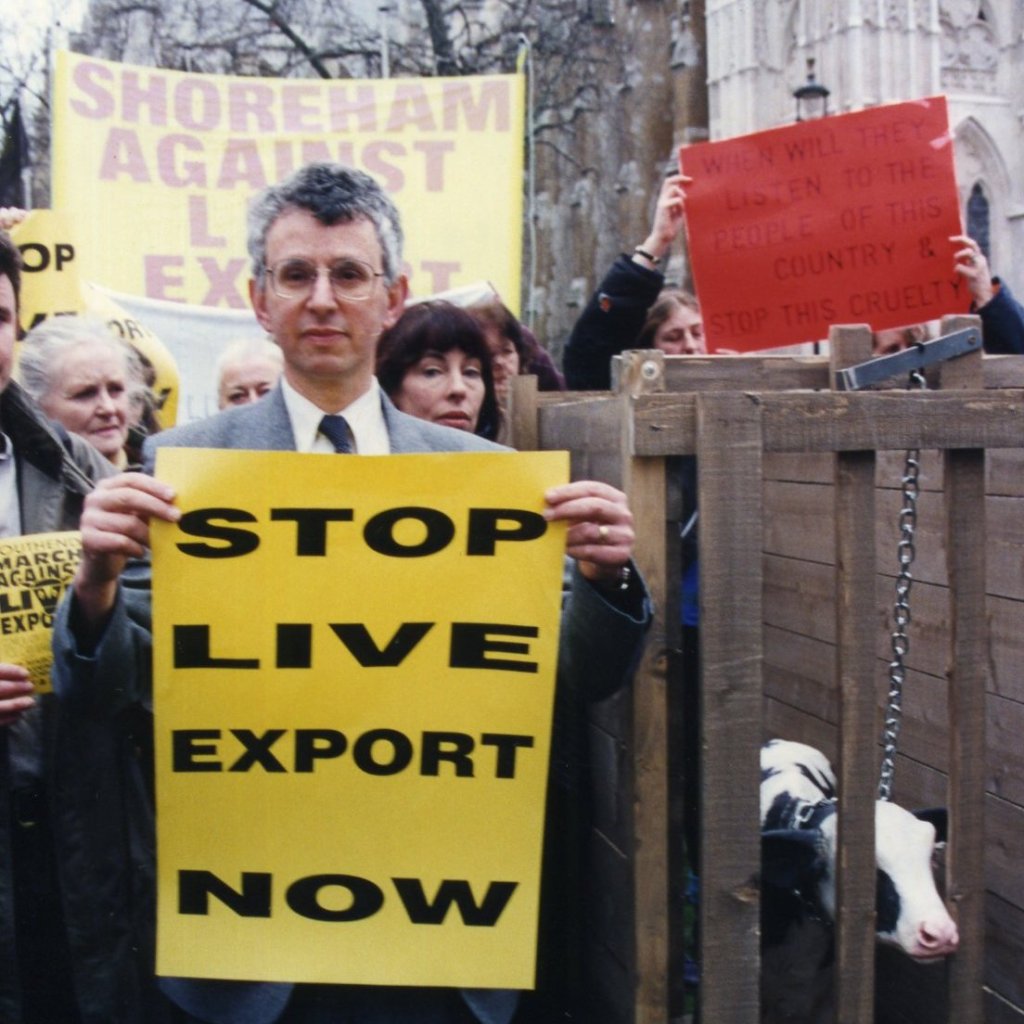
In 2021 the UK will be able (through UK government legislation) to introduce new laws which will meet the wishes of the public and greatly improve animal welfare standards as they wish; one being to stop the live transport (export) of farm animals; an issue we have campaigned about for the last 30+ years.

The current UK government is ‘Conservative’; and will probably remain so for the next 3 or 4 years.  It has a big majority of MP’s (Members of Parliament) – around 80; who should be able to vote through legislation with a degree of ease.

It is only through intensive lobbying and providing the evidence that we, as welfare groups, can be a voice for animals – a voice that eventually brings change.   We trust that from 2021 onwards when the UK is free from the uselessness of the EU, stronger and larger animal welfare laws will be passed into UK law.

Here is a video just released by the ‘Conservative Animal Welfare Foundation’ (CAWF) which outlines the future prospects for UK animals and their legislation.  There are many speakers from the UK government; people who will help to get the new legislation through into (UK) law.

Animal Welfare Matters is a new film by the CAWF filmed by a Cannes Film Festival award winning film maker. It urges for an end to live animal exports for slaughter and fattening, pig farrowing crates, cages for egg laying birds and calls for the introduction of clear mandatory labelling so consumers can make an informed choice.

Speakers include:

Rt Hon Lord Goldsmith, Minister of State (Minister for Pacific and the Environment)

Rt Hon Theresa Villiers MP

Rt Hon Sir Roger Gale MP

Sir David Amess MP

Henry Smith MP

John Flack former MEP

Elise Dunweber Chairman, Esher And Walton Conservative Women’s Organisation

Peter Hall (AM) Director, Conservative Animal Welfare Foundation

Lorraine Platt Co-Founder, Conservative Animal Welfare Foundation

Chris Platt Co-Founder Conservative Animal Welfare Foundation

It is never easy; you don’t give over 30 years of your campaigning life only to fail; global live animal transport bans have been that for me and I am still fighting.  People and campaigners have the tenacity to fight through to the end; and they will – eventually winning. 

Sentient animals deserve better; and with our input we hope they will get it.

Please watch the video below; and gain strength that we in the UK are moving forward now into 2021 for changes.

If only the EU was not ‘all talk and do nothing’ then animals throughout the EU would do better.  That is a matter for citizens of existing member states to vote and make the changes.

Regards Mark.

We are not politically associated with any plitical party – we simply provide the data and let you, the voters, make the choices.

Italy: Essere Animali Reveal Terrible Violence on a Pig Farm Supplying Beretta Cured Meats.


Cruelty on a farm supplying the Beretta brand

5 October 2020

Essere Animali

Through an undercover investigation, our Italian member Essere Animali revealed terrible violence on a pig farm supplying Beretta cured meats.

For 6 weeks, one of our investigators worked at a farm supplying the Fratelli Beretta brand, documenting terrible violence against pigs – even sick pigs – and extremely poor sanitary conditions. Some of the footage was broadcast on TG1 and handed over to the competent authorities in order to lodge a complaint against those responsible.

The images show a worker pulling out a pig’s teeth with pliers because he had been biting other pigs’ tails. A brutal and illegal operation, carried out without anaesthesia or subsequent treatment and which increases the possibility of having to resort to antibiotics. During transport, pigs are moved violently, kicked, hit with blunt objects, grabbed by the ears, lifted off the ground or thrown down by a tractor. As shown in the footage and confirmed by the words of the owner, whenever emergency kills on site are needed pigs are stunned using a captive bolt gun without immediately having their throats slit as required by law. This treatment causes pigs to endure interminable agony.

Beretta - Design Group Italia

The sanitary conditions are also very worrying: the pigs are in constant contact with the wet floor that is covered with excrement. Their food is also contaminated with faeces, as the edges of the feeders are too low.

Read more at source

Essere Animali

Regards Mark

*Fratelli Beretta Prosciutto, 5 lb avg wt

Portugal: Unpublished and shocking images inside the ships transporting live animals from Portugal to Israel.

Unpublished and shocking images inside the ships transporting live animals from Portugal to Israel

5 October 2020

The images were collected inside the ships that regularly transport cattle and sheep from Portugal to Israel.

The videos reveal the shocking reality of live export by showing animals huddled together, without space, injured and sick. The videos also show serious and repeated violations of national and international legislation.

The images are starting to be released within the framework of the newly created European Parliament’s commission of inquiry, which will investigate violations of European legislation that regulates the transport of live animals. Additional images will be delivered to the European Commission, the media and the national authorities that requested them.

These images are unpublished and were captured on several trips throughout 2019. The videos show the animals’ ear tags, confirming their Portuguese origin. The responsibility of the Portuguese State for compliance with the applicable legislation only ends at the moment of disembarkation, no inspection is foreseen on board.

Read more at source

PATAV

Regards Mark

USA: I Went Undercover On A Factory Farm – This Is What I Learned.


The listing was from a non-profit looking for an undercover investigator. I found it while searching for animal-related positions on a job site that catered to non-profits. The ad said they were looking for someone to work and film inside factory farms and slaughterhouses. Truthfully, I felt a bit out of my depth even before applying. I hadn’t had much exposure to the animal rights movement, besides attending a couple of events during college with a friend. I certainly didn’t have experience working undercover. But I was interested. I had studied Ecology in school because I wanted a job protecting animals. I was newly vegan, so I had some knowledge of the inherent cruelty in animal agriculture. Perhaps most importantly, I read a lot of comic books and was obsessed with being a hero. It looked like this job was everything I was looking for. It would also be the hardest job I’ve ever done.

Despite my enthusiasm, the application process did give me pause. Everything, from the job listing up until you’re actually put into the field, is designed to convince you not to do this type of work. I was warned about stress so intense it made people break down. I was warned about lifelong injuries sustained on the job. I learned that most potential investigators quit before completing their first investigation. I also learned that I wouldn’t fully understand these warnings until I actually experienced fieldwork myself.

They weren’t exaggerating. Everything about the job was hard. I investigated three slaughterhouses during my time in the field—a chicken slaughterhouse, a pig processing plant, and the largest lamb slaughterhouse in the U.S. It never got any easier. When I talk about it now, most think of how horrible it must be to bear witness to cruelty on a daily basis. Investigators, many of whom took this job because of their empathy, have to keep a straight face while animals are beaten, neglected, and slaughtered. They have to pretend everything is fine to maintain their cover, as blood flows freely from the cutthroats of animals just as sentient as your dog or cat at home. Work in slaughterhouses is so devastating that it’s been linked to PTSD and other disorders. To protect and support our investigators, we offer to pay for any mental health services they want.

Maintaining cover also means being able to respond to questioning at a moment’s notice. This is something that was always nerve-wracking for me. Every time I spoke to my coworkers, I was paranoid that they could see right through me. I thought everything I was doing was awkward and at any minute they would surround me and accuse me of being an undercover agent. It’s something that was constantly in the back of my mind, so much so that I still have nightmares about it, and I’ve been out of the field for three years now.

One of the things I was most afraid of was not being able to keep up with the work. As an undercover investigator, you spend months doing tough physical work at high speeds. When I worked in “live hang” at a chicken plant, my coworkers and I had to wedge the bony legs of live chickens into shackles that zoomed by at eye level. The requirement was shackling 24 birds per minute, a ludicrous speed both for the animals and the workers. I remember my joints swelling and constant pain in my hands and back. My coworkers would tell me that’s just how it was to work there. In addition to the injuries from the repetitive movements, meat packing facilities are notoriously dangerous, with workers frequently suffering amputations due to working in close proximity to heavy machinery. This danger is omnipresent during the long, grueling work hours. I frequently worked 12-hour shifts and interviewed for jobs that only gave workers every other weekend off. Investigators work long hours and have to do more investigations-related work when their shifts are done. They can work in a factory farm or slaughterhouse for months.

Though investigators go through stressful experiences, they can’t really talk with many people about them. They’re sent off alone, potentially thousands of miles from home, and are basically barred from telling friends and family what they’re going through. They keep quiet until they’re completely retired from fieldwork. It’s isolating and you often feel very much alone out in the field. I turned to journal writing just to get some of my thoughts out, even though no one would ever see them.

It was really only after I completed an investigation that most of the weight lifted from my shoulders. The stress I was constantly under was replaced by a feeling of accomplishment unlike anything else I’ve experienced. I remember walking out of the pig slaughterhouse on my last day and going straight past my car to a nearby park next to a river. I sat on a bench and just stared out at the river. It’s a feeling like you’ve regained control over your life.

Investigators get a break after finishing work in a facility when they can spend much deserved time at home with the people closest to them. After they’ve had some rest, the investigator serves as an expert, ensuring the accuracy of the investigation release materials produced by the organization. They do interviews and get to see their work released to the general public, often in major media outlets like the Washington Post or The New York Times. We’ve also had footage in documentaries including Eating Animals and What the Health. Letters of support pour in.

We often send investigators a trophy or framed picture to commemorate their accomplishments. Though local law enforcement is often reluctant to prosecute animal cruelty in rural areas, sometimes criminal charges are pressed. We’ve had facilities settle lawsuits with the Department of Justice and companies change their standard practices as a result of our investigations. Each time I saw the impact of my investigations, a second wave of accomplishment washed over me.

Though I struggled in the field, it was worth it to see my footage released to the public. Investigators pride themselves in knowing their work has been seen by thousands or millions of people, some of whom have changed their eating habits as a result of what they were shown. I know the footage is hard to watch, but please do, and share it with others. We’re trying to change the world and we need your help to do it.

Read More

Bringing Big Ag’s Right to Harm to the U.S. Supreme Court

$100 Million Financing for Plant-Based Protein? Let’s Talk About Billions for Animal Ag

Does “Certified Humane” Mean Cruelty-Free?

How Undercover Investigation of Lamb Slaughterhouse Led to Federal Prosecution

Big Ag Is Leaving Sulphur Springs Valley Residents Without Water to Drink

https://sentientmedia.org/i-went-undercover-on-a-factory-farm-this-is-what-i-learned/


Regards Mark


Defending the Indefensible – Has Anything Changed in the ‘David and Goliath’ World ?

https://www.plantbasednews.org/lifestyle/mcdonalds-uk-to-launch-vegan-beyond-burger-say-reports

McDonalds is known to most UK animal activists as ‘McShitty’. This is really because of what was dubbed the ‘Mc Libel Case’ many years ago.


It is a story which goes back decades but is still very prominent in the minds of older generation animal activists such as myself (Mark).  I will try to summarise the issue as much as possible with big inputs from Wikipedia, a free encyclopedia site which I personally financially contribute to (to help them produce free data) each year.


Read all about it below. It was a huge ‘David and Goliath’ case; the big organisation (McDonalds) against animal / environmental activists Helen and David from London Greenpeace; which was not linked to the main Greenpeace organisation.  McDonalds flew into London all their big legal personnel from the USA in an attempt to simply crush the minnows named Helen and David.  The result was not quite as simple as McDonalds thought it would be.


And now in 2020; with the plight of the Amazon rainforest being destroyed and cattle farming in the area under vast scrutiny; you have to tell yourself that Helen and David were almost certainly correct with what they said all those years ago.  Sadly; as with so many correct people and organisations who speak out; the ;big guns’ and their lobbyists immediately go into overdrive with their vast financial support to eliminate the little ‘Davids’ who so very often speak the real truth.


I can personally remember doing animal rights marches decades ago in ol London town; and the Met police always diverting the march away from any McDonalds because of what was going on with the McLibel case at the time.


Most (or probably all) of those who have a happy meal at McDonalds now do not have a clue about the past actions taken to shut up anyone speaking out about environmental destruction; and animal and human (low wage) abuses.  We don’t forget; and despite how Mc dress up their foods as Vegan friendly and the rest; they will always, first and foremost, protect their financial interests and their name at any attempt.

Read below and decide for yourself;

Regards Mark.

Note – UK visitors may recognise a younger Kier Starmer in the video. He is now (2020) the leader of the Labour Party – the main UK opposition party to the current Conservative Party.

 ————————-

From our friends at Wikipedia, the free encyclopedia

McDonald’s Corporation v Steel & Morris [1997] EWHC QB 366, known as “the McLibel case”, was an English lawsuit for libel filed by McDonald’s Corporation against environmental activists Helen Steel and David Morris (often referred to as “The McLibel Two”) over a factsheet critical of the company. Each of two hearings in English courts found some of the leaflet’s contested claims to be libellous and others to be true.

The original case lasted nearly ten years which, according to the BBC, made it the longest-running libel case in English history.[1] McDonald’s announced it did not plan to collect the £40,000 it was awarded by the courts.[2] Following the decision, the European Court of Human Rights (ECHR) ruled in Steel & Morris v United Kingdom the pair had been denied a fair trial, in breach of Article 6 of the European Convention on Human Rights (right to a fair trial) and their conduct should have been protected by Article 10 of the Convention, which protects the right to freedom of expression. The court awarded a judgement of £57,000 against the UK government.[3] McDonald’s itself was not involved in, or a party to, this action, as applications to the ECHR are independent cases filed against the relevant state

Franny Armstrong and Ken Loach made a documentary film, McLibel, about the case.


Background

“What’s wrong with McDonald’s: everything they don’t want you to know”, the cover of the leaflet at the center of the libel case

Main articles: London Greenpeace and Helen Steel

Helen Steel and David Morris were two environmental activists of London Greenpeace, a small environmental campaigning group that existed between 1972 and 2001. In 1986, they co-authored a six-page leaflet titled “What’s wrong with McDonald’s: everything they don’t want you to know” of which they distributed “a few hundred copies” in Strand, London.[4][5]

The leaflet accused the company of paying low wages, of cruelty to animals used in its products and other malpractices.[6] The group were not affiliated with the larger Greenpeace International organisation, which they declined to join as they saw it as too “centralised and mainstream”.[7]

Libel charges

In 1990, McDonald’s brought libel proceedings against five London Greenpeace supporters, Paul Gravett, Andrew Clarke and Jonathan O’Farrell, as well as Steel and Morris, for distributing the sheet on the streets of London. This case followed past instances in which McDonald’s threatened to sue more than fifty organisations for libel, including Channel 4 television and several major publications. In all such cases, the media outlets settled and apologised.[8]

Under English defamation law, the defendant must show that each disparaging statement made is substantively true. This can be an expensive and time-consuming process. Gravett, Clarke and O’Farrell apologised as requested by McDonald’s, but Steel and Morris chose to defend the case.[9]

The two were denied Legal Aid, as was policy for libel cases, despite having limited income.[10] Thus, they had to represent themselves, though they received significant pro bono assistance, including from Keir Starmer. Steel and Morris called 180 witnesses, seeking to prove their assertions about food poisoning, unpaid overtime, misleading claims about how much McDonald’s recycled, and “corporate spies sent to infiltrate the ranks of London Greenpeace”.[11]

McDonald’s spent several million pounds, while Steel and Morris spent £30,000; this disparity in funds meant Steel and Morris were not able to call all the witnesses they wanted, especially witnesses from South America who were intended to support their claims about McDonald’s activities in that continent’s rainforests.[12]

In its libel allegation, McDonald’s asserted all claims in the pamphlet to be false.[13] They found it difficult to support this position despite the indirectness of some of the claims. The case eventually became a media circus. McDonald’s executives, including Ray Cesca, entered the witness box, enabling cross-examination by the defendants.[14]

In June 1995 McDonald’s offered to settle the case (which “was coming up to its [tenth] anniversary in court”[15]) by donating a large sum of money to a charity chosen by the two. They further specified they would drop the case if Steel and Morris agreed to “stop criticising McDonald’s”.[15] Steel and Morris secretly recorded the meeting, in which McDonald’s said the pair could criticise McDonald’s privately to friends but must cease talking to the media or distributing leaflets. Steel and Morris wrote a letter in response saying they would agree to the terms if McDonald’s ceased advertising its products and instead only recommended the restaurant privately to friends.[12]

Judgment

High Court

The case was adjudicated by the Hon. Mr. Justice Rodger Bell.[16] On 19 June 1997, Bell J delivered his more than 1,000-page judgment largely in favour of McDonald’s, finding the claims that McDonald’s was responsible for starvation and deforestation were false and libellous.[17] The ruling was summarized by a 45-page paper read in court.[18] Steel and Morris were found liable on several points, but the judge also found some of the points in the factsheet were true.[12] McDonald’s considered this a legal victory, though it was tempered by the judge’s endorsement of some of the allegations in the sheet. Specifically, Bell J ruled that McDonald’s endangered the health of their workers and customers by “misleading advertising”, that they “exploit children”, that they were “culpably responsible” in the infliction of unnecessary cruelty to animals, and they were “antipathetic”[19] to unionisation and paid their workers low wages.[20] Furthermore, although the decision awarded £60,000 to the company, McDonald’s legal costs were much greater, and the defendants lacked the funds to pay it. Steel and Morris immediately appealed against the decision.[21]

In 1998 a documentary film was made about the case, also titled McLibel. This was updated in 2005 after the verdict of the final appeal.

In September 1998, the pair sued the Metropolitan Police for disclosing confidential information to investigators hired by McDonald’s and received £10,000 and an apology for the alleged disclosure.

Court of Appeal

An appeal began on 12 January 1999 and lasted 23 court days, ending on 26 February.[22] The case was heard in Court 1 of the Court of Appeal in the Royal Courts of Justice. The case was adjudicated by Lord Justices Pill and May and Mr Justice Keene. The defendants represented themselves in court, assisted by first year law student Kalvin P. Chapman (King’s College London).

McDonald’s were represented by libel lawyer Richard Rampton QC,[23] and a junior barrister, Timothy Atkinson,[24] and Ms Pattie Brinley-Codd of Barlow, Lyde & Gilbert.[25] Steel and Morris filed a 63-point appeal. They had requested a time extension, but were denied. The verdict for the appeal was handed down on 31 March, in Court 1 at the Royal Courts of Justice.[26]

The judges ruled it was fair comment to say that McDonald’s employees worldwide “do badly in terms of pay and conditions”[27] and true “if one eats enough McDonald’s food, one’s diet may well become high in fat, etc., with the very real risk of heart disease”.

As a result of their further findings against the Corporation, the three Lord Justices reduced Mr Justice Bell’s award of £60,000 damages to McDonald’s by £20,000. The court ruled against the argument by Steel and Morris that multinational corporations should no longer be able to sue for libel over public interest issues. Steel and Morris announced their intention to appeal over these and other points to the House of Lords, and then take the UK government to the European Court of Human Rights if necessary.

In response to the verdict, David Pannick QC said in The Times: “The McLibel case has achieved what many lawyers thought impossible: to lower further the reputation of our law of defamation in the minds of all right thinking people.”[28]

Steel and Morris appealed to the Law Lords, arguing that their right to legal aid had been unjustly denied. When the Law Lords refused to accept the case, the pair formally retained solicitor Mark Stephens[29] and barrister Keir Starmer QC (later Director of Public Prosecutions (England and Wales), Head of the Crown Prosecution Service and Leader of the Labour Party) to file a case with the European Court of Human Rights (ECHR), contesting the UK government’s policy that legal aid was not available in libel cases, and setting out a highly detailed case for what they believed to be the oppressive and unfair nature of UK libel laws in general, and in their case in particular.[30] In September 2004, this action was heard by the ECHR. Lawyers for Steel and Morris argued that the lack of legal aid had breached the pair’s right to freedom of expression and to a fair trial.

European Court of Human Rights

An anti-McDonald’s leafleting campaign in front of the McDonald’s restaurant in Leicester Square, London, during the European Social Forum season, 16-10-2004.

On 15 February 2005, the European Court of Human Rights ruled[31] that the original case had breached Article 6 (right to a fair trial) and Article 10 (right to freedom of expression) of the European Convention on Human Rights and ordered that the UK government pay Steel and Morris £57,000 in compensation.

In their ruling, the ECHR criticised the way in which UK laws had failed to protect the public right to criticise corporations whose business practices affect people’s lives and the environment (which violates Article 10); they also ruled that the trial was biased because of the defendants’ comparative lack of resources and what they believed were complex and oppressive UK libel laws

This has always been at the back of our minds with WAV – we attempt to tell the real truth and nothing but the truth regarding animal and environmental abuses.  At the end of the day; different people have different opinions, and we respect that.

We will continue to be a world animals voice confident in the data we provide and with the past McLibel issue firmly entrenched in our minds.

Regards Mark

WAV (London).